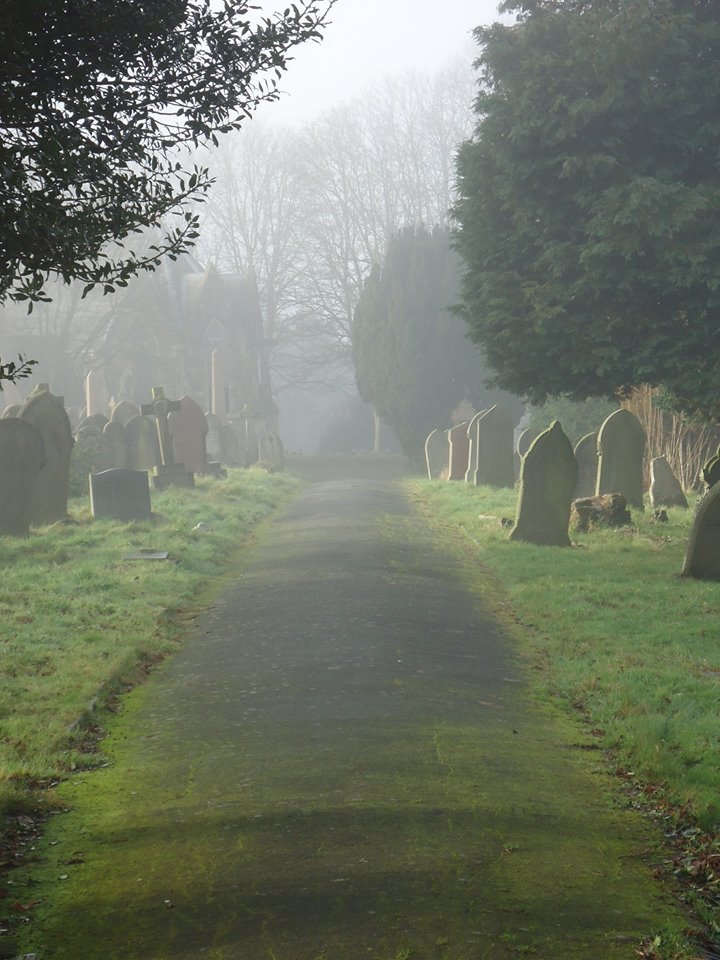
I am frequently asked if I have ever seen a ghost in the cemetery and have been told by others of their own paranormal experiences, but I don’t tend to go in for ghostly graveyard stories. For me Radnor Street Cemetery is a place of beauty and serenity and it’s the life and times of those buried there that interest me.
As a team of volunteers it is our mission to remember. We remember those who served in war; those who served in the industry of our town; those ordinary men and women, some of whom devoted their lives to good works, and those who had such short lives they are in danger of being forgotten.
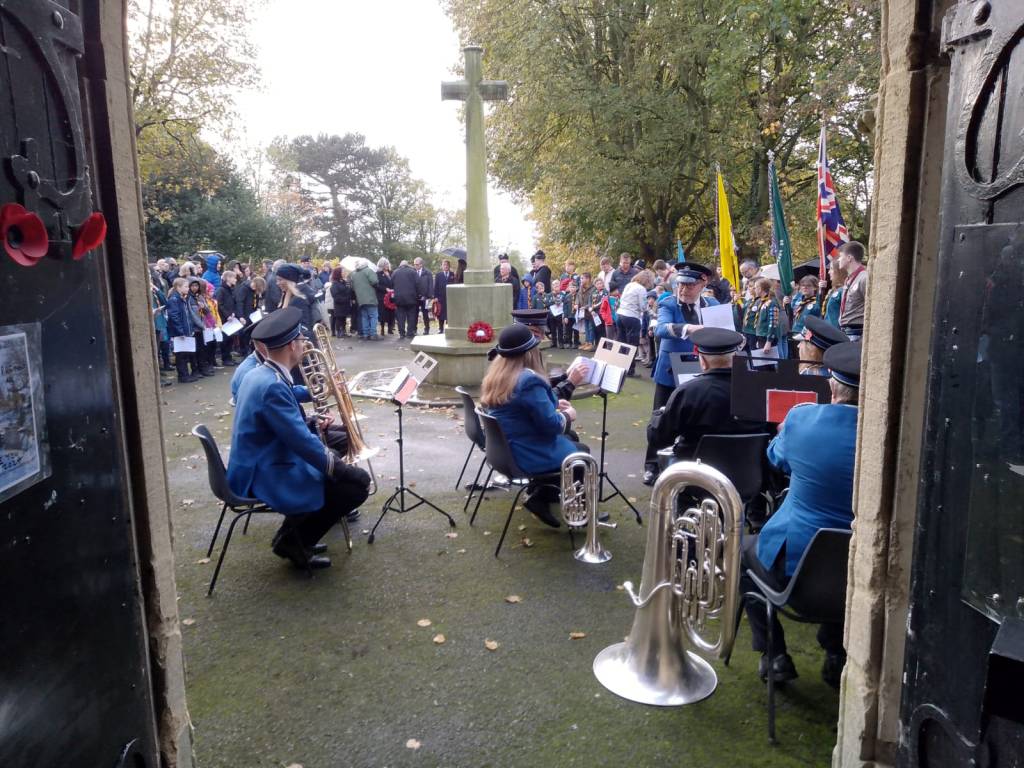
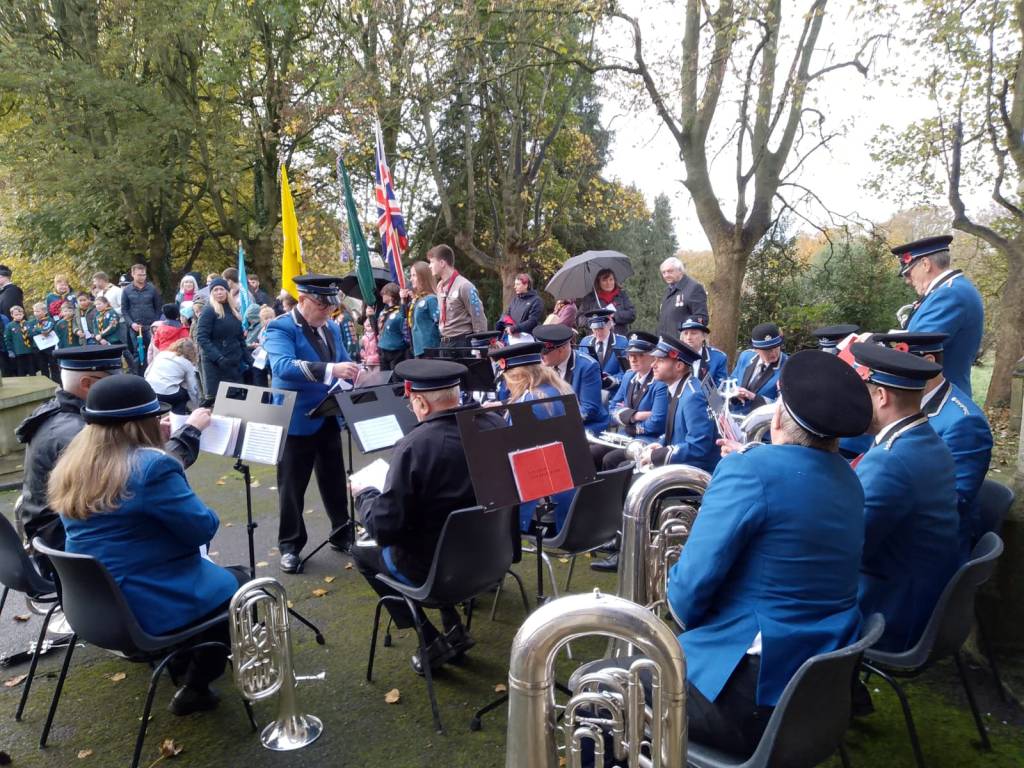
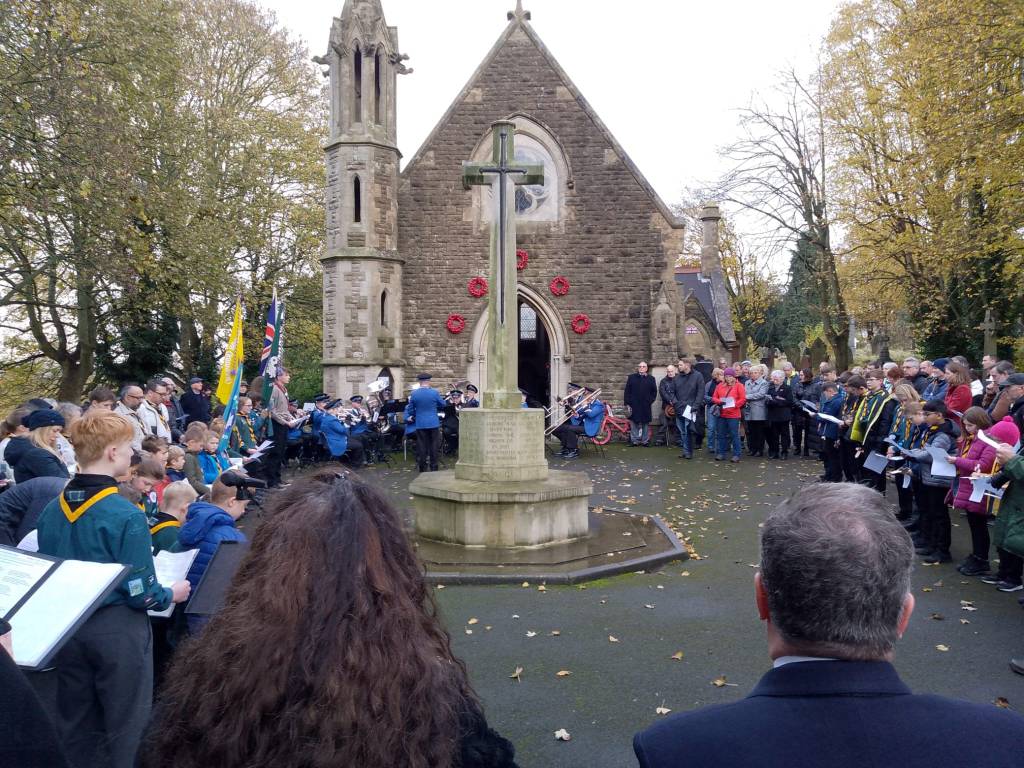
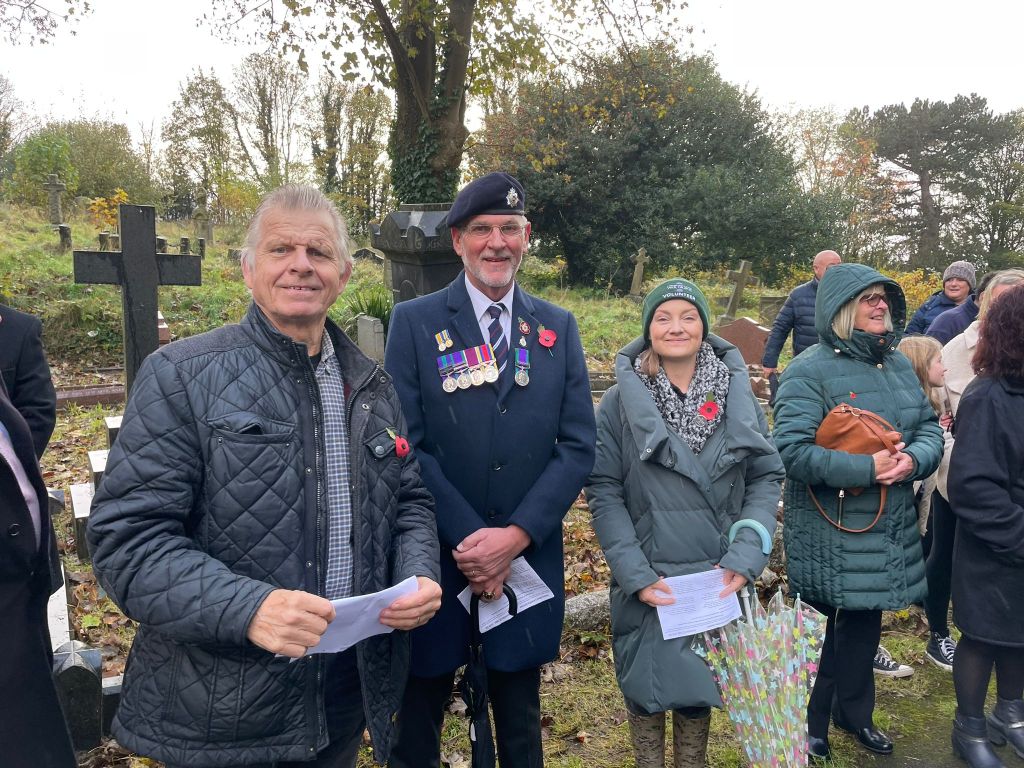
On Remembrance Day November 12 we will be honouring Mark Sutton who spent all his life remembering others and doing good works. We hope you will join us for a Service at the Cross of Sacrifice at 2 pm followed by the unveiling of a plaque dedicated to Mark.
The burial of Swindon’s dead continued to be a controversial subject even after the opening of Radnor Street Cemetery in 1881.
The following letter to the editor of the Swindon Advertiser reveals burial practices that should have been eliminated following legislation passed during the previous 30 years.
To the Editor of the Swindon Advertiser
Sir – Can any of your readers tell me how it is that the inhabitants of that part of the parish of Swindon known as Old Swindon do not use the new cemetery, provided at their cost some five years ago? When it was decided to purchase this cemetery it was generally held out as an inducement to ratepayers to part with their money that the parish church burial ground would be closed, except to owners of vaults. Instead of this being the case, however, the churchyard is not only being crowded with bodies, but some of those interred there are being dug up in a most indecent manner to make room for more.
At the funeral of a pauper this week there was exposed beside the grave the skull, vertebra, and other bones of a corpse which previously occupied the same ground, together with the handles and other portions of the coffin furniture. I do not think this is right, or that it is decent. With the spacious cemetery we have it cannot be necessary. I am told that the reason Swindon paupers are buried in the churchyard instead of the cemetery is that the poor law authorities refuse to pay the cemetery fees. If this is so I do hope the Swindon guardians will bestir themselves and put an end to such a state of things.
When the cemetery chapel was built in 1881 there were few adornments. The non-denominational chapel was designed with elegant simplicity and this extended to the windows. Above the door is situated a rose window, which continues to cast a serene shadow during the sun’s afternoon trajectory. Sadly, this window was damaged by vandals some years ago. The three windows at the east end contain a few panes of subtly coloured glass, and these were also smashed. The four remaining windows are plain.
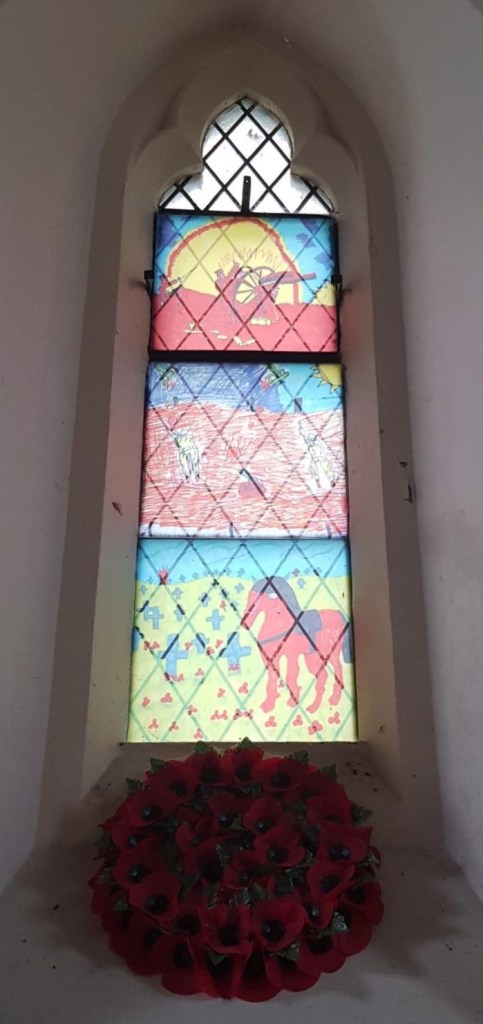
In 2015 we commemorated the 75th Anniversary of the Battle of Britain along with Swindon Heritage, Paul R. Gentleman Associates and Green Rook. Swindon Remembers was a series of events held across the town, and most especially in Radnor Street Cemetery. We involved primary schools in the area who designed a montage for each of the five windows. We talked to the children about the people buried in the cemetery; the war graves and the two world wars; the GWR and the role of women in the 19th and 20th centuries. We talked about nature in the cemetery, this green oasis in the middle of town, and they encapsulated it all in their designs.
The childrens’ work is still in place eight years later and can be viewed when the chapel is open during our guided cemetery walks.
Join us for the last walk this season on Sunday October 29. Meet at the chapel for 2 pm.
The Second World War by Lethbridge Primary School
Nature of Radnor Street Cemetery by St. Mary’s Primary School
Famous Women by Robert Le Kyng Primary School
The First World War by Goddard Park Primary School
Did Emily stand at this spot? Did she watch the dappled sunlight dance across the headstone? But of course the tree may have been a mere sapling then, like her son who died aged 17. Perhaps she had no time to stand and stare, what is there to ponder on when a son is taken before his time. The headstone may have been a later addition, raised after both she and her husband Fred had gone. There were a lot of words written about Fred (a well-known Swindonian) when he died.
What is there to say when a 17 year old son has been taken. Nothing that is of any comfort.
Death of Mr Fred Tegg
A Well known Swindonian
We sincerely regret to announce the death of Mr Fred Tegg, which took place quite suddenly at his residence, Lyndhurst, Clifton Street, Swindon, on Sunday.
Deceased was in his usual health and attending to his duties last week, and the end came quite suddenly. He was apparently quite well on Christmas Day and on Sunday morning, but in the afternoon of the latter day he was taken suddenly ill, and passed away about half-past two
Mr Fred Tegg was a typical self-made man. Born at Bucklebury, in Berkshire, he came to Swindon some forty years ago, and started work as a carpenter in the GWR Works. By his indomitable courage, he rose to a higher post, and then, coming under the eye of the late Mr Samuel Carlton, then Manager of the GWR Works, he made further headway, being a good shorthand writer. In those days shorthand was little known, and it may be here recalled that the present Mayor of Swindon (Ald. W.H. Lawson) and Mr W. H. Stanier, an ex-Mayor, in addition to Mr. Fred Tegg, were the only shorthand writers connected with the GWR Works at that time. Mr. Tegg was taught shorthand by Miss Wreford, and in after years he did a great deal of reporting for the Swindon Advertiser.
Owing to his great abilities as a stenographer, Mr Fred Tegg made great progress and at the time of his demise he was Chief Clerk to Mr. H.C. King, Manager of the Locomotive Dept. He had completed his term of service, and was about to retire, when the sudden call came.
Mr Tegg was for 12- or 13-years Secretary to the GWR Medical Fund Society, in the work of which he was deeply interested. He was also a prominent Oddfellow being a member of the “Mackie’s Good Intent” Lodge and he was present at a meeting recently. He had held all the high offices, and was a Trustee of the Lodge at the time of his death. He was most popular among all classes, and his death will be deeply mourned by a very large circle.
The Inquest
On Monday last the Deputy Coroner for North Wilts, Mr J.W. Pridham, held an inquest on the body of deceased at the Clifton Hotel. Mr J. Stafford being chosen foreman of the jury.
Evidence was given by Mr. E. Tegg (son of deceased) and Dr. Haddon, and the jury returned a verdict of death from cardiac failure.
Dr Haddon stated that life was extinct when he was called to deceased. Death was probably due to cardiac failure, caused by indigestion.
Impressive Funeral
Amidst many tokens which spoke eloquently of the respect and high esteem in which the late Mr. Tegg was held by all associated with him, the mortal remains of the deceased gentleman were laid to rest in the Swindon Cemetery, at three o’clock on Thursday afternoon. The funeral was an impressive one. Four carriages conveyed the family mourners, and no fewer than 90 gentlemen walked behind. Preceded by a hand bier bearing the many beautiful floral tributes, the cortege proceeded from Mr. Tegg’s late residence “Lyndhurst,” Clifton Street, to the Cemetery Chapel, where the Rev. J.T. Evans (Primitive Methodist minister), assisted by the Rev. H.W. Smith, conducted the first portion of the solemn rites. Later, the Rev. J.T. Evans also officiated at the graveside.
The remains were enclosed in a polished elm coffin with brass furnishings, and the breast-plate born the inscription: Frederick Tegg, died December 26, 1909. Aged 61 years.
Extracts from the Swindon Advertiser, Friday, December 31, 1909
Harry Frederick Hamilton Jerome Tegg was buried in grave plot B1695 on July 10, 1890. Fred Tegg was buried in the neighbouring plot B1694 where Emily joined him when she died in April 1932.
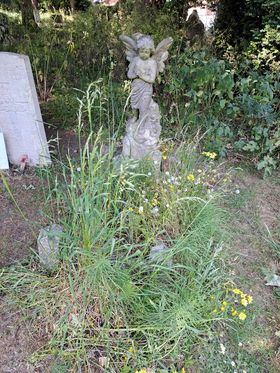
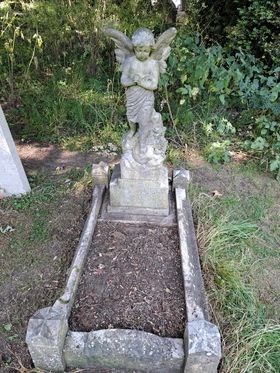
One of our volunteers recently sent me a photo of a grave she had cleared and tidied up. This angel memorial surmounts the grave of a young child. Bex has a knack of finding graves with a particularly poignant story.
Terence Anthony Woolford was born in July 1930, the first of Reginald and Gladys Woolford’s three children. Reginald Charles Woolford was born in 1904, the son of Charles Woolford who worked as a wheel turner in the railway factory. In 1928 Reginald married Gladys Rose Popham, the daughter of Ernest Popham, a fitter in the railway factory.
Reginald and Gladys were living at 7 Drove Road in January 1936 when their young son was taken ill. He was admitted to the Isolation Hospital where he died. He was 5 and a half years old. His funeral took place in Radnor Street Cemetery on January 20 where he was buried in grave plot C1720.
I am presently engaged in a BIG project transcribing the diaries of a local farmer as part of the Friends of Lydiard Park’s archival work. Elliot Woolford kept a daily diary from 1885 until his death in 1940. No mean feat for a busy farmer with a small team of family members and local labourers working with him.
And then I wondered if there could possibly be any connection between Elliot and this little boy buried in Radnor Street Cemetery.
So far I have traced Elliot’s family back several generations. There have been Woolfords living in the Purton, Lydiard Millicent and Lydiard Tregoze area for at least 600 years. From Robert Woolford who married Susannah Staley in the parish church at Lydiard Millicent in 1757 to “William Woolford of ye parish of Lidyeard Treagoze in the County of Wilts yeoman” who in 1695 left four of his sons William, Benjamin, Nicholas and Oliver, £5 each in his will.
Returning to the story of little Terence Anthony Woolford…
A family historian has placed an extensive Woolford family tree on the Ancestry, website which I navigated with alacrity. At first there were no obvious connections; no farming background for Reginald, no links with the rural Lydiard parishes, but back and back I went. Then I discovered John Woolford born in 1600 in Trowbridge. John married Elizabeth Baker in the church of St. Mary’s, Lydiard Tregoze on February 12, 1621. He died in his adopted parish on February 28, 1674 and was buried in the churchyard there. This John Woolford appears in both little Terence and Elliot Woolford’s family tree.
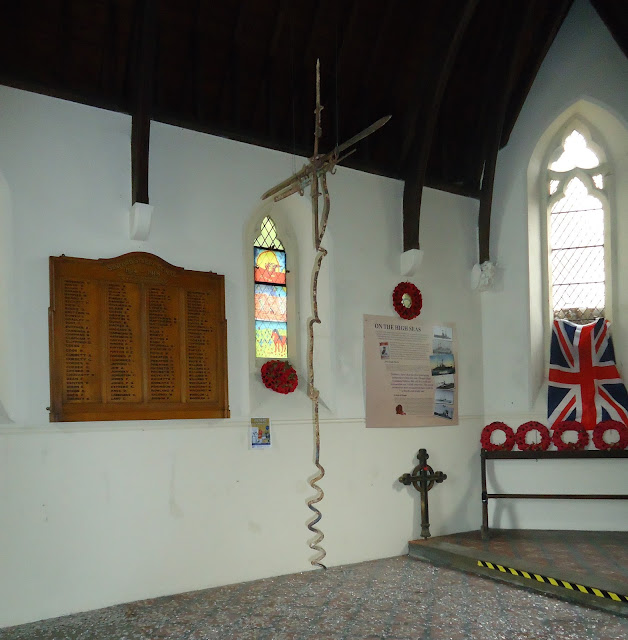
The non-denominational chapel, built to seat 100 people, was never flash. Four angels on the ceiling bosses are the only adornments, a little colour glass in the windows, but I’ll come to that another time. Any hymn singing was probably unaccompanied, the non-conformist ministers leading the mourners.
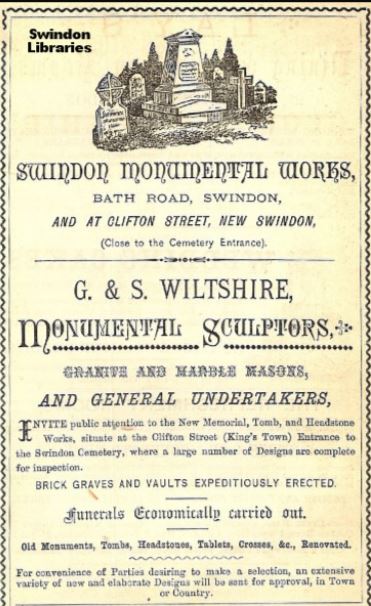
Look up and marvel at the intricate timber framed roof, a credit to builders Phillips & Powell and George Wiltshire, still weather proof, still doing the job for which it was intended.
Sadly, most of the original pews were removed some years ago. There are a couple still left, showing their age, but able to give us a snapshot of how things once were.
A lectern has survived the ravages of time and the work of vandals. And so have two trestle coffin stands. At first sight they might appear rather tall, but they are just the right height to allow the pall bearers to carefully lower their burden.
Everything perfectly designed, carefully thought out, everything just right.
A Wesleyan ministry was not for the faint hearted and if it was a hard life for the Minister, imagine what it was like for his wife.
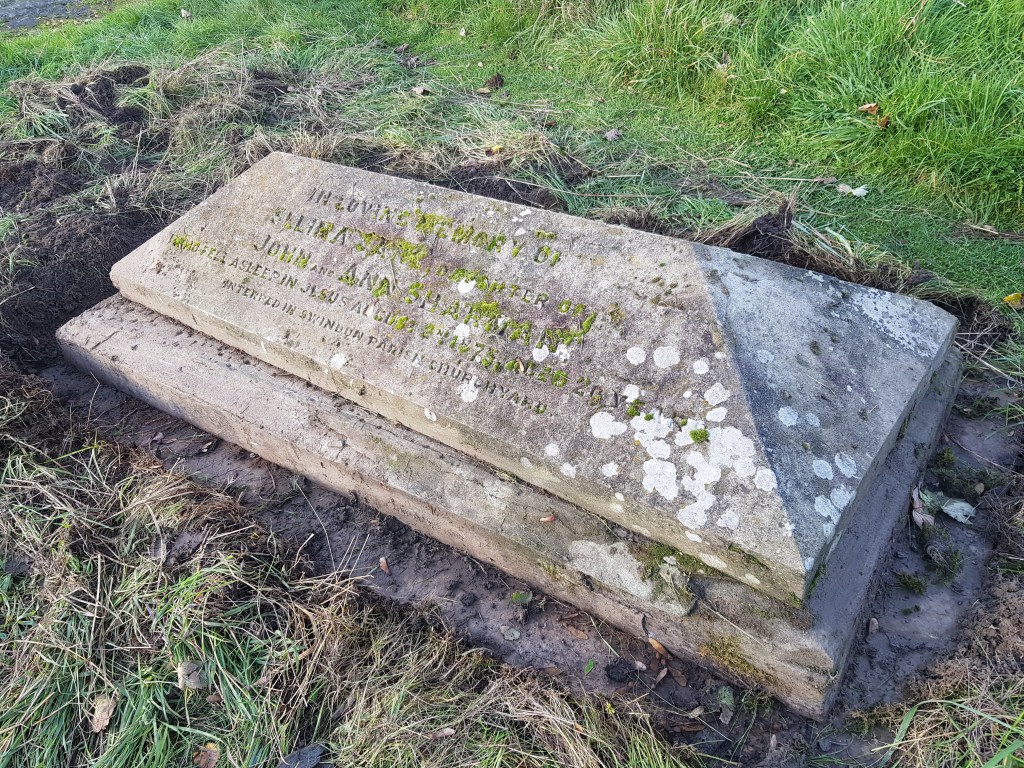
John Sharman was born on May 22, 1814 the son of Michael Sharman and his wife Hepzibah, in the parish of Walsoken, Norfolk. He began his ministry in 1835 and five years later married Ann Allen. Ann was born in 1840, the daughter of Thomas and Susannah Allen, themselves Methodists.
By researching the birth of John and Ann’s eleven children it is possible to map the many places where John ministered.
Their first child John Parker Sharman was born in Whitchurch, Hampshire on April 25, 1841. Annie Rebecca (1842) and Thomas Michael (1844) were both born in Ashford, Kent. Selina Jane was born here in Swindon on January 31, 1846. She was baptised at the ‘Wesleyan-Methodist Chapel Swindon & at places in its Vicinity’ on May 16 with her brother John Parker Sharman. James Allen was born in 1847 in New Buckenham, Norfolk and baptised on March 19, 1848 at Attleborough, Norfolk. Frederick William was born in 1850 in Bury St. Edmunds, Suffolk. At the time of the 1851 census the family were living in the small hamlet of Botesdale on ‘the turnpike road leading from Scole to Bury Saint Edmunds.’ Elizabeth Hephzibah (1852) and Catherine Laura (1853) were both born in Botesdale. Frederica Allen was born in 1855 in Harwich, Essex as was her brother Frederick James born the following year. Mary Susannah was the last of John and Ann’s children. She was born in St. Just, Cornwall and baptised on July 12, 1859 at East Looe, just three months before John died.
At least seven different homes in 19 years of marriage (and child bearing for Ann) travelling England and Wales.
John died on October 11, 1859 at Holsworthy, Devon, aged 45.
By the time of the 1861 census Ann was living at Grove Street, Wantage with seven of her children and her widowed mother Susannah Allen. In 1871 she was living in Harwell Street, Harwell, Berkshire with her five daughters and by 1881 she was living at 65 Clifton Street, Swindon.
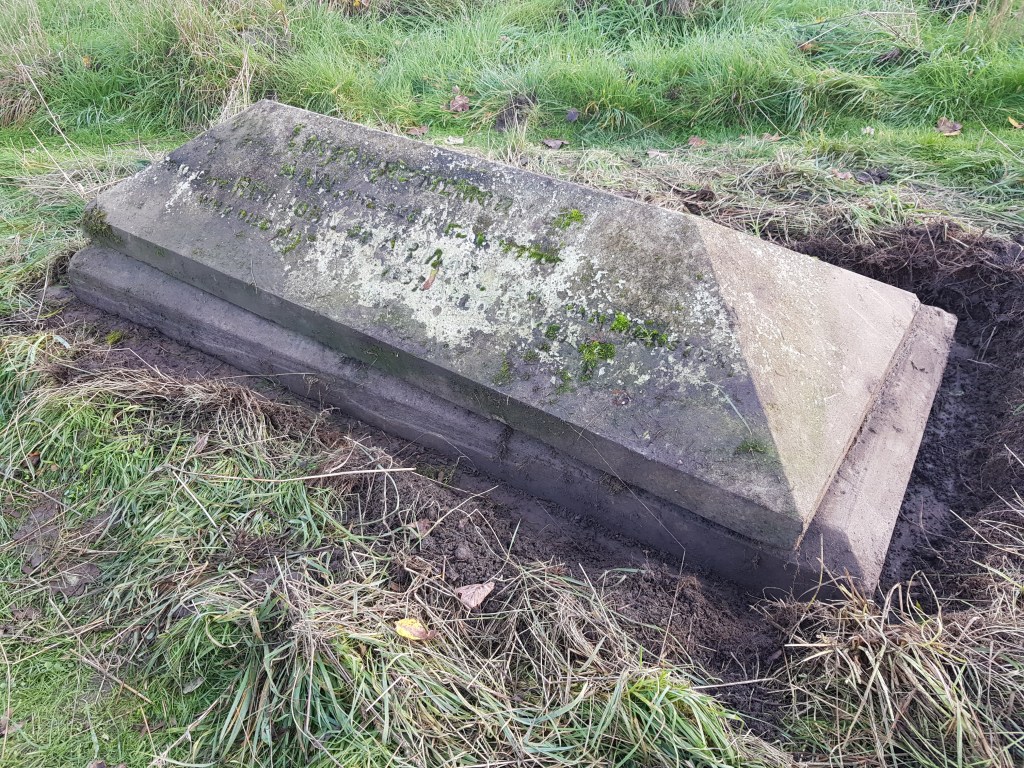
Ann Sharman died in March 1887 at 3 Graham Terrace, Clifton Street, aged 68. She was buried in grave plot E8500 where two of her daughters would later join her; Annie Rebecca Cole who died in February 1913 and Mary Susannah Richards who died in March 1924. Selina Jane Sharman is also mentioned on the memorial. The only child to be born and to die in Swindon was buried in the churchyard at Christ Church. She died aged 29 in 1875, before Radnor Street Cemetery was built.
Ann and John’s son, Frederick James Sharman, who died in 1916, is buried with his wife and daughter in grave plot E8515 just a short distance from his mother’s grave.
A few examples of the busy life of Rev. John Sharman.
“On Thursday morning at five o’clock, the Rev. John Sharman of Abingdon, preached to a large congregation.” Newbury, Berkshire May 1839.
Rev. John Sharman of Tredegar preached at Nantyglo in October, 1846.
November 1846 – Tredegar. “In the morning of Sunday November 15, Rev. John Sharman, resident minister, preached in the morning.”
Wesleyan Missions – On Sunday, Feb 6th, two sermons were preached in the Trewelland Chapel, St. Just Circuit, on behalf of the above missions; viz., in the morning by the Rev. John Sharman, and in the evening by the Rev. N. Alston. On the following Wednesday, the annual public meeting was held, when the claims of missions were ably advocated by the Revds. John Hobson of Redruth, Sharman and Alston, of St. Just; William Trezise, Esq. in the chair. Collections were made, amounting to the same as last year.
Royal Cornwall Gazette, Friday Feb 18, 1859.
St. Just Institution
On Monday last, the Rev. John Sharman, Wesleyan Minister, of St. Just, lectured on “Druidism.” The Rev lecturer handled his subject in his usual masterly style, and delivered a highly interesting and instructive lecture, which was approved of by the audience in a cordial vote of thanks, on the motion of Mr John Boyns, seconded by Mr William Holman, and presented to the reverend lecturer by the Chairman, Mr A. Chenhalls.
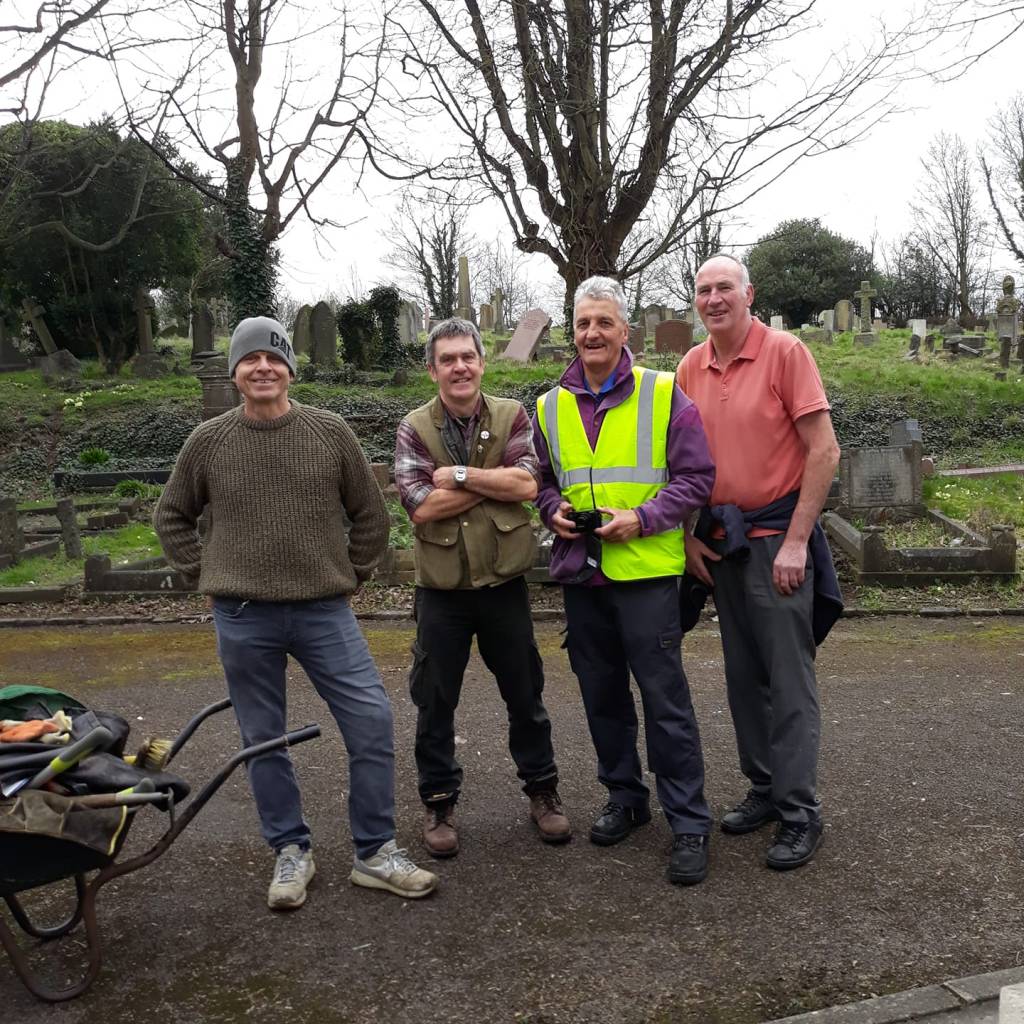
In the beginning there were just two members of the Radnor Street Cemetery volunteers. Pictured below with Andy are Jon and David shortly after appointing Brian as their new apprentice. More than six years on and the group is considerably larger and Brian has ‘done his time.’*
The original objective of the group was to care for the Commonwealth War Graves. Today the volunteers are members of the CWGC Eyes On Hands On initiative, keeping the area around the war graves clear and reporting any concerns over safety or damage to the headstones. They are also recording family memorials that mention service personnel lost or missing in war. Their latest project is an attempt to secure recognition by the CWGC for a soldier who died in the Victoria Hospital, Swindon in 1918 from broncho pneumonia having recently been discharged from the army as unfit for service. We believe that his death may have been as a result of his military service. If successful this will be the second WWI soldier to be so recognised in the past two years.
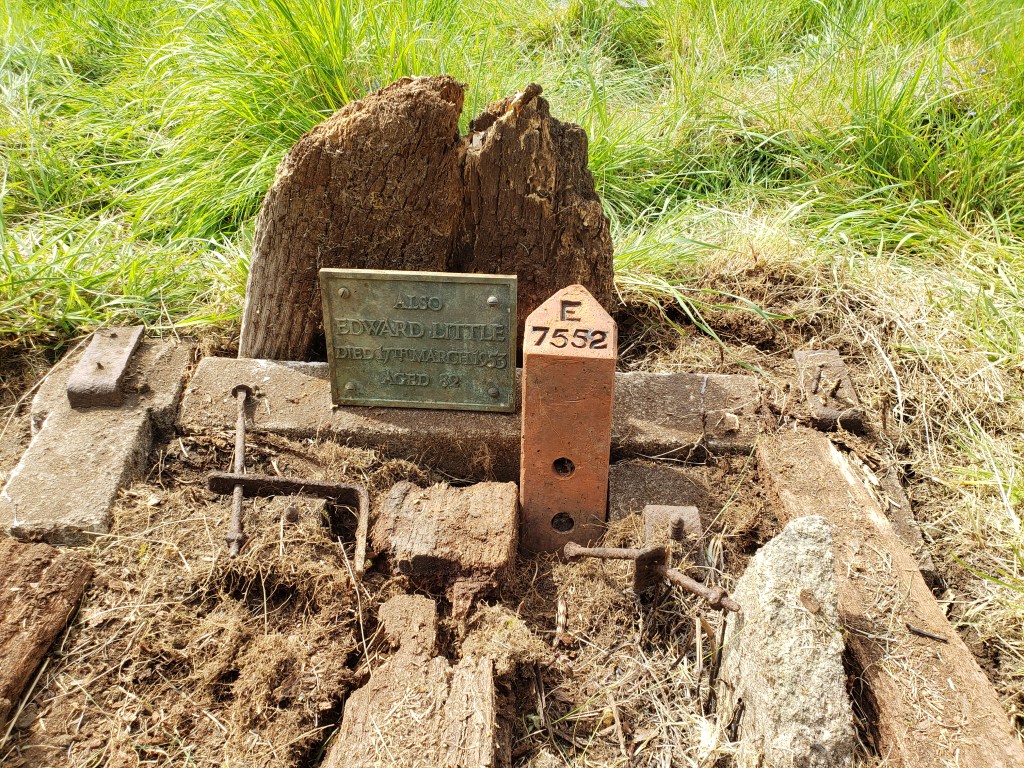
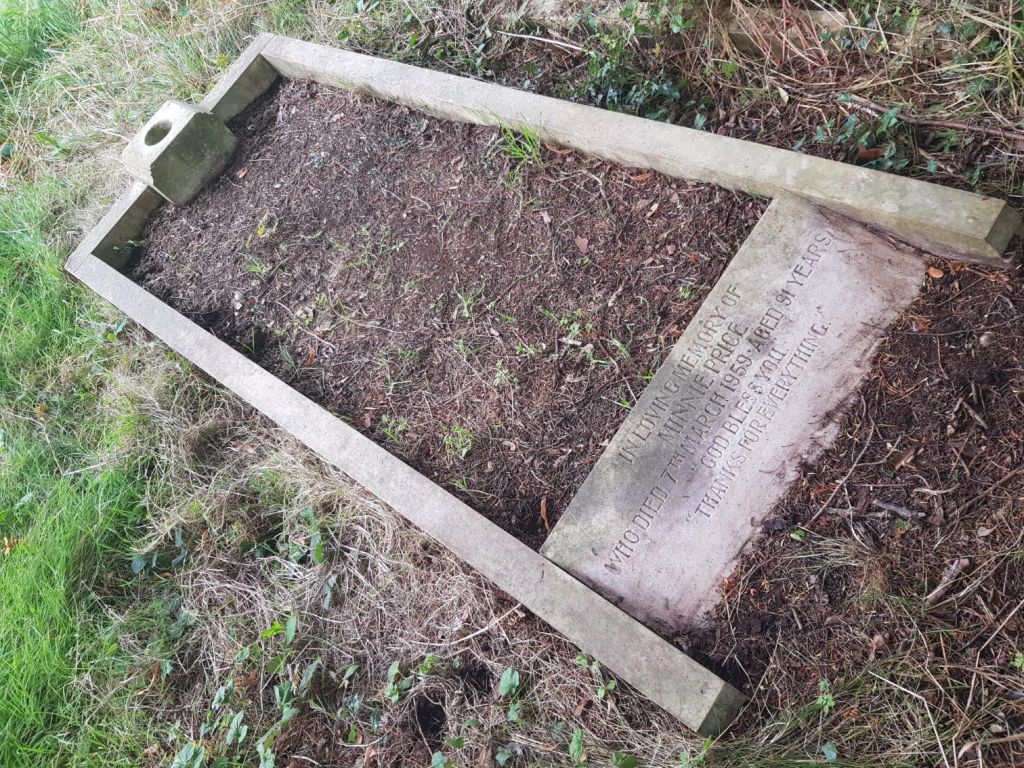
But this is only part of the volunteers work, as you can see from the photos below.
Would you like to join them?
You can contact us in a number of ways. You can leave a message here on this blog or on our Radnor Street Cemetery Facebook page and we also have a Twitter (now known as X) feed @StreetRadnor.
Why not come along to our next guided cemetery walk when Jon will be able to tell you more and answer your questions?
Our last walk of this season will be on Sunday October 29, meet at the cemetery chapel for 2 pm.
*finished his apprenticeship
Before and after … Kent Road gate
Read about Bob Menham, Swindon Town FC goal keeper.
One of the most important people in Swindon’s history not buried in Radnor Street Cemetery is Joseph Armstrong.
Joseph Armstrong’s funeral was described as a spectacle seldom seen, with ‘the whole town and neighbourhood showing every possible honour to the memory of the deceased.’
Image published courtesy of Local Studies, Swindon Central Library.
The railway works closed for the day and an estimated 6,000 people lined the streets between Armstrong’s home at Newburn House, through Rodbourne and to the church of St. Mark’s.
During the first week of June 1877 Joseph Armstrong had left Swindon for a short holiday. He was suffering from heart disease and exhaustion exacerbated by his heavy workload. He died on June 5 at Matlock Bath.
Joseph Armstrong was born in 1816 in Bewcastle, Cumberland. Throughout his railway career he worked for the Liverpool and Manchester Railway, the Hull and Selby Railway, the London and Brighton Railway and the Shrewsbury and Chester Railway before arriving in Swindon in 1864. He was appointed the second only Chief Superintendent of the GWR Locomotive, Carriage and Wagon Works succeeding Daniel Gooch where he was responsible for the construction of all new engines, carriages and wagons and in charge of 12,900 employees.
A non-conformist, Joseph Armstrong was a staunch supporter of the need for a burial ground where non conformists could bury their loved ones according to their own beliefs and without the strictures of the established church. Sadly, at the time of his death just such a cemetery was still the subject of rancorous debate. It would be another four years before Radnor Street Cemetery was opened.
The strength of feeling at the time of Armstrong’s death is conveyed in the following extract from the editorial written by William Morris, published in the Swindon Advertiser.
Today an elaborate Grade II listed monument stands on the Armstrong family grave in St. Mark’s churchyard.
And this brings us to the lesson of Mr Armstrong’s death, and of the work and duty it has thrown upon us. We believe it was his desire to secure for others that liberty of religious thought which he enjoyed himself. And that this end might be secured he had taken an active interest in obtaining for the large and populous parish of Swindon that burial accommodation which the religious liberty of the subject demands should be provided for every parish, and the proposition to provide which for Swindon has been met and opposed by so many wretched subterfuges. We may treat with proper contempt the wretched work of bedaubing tombs and harrowing widowed hearts; but, as we have said we cannot afford to submit to such obstructions to our progress, to such evidences or the existence among us of a dogmatic priestly rule, altogether out of accord with the spirit of the age in which we live. This, then, is a work Mr Armstrong has left us to do – to provide a cemetery without priestly rule – a place of interment where we may bury our dead without the danger of having our feelings outraged by some impertinent and officious interloper who, by bell and book, would consign us to eternal punishment if we dared dispute his authority.
The Swindon Advertiser Saturday, June 16th, 1877
Extract from the editorial – written by William Morris
and a letter to which he refers in this lengthy editorial.
To the Editor of the Swindon Advertiser
Sir – Will you kindly allow me a space in your paper to lay before the people of Swindon the facts of a case upon which I think they should give judgment.
On Wednesday in Whitsun-week, (as you announced in your paper), a man named Benjamin Browning, of New Swindon, died suddenly, and his remains were interred at St. Mark’s on the following Sunday. His widow caused a tombstone to be erected to his memory, and underneath the usual inscription were placed the Latin initials R.I.P. Requiescat in pace or “May he rest in peace.” The Rev. George Campbell, vicar of St. Mark’s, seeming to consider these initials illegitimate, had them effaced with a covering of cement, and now in their stead there is a patch of a different shade to the stone.
I respectfully ask you, Sir, and the people of Swindon, if this is fair or Christian in a burial ground which, if it is not a public one, is the only one in the town for all denominations. And I ask also if the Rev. George Campbell has acted legally in defacing the property of another person?
There is something so simple, so sweet, and so impressive in the sentence for which those initials stand, that I think none could dislike it but those (if there be such a class of People) who do not wish the departed to rest in peace.


















 Radnor Street Cemetery