The burial of Swindon’s dead continued to be a controversial subject even after the opening of Radnor Street Cemetery in 1881.
The following letter to the editor of the Swindon Advertiser reveals burial practices that should have been eliminated following legislation passed during the previous 30 years.
To the Editor of the Swindon Advertiser
Sir – Can any of your readers tell me how it is that the inhabitants of that part of the parish of Swindon known as Old Swindon do not use the new cemetery, provided at their cost some five years ago? When it was decided to purchase this cemetery it was generally held out as an inducement to ratepayers to part with their money that the parish church burial ground would be closed, except to owners of vaults. Instead of this being the case, however, the churchyard is not only being crowded with bodies, but some of those interred there are being dug up in a most indecent manner to make room for more.
At the funeral of a pauper this week there was exposed beside the grave the skull, vertebra, and other bones of a corpse which previously occupied the same ground, together with the handles and other portions of the coffin furniture. I do not think this is right, or that it is decent. With the spacious cemetery we have it cannot be necessary. I am told that the reason Swindon paupers are buried in the churchyard instead of the cemetery is that the poor law authorities refuse to pay the cemetery fees. If this is so I do hope the Swindon guardians will bestir themselves and put an end to such a state of things.
When the cemetery chapel was built in 1881 there were few adornments. The non-denominational chapel was designed with elegant simplicity and this extended to the windows. Above the door is situated a rose window, which continues to cast a serene shadow during the sun’s afternoon trajectory. Sadly, this window was damaged by vandals some years ago. The three windows at the east end contain a few panes of subtly coloured glass, and these were also smashed. The four remaining windows are plain.
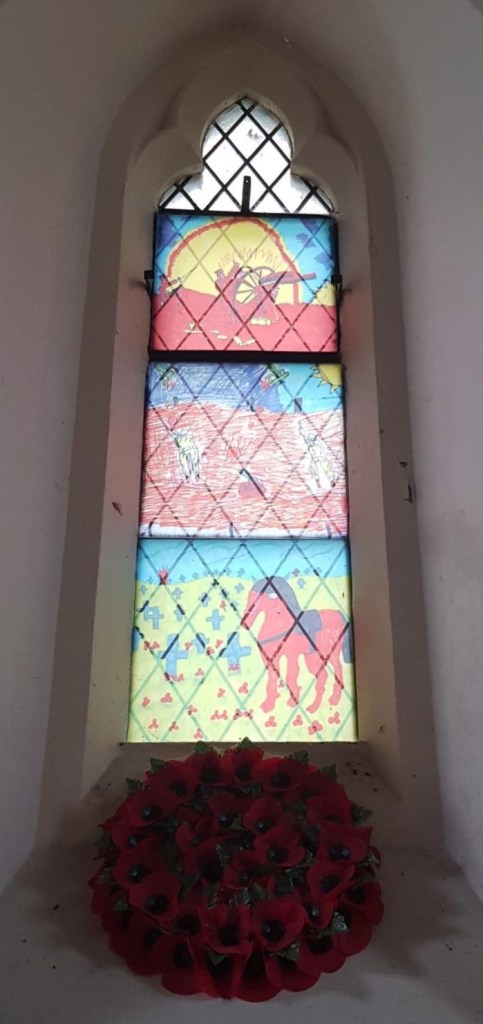
In 2015 we commemorated the 75th Anniversary of the Battle of Britain along with Swindon Heritage, Paul R. Gentleman Associates and Green Rook. Swindon Remembers was a series of events held across the town, and most especially in Radnor Street Cemetery. We involved primary schools in the area who designed a montage for each of the five windows. We talked to the children about the people buried in the cemetery; the war graves and the two world wars; the GWR and the role of women in the 19th and 20th centuries. We talked about nature in the cemetery, this green oasis in the middle of town, and they encapsulated it all in their designs.
The childrens’ work is still in place eight years later and can be viewed when the chapel is open during our guided cemetery walks.
Join us for the last walk this season on Sunday October 29. Meet at the chapel for 2 pm.
The Second World War by Lethbridge Primary School
Nature of Radnor Street Cemetery by St. Mary’s Primary School
Famous Women by Robert Le Kyng Primary School
The First World War by Goddard Park Primary School
Did Emily stand at this spot? Did she watch the dappled sunlight dance across the headstone? But of course the tree may have been a mere sapling then, like her son who died aged 17. Perhaps she had no time to stand and stare, what is there to ponder on when a son is taken before his time. The headstone may have been a later addition, raised after both she and her husband Fred had gone. There were a lot of words written about Fred (a well-known Swindonian) when he died.
What is there to say when a 17 year old son has been taken. Nothing that is of any comfort.
Death of Mr Fred Tegg
A Well known Swindonian
We sincerely regret to announce the death of Mr Fred Tegg, which took place quite suddenly at his residence, Lyndhurst, Clifton Street, Swindon, on Sunday.
Deceased was in his usual health and attending to his duties last week, and the end came quite suddenly. He was apparently quite well on Christmas Day and on Sunday morning, but in the afternoon of the latter day he was taken suddenly ill, and passed away about half-past two
Mr Fred Tegg was a typical self-made man. Born at Bucklebury, in Berkshire, he came to Swindon some forty years ago, and started work as a carpenter in the GWR Works. By his indomitable courage, he rose to a higher post, and then, coming under the eye of the late Mr Samuel Carlton, then Manager of the GWR Works, he made further headway, being a good shorthand writer. In those days shorthand was little known, and it may be here recalled that the present Mayor of Swindon (Ald. W.H. Lawson) and Mr W. H. Stanier, an ex-Mayor, in addition to Mr. Fred Tegg, were the only shorthand writers connected with the GWR Works at that time. Mr. Tegg was taught shorthand by Miss Wreford, and in after years he did a great deal of reporting for the Swindon Advertiser.
Owing to his great abilities as a stenographer, Mr Fred Tegg made great progress and at the time of his demise he was Chief Clerk to Mr. H.C. King, Manager of the Locomotive Dept. He had completed his term of service, and was about to retire, when the sudden call came.
Mr Tegg was for 12- or 13-years Secretary to the GWR Medical Fund Society, in the work of which he was deeply interested. He was also a prominent Oddfellow being a member of the “Mackie’s Good Intent” Lodge and he was present at a meeting recently. He had held all the high offices, and was a Trustee of the Lodge at the time of his death. He was most popular among all classes, and his death will be deeply mourned by a very large circle.
The Inquest
On Monday last the Deputy Coroner for North Wilts, Mr J.W. Pridham, held an inquest on the body of deceased at the Clifton Hotel. Mr J. Stafford being chosen foreman of the jury.
Evidence was given by Mr. E. Tegg (son of deceased) and Dr. Haddon, and the jury returned a verdict of death from cardiac failure.
Dr Haddon stated that life was extinct when he was called to deceased. Death was probably due to cardiac failure, caused by indigestion.
Impressive Funeral
Amidst many tokens which spoke eloquently of the respect and high esteem in which the late Mr. Tegg was held by all associated with him, the mortal remains of the deceased gentleman were laid to rest in the Swindon Cemetery, at three o’clock on Thursday afternoon. The funeral was an impressive one. Four carriages conveyed the family mourners, and no fewer than 90 gentlemen walked behind. Preceded by a hand bier bearing the many beautiful floral tributes, the cortege proceeded from Mr. Tegg’s late residence “Lyndhurst,” Clifton Street, to the Cemetery Chapel, where the Rev. J.T. Evans (Primitive Methodist minister), assisted by the Rev. H.W. Smith, conducted the first portion of the solemn rites. Later, the Rev. J.T. Evans also officiated at the graveside.
The remains were enclosed in a polished elm coffin with brass furnishings, and the breast-plate born the inscription: Frederick Tegg, died December 26, 1909. Aged 61 years.
Extracts from the Swindon Advertiser, Friday, December 31, 1909
Harry Frederick Hamilton Jerome Tegg was buried in grave plot B1695 on July 10, 1890. Fred Tegg was buried in the neighbouring plot B1694 where Emily joined him when she died in April 1932.
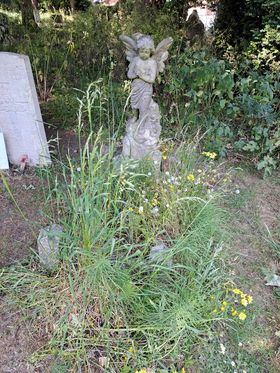
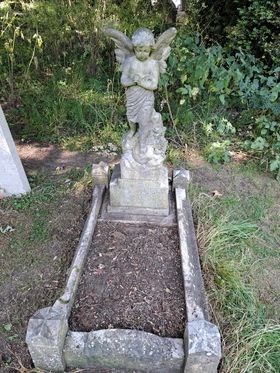
One of our volunteers recently sent me a photo of a grave she had cleared and tidied up. This angel memorial surmounts the grave of a young child. Bex has a knack of finding graves with a particularly poignant story.
Terence Anthony Woolford was born in July 1930, the first of Reginald and Gladys Woolford’s three children. Reginald Charles Woolford was born in 1904, the son of Charles Woolford who worked as a wheel turner in the railway factory. In 1928 Reginald married Gladys Rose Popham, the daughter of Ernest Popham, a fitter in the railway factory.
Reginald and Gladys were living at 7 Drove Road in January 1936 when their young son was taken ill. He was admitted to the Isolation Hospital where he died. He was 5 and a half years old. His funeral took place in Radnor Street Cemetery on January 20 where he was buried in grave plot C1720.
I am presently engaged in a BIG project transcribing the diaries of a local farmer as part of the Friends of Lydiard Park’s archival work. Elliot Woolford kept a daily diary from 1885 until his death in 1940. No mean feat for a busy farmer with a small team of family members and local labourers working with him.
And then I wondered if there could possibly be any connection between Elliot and this little boy buried in Radnor Street Cemetery.
So far I have traced Elliot’s family back several generations. There have been Woolfords living in the Purton, Lydiard Millicent and Lydiard Tregoze area for at least 600 years. From Robert Woolford who married Susannah Staley in the parish church at Lydiard Millicent in 1757 to “William Woolford of ye parish of Lidyeard Treagoze in the County of Wilts yeoman” who in 1695 left four of his sons William, Benjamin, Nicholas and Oliver, £5 each in his will.
Returning to the story of little Terence Anthony Woolford…
A family historian has placed an extensive Woolford family tree on the Ancestry, website which I navigated with alacrity. At first there were no obvious connections; no farming background for Reginald, no links with the rural Lydiard parishes, but back and back I went. Then I discovered John Woolford born in 1600 in Trowbridge. John married Elizabeth Baker in the church of St. Mary’s, Lydiard Tregoze on February 12, 1621. He died in his adopted parish on February 28, 1674 and was buried in the churchyard there. This John Woolford appears in both little Terence and Elliot Woolford’s family tree.
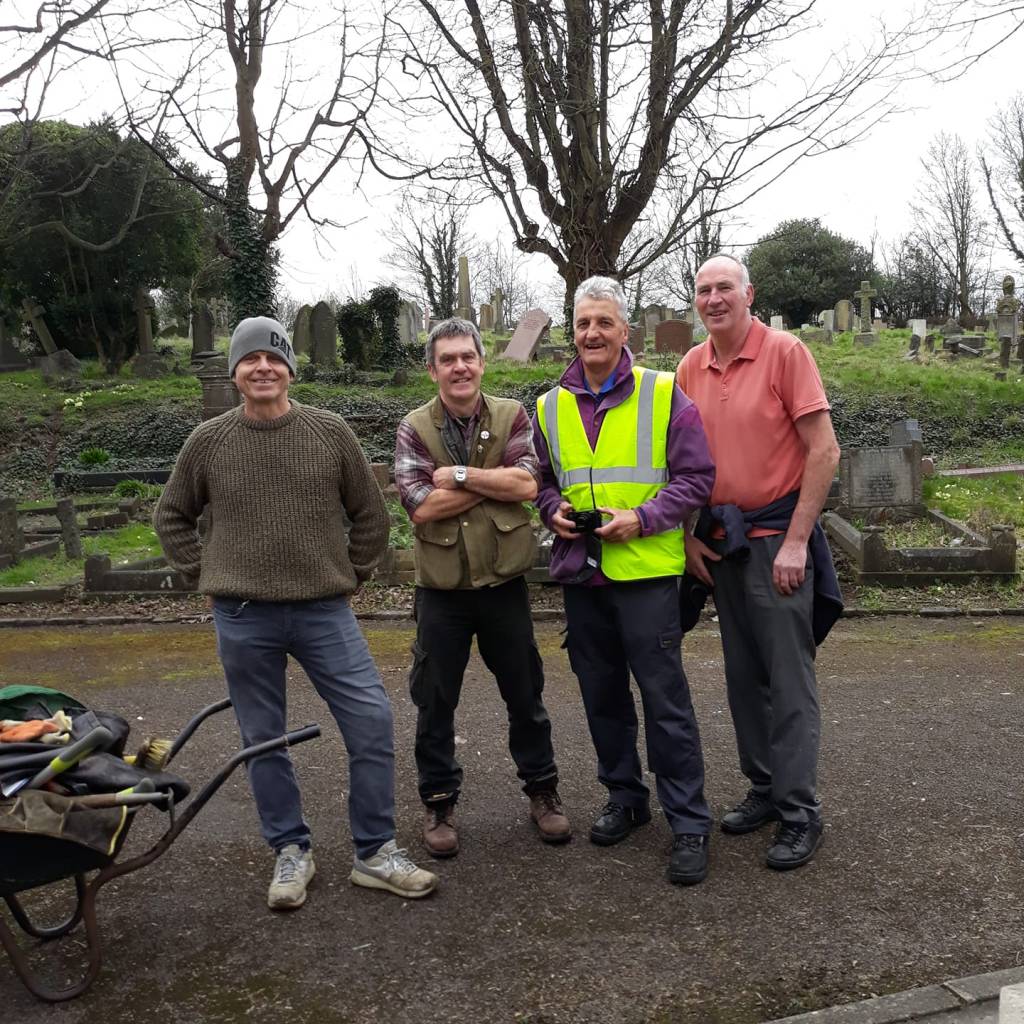
In the beginning there were just two members of the Radnor Street Cemetery volunteers. Pictured below with Andy are Jon and David shortly after appointing Brian as their new apprentice. More than six years on and the group is considerably larger and Brian has ‘done his time.’*
The original objective of the group was to care for the Commonwealth War Graves. Today the volunteers are members of the CWGC Eyes On Hands On initiative, keeping the area around the war graves clear and reporting any concerns over safety or damage to the headstones. They are also recording family memorials that mention service personnel lost or missing in war. Their latest project is an attempt to secure recognition by the CWGC for a soldier who died in the Victoria Hospital, Swindon in 1918 from broncho pneumonia having recently been discharged from the army as unfit for service. We believe that his death may have been as a result of his military service. If successful this will be the second WWI soldier to be so recognised in the past two years.
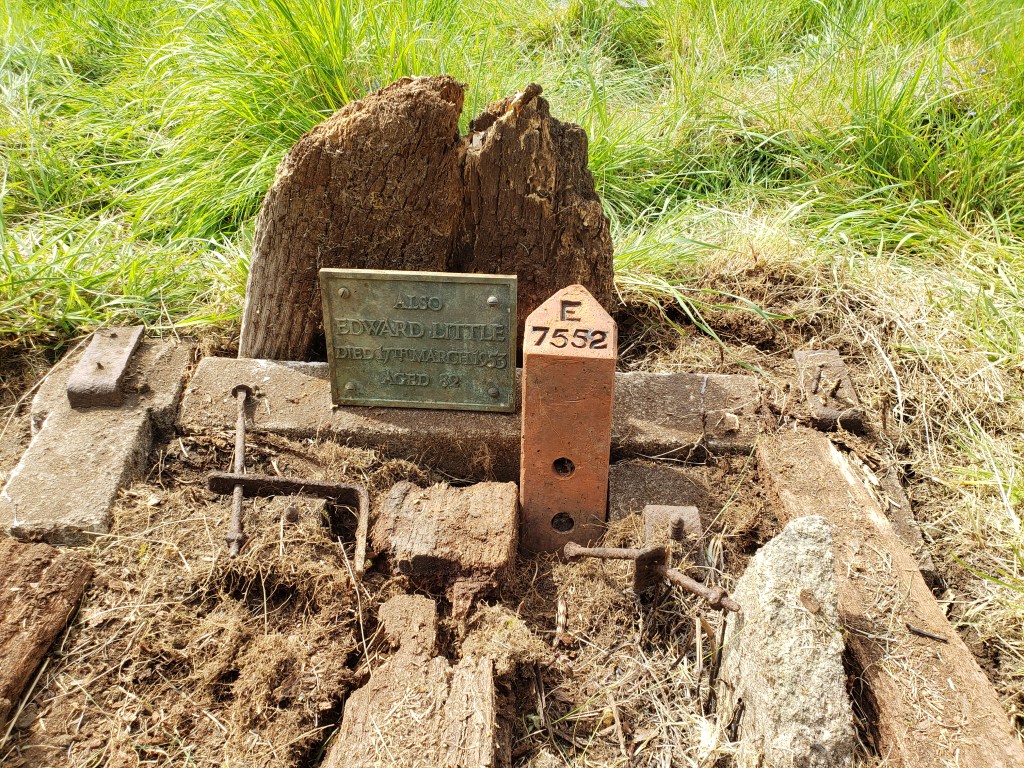
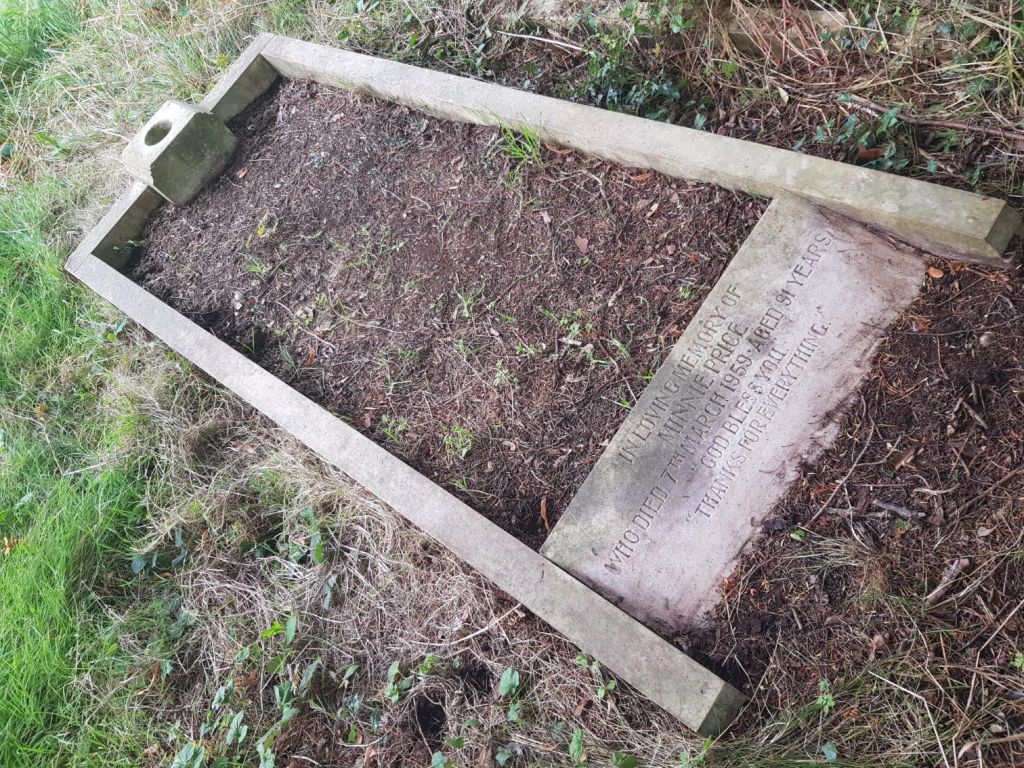
But this is only part of the volunteers work, as you can see from the photos below.
Would you like to join them?
You can contact us in a number of ways. You can leave a message here on this blog or on our Radnor Street Cemetery Facebook page and we also have a Twitter (now known as X) feed @StreetRadnor.
Why not come along to our next guided cemetery walk when Jon will be able to tell you more and answer your questions?
Our last walk of this season will be on Sunday October 29, meet at the cemetery chapel for 2 pm.
*finished his apprenticeship
Before and after … Kent Road gate
Read about Bob Menham, Swindon Town FC goal keeper.
For some considerable time the Davis family memorial stood in a dilapidated, collapsed condition. This was one of the first restoration projects our dedicated team of volunteers undertook.
William Davis was born in Faringdon in 1856, the son of Joseph and Jane Davis. He married Agnes Greenaway, the daughter of John, a farmer in Stratton St Margaret, and his wife Susan. For most of their married life William and Agnes appear to have had a member of the Greenaway family living with them.
William worked as a draper’s assistant and the couple began married life at 14 Edgeware Road. By 1891 they had moved to Rose Cottage next to the catalogue houses on Drove Road.
On one side of the monument you can see the name of Reginald Ernest Davis, the couple’s second son. Reginald had a complicated personal life and a tragic death.
He worked first as a teacher at a local board school here in Swindon. In 1908 he married Rose Louise Gorton in the parish church in Clapham, South London when he described himself as a dairy farmer. Rose’s father was a farmer at South Marston.
The following year Reginald, now described as a clerk, and Rose, emigrated to Canada and in 1916 they were living in Regina, Saskatchewan with their six year old daughter.
The next time I find the couple is at the time of their re-marriage on December 7, 1923, describing themselves as divorcees on the marriage certificate, so presumably they divorced sometime after 1916.
Sadly it was not to be a happy ever after story as less than a year later Reginald committed suicide at his home in Toronto, which is where he is buried.
Moving around the monument we see a reference to William and Agnes’ eldest son. William Harold Davis worked as an agent for a British Merchant in West Africa. In November 1917 he was returning home from a business trip on the SS Apapa when the ship was torpedoed by a Germany submarine off the coast of Anglesey. William was one of 77 people lost.
In the beginning the cemetery was simply called Swindon Cemetery, but it could so very easily have become known as Redcross Street Cemetery.
Today this is the only reference to Radnor Street’s previous name.
When building began in the street that would begin at the top of the precipitous Stanmore Street and continue to the junction with Shelley Street and Cambria Bridge Road it was known as Redcross Street.
Mr James Hinton, auctioneer, announced that on January 29, 1879 there would be a sale of ‘All those EIGHT NEWLY-ERECTED SIX ROOMED, COTTAGES with GARDENS thereto, Situate on the North side of Redcross-street, Kingshill, Swindon, being Nos. 177, 178, 179, 180, 181, 182, 183, And 184 on the Plan of the Lower Kingshill Estate, which Plan will be produced at the time of Sale.’
Just a week later more properties and additional building plots in Redcross Street came under the hammer. Lot 1. All those five newly-erected six-roomed COTTAGES, and five similar COTTAGES not quite completed, with gardens thereto, situate on the north side of Redcross-street, Kingshill, Swindon, being Nos. 185, 186, 187, 188, 189, 190, 191, 192, 193 and 194 on the plan of the Lower Kingshill Estate, which plan will be produced at the time of sale. Lot 2. All those ten PLOTS of valuable FREEHOLD BUILDING LAND, situate on the south side of Redcross street aforesaid, being Nos. 223, 224, 225, 226, 227, 228, 229, 230, 231, and 232 on the plan of the Lower Kingshill Estate. Each plot has a frontage of 15 feet to Redcross-street.
By 1881, when negotiations for the new cemetery were under way, the street was already being referred to as Radnor Street, however at the time of the census taken in April 1881 it was still called Redcross Street and was apparently renamed sometime later that year.
Jacob Pleydell-Bouverie, 4th Earl of Radnor served as Lord Lieutenant of Wiltshire from 1878 until his death in 1889. The Pleydell-Bouverie Wiltshire base was at Longford Castle, near Salisbury and closer to home, they owned the stately pile that was Coleshill House. Maybe Swindon thought it advantageous to name one of their many streets of red brick terrace houses after the local aristocracy.
Building continued in Radnor Street throughout the 1880s with properties built by S. Spackman, J. Longland and B. Jefferies.
As this unseasonal September heatwave looks set to continue for the next few days, I revisit September 1929 when Swindon was hit by a devastating water shortage.
Additional inspectors were assigned to locate cases of wilful misuse, and Mr Thompson, Borough Engineer and Water Engineer, said it was the duty of the housewife to be sparing in the use of water, adding somewhat threateningly “if she is not she will have to be taught how to be sparing.” A total ban was imposed upon the use of water in the cemetery.
Water Shortage
Alarming Situation in Swindon: Utmost Economy Needed
News regarding the position of Swindon’s water supply is of an alarming nature. During the week-end there was a most serious drop in the amount of water available.
The townspeople have already effected some economies in their usage of water; but it is now vitally necessary that the present consumption should be cut down by at least another 50 per cent.
It is therefore the immediate duty of everyone to use only half the amount of water they have been doing. For the present the use of baths should certainly be given up, and their place taken by an ordinary sponge-down with the minimum quantity of water.
Housewives can do much to help. They must look on water as a precious fluid, and cut down their usage to the least possible quantity.
Every step is being taken by the Borough Engineer and his staff to augment the supply; but the co-operation of the general public is essential.
Mr J.B.L. Thompson, the Borough Surveyor and Water Engineer, tells the North Wilts Herald that the fall in the available supplies which has taken place over the week-end is unprecedented, and has forced the Water Committee to reconsider the whole position.
Unless still more drastic economies are made, Swindon is going to be faced with a very unpleasant situation.
The use of water for certain specified purposes must, under heavy penalty, be absolutely discontinued. Leakages, however small, must be reported at once.
Warning to Wasters
The Borough Engineer has been instructed to employ further inspectors to locate cases of wilful misuse.
Official Notice
In an official notice, signed by the Town Clerk, to be distributed to householders, it is stated:
“Owing to a rapid and unprecedented decrease during the past two days in the water supplies available in the well belonging to the corporation, the attention of all consumers of water is drawn to the urgent necessity of preventing waste and of strictest economy in the use of water.”
It is further stated that water must not be used for the purpose of washing foot-pavements, yards, cars or garage floors, nor used on allotments, tennis courts, bowling green, cricket patches or gardens.
Prosecutions will be instituted where there is evidence of waste of water.
A Critical Three Months
“It will be the end of December before we can hope for the wells to recover,” said the Borough Surveyor to a North Wilts Herald representative.
“The next three months are going to be very precarious from the point of view of obtaining water sufficient to keep the town going.
“Unless people limit their consumption by at least 50 per cent, it will mean that as a last resource the town will have to be shut off from the regular supply and that we shall have to draw it from certain points.”
Meanwhile wells at Ogbourne continue to diminish, and though water is being drawn from the GWR supply at Kemble the time will come when this supply must stop.
It is the duty of the housewife to be sparing in the use of water. If she is not – to use Mr Thompson’s words – “she will have to be taught how to be sparing.”
Owing to the acute shortage, the Swindon Corporation have stopped the use of water for growing plants in the Swindon Cemetery. Water has now been banned from any kind of use in the Cemetery.
The supply in the Highworth parish at present is fairly satisfactory, this being attributed mainly to the fact that some two or three years ago the district council constructed auxiliary works at Eastrop.
In recent years we have been fortunate to have the occasional assistance of the Community Payback Team in the cemetery. This group does some sterling work, often tackling the most overgrown sections of the cemetery. It was on one such occasion some years ago that they cleared a huge amount of shrubs and brambles and in doing so revealed several graves that had been hidden for years. Among those newly revealed graves was this magnificent memorial to the Lodge family.
William Lodge and Elmira Faville were both born in Gloucester and married in St James’ Church, there on October 13, 1867. By 1871 they had moved to London where they were sharing accommodation at 33 Desborough Lane, Paddington with James Affleck (another Swindon connection). In 1881 they were living in William Street, Swindon where William worked as an engine driver. By 1901 William was working as Railway Engine Inspector and the family lived at 36 Rolleston Street, one of the few houses that remain after the demolition work of the 1960s and now tucked away behind the doomed Regent Circus development.
So, who is buried beneath this memorial in this spacious, double plot E8482/3.
First we have Elmira who died in 1905, then Mary who died in 1917. William Lodge died in 1922 followed by another daughter, Emma who died in 1926. Eldest daughter Ellen died in 1950 and son Charles and his wife Annie are buried here, they died in 1945 and 1963 respectively.
Looking at this impressive memorial it is difficult to imagine it was once hidden by brambles. When so little maintenance is done by the local authority it would be great to see the Community Payback Team back in the cemetery.
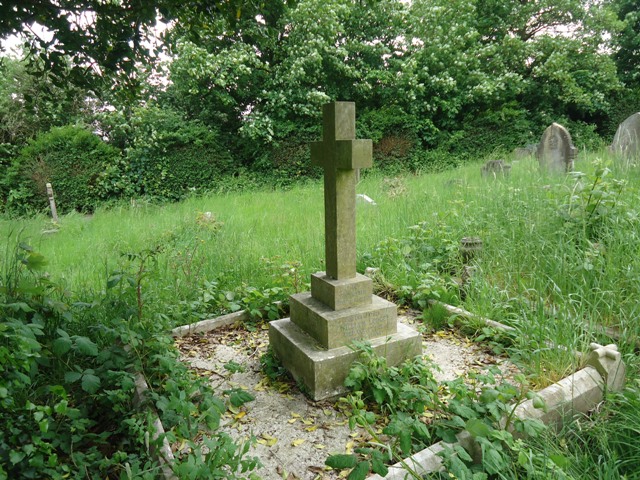
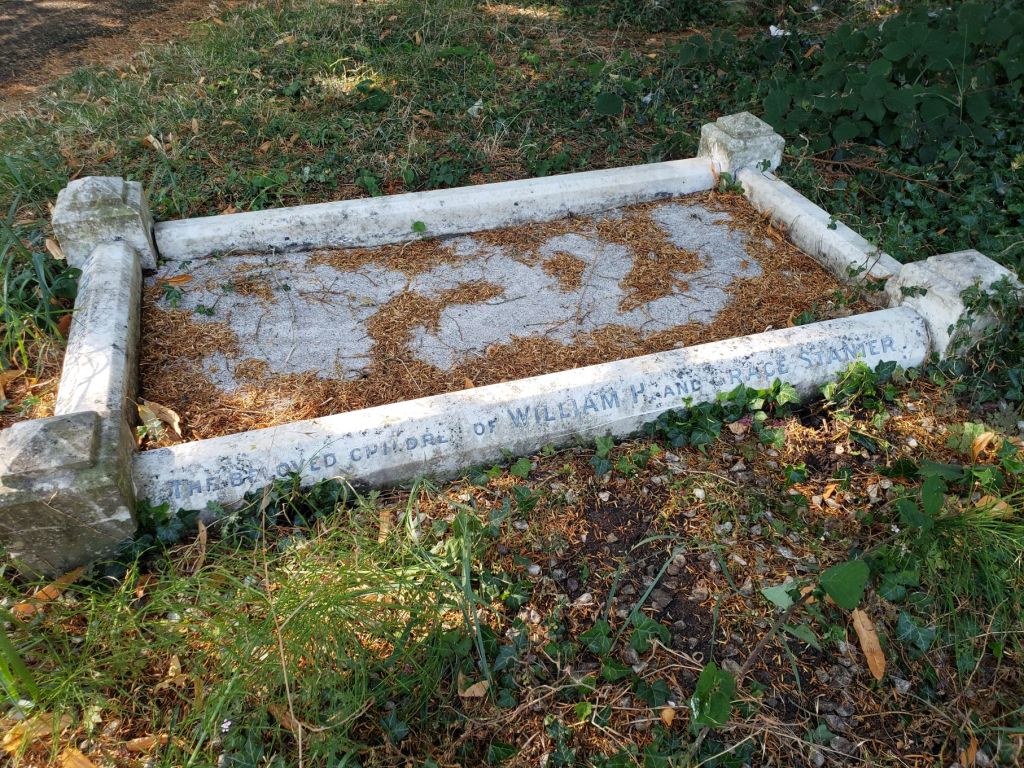
As you might guess, this diminutive grave is that of a child – two young children, infact. Francis John Stanier was born in the summer of 1881 and died in January 1885. He was buried in grave plot A188, aged 3 years old. On May 7, 1886 his 3 week old baby brother Alfred was buried with him. These children were the sons of William Stanier and his wife Grace.
William Henry Stanier was born in Wolverhampton in 1849 and entered the services of the Great Western Railway on November 7, 1864 in the Managers Office, Loco Works, Wolverhampton. He moved to Swindon in 1871 at the insistence of William Dean, Chief Locomotive Engineer and became Dean’s clerk and personal assistant, his right hand man. In 1879 he was appointed Chief Clerk Loco & Carriage Department and in June 1892 he was made Stores Superintendent. He was elected to the Swindon School Board in 1879, serving as chairman for many years. He was appointed JP for Swindon in 1906 and for Wiltshire in 1915. He served as Swindon’s 8th Mayor in 1907-8 and Stanier Street is named after him. William Henry Stanier retired from the GWR in 1919 but continued to serve on the Railway Executive Committee in connection with the distribution of controlled materials.
His son, William Arthur Stanier, the elder brother of these two little ones, was born on May 27, 1876 and went on to have a prestigious railway career. He became Assistant Works Manager at Swindon in 1912 and then Works Manager in 1920 before being head hunted by the London Midland and Scottish Railway where he became the Chief Mechanical Engineer. He was knighted on February 4, 1943. He died in Rickmansworth, Herts in 1965 aged 89.
You can’t help but wonder what future those two little boys might have had – Francis who died in 1885 aged 3 years and Alfred who died in 1886 at just three weeks old.












 Radnor Street Cemetery