Continuing the story of Elliot Woolford, farmer at Hook Farm from 1899-1941. On Friday December 31, 1915, as the impact of the deprivations of the First World War tighten, Elliot writes about the Childrens’ Christmas Tree – a big event on the local Christmas calendar held at the school in Hook, usually a few days after Christmas. A particularly welcome event, especially in 1915.
Friday December 31, 1915.
I went to Swindon and sold butter 12/- 12 0
Bt Groceries 2/6 Meat 2/3 papers 1/- Cigarettes,
Soap & Diary 3/3 9 0
Dog Biscuits 2/8 Sauceges 7d Sundries 2/6 5 9
Paid Carter 17/- William 14/6 Walter 14/6 Frank 8/-
Clarence 5/6 2 19 6
3 14 3
Carter, William, & Walter, attending to Cows
Frank not at work
Clarence took the milk first time instead of Frank
Amy, & Dora Ody, & Babe, went up to the school tea. Amy was the sole means of they having a tea. She had no difficulty in Begging the money. Miss Dora & Dolly Ody Mrs Newth Mrs & Miss Hale Miss Habgood Mrs Webb Mrs Painter & Mrs W. Ody took their Children & assisted. About a 100 children attended. It was quite a success. Mr Leighton School master & his wife worked hard preparing the school etc.
My mother wasn’t an emotional type of woman, but when John and Hannah Bates moved away she was inconsolable. I don’t think I’d ever seen her cry before, so it came as quite a shock.
The Bates boys Bill and Tom had already gone and with the selfishness of youth all I could think was how lucky they were to escape. There was nothing in Snap anymore, but to be honest the village probably never had a thriving social life; not like Swindon where there were theatres and clubs and pubs.
But what there had been in Snap was a sense of community, and now even that had gone. I think that’s probably what upset mother as much as the departure of John and Hannah Bates. The families she had lived alongside had all left – the babies born at the same time she had hers, the children raised, the hardships shared, the good times celebrated, all in the past.
I hoped we might follow the Bates family but my parents were loathe to leave. We stuck it out a while longer, but things were never going to improve. There would be no new jobs, no one moving into the empty cottages; no one even came back to visit those of us still here.
I never made it to the bright lights of Swindon. My parents moved up the road to Aldbourne, and now I find, like mother, I don’t like change much either.
The facts …
The first recorded mention of Snap, or Snape as it was sometimes called, is in a medieval document dated 1268. In the 14th century Snap was the smallest settlement in the parish of Aldbourne and one of the poorest in Wiltshire.
During the last decades of the 18th century the village consisted of five cottages built on the southern side of the valley and by 1851 there were just 41 inhabitants. For more than one hundred years Snap village was the home of the Bates family.
Three generations of the Bates family made their home in Snap. They worshipped at the Wesleyan Methodist Chapel at Woodsend where John Bates was a trustee, and worked as agricultural labourers on the two farms that supported the village.
In 1861 John Waldron owned Snap Farm where he employed 8 men, 7 boys and a groom on his 411 acre holding. Thomas Bates was employed as a carter, living in one of the larger properties in the village which had an extension to accommodate the cart and stable the horses. His son Joseph boarded at Snap Farm where he worked as under carter. Thomas’ father Joseph lived in the village and at the age of 76 he was still working as an agricultural labourer.
The difficult years 1871-1880 saw the onset of an agricultural depression. A series of cold, wet summers resulted in a succession of poor harvests and the residents of Snap began to move away.
At the time of the 1881 census there were just seven occupied cottages and a property described as a hut where the young shepherd William Marten lived.
John Bates lived at Snap Cottage with his wife Hannah and their three youngest children, William 14, Emily 10 and Thomas 7. For William, already working as an agricultural labourer, and his younger brother Thomas, there was no future for them in Snap.
William moved to Swindon where there were jobs aplenty in the railway factory. He married Ada Florence Gerrard at St Mark’s Church on September 30, 1893 and at the time of the 1901 census the couple and their three young children Dorothy 6; Hubert 4 and 8 month old Frances, were living at 13 Curtis Street. William’s brother Thomas was boarding with them and the brothers both worked as Machinemen in the GWR Works.
Back home in Snap a series of events would sound the death knell for the village. William’s parents had already left the cottage that had been their home for more than thirty years and moved to East Garston near Lambourn. Then in 1905 Henry Wilson, a butcher and sheep dealer from Ramsbury, bought both Snap and Leigh Farms. He quickly turned the land to grass and shipped in a more profitable crop – sheep.
Snap was all but deserted with just two remaining residents, James and Rachel Fisher. Following the death of her husband, Rachel was persuaded to move into Aldbourne, which she found too quiet, missing the birdsong and the barking of foxes in her cottage garden at Snap.
Following the outbreak of war in 1914 the village was used by the War Office for military training. The cottages fell into ruin, the stones robbed for new building in neighbouring Woodsend during the 1940s.
William Bates died on September 26, 1925 at his home in Curtis Street. His funeral at Radnor Street Cemetery took place on September 30th when he was buried in plot D907 where he was later joined by his son Hubert who died in 1932 and [Ada] Florence, his wife, who died in 1943.
Above photograph pictures theruins of Snap farmhouse in the 1930s.
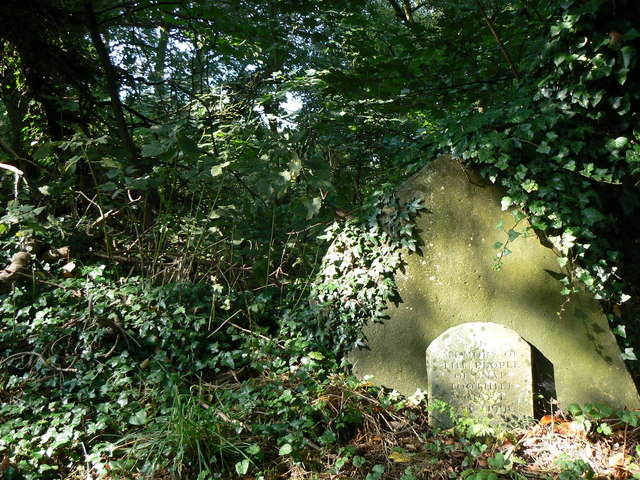
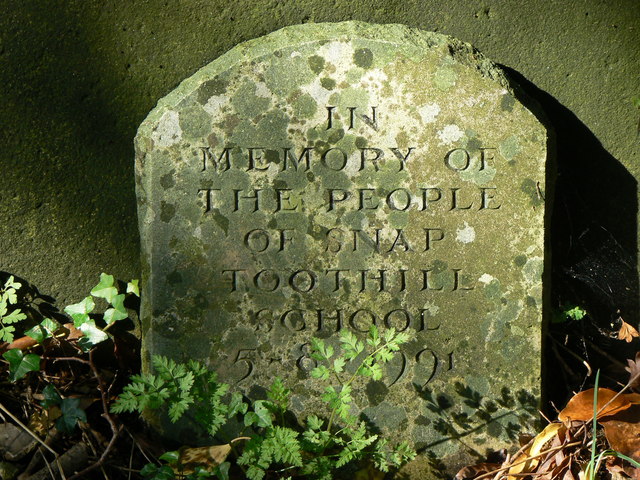
In 1991 the pupils of Toothill School, Swindon placed a stone in memory of the people of Snap. Photograph is published courtesy of Brian Robert Marshall.
Among the fitters and turners, the boilermakers and the carriage makers buried in Radnor Street Cemetery lie the farmers. Richard Strange, tenant at Mannington Farm, is buried with members of his family in a triple grave plot numbered E8463/4/5 and Martha Hale from Creeches Farm in Hook, Lydiard Tregoze is in grave plot E7999 and most recently I have discovered the Croom family, originally from Somerset, who farmed at Walcot Farm.
The 1891 census records three properties in the Walcot Tything. Henry Thorne and his family occupied the ‘farmhouse’; Ernest E. Cox was at Walcot Farm (3) and Robert Croom at Walcot Farm (2). Lower Walcot Farmhouse remains to this day, renamed Bailey’s farm after its long association with the family of butchers who signed a lease with Fitzroy Pleydell Goddard in 1916. It seems likely that this was where Robert Croom and his family lived in the 1890s.
Robert Croom and his wife Martha Ann nee Crees shared ancestral links to Witham Friary near Frome, Somerset. Both came from large, farming families. Robert was the son of James Croom and Elizabeth Ann nee Crees and grew up at Quarry Hill Farm in Witham Friary while Martha Ann Crees was the daughter of Benjamin Crees and Charlotte nee White and grew up at Brook House Farm, Westbury, Wilts. As you can see the Crees and Croom families intermarried.
Robert and Martha Ann married in 1866 and in 1871 were living at Grange Farm, West Lydford in Somerset where they farmed 200 acres and employed 9 men and 3 boys. Within a couple of years they had moved to Draycot Foliat, Wiltshire and by 1891 they were at Walcot Farm, most probably Lower Walcot. Following Robert’s death on October 14, 1892 Martha carried on in business with the support of sons James, Edward, Henry and youngest son Archibald Ernest Crees Croom.
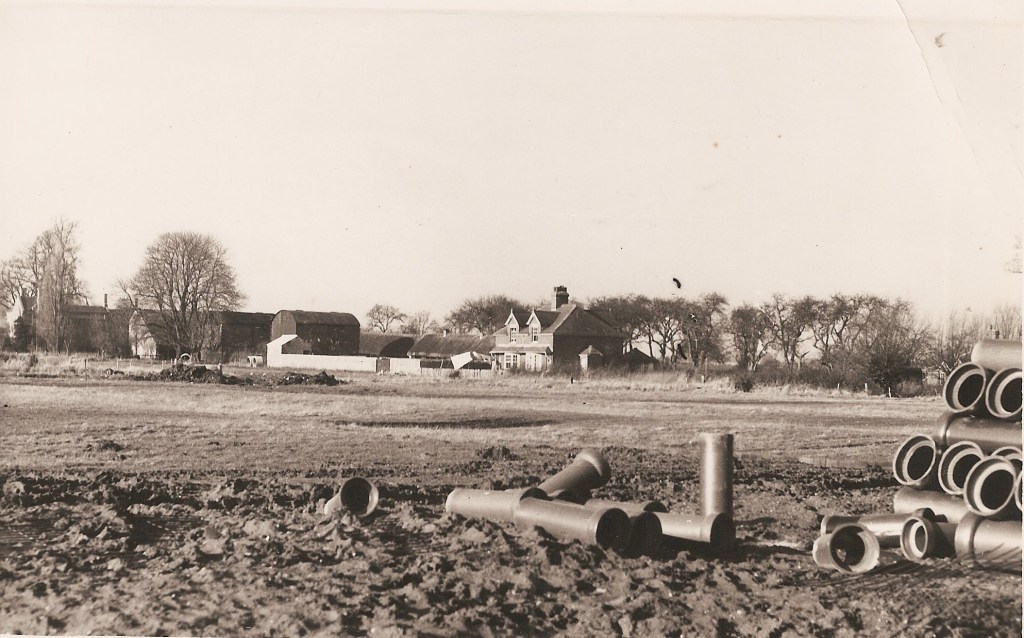
Walcotunder construction, but which of the farms is pictured in the distance?
It is difficult today to picture the numerous farms that comprised our town but several were still in existence until the 1952 Town Development Act was adopted. Swindon Corporation acquired 1,000 acres of land for building to the east of the town, swallowing up long held Goddard family property, including Lower and Upper Walcot Farms. The housing estates at Walcot cover former farmland that included ancient fields once named Glazemore Ground and Chantery Green.
Martha Ann Croom died in 1899 at Walcot Farm and was buried in grave plot D43 where she was later joined by her 5 year old granddaughter Ethel Lilian Croom who died in 1911. Lilian Croom, Martha Ann’s daughter-in-law, died in 1927 and was also buried in D43. Then in 1949 Martha Ann’s youngest son Archibald Ernest Crees Croom (husband of Lilian and father of Ethel) died at Liddington Wick Farm, Coate and he too was buried in plot D43.
By 1911 the population of Swindon was more than 50,000 with the Great Western Railway the largest employer by a country mile. You might think that the Radnor Street Cemetery residents would probably have a history of employment in the Works, and of course you would be correct. But just occasionally I discover a family with a history seeped in Swindon’s agricultural past.
Chiseldon Church by Kate Tryon
Rachel Hancock was baptised at the parish church Chiseldon on April 24, 1836, the daughter of William Hancock, an agricultural labourer, and his wife Mary.
By 1851 Rachel aged 15 was working as a house maid for Thomas Choules 60, a farmer at Badbury. Choules farmed 326 acres and employed 13 labourers. Living with him was his wife Mary 68 and his nephew Robert 24, a farm bailiff.
An entry in the Chiseldon parish registers record the baptism of Alfred Thomas the son of Rachel Hancock Single woman on April 25, 1851. (Could this be our Rachel?) At the time of the 1861 census Thomas is living with William and Mary Hancock in Badbury (Rachel’s parents). In the 1871 census I discovered Robert Choules living with his family in Swindon where he worked as a Railway Watchman. Boarding with him was Thomas Hancock 19, (is this our Alfred Thomas?)
Rachel married close neighbour Henry Brunsden on October 14, 1858. The couple married at St. James’s Church, Paddington, perhaps because they didn’t want a big, local wedding, perhaps because their first child (John) Henry Brunsden had been born the previous year.
I can’t discover the whereabouts of Rachel on the 1861 census (possibly a mis-transcription) but by 1871 the family are at Snodshill Farm where Henry employs 5 men and a boy, along with two live in servants – Mary Cox 17, a general domestic and Elizabeth Cook 15, a nursemaid. Henry and Rachel have seven children and Henry’s brother John also lives with them.
And Rachel’s life continues to be mis-recorded, right up to the very end.
Inquest at Coate
On Wednesday morning, with painful suddenness, the death occurred of Mrs Rachel Brunsden, widow of Mr Henry Brunsden* of Lane Farm Coate.
Deceased had not been ill for quite three years although she was 75 years of age, and therefore it was found necessary for an enquiry into the circumstances to be held.
Mr Brunsden and his wife have been well known and respected in the neighborhood for many years, and there are a number of grown up sons. Prior to their retirement for their active agricultural pursuits they tenanted the land adjoining the homestead in which they have resided for so many years.
An inquest was held the same evening by Mr A.L. Forrester at the farmhouse.
Ernest Brunsden (son) said his mother went to bed the previous night apparently in her usual health. She rose at 7 o’clock that morning and went downstairs, where she prepared breakfast.
She then took it upstairs on a tray for her husband, who was in bed. Afterwards, when she brought the tray down subsequent to partaking of her own breakfast, she complained of a pain round her heart, and almost immediately after fell down dead.
Dr Beatty said he was sent for, but could only pronounce life extinct. Death was due to heart failure.
A verdict was returned in accordance with the medical evidence.
North Wilts Herald April 12, 1912.
*Henry Brunsden was still alive at the time of Rachel’s death.
Lower Snodshill Farm where Rachel lived for most of her married life
Rachel was buried on April 13, 1912 (when the burial registers record her home address as Love’s Farm) in grave plot C1856. Henry died the following year, aged 88, and was buried with Rachel on October 25, 1913.





 Radnor Street Cemetery