The following article was published in Swindon Heritage Magazine in the Summer 2015 edition. Swindon Heritage was co founded by Graham Carter, Mark Sutton and myself in 2013. During a five year period we produced 20 editions of the magazine plus a Battle of Britain 75th anniversary commemorative issue in 2015.
Sadly, Mark died in 2022, but his work to remember the Swindon men who served in the First World War continues at Radnor Street Cemetery.

A memorial to 19 Swindon men who died during the First World War might also have been lost forever – but for the diligence of Gorse Hill resident Paul Jevder.
Paul, who lives in St Paul’s Road, put out an appeal for the impressive marble memorial to be given an appropriate new home after he found it under a pile of rubbish on his property.
He had been clearing the ground in preparation for some building work when he made the discovery.
Swindon Heritage co-founder Mark Sutton was the first caller to answer Paul’s appeal, and dozens of other people also phoned, some looking for more information, but many recommending that Paul get in contact with Mark.
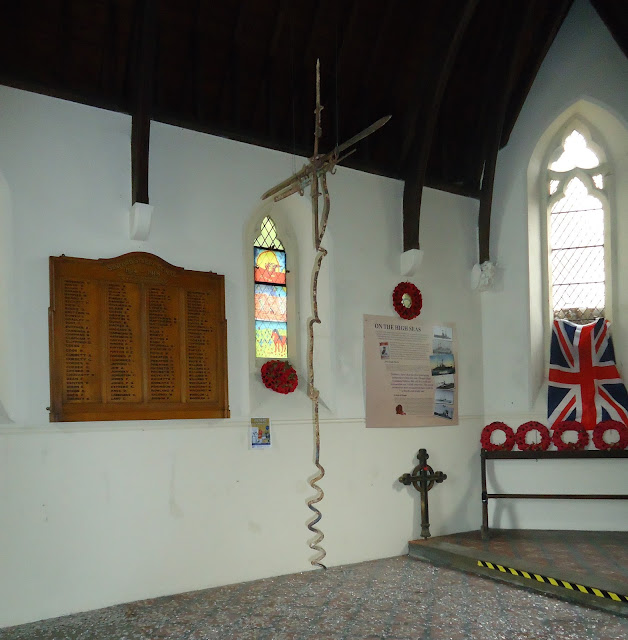
Within hours the memorial had been loaded into a van and moved to the chapel at Radnor Street Cemetery, which is already the home of several other memorials to the town’s war dead, including another from Gorse Hill. That one commemorates members of the working men’s club, although none of the names are duplicated.
It seems Gorse Hill folk were particularly keen to remember the area’s heroes because St Barnabas Church also has its own war memorial, made of wood, inside the church.
The newly found memorial is dedicated to the memory of former members of a ‘sabbath school’ who died in the war – and this was almost certainly attached to the former Wesleyan Chapel in Cricklade Road, because that building backs on to Paul’s property.
The chapel, along with associated land, has been earmarked for development into flats, and it is thought the memorial, which is slightly chipped but otherwise in good condition, may have become displaced during work to prepare for that.
Thanks to his extensive research into Swindon’s military history, all the names listed on the memorial are familiar to Mark Sutton, who also owns medals and photographs associated with many of them including the ‘dead man’s penny’ (officially called a memorial plaque) that was issued to the family of Walter Thatcher after his death.
Walter, who lived at 4 King Edward Terrace in Gorse Hill, joined the Wiltshire Yeomanry in 1915, aged just 18, and ended up on the Western Front.
As with most of the Yeomanry, he was absorbed into the 6th Wiltshire Regiment, and was sadly killed on the Bapaume-Cambrai Road on March 23, 1918, during the big German offensives of that year.
He has no known grave, but is remembered on the Arras Memorial.
Two of Walter’s brothers also served.
Mark’s researches over the years also traced a photograph of another of those on the Gorse Hill memorial, Augustus Strange, who lived at 199 Cricklade Road, a stone’s throw from where the memorial was found.
Serving with the Royal Engineers, Augustus died two weeks before the end of the war, on October 29, 1918.
“It was nice to be able to tell Paul about some of the men listed,” said Mark, “including one, Sidney Curtis, who lived in the house opposite Paul’s.
“We’re really grateful to him for making sure it has been recovered and seeing it went to a proper home.
“It will now be safe at in Radnor Street, and anybody will be able to come and see it from time to time as the cemetery chapel is sometimes open for events, and during this summer is the meeting place for guided walks we are running on the second Sunday of every month.”
And Paul, who lived in Cyprus as a child and whose family are Turkish Cypriots, will have understood the relevance of a war memorial, having witnessed, at first hand, the bitter division of the island in 1974.
Swindon Heritage Summer 2015.
#TellThemofUs










 Radnor Street Cemetery