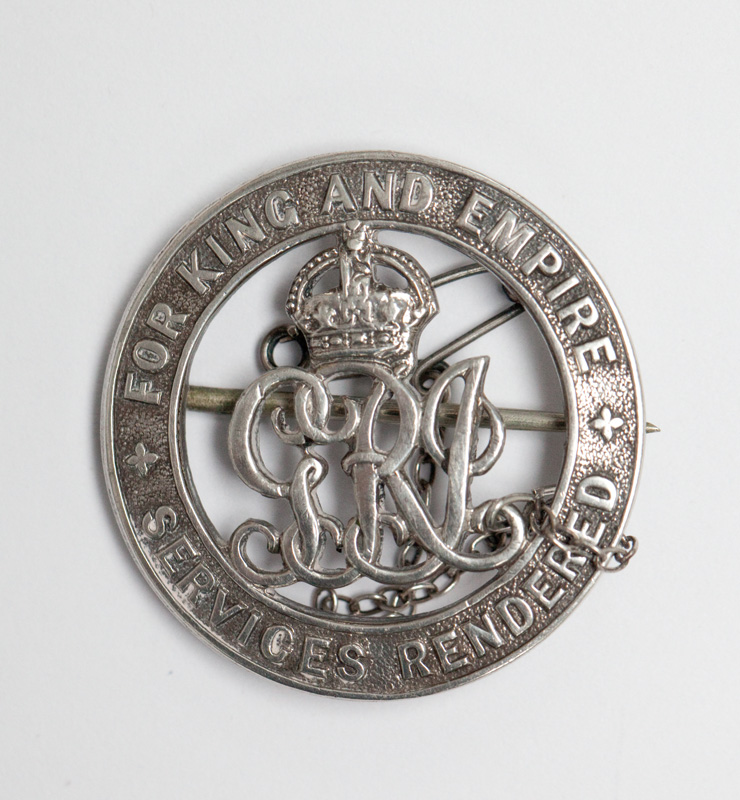
George Augustus Crocker – with Mother’s fond love

The re-imagined story …

‘Some say it was a futile war, a pointless war, an unjustifiable war. Tell that to Kate Crocker, that’s what I say.

When the old Queen married off her children into European Royal households she did it to create one big family. Well, we all know what families are like – there are favourite children and jealous cousins and an interferring aunt and uncle – but it’s something quite different when family members fall out on the world wide stage. Some people don’t know when they’re well off.

The First World War began when Gavrilo Princip assassinated Archduke Franz Ferdinand of Austria, but of course there was more to it then that. The causes of that Great War were many. Tell that to Kate Crocker.

By the time Kate took possession of her son’s war medals she was alone in this world, her immediate family gone, her husband and both her children dead. Europe was a different place as well. The old Queen’s plans for her family had come to nothing. Just like Kate’s.’
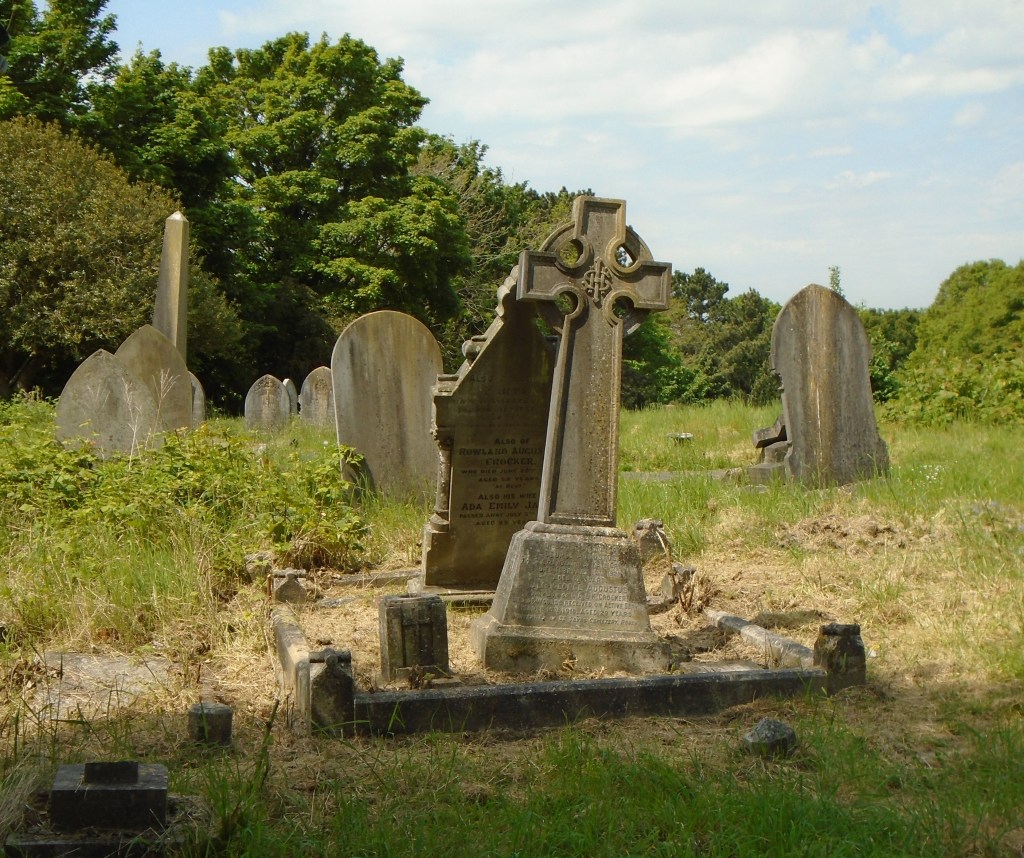
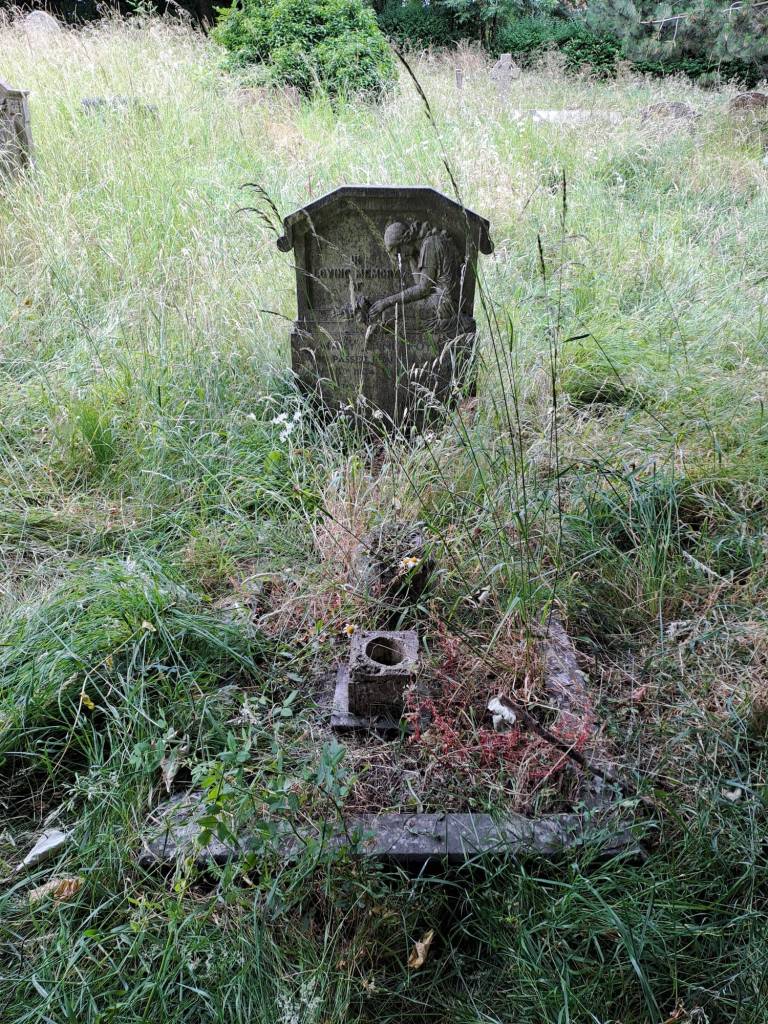
The inscription on the headstone reads:

Also George Augustus

only son of G.A. & K. Crocker

Died of wounds received on Active Service

March 15th 1918 Aged 29 years

Interred in St Seves Cemetery Rouen

The facts …

George Augustus Crocker and his sister Edith were baptised together at St. Mark’s on December 3, 1888. The family home at that time was at 28 Reading Street. In 1901 the family are recorded as living at 63 Exmouth Street.

George followed his father into the Works and a job as a railway clerk in the Operating, Traffic, Coaching Depts. He began his employment as a 16 year old on an annual salary of £25 on May 16, 1904.

George Augustus Crocker enlisted in the Royal Army Medical Corps at Swindon on May 10, 1915. He later transferred to 6th Cyclists Bttn Field Ambulance. He died on March 15, 1918 from wounds received in action (Gas) in No 9 General Hospital Rouen. He was 29 years of age. He had served a total of two years and 310 days – a year and 280 days at Home and 1 year and 30 days in France. He is buried in St. Sever Cemetery extension, France. The inscription on his headstone reads – They died that we might live with Mother’s fond love.

He left effects valued at £125 to his mother. Property returned to Kate included letters, photographs and a diary.

Kate Crocker died on June 8, 1938, She is buried in plot E8506 with her daughter Edith who died in 1908 aged 21 years and her husband George Augustus senior who died in 1921. Their son George Augustus is mentioned on their memorial. Ada Emily Jane Crocker, the widow of Rowland Augustus Crocker, George Augustus senior’s brother, was buried in the same plot in 1967.

In the neighbouring grave plot E8507 lies William Crocker, George Augustus senior’s brother, his wife Martha and the aforementioned brother, Rowland Augustus Crocker.

St Sever Cemetery and St. Sever Cemetery Extension are located within a large communal cemetery situated on the eastern edge of the southern Rouen suburbs of Le Grand Quevilly and Le Petit Quevilly. – see www.cwgc.org.

Season of mists Pt II

And still more, later flowers for the bees,
Until they think warm days will never cease,
For Summer has o’er-brimm’d their clammy cells.

To Autumn by John Keats

Hope you can join me from the warmth of your sitting room where the logs crackle in the hearth and the wind moans down the chimney. You might have expected the cemetery to be inaccessible after the deluge yesterday, but I shall pull on my wellington boots and my raincoat and venture forth.

This is the final resting place of members of the Wall family, husband and wife William and Mary Ann, and their son Arthur Henry.

Arthur was born in 1899, one of William and Mary Ann’s six children of whom sadly only three sons survived childhood.  He grew up in Rodbourne living at addresses in Redcliffe Street, Drew Street, Linslade Street, Montague Street and Jennings Street.  William worked as a Boiler Maker in the railway factory and when young Arthur left school he followed him into the GWR Works and the same trade.

Following the outbreak of war in 1914 Arthur was keen to join up and enlisted in the 2nd Wiltshire Battalion on January 12, 1915.  He gave his age as 19.  He was in fact not yet 16, but recruiting officers were apt to turn a blind eye to a fresh faced, eager young volunteer.  He was posted to France on June 1 where his age was quickly detected and on July 7, 1915 he was sent back to England as being ‘under age and physically unfit for service at the front.’  He spent the following year in service on the home front before returning to France in June 1916, this time in the 1st Hertfordshires.

His service records reveal that on May 12, 1918 he was gassed. His medical records state that his capacity was lessened by 40% and he was left with defective vision and suffering from headaches.  He was discharged on November 23, 1918 as being no longer physically fit for war service.  He received a pension of 11s and returned to Swindon where he married Mabel Pinnegar in 1919.  

Whether Arthur was able to return to work as a boiler maker remains unknown.  In 1920 he wrote to the Infantry Record Office asking if he was entitled to anything under Army Order 325/19 concerning the Territorial extra allowances.  He received this reply:

‘I regret to inform you that you are not entitled to any extra pay or allowances under Army Order 325 of 1919 as you were discharged on 23rd November, 1918. The increase of pay authorised under the Army Order in question was only granted from 1st July, 1919 to soldiers who were actually serving on the date of the order, viz 13th September 1919.

Arthur died on May 22, 1922 aged just 23 years old. Have you noticed the date of death of Arthur and his father William? You can read more about the sad event here.

But for now I think I shall quicken my step and head off home as the rain clouds are gathering again. See you tomorrow to continue our virtual tour of Radnor Street Cemetery.

The Foyle and Finney families

The Radnor Street cemetery volunteers are a versatile group. Not only do they care for the CWGC graves and identify others with a military connection, but they mow and hoe, weed and clean and also locate lost graves. Bex recently helped Liz, a visitor to Swindon, to find her great grandparents grave and in doing so revealed yet another fascinating Swindon family history.

Liz helpfully had the cemetery paperwork concerning two family graves – plots D937 and D938. These proved to be the graves of two brothers, William John and James Henry Foyle with their respective wives, Margaret Ann and Mary Jane. The brothers were two of four sons born to Isaac and Rebecca Foyle. All four sons were born and raised in Swindon and all four followed their father Isaac, a labourer in the GWR iron works, into the railway factory; William as a boiler smith, James a brass finisher, George a railway clerk and Alfred an electrical fitter. William would eventually move to Wolverhampton, but following his death he was buried next to his brother James.

James’s grave with its elegant headstone was easy to locate. See below two before and after photographs taken by Bex.

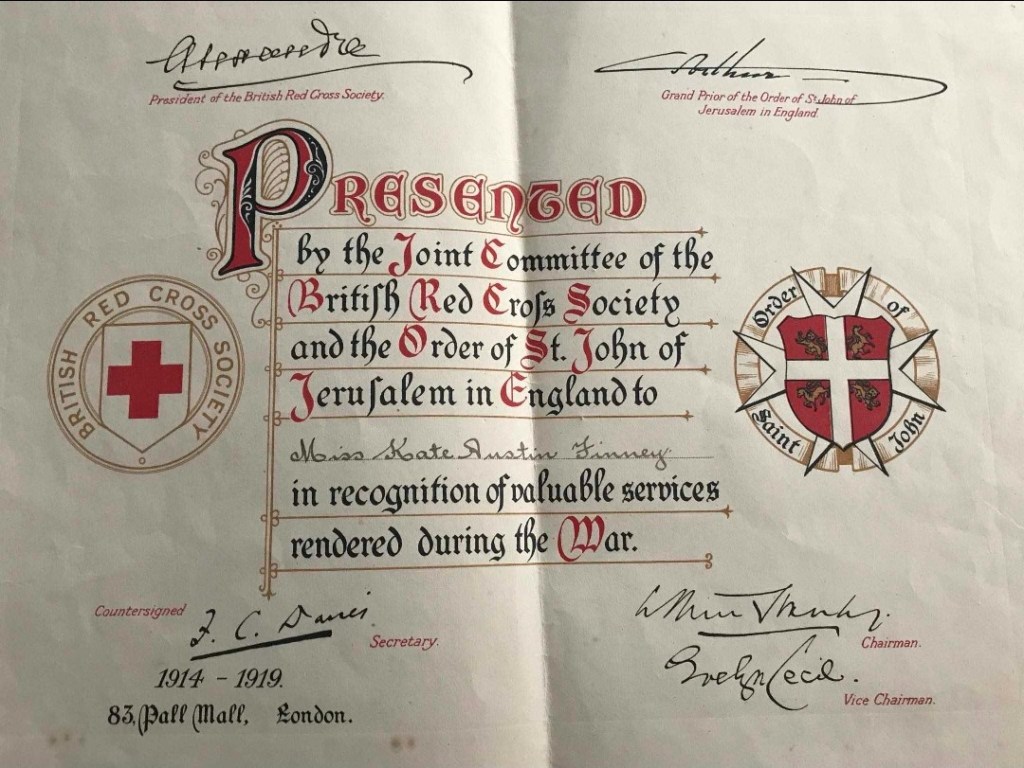
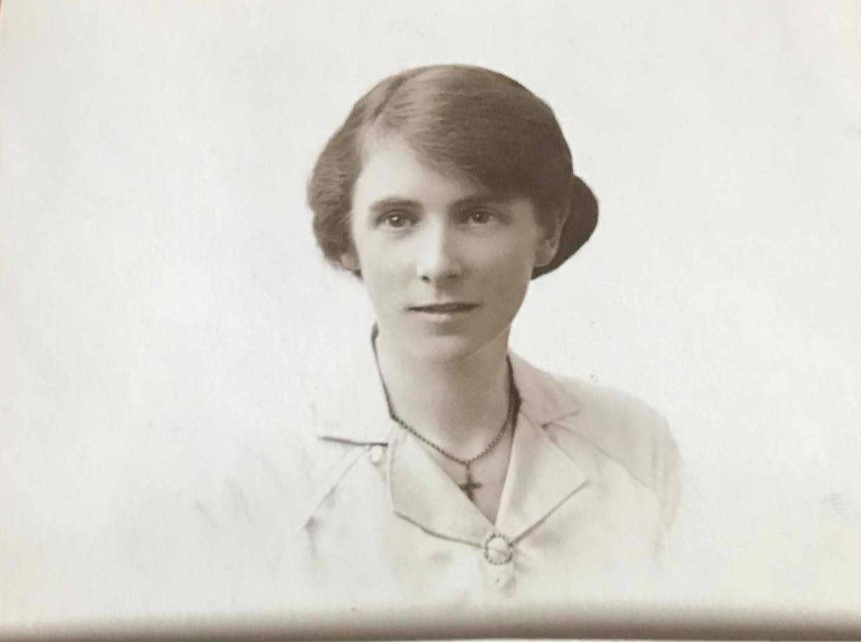
Liz was also keen to find other family graves, including those of Esther and Kate Finney. Research revealed that the two sisters were the daughters of William and Emma Finney.

Esther and Kate both served as Red Cross nurses during WWI. Esther was a volunteer at the Red Cross Hospital In Taunton in 1917 while Kate stayed closer to home and served as a Ward Helper at the Red Cross Hospital in Stratton in 1918.

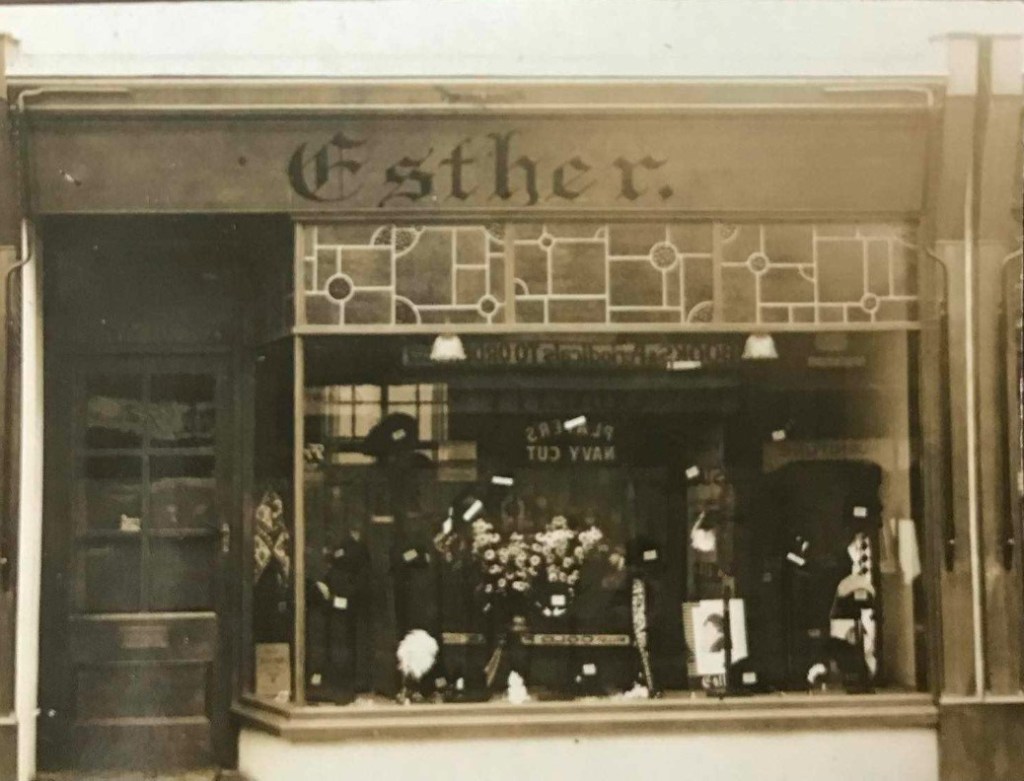
In 1939 Esther, Kate and their brother William lived with their widowed mother at 11 Clifton Street. Esther is described as a Shopkeeper (Gown and Millinery) and Liz was able to provide a photograph of the shopfront.

Esther died in 1959 and Kate in 1970 and they are buried together in grave plot E8298 with their brother William who died in 1957.

The connection between the Foyle and Finney family is that Esther and Kate’s brother John Marshall Finney, married James and Mary Jane Foyle’s daughter Elsie Gladys Foyle.

Hopefully Liz will keep in touch with Bex and even more family stories will emerge.

The nurses call me Edie

more bluebells

The re-imagined story …

They’ll be along in a little while. I see them most days, the young man and the little girl. Sometimes they walk past me but sometimes they sit next to me on the bench. I like those days. The young man exchanges a few pleasantries, comments on the weather, that kind of thing. The little girl only talks to him. My, she’s a chatterbox. She tells him about her friends and about school and who got told off that day. She has a nasty cough, mind; some days I think she doesn’t wear enough clothes. She never wears a coat in the winter, but then the young man takes off his greatcoat and puts it around her shoulders while they sit on the bench.

bluebells

But today it is summer and the sun shines on the cemetery and warms the cold earth. Yesterday she collected some flowers from one of the graves. He gently explained that she couldn’t take them and that someone had placed them there as a token of their love for the person who had died. She said she wanted to take some flowers to her mother so they picked some harebells that grew by the cemetery gate.

harebells

Here they come now. She is skipping alongside him, holding his hand. He is smiling. There is something very familiar about that smile. He reminds me of someone, but I can’t remember who. My thoughts are so muddled these days. The nurses call me Edie but I don’t think that’s my name. Tom never called me Edie. After the children came along he called me ‘ma’ like they did. I’m sure my name isn’t Edie though.

more bluebells

They’re not stopping at the bench today. That’s a shame. I like listening to their conversation. Never mind, there’s always tomorrow.

bluebells

Evening is drawing in. Doris will be along soon. She is never far away. She knows where to find me. It’s funny, I never forget her name. Here she comes now.

“Did you see them Ma?”

“Yes. They were along earlier.”

“Did Charlie speak to you?”

“No, not today. But he did smile. Do you know him then?”

“Of course I do Ma. It’s our Charlie and little Vera.”

“He doesn’t recognise me. Why doesn’t he recognise me Doris?”

“It was a long time ago Ma. You’ve changed a lot, got older. He doesn’t recognise me either.”

“I’ll remind him who I am tomorrow. They’ll be along again tomorrow.”

“Come on Ma, it’s beginning to get dark. We should make a move. Take my arm.”

I lean heavily on her, but she never complains. She’s a good girl. She’ll make some lucky man a lovely wife. I wonder why she hasn’t got married by now. I wish I could remember these things.

The nurses call me Edie, but I’m sure that’s not my name.

The facts …

Edith Emily was born in 1876 in Gorse Hill, the daughter of John Painter, a sawyer at the GWR Works, and his wife Hannah. She married Thomas Gray, a steam engine fitter in the Works, in 1895 and at the time of the 1901 census the couple were living at 263 Cricklade Road, Gorse Hill with their two children Florence aged 4 and one year old Charles. They would go on to have a total of 11 children, the last born in 1919, a daughter Gwendoline, who died before her first birthday. Two other daughters died in the 1920s. 

On the 1939 List Thomas and Edith are living at 13 Carlton Street with their daughter Irene, who works as a domestic servant and son Ronald, a van driver for a Wine and Spirit Merchant.

Thomas died in November 1941 at Carlton Street and was buried on December 3 with his two daughters in plot C1024. He was 67 years old.

Edith Emily Gray died on Christmas Day 1959 at Roundways, a psychiatric hospital in Devizes. The hospital had opened in 1851 when it was called the Wiltshire County Lunatic Asylum, changing its name to the Wiltshire County Mental Hospital in 1922 and eventually Roundways. Edith was 83 years old. She was buried on December 31, in plot C1024, with her husband and two daughters. This is a public or pauper’s grave and the Gray family members are buried with two others.

Thomas and Edith’s eldest son was Charles Herbert, born in 1899. He served with the 6th Wilts regiment from the outbreak of the First World War and was discharged  from the army on March 15, 1919. Sadly his records are among those destroyed during bombing in the Second World War, but we do know what action the 6th Wilts served in and that Charles was most probably with them.

The 6th Wilts embarked for the Western Front in July 1915 as part of the 19th Division and were involved in action at Loos in September of that year. After the attack they returned to Neuve Chapelle for the remainder of 1915.

In 1916 they were engaged in training at Albert in preparation for the Somme offensive, during which they suffered 380 casualties in two months.

In 1917 the 6th Battalion saw action on the Ypres salient, Messines Ridge and Passendaele Ridge. They became the 6th (Royal Wiltshire) Yeomanry Battalion following more heavy losses.

Throughout the last year of the war the 6th (Service) Battalion were heavily engaged. They sustained heavy losses and despite reinforcements were eventually disbanded, most of the men being sent to the 2nd Battalion. They were eventually disbanded in Devizes in 1919.

During the September quarter of 1920 Charles married Ada J. Edginton and the coupled lived at 14 Haydon Street. Charles died from Pulmonary Tuberculosis on April 4, 1921 at Salisbury Hospital.* He was 22 years old. He was buried on April 9 in grave plot B2321.

The birth of Charles and Ada’s daughter, Vera Dorothy Joan was registered during the June quarter of 1921, so probably around the time of Charles’s death.

Vera died in January 1926 at the Isolation Hospital. She was four years old. She is buried in Radnor Street Cemetery in plot C569, a public grave which she shares with eight others.

*Paul Cook kindly obtained the death certificate for Charles Herbert Gray.

Gray CH

History of the 6th Wilts taken from The Wardrobe – Home of the Infantry Regiments of Berkshire & Wiltshire.

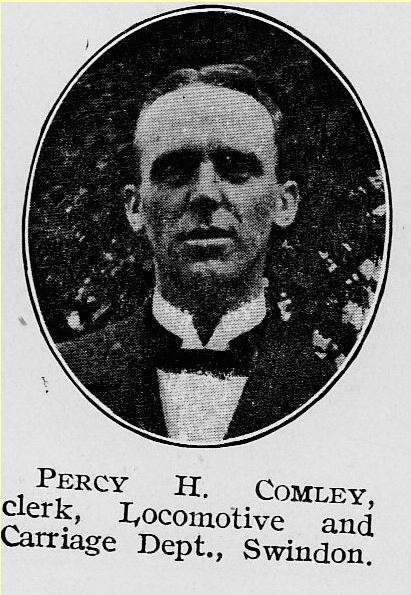
War Graves Week – Sapper Percy Harold Comley

Mary Elizabeth Hutchings and Percy Harold Comley are pictured (middle row right) at a family wedding in 1914.

Saturday May 11 sees the launch of the annual CWGC War Graves Week 2024. Radnor Street Cemetery friend and colleague Mark Sutton spent a lifetime devoted to remembering those who served in WWI.

Our thoughts today go out to those parents who lost a son, and in many tragic cases, more than one. But, Albert and Mary Ann Comley were not to know their youngest son had been killed in action.

Percy Harold Comley was born on August 12, 1889 and began work as a 14 year old clerk in the GWR Works. He enlisted on November 24, 1915 and was put in the Army Reserve. He was mobilized on January 5, 1917, a Sapper in the Royal Engineers serving with the 2nd Light Railway Operating Coy.

He had married Mary Elizabeth Hutchings on October 26, 1916 at Christ Church. Less than a year later he was dead.

The charred remains of a telegram survive with his military records. It reads:

“Regret to inform you Officer Commanding 2 Canadian Casualty Clearing Station France reports 1st October 218815 PH Comley RE 1st October shell wound abdomen.”

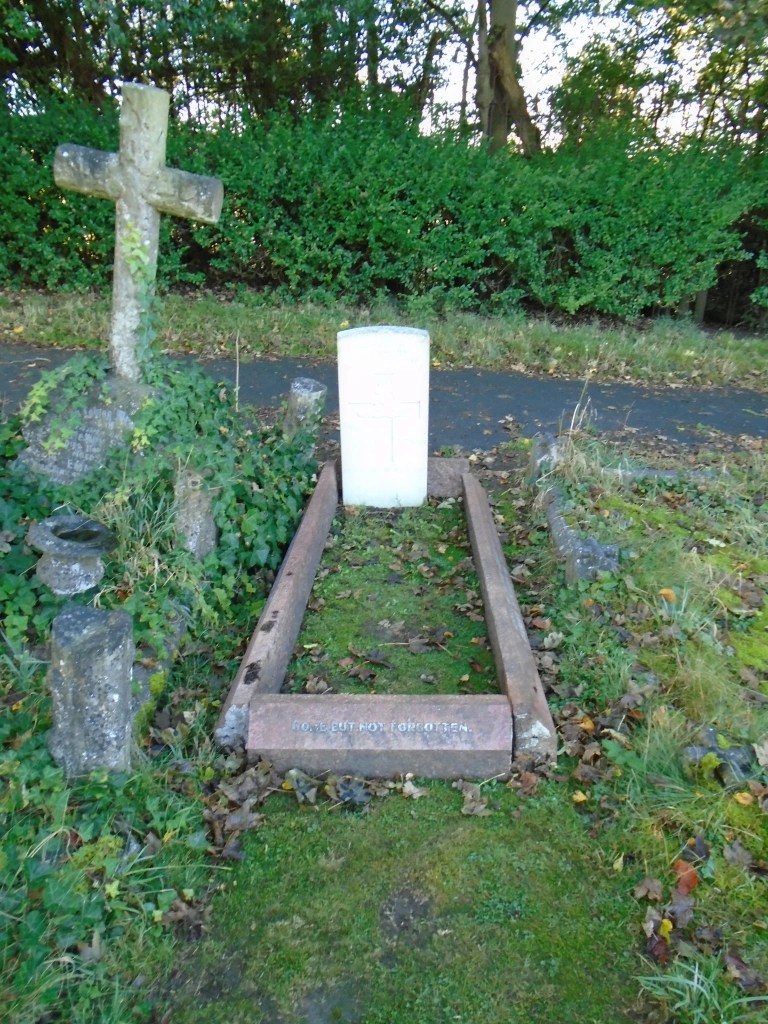
Percy Harold Comley is buried in Lijssenthoek Military Cemetery Poperinge, Belgium. Mary Elizabeth never remarried. She died on February 4, 1947 at Weston-super-Mare.

Today our volunteers continue Mark’s work, caring for the Commonwealth War Graves headstones and recognising those remembered on private, family graves. To date they have noted 50 such fallen heroes. For more information about the War Graves Week visit the Commonwealth War Graves Commission website.

Mary Ann Comley died at her home 8 Ashford Road and was buried on May 21, 1915 in grave plot E8044. Her husband, Albert Comley, a watchman, died at Guys Hospital, London and was buried with her on August 15, 1916.

Rodbourne Remembers

In 2018 the Rodbourne Community History Group hosted Rodbourne Remembers, a joint project with St. Augustine’s Church, to honour the Rodbourne men who died in the First World War.

Of those who returned to Rodbourne after the war many suffered from poor health and died as a result of their military service. These are the stories of some of those men now buried in Radnor Street Cemetery, their graves attended to by our CWGC volunteers, the Eyes On Hands On team.

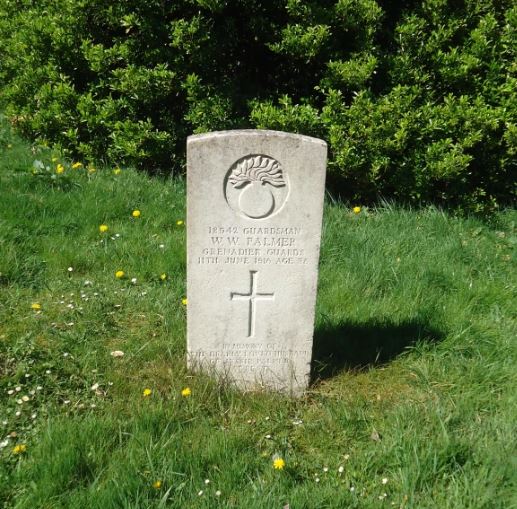
Walter William Palmer – Tell Them of Us

Charles Normandale and Walter George David Hughes

William Jasper Hall – DSM

William Jasper Hall pictured in uniform

William James Pitt – no longer physically fit to serve

The Rodbourne Community History Group meets at Even Swindon Community Centre, Jennings Street on the last Wednesday of the month. Find out more here

William and Maud Brotheridge

Could this be a wedding photograph of William and Maud? She looks very young; only 20 years old at the time of their marriage in 1893. William was 8 years older and had already seen service in the Warwickshire Regiment.

We find them next on the 1901 census living at Wroughton Road. William is working as a ‘Collector and Salesman for Singer Sewing Machines.’ The family had moved around with the elder children’s birthplaces recorded as Cheltenham and Fairford.

By 1911 they were living in Ashton Keynes with further children born in Swindon, Faringdon, Stanford in the Vale and Ashton Keynes. By then Maud had had 10 children, 9 of whom were still living. At least 3 more sons were born between 1911 and 1915 but only one survived to adulthood.

Another baby, Thomas Reginald Brotheridge, was born in 1915 and died aged just 7 months old when the family were living at 90 Montagu Street. By then war was raging. William and Maud’s eldest son, also named William, had joined his father’s old regiment, the Warwickshires. On May 27, 1918 he was on board the Leasowe Castle, an armed troop transport ship, when it was torpedoed and sank off the coast of Alexandria. A total of 83 officers and men were drowned that day, including 21 year old William. He is remembered on the Chatby Memorial in Egypt. He left a small sum of money, including a War Gratuity of £17, to his mother, as previously agreed with his father.

William and Maud were just one of many Rodbourne couples who lost a loved one during that awful conflict.

Montagu Street, Rodbourne

Maud died in February 1924 at 90 Montagu Street. She was 51 years old – no age to die, we would say now. She had given birth to at least 13 children and along with the babies she lost she also lost a son to war.

She was buried in Section Lower C grave plot C3953 where in 1934 her daughter Elizabeth Maud Mary joined her. Elizabeth was 38 years old and unmarried.

William Brotheridge died at 86 Montagu Street in November 1941. He was laid to rest with his wife and daughter.

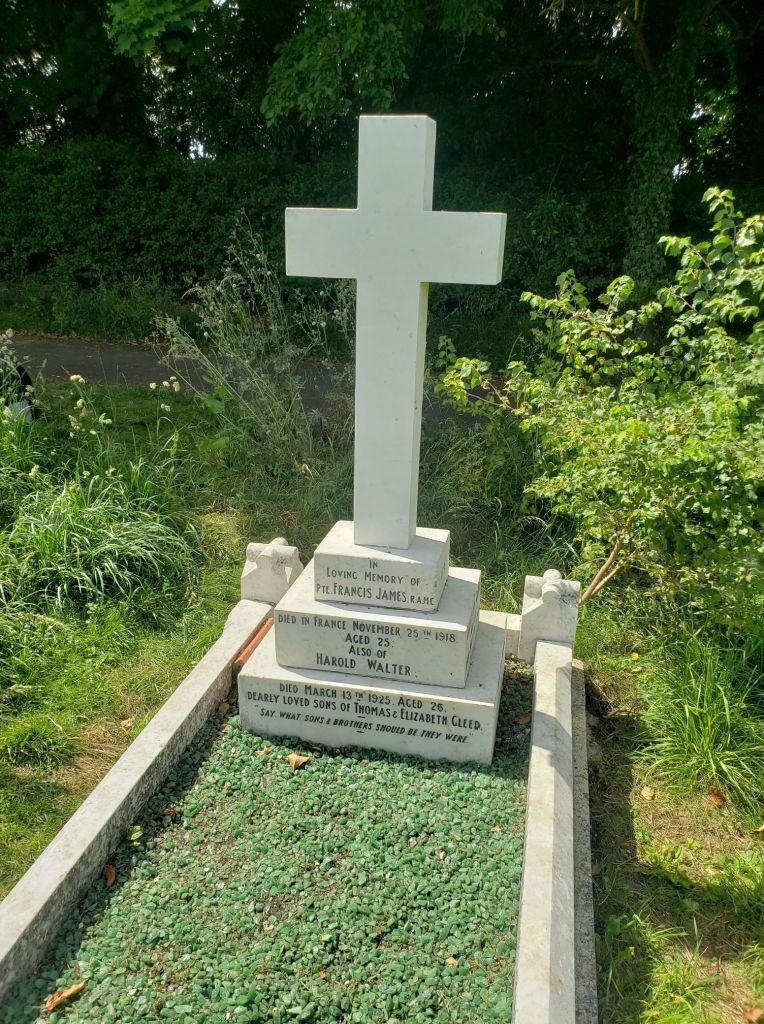
Private Francis James Gleed – Royal Army Medical Corps

456089 Private Francis James Gleed of the Royal Army Medical Corps died on October 28, 1918. He was not killed in action, neither did he die from wounds or disease, but he did die as a direct result of his military service.

Francis James Gleed was born in 1893 the third of four sons of blacksmith striker Thomas Gleed and his wife Elizabeth. Unlike his two elder brothers, Francis did not follow his father into the railway works but instead took up a tailor’s apprenticeship.

Francis enlisted in Swindon on May 11, 1915 in the Royal Army Medical Corps and was posted with the Mediterranean Expeditionary Force on November 30, 1915. His military service would last for 3 years 199 days, most of it spent in Egypt. Francis continued to serve in the 231st F.A. before being transferred to France in May 1918. Three months later he was granted 14 days leave to the UK, the last time he would see his family in Swindon.

His medical notes detail the nature of his injury which occurred in March 1916 when he was loading an ambulance train in Minia Station, Egypt. He was working with a bearer party when he strained himself, causing a hernia. An operation was successfully performed, but Francis complained of a recurrence in October 1918.  After wearing a truss with unsuccessful results he was admitted to the 32 Casualty Clearing Station and then transferred to the 54 Casualty Station before being moved to the 7 Stationary Hospital where he died on October 28, 1918. His cause of death was an inguinal hernia caused by a weakening of the muscles in the lower abdomen.

Francis James Gleed was buried in Terlincthun British Cemetery, Wimille on the northern outskirts of Boulogne. The inscription on his headstone as submitted by his mother Elizabeth reads – Life’s Work Well Done Life’s Race Well Run Life’s Crown Well Won Now Comes Rest

In 1921 Thomas Gleed took receipt of his son’s 1914-1915 Star Medal followed a year later by his British War and Victory Medals.

On April 22, 1919 Francis’s personal effects were returned to his family. They were listed as follows:

Letters

2 religious books

Valet safety razor in case

Metal cig. Case

Pipe

2 titles

Purse

2 wallets

Photos

Note book

P. cards

Safety razor & blades in tin box

Defaced coin 5 cts coin ½

However, there was something of far more significance that Elizabeth wanted returned. She acknowledged receipt of the above mentioned items and wrote:

There is my sons 2 pairs of scissors one large and one small and a pen knife white handle – should be pleased if you could find it and send it on. Yours truly E. Gleed.

The scissors were possibly tools of his tailoring trade tangible reminders of the son she had lost and the career he had pursued at home in Swindon.

Francis James Gleed is remembered on the Gleed family headstone in Radnor Street Cemetery.

“Say what sons & brothers should be. They were.”

Charles and Annie Guley and their two soldier sons

Edward George Guley was born on January 25, 1895 and baptised at St. Paul’s Church, Swindon on July 7. He was the second son of railway carriage fitter Charles Guley and his wife Annie. In 1911, the last census taken before the outbreak of war in 1914, the family lived at 8 Beatrice Street, Gorse Hill. All three men in the family worked in the railway factory. Charles as a Railway Carriage Fitter, his eldest son Harold Charles Guley was 19 and employed as an Engine Fitter apprentice and part time student and Edward George Guley was 16 and a machine boy and part time student.

Both Charles and Annie’s boys enlisted – possibly together, and both served in Basra. Harold was nearly 24 years old, Edward was 20. Harold’s service records have survived but unfortunately Edward’s haven’t. Harold served in the Royal Army Service Corps and Edward in the 5th (Service) Battalion. Harold returned home to Swindon at the end of the war; Edward didn’t.

The First World War campaign in Mesopotamia (modern day Iraq) cost 85,000 British casualties, one of whom was Edward George Gulley, killed in action on March 29, 1917.

The 5th (Service) battalion were in action on the 25th January 1917 when they assaulted the Turkish front line, one flank of which rested on the Hai River which they had crossed only a month before. They took heavy casualties in this action. On the 25th of February they crossed the River Tigris and by the end of the month after hard marching they were 40 miles short of Baghdad. On the 10th March they made a night river crossing over the Diala River establishing a bridgehead and taking 120 prisoners in the process. The way to Baghdad was open and the battalion was the first to enter the city. At the end of March the battalion advanced on Turkish positions 35 miles north of Baghdad near Daltawa. They sustained heavy casualties in this attack. In April and May they continued the advance up the line of the River Adhaim with contact being made with the Russians operating from the Caspian Sea. They then took up defensive positions between the rivers Tigris and Adhaim, East of Samara. In early December they advanced towards Kara Tepe, with the battalion pursuing the Turks through Sakaltutan Pass. They paused at this point and ended the year reorganizing and training.

The Rifles Berkshire and Wiltshire Museum

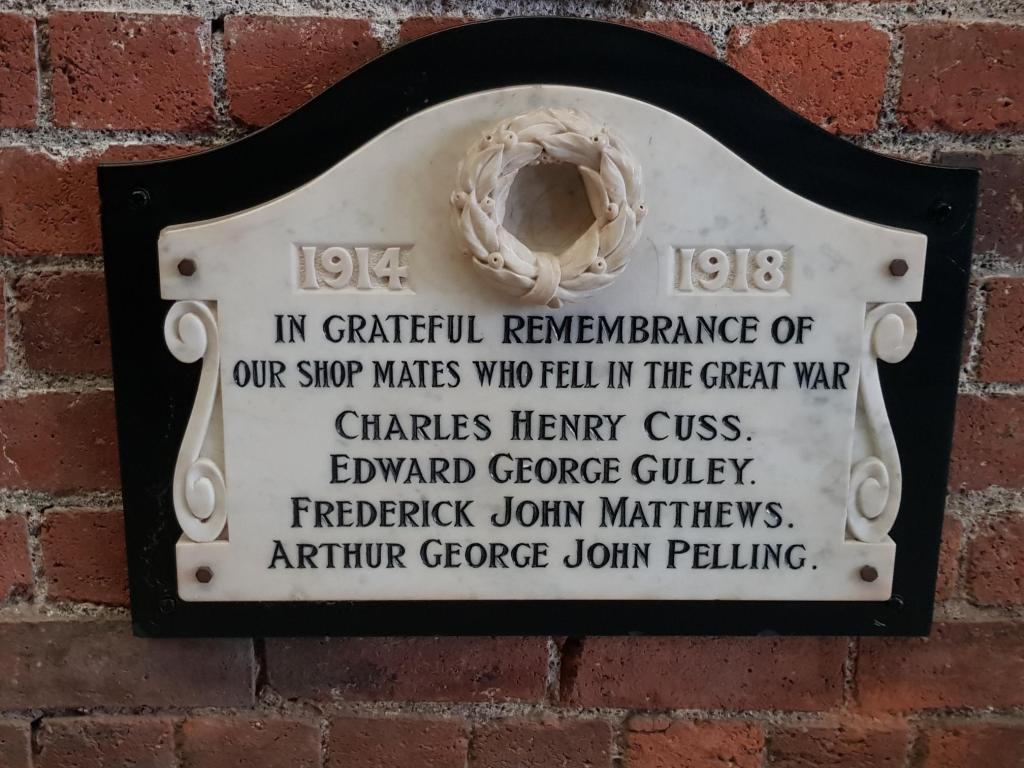
Edward has no known grave and is remembered on the Basra Memorial. He is also remembered on a plaque raised by his colleagues in the GWR Works, which now hangs in the STEAM – Museum of the Great Western Railway

Annie survived the war and the loss of her son, but what was survival like for her? Did parents ever recover from the loss of their boys? I doubt it. Her husband Charles was buried in Radnor Street Cemetery on January 5, 1928 in plot D245 where Annie joined him on June 20, 1933.

The Order of the White Feather

The Order of the White Feather was founded at the outbreak of war in August 1914 by Admiral Charles Penrose Fitzgerald. The campaign encouraged women to present white feathers, a potent symbol of cowardice, to men not wearing uniform. The campaign was incredibly successful, even as the details of the death toll and casualties became widely known.

The practice seems to have carried on for the greater part of the war and in September 1916 the Silver War Badge was issued for men to wear who had been honourably discharged due to wounds or sickness.

Why did women subscribe to this propaganda?  The writer Compton Mackenzie, who served with British Intelligence in the Eastern Mediterranean, said ‘idiotic young women were using white feathers to get rid of boyfriends of whom they were tired.’

For some it was no doubt misplaced patriotism.  For those who had lost husbands and loved ones it might have been a reaction to their grief.

One such young woman who handed out white feathers on the streets of Swindon did so because her four brothers were all serving soldiers.

Alice Elizabeth Godwin grew up at 21 Redcliffe Street, the daughter of Charles Thomas Godwin, a furnaceman in the Works, and his wife Clara Annie.  You can imagine the daily dread the family experienced with four sons in service and how a young, impressionable girl might have been coerced into joining the white feather campaign.

But it would be the experiences of one of her brothers which ultimately changed her mind.

She was at the station in Swindon seeing him off back to the front at the end of his leave, when he broke down, weeping and shaking uncontrollably.  It was seeing him so terrified that made her cease her practise of handing out white feathers. Thankfully, all four brothers returned home.

Propaganda poster

Charles Thomas Godwin died on November 8, 1914 and was buried in grave plot B3265. His wife Clara Annie died in 1939 and was buried with him. Their son Albert Howell, who had served in WWI, died in 1940 and joined his parents. In 1985 Albert’s wife Clara Agnes was buried with her husband and his parents. In 1993 the ashes of their son Arnold William Godwin were interred in the family grave.