Cheers!

Come and join me for a swift half at these local pubs while I tell you the story of the people who once lived there.

The Mechanics’ Arms

Read all about Frederick George Leighfield – landlord at the Mechanics’ Arms

c1910 Ship Inn, Westcott Place.

Read all about Esther Swinford – victim of a shooting tragedy

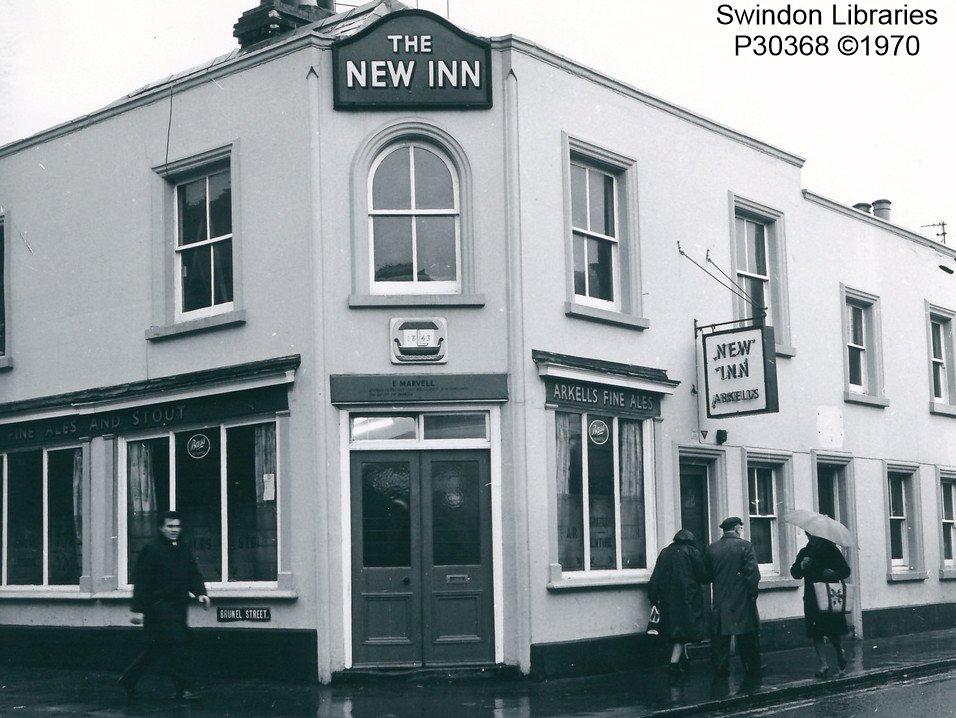
c1970 The New Inn, Cromwell Street.

Read all about Comrades of the Great War

1911 The Eagle Hotel, Regent Street.

Read all about Pte William Henry Thomas – art student

Jesse John Preater – brothers in arms

Three brothers died in the First World War, another returned with his health compromised. But what was it like for the two brothers who never went to war but stayed at home?

At the beginning of the 20th century the busy Preater family were running two businesses. Charles Preater ran first a haulage business before becoming licensee at the New Inn in Cromwell Street with his wife Mary Jane.

Harry Charles Preater was born on April 25, 1880 and baptised at St. Mark’s Church on May 27. He was the eldest of Charles and Mary Jane Preater’s nine children. In old photographs of Swindon you will see H.C. Preater’s garage at the Whale Bridge close to where the Leonardo Hotel now stands. Harry became a prominent business man and a Freemason. During the Second World War Harry was Secretary of the Swindon Penny a Week Fund, which raised £16,500 towards supporting prisoners of war. Harry died in 1968 and is buried in grave plot D65A.

Second son Jesse John Preater was born on April 2, 1882 and baptised at St Paul’s Church on May 14. By 1901 Jesse, then aged 18, was working alongside his father in the haulage firm. Ten years later his younger brothers Charles and John had joined him in that side of the family business.

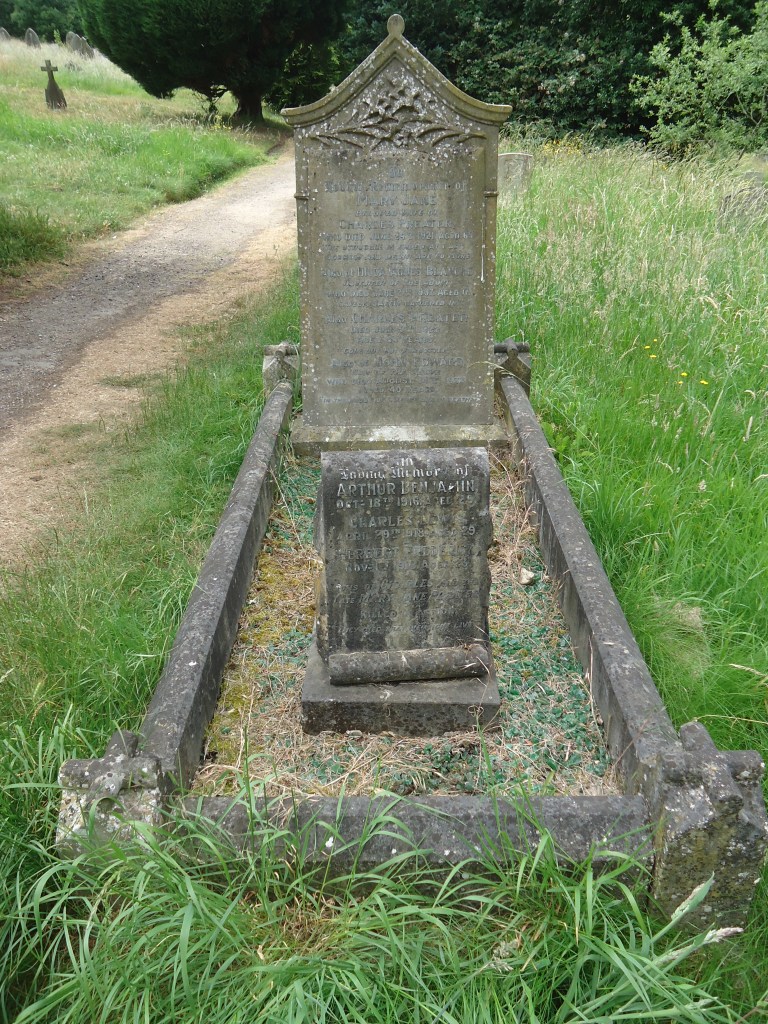
Arthur Benjamin Preater, Charles Lewis Preater and Herbert Frederick Preater were all killed in action, Arthur in 1916 and Charles and Herbert in 1918.  John Edward Preater served and returned home.

Why did neither Harry nor Jesse go to war? I’m sure their parents were relieved to save these two sons, but what was life like for them during and in the aftermath of the war. They shared their fate with many other men, but that couldn’t have made it any easier. Today we have a name for this condition ‘survivor guilt.’

Jesse married May Wallis at St Mark’s Church on October 4, 1915. Their son Charles Wallis Jesse was born in 1922. They are buried together in grave plot B2693 close to the grave where Jesse’s parents, his sister Hilda and John Edward, the brother who survived the war, are buried. A separate memorial commemorates the three brothers who were killed in action.

You may also like to read

Comrades of the Great War

Harry C. Preater and the Red Cross Penny a Week Fund

A new headstone and a soldier remembered

Private George James Smith pictured with his mother and two sisters published courtesy of an Ancestry public family tree.

Radnor Street Cemetery closed to new burials in the 1970s but the occasional interment (usually cremated remains) does still take place where there is room in a family grave. More unusual is the installation of a new headstone, although in recent weeks this has also taken place.

The new headstone commemorates Frederick Smith and his wife Elizabeth who died in 1917 and 1918 respectively and their son-in-law William “Alf” Penney who died in 1960. The inscription on the headstone also commemorates Frederick and Elizabeth’s son Private George James Smith who was killed in action in Salonika during WWI.

George James Smith was born on March 7, 1895 one of the four surviving children of Frederick and Elizabeth Smith. Frederick worked as an Iron Dresser in the GWR Works and George grew up at 87 Linslade Street, Rodbourne. He too entered the Works and as a 15 year old worked first as a cleaner, then a call boy and by 1913 he was a time and storekeeper. The UK Railway Employment Records 1833-1956 include an added comment to George’s employment record “25 Apl ’17 Reported by War office as missing.”

George was serving in the 7th Battalion of the Wiltshire Regiment in Salonika when he was declared missing presumed dead. He is remembered on the Doiran Memorial, Greece. George has no known grave but this new headstone in the cemetery will be cared for by our team of CWGC Eyes On Hands On volunteers.

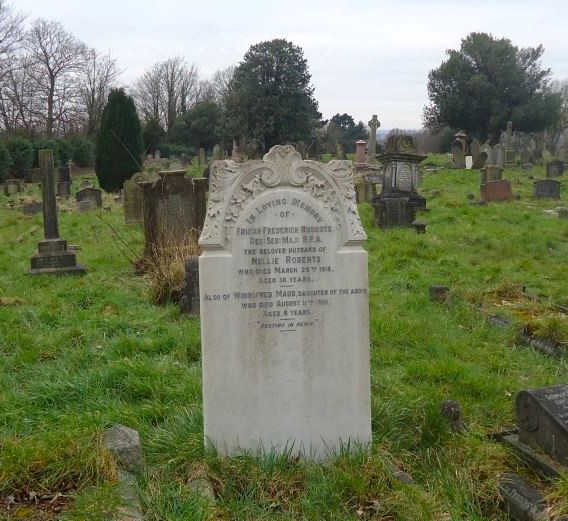
Friday Frederick Wright Roberts – physically unfit for military service

Friday Roberts joined the army in 1893. He was a little over 14 years old. His comprehensive records reveal he had a military career of almost 17 years spanning the South African war and the Great War, the effects of which eventually killed him.

Friday enlisted with the Royal Field Artillery for a period of 12 years on December 27, 1893. He was 14 years and 4 months old and stood 5ft 2½ inches. He weighed 93lbs and had a chest measurement of 29 inches – smaller than the average modern day 14 year old.  He had a fresh complexion, grey eyes, brown hair and indistinct tattoo marks on both forearms.

Friday served as a gunner before passing professional examinations and promotion to bombardier (corporal) rank. However in November 1898 he reverted back to a gunner at his own request. Promotion to Sergeant followed in 1902.

Friday was posted to South Africa in 1897 where he served more than 4 years. He received the Queen’s South Africa Medal with clasps for Talana, Laing’s Nek, Relief of Ladysmith and Transvaal. He was then posted to India where he served a further 5 years.

In 1904 Friday re-engaged to complete 21 years service. It can only be assumed he liked the military lifestyle. But then everything changed. In 1907 Friday was discharged from the army at his own request after nearly 14 years service. Perhaps he’d had enough of the army life after all, seen enough of the world to last him a lifetime. Perhaps he just wanted to settle down to civilian life with Alice, the women he married on February 23, 1907 at St. John’s Church, Woolwich. Their daughter Winifred Maud was born a year later, but sadly Alice died soon after her birth.

In 1910 he was living in Oldham, Lancashire where he married Nellie Vaughan and where their daughter Aileen Vera was born in 1912.

By 1914 Friday had a job as an Officer for the RSPCA and was living with his wife and two daughters at 81 Stafford Street. He probably hoped that his days as a soldier were over, but he was still on the reservist list and so with the outbreak of war in 1914 he re-enlisted with his old regiment and joined the BEF in France.

He was wounded within weeks of his arrival and was invalided back to England, but not for long. He soon returned to France and served two more years.

RSM Friday Frederick Wright Roberts was discharged on October 6, 1917 as physically unfit for military service, suffering from Tuberculosis of the Larynx.

The Medical Board confirmed his illness was a result of active service and exposure to infection during November 1916 while fighting near Vimy Ridge. His condition was described as permanent and requiring further treatment.

He was awarded a pension; 48 weeks at 42/6 from October 24, 1917. Five months later he was dead.

Friday is buried in plot E7368 with his little daughter Winifred who died in 1916 aged 9. His details appear on the Commonwealth War Graves website.

A happy ending for one war torn family

On January 9, 1919 the SS Northumbria sank in the North Sea. Only two members of the crew survived; among those lost was Thomas Poole.

Thomas Poole was born in 1882, the son of William and Elizabeth Poole. He enlisted with the Royal Marine Light Infantry on April 9, 1901. In 1919 he had been drafted to the SS Northumbria, a Defensively Armed Merchant Ship carrying wheat from Baltimore to the UK, to man the ship’s gun. The ship sank off the coast of Coatham, County Durham, after striking two mines.

Thomas’s younger brother Henry John joined the Royal Navy in January 1907. He served on HMS Empress of India, Argyll and Leviathan before being transferred to the Royal Fleet Reserve in 1912. Able Seaman Henry Poole ended his naval career in 1921 on Vivid I, a shore based ship.

And along with a patriotic love of their country, the two brothers shared the love of a woman.

On February 16, 1916 Thomas Poole, a Royal Marine aged 34, married Beatrice Fanny Dixon aged 26 at Christ Church. The couple’s son Derrick Thomas Poole was born on October 20, 1918. Less than three months later Thomas was killed on the SS Northumbria.

Did he ever get to see his son? What was Beatrice to do now?

We can’t begin to imagine what life was like for those women in the immediate aftermath of the war. The 1921 census figures revealed that there were in excess of 1.7 million more females than males in the population – known collectively as the ‘Surplus Women.’ The prospect of marriage and a family unlikely for so many. But what about the women like Beatrice, widowed aged 30 and with a child to support. What kind of future could she expect?

In the December quarter of 1919 Beatrice married Henry John Poole, Thomas’s younger brother. They went on to have two children of their own – Gordon Henry John born in 1920 and Doreen Elsa born in 1930.

In 1939 the family lived at 138 Broad Street. Henry John Poole was working as a Rivetter’s Holder Up in the railway factory, Derrick was a Motor Mechanic and Gordon a Metal Machinist also in the railway works. Nine year old Doreen was still at school.

A happy ending for one war torn family.

Henry John Poole died in 1965 and Beatrice Fanny in 1977. Neither of them are buried in Radnor Street Cemetery.

Thomas Poole was buried on January 16, 1919 in grave plot D1023 where he lies alone. The CWGC Eyes On Hands On team of volunteers care for his grave.

Rear Admiral Sir Arthur Hall – an extraordinary Swindon story

Sir Arthur Edward Hall KBE CB is not buried in Radnor Street Cemetery but his extraordinary Swindon Story deserves to be told.

Arthur Edward Hall was born on February 1, 1885, the son of Charles Hall, a boilermaker in the GWR Works, and his wife Emma. He grew up at 6 Andover Street, one of the streets that branched off the canal. A humble beginning for a man who went on to have a quite amazing career, as can be followed here in the obituary that appeared in The Times.

Adm. Sir Arthur Hall

Education in the Royal Navy

Instructor Rear-Admiral Sir Arthur Hall, K.B.E., C.B., who died at his home in London on Saturday at the age of 74, was a former Director of the Education Department of the Admiralty.  He was the first naval officer to hold that post and the first to have the rank of instructor rear-admiral.

Arthur Edward Hall was born on February 1, 1885, the son of Charles Edward Hall.  He was educated at Swindon College and the Royal College of Science, London.  He taught for six years in the physics department of the Imperial College of Science before entering the Navy as an instructor in 1915.  He served in the Inflexible during that war, was present at the Battle of Jutland, and was successively Fleet Education Officer to the Atlantic and Mediterranean Fleets, before he was appointed Deputy Inspector of Naval Schools in 1932.  Four years later he was promoted to the new post of Director of the Admiralty Education Department where he served until his retirement in 1945.  He was then for five years Director of Studies and Dean of the Royal Naval College, Greenwich.

Hall’s services to naval education were of the first importance.  Yet he was active in many other fields as well.  His connexion with the English Association was of long standing and he was chairman from 1951.  He was a governor of Imperial College and chairman of the Royal School for Naval and Marine Officers’ Daughters from 1943.  He was a member of the Hankey Committee on Further Education and Training (1943-45) and of the council of the Society for Nautical Research (1947-51).  Among other organizations to which he gave his time were the Institute of Naval Architects and the Navy Records Society, of both of which he was treasurer, and the RN Scholarship Fund and the RN Benevolent Society.

He married in 1920 Constance Martha Gibbens, by whom he had a son and a daughter.

The Times, Monday November 23, 1959.

You may like to read the following family stories:-

Rev George Hunter – Primitive Methodist Minister

Rev George Hunter and his daughter Edith

Charles Edward Hall – 75 Morris Street

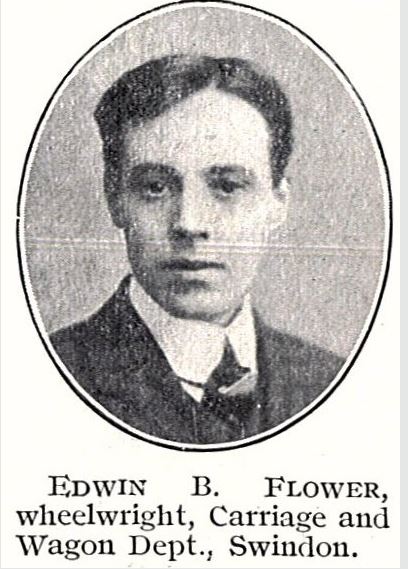
Emma Flower’s boy Edwin

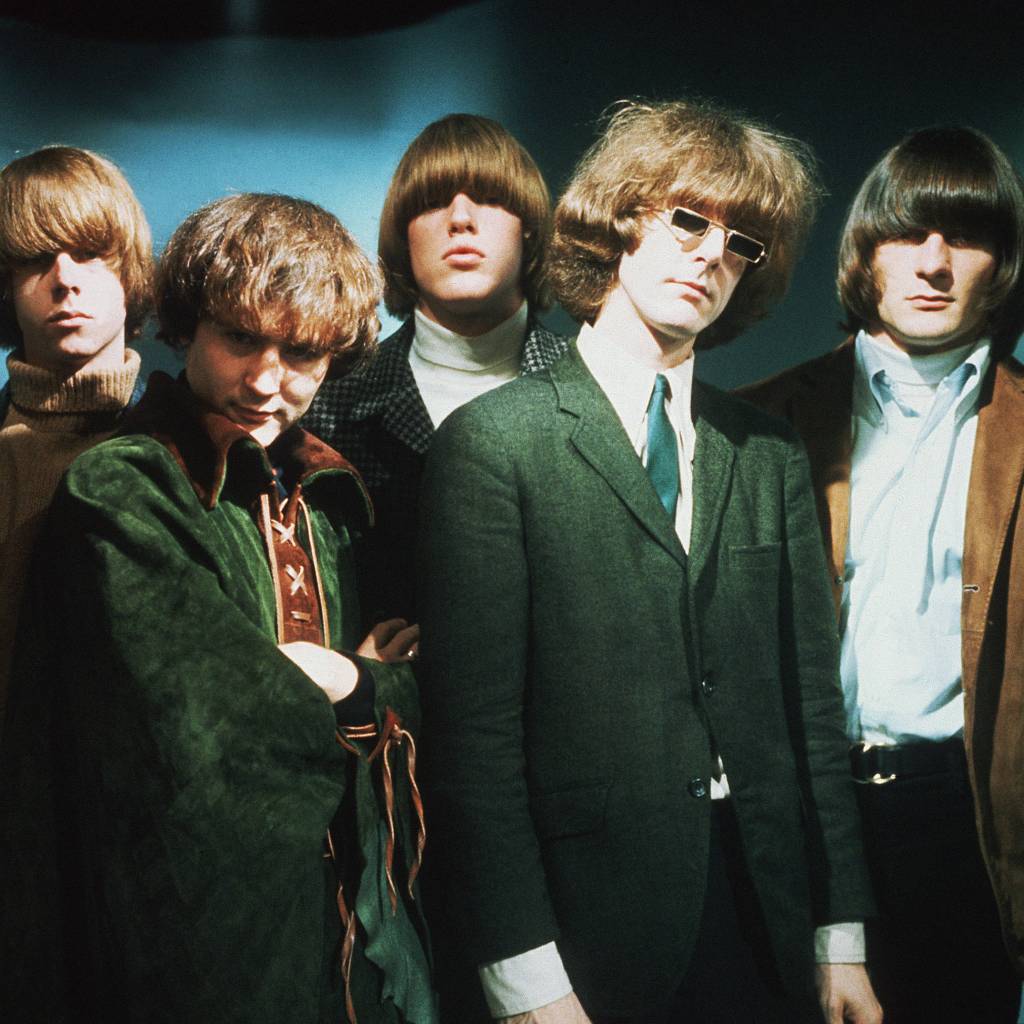
If you are of a certain age you may remember Turn, Turn, Turn, a song released by The Byrds in 1965. The lyrics were written in 1959 by Peter Seeger and are taken from the book of Ecclesiastes Chapter 3 verses 1-8.

So, what do you think? Is there a time to be born and a time to die.

Emma Flower died in March 1912. She had lived to see her only surviving child, Edwin Brian Flower, marry. She was 49 years old. A tragedy to die at that age both now and then. Had she suffered a long, painful illness, in which case it might have been a time to die?

Emma Head was born in 1861 the daughter of John Head and his wife Hannah. She married Edwin Flower at the church in South Marston on Christmas Eve 1888. At the time of the 1891 census the young couple and their baby son were living at 36 Avening Street, Gorse Hill. By 1911 the family had moved to 23 Florence Street where their son Edwin Brian was married from on October 21, 1911 and where Emma would die five months later. She was buried on March 14, 1912 in grave plot B3209 where she lies alone. Her husband Edwin married again in 1913 to widow Jane Martha Stone (nee Head) most probably Emma’s elder sister.

Edwin Brian Flower was the only one of Emma’s three children to survive childhood. He was born on September 23, 1889 and lived in Gorse Hill all his life. At the age of 13 he started work as an office boy/messenger in the Carriage Works, later transferring to the Wheelwright Shop. He married Ethel Woodman in 1911 and they had a daughter Iris Minnie born the following year. By 1917 Edwin was serving with the 9th Light Railway Operating Company as a Sapper in the Royal Engineers. He was killed in action on October 4, 1917 aged 28 and is buried in the Rocquingny-Equancourt Road, British Cemetery, Manancourt. Was it his time to die?

This is Emma Flower’s boy, Edwin.

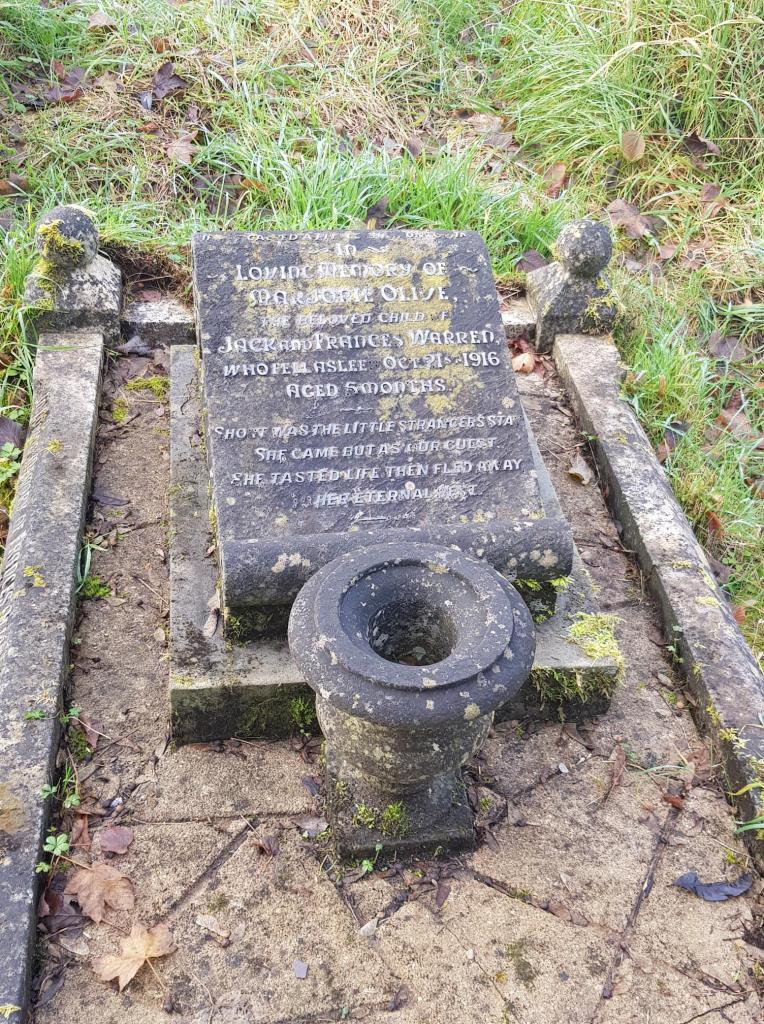
Majorie Olive – the beloved child of Jack and Frances Warren

Marjorie Olive was a precious baby, as every baby should be. The fact that she only lived 5 months did not diminish the joy and bewilderment her parents experienced at her birth and her death.

Short was the little strangers stay

She came but as our guest

She tasted life then fled away

To her eternal rest

John Oliver Warren and Frances Alice Iles were married at St. Paul’s Church, Swindon on April 10, 1915. John was working as a clerk in the GWR Loco Department Offices – but not for much longer. The First World War was raging; conscription was introduced in January 1916. Perhaps John was already serving by the time of Marjorie Olive’s birth and death.

Unfortunately, John’s Attestation Papers (the documents drawn up at the time of enlistment) have not survived. However, his discharge papers are accessible and we know he was serving as an Acting Sergeant in the Royal Army Medical Corps when he was discharged on June 11, 1919 at the end of the war.

John returned to his former life; to Frances and his home in Swindon; to his job as a clerk in the railway works. But life would never be the same again – how could it?

Frances died in 1926 and John in 1930. They are buried together with their little daughter Marjorie Olive. Their grave has recently been re-discovered and cleared by the Radnor Street Cemetery volunteers.

William George Driver – soldier

I am closing this month of remembrance with the story of William George Driver. Born in Torquay in 1892 William Driver had no obvious connections with Swindon but this is where he lies buried in an unmarked grave in Radnor Street Cemetery. Volunteers Jon and Kevin are presently making an application to the Commonwealth War Graves Commission to have his death recognised as being the result of his military service and to have an official headstone installed. We know this consultation is likely to take a long time so I am publishing William’s story now in hopeful anticipation.

William George Driver married Emily Dorothy Pretious at St. Anne’s Church, Wandsworth on August 21, 1911 and the couple had two children, George William and Patience. William and Emily were both 19 years old at the time of their wedding and William was working as a clerk in the Civil Service, although he apparently later set up business as a watchmaker and jeweller.

William enlisted at Hounslow on March 19, 1915. He served first in the Army Cyclist Corps and later transferred to the Yorks & Lancaster Regiment.

On William’s attestation papers there was no mention of any health problems but by January 1917 he was suffering from chronic bronchitis and asthma and by February he had been transferred to Bicester VAD Hospital. By June of that year he was in the 2nd General Hospital, Chelsea. His medical notes tell that he was admitted from the Expeditionary Force, France on January 1, 1917 with bronchitis & asthma. He looked ill and presented the usual signs and symptoms of an old standing Asthma & Bronchitis – his condition was not considered to have been caused by active service, climate or ordinary military service, although none of these symptoms had been evident when he enlisted. At the same time there was an enquiry received concerning his son. It appears that seven year old George William was in a home for Waifs and Strays at this time, so his wife was obviously in great distress.

Driver was discharged from the army on September 24, 1917 as unfit for military service suffering from Asthma & Emphysema aggravated by exposure on active service. By then William’s eyesight had also deteriorated and he was unable to resume his work as a watchmaker and jeweller. His service records show that he expressed a desire for outdoor employment in munitions work. He was awarded a pension of 11s 8d a week, which was later reduced to 11s.

William didn’t return to his wife who was then living in Plaistow, East London, but came instead to Swindon where he lodged with Mrs Howard at 49 Cambria Bridge Road.

William died aged 26 years old in the Victoria Hospital on November 14, 1918 from broncho pneumonia. He was buried on November 18, 1918 in grave plot C573.

Lance Corporal Thomas Neate Harding – Tell Them of Us

The First World War was all about loss; loss of life and loss of prospects. Landed property was lost with the death of an heir; local businesses were lost when sons did not return, and in this case, families fell on hardship with the loss of a breadwinner.

Within the records of the UK World War I Pension Ledgers and Index Cards 1914-1923 published on Ancestry are claims mostly made by service personnel incapacitated by their military service, and war widows. However, Thomas Henry Harding, the father of Lance Cpl. T.N. Harding, made an application declaring he was a dependant of his son.

Thomas Neate Harding was baptised on July 15, 1888 in the parish of Holy Trinity, Slad. He was the only child of Thomas Henry Harding, a labourer, and his wife Caroline.

The family moved to Argyle Street, Gorse Hill, Swindon three years after Thomas’s birth. By the time of the 1911 census both father and son were employed in the GWR Works. Thomas Henry Harding worked as a wood sawyer and 23 year old Thomas Neate Harding as a Blacksmith’s Striker.

Caroline Harding died in March 1913 and is buried in a public grave in Radnor Street Cemetery. So now father and son carried on alone at home.

At the outbreak of war in 1914 Thomas Henry Harding was about 54 years old, his son 26. Thomas Neate Harding was not one of the early volunteers to join the army. Perhaps his responsibilities at home were too great. But with the introduction of conscription in 1916 he would eventually be called up, enlisting in July 1917 with the Royal Engineers and serving with the Inland Waterways and Docks.

Thomas Neate Harding died on February 12, 1920 at the Northern Hospital, Liverpool. He was 32 years old. His father made an application to the War Office for the cost of his son’s funeral expenses.

Administration of Thomas Neate Harding’s will was granted to his father in April 1920. His effects were valued at £173 7s 1d.

Thomas Neate Harding was buried in a public grave plot number B1271. The same grave in which his mother Caroline was buried.

Lance Corporal Thomas N. Harding is commemorated on plaque in St. Barnabas Church, Gorse Hill.

First published November 3, 2022.