I started in the Works in the polishing department in 1937 and stayed for two years. I hated every day I was there.
French polishing sounds as if it might be a delicate, artistic occupation. I suppose there was an element of artistry about, it but it certainly wasn’t delicate. French polishing involved stripping back to the basic wood, making good any damage and then building up the polish again, brushing and sanding, brushing and sanding. A door could take you five days, on and off. We worked on anything made of wood, everything from panels and partitions to toilet seats.
12A Shop was in the Carriage Works along London Street and it was cold and filthy. We were quite separate from the men in the railway factory and had our own facilities. That’s a laugh, one toilet with two washbasins and some disinfectant soap useless at getting all the muck off our hands. Methylated spirits worked much better but it was hard on your hands and left them red and raw.
The mess room was under the workshop but no one wanted to spend their lunchtime there. When the weather was good me and Ivy used to walk to the GWR Park and eat our sandwiches on a bench. It got you out of the dirt and fumes for a bit.
In those days, just before the Second World War, jobs in the Works were few and far between for women. In fact, the polishing department was the first to employ women back in the 1870s. A big deal had been made about ‘the comfort of the women.’ Ha, well by 1937 that had all gone by the board.
My dad used to keep on about getting a trade and being set up for life, as if I were a man, but I couldn’t wait to get out of that place. All I wanted was a nice, clean little job before Ted and me got married. I looked forward to polishing my own furniture and it would be a sight easier than French polishing railway carriage doors, I can tell you.
The Carriage and Wagon Works, London Street published courtesy of Local Studies, Swindon Central Library.
The facts …
By the 1870s the railway factory had been in operation for some 30 years but the GWR were finding it difficult to recruit skilled men. The problem was a shortage of jobs in Swindon for young women, the railwaymen’s daughters. The men wouldn’t move their families to Swindon if there was no work for their daughters.
Joseph Armstrong, the Locomotive, Carriage and Wagon Superintendent, the top man, addressed the problem by extending the Carriage Works on London Street and creating a separate upholstery department for the employment of girls only. By the end of 1874 five women were employed in the new trimming department.
Celia Folland was born in Tredegar, Monmouthshire in 1857, the daughter of Richard Folland, a rail sawer, and his wife Margaret. By 1871 the family had moved to Swindon and were living at 1 Reading Street in the railway village.
Celia Folland was the first woman to be employed in a GWR workshop where she worked as a French polisher, checking in for the first time on July 18, 1874.
Celia married George Morkot at St Mark’s Church, Swindon on July 19, 1883 and by 1891 they were living at 31 Chester Street with their three children, Charles 6, Nellie 4 and George 2. Celia would go on to have another four children.
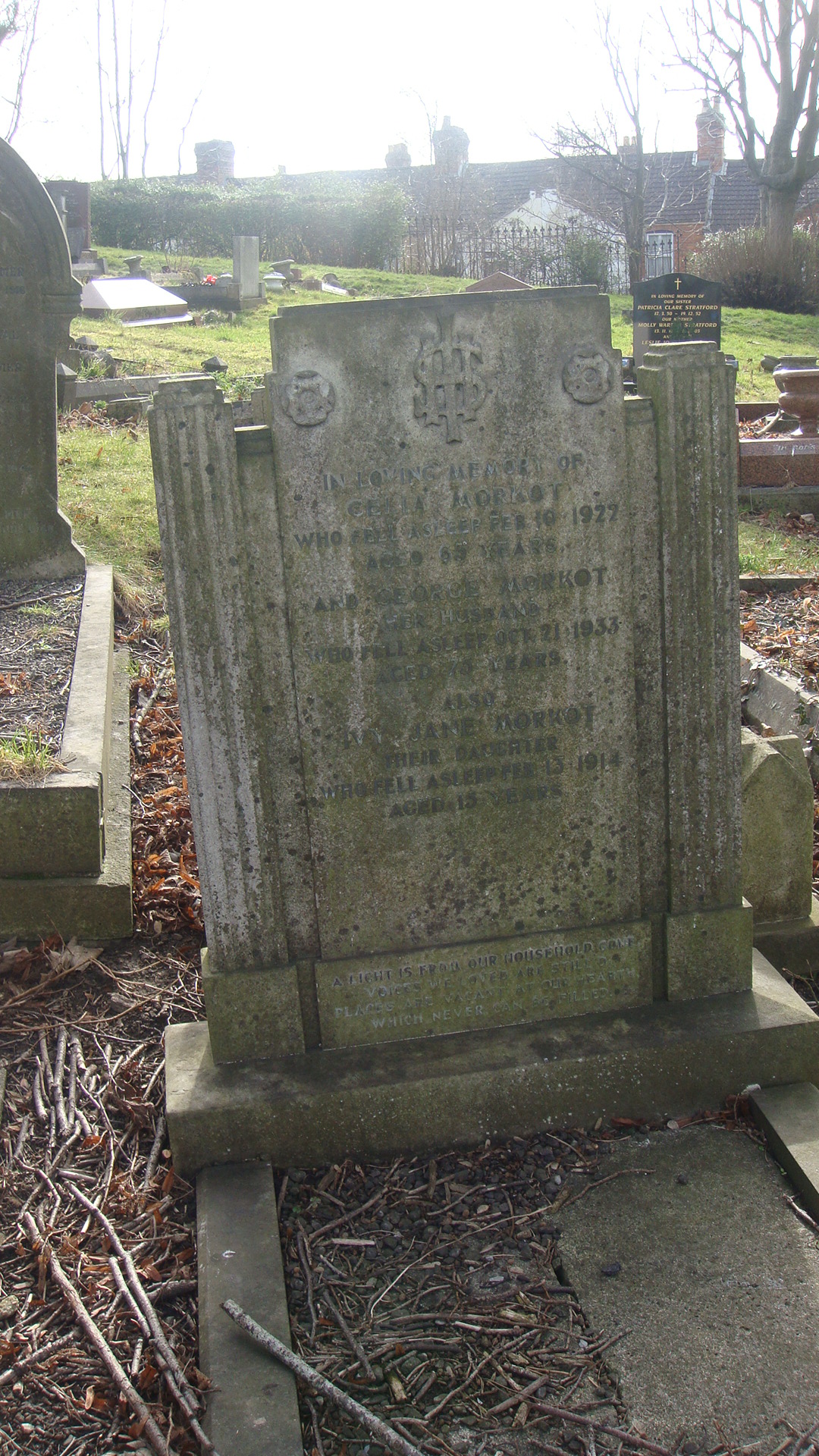
Celia died aged 65 years old in February 1922 at 31 Chester Street where the family had lived for more than 30 years. Her funeral took place at Radnor Street Cemetery on February 15 and she is buried in plot D1613.
Some years ago, I attended a talk about life ‘inside’ given by Miss Lorna Dawes at the Central Community Centre. The talk was hosted by The Railwaymen’s Association who had been meeting regularly following the closure of the Works in 1986 with guest speakers delivering talks about all things railway related. To those of you unfamiliar with Swindon railway jargon ‘inside’ refers to working in the railway works and it has to be said it was a rare occasion to hear a woman talking about such a subject. The only other woman I had ever heard give such a talk was social and railway historian, Dr Rosa Matheson.
Lorna sat at a table at the front of the hall and without the aid of any photos or slides or whizzy technical gizmos, spoke about her time in the Works. Lorna had a small sheaf of notes in front of her and thus armed she set about informing and entertaining her audience. Of course, she knew all the railwaymen present and exchanged quips and jokes with them during the course of her presentation.
I soon gave up trying to take my own notes and just sat back and listened to this amazing woman.
Lorna was born on March 23, 1931, the daughter of iron moulder Albert Edward G. Dawes and his wife Mona and lived all her life in Tydeman Street, Gorse Hill. She started work as a messenger in the Works in April 1945, aged 14 years old.
Lorna had taken lessons in shorthand while still at school and later attained a certificate for 120 words per minute at evening school. However, her first job as a messenger presented few opportunities to sit down and take notes. She had to quickly learn her way around the vast railway factory, which in the 1940s covered 326 acres. Walking through the tunnel to access all areas was obviously the bane of the lives of the young women where the sludge and filth ruined their stockings.
Most days included a trip to Grays [bakery] in Bridge Street for small lardy cakes for the office staff and to collect the milk and make the drinks to go with those lardies.
Then there was collecting the absences book from the tunnel entrance, delivering the bank bag to London Street, taking messages to Bristol Street, Park House and the laboratory housed in the old school.
She then went on to describe the staff office work, which involved everything from filing accident reports in Park House to duties in the Booking Office and collecting rent owed on the company houses.
She mentioned the double length typewriters used to type charts of salaried staff promotions and wrote: “I enjoyed manipulating lines of names into spaces.” She was also able to fix minor repairs on the typewriters until the mechanic came from Bristol.
Lorna participated in the busy social life of the Works, playing tennis and badminton, representing the offices in tournaments.
Lorna was one of the earliest and most enthusiastic subscribers to Swindon Heritage, a local history magazine published between 2013-2017 with which I was involved. I would have loved to have told her story in the magazine but Lorna wasn’t ready then.
It was with great sadness that I learned about her recent death and regret that I had not captured her memories.
And then I had the good fortune to exchange emails with Yvonne Neal, a member of the Swindon branch of the Wiltshire Family History Society. Yvonne had been in touch with Lorna’s brother and quite remarkably the notes from that talk survive.
The handwritten notes cover more than 11 pages and include not only the big events but the more personal ones too, those of Christmas’s in the offices, weddings, birthdays and babies.
And then she wrote: “My story was due a book “Tempus” pub. but interviewer left post. Didn’t get published.” Perhaps she felt so let down she wasn’t going to go through the performance again with me.
I wish I had had one more conversation with Lorna, to thank her for her support and enthusiasm during the publication of Swindon Heritage and to persuade her to tell her story again. I’ve done my best here.
I should never have read the account of the inquest in the Adver. I knew there had been an accident, I knew he was dead, I didn’t need to know all the details or the extent of his injuries.
I’d only known him a few months but long enough. He was a lost soul. My mother always says I’m attracted to the poor little sods of this world.
He hadn’t yet told me what had gone wrong in his life, but something obviously had. At the inquest he was described as being a little addicted to drink. What a quaint expression. He drank for a reason and it wasn’t because he liked the taste of the beer.
He drank because he was lonely and sad and disappointed with how his life had turned out. When he wasn’t drunk he was angry and resentful but when he was drunk he was happy, or so he thought, but we both knew that wasn’t the case.
I tried to help. If we’d had longer together I might have made a difference, might have got to know the real man.
The facts …
The Fatal Accident Near Wootton Bassett
Inquest and Verdict
Mr W.E.N. Browne, Coroner, held an inquest at the Beaufort Inn, Wootton Bassett, on Saturday afternoon, on the body of William Johnson, who was killed by being knocked down by a train on the GWR near Wootton Bassett Station, the previous Thursday evening, as briefly reported in our last issue. Inspector Wheeler, of Chippenham, was present to watch the proceedings on behalf of the Great Western Railway Company. Mr T. Taylor was chosen foreman of the jury, who then proceeded to view the body, which was lying in an outhouse at the Beaufort Inn yard. The head and face was fearfully knocked about, and almost beyond recognition. The body had, however, been identified as that of William Johnson, 37 years of age, a native of Coventry, and for the past three years employed as a shop clerk in the GWR Works at Swindon. Deceased was a single man, living in lodgings at 41 Chester St., New Swindon. Deceased’s only brother, Thomas Johnson, who is also employed in the GWR Works and lives at Swindon, was present. Particulars as to the occurrence will be found in the following evidence:-
William Hyland, of Swindon, was the first witness called, and identified the body. He said deceased had worked with him in the same shop in the factory at Swindon- the carriage finishing shop. He last saw him alive on the previous Tuesday Morning at nine o’clock when they had a chat about the “Trip” and other matters. Deceased told him he was not going away this trip time; he had nothing whatever to do with the trip. Deceased has never appeared despondent, but was more of a lively, excitable nature, and much more so when he had beer. Deceased was addicted to drink a little. He had worked in the factory since 1888. Two years ago deceased had a fit in the Works and fell, receiving a blow in the head, which rendered him insensible, and he had to be carried out of the Works. Deceased had told him he had been abroad, having been in the army – the artillery. He was not married.
The next witness called was Matthew Henry Cameron, of Paddington, engine driver on the GWR. He said he was the driver of the express train leaving Bristol at 5.18 pm on the previous Thursday. This train usually ran to Swindon without stopping. When they got this side of Dauntsey on Thursday evening he did not see anyone on the line. The first intimation he received of anything being wrong was when they got close to the bridge about half a mile or so from Wootton Bassett Station. His mate blew the whistle, and he looked round to see what was the matter. The fireman then told him he thought a man had been knocked down by the engine. He immediately shut off the steam, pulled up the train as quickly as possible at Wootton Bassett station, and told the signalman to send someone back to the bridge, as he believed a man had been knocked down by the engine. He felt sure someone had been killed, as there were marks of blood and flesh on the engine. The train was going at a speed of fifty miles an hour. There was no level crossing near the spot where the man was knocked down, nor any public footpath. He believed the buffer plank of the engine must have struck the deceased.
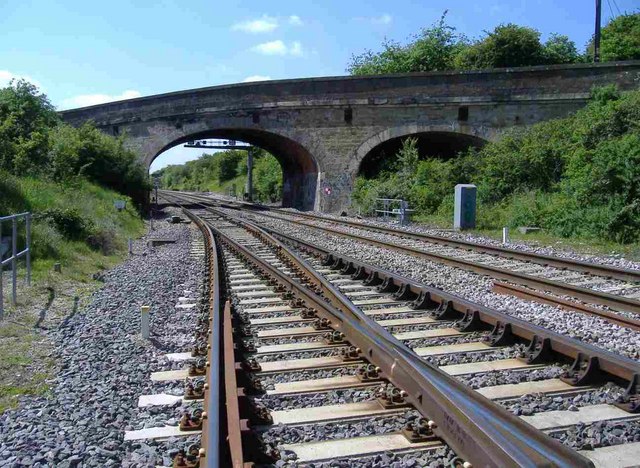
View of the Skew Bridge, Wootton Bassett published courtesy of Roger Cornfoot
Frederick Albert Hurson, fireman, also of Paddington, said he was on the same engine with the last witness. When near the skew bridge at Wootton Bassett he saw a man come down the bank on the Wootton Bassett side of the bridge and stop just by the side of the rails. He (witness) blew the whistle, and the man turned for a moment and looked toward him (witness), and just when the engine was close upon him he made a sudden movement as if he was going to cross the line in front of the engine. He (witness) asked the driver to see if the man was got across, and he looked and replied, “No,” He (witness) then looked on the side of the train again, and saw flesh and blood all up the side of the engine. They then pulled up the train at Wootton Bassett station, and informed the signalman of what had happened.
Thomas Johnson, a clerk in the GWR Works, living at 17, Clifton Street, New Swindon, said deceased was his only brother, and was a single man. He last saw him alive on the previous Monday evening at Swindon. Deceased then appeared to be in his usual health, and was going to the Mechanics’ Institute to see the evening news. Deceased had formerly lived with him. He had no reason to suppose that deceased would commit suicide. He was very much surprised when he heard the previous night what had occurred. He had no idea whatever that deceased came to Wootton Bassett the previous Thursday – he had never heard him speak of the place during the whole 2½ years he had been living at Swindon. He was not aware that deceased knew anyone at Wootton Bassett. – By the Coroner: He had not been altogether friendly with deceased lately. Deceased seemed to have a feeling of being jealous of his (witness’s) position in the Works. If he was at all despondent it was because he did not make such progress in the world as he would like to. Deceased was formerly in a good business as a watchmaker before he entered the army, and he might now have been in a comfortable position had he not been a little addicted to drink.
James Merrett, a labourer on the GWR, said he was working about a quarter of a mile from the scene of the occurrence on Thursday. He and a fellow workman saw the driver of the train shut the steam off, and after the train had passed they could see something lying on the four-foot way which ought not to be there. They went to examine it, and found it was the body of a man; he was quite dead. They sent for a doctor, and put the body on a trolley and took it to Wootton Bassett station. Witness added that he never saw any person on the line or inside the railway fence before the train came up. There was no public footpath near, but there was a path which was used by the packers working on the line, and at the entrance to it there was a notice board warning the public to keep off the line. – In reply to a juryman, witness said he found the body fifteen yards on the Wootton Bassett side of the bridge.
This concluded the evidence, and the Coroner briefly summed up, remarking that there was no evidence to show that deceased was temporarily insane at the time, or that he attempted to commit suicide.
The Jury returned a verdict of “Killed by a passing train.”
Extracts from the Swindon Advertiser, Saturday, July 18, 1891
At the time of the 1891 census William was lodging at 41 Chester Street with William Lang, his wife Mary and their infant son. William’s age is recorded as 39 years, born in Coventry, his occupation was Stores Keeper.
William’s funeral took place on July 13, 1891 and was conducted from his brother’s home in Clifton Street. He is buried in a public grave, plot B1964, with five other unrelated people.
There are some obvious points raised in the following inquest; to establish that machinery and practises in the Works were not at fault and that proper medical attention was received by the victim.
But what I find astonishing is that a 55 year old man, already identified as having a weak heart, and who had previously suffered a rupture and was wearing a truss, was continuing to work as a smith in the Works.
The Fatal Accident in the GWR Works
Inquest This Morning
Mr W.E.N. Browne, County coroner, held and inquest this morning at the Clifton Hotel, New Swindon, on the body of Thomas Barter, a GWR employee, aged 55 years, and lately residing at 59, Radnor Street, Swindon. Deceased, who was a widower, was accidentally struck with a hammer by his mate, and two days after affair died through the injuries received.
Mr J. Gregory was chosen foreman of the jury. Mr. C.R. Pendock, Inspector of Factories, was in attendance.
Mr George Finch, son-in-law of deceased, was called, and said that the latter was a smith in the GWR Works. On Tuesday last he went home about mid-day, and the daughter told witness that he had complained of having had a blow. Later in the day, Dr. Maclean was sent for. Before going home deceased had called in at the Surgery, but a surgery doctor was not sent for afterwards. Witness saw deceased the evening of the next day, and he appeared to be gradually sinking.
By the Coroner: Witness had made no complaint about insufficient attention on the part of the surgery doctors.
By Inspector Pendock: Witness believed that deceased had suffered from a weak heart for some six months before the accident.
By a Juror: A Surgeon was at the Surgery when deceased called and attended to him.
William Berry, who was engaged with deceased in making crown bar ends, said he was striking side blows at the bar, and deceased was stood on his left. The bar happening to swerve witness missed the bar and struck the deceased in the lower part of the stomach. Deceased said he was hurt, but acknowledged to witness that it was a pure accident and not witness’s fault at all. Deceased worked for three-quarters of an hour after the accident, and then he put his coat on and said he was going out to see a doctor.
By the Inspector: Had you been long accustomed to the work?
Witness: Yes, sir. Six years. I have known the deceased for 15 years, and never known him to have a misword with anyone in the shop. He was the best man I ever worked with in my life.
The Inspector: The work you were engaged on was nothing unusual?
Witness: No, Sir. We have made thousands of these same things.
The Inspector: Was the bar hanging by a chain at one end?
Witness: Yes, sir, and in a crane and block at the other.
The Inspector: Did the chain give way at all?
Witness: No sir.
David Jeans, another workmate of deceased, gave similar evidence, and added that he (witness) had gone to the foreman after the occurrence, and made him acquainted with the facts of the same. The foreman promptly ordered witness to take deceased to see a doctor, but deceased said he would go by himself. Witness saw deceased at his home on Wednesday. He was then too ill to speak much, but made witness understand it was all an accident. He said he had gone to the Surgery on the Tuesday, but witness could not gather whether or not deceased had seen a doctor there.
The Inspector: You don’t make any complaint of the appliances you use for this work?
Witness: No, sir, not at all. We have made thousands.
The Inspector: They are properly fitted to the work, and no blame attaches to the Company?
Witness: That is so.
Dr. Carew Webb, assistant to Dr. Maclean, said he was called in on Wednesday evening, and examined the deceased. There was a certain amount of tenderness on the lower side of the abdomen, but no marks of bruising, nor was there any swelling or anything to suggest any serious internal injury. Deceased had been previously ruptured, and at the time of the accident was wearing a truss. The hammer must hit the truss, or the accident might have proved fatal sooner than it did. Witness saw deceased on Thursday morning, and he seemed a little brighter then but on the way to the station later, witness was stopped and asked to go to the house. When he arrived there the man was dead. They told him at the house that deceased had vomited a great deal before he died. Having heard from Dr. Maclean that deceased had suffered from heart disease, witness gave it his opinion that the immediate cause of death was heart failure, due to a weak heart, and accelerated by the accident.
The Coroner then asked Dr. Gardner, of the GWR Surgery, if he wished to say anything, as it had got about the town that the deceased was neglected at the Surgery. Dr. Gardner said that he himself had seen the deceased, and ordered him to go home and keep to his bed, and that the doctor would call in the morning. The doctor did call, but found Dr. Maclean had been called in.
A verdict in accordance with Dr. Webb’s testimony was returned.
Swindon Advertiser, Saturday, August 19, 1899.
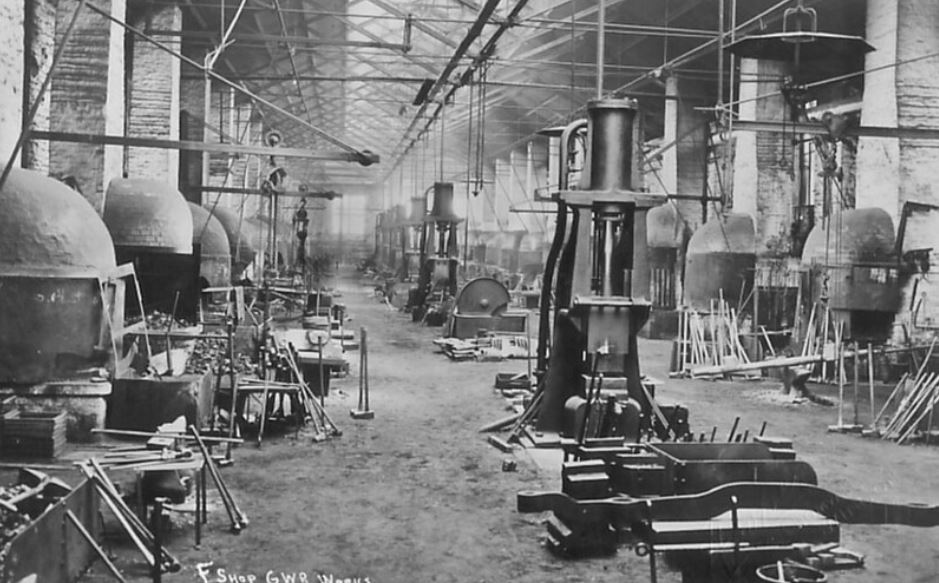
F Shop, GWR Works where Thomas Barter was employedpublished courtesy of Local Studies, Swindon Central Library.
The Fatal Accident in the GWR Works
Funeral of the Deceased
A Large Gathering
The funeral of the poor unfortunate victim of the accident which occurred in the GWR Works last Tuesday took place on Saturday afternoon. Owing to the popularity of Mr. T. Barter amongst his shopmates, the funeral was largely attended, over 100 mourners following. The procession was formed at deceased’s late residence in Radnor Street, and wended its way to the Cemetery where the interment took place, the officiating clergyman being the Rev. J.W. Fish, of Stratton.
Deceased had been in the habit of attending the Clifton Street Primitive Methodist Chapel for many years, and was only recently appointed as one of the trustees of the new building fund.
The coffin was conveyed on a handbier, the bearers being Messrs. D. Jeanes, D. Hunt, Wm. Harvey, Alf Reece, Jas Welch and Thos Brett, all shop mates of the deceased.
The Swindon branch of the A.S.E. was represented by the Secretary (Mr B. Johnson). Deceased was a prominent member of this Society and was Secretary of the Superannuation Fund for this district.
Deceased’s only sister (Miss Barter) was unable to be present as she crossed to Ostend on the morning of deceased’s death.
Last evening a memorial service was held at the Clifton Street Chapel, when an appropriate sermon was preached by the Rev. J.W. Fish, who took for his text the following words “There is but a step between me and death.” The rev. gentleman dwelt upon deceased’s life in connection with their church, and also of the good feeling which existed between him and his fellow workers. The congregation joined in singing the special hymn “Sleep on beloved,” and Mrs Westmacott sang as a solo “We shall meet at the beautiful gate.”
No flowers were sent by special request.
Extracts from Swindon Advertiser, Monday, August 21, 1899.
Clifton Street Primitive Methodist Chapel published courtesy of Paul Williams
The funeral took place on August 19, 1899 when Thomas Barter was buried in grave plot D23.
This article was written by Graham Carter, Swindon Advertiser columnist, and published in the Autumn 2016 edition of the Swindon Heritage Magazine.
Milton Road Baths published courtesy of Local Studies, Swindon Central Library.
Grandpa, the man who saved the Medical Fund
Swindon’s GWR Medical Fund was famously a blueprint for the National Health Service when it was introduced in 1948, but what is often overlooked is the crisis that seemed destined to destroy the organisation during the First World War.
And while the name of George W. Brunger isn’t often remembered as one of the visionaries of a railway town with a health service more than a century ahead of its time, as chairman for 29 years and its last, then he deserves a special place in Swindon’s history.
And George’s granddaughter, Maggie, along with her elder brother Alan, who spent hours recording ‘Grandpa’s’ oral memoirs’ before his death in 1964, have been piecing together the family history.
It tells of how George, who had previously only been an ordinary member of the Medical Fund, stumbled on a crisis meeting at Milton Road Baths – now the Health Hydro – and took control of its destiny.
“Grandpa was returning home from a union meeting in London,” said Maggie. “After disembarking from the train in Swindon, he was walking home when he heard a commotion coming from the Medical Fund building, and decided to go in.”
Formed in 1847, the Medical Fund provided a comprehensive ‘cradle to grave’ service and operated its own hospital, but exactly a century ago, in the last weeks of 1916 faced a huge dilemma because of the First World War.
Many local men were occupied with the Railway Works’ contribution to the war effort, George himself working as a fitter in AE Shop, making heaving guns. But many of the town’s men were away on active service, so subscriptions were critically low, and the crisis meeting was called to find solutions for an organisation that had exhausted its credit at the bank, so its cheques for doctors’ salaries were bouncing.
With the management committee and members arguing over a proposal to increase subscription rates, the closure of the Medical Fund altogether was a very real prospect.
“Grandpa entered the meeting, which was in uproar, and pointed out that they would stay there all night and still not get anywhere. So he suggested that a special committee be appointed to investigate their problems, and report back to members.
“His motion was passed unanimously, with seven people nominated; and Grandpa was the seventh.”
After a few weeks’ deliberation, the special committee reported in February 1917, in a hall that was packed to overflowing.
Surprisingly, it recommended only a penny-a-week increase in subscriptions, rather than the threepence suggested by the management committee, whose view was backed up by the Medical Fund’s lawyer.
When the members overwhelmingly supported the penny plan, it was effectively a vote of no confidence in the management committee, and most of them resigned.
George felt obliged to stand for election to the new committee of 15, and after the man he proposed as chairman refused the post, he put himself forward, and was elected.
Then aged 35, he would remain chairman until the Medical Fund was dissolved to make way for the introduction of the National Health in 1948, apart from when he took a year off and was vice-chairman in 1924.
In interviews with his grandson, Alan, in later years, he revealed that many of the ideas adopted by the Medical Fund during his time as chairman were his own.
Aneurin Bevan, the Minister of Health who was in charge of introducing the NHS, naturally interviewed George during visits to see how the Swindon model worked, and they must have had discussions about the handling of doctors, which was a key issue when the NHS was eventually formed.
A major cause of the Medical Fund’s financial problems were the huge salaries commanded by the three senior doctors they employed who were based at Park House in the Railway Village. George’s novel solution was actually to increase the salaries of junior doctors, while slashing those of the senior ones, including Dr Swinhoe, at the top of the pyramid.
His dealings with the Medical Fund inevitably brought George into contact – but also conflict – with management.
As a humble fitter – his union activities prevented him from progressing up the managerial ladder – he found himself in meetings with the railway company’s Swindon top-brass, but stood his ground.
He was once ordered to remove his hat when meeting FW Hawksworth, but told the Chief Mechanical Engineer: “I haven’t come here to undress!”
George had come from humble beginnings, but showed himself to be a committed and fearless young man.
Born in Maidstone in 1881, when he was 17 he lied about his age, claiming to be 18, so he could enlist in the Royal Engineers.
He quickly found himself in South Africa with the outbreak of the Boer War, the following year, and, apart from a long spell recovering from dysentery, fought much of the campaign, receiving clasps on his medals from six key battles, including the reliefs of Mafeking and Ladysmith.
After the war he stayed in South Africa to work in the diamond-mining boom, but returned to Britain in 1906, and soon married a local Maidstone girl Lillian Price.
They were married on Boxing Day 1906, but instead of honeymooning, after the ceremony they took the train to Swindon to begin a new life.
Arriving at 9.30pm, with snow on the ground, they walked from the railway station to their lodgings in Rodbourne, with a canary in a cage among the wedding presents they carried with them.
They later set up a permanent home at 40 Kingshill Road.
Always a union man, and an official for the Amalgamated Engineering Union (now the AUEW), George was also one of the founders of the Labour Party in Swindon, and served the party on the Town Council from 1919 to 1932.
As Chairman of the Housing Sub-committee in 1922 he oversaw the building of Swindon’s first (and one of the country’s first) council housing estates, at Pinehurst.
Such was the demand for houses that the queue of people outside the Brungers’ home in Kingshill, applying directly to George to move them up the list, led to the family calling the front room ‘the office’.
“He would have been mayor,” said Maggie, who lives in the United States but has been on an extended visit to her home town. “But my grandmother, who was very retiring, wouldn’t have it.”
He retired from both the Railway Works and the Medical Fund in 1947.
Maggie was 16 when he died, and missed the funeral because she was taking O Level exams on the day. Remarkably, his death occurred the day after Maggie’s brother Alan left Swindon to emigrate to Canada.
“He was a lovely old man,” said Maggie. “And of course to me he was always an old man. He was not a big talker, but he was well respected.
“I remember his black leather boots, which he kept by the fireplace, his red hair and his big hands. Every time I go up the beautiful stairs in the Health Hydro, I like to think of him grasping the rails.”
These days the committee room where George presided is often empty, while the smaller of the building’s two swimming pools is also closed, perhaps permanently.
The building was once a jewel in Swindon’s crown, and says as much about the vision and approach of Swindon’s leaders in past times – men like George Brunger – as the Mechanics’ Institute.
With its washing baths, swimming baths and even Turkish and Russian baths, it represented arguably the best leisure facilities enjoyed by any British workers at the time, as well as the medical facilities and services also available to members of the Medical Fund and their families.
But the building faces an uncertain future, just as it did, exactly a century ago, when destiny brought George Brunger, with perfect timing, to its doors.
Graham Carter
George Brunger died at St Margaret’s Hospital in June 1964 and is buried in grave plot C956, which he shares with his wife Lillian who died in 1955.
George William Brunger
Swindon Heritage was a quarterly local history magazine co-founded by Graham Carter, the late Mark Sutton and myself and was published from 2013-2017. Back copies are still available at the Swindon Library Shop, Swindon Central Library and at the cemetery chapel during our guided walks.
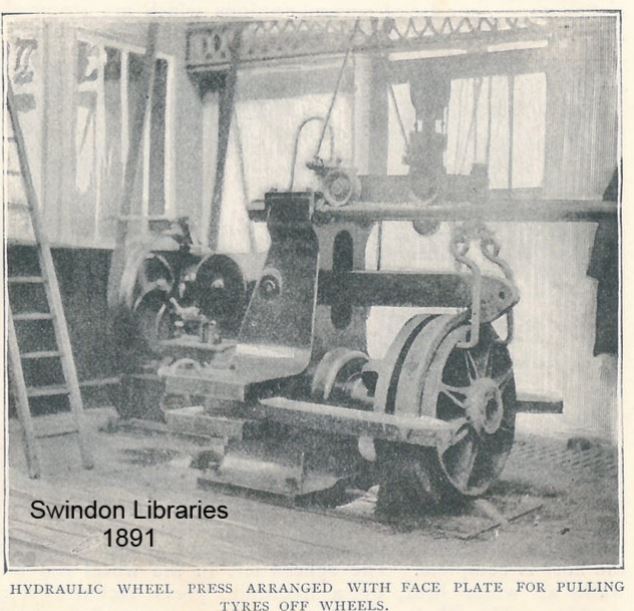
So, where did responsibility lie for the death of Herbert Hole? Described as ‘a fully qualified man and a good man’ it seems unlikely it was due to his incompetence. Investigations later that day revealed a previously unseen flaw in the hydraulic press, which had been working constantly for 19½ years. Today we bemoan the curse of ‘health and safety regulations.’ I dare say Mrs Hole and her family would tell us how fortunate we are to have such laws in place.
Fatality in the GWR Works
The circumstances attending the sad death of Herbert Henry Hole, aged 53 years, of 20, Curtis Street, Swindon, a fitter in the GWR Works, who was killed by an accident, were inquired into before M A.L. Forrester, Coroner for North Wilts, on Friday afternoon in last week at the Mechanics Institution, Swindon.
Mr O.A. Shinner, H.M. Inspector of Factories, of Bristol, was in attendance.
Arthur Herbert Hole, a fitter, who said he left home only two days ago and went to Grimsby to work, identified deceased as his father, 53 years of age, who had been in the employ of the GWR Co. a number of years, and was engaged in the stamping shop.
Dr W. Boxer Mayne said he was called to the Hospital about 4.30 p.m. on Wednesday. He found deceased suffering from a deep and extensive wound in the neighbourhood of the rectum. There was also the evidence of the fracture of the pelvis. He died in a few minutes from shock following the injuries.
Alfred Edward Mayor, of 28, Oriel Street, Swindon, hydraulic forgeman in the factory, said he and deceased were working on two hydraulic presses in the Stamping Shop. On Wednesday afternoon one of the presses was out of work, and deceased came there to put a guage on the dies of the press which was out of work. Whilst he was doing this witness was working the other press. About 3.50 p.m. witness heard a banging noise, and on looking round he saw deceased lying on the floor. Witness went to pick deceased up, but found his left foot was pinned down by a piece of iron (the crosshead of the machine). With assistance, witness raised the iron, and got deceased up and found he was seriously injured. Witness had left the machine ready for Hole to do the work. He was down on the block, and witness told him it was all right. He told deceased not to touch the lever, or the press would go up. Deceased could work the guage without touching the lever.
By Mr Skinner: The machine was not doing any work at the time of the accident. Deceased was doing some work to the guage.
Thomas Axford, of 161, Victoria Road, Swindon, GWR foreman, said he was in charge of the shop where deceased was working. Witness was 15 yards away from the scene of the accident at the time, and heard the noise. On turning round he saw deceased on the ground. Witness fetched an ambulance and also telephoned for a doctor, who quickly arrived. The same day, about 6 p.m. witness examined the machine and found an unseen flaw in the tie-rod coupling the top piston of the cylinder to the bottom one. The effect or result of the accident was that the tie-rod broke. Deceased was evidently knocked down. Someone must have touched the lever for the tie-rod to break. Deceased was standing near the lever, and in witness’s opinion the lever must have been touched or the tie-rod would not have broken. After the accident the lever showed that the machine was on the down stroke ready to press. This showed that the machine had moved on the up-stroke about an inch and then come down. The water was not shut off on the main during meal hours or for repairs. Every machine had a separate valve. Deceased was a fully qualified man and a good man.
By Mr Shinner: There was no particular pressure put on to cause the accident. There must have been pressure, and an improper pressure put on accidentally. The machine had been working constantly for 19½ years.
The jury, of whom Mr Waldon was foreman returned a verdict of “Accidental death,” and passed a vote of condolence with the widow and family of deceased in their great bereavement.
The Faringdon Advertiser, Saturday July 14, 1917.
Photograph published courtesy of Local Studies, Swindon Central Library.
Was this the type of machine at which Herbert Hole was fatally injured?
Herbert’s funeral took place on July 9, 1917. He is buried in Radnor Street Cemetery in plot D1624 with his wife Priscilla and son A.P. Hole.
I’ve seen some accidents in the saw mill in my time, but I’ve never seen so much blood before.
No one could fathom out how the saw had fallen from the frame. At the inquest we were asked the very same question, which no one could satisfactorily answer. Putting the saws in the frame had been Charlie’s job.
Charlie had already replaced the first saw, which had fallen from the frame when a second one fell, the blade skimming across his wrist. He was a big old boy, but we managed to lift him out of the way of the machinery until we could get him to the Medical Fund Hospital.
It wasn’t until Charlie had been transported to the hospital that I remembered Harry, the young apprentice who had started work with us that same week. I eventually found him hiding in the cloakroom curled up in a ball on the floor. I thought we were going to have to call the doctor back out again, I’ve never seen anyone look so queer. I suppose it must have been the shock of seeing all that blood.
I told him Charlie was going to be alright, but he didn’t seem to understand me and in the end we had to find his father to come and take him home. He came back to work the following day, but he soon transferred to the Stores. People said he was never the same again.
Like I said, I’ve never seen so much blood before. We spent the rest of the day scrubbing the place down.
Death at the GWR Medical Hospital
Inquest and Verdict
On Tuesday last at the Lecture Hall of the Mechanics’ Institute, Swindon, Mr A.L. Forrester, Coroner for North Wilts held the inquest on the body of W. Cook, who died at the Medical Fund Hospital, under circumstances detailed in the evidence given below.
Mr Greenaway was chosen foreman of the jury.
Mrs Annie Cook, of 15 Carr street, Swindon said that she identified the body as that of her husband, William Cook, aged 64, a sawyer, employed in the GWR Works. He died on Saturday at the Medical Fund Hospital, and witness was there at the time of his death.
George Ockwell, of Purton, sawyer, in the GWR Works, said that on last Thursday week between 11 and 12, witness was in the saw pit putting the blocks in to cut the timber to a certain size. The saws were hung in the frame but not set, and as Cook put a block in the saw fell down. As Cook went to put the saw back in its place the other saw next to it fell down and cut his wrist. Witness who was in the pit saw the blood coming down. It was Cook’s duty to fix the saw.
The machinery was not in motion of course.
Oh no sir. You had nothing to do with these blocks below? Cook had to hand me the blocks to put in, and the first saw fell down as he was handing me the first block.
You had not put this block in position? No sir.
What do you think caused the saw to fall? I don’t know.
Did the saw fall right down into the pit? Oh yes, sir, close to me.
How deep is the pit? About 14 inches.
Witness explained that he sat on a board to adjust the saw, his legs only being in the pit. The back of the saw was towards witness, and the saw fell down between his legs. The saws were not circular, but were straight “up and down” saws.
Ernest Samuel Richards, shop foreman in the saw mills, said that the mill at which Cook was working was a vertical long frame. The saws were 5ft 10in long, and the average width would be about 5½ inches. The saw had a buckle on, with a hook, and it was attached to the tiller with the hook the reverse way. They were fastened in the frame by a steel cotter. The blocks were simply packing, and did not affect the hook at all. He had never heard of saws falling down during adjustment. If these saws are hooked up and keyed how could it drop down? They cannot drop down when they are adjusted unless they come off the hooks, and that could only happen by a blow or by their being lifted in some way or other.
Dr G.R. Swinhoe said that on May 6th the deceased was received at the GWR Hospital suffering from a cut to the left side of the wrist, severing the radial artery. The bleeding was stopped and the wound was dressed, and he asked the man to stay in the Hospital, but the deceased took his discharge and went home. He come up every day to have the wound dressed until the day before he was re-admitted (May 12th). He was admitted on the 13th suffering from blood poisoning to the left arm. Hypostatic pneumonia had set in and Cook died from hypostatic pneumonia on May 15th. Witness then explained how the temperature from the blood poisoning would affect the heart, and render the heart unable to pump the blood through the lungs. The primary cause of all the trouble was the suppuration set up in the cut wrist, and the other things followed in an elderly and very stout man with a weak heart.
The jury returned a verdict that Cook died from hypostatic pneumonia following a cut on the wrist, accidentally caused by a saw in the GWR Works.
Mr H.B. Dawe was present as being in charge of the GWR Timber Department. Mr W. Ireland, Factory Inspector was also in attendance.
Funeral of Deceased
Yesterday afternoon the remains of the late Mr William Cook were laid to rest in the Swindon Cemetery. The funeral cortege left Carr Street shortly after three o’clock, and proceeded to the Cemetery where the funeral service, both in the Chapel and at the graveside, was conducted by the Rev. J.T. Evans, in the presence of a large number of relatives and sympathising friends. The remains were enclosed in a polished elm coffin with brass furnishings, and bearing a breastplate with the inscription “William Cook died May 13th, 1909, aged 64 years.”
Swindon Advertiser Friday May 21st, 1909
William Charles Cook was born in Bath in 1845, the son of John Cook. He married Eva Annie Perrin on October 22, 1874 in Aylesbury, Buckinghamshire and by 1876 they were living in Swindon where their son Lewis Ernest Samuel Cook was born. At the time of the 1891 census William and Eva, were living at 15 Carr Street with 15-year-old Lewis and 2-year-old daughter Frances.
William was buried on May 20, 1909 in plot E7378 in Radnor Street Cemetery. He lies with his son Lewis who died in 1900 aged just 24 and his wife Eva Annie who died in 1913.
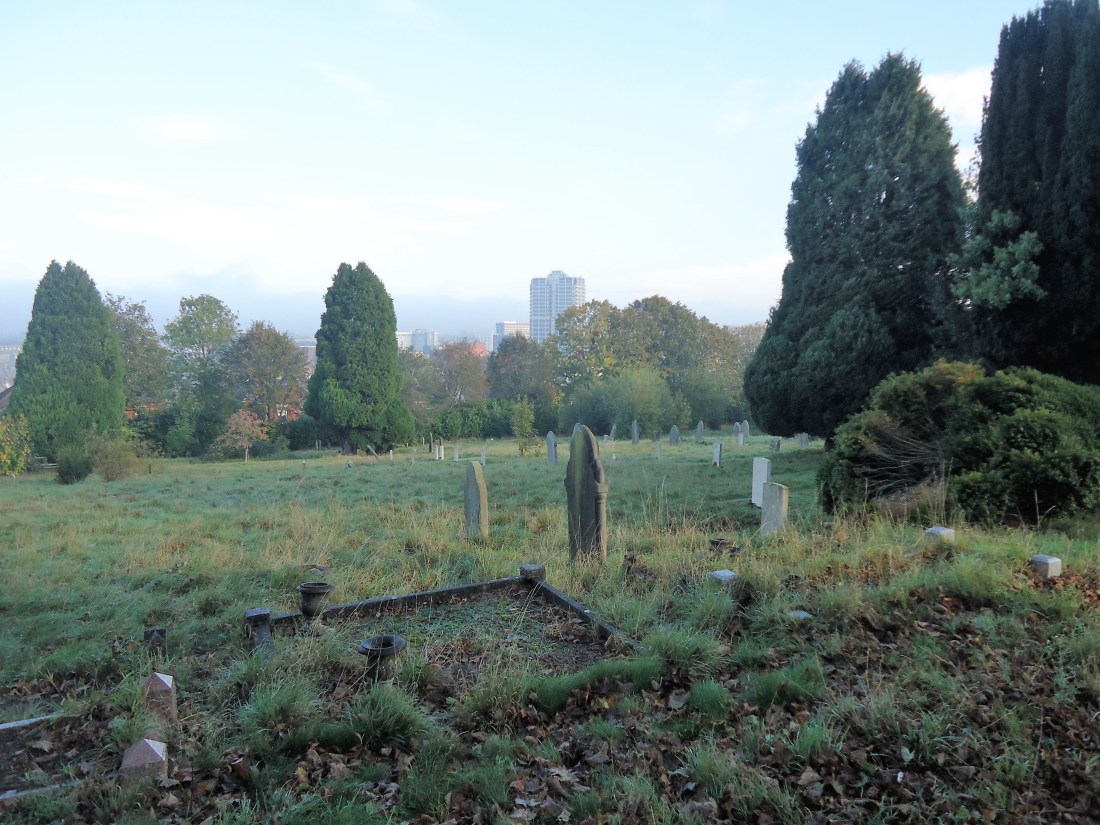
There may or may not be a headstone to William Charles Cook beneath all those brambles. We fully appreciate the financial constraints upon Swindon Borough Council – that the coffers are depleted and there is only enough money for essential services. But it is such a shame that an important heritage site such as Radnor Street Cemetery receives so little maintenance. Here lies, quite literally, the history of our town – remembering the ordinary people of Swindon.
How we like to moan about good old ‘health and safety’ regulations. What a nuisance it all is – well this is how life was before we had such protection.
When John Parkinson went to work that Tuesday in October 1901 it was just another day in the railway factory. By eight o’clock that evening he lay dead in the Medical Fund Hospital, his wife Kate a widow and his four young sons Ernest 8, George 6, Percy 4 and 2 year old Wilfred without their father.
The Fatal Accident in the GWR Works
A Rodbourne Man Killed
A terrible accident occurred in the GWR Works, Swindon, on Tuesday, which, unhappily, terminated fatally. A man named J.E. Parkinson, of 46, Linslade-street, Rodbourne, and engaged in the boiler shop of the GWR Works, was the victim, a large boiler falling on his back, and inflicting such injuries that his life was despaired of from the first. The accident happened about four o’clock on Tuesday last, and the unfortunate fellow, who was 31 years of age, was conveyed to the GWR Medical Fund Hospital, where Drs. Rodway and Astley Swinhoe attended to his injuries. The injuries to the back and sides were so terrible that it was utterly impossible to do anything more for the unfortunate man than give him stimulants and keep him warm. He only lingered four hours, passing away soon after eight o’clock in the evening. He leaves a widow, who is prostrated with grief, and four children.
GWR Boiler Shop c1886 – image published courtesy of Local Studies, Swindon Central Library.
The Inquest
Was held yesterday (Thursday) afternoon in the Council Chamber of the Mechanics’ Institution, by Mr Coroner W.E.N. Browne, and a jury, of which Mr. Thos. Tranter was chosen foreman. There were also present J.S. Maitland, Esq., H.M. Inspector of Factories, and Mr. A.E. Withy, representing the widow of deceased.
The Jury having viewed the body, the first witness called was William Simpkins, employed in the GWR Works, who was working on the boiler at the time of the accident. His evidence went to show that the boiler was mounted on trestles outside the shop. It had been there about three weeks. It was an ordinary engine boiler, and the trestles were standing on the bare ground. He did not notice anything wrong until a minute before the accident happened, and then he saw the trestles were sinking at one end. He gave the alarm, and one man was got out from the smoke box end, but the deceased was too late, and the boiler caught him as it tilted over.
By the Coroner: Is it usual to do this kind of work with the boiler mounted on trestles? Sometimes they are mounted on bogies, but they are done as much one way as another. – Has there ever been any accident before? Not to my knowledge.
By the Inspector: since the accident iron plates have been put under the trestles. Is that any improvement? Yes, undoubtedly.
By Mr Withy: Was it impossible for the man to get away after the warning was given? Quite impossible.
At this point a desire was expressed on the part of the jury to see the spot where the accident happened, to which the Coroner agreed.
Upon returning, Charles Bray, who was also working on the same job, gave evidence. He said that when the boiler began to slip, he shouted, and the man in the smoke-box end was got out. He then shouted to the man in the fire-box end, who said “What’s up?” He (witness) said that the boiler would fall presently, as the trestles were giving way. Parkinson then tried to get out, when the boiler went, crushing him between it and the packing.
By the Coroner: How long had the packing been there? I couldn’t quite say. – Were the trestles good? They were when they were put up. – Was there anything under the trestles- plate or anything? No. – Is this usual? Yes. – Was the boiler empty at the time? No, full of water, and deceased was marking what tubes had to come out.
Mr Llewellyn Dyer, foreman of the B Shop, was the next witness. In answer to the Coroner, he said that the trestles were quite strong enough. – Is it usual to put boilers on trestles? Yes, it is done every day. When they had sufficient bogies they were used, and when not they were put on the ground. – Had deceased stopped in the boiler, would he had been safer? Yes, I think so.
By the Inspector: Whose duty was it to see the boiler put on the trestles? My own nominally, but necessarily I have to leave details to others. – Will precautions be taken to prevent similar accidents in the future? You my take it from me, sir, such an accident will never occur again. – Witness went on to state that the ground on which the boiler stood was new ground, and had not, previous to a month ago, been used for the purpose for the past 30 years.
Dr. G. Rodway Swinhoe gave evidence that he attended the deceased soon after the accident, and found him suffering from very severe shock. After examination he was put to bed, and stimulants were administered, but he was too bad to be moved about. Deceased never recovered from the shock, and this was undoubtedly the actual cause of death.
The Jury returned a verdict of “Accidental Death,” caused by severe shock to the system, through the accident.
At the conclusion of the enquiry, Mr. Dyer stated that a communication would be sent to Mr. Maitland by the Manager of the Works stating what steps had been taken to prevent a recurrence of the unfortunate affair, at which the Inspector and Coroner expressed their satisfaction.
Swindon Advertiser, Friday, October, 18, 1901
The Fatal Accident in the GWR Works
Funeral of the Deceased
The body of John Ernest Parkinson, of Linslade Street, Rodbourne, who succumbed to injuries received in the GWR Works, Swindon, on Tuesday week, as already reported in our columns, was interred in the Swindon cemetery last Saturday morning. Nearly a hundred persons followed the coffin to the grave, the chief mourners being the deceased’s widow, his mother, and children. Mr. C. Hall and Mr F. Green, assistant foremen in the same shop that deceased worked in, followed many shop mates and others being present. The Rev. F.J. Murrell (Wesleyan) conducted the service, and the coffin, which was of elm with black fittings, was covered with floral tributes….
Mr Charles Dunn carried out the funeral arrangements.
Extracts from the Swindon Advertiser Friday October 25, 1901.
Linslade Street, Rodbourne c1920s image published courtesy of Local Studies, Swindon Central Library.
When John Ernest Parkinson married Maud Mary Kate Clack at St. Mark’s Church, Swindon in 1892 he gave his occupation as Cheese Monger and an address in London. By the time of the census in 1901 he describes his occupation as a Locomotive Boiler Tuber in the GWR Works here in Swindon.
His funeral took place on October 19, 1901 and he was buried in grave plot C1979 where he lay alone for 74 years. In 1975 his son George Clement Parkinson was buried in the same plot and two years after that Kate Parkinson (most probably George’s wife) joined them.
Sadly, this is all that remains of a once magnificent memorial to the Ellis family in Radnor Street Cemetery. Thieves armed with cutting equipment removed the ornate metalwork and with it all reference to the family buried there.
William Ellis was one of the first members of the New Swindon Local Board, a director of the Swindon Building Society, Chairman of the New Swindon Gas Company and a director of the Swindon Water Company. A devout Methodist, he was described as being ‘a most acceptable lay preacher widely known in Wiltshire and South Wales.’
Expansion at the GWR Works in 1861 saw the building of new Rolling Mills. Once established the rail mill produced an estimated 19,300 tons of rails a year with the workforce consisting mainly of Welsh iron workers.
Thomas Ellis was the first manager at the Rolling Mills and was responsible for building the cottages along Cambria Place to house the Welsh workers.
William came to Swindon with his two young children and took over as manager in 1863. The family’s first home was at 4 Church Place, before moving to the Woodlands, a GWR manager’s house.
When William died on May 25 1896 the Advertiser published a lengthy obituary in which he was described as having the ‘esteem of the large number of men who were under his control.’
“The first portion of the funeral service was conducted at 8 am on the lawn in front of the Woodlands by Revs A.A. Southerns and G. Osborne. Portions of Scripture were read, and hymns No. 680 and 940 from the Wesley hymn book were sung at the close of the beautiful and impressive early morning service,” the Advertiser reported. “The cortege then proceeded to a saloon, which was placed near the house, and the family left by the 9-5 train for Abergavenny where a hearse and carriages were in waiting to convey the remains and family to Lanelly church, where a large number of friends from neighbouring places had assembled.”
William’s son Ernest followed his father into the Rolling Mills where he worked as Assistant Manager. He and his wife Catherine lived at the old Ellis family home at 4 Church Place. Two of their children who died in infancy were buried in the Radnor Street plot, Olga Louise in 1897 aged 2 years and 2 months and Louis Robert in 1890 aged just six months.
Ernest died in 1915. The Advertiser published an account of the Memorial Service held in the Wesley Chapel, Faringdon Street during which Ernest was described as a man who ‘hoped for the best, and believed of the best in people,’ ironic considering the vandalism of his family’s memorial.
Ernest’s wife Catherine who died in 1931 aged 78 and his sister Louisa who died in 1944 aged 89 were both buried in the family plot. The names of William and his wife Emily were included on the family memorial.
Fortunately there are photographs of the distinctive monument preserved on Duncan and Mandy Ball’s website. Without this record the memory of one family who made such a large contribution to 19th century Swindon would be lost.
On Friday December 14, 1894 Thomas Messenger was involved in a fatal accident in the Timber Yard at the GWR Works. Back home in Linslade Street his wife Emma went into labour. Thomas died two days later. He was 31 years old and according to the report made to the Great Western Railway Board he had been employed in the Company for 5 years and 5 months, his daily rate of pay was 3s 2d.
Fatal Accident in the GWR Works – On Tuesday morning, Mr. Coroner Browne and a jury, of whom Mr W.J. Deavin was foreman, held an inquest at the Cricketers’ Arms, New Swindon, on the body of Thomas Messenger, aged 31 years, a labourer, employed in the Great Western Railway Works timber yard department. Mr T.O. Hogarth and Mr H. Hayward were present to watch the case on behalf of the GWR Company.
From the evidence adduced, it appeared that deceased was on Friday morning employed with other men in stacking timber. A “skid” – a piece of timber weighing some 7 cwt. – was used for sliding the timber on to a stock in order to save labour. Deceased placed the skid too far over the corner and it rebounded and stuck him in the head, causing a fracture of the skull.
A verdict of accidental death was returned. The jury gave their fees to, and also made a subscription on behalf of deceased’s widow, who is left with three children, and was confined on the morning of the accident. The sum handed to the widow was £1.
Wilts and Gloucestershire Standard, Saturday, December 22, 1894.
Thomas was buried on December 19 in a public grave plot B2264. His father, also named Thomas, was buried with him in 1902. They share the grave with a baby and an elderly widow, both unrelated.
Thomas and Emma had been married less than two years. Emma had already been widowed once before, left with two little daughters Martha and Amelia. Now she was on her own again with another child. The baby was baptised at the parish church in Latton on January 27, 1895. She was named Thomasina Polly Strong Messenger. Emma went on to marry for a third time in 1901. She died in 1943, aged 82.
Thomasina married, raised two children and died in High Wycombe in 1973, aged 79.
No 1 Shop, Timber Yard pictured in 1928. Image published courtesy of STEAM Museum.









 Radnor Street Cemetery