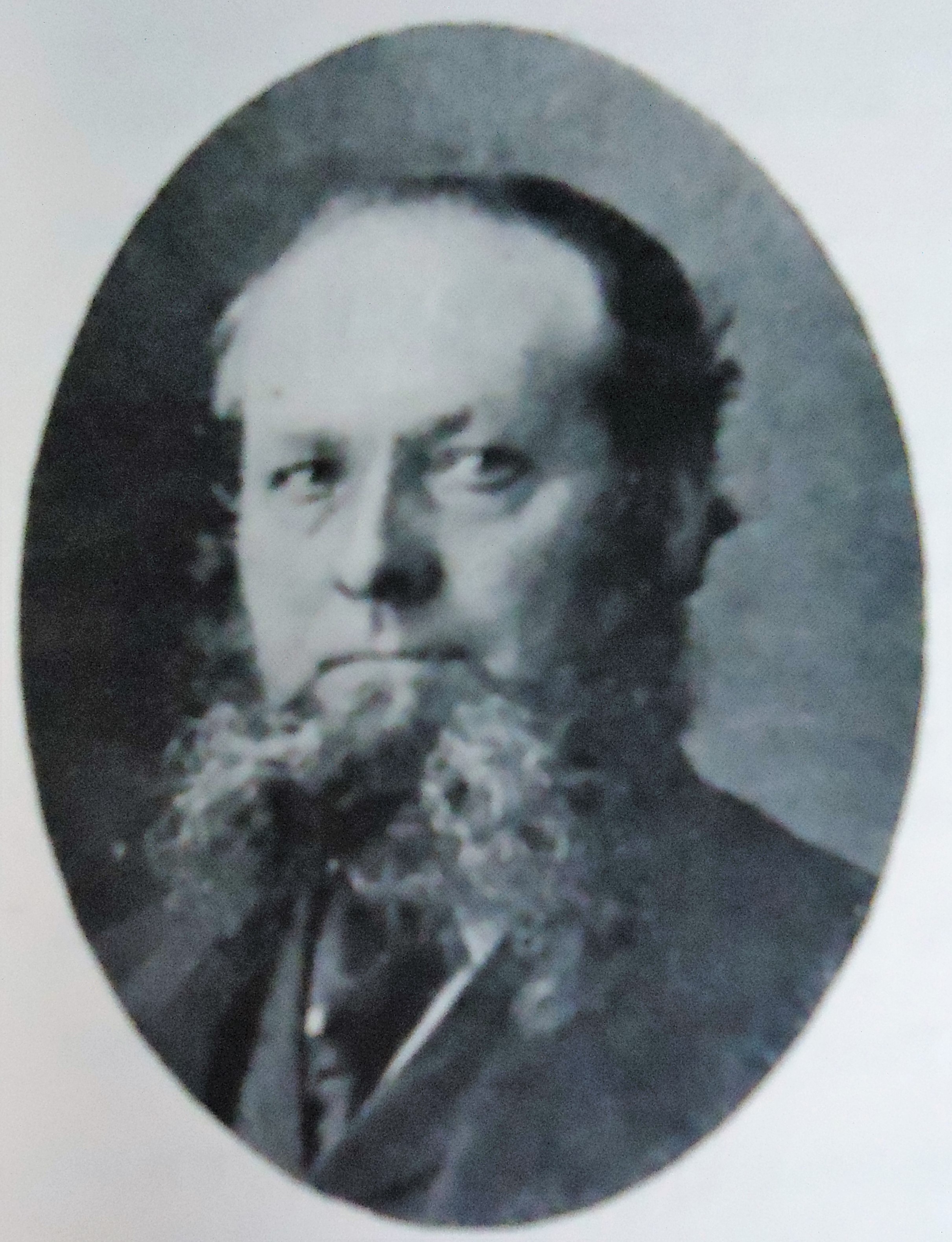
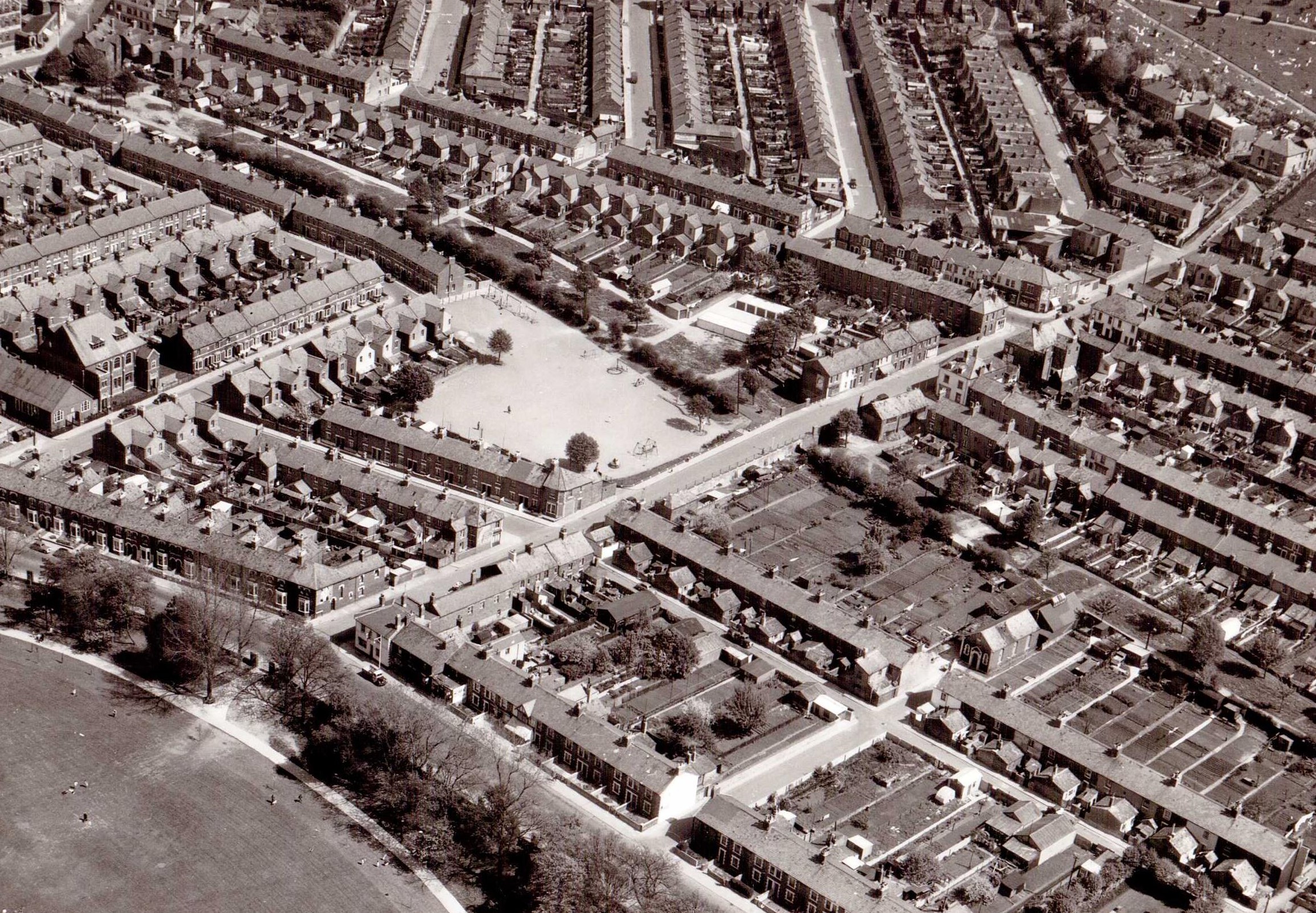
Joseph Robert Pinchon 14, fatally injured

When James Pinchon completed the 1911 census form he was required to state next to his wife’s name the number of years they had been married, how many live births she had had, how many children were living and how many had died. At the time of the 1911 census James and Ann lived at 1 Cyrus Cottages, Rodbourne Cheney. James was 69 years old, a retired Herald Painter (i.e. a coach painter). Ann was 70 years old, an old age pensioner. James and Ann had been married for 46 years. They had had 8 children of whom 2 were still living and 6 had died. One of those children was Joseph Robert who aged 14 had sustained fatal injuries in an accident in the Works.

Much has been written about the GWR Medical Fund, a health care system established in 1847 and credited with informing the foundation of the NHS a hundred years later. The Accident Hospital was opened in 1872 in a building which had previously been the drill hall and armoury for the XI Wiltshire Volunteer Rifle Corps. The new hospital had four beds, an operating room, a bathroom, a surgery, a mortuary and accommodation for a nurse in an adjoining cottage.

Following the accident, Joseph Pinchon’s workmates carried the boy to the nearby Accident Hospital where he died ten hours later. Joseph Robert Pinchon of 16 Reading Street was buried in grave plot E8072 on September 25, 1888.
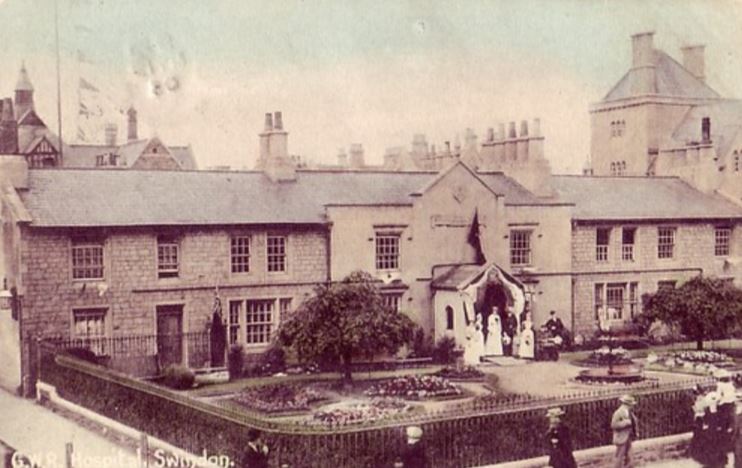
Medical Fund Accident Hospital – image published courtesy of Local Studies, Swindon Central Library.

Fatal Accident in the GWR Works – On Thursday morning in last week a sad accident happened to a youth named Joseph Pinchon, residing in Reading Street, New Swindon. He was working in the brass finishing shop in the GWR Works, and had occasion to go to the carriage department. In attempting to pass between two tracks of a train which was engaged in shunting operations, the buffers caught him in the chest and back and severely crushed him. He was immediately picked up and conveyed on a stretcher to the GWR Medical Fund Society’s Hospital, where he lingered till midnight and then expired.

On Saturday morning Mr Coroner Browne held an enquiry into the cause of the death of deceased, at the Cricketer’s Arms, New Swindon. Mr J. Bradbury was chosen foreman of the jury. Mr W. Mole represented the GWR Company.

James Pinchon, father of deceased, said his son was 14 years of age, and had only been employed in the Works two or three months. Dr. Cleveland (Messrs Swinhoe, Howse and Bromley), stated that death was due to internal injuries accompanying collapse.

Walter Martin, shunter in the Works, stated he was engaged in shunting operations when the accident happened. When the coaches were about two yards apart he saw deceased attempt to pass between them. It was impossible to stop the coaches when he saw deceased. – The jury returned a verdict of “Accidental Death.”

Swindon Advertiser, Saturday. September 29, 1888.

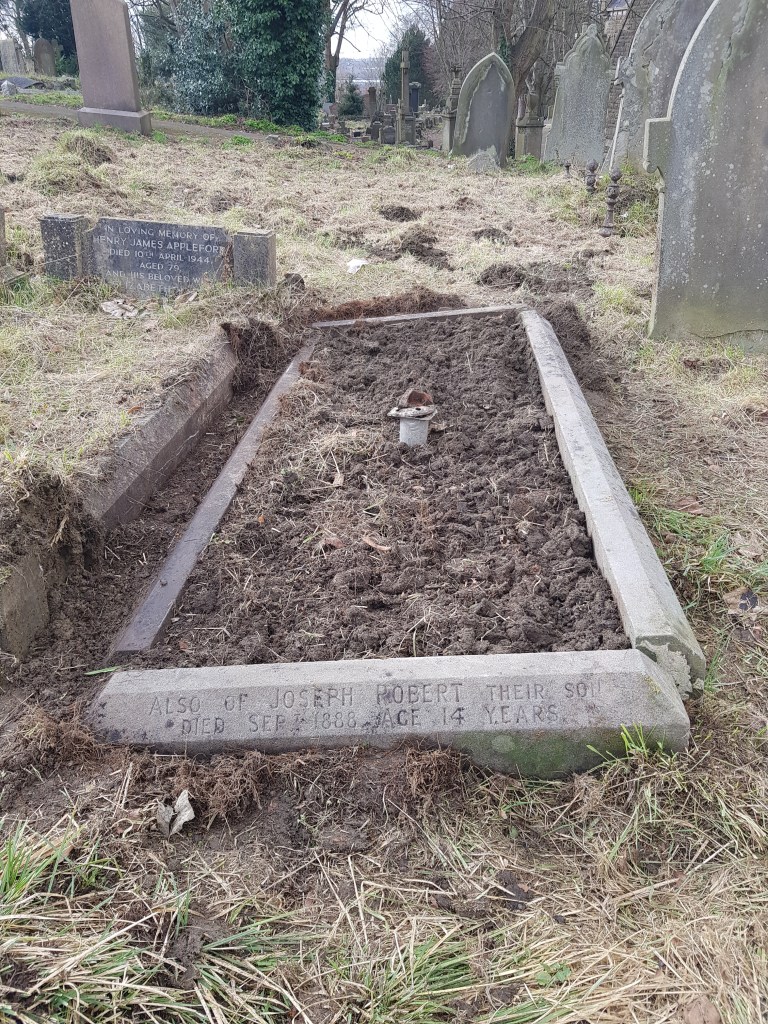
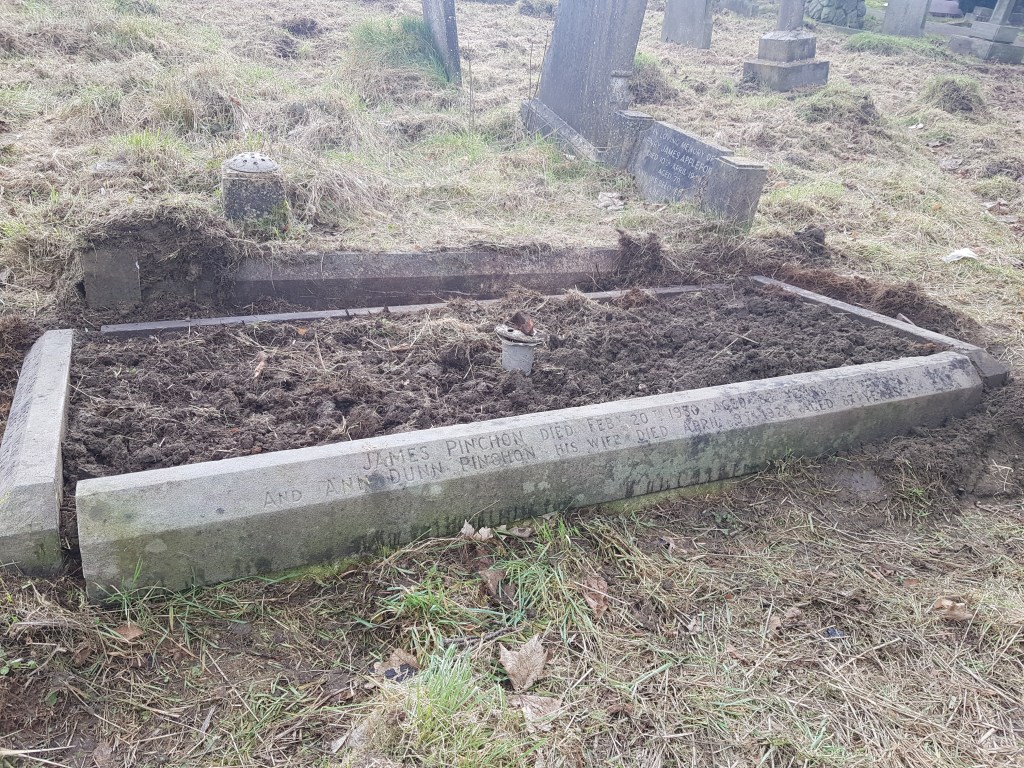
Our volunteers have revealed the Pinchon family grave. Young Joseph Robert was the first to be buried in this plot and it is likely there was no permanent memorial at the time of his death. The kerbstone would appear to have been erected after the death of his parents with an inscription which included his details. Ann died at her home in Rodbourne Cheney in 1928 aged 87 years. James died in 1930 aged 88 years. They were both buried with their young son who had died some 40 years earlier.
William Hall – killed at work aged 13 years and eight months

At 13 years and 8 months of age William was working as a ‘slipper.’ A ‘slipper’ was a young lad who assisted with the movement of wagons by horses. He would place the chocks to ensure that the wagon did not move when parked. They were called slippers because the chock looked like a slipper.* As one of the jurymen remarked during the inquest – ‘he thought it a great shame that the Co. should employ lads at such work. It was very dangerous for the lads so employed.’

William Hall had a short life. You could easily miss him on the 1881 census returns where he is recorded as James William Hall aged 4 years old. He was then living in Llanelly, Carmarthenshire with his parents John and Ellen, and two brothers. William was born in Swindon in 1877 but by 1881 the family had lived in Wales for a few years. His younger brother Thomas was born in 1879 in Llantrisant while Frederick was born in Llanelly in 1883. By 1890 the family were back in Swindon living at 166 Rodbourne Road, handy for the Works where John worked as a Stationery Engine man and where William would soon join him.

The Fatal Accident at the GWR Station

On Saturday, Mr W.E.N. Browne, coroner, held an inquest at the Cricketers’ Arms, New Swindon, on the body of the lad William Hall who received fatal injuries at the GWR Station, New Swindon, on the previous Thursday. Mr T. Wheeler was chosen foreman of the jury, who then proceeded to view the body, which was lying at the GWR Medical Fund Society Hospital. Inspector Wheeler was present to watch the proceedings on behalf of the GWR Co. The following evidence was taken:-

John Hall sworn, said: I am father of deceased, whose age was 13 years and 8 months. He had been only two days in the employ of the GWR Co., but he was at the same work for three days a fortnight ago, but left and did nothing till he was taken on again during the past week.

Henry Roach, shunter, in the Loco. Dept., said he was standing near the E Box in the afternoon. He heard someone call out, and on looking round he saw the second wheel of the van go over the deceased. Witness went to the lad’s assistance and picked him up. He asked deceased how he got under the van, and he replied, “My foot caught in the points, and it threw me down.” Deceased was quite sensible when picked up. The driver was at the horse’s head.

By a juryman: – It was a general practice for boys to be employed in “slipping coaches.”

(A juryman here interposed with the remark that he thought it a great shame that the Co. should employ lads at such work. It was very dangerous for the lads so employed).

Albert James Ford, said he was a driver in the employ of the Great Western Railway Company. Deceased was working with him as a “slipper.” On the day of the accident he was at work with the deceased, as usual. The first he heard of the accident was when the boy, being caught under the wheel, cried out. He went to the lad, and found the wheel had passed over him, and his shoe was left in the points. It was a horse box that was being drawn, but the boy was not riding on it at all. Witness had that same morning cautioned the deceased against walking on the rails, and he was not doing so when the accident happened. If the lad’s foot had not caught in the points the accident would not have occurred.

Mr Cailey, assistant to Messrs Swinhoe, Bromley, & Howse, said deceased was admitted to the hospital about 2.30 p.m. on Thursday. He was suffering from severe injury to the thigh and one arm. Deceased had his boots on when brought to the hospital. He lingered till six o’clock, when he died from exhaustion.

The Coroner having briefly summed up, the jury returned a verdict of “Accidental death.”

The Swindon Advertiser, Saturday, Feb. 15, 1890.

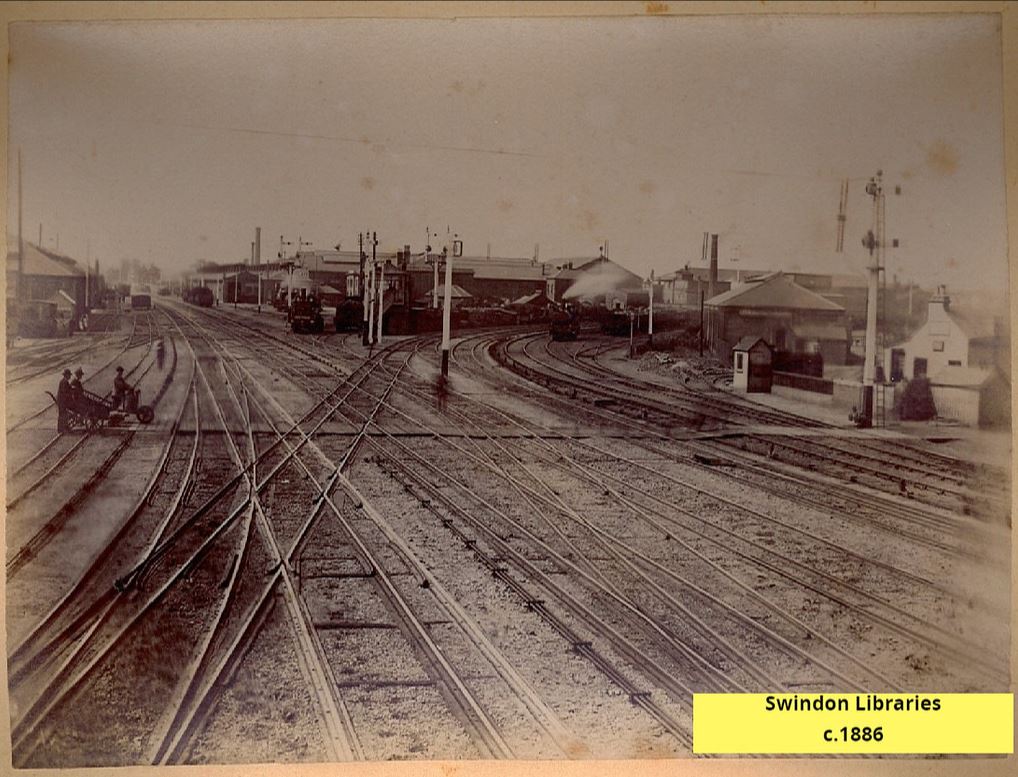
c1886 View of Swindon GWR Works from railway line published courtesy of Local Studies, Swindon Central Library.

Today there is no one left to remember the young boy who was doing the work of a man. No one to remember that William Hall was 13 years and eight months old when he was killed at work.

William was buried on February 18, 1890 in grave plot B1778 – a public grave that he shares with two others.

*Many thanks to David Robert for correcting a previous error.

Season of mists Pt IV

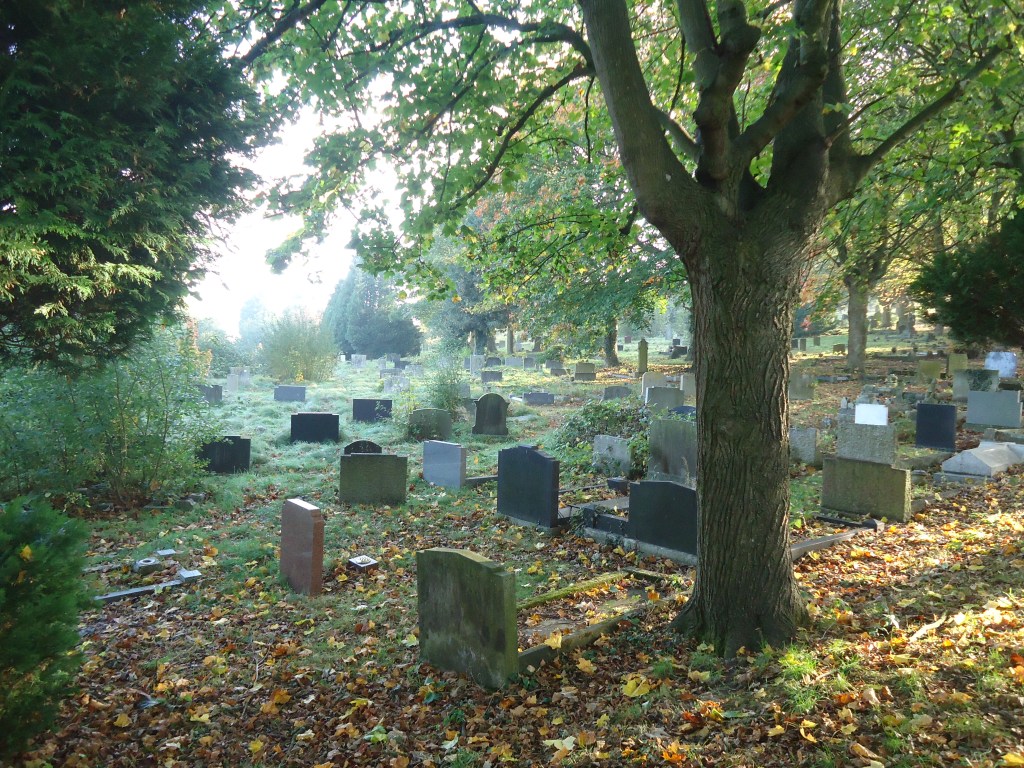
The sun is shining brightly this morning, but will the weather hold? I’ll make an early start, just in case, but you can relax at the kitchen table and take your breakfast at leisure. Join me on a virtual walk around the cemetery.

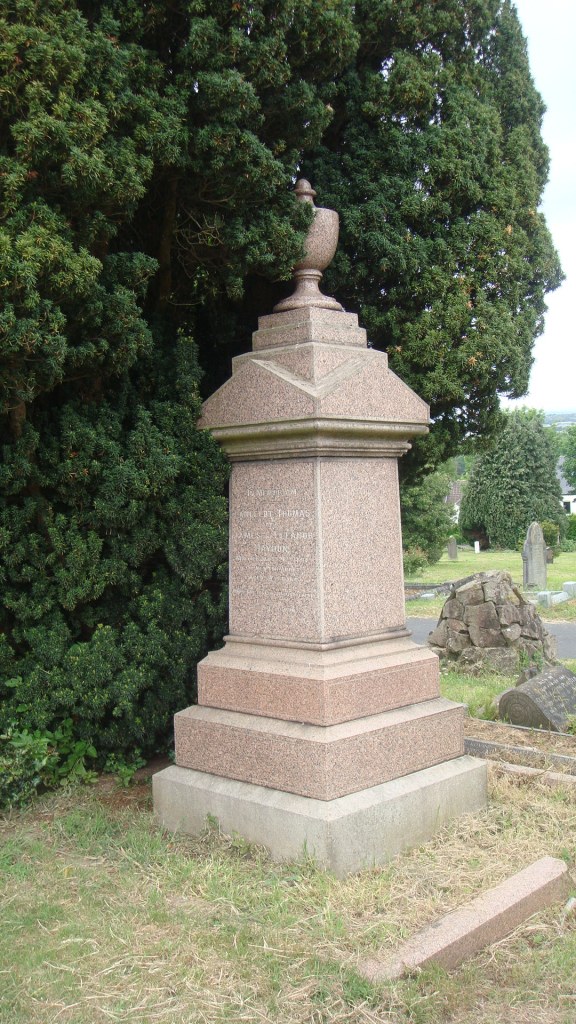
It’s easy to almost miss this magnificent pink granite monument to another railway father and son, encompassed by this large yew tree.  Like the Carlton obelisk opposite that we visited on our summer walk, this memorial was also paid for by employees at the GWR Works. 

James Haydon was born in Bristol in 1826.  The Railway Employment Records available on the Ancestry website, indicate that James entered the railway employment in March 1851 when he was about 25 years old.

By 1861 he was working as an engine fitter in the Swindon Works.  He lived with his wife Ellen, their young son Lancelot and his wife’s nephew Henry Wardle at 9 London Road.  Sharing number 9 were Thomas Watson and his wife Ann along with Ellen’s parents, Lancelot Young (who at 64 was still working as a boilersmith) Eleanor Young and several other Wardle children. Things must have been very cosy at number 9.

By 1871 James Haydon was Deputy Manager at the Works and was living in a house in what was then still known as Sheppard Fields.  This later became Sheppard Street, named after the former owner of this area, John Harding Sheppard.

James died on July 5, 1888.  He had been Assistant Manager in the Loco Works for 22 years. The inscription reads ‘this monument has been erected as a token of affection and esteem by his fellow officers and employes.’

Also remembered on this memorial is James’s son, Lancelot who died in 1894 aged just 38. Lancelot followed his father into the works and his career can be charted through the same railway records. He began work as a pattern maker apprentice in 1871.  In 1877 after he had finished his apprenticeship, he transferred to the Drawing Office. In 1881, by then a mechanical draughtsman, Lancelot left the GWR for an appointment on the Swindon, Marlborough and Andover Railway, but by 1888 he was back at the GWR firstly as Assistant Draughtsman and later as Chief Draughtsman.

At the time of the 1891 census he was living at his old family home, 21 Sheppard Street, with his wife Isabella and their young daughter. The following year Lancelot was on the move again, this time to Newton Abbott as Assistant District Superintendent Loco Carriage Dept.  He died less than two years later.

Tomorrow we meet another man who has left his mark on Swindon but now I will take a brisk walk down the hill as I’m sure I just felt some spots of rain.

Herbert Pinnegar – killed at work aged 14

Emma Pinnegar’s five sons all followed their father into the railway works. Francis and Ernest became fitters, Nelson a blacksmith and Levi a coppersmith. Her youngest son Herbert had been employed just a few months when he was killed at work one Monday afternoon.

Herbert was working in D Shop “cutting of tyres for the wheels of railway carriages.” He was rather short sighted, according to the newspaper report, and working with heavy machinery. Do you suppose he was wearing glasses? I doubt it. Do you suppose anyone was supervising him? I doubt it.

In Swindon Works – The Legend, Dr. Rosa Matheson devotes a chapter to accidents. She writes: “The causes of accidents could be put down to a number of things – workers’ carelessness, difficult and horrendous conditions, over work, inexperience, lack of supervision, inattention, youth, old age, bad luck.”

It would seem young Herbert ticked a number of these boxes.

The railways brought employment and prosperity to Swindon; the railways brought life and they also brought death. Emma’s husband had been killed ten years previously walking home to Purton along the railway line. It appears he had been doing some shopping in Swindon that evening after work – it was the week before Christmas.

Fatality at Swindon

A terrible fatal accident occurred in the D Shop of the GWR Works on Monday afternoon. A lad named Pinnegar, aged about 14, was engaged upon a machine for the cutting of tyres for the wheels of railway carriages. Pinnegar, who was rather short sighted, was looking down to see if his work was placed in a right position, when going too near the large wheel, he was knocked down between the chisel and another part of the machine. The top of the poor boy’s head was cut completely off. Death, of course, was instantaneous. Deceased’s father, about six years ago, was killed on the railway while returning home from work.

The Bristol Mercury, Wednesday, September 16, 1891.

Herbert was buried in Radnor Street Cemetery in grave plot B1592, a public grave. He is buried with three other unrelated persons.

Fatal Railway Accidents Near Swindon – Between twelve and one o’clock on Saturday morning the stoker on a goods engine passing the Rifle Butts, between Swindon and Purton, saw what he thought to be the body of a man lying by the side of the rails. On search being made the body of a man named Frank Pinniger, a boilersmith in the Great Western Railway Works, but living at Purton, was found. He had been in Swindon shopping on the previous night, and left Rodbourn Lane about eleven o’clock to walk to his home down the line. The night was rough and windy, and it is supposed he was struck by the 11.20 mail train from Swindon. His body was removed to the mortuary at Swindon to await an inquest. Deceased was between 40 and 50 years of age, and leaves a wife and eight children.

The Stroud News and Gloucestershire Advertiser Friday, December 24, 1880.

Frank was buried on December 24, in St. Mark’s graveyard ‘by Coroner’s Order.’

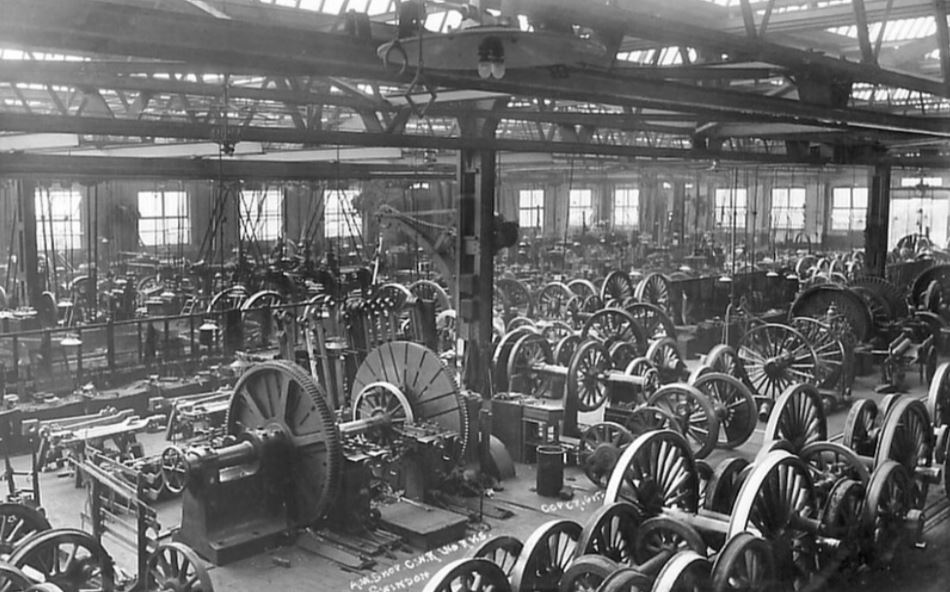
A William Hooper image of A W Shop taken in 1907 and published courtesy of Local Studies, Swindon Central Library.

Jim Hurst: king of all engine drivers

In the Summer 2016 edition of Swindon Heritage Noel Beauchamp told the story of the man who drove the GWR’s first train and was a personal friend of no fewer than three railway pioneers, and lived and died in the Railway Village. Here is an extract from that article – Colourful career of the man they couldn’t sack.

He was a personal friend of Sir Daniel Gooch, but there is no getting away from the fact that Jim Hurst was a difficult character.

Official GWR reports reveal a catalogue of arguments, rows, conflicts, accidents and even fights throughout the career of the man who became the company’s first driver.

His first accident occurred in 1836 while he was still working for the Liverpool & Manchester Railway.

Sacked, he was almost immediately hired by Daniel Gooch, then Locomotive Superintendent of the GWR – although when recounting the story to the company magazine, many years later, he gave an entirely different explanation of the circumstances.

He also told the GWR magazines that he had had “some very narrow escapes”, including in 1855 when the engine he was driving exploded and “I was blown up through the air and my mate was killed.”

The first blot on his GWR career came in 1840 when he was reported for driving his engine in a careless manner and colliding with the engine Wildfire, which was severely damaged, along with the tender of the engine he was driving.

The following year he was reported for refusing to work a train with a particular guard he had taken a dislike to: a policeman called Burton.

Jim was fined £2.

In 1842 he was accused of taking passengers for a joyride, and charging them for the privilege.

‘Sundry policemen’ reported him for the offence, one claiming Jim was “in the habit of taking people on the engine to and from Kemble and Cirencester, as many as three at a time … but stopped the engine about three-quarters of a mile from Cirencester and set them down.”

Not for the last time, his friend Gooch stepped in, and Jim was able to produce a leter from one of the ‘passengers’, denying that any payment was made.

So he was off the hook.

The same year he was involved in a serious accident at Kemble in which an engine called Meteor overturned, and the passenger train that Jim was driving ended up in a siding. He later claimed it was caused by a switchman.

In 1854 he was in trouble again.

This time he threatened to take a policeman into a nearby field for a fight and after the matter came before the GWR Board, they fined the hapless driver ten shillings (50p).

Two years later it looked like Jim’s employment with the GWR was over when the Board sacked him for fighting with a porter at Newnham.

However, Gooch had been away at the time, and 10 days after his friend’s sacking he intervened and Jim was reinstated.

At the hearing it was noted by one GWR man that “You can do nothing with Hurst. He follows Gooch’s order.”

Then, in 1858, Jim found himself fined another £3 for damaging a horse box after running past a danger signal at Farringdon Road, London.

Another bad year in Jim’s career was 1859, when he ran into two engines in two separate incidents.

First he hit the tender of Dart, a Firefly Class loco, for which he was fined 14s 3d (71p), then he wrecked the buffers of Alma, an Iron Duke Class engine.

This time he was ordered to pay the cost of repairs, which would have been carried out at Swindon and amounted to £3 6s 10d (£3.34).

Then, in August 1862, there was another incident, the details of which are not recorded. But it was serious enough for him to be removed, at last, from the footplate, and permanently transferred to Swindon Works. Even Gooch seemed unable to save Jim’s driving career this time, but he still had a job – and would eventually receive a generous pension.

Although drivers were often moved around the GWR, in Jim’s case it seems successive managers at Paddington, Taplow, the Forest of Dean, Cirencester, Totnes, Swansea and Leamington all found that if they couldn’t dismiss him, there was always the option of transferring him to another part of the vast network.

For the last 30 years of his life Jim was a Swindonian, living in the Railway Village and earning, through his pension, more than most of the general workers ‘inside.’

Time ran out for him in August 1892 when he died in his 81st year, and he was buried with his wife in Radnor Street Cemetery.

Strangely, considering he and his family would have been able to afford a memorial, the grave is unmarked, and was only recently rediscovered by the Swindon Heritage team. (Summer 2016).

The burial took place on August 15, 1892 of James Hurst, 80 years old, of 30 Taunton Street. He was buried in grave plot B1641.

Septimus Hyde – a tomb with a view

The re-imagined story …

I’ve been on some strange first dates in my time, but this one took the biscuit.

“It’s a lovely day. Let’s go for a walk round the cemetery,” she said, taking the initiative, as women so often do these days. When I was a youngster it was usual to ask a girl to go to the cinema on a first date, not to take a turn round a cemetery.

We paused at a crossroads where the meandering footpaths converged and she pointed out the grave of Trooper Cecil Howard Goodman. I was wearing the wrong glasses so she read the inscription to me.

“To the Memory of Trooper Cecil Howard Goodman 1st Co. Imperial Yeomanry who died November 11 1900 while fighting for his country in South Africa. Erected by his fellow clerks GWR Staff, Swindon, April 1901.”

I mentioned what an unusual headstone it was.

“He isn’t buried here of course, he’s in South Africa,” she said. “The headstone resembles the graves of the fallen soldiers buried in South Africa. There they heaped rocks on the grave to stop the wild animals digging up the bodies.”

How did she know such a bizarre fact?

The chapel was closed, but she could describe it perfectly.

“There used to be some lovely pews in there. Some said they were made in the Works. The council took them away a long time ago. Shame that.” We walked on.

“Poor Mr. Shopland – his was a tragic death,” she said pausing by a grave carpeted in primroses. I really hoped she wasn’t planning on going into detail.

At the end of the path, she stopped at a decorative headstone. Someone else she knew?

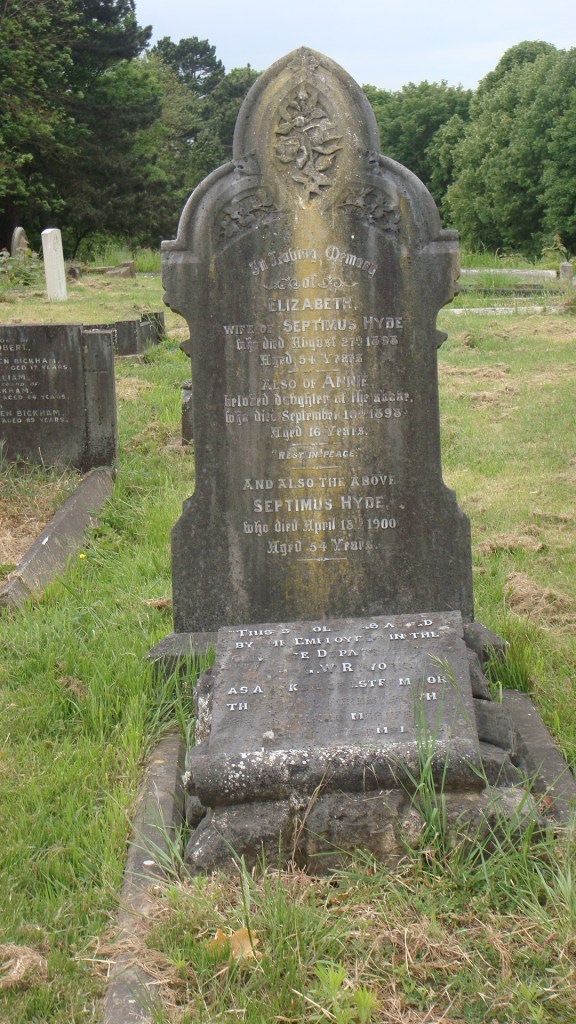
“Mr Septimus Hyde.” We paused while she read the inscription. “The story goes that he chose this plot because he could see his house from here.”

I looked around. The gardens on Clifton Street were clearly visible from this point, as the cemetery must be to those who lived in them. I assumed Mr Septimus Hyde must have lived there. I’m not sure how I’d feel about living alongside a cemetery.

“He must have had good eyesight,” she said, “he lived in Exmouth Street.” She looked at me with a twinkle in her eye. “Come on – I need a drink, and I don’t mean a cup of tea.”

This was the weirdest first date I had ever been on – but what can you expect when you’re pushing 80 – at least I’m not pushing up daisies.

The eldest child of Henry Hyde, a tailor and his wife Elizabeth, Septimus was born in Worcester on May 26, 1846. He married Elizabeth Sturge at St. Peter’s, Worcester on August 2, 1868.

The UK, Railway Employment records, 1833-1956 state that Septimus Hyde re-entered the GWR as a Foreman in the Carriage Body Makers Shop on August 5, 1871. At the time of the 1881 census Septimus and Elizabeth were living at 5 East Street, New Swindon with their three children Frank E., Septimus G. and Robert.

Death of Mr. S. Hyde

A G.W.R. Foreman

Deep regret was expressed throughout the GWR Works, at Swindon, on Wednesday in last week, and especially in the Coach Body Making Department, when it was known that Mr. Septimus Hyde had passed away at his residence, No. 58, Exmouth Street. Deceased, who was born on May 26th, 1846, was during his long service as foreman of the coach body making shop, a very popular official. He was ever kind and thoughtful to his men, willing at all times to hear their troubles and to give them advice. As a foreman he will be greatly missed both by his employes and by the GWR Company, to whom he was ever a very faithful servant. Deceased had been unwell for some time past, suffering from paralysis of the brain, but in spite of his doctor’s orders to stay at home he would be at his post. So late as Saturday the 21st he was in the works attending to his duties. Later in the day he had a stroke from which he did not recover, and passed away at  noon on Wednesday, deeply mourned by all who knew him.

Deceased served his time with the Oxford, Worcester, and Wolverhampton Railway Company at Worcester, a line afterwards taken over by the GWR Company. When out of his time he worked at various places until August 5th, 1871, when he entered the service of the GWR at Swindon. Three years later, on August 8th, 1874, he was appointed foreman of his shop, which position he held till the time of his death. The Royal train used for the Diamond Jubilee and subsequent journeys was made under his supervision. He leaves a grown up family to mourn their loss, his wife having predeceased him.

The deep respect in which the late Mr. Hyde was held in Swindon generally, and in the GWR Works in particular, was evidenced by the large attendance at the cemetery on Saturday afternoon, when the remains were interred in the family grave, where some eighteen months ago the deceased’s wife and daughter were buried. Hundreds of the employes at the works took part in the funeral procession, and a large crowd awaited the arrival at the Cemetery.  From the home the body was taken to St. Saviour’s Church, where a short service was conducted by Canon the Hon. M. Ponsonby, who also performed the last rites at the graveside….

The coffin which was of polished elm, bore the following inscription: “Septimus Hyde. Died April 18th, 1900: age 54 years.” A large number of wreaths and tokens of respect and sorrow were sent by his fellow employes and relatives.

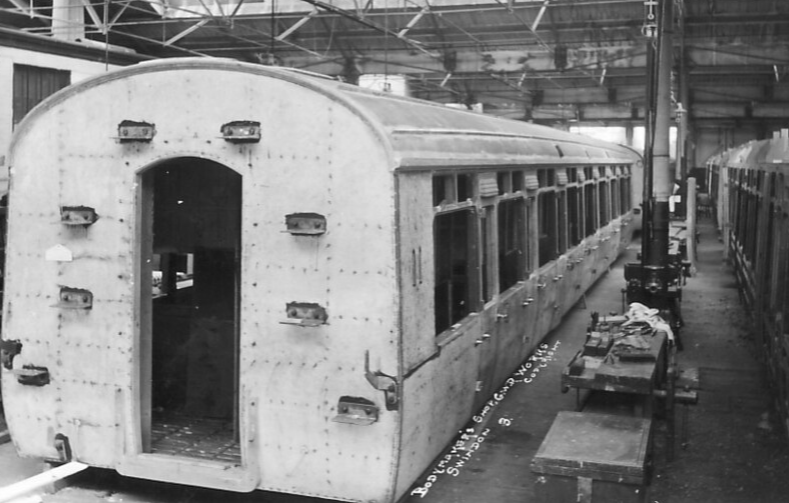
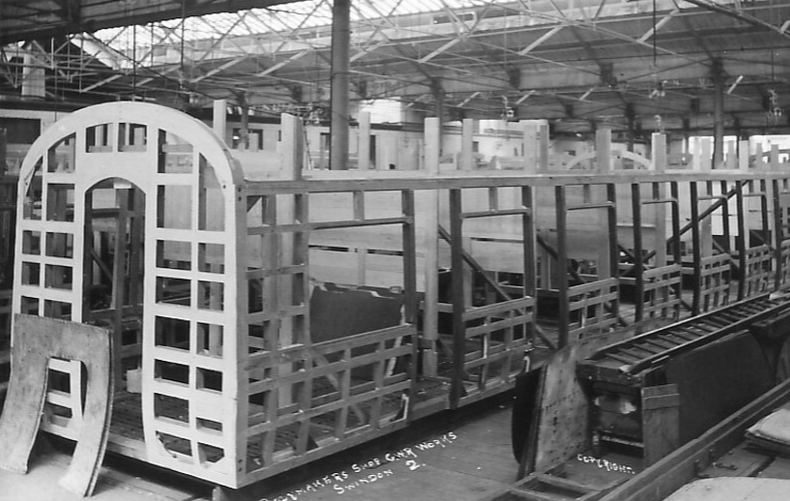
All images of the Bodymakers Shop are published courtesy of P.A. Williams and Local Studies, Swindon Central Library

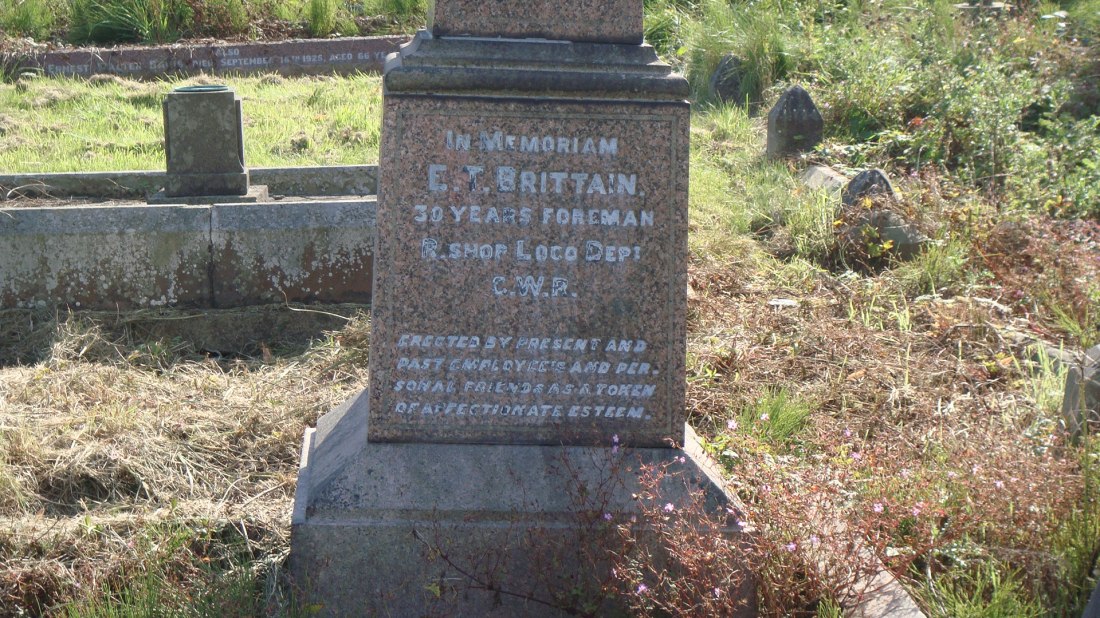
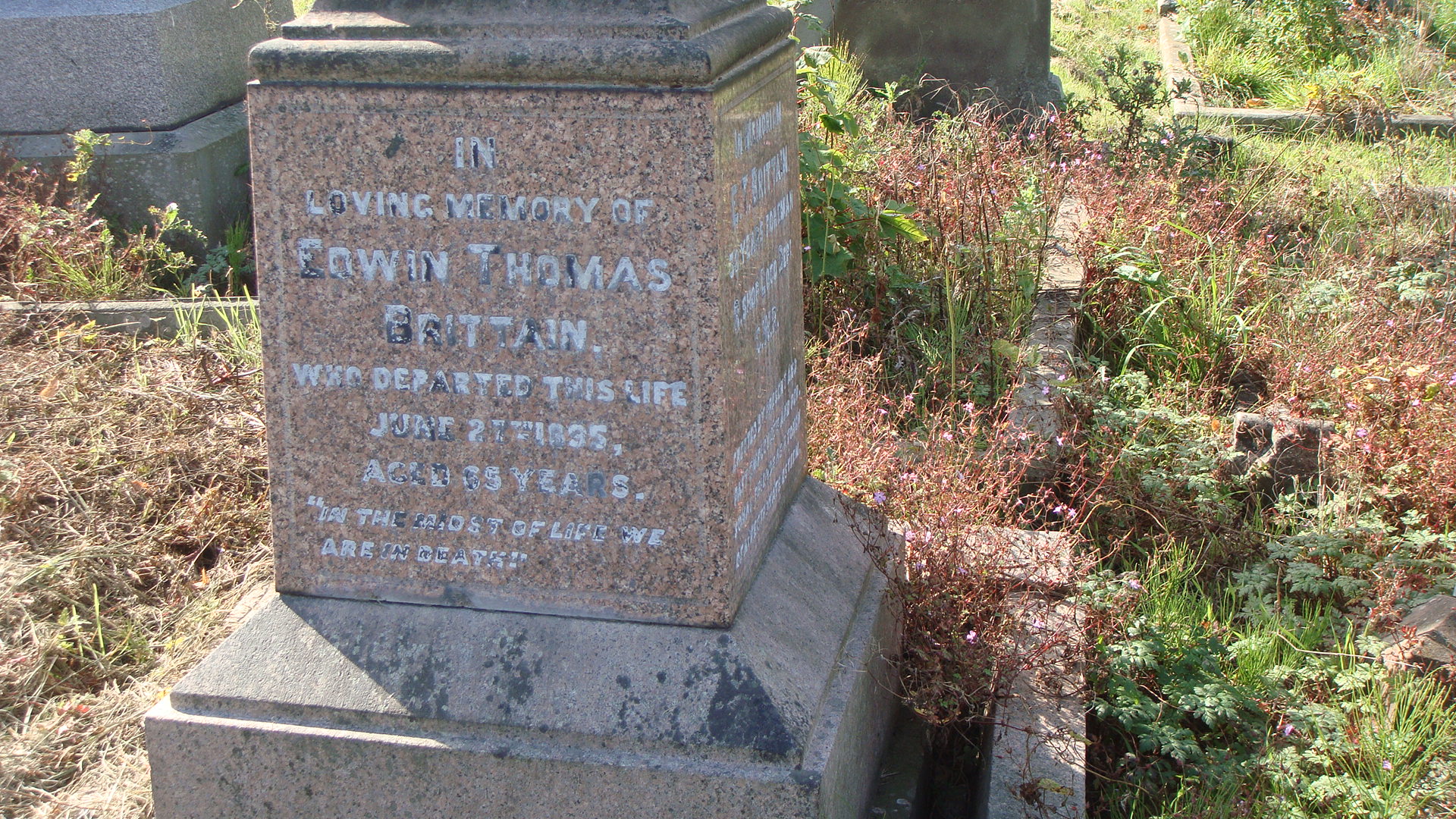
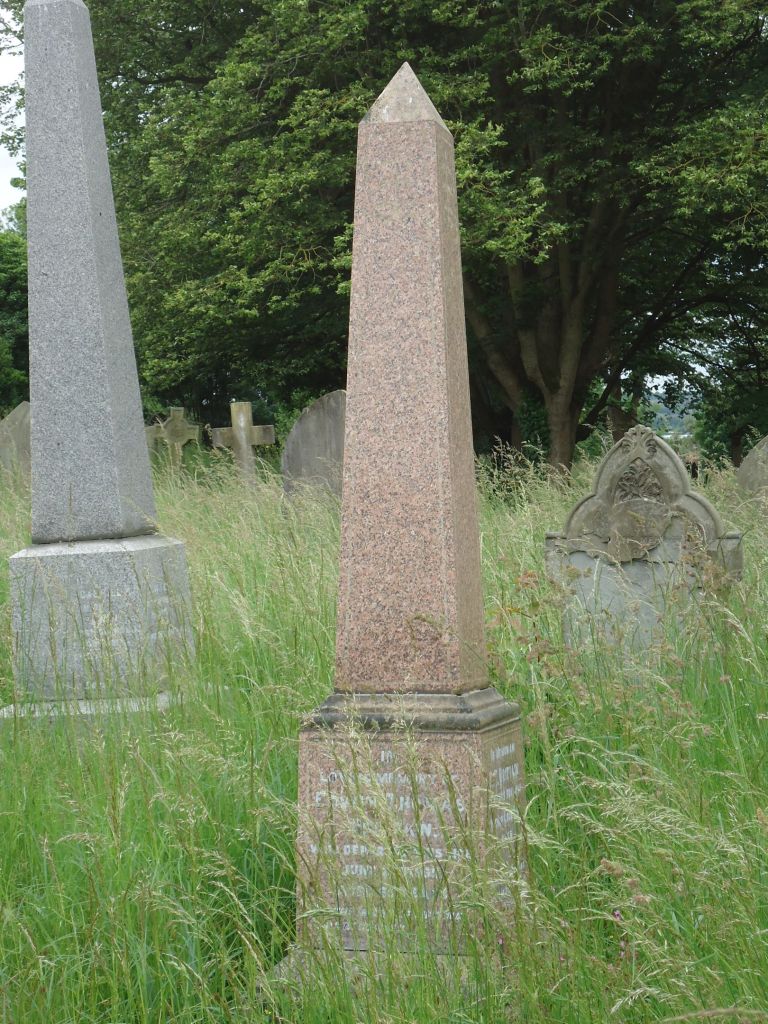
Edwin Thomas Brittain – oldest foreman in the Works

The re-imagined story …

Gran loved a good funeral. She especially liked the ones held at St Mark’s where Canon Ponsonby officiated as he had such a lovely voice, she said. But she wasn’t adverse to attending services at one of the many non conformist churches or chapels across town, or even the little cemetery chapel itself.

And afterwards she would come round to our house and over a cup of tea she would recount the events.

Mr Brittain’s funeral ranked as one of the best she had attended, she told us. The list of mourners read like a Who’s Who of Swindon railway royalty, she said.

As a child I accepted Gran’s funeral fascination as just one of the funny things old people did. Most things about the elderly were pretty incomprehensible to the young. It wasn’t until Gran died that I began to understand.

Gran had been born at a time when death was very much a part of life. Before she was ten years old she had lost her own mother and several siblings. Today we tend to think people must have become used to all that death and dying. One child died and the next one born received their name. Perhaps people didn’t invest so much love in their children then as we do now. Of course once I had my own family I realised what a ridiculous notion that was and I came to understand the loss Gran continued to mourn throughout her life.

Mr Brittain’s funeral was one of the best she’d ever seen, Gran told us.

E T Brittain 4

The facts …

The Late Mr E.T. Brittain – We gave a brief account in our last Saturday’s issue of the sudden death of Mr E.T. Brittain of Wellington-street, New Swindon, the esteemed foreman of the R. Shop (Loco. Dept.) of the GWR Works.

Mr Brittain, who was 65 years of age, was well-known in New Swindon. For many years he occupied a seat on the Council of the Mechanics’ Institute, and for 17 years he was a director of the New Swindon Industrial Society, and during the last 12 years he ably filled the office of chairman. Deceased also took a great interest in political matters; he was a staunch Conservative, and at the time of his death was treasurer of the North Wilts Conservative Association.

His position in the GWR Works was unique, as he was the oldest foreman in the Works. He commenced as assistant foreman in the R. Shop, the principal fitting and machine shop, under the late Mr James Haydon. Upon that gentleman being appointed as Assistant Works Manager, Mr Brittain continued in the same capacity under Mr E.J. Davies. When some 20 years ago, Mr Davies obtained the appointment of the managership of the Engine Department of Messrs Ransomes, Sims and Jefferies, Limited, Ipswich, Mr Brittain was appointed to the chief foremanship, a position which he held and worthily filled to the day of his death.

We understand that for many years nearly all the fitter, turner and erector apprentices received their early training under Mr Brittains’s management and we are sure that his lamented death will come as a great shock to engineers who have been trained under him, and who are to be found at most centres in the world where engineers are employed.

The funeral of deceased took place on Monday last, and was the occasion of a striking demonstration of respect on the part of the officials and workmen of the GWR and the various bodies with which deceased was connected, as well as the general public.

The funeral cortege left deceased’s late residence in Wellington-street at half-past four, and proceeded to St Mark’s Church, where the first portion of the service was conducted by the Vicar, the Hon. and Rev. Canon Ponsonby, who also read the concluding service at the graveside in the Cemetery.

There were five mourning carriages, and the chief mourners included deceased’s three sons and brother-in-law. Deceased being an old Volunteer, eight members of the New Swindon Companies attended as bearers. Nearly 400 persons followed the remains from the church to the graveside, and the route was lined with spectators, besides which a vast crowd assembled in the Cemetery. Some idea of the extent of the procession may be gathered when we state that it extended from the Cemetery entrance throughout the whole length of Radnor-street.

The coffin was covered with an immense number of beautiful wreaths and crosses and other floral offerings. Amongst the mourners, besides deceased’s relatives, we noticed Mr. D.E. Marsh (Loco. Dept.), Mr J. Fordyce Stevenson (district engineer), Mr F.C. Kent (district estate agent), Mr Webb (representing Mr Carlton), Messrs. T.B. Watson, A. Adams, W.H. Ludgate, E.L. Pugh, Theo Wright, R.B. Pattison, W. Mole, W. Hunt, T. Veness, W.H. Lawson, J. Ireland, T. Stone, T. Money, H. Green, G.M. Butterworth, R. Baker, A. Nash, W. Booth, W. Harvie, R. Affleck, H.J. Southwell, F. Tegg, W. Sewell, D. White, J.D.R. Phillips, T. Spencer, H. Morris, R. Chirgwin, H. Wright, L. Dyer, H. Andrews, J. Christelow, E.Y. Westlake, E. Harvie, R. Hogarth, W. Morrison, R.N. Sutcliffe, E. Burns, W. Clark, J.S. Protheroe, W.J. Greenwood, C. Fox, T.C. Morgan etc. etc. The funeral arrangements were satisfactorily carried out by Mr H. Smith. Mrs Brittain and family desire to thank the many kind friends for the expressions of condolence and sympathy in their recent bereavement.

The Swindon Advertiser, Saturday, July 6, 1895.

20240807_143421[4011]


Edwin Thomas Brittain pictured centre – published courtesy of Rosa Matheson – Railway Voices ‘Inside’ Swindon Works

Edwin Thomas Brittain was born in the parish of St Pancras on November 21, 1829, the eldest son of Henry James Brittain, an undertaker, and his wife Charlotte.

He married Louisa Elizabeth Hooker at Trinity Church, St Marylebone on January 11, 1852 and the couple soon moved to Wolverton in Buckinghamshire where Edwin was employed at the London & North Western engine works. Their son Thomas is born in Wolverton but by 1853 the family have moved to Swindon.

Edwin Thomas Brittain entered the GWR Service on July 26, 1853 working as a Fitter in the Loco factory. He was made Assistant Foreman on October 7,1865 and Foreman on January 12, 1867.

At the time of the 1861 census he was living at No 6 King Street with Louisa and their five children. The couple had nine children in total, moving to Wellington Street where they lived at No 18 and No. 39 at various times over the next twenty year period.

Edwin died at his home at 39 Wellington Street on June 27, 1895. He left effects to the value of £181 5s 2d. Louisa survived him by eighteen years and is buried here with him.

William Harvie and the amazing Multiple Cake Cutting Machine

The re-imagined story …

There are two highlights in the Swindon calendar for the children – Trip, when the Works shut down for the annual holiday and we go to the seaside, and the Children’s Fete, and I can never sleep the night before either of them.

Preparations for the Children’s Fete begins well in advance and I have first-hand knowledge of this as my father is on the Mechanics’ Institute Council and our whole family is involved.

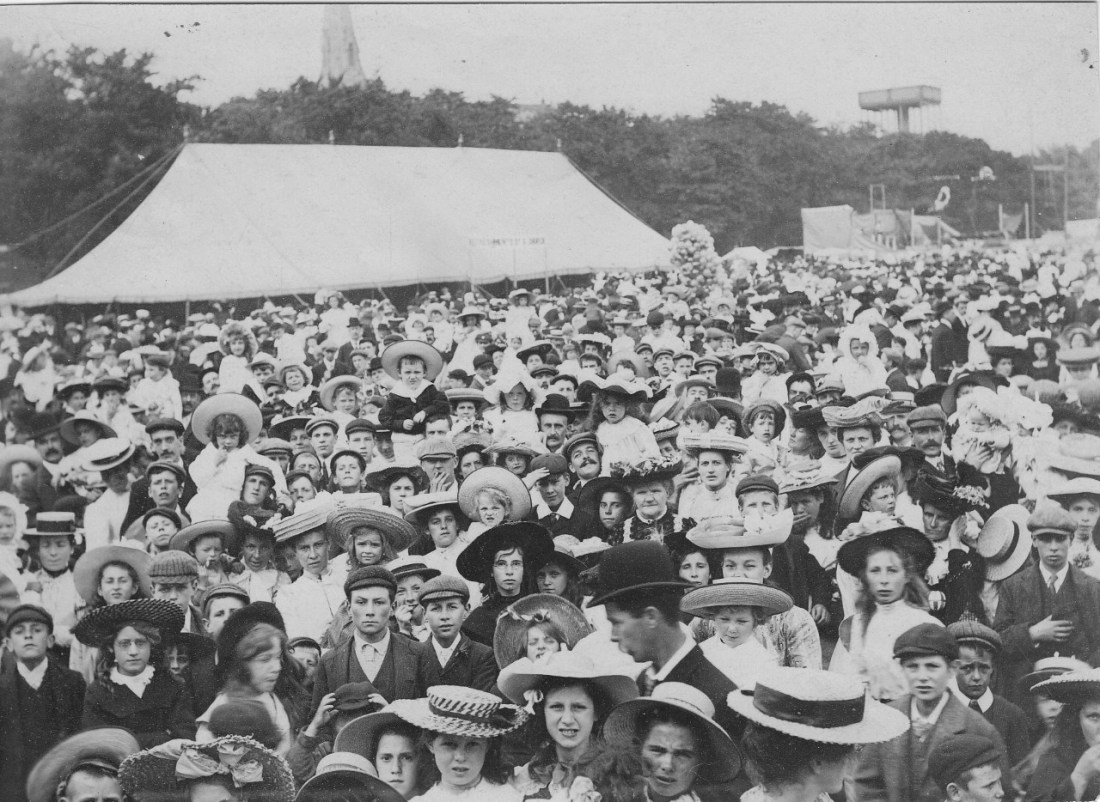
The fete takes place in the GWR Park, the gates open at half past one. Tickets cost 3d for adults and 2d for children. The children receive two free rides on the steam roundabouts, a drink of either tea or oatmeal water and a piece of cake.

For weeks beforehand we save every penny, ha’penny and farthing we can; never have so many errands been run, so many jobs done about the home.

The familiar GWR Park becomes kaleidoscopic with rides and stalls and fairy lamps festooned around the Cricket Pavilion and the bandstand. Entertainments on the central stage take place throughout the afternoon; comedy acrobats and trapeze artistes and trick cyclists and one year there was even a troop of performing dogs. Mr Harvie is the chairman of the fete committee and director of amusements but this isn’t what he became best remembered for.

The event runs like a well-oiled machine, which is hardly surprising as it is organised by some of the most well qualified and experienced engineers in the railway works. And perhaps the greatest feat of organisation is the cake.

The quantity of cake required was enormous, amounting to no less than 2 tons 13 cwts. The job of baking it went to Mr E.P. Monk of Old Swindon who produces annually approximately 1,200 cakes weighing 5lbs each. Next comes the task of cutting the cakes into half pound slices, a job which had previously fallen to a handful of volunteers. It used to take 12 people approximately six hours to cut up and bag the cake. And then Mr Harvie invented the Multiple Cake Cutting Machine.

At this year’s event Mr Harvie’s new improved machine will be used for the first time. The machine, a dangerous looking contraption, is composed of crossed knives, balanced on spiral springs, which hover above each cake. The average speed of this new machine being no less than 6 cakes, or 60 half pounds per minute. The cakes are fed into the machine on 12 wooden trays by an endless band on rollers worked by the handle at the end of the machine, and here Mr Harvie has introduced another novelty in the shape of an electric bell, which is so adjusted that when the tray reaches the exact centre of the knife it strikes two levers and forms an electric communication with the bell, which commences ringing, and continues to do so until the cake is cut. The tray then passes on with the cake to make room for the next. When the tray on which the cake is cut reaches the end of the machine, it runs on an inclined board which carries it to the packers.

So exciting is the whole process that I think it should form part of the entertainments on the fete stage. Perhaps I’ll suggest that to Mr Harvie for next year.

My fete dress hangs on the back of the bedroom door. My hat, decorated with ribbons and flowers, sits on the dresser. I open the curtains a crack, it is not quite dark yet. Early tomorrow morning my father will join the others assembling the stage. I squeeze my eyes tightly shut. I must go to sleep, I must go to sleep.

children's fete cake cutting

The facts …

William Harvie was born in Islington, London in c1849. He began his career as a coach trimmer in Birmingham where he met and married his first wife, Susan Newman, at St Peter and St Paul’s Church, Aston. Susan was a widow with a young son. By 1871 the couple were living at Rushey Platt with Susan’s son Edward and two children of their own, Henry and Louisa. They would have a third child George William. The family lived at 15 Faringdon Street for a number of years and by 1891 William had been promoted to foreman.

He served as foreman over the women in the polishing shop, and during the 1890s he was responsible for organising the entertainment for the ‘annual tea of the female staff employed in the Carriage Department.’ He even performed a couple of humorous songs, said to have contributed to the event.

By the time of Susan’s death in 1906 they were living at 6 Park Lane. Two years later William married again. His second wife was Alice Elizabeth Turner. She died in 1921 at their home 92 Bath Road but does not appear to be buried in Radnor Street Cemetery.

William died in 1930. Details of his estate were published in various newspapers, including the Daily Express.

‘A Black Country working lad who, in his spare time, played in a theatre orchestra, became a railway foreman, and dabbled in stocks and shares during fifty years’ service, has died worth nearly £44,000. The workers of this great railway centre used to dub William Harvie of Bath road, Swindon, “the wealthiest workman in England,” but even they were surprised when his estate was announced, and the sole topic of conversation in the town was the large sum he left. He was 84 when he died last October, a widower, and intestate.’

A notice in the Western Morning News reported that he was instrumental in building the first saloon railway coach for Queen Victoria but there is no mention of his famous invention, the Multiple Cake Cutting Machine.

William is buried in plot D14a with his first wife Susan. They were later joined by their elder son Henry.

Susan and William Harvie

13 Wellington Street

The re-imagined story …

Number 13 Wellington Street was perfect, just perfect. I knew it would be. I had a look at the property as soon as I heard it was going on the market; only from the outside, that is.

Eric took some persuading.

“It wouldn’t hurt to ask for a viewing.”

 “We won’t be able to afford it Lil. It’s got four bedrooms. Why set yourself up for a disappointment?”

The house belonged to Mr Goudge who worked in the offices at the Works. He was a fair and honest man. I hoped the house would sell at a price we could afford with the help of a small mortgage.

We had been saving hard, well as hard as you can with two children and another on the way. Eric was earning good money as a fitter in the Works and mum didn’t take much money off us in the way of board. But now she was expecting another child and the house in Reading Street was just too small to accommodate all of us.

A clerk from Mr Kinneir’s office met us at No 13. The front garden had a neat little square of grass surrounded by rose bushes all neatly pruned back for the winter, the iron palisades freshly painted. As we were led through the gate and up to the front door, I imagined myself turning the key in the lock.

It was beautiful inside. At the front of the house a drawing room led off from the hall with a dining room at the back. The kitchen overlooked the back garden.

Mrs Goudge was there to greet us. She showed us upstairs. The boys’ bedroom was at the back of the house, her two daughters slept in the smaller one at the front. Both rooms were light and airy; the girls’ room was so pretty with pink rosebud wallpaper.

“We’ll be leaving the gas fittings and the Venetian blinds,” she told us.

We ended up renting a little house in Westcott Place. I made it home. I even papered the second bedroom; pink rosebuds for the girls. We were very happy living there, but I often used to take a walk down Wellington Street and ponder on what might have been.

Joseph Goudge
Mr Joseph Goudge

 The facts …

Joseph Goudge was born on November 8, 1842 in Westminster, the son of James, a dressing case maker, and his wife Annie Elizabeth. Joseph was baptised at St John the Evangelist, Westminster on December 11.

By 1859 16-year-old Joseph was living in Swindon where he entered the employment of the GWR as a clerk on August 1. Two years later he is recorded on the 1861 census as lodging at Belle Vue Villas with George Dicks and his wife Jane.

Joseph married Mary Hall on June 10. 1868 at Christ Church, Swindon. The couple had six children, but sadly one died in childhood.

The couple lived first at 32 Prospect before buying the Wellington Street property. By 1891 they were living at 4, Brunswick Terrace, Bath Road (later known as 94 Bath Road) which remained their home.

 Joseph progressed up the career ladder from clerk to accountant. He served as Education Secretary of the Mechanics’ Institute and also as Secretary of the New Swindon Improvement Company. He worked within the co-operative and trade union movements in the town and was also a Freemason and member of Gooch Lodge. He was a talented calligrapher and produced certificates, memorials and testimonials.

Mary died on January 1, 1916 and Joseph on Christmas Eve, 1916. They are buried together in plot A1065.

Among the staff.

Swindon. – The clerical staff of the chief Locomotive Superintendent has recently, in consequence of retirement under the age limit of Mr. Joseph Goudge, lost one of its most valued and capable members. Mr Goudge, who was born in 1842, entered the Company’s service on 1st August, 1859, and undertook increasingly important work, eventually having charge of the Chief Superintendent’s statistical office. In this capacity he rendered valuable service in the preparation of statistics affecting the Locomotive and Carriage Department in connection with legal and parliamentary business, and working arrangements with other companies. One of his many other important duties was that of examining candidates for clerkships in the department.

Mr. Goudge had the honour of taking up the Freedom of the City of London in the Haberdashers’ Company in 1863, on the same day, curiously, as a brother of the late Mr. William Dean. It is interesting to note that Mr. Goudge’s three sons gained various scholarships in connection with that Company and at public schools, finally winning open scholarships at Oxford.

Mr. Goudge joined the Volunteers on the formation of that body, and served for ten years. Always an earnest advocate of educational work he became a member of the Council of the Mechanics@ Institute in 1867, was appointed educational secretary and continued so for twenty-five years.

The deep respect and esteem in which Mr. Goudge was held by his colleagues was expressed in a tangible manner by the presentation of a cheque and illuminated address signed amongst others, by the Chief Superintendent and his assistants, the Stores Superintendent and other officials.

Great Western Railway Magazine May 1908

No 13 Wellington Street.

The House has a flower garden in front, with iron palisading, and contains an entrance hall, dining room, drawing room, 4 bedrooms, kitchen, and pantry. Outside are wash-house, with copper, closet, and coal house, and there is a Garden, with backway. The House has a frontage of about 20 feet, and is of the estimated rental value of £30 per annum, exclusive of rates. The gas fittings and Venetian blinds will be included in the sale.

The above, being situate in a favourite locality, where Houses are much in demand, forms a desirable House for investment or occupation. The same is in a good state of repair, and early possession will be given.

To view, apply to Mr Joseph Goudge the owner, and for further particulars to Messrs Kinneir and Tombs Solicitors Swindon or to The Auctioneers Faringdon Street.

Swindon Advertiser 6 December 1890

Joseph and Mary Goudge

Luke Higgs – a first class engineman

Luke Higgs

I could see Mr Higgs next door, standing at the bottom of his garden, looking out over the old canal. He was there most mornings, just standing and staring.

I picked up my basket of laundry and opened the back door. I could spare a few minutes chatting to him while I hung out the washing.

“Morning Mr Higgs,” I called. “Bit breezy! This washing should dry quickly enough.”

He was dressed in shirt sleeves even though it was a chilly January morning. I suppose he was used to being out in all weathers. He once told me that the old locos were open to the elements; no cab over the engineman then. Life for the drivers was hard in those early days.

It was all he talked about – the old days. The journeys he had done with the Royal family, how much the job had changed over the years.

He was hungry for news from the Works, but he had few visitors. Everyone was too busy, but I tried to find a few minutes in the day to talk to him, although I couldn’t bring him the conversation he wanted.

“Fifty-two years and two months, I worked for the Company,” he proudly told me, “and an unblemished career. I’m still fit and able to work but these new rules meant I had to retire.”

I’d read the newspaper reports published when he retired at Christmas. My husband Jack told me how Mr Higgs had fought the retirement ruling, but there was nothing the Company could do.

“I think he’d have taken any job going, but it just couldn’t be.”

I wasn’t so sure about that. Mr Higgs believed he was still fit enough to drive locos and that’s what he wanted to do. I don’t think a caretaker’s job would have suited him.

He turned his back on me as I started to peg out my washing. He didn’t seem to want to chat today.

“Everything alright Mr Higgs?”

He looked across towards the railway line.

“The wind must have changed direction,” he said. “I can’t hear the trains today.” He turned around and walked slowly back up the garden path.

“I think we might have some rain. Your washing won’t dry after all.”

canal route

1950s photograph of Faringdon Road and the route of the old Wilts and Berks Canal

The facts …

Luke Higgs was born on December 3, 1834 and consistently gave his place of birth as London, Tower on census returns.

He married Margaret Beaupre in Bourne, Lincolnshire in October 1859. At the time of the 1861 census the couple were living at 20 Bath Street (now known as Bathampton Street) in the railway village, however their first child, a daughter Annie Agnes, was baptised at Holy Trinity Church, Paddington when they were living at 16 Waverley Road. The couple went on to have four more children and by 1871 the family was living at 19 Brunel Street. They soon moved to 8 College Street, their home for more than 40 years.

Luke entered the employment of the Great Western Railway in October 1852 just a few weeks before his 18th birthday. He worked first as an engine cleaner and lighter up before become a fireman in 1855. By 1861 he was working as an engineman and in a career that spanned more than 50 years.

Luke Higgs died at his home, 8 College Street, on March 12, 1913 aged 78. He left effects valued at £707 11s 3d (later resworn £642 11s 3d) to his wife. Margaret outlived him by a further twelve years. She died at 8 College Street on October 29, 1925 aged 90. They are buried together in plot D950 where they were later joined by their daughter Margaret Easley who died in 1953 and their grandson Elliott Tuckwell who died in 1967.


Retirement of a Railway Veteran

Over 50 Years’ Service

Mr Luke Higgs, of Swindon, who has just retired from his duties as driver on the Great Western Railway through the operation of the age limit of 70 years, has probably achieved a record of service, having been no less than 52 years and 2 months in the employ of the Company. It is remarkable that notwithstanding his great age he enjoys the best of health and looks a robust, able bodied man. He passed the eye sight and health test of the GWR doctor on 13 occasions, and when he passed last time his sight was exceptionally good.

Mr Higgs was born in London on December 3, 1834, his father being a noncommission officer in the Scots Fusilier Guards. Early in life he joined the service of the GWR and has grown in age with the railway, seeing many different systems in vogue during the half century. Improvements in the working of locomotives have of course come under his notice more particularly than any other, and he speaks of the time when there was no protection on the engines beyond the fire box, and no leg plates or cab, no steam pressure gauges, and no dry sand boxes. Those were hard times for enginemen, and great judgement was required to work the trains in safety.

He was fireman on the engine which took the late Prince Consort from Windsor to open Saltash Bridge in June 1857, and also filled a similar capacity on the train which conveyed the present King to Oxford, to open his college education, on Monday, Oct. 17, 1859. Not only that, but he has been fireman several times on the Royal train between Paddington and Windsor.

It is interesting to note that he was made a permanent engine driver the same day as the late Prince Consort died – December 14, 1861 – and ever since he has held a good reputation, so that when he retired there was not a black mark against his name. We are given to understand that he has the cleanest record on the Great Western line. In his career he has never lost an increase in wages or a premium, and has received from the Company £325 for good conduct whilst in their employ.

His varied experiences are of more than ordinary interest, and he modestly tells of incidents which would have turned but disastrously had it not been for his prompt actions. His advice in working trains has been frequently sought after by younger men, and many a good driver have been turned out of his engine. He was most economical in his work and studied the Company’s materials as though they were his own.

He is held in the highest esteem by all the officials with whom he came in contact, and all regret his retirement. The doctor who signed the last certificate said that Mr Higgs was well able to work for another five years, but of course the age limit had to be observed.

North Wilts Herald January 28th 1905

Luke and Margaret Higgs
Luke and Margaret Higgs with one of their daughters. Published courtesy of philstree18 from a public family tree on Ancestry.