Minnie Price – Thanks for everything

Minnie Price could so easily have slipped out of the pages of history. As a single woman she left no children to tell her story, but she did leave someone who remembered her with affection and made sure the world knew of their gratitude.

In loving memory of

Minnie Price

who died 7th March 1959 aged 91

God Bless You

Thanks for everything

Minnie was born on July 19, 1867 the daughter of John Price, a pudler in the GWR Rail Mills, and his wife Mary. By 1881 13 year old Minnie was out at work, employed by James Chisholm Wilson, a grocer with premises at 72 Regent Street. James’s wife Jane had recently given birth and young Minnie was employed as a nurse to care for both mother and child.

Minnie continued to live a life in service and in 1911 she was working as a housekeeper and recorded as a visitor at Richard Smith’s home in Didcot. Visiting with her was 10 year old Clifford Eugene Price. Clifford was born on November 19, 1900. He can be found on the 1901 census living in Barry – the 5 month old son of Arthur Price and his wife Jane. Arthur Price was Minnie’s elder brother.

The 1911 census finds Arthur back in Swindon and living with his father at 68 Curtis Street. Widower John Price is 82 years of age, a retired labourer who has several boarders living with him. Arthur is 49 years of age, also a widower and in 1911 has no job. He died in 1926 but cannot be found in the Radnor Street Cemetery burial registers.

In 1915 Clifford Eugene Price is also living in Swindon when he began work as a Machine Boy in the GWR Works Loco factory. By 1917 he was working as an engine cleaner and in 1918 he was a fireman, well on his way to becoming a loco driver. From July to September 1938 he was employed as ‘acting driver.’ At the time of the 1939 census he was living at 68 Curtis Street with Minnie and he states that he was working as a Loco Engine Driver. But by 1946 his mental health had taken a downward turn. His employment records reveal that at his regular annual medical examinations he suffered from ‘neurosis’, ‘nervousness’ and ‘nervous exhaustion’.

Clifford lived with Minnie for most of his life and I feel sure that he was the person who chose those words on her gravestone.

God Bless You

Thanks for everything
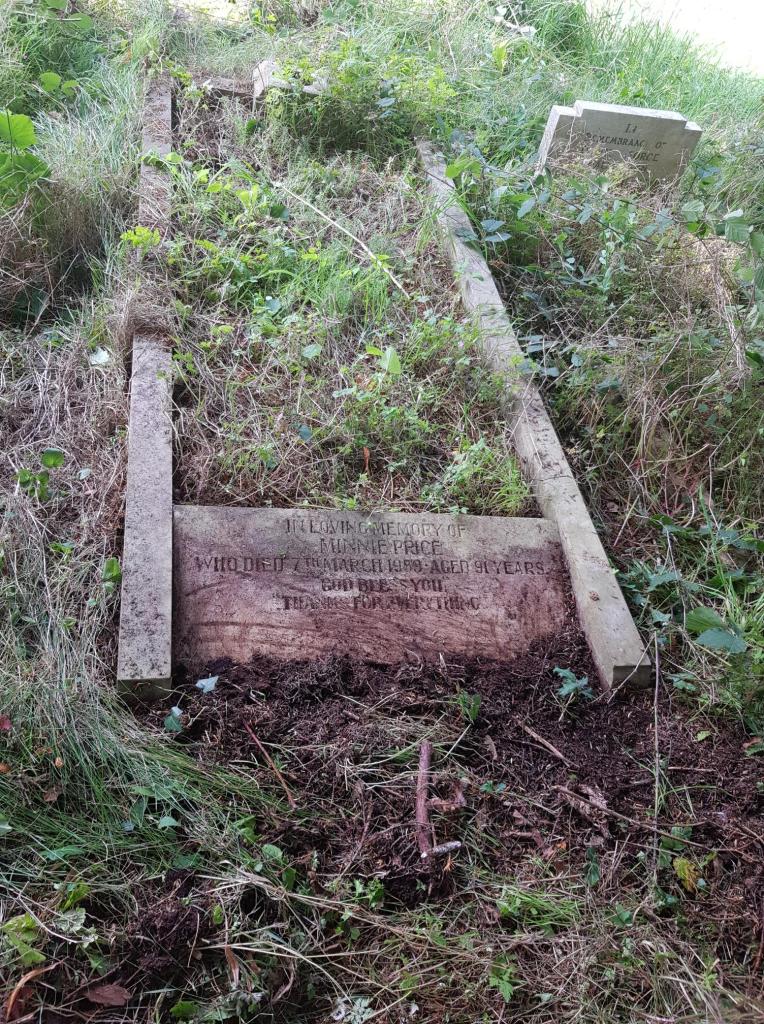
Minnie died at her home 48 Euclid Street and was buried in Radnor Street Cemetery on March 11, 1959. She shares this plot with her mother Mary, who died in 1900 and her father John, who died in 1920.

Clifford died at 48 Euclid Street on July 21, 1972. He is not buried in Radnor Street Cemetery.

This gravestone, recently cleared by one of our cemetery volunteers, has saved the story of both Minnie Price and her nephew Clifford.
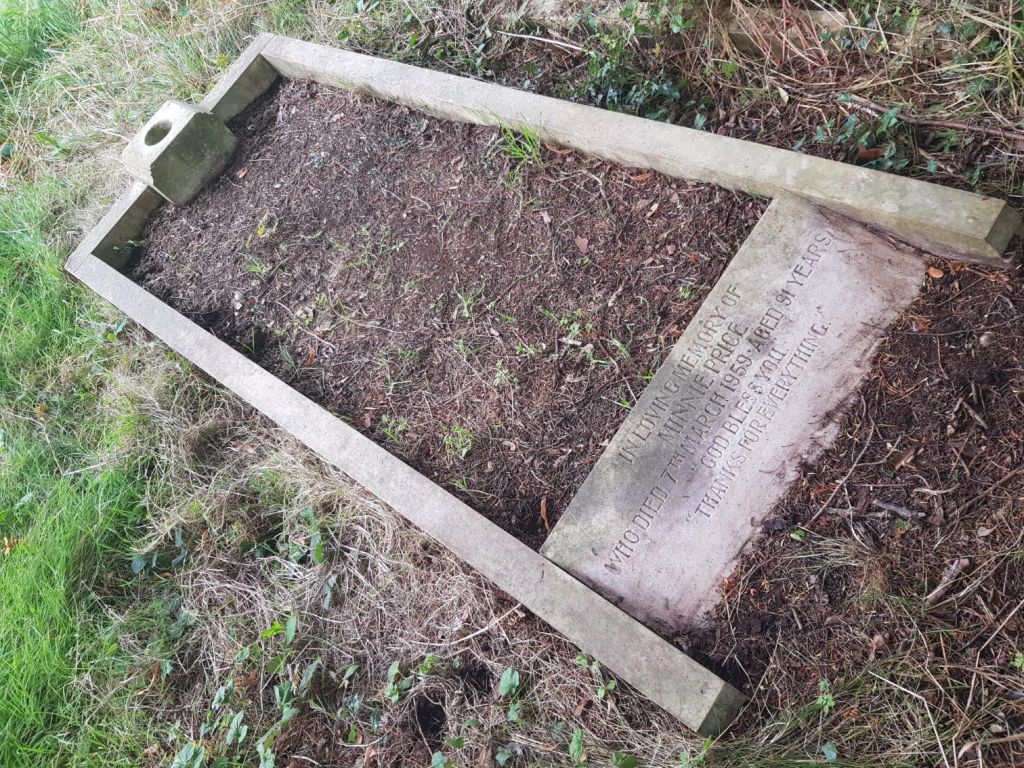
Our cemetery volunteer has returned and completed the clear up of Minnie Price’s grave.

George Richman Alley and his family

And just when I thought I’d seen all the Alley family photos, along came two more.

George Richman Alley was born in Trowbridge in 1841, the son of Job Alley, a dyer.  He moved to Southampton in around 1860 where he worked as a Coach Body Maker and in 1865 he married Emma Jane Ross, the daughter of a mariner.  By 1881 they had moved to Swindon where George worked as a wheelwright body maker in the GWR Works.  The couple lived first at 3 Carfax Street and then at 8 Merton Street where George died in 1925.  Emma survived him by seven years.

George and Emma had one son, George pictured in the back row of this photograph, and seven daughters.  Four of the daughters lived into their 90s and one reached her 100th birthday. Only one of the daughters left the Swindon area, of the other six, four went into business in the town.

Eldest daughter Emma trained in London as a ladies tailor before her marriage to Walter Lloyd Hull, a Bournemouth shopkeeper.

Following her husband’s death in 1947 Emma returned to live in Swindon.  Then in her 80s she became a member of the Swindon Business and Professional Women’s Club and was active in many other organisations in the town, including the Richard Jefferies Society and the WEA.

In 1954 Emma gave a talk to the Women’s Club about her involvement with the suffrage campaign. when she had been an active member of the Women’s Freedom League and was arrested on several occasions and imprisoned. At these talks she was said to have worn a badge carrying an engraving of Holloway prison pinned to her dress.  Other suffragette souvenirs she had were a cocoa mug and a salt pot smuggled out of Holloway and a Votes for Women banner.

Second daughter Maud, a dressmaker and upholsterer, married Henry John Lewis, a bootmaker and moved to Chippenham. Third daughter Mabel held the role of Postmistress at Westcott Place for more than 50 years and on the New Year’s Honours List of 1960 she was awarded the British Empire Medal in recognition of her service to the community.

Fourth daughter Amelia Ann, the only daughter to never marry had a milliners business at No. 90 Victoria Road which she ran with her sister Ethel (sixth daughter) until she married Wilfrid Hewer and together they ran the Oddfellows Arms in Cricklade Street. Fifth daughter Flora became a teacher. She married William Harold Hall and lived at 42 County Road.

Youngest daughter Eva pictured standing between her parents, married George Babington on March 1, 1911 at the Baptist Tabernacle.  Eva and George ran a draper’s shop at 92 Victoria Road, next door to her sister Amelia’s millinery shop.

The following photograph was published following the death of George in 1925.

In reference to the death of Mr George Alley, of Swindon, the above photograph of members of the family is of interest from the fact that all were over 80 years of age. Left to right: Mr George Alley (85), Anna Alley (86), Louisa Alley (82), Martha Blatcher (84), and Fred Alley (80). Of the present living members the Misses Anna and Louisa Alley live at The Halve, Trowbridge, and Mr Fred Alley at 8 Merton Street, Swindon.

North Wilts Herald, Friday, December 4, 1925.

And so perhaps the reporter from the North Wilts Herald got a fact or two incorrect. With an exuberant and irrepressible family such as the Alley’s it’s easy to get confused.

The Late Mr G. Alley

A Well-Known Resident of Swindon

By the death of Mr George Richman Alley, of Merton Street, Swindon has lost one of its best-known residents. Deceased, who was 84, came to Swindon from Salisbury 51 years ago, when he entered the service of the Great Western in the Carriage Department. For nearly 25 years he was in charge of the road wagon department and he relinquished his position as foreman 18 years ago, when he entered upon a well-earned period of retirement. Had Mr Alley lived until Christmas he and his wife would have celebrated their diamond wedding, and a pathetic feature of his demise is that one of his daughters was at home at the time making preparations for the celebrations. Deceased leaves seven daughters, five of whom reside in Swindon, one in Bournemouth and one in Chippenham. His only son is a retired naval engineer, and lives in Suffolk. Deceased’s only brother, Mr Fred Alley, who is 80 years old, is the secretary of the GWR Retired Workmen’s Association. He celebrated his diamond wedding 12 months ago.

The funeral took place on Tuesday, a short service being previously held at the house. The coffin was followed to the graveside by deceased’s only son, his six sons-in-law, representatives of the Foreman’s Association and the Baptist Tabernacle.

North Wilts Herald, Friday, December 4, 1925.

George Richman Alley died aged 84 years at his home 8 Merton Street. His funeral took place in Radnor Street Cemetery on December 1, 1925. He was buried in grave plot D31A. Emma Jane Alley died aged 87 at 12 Park Lane and was buried with her husband on October 29, 1932.

My thanks, as always, to the lovely Alley ladies Di, Kay, Wendy and Christine for sharing their information and their photographs.

You may also like to read:

All of us back together again – The Alley Sisters

The Lost Alley family babies

Ellen Amanda Alley – an ordinary woman

The Alley family reunion

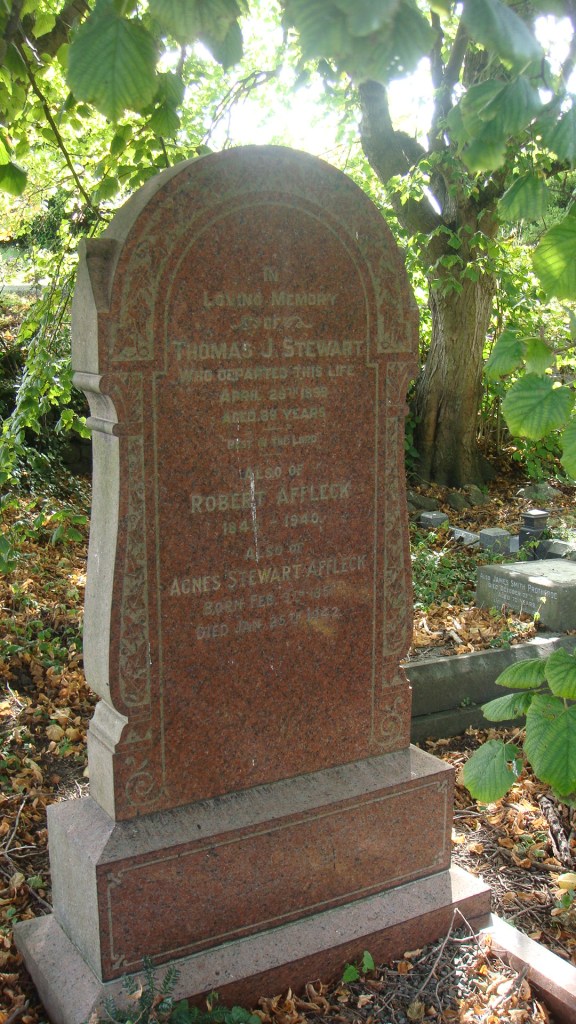
Thomas J. Stewart – the first smith in the GWR Works

I had read the story of Thomas J. Stewart in the writings of the late Trevor Cockbill, railway and local historian, but sometimes the story you start out researching turns into something a little different.

Thomas Stewart was one of the very first railwaymen to arrive at the frontier town of New Swindon, travelling in an open railway truck, it is said. He started in the Works on Monday, December 20, 1842, a fortnight before the official opening and lit the very first smith’s fire in the factory.

Thomas was born in 1811 in Lanarkshire and on arriving in Swindon he first lodged in Stratton St Margaret. He appears on the first census taken in the railway village in 1851.

Thomas Jack Stewart died on April 26, 1899 aged 87 years at the home of his son-in-law Robert Affleck and left effects valued at £11 4s to his daughter Agness Stewart Affleck. But Thomas had never married.

Agnes was born on February 9, 1851 the daughter of Maria Smith and baptised at Christ Church on March 23. The entry in the baptism registers includes the name of Thomas Stewart but this has been crossed through and the words ‘illegitimate daughter of Maria Smith’ remain.

Maria Lucy Smith was the eldest daughter of Edward and Elizabeth Smith and at the time of the 1851 census, taken shortly after the birth of her daughter Agnes, she is living with her parents in Cricklade Street. The census records that Edward and Elizabeth have three other daughters and a niece living with them and the last entry is that of their granddaughter Agnes aged 1 month.

Thomas obviously had some involvement with his daughter. When she married Robert Affleck at Christ Church in 1875 Thomas was a witness at the wedding ceremony, although his name does not appear as ‘father’ on the marriage certificate, which is left blank. In 1891 he was living with Agnes and her husband and family at 37 Prospect Place where he is described on the census as Thomas Stewart father-in-law 79 years old retired blacksmith born in Scotland. And at the time of his death in 1899 he was still living with the Affleck family.

The Late Mr t. Stewart,

Funeral on Saturday

The funeral of the late Mr Thomas Stewart, an old GWR foreman whose death we announced last week took place on Saturday afternoon. The funeral cortege left deceased’s late residence, Southfield House, The Sands, Old Swindon, at three o’clock. The coffin was borne on a handbier, and covered with a pall, there being no flowers by request. The bier was attended by eight bearers, from the F Shop, all workmen who were formerly employed under deceased.

The coffin was of polished panelled oak with massive brass fittings and engraved plate bearing the words:- “Thomas Jack Stewart. Born June 7th, 1811. Died April 26th, 1899.” The chief mourner was Mr R. Affleck (son-in-law), the other coaches containing deceased’s grandsons, and Messrs T.B. Watson, and W. Chivers.

There were three mourning coaches, and between 20 and 30 mourners on foot, including the following:- Messrs. R. Baker, T. Patterson, J. Sykes, W. Morgan, Enoch Smith, W.S. Dawson, John Fox, E. Tomkinson, Ellison, ? ? Broadbear, Alf Bowker, Pickard, Robert Fawcett, J. Clark, W. Sewell, R. Gadd, Burrows, D. White, E.L. Pugh, etc.

The first portion of the service was conducted at St. Mark’s Church, and the remainder in the Cemetery, the Hon. Canon Ponsonby officiating.

The funeral arrangements were most satisfactorily carried out by Mr. Fred. J. Williams, on behalf of Mr. Joseph Williams.

Writing from London to Mr T.B. Watson, of New Swindon, on Saturday, in reference to the death of Mr. T.J. Stewart, Mr John Fawcett, whom we mention in our last week’s issue, says:- “I was transferred from Bristol to Swindon on January 1st, 1843, and found Stewart had been at work here about a fortnight. He lit up the first fire in the new smiths’ shop, and I the second. There were, of course, the ordinary staff of men in the Running or A Shed, under Mr Appleby, but Stewart was, I believe, the first man Mr Sturrock (the first manager at the Works), engaged for the opening of the new Works. Mr Stewart had built a couple of houses at Patercroft, where he must have been residing some four or five years before coming to Swindon. He used to go regularly to Patercroft to look after the repair of these houses long after he came to Swindon. I have made out a list of the names of all the foremen and contractors up to the time I left Swindon in 1866, and I am sorry to find that out of about 30 contractors there is scarcely one left beside myself. The same may be said of the foremen, managers and draftsmen. I was pleased to hear a few days ago that Mr Sturrock is still living and residing at Chelsea like myself, he is an octogenarian, and well into his 83rd year. I feel I am the only shopmate left who could give reliable information as to Mr Stewart’s career at Swindon in the early days.”

Thomas was buried in grave plot D1a. Robert was buried with him in 1940 and Agnes in 1942. The elegant, pink granite headstone is decorated with entwined ivy, a symbol of friendship, fidelity and immortality.

Robert and Margaret Patterson

During a period when we might have thought people stayed in the area in which they were born, railwaymen and their families were frequently on the move.

Born in about 1805 in Lamesley, Durham, Robert had already moved about a fair bit by the time he arrived in Swindon. His route can be traced by the birth place of his children in Penshaw and Shields in Durham, Paddington and then Swindon.  

Engine driver Robert Patterson appears on the 1851 census in Swindon when street numbering was still to be established. He lived in No. 2 or 5 Farringdon Street with neighbours Robert Laxon at No. 1 or 4 and William Laverick at No. 3 or 6, although that was not the end of his travels. Between 1871 and 1881 (when he was 78 years of age) he was still working as an engine driver and living in Milford Haven, Pembrokeshire, which is a bit of a coincidence as I lived there as well exactly a hundred years later.

The couple had seven children – two sons Thomas and Michael, who sadly died aged 20 in 1856, and five daughters, two of who died aged 22 and 24. Hannah and Barbara Patterson died in identical circumstances in 1862 within just five weeks of each other, their tragic deaths reported in the local press.

New Swindon

Singular Circumstance – Four weeks ago to-day we recorded the death of Miss Barbara Patterson, of New Swindon, in a peculiarly sudden and lamentable manner, and we have to-day to announce the death of her elder sister, Miss Hannah Patterson, under similar circumstances.

It was be remembered that Miss Barbara Patterson was taken ill on the Sunday evening after having been about as usual during the day, and after lingering until about the same hour on the following day she expired. A post mortem examination of the body subsequently disclosed the cause of death to have been the rupture of an internal abscess, the discharge from which had flooded the heart.

On Sunday week, Miss Hannah Patterson was apparently in her usual state of health, and was out walking both in the afternoon and evening. Some time after she had returned home in the evening she complained of sudden illness; medical aid was at once procured, and, notwithstanding that Mr. Swinhoe was in almost constant attendance upon her, she, after being ill to within half an hour of the period of her sister’s illness, expired; and from the symptoms under which she laboured, there appears to be no doubt whatever but that the cause of death in both instances was precisely the same.

The death of two young women – the one 22 and the other 24 years of age – in so sudden and peculiar a manner, has produced quite a sensation in New Swindon.

Wiltshire Independent, Thursday, November 6, 1862.

The late Trevor Cockbill, railway and local historian, writes in his book A Drift of Steam that the Choral Society arranged a Sacred Concert, conducted by Mr Albert Sykes, which included Mozart’s Twelfth Mass to be held in the Mechanics’ Institution. The proceeds were donated to provide a memorial for Miss Hannah Patterson’s grave in St. Mark’s churchyard. Trevor writes that the programme included a tribute to Miss Patterson “who for so many years past contributed, by the aid of her great vocal talent to the edification and pleasure of this and the surrounding neighbourhood. Her services were at all times cheerfully and gratuitously rendered.”

Robert Patterson died in December 1884 aged 82 at 2 Gloucester Terrace, Swindon. He was buried in grave plot A1093. Margaret died in August 1887 aged 77. Her last address was in Brigstock Road, Bristol. She was buried with her husband on September 1, 1887.

William Nicholson and a lot of words

There were a lot of words written about William Nicholson following his death in 1880.

We are sorry to notice the death, on the 13th instant, at New Swindon, of Mr William Nicholson, who, for the long period of nearly 45 years, was a valued and trusted servant of the Great Western Railway Company, and who at the time of his death was, we believe, the oldest foreman in the employ of that company, having served in that capacity very close upon 40 years.

Leaving his native place, Bolton, in Lancashire, very shortly after serving his time as an apprentice to the engineering business, he went to Liverpool, where he married, and obtained employment in an establishment where Daniel (now Sir Daniel) Gooch and his brother were serving their articles as pupils. He, however, did not stay there long, but removed to Paddington, where the Great Western Railway Company had just opened their first engineering works, and when the Swindon works were opened Mr Nicholson came to Swindon, now 39 years since, and after a very short time was appointed foreman over the turning and fitting department, and in this important position he remained until about 15 years ago, when the whole of the Swindon works were considerably enlarged under the direction of the late Mr Armstrong, and the new gas works were then put under the sole charge of Mr Nicholson, and in this position he remained until his death, which took place on Tuesday week, after a somewhat protracted illness caused by heart disease and dropsy.

During his lengthened connection with Swindon and the Railway Company Mr Nicholson enjoyed the respect and esteem of all who knew him. He was devoted to his duties and the interests of his employers, and was strictly conscientious in all his dealings, whilst to the thousands of men who had been placed under his superintendence he was always kind and courteous.

Having known Mr Nicholson from the time when he first came to Swindon, it affords us some satisfaction to be able to bear our testimony to the sterling character of a strictly honest and upright man, and one who, although never ostentatious in any of his dealings, by his general demeanour set a good example before those under him or who came in contact with him. We have been asked to publish the following, which has been forwarded to us by an old workman under Mr Nicholson:

“Another old servant of the Great Western Railway Company has gone to his long home. Mr William Nicholson, who was one of the earliest arrivals from Paddington to Swindon on the opening of the line, and who for many years occupied the position of foreman in the fitting and turning shops in the local department, but latterly that of superintendent of the gas works recently erected by the GWR Company, he having only survived to witness the completion of the extensive and elaborate works of which he was so proud. He was followed to his last resting place, in St. Mark’s Churchyard, by numerous foremen of the works, and a large number of old hands who served under him, who attended to bear testimony to the respect they bore him while living. His widow, with whom he has lived for upwards of half a century on the most affectionate terms, is left to mourn her loss.”

The Swindon Advertiser, Saturday, January 24, 1880.

And in 1992 railway and local historian Trevor Cockbill wrote a few more in his excellent book A Drift of Steam, describing William Nicholson as a devout Wesleyan Methodist who founded the New Swindon Wesleyan Methodist Society and became the first Superintendent of its Sunday School.

But when it comes to his wife Betsey no one appears to have written about her.

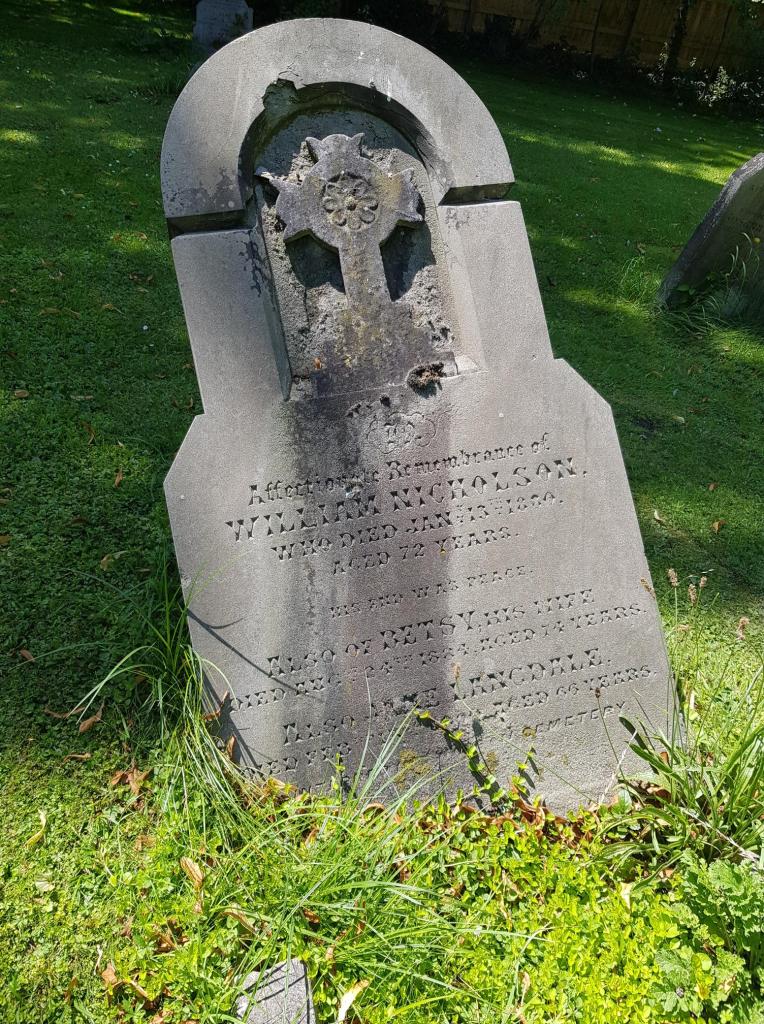
William married Betsey Langdale at St Anne’s Church Liverpool on May 17, 1830. We find them on the 1851 census living at Westcott Place, Swindon with four of their children, Betsey’s sister Jane Langdale, a lodger and a 12 year old servant girl. Apart from the official census records the only words I have discovered about Betsey appear on her headstone – and even this isn’t how things might first appear.

William died in 1880 and was buried in the churchyard at St. Mark’s. Betsey died in 1884 but by then the churchyard at St Mark’s had closed and the new cemetery at Radnor Street had opened, which is where Betsey was buried on August 30, 1884 in grave plot A55. She lies in an unmarked grave where she was later joined by the sister who had lived with her for so many years, Jane Langdale who was buried on February 17, 1890. However, the family had made sure that both Betsey and Jane were remembered by adding their names to William’s headstone – interred in Swindon Cemetery.

Ann and Thomas Barefoot

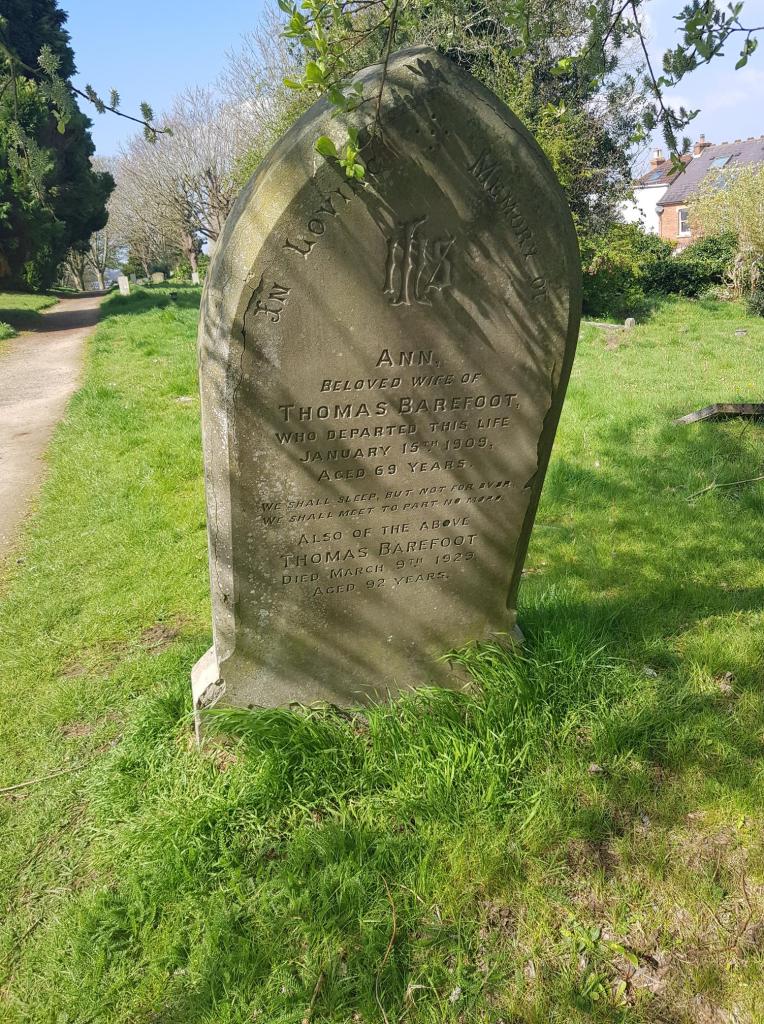
What better place to rest for all eternity than in the shade of a tree in Radnor Street Cemetery?

Thomas had spent a lifetime working as an engine fitter, a skilled job but hardly a glamorous one, except in nostalgic retrospect. Ann had given birth to at least 8 children – there may have been others who were born and died in between the ten yearly census count.

Thomas Barefoot was born in about 1835 in Maidenhead, Berkshire, the son of James and Elizabeth Barefoot. On census returns James is recorded as a ‘policeman’ with the GWR. During this period this means that he was a guard, according to railway historian Trevor Cockbill.

Like many railway employees the Barefoot family moved around a lot but by 1851 both James and his younger son Thomas were living in Swindon. His eldest son George was living in Boston, Lincolnshire where he worked as a coppersmith, although he too later returned to Swindon.

Thomas married Louisa Bizley at Christ Church in 1857. They were both very young, Thomas was 21 and Louisa only 18. Sadly, she died in 1859 and was buried in the churchyard at the church where she married.

During the 1860s Thomas married for a second time and appears to have lived in London for several years where five of his children were born. By 1871 the family were back in Swindon and living at 22 Tabernacle Terrace, Stratton St. Margaret.

Thomas’s brother George was a member of the Mechanics’ Institute Council but so far I have not discovered whether Thomas took such an active role in the civic life of the town. Perhaps it was enough for him that he paid his way and raised his family.

Both Ann and Thomas spent their last years living at 9 St Paul’s Street, Swindon with their daughter Florence Hatter and her family.

Ann died on January 15, 1909 aged 69 and was buried in this shady spot on January 19. Thomas died 20 years later at the age of 92. He was buried with Ann on March 14, 1929 in grave plot B3032.

You may also like to read:

George Barefoot – an investor in people

George Henry Barefoot – like father, like son

William Barnes Keylock – Railway Clerk and Licenced Victualler

After some 15 years of research the Radnor Street Cemetery archives are becoming quite extensive. Between us Andy, Noel and I have many hundreds of photos and items of ephemera and it was while looking through one of my boxes that I came across this cache of documents.

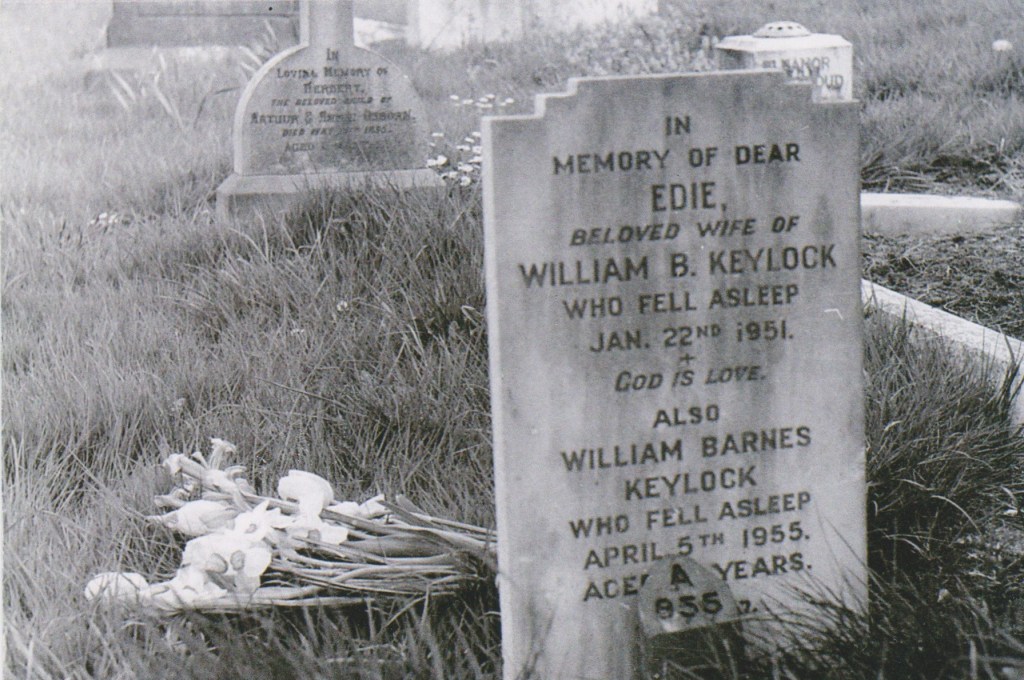
Rose contacted me some years ago as she feared her family headstones had been removed from the cemetery. The passage of time had seen the memorials sink and tilt and become very discoloured and almost unrecognisable, but I was able to confirm they were still there. At the time Rose provided me with family documents regarding graves and burials and several photographs including one of the grave of William Barnes Keylock and his wife Edie.

William was born on December 2, 1872 and baptised at Christ Church on December 10. He was the only surviving child of William John White Keylock and his wife Susanna. In 1881 William J.W., a pattern maker, Susanna and William B. were living at 9 Read Street. William B. started work as a Railway Clerk on April 2, 1888 and at the time of the 1891 census he was living with his parents at the Bakers Arms in the Railway Village where his father was the inn keeper.

William Barnes Keylock married Edith Prideaux Dymond on July 27, 1895 at the parish church in Porlock. The couple had two children, William Harold and Dorothea Edith May. Sometime after Dorothea’s birth in 1901 the family moved to London where William was licenced Victualler at the White Hart, Clerkenwell and later The Eagle in Woolwich.

By 1939 the family had returned to Swindon and William, Edie and Dorothea were living at 11 College Street.

Edie died aged 77 at the Victoria Hospital. She was buried in plot A855 on January 26, 1951. William died aged 82 on April 5, 1955 at St Margaret’s Hospital. He was buried here with Edie on April 9, 1955.

My thanks to Rose for providing so much information and my apologies for taking so long to publish her family story.

To be continued …

Photograph believed to be William Barnes Keylock as a boy – published courtesy of Ancestry

Zacharias Peskett – Medical Fund Society Treasurer

Saturday July 8 sees Swindon celebrate the 75th anniversary of the NHS with the Mechanics’ Institution Trust. Events in the Emlyn Square area include an exhibition in the Central Community Centre with a talk on the GWR Medical Fund by Adam Busby at 4 pm. Visit the Railway Village Museum open 11-3 and join a walking tour of the Railway Village focussing on ‘Health.’ The Bakers Café will be open for refreshments.

And read below about one of those pioneering members of the GWR Medical Fund Society.

Swindon

Obituary

The death occurred on Thursday morning at his residence, 6, Milton Road, Swindon, of Mr Zacharias Peskett, an old and highly respected resident of Swindon. For the long period of 44 years he had been in the service of the GWR Company, and for over 30 years he had uninterruptedly held office as treasurer of the GWR Medical Fund Society. He was generally esteemed as an upright and honourable man, and was a valued servant of the company. He was in his 70th year.

Western Daily Press, Bristol, Friday, May 29, 1914.

The Late Mr Z. Peskett,

Funeral

The esteem in which the late Mr Zacharias Peskett, of 6, Milton Road, Swindon, was held by his former colleagues in the GWR Works and by the officials of the GWR Medical Fund Society – an organisation with which his name had been prominently associated for more than 30 years – was exemplified on Tuesday afternoon, when the funeral took place at Swindon Cemetery amid every manifestation of sorrow and respect.

The cortege left Milton Road at 3.15 and proceeded to St. Mark’s Church, where a short but impressive service was conducted by the Rev. Lionel Calway.

The coffin, on which was a large cross of white flowers from the family and other beautiful floral tributes, was conveyed on a four-wheel bier, Messrs J. Lawrence, E. Griffiths, W. Sansum, T. Jackson. R.A. Zebedee and Humphries (representatives of the Medical Fund Society) acting as bearers.

Then followed a hand-bier on which were placed the wreaths, and in charge of Mr Peskett’s personal staff – Messrs. T.H. Westbury, C.E. Knapp, J. Clark and Angle. Behind the mourning coaches walked the Rev. H.J. Parker (pastor of South Street Baptist Chapel, where deceased formerly worshipped), representatives of the Medical Fund Society and the Sick Fund Society and many old friends and former colleagues of the late Mr. Peskett.

Long list of mourners …

From St. Mark’s Church the coffin was borne to the Cemetery, the route chosen being Cambria Bridge Road, Radnor Street and Clifton Street. The Blinds at many of the houses on the way to the Cemetery were drawn as a mark of respect to the deceased.

At the graveside the cortege was joined by a large number of sympathisers, and the service was impressively conducted by the Rev. L. Calway. The coffin was of polished elm, with heavy brass furnishings, and the breast plate was inscribed as follows:-

Zacharias Peskett,

Died May 28th, 1914.

Aged 69 years.

Many beautiful floral tributes were sent by relatives and friends…

The funeral arrangements were satisfactorily carried out by Messrs. H. Smith & Sons.

Extracts from the North Wilts Herald, Friday, June 5, 1914.

Zacharias Peskett was buried on June 2, 1914 in plot D1297, a grave he shares with his wife Annie who died in December 1924.

Robert Martin – Grenadier Guard and Crimean Veteran

Queen Victoria and Prince Albert with their sons inspect the wounded Grenadier Guards at Buckingham Palace February 20, 1855.

In 1861 Robert Martin, Grenadier Guard, was part of the District Foot Guards Detachment based at North Camp Aldershot. The Grenadier Regiment of Foot Guards had served with distinction during the Crimea War, seeing action at the Alma (1854), Inkerman (1854) and Sebastopol (1854-1855). His military career was drawing to a close.

Robert Martin was born in 1834 in Lolworth, Cambridgeshire, the son of agricultural labourer William Martin and his wife Sarah. At the time of the 1851 census Robert was also working on the land. Was he restless? Did he see his future as just more of the same? Was he looking for an adventure when he decided to join the army?

Robert was no doubt grateful to have survived the horror of the Crimea War. On Christmas Day 1863 he married Harriett Kimberely at St Andrew’s Church, Bordesley, Birmingham. She was 20 years old, the daughter of John Kimberley, a victualler from Small Heath. Robert was 29 and working as a railway servant.

The couple moved around a fair bit and lived in Birmingham and Aberdare before rocking up at Swindon in the late 1870s. In 1881 they were living at 25 Carfax Street – Robert worked as a Railway Guard and his two sons, Alfred 14 and William 11 were Telegraph Messengers.

Harriett died in 1882 and the following year Robert married Fanny Maria Roberts at St. Mark’s Church. They went on to have a daughter, Daisy Harriett Gertrude Maude.

In addition to serving in the military for eight years, Robert Martin worked for the GWR for 43 years. It was said that his ‘familiar figure will be greatly missed on Swindon GWR platform.’

Death of a Crimean Veteran

An old GWR Guard

Mr R. Martin, of Swindon

The Funeral

There was laid to rest in Swindon Cemetery on Sunday afternoon the mortal remains of the late Mr Robert Martin, who passed away in his 72nd year at his residence, 25, Carfax Street, Swindon, last week, after a very short illness.

Mr Martin, whose familiar figure will be greatly missed on Swindon GWR platform, had been in the service of the Co. for the long period of 43 years, during 39 of which he was a passenger guard. During his extended period of service, he gained the entire confidence of all the officials of the line, and he was very popular with regular passengers. His upright soldierly bearing and his pleasant manner made him one of the most familiar figures on the line.

On reaching the allotted span, in January, 1904, he retired from the Company’s service, and his colleagues then, to show their esteem and appreciation, presented him with a silver teapot.

Deceased, who was twice married, leaves a widow and family of five grown-up children – three sons and two daughters.

In his younger days, Mr Martin served for eight years in the Grenadier Guards. He saw active service in the Crimea, and was proud of his possession of Crimean and Turkish medals, with the Sebastopol clasp.

The Funeral

Was very numerously attended, there being an exceptionally large crowd assembled in the Cemetery. The first portion of the burial service was conducted at St. John’s Church, by the Rev A.G. Gordon Ross, Vicar of St. Mark’s, who also officiated at the graveside. In addition to the family mourners, there was a large attendance of railway men and local Volunteers…

Following the family mourners came Mr John Brewer (GWR Stationmaster), and Inspector Rochester, and about forty guards, ex-guards, porters, and other officials on the line. Then came about thirty Volunteers, under Sergt. Ellwood. The coffin, which was covered with beautiful wreaths, was of polished oak, with brass fittings, and on the breast plate was the following inscription:- “Robert Martin, died Sept. 18th, 1905, aged 71 years.”

Mrs Martin and family desire to tender their sincere thanks to numerous friends for all kind expressions of sympathy with them in their bereavement.

Extracts from the Swindon Advertiser, Friday, September 29, 1905.

Robert Martin aged 71 years, died at his home in 25 Carfax Street and was buried in grave plot C1694. He is buried with his second wife, Fanny Maria ‘who died on her way to hospital’ July 1911. Robert’s first wife, Harriett died in January 1882 at the age of 38 years and is buried alone in grave plot E7001.

Henry James Fortune – Assistant Secretary to the Medical Fund Society

Henry James Fortune was 82 years old when he died in 1943. He had lived an eventful life but was there anyone still around who remembered him as a young man? His wife Nellie had died 20 years previously.

So, let’s go back to the beginning.

Henry James Fortune was born on July 5, 1861, in Mells, Somerset, the son of John Fortune, a policeman, and his wife Mary.

As a young man, a little older than 15 when boys these days are still in school, Henry joined the navy. His service records describe him as 5ft 1½ ins, light brown hair, blue eyes, fair complexion. The first ship he served on was HMS Impregnable. On census night 1881 Henry, aged 19, was serving on the HMS Temeraire in the Grand Harbour, Malta. His last service date was April 22, 1886 and the last ship he served on was the HMS Hercules.

By 1886 Henry was settled in Swindon, employed as a Stores Clerk in the GWR Works. The following year he married Ellen Louisa House at Holy Trinity Church, Frome. At the time of the 1891 census he was living at 26 Taunton Street aged 29 years when he describes himself as a Fitters Labourer (another change of occupation?) – Ellen and their two children are visiting her parents in Frome.

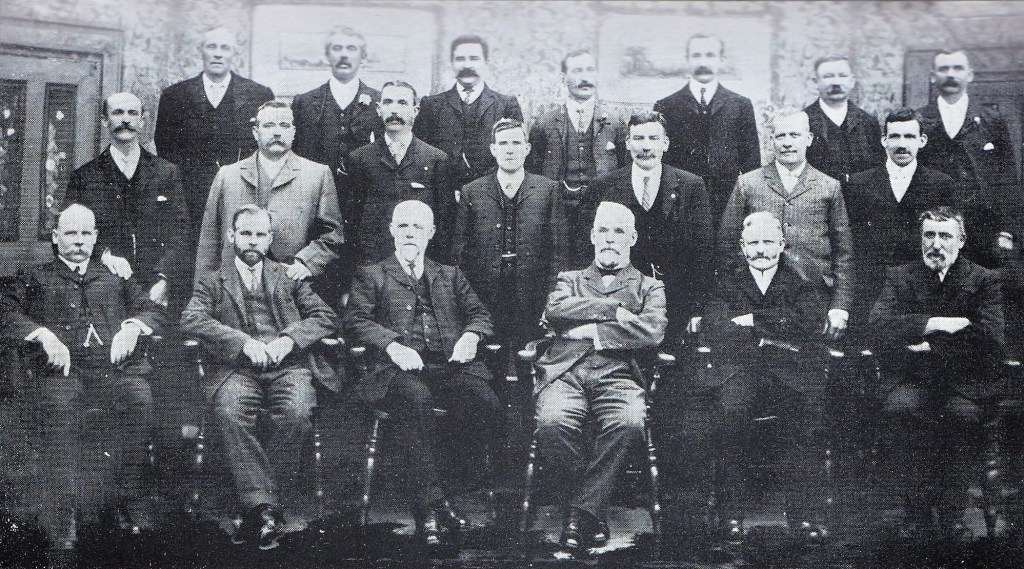
Henry was nominated for election to the Management Committee of the GWR Medical Fund Society in 1904 and in 1907 is pictured on a formal photograph seated next to Zacharias Peskett, the long serving treasurer.

On the 1911 census returns the Fortune family are living at 20 Oxford Street where 49 year old Henry works as a railway clerk. The couple have been married 23 years during which time they had 12 children of whom sadly 4 have already died.

In 1939 he was at 246 Ferndale Road, a widowed retired Railway Clerk living with Leonard and Edith Brain (daughter and son-in-law) and their family.

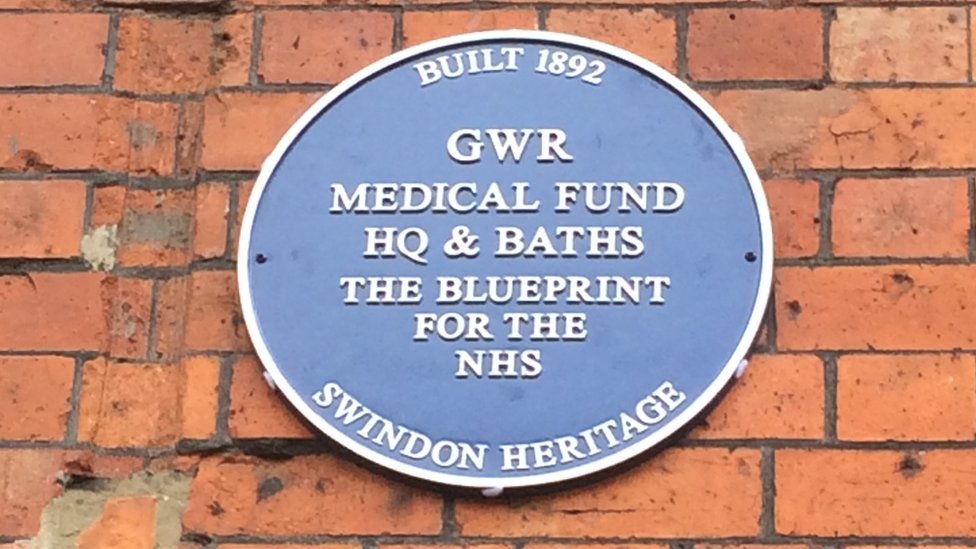
The GWR Medical Fund Society, like many other similar organisations across the country, provided a blueprint for the National Health Service established in 1948. Henry had been gone nearly five years by then. For those who remained on the Medical Fund Committee it must have been a time of mixed feelings. Free health care for all but with that came the eventual dismantling of the Medical Fund and 100 years of endeavour in Swindon.

Henry James Fortune died in St. Margaret’s Hospital aged 82 years. His funeral took place on December 30, 1943 when he was buried in grave plot C3868 with his wife Ellen who had died in 1923.