God’s Wonderful Railway – this colloquialism reveals the reverence in which the Great Western Railway was held. The railway company, established in 1835, was the epitome of excellence, innovation and achievement. The young engineer Isambard Kingdom Brunel (26 years) and his right hand man Daniel Gooch (20 years) sited the railway company’s principle Locomotive Station and Repairing Shops on a green field site at Swindon where ‘the Works’ would become the beating heart of the organisation.
But life was difficult for those early settlers who put their faith in the GWR, and the dangers came not only from working conditions within the railway factory. In 1841 building contractors J.D. & C. Rigby began work on 300 cottages in what today is known as the Railway Village. The company houses were overcrowded and conditions unhygienic with an insufficient water supply sourced from the Wilts & Berks Canal. A slaughterhouse and pig sties discharged into the streets while overflowing cesspits and ineffective drainage created frequent outbreaks of smallpox, typhus, typhoid and cholera.
As the ‘principal locomotive establishment’ opened in 1843 and families settled into their less than ideal homes, the railway men established the GWR Locomotive Department Sick Fund. In 1844 provision was extended and it became the GWR Locomotive and Carriage Department Sick Fund Society. Membership became a condition of employment, offering various levels of sickness benefit and provision for funerals. The management committee consisted of elected members and the Works Manager was President ex-officio with some financial assistance coming from the GWR directors.
Swindonians are well acquainted with the legend that was the GWR Medical Fund, innovator of a wrap around system of health care for more than 100 years. Fortunately, some of the buildings central to that organisation still survive – the Milton Road Baths/Health Hydro and the Medical Fund Hospital now called the Central Community Centre, are evidence of the comprehensive health care system enjoyed by railway employees and their families. Subsumed into the post second world war National Health Service, the Medical Fund became redundant in 1948, but what about the ‘Sick Fund?’
Now, if like me, you had heard of the Sick Fund and believed it to have evolved into the Medical Fund, you would be wrong. The Sick Fund Society was always a separate entity and survived long after the establishment of the NHS. Local Studies in Swindon Central Library hold a collection of Sick Fund ephemera, including Rule Books dated 1953 and 1971, long after the end of the Medical Fund and the introduction of the NHS. Further research is required to establish when this organisation was eventually dissolved, but this evidence proves it was in existence long after the demise of the Medical Fund.
Those early settlers were not only railway pioneers but social activists and reformers, and many of them were later buried in Radnor Street Cemetery. You can read about some of them here on this growing archive.

Milton Road Baths
The 42nd annual general meeting of the members of the GWR Locomotive and Carriage Department Sick Fund Society, was held on Monday last in the hall of the Mechanics’ Institute. There was a very small attendance.
Mr J. Williams presided, and was supported on the platform by Messrs. J. Horsington, James Beer, Robert Carver, Edward Leonard, Thomas Anderson, and Wm. Bell, committeemen: Mr S. Whiteman, treasurer; Mr George Stone, secretary, and Mr H. Gibbons, assistant secretary. The report presented was as follows:-
In submitting this, the forty first annual report of the society for your consideration we trust it will meet with your approval. Your committee are pleased to report that the society register is now completed (for which the best thanks of the society are due to the trustees) and it has been so arranged that every member’s ticket number shall be his registered number in the society, therefore to prevent any confusion in the future, as well as to facilitate the work of the secretaries, members are requested to see that their ticket number is properly entered on their medical certificate when declaring on sick benefit, also that it is properly dated, as several cases have recently come under the notice of the committee where members have worked the greater part, and in some instances the whole of the day, and sent their certificates in, dated for that day, which is decidedly contrary to rule. Your committee wish to inform the members that at a committee meeting held June 12th, 1884, the following resolution was passed, which we venture to think will be appreciated and approved of by the members: “That so much of the funds of the society as may not be wanted for immediate use, or to meet the usual accruing liabilities, may, with the consent of the Committee of Management, be lent to members upon mortgage of freehold house property, at 5 per cent per annum. All application for the above must be from members over 21 years of age, and over two years standing in the Society.” Since passing the above resolution we have advanced to members the sum of £310, £10 of which has been repaid. Our total investments now amount to £4,116; and the increase in our balance this year is £520 1s 10d.
Attached to the report was a financial statement, and a list of members who had received benefits during the year. The present number of members is 6,051, made up as follows:- Locomotive department 4,049, carriage department 1,747, outside members 206, superannuated 23, widows 30. The general fund account showed the balance brought forward from last year was £4,471 19s 3d; the contributions of members amounted to £4,582 18s 2d; fines, £27 17s 9d; dividends, £184 9s; income tax returned £27 17s 9d; contribution cards, 18s 4d; returned from Management Fund £72 2s 4d; total, £9,323 10s 10d. On the expenditure side it appeared that the superannuation allowance comes to £385 17s 4d, the sick benefits to £3,207 13s; funeral benefit £489; returned contributions £50 16s 6d, and 5 per cent of contributions to Management Fund £228 2s 11d, the balance at the end of the year being £4,992 1s 1d. The management fund showed an actual expenditure of £156 0s 7d, while the balance showed that the total value of the funds on December 31st last was £5,012 1s 1d, of which £4,116 was invested as follows:- GWR 5 per cent preference stock £800, New Swindon Gas Co. 5 per cent debentures £600, Swindon Cemetery 4 per cent £1,500, Metropolitan District Railway 4 per cent. £500, Kittering and Mapstone 4 per cent £416, on mortgage at 5 per cent £300, in addition to £658 2s in the County of Gloucester Bank, and £237 19s 1d in the hands of the treasurer.
The proceedings were opened by the Secretary reading the minutes of the past year’s meeting. These having been passed, and the report taken as read, the Chairman said he did not see that it required supplementary remarks, and he asked that it be adopted. This was unanimously done, and discussion thereon invited, the Chairman saying it was a great surprise to the committee themselves to see such a good balance after the extraordinary amount of sick pay they had been called upon for during the past year. There being no response, or no question to ask the Auditors as to the manner in which they found their accounts, the report was adopted.
The Chairman said the committee felt very strongly on the matter referred to in second paragraph of the report. It was found that the practices therein complained of were very prevalent. Members detected blamed the doctor, but the society had nothing to do with the doctor – only with the member, whom they could fine, and were determined to do so in future. If a member went in the first quarter in the morning and found he could not keep on, the society would be very willing to pay him, but if he stayed at home the first quarter and then went in they thought he should not be paid.
The election of officers was then proceeded with. Mr George Stone was unanimously re-elected secretary, on the proposition of Mr George Howse. Mr S. Whiteman was unanimously re-elected treasurer, on the proposition of Mr T. Money. Mr H. Hinton was re-elected steward. As committee men, Messrs J. Williams and Edward Leonard were unanimously re-elected for the Loco Department; Mr James Beer was proposed for re-election for the carriage Department, but Mr Hillier proposed in his stead Mr Edward Bullock. On a vote being taken there were ten hands held up for Mr. Bullock, and an overwhelming majority for Mr Beer, who was, therefore, declared elected. Mr T. Lucas was re-elected auditor. On the proposition of Mr George Howse, a vote of thanks was passed to the committee for past services, and the proceedings closed, not having occupied 20 minutes.
Swindon Advertiser, Saturday, January 31, 1885.
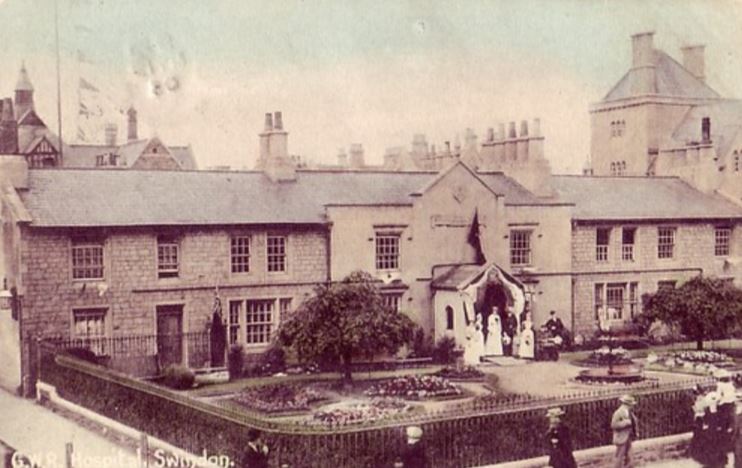
GWR Medical Fund Hospital
 Radnor Street Cemetery