The continuing story of James George Merricks

Sometimes I get lucky. No, honestly, I get really lucky.

Last year I came across some details concerning James George Merricks while researching the Astill family. Catch up here with the information I discovered then about James https://radnorstreetcemetery.blog/2024/06/04/james-george-merricks/

James spent some 15 years in South Africa but why had he left England and why did he eventually come back. And even more intriguing, what was the story behind his romance with Alice Healey, born in Bath in 1861, whom he married in South Africa in 1891.

I put out a general enquiry on this blog, hardly thinking anyone would reply but this week James’s great-grandson David got in touch and filled in all the blanks.

David forwarded me several family photographs including a most beautiful one of Alice Sarah Merricks nee Healey born in 1861 the daughter of Edward Healey, a wire worker, and his wife Frances who grew up at 7 Southcot Place, Bath.

David was also kind enough to send me a typed transcript of James George Merricks’ diary 1876-1896.

James Merricks was born February 24, 1860 in Chichester, Sussex. He left school in 1876 and began work as first an auctioneers clerk then later becoming apprenticed to draper Alfred Dunn of West Street, Chichester.

His apprenticeship completed in 1880 James began working for Stokes and Sons of Cheap Street, Bath which he describes as a “high class drapers etc easy berth, think I shall get on allright.”

The first mention of Alice comes in a diary entry dated June 4, 1880.

Have been impressed considerably by a young lady I met at Mr. Philpot’s and find her to be the daughter of Mr Healey, Stall Street, shall look forward to a closer acquaintance if possible.

By July 1 James writes.

Have managed to meet Miss H. several times and like her even better than I expected, suppose in my position tis foolish to look so far forward but should feel upset I am sure if I saw anyone else with her.

And after attending Mr Philpot’s New Year’s Eve party James writes: Believe Miss H. has some liking for me and I am quite sure I never knew anyone I liked as well.

However, the course of true love never did run smooth.

March 1881 and James had become disenchanted with his job in Bath. A chance meeting with Mr Burnet-Stoakes from South Africa convinced him his future lie there where he could easily earn £120 a year, a vast improvement on the £30 he was earning in Bath.

A mere three days later, his berth to Hong Kong booked, James wrote to his parents and Alice.

By this time Alice was employed as a governess working for Walter G. Cloke at Wiltshire Farm in Wokingham, Surrey where she had responsibility for his 5 school age children (and most probably the two babies in the nursery as well).

At home in Chichester for 10 days prior to his departure, James cycled across country to visit Alice before he left England.

May 9 – Slept or rather passed the night at “The Bush” and met Alice soon after sunrise for another hours talk, she was most kind and promised if I could make her a home in S. Africa she would be mine.

On May 19, 1881 James embarked for South Africa at Southampton, arriving in Cape Town on June 9.

After two low paid, short term jobs James began work for T. Copelands at £11 per month. He writes home to his parents and Alice, but she fails to reply.

James leads a busy life with work, church and an active social round. He joins the Baptist choir, the Choral Society and assists the Desalins Sisters Opera Company.

Eventually he writes on January 1, 1882 …also generally have enjoyed this Christmas and New Year day exceedingly, but although accompanied by some of the jolliest and prettiest girls have not lost my heart to any of them, cannot understand the underlying motive (if any) which prompted Alice’s letter received Oct 11th last finally deciding that she could never leave England for me – well perhaps I may go home someday and then – but its no good guessing the future.

More than 18 months passes and James writes … as I have not heard directly from Alice since October 11th 1882 can now decide that I must think no more of the matter.

Although, of course, we know differently!

During the intervening years James set up his own store in the area that was soon to become Johannesburg. This was probably precipitated by the opportunities presented by the Witwatersrand Gold Rush, which really got under way with the 1886 discovery of gold at Langlaagte, where it is believed the stores were situated.

After six long years the mystery is solved… my Alice was true to me after all and that her long silence was only the result of her having misunderstood my careless conduct with regard to another in her absence for my heart was not in least affected by Miss M.P. though she (the latter) might have imagined she had fascinated me, but I always took her for an accomplished flirt, however “Alls well that ends well”…

Alice arrived in South Africa on October 15, 1890. The couple signed an ante nuptial contract the following day and were married on October 17 by Landrost Von Blommestein at his house Doornfontein with a religious service at Mrs. Jones by Rev. Ecclestone. Their first son, Eric George was born on August 9, 1891, their second Edward Alfred on November 30, 1893 and a third Lionel Marten on January 7, 1896.

In 1896 the volatile political situation, the threat of war and the Jameson Raid with the subsequent commotion probably caused James to reassess the family’s situation.

Alice and their three young boys accompanied by James’s brother Alfred sailed for England on April 24. By the end of 1896 James had joined them. There were no further entries in the diary.

By the time of the 1901 census James and Alice were living at 42 St. Margarets Road, Swindon where a fourth son, John Gordon was born on June 14, 1900.

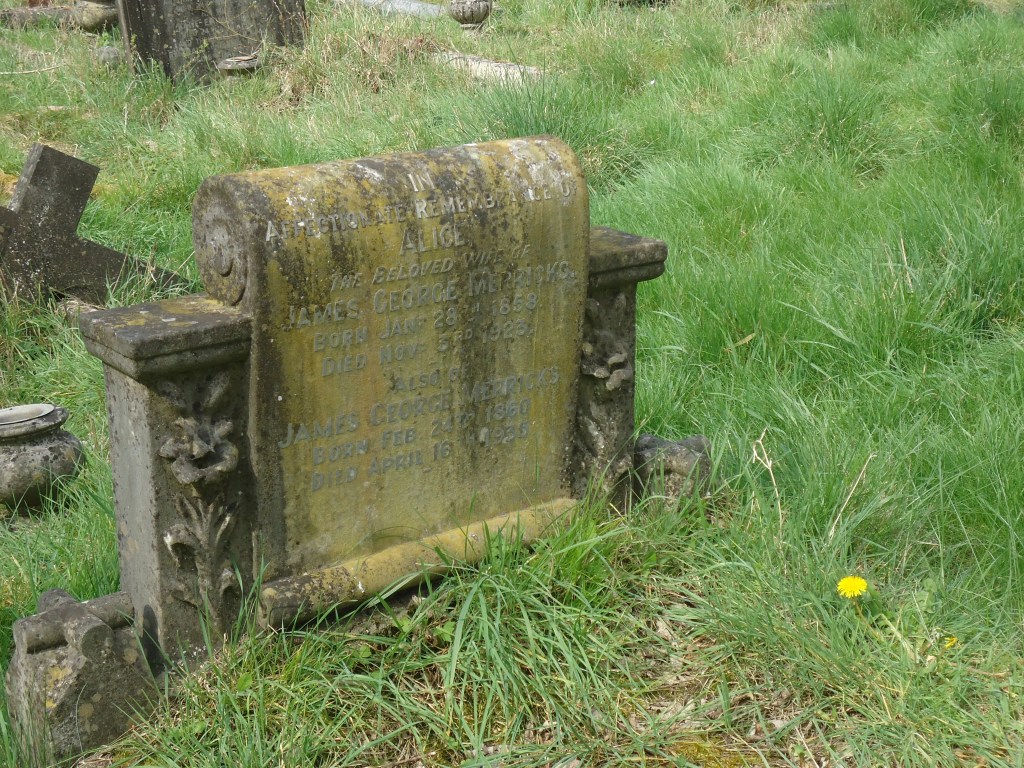
James George Merricks died aged 75 years at his home 38 Devizes Road. He was buried on April 20, 1935 in Radnor Street Cemetery in grave plot E7574, joining his beloved wife Alice who died in November 1923.

published with thanks to David Merricks

Alice Sarah Merricks nee Healey

James Merricks’ store

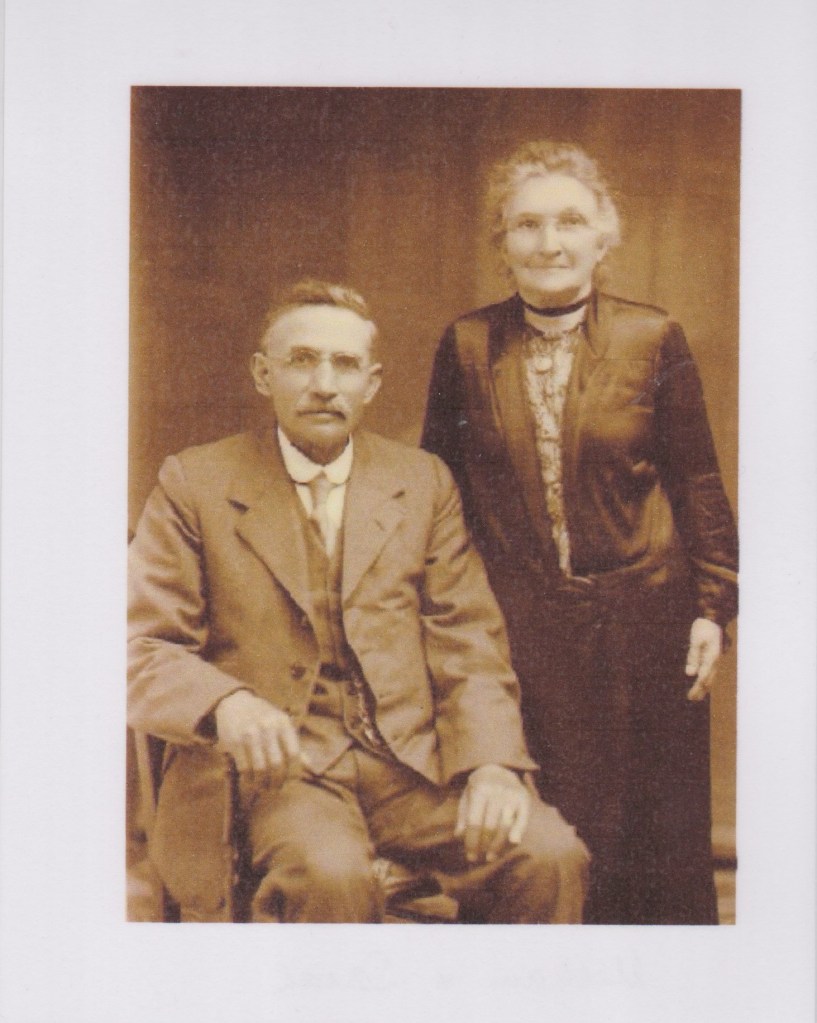
Alice and James with one of their grandchildren
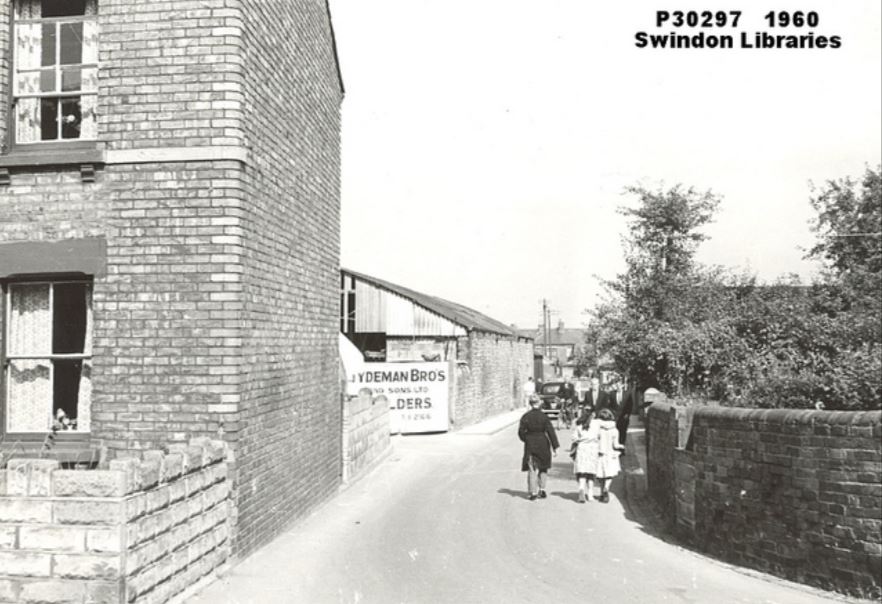
Tydeman Bros and Sons Ltd.

Younger residents might not know the significance of some of the Swindon street names. If you live in Tydeman Street, Gorse Hill you might be interested in this story about the Tydeman family.

Published courtesy of Duncan and Mandy Ball

The son of a Police Sergeant, William Henry Tydeman married Sarah Anne Barnes in the parish church at Aldbourne on May 14, 1892. The couple moved to Swindon shortly afterwards and appear on the 1901 census living at 1 Edgware Road with their five young children, Elsie 7, Dorothy 6, Hilda 4, Henry 2 and 8 month old Lilian.

It was around this time that William went into partnership with his younger brother Walter and they began work on an ambitious building project in Rodbourne – nine houses in Linslade Street and eight in Jennings Street.

In 1904 the brothers advertised their business as ‘Contractors, Decorators and Undertakers at Sanford St. Swindon.’ In 1907 they built the Wesleyan Methodist Hall in Clarence Street, an iconic Swindon building, which was sadly destroyed by fire in 1977.

The business and the workforce grew following the First World War, eventually becoming Tydeman Bros. and Sons when the brothers two sons Henry and Nelson joined the firm. During the 1920s among their projects were 22 houses in Southampton Street, 19 houses in York Road and 16 houses in Iffley Road and more than 100 houses in the street that would bear their name, Tydeman Street.

In 1927 they were encouraging Swindonians to ‘Employ Your Own Townsmen – Tydeman Bros., Shopfitters, Builders & Undertakers Edgeware Rd. & Sanford St., Swindon. Inspect the Shopfront Alterations recently carried out by us at Messrs. Freeth & Son, Centre, Swindon, and the John Farmer Shoe Co., Regent Street, etc., Then send us your enquiries. Telephone 166.’

Sarah died in 1935 and was buried at Radnor Street Cemetery in grave plot D1310 with her daughter Hilda who had died in 1921, aged 25 years.

1960 image published courtesy of Local Studies, Swindon Central Library. Tydeman Bros off Cow Lane

Tributes to Mrs W.H. Tydeman

Funeral of Swindon Builder’s Wife

Mission Stalwart

The funeral of Mrs Tydeman, wife of Mr. W.H. Tydeman, of “Wanbourne,” 5 Downs View Road, Swindon, a member of the firm of Messrs. Tydeman Bros. and Sons Ltd., builders and contractors, took place last Thursday.

Mrs Tydeman had not been in good health for some months, but was taken seriously ill a week before her death on the previous Sunday. She was 73 years of age.

Although a native of Aldbourne, Mrs Tydeman had resided in Swindon for more than 40 years, during which time she made a host of friends, particularly in her connections with the Wesleyan Church.

Foundation Member

A foundation member of the Central Mission, which she had regularly attended since its inception, she gave endless time and energy to the furthering of the several activities with which she associated herself, and the many tributes received from the worshippers at the Mission bore evidence of her great work.

In his address during the service at the Central Mission Pastor J.W. Spargo, late of Swindon, and now residing at Reading, who assisted the Rev. R.A. Rogers in the service, spoke in feeling terms of Mrs Tydeman’s faith under adversity.

Mr F. Street was at the organ, and the hymns, “Jesu, the very thought of Thee” and “For all the Saints,” were sung. The lesson was taken from Psalm xxiii and a passage from Revelations.

The interment was at Radnor Street Cemetery, the committal sentences being pronounced by Pastor Spargo.

Mrs Tydeman is survived by a widower, one son, three daughters and one adopted son. Her mother also survives her at the age of 95 years.

Extracts from the funeral report published in the North Wilts Herald, Friday, 7 June, 1935.

A Prominent Methodist

Death of Mr W.H. Tydeman

A prominent Methodist, and a founder member of the well known Swindon firm of Messrs. Tydeman Bros and Sons, Ltd. Mr William Henry Tydeman, died at his home, 5 Downs View road, Swindon, on Saturday night two days before his 72nd birthday.

Mr Tydeman was a native of Donhead, South Wilts, his father being a sergeant in the Wilts Constabulary. He went to live at Upper Wanborough when he was about 13 years of age and was apprenticed to Mr Payne, builder of that village. On completion of his time he went to work in London. Later he spent a short period in the GWR Works and then, before branching out in business on his own account, was foreman for Mr George Whitehead, builder, of Swindon.

He and his brother, the late Mr Walter Edward Tydeman, founded the firm of Tydeman Bros. Some 40 years ago.

Built Central Mission

The firm of Tydeman Bros. built the Central Mission Hall, Clarence Street, Swindon, where Mr Tydeman was a prominent worshipper. He was a trustee of that church, and for a period of 25 years was superintendent of the Sunday school and church treasurer.

He was a keen sportsman and at one time belonged to the County Ground Bowling Club. He was also a life-long follower of Swindon Town Football Club.

Mr Tydeman, whose wife died five years ago, leaves three daughters – Mrs Ball, of 6 Cumberland Road, Mrs Austin, Bouverie Avenue, and Mrs Barrett, 48 Burford Avenue – one son, Mr W.H.T. Tydeman, who lives at 1, Edgware Road, Swindon, and an adopted son Mr Fred Vizor.

The funeral took place yesterday.

North Wilts Herald, Friday, 9 February, 1940

William Henry Tydeman was buried with his wife and daughter on February 8, 1940 in grave plot D1310.

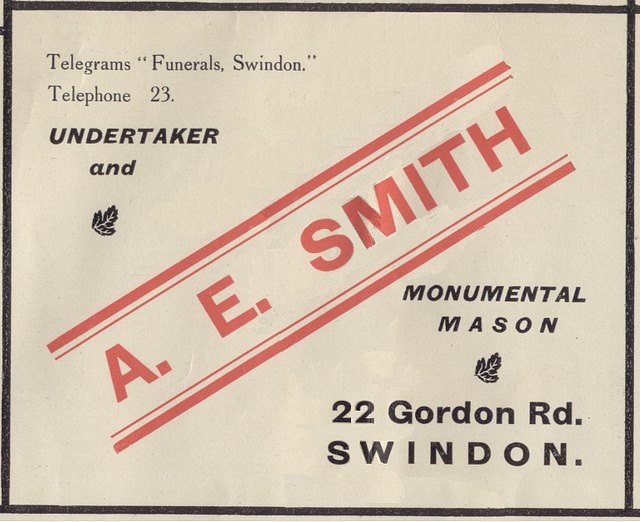
Henry Smith – undertaker and monumental mason

advertisement published courtesy of A.E. Smith

The re-imagined story …

My friend Albert Smith had his career planned well ahead. To be honest I suppose most of us boys did. We all knew we would follow our fathers into the Works, but Albert had a different career path. He was going to be an undertaker – death was big business in the 1880s.

“He’s a canny bloke, that Henry Smith,” my father said. He had worked alongside Albert’s father in the Carriage and Wagon Works before Mr Smith made undertaking his chosen profession. “Have you seen the size of that new cemetery they’re building on Kingshill? Perhaps it’s something you could be thinking about.”

I looked at him in horror. He laughed when he saw my expression.

“Don’t worry boy, I’ve already spoken for you.”

I don’t think I would have been cut out to be an undertaker, not like Albert. I think it’s more of a calling.

“Everyone dies, boy,” said my father. “Everyone dies.”

Henry Smith’s working notebook

The facts …

A.E. Smith was founded around 1880 by Henry Smith a carpenter and joiner. The early premises were situated in Gordon Road, Swindon next to what is now the Princes Street car park. 

At the time of the 1911 census Henry lived at 1 Clifton Street, close to the cemetery where he had spent so many hours.  He died there on November 14, 1917.  He left £3,072 17s 6d to be administered by his three sons.  Albert Edward had taken over the funeral business while James Henry Smith was a railway official and Joseph William a railway storekeeper.

Henry was buried in Radnor Street Cemetery on November 17th.  The service was conducted by Mr Spargo and naturally the funeral was performed by his son.  Henry lies in plot D191.

In the mid 1960’s A.E. Smith & Son moved to their present site in Queens Drive, Swindon and these premises have been expanded and refurbished as the business continued to grow.

The business finally passed out of the Smith family in 1976 when it was acquired by Lodge Brothers, another family firm of funeral directors founded by James Lodge in 1780.

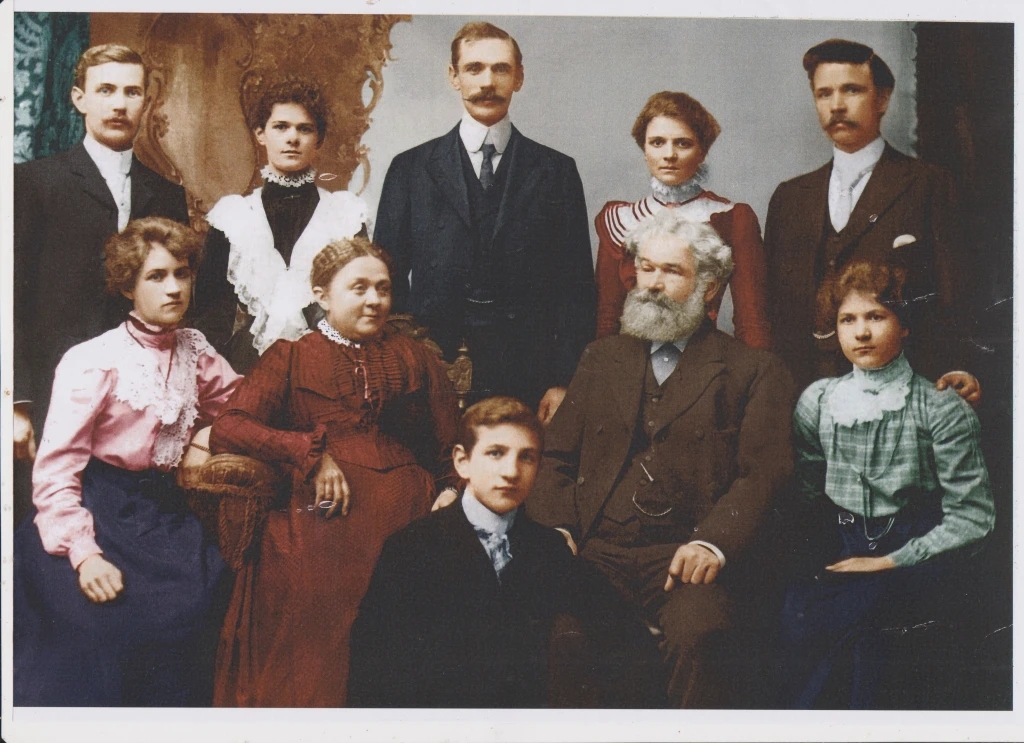
The Smith family

Death of Mr. H. Smith – Mr Henry Smith passed away on Wednesday at his residence in Clifton Street after being ill for a considerable time. He was 75 years of age. Mr. Smith was a very well known and highly respected resident, and was formerly a member of the New Swindon District Council and of the Town Council. He went to London when a young man, but returned to Swindon and obtained a position in the GWR Works. When he left the Works he commenced business on his own account as a carpenter and undertaker. He married the eldest daughter of the late Mr. James Sextone, of Burderop. Deceased leaves a sorrowing widow, with four sons and four daughters. The funeral will take place tomorrow (Saturday.)

North Wilts Herald, Friday, November 16, 1917.

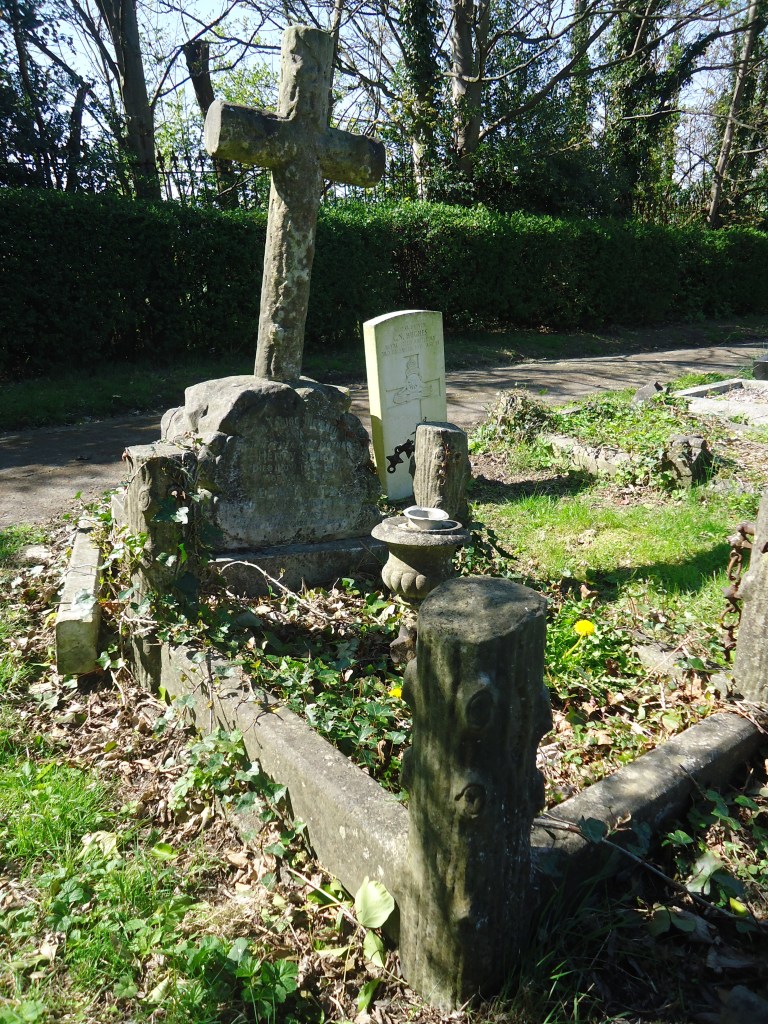
An old photo of Henry Smith’s memorial which has recently been renovated and restored.

Wilmer Bradford Wilmer – coal merchant

The re-imagined story …

I’m not sure about central heating – not that we’re going to be able to put ours on this winter! Personally, I don’t think you can beat an open fire. I can remember sitting in my nan’s house, all of us clustered around the coal fire, our faces red hot while up in the bedrooms the temperature was sub-zero. Nan often had ice on the inside of the bedroom windows, no double-glazing in those days.

I remember the coalman delivering by horse and cart. He used to stop outside our house and put a nosebag on the old horse. I never saw him clean, the coalman not the horse – infact, I think the horse might have been cleaner.

Nan used to complain about the mess the coal fire created and I suppose we have to blame climate change on all that muck belching out into the atmosphere. She eventually invested in a two bar electric heater with a coal effect. All the warmth and none of the dirt, except she couldn’t afford to use that in the end. A bit like us with the central heating. We won’t be able to have ours on this winter.

The facts …

Death of Mr W.B. Wilmer

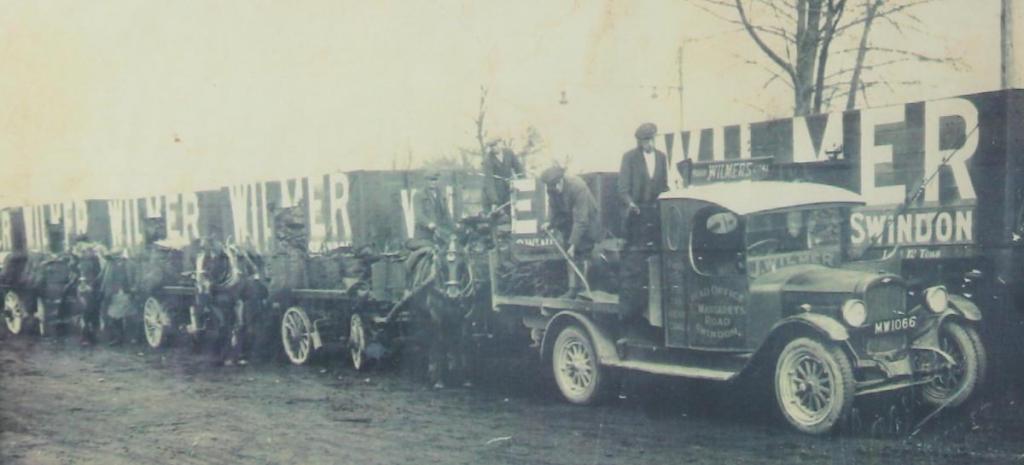
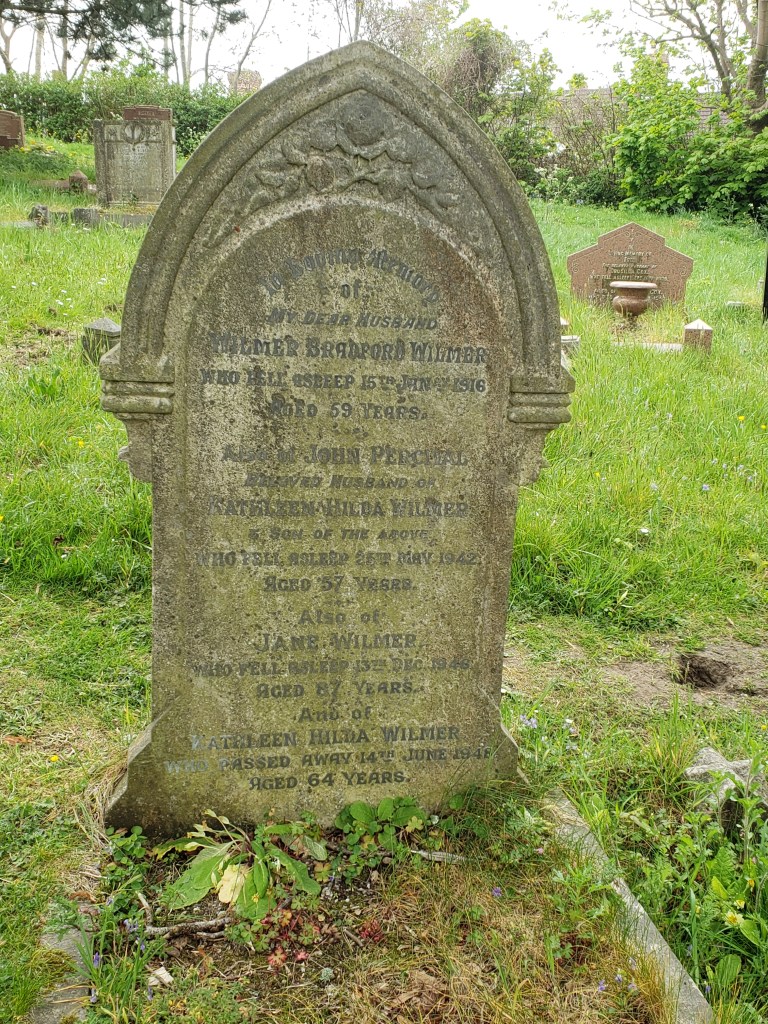
The death took place on Saturday at his residence, 96, Goddard Avenue, Swindon, of Mr. Wilmer Bradford Wilmer. The deceased, who was 59 years of age, came to Swindon from Paignton, Devon, 14 years ago, and started business as a coal merchant. For the scene of his operations Mr Wilmer chose a field at the end of St. Margaret’s Road, and commenced business in a small way. At this time Mr. Wilmer was a perfect stranger to the town, but by dint of hard work and careful trading he slowly but surely built up a sound and extensive business. It was not long before he was appointed agent for the Midland and South Western Junction Railway Company, whose lines his wharf adjoins and in this way he became one of the best known men in the town.

Mr Wilmer had been ailing for a considerable time, but his illness, due to an internal complaint, did not become serious until a month ago, and that it would have a fatal termination was not contemplated by his family until four days before his death.

The funeral took place on Wednesday at the Cemetery, where the burial service was conducted by the Rev. C.A. Mayall. The chief mourners were. Mr J.P. Wilmer (son), Mr and Mrs C. Love (sister and brother-in-law) Mr G. Ashworth, Mr. W. Beer, Mr. W.B. Armitage, and Mr E. Mackelden.

Mr Wilmer and family 96 Goddard Avenue, wish to thank all those friends who so kindly sent letters of sympathy during their sad bereavement.

Extract from North Wilts Herald, Friday, January 21, 1916.

Wilmer Bradford Wilmer was born in about 1857 the youngest son of Benjamin and Jane Wilmer. Benjamin was the publican at the Cross Keys Public House in Caxton, Cambs.

It would appear that the move to Swindon got off to a bit of a rocky start for Wilmer. In 1902 Wilmer was declared bankrupt with liabilities of over £1,000. He declared to the bankruptcy court that he was “absolutely without any estate, and admitted being a bankrupt before, in the year 1889.” – Wilts & Gloucestershire Standard Saturday 31st May 1902.

The family had arrived in Swindon sometime between 1891 and 1901 when Wilmer is recorded as a Stock Broker Agent living at 96 Goddard Avenue with his wife Jane and their two children, John P. 16 an architect’s apprentice and two year old Lilian. Their home in 1891 was in Batley, Yorks where Wilmer and Jane had married in the September quarter of 1883. He describes himself on the census of that year as “Living on own means.” They then spent some time in Paignton, Devon where daughter Lilian was born, before coming to Swindon.

Whatever had happened in Wilmer’s past, he soon managed to get his act together and established a business that would survive beyond his death and through several generations of the Wilmer family, until in 2015 when cousins Ken and John Wilmer made the difficult decision to sell the family business.

John told the Swindon Advertiser: “We were coming to the yard as toddlers but when we were teenagers we started helping out a bit more. Once we got our driving licences I think we were a bit more useful and we went all over the county delivering. Life was simpler back then,” he said.

Swindon Advertiser 20th April 2015

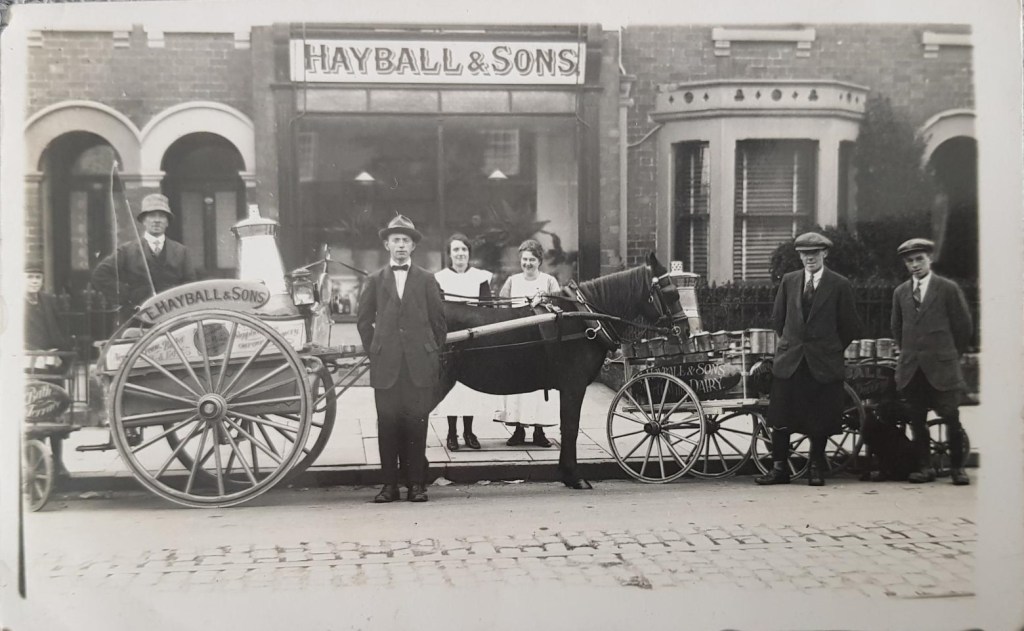
Ernest Hayball – dairyman

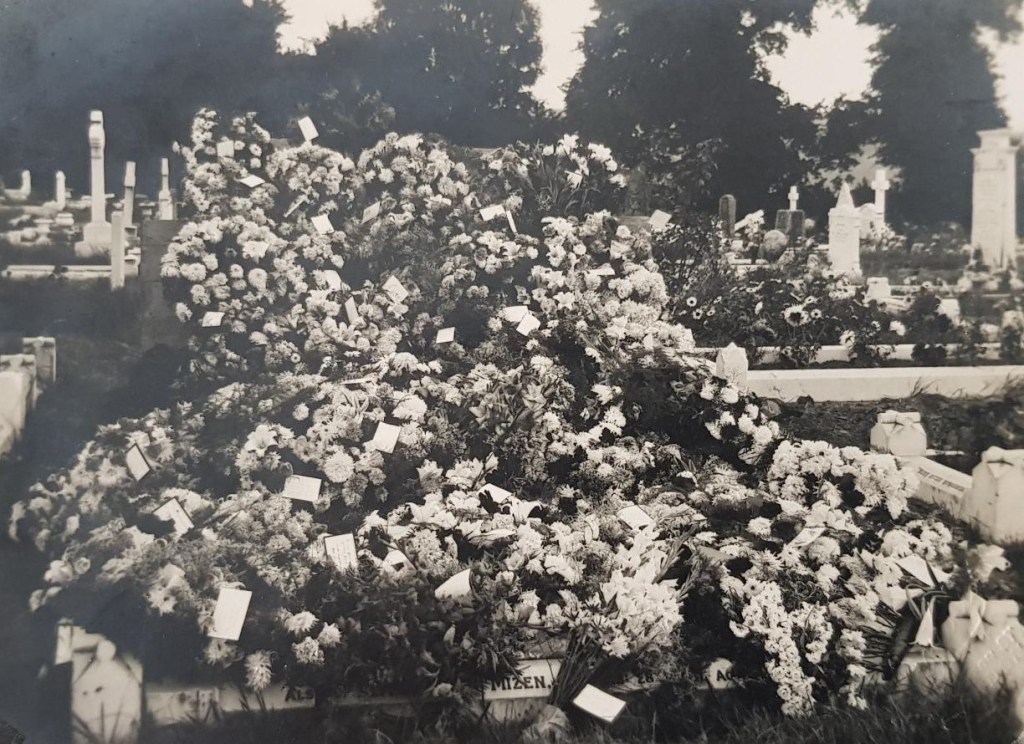
One of our regular cemetery followers has a wealth of family history knowledge, a vast archive of photographs and ephemera, more than one family grave in Radnor Street Cemetery plus a photograph taken at the time of his grandmother’s funeral in 1937. How lucky are we to be given access to all this material and the story of Ernest Hayball!

Ernest Edwin Hayball was baptised on April 1, 1872 in the parish church of Donyatt, Somerset, the son of Mathias Hayball, a tailor and his wife Emma.

By 1891 he had moved to Swindon and was living in Commercial Road and working as a dairyman with his brother-in-law George Parkhouse.

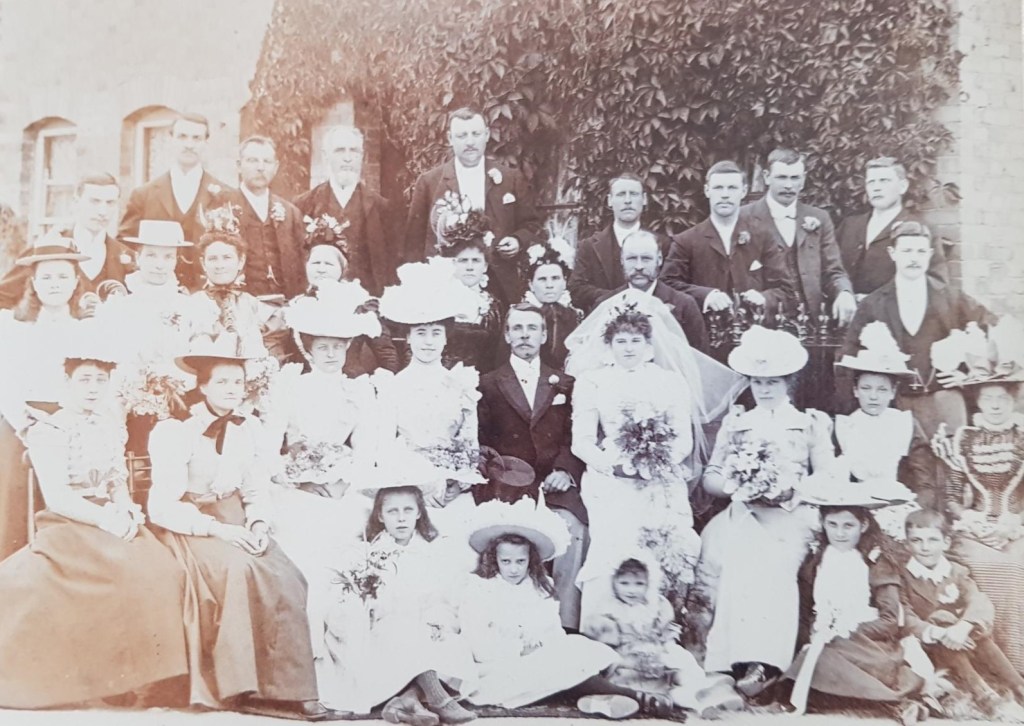
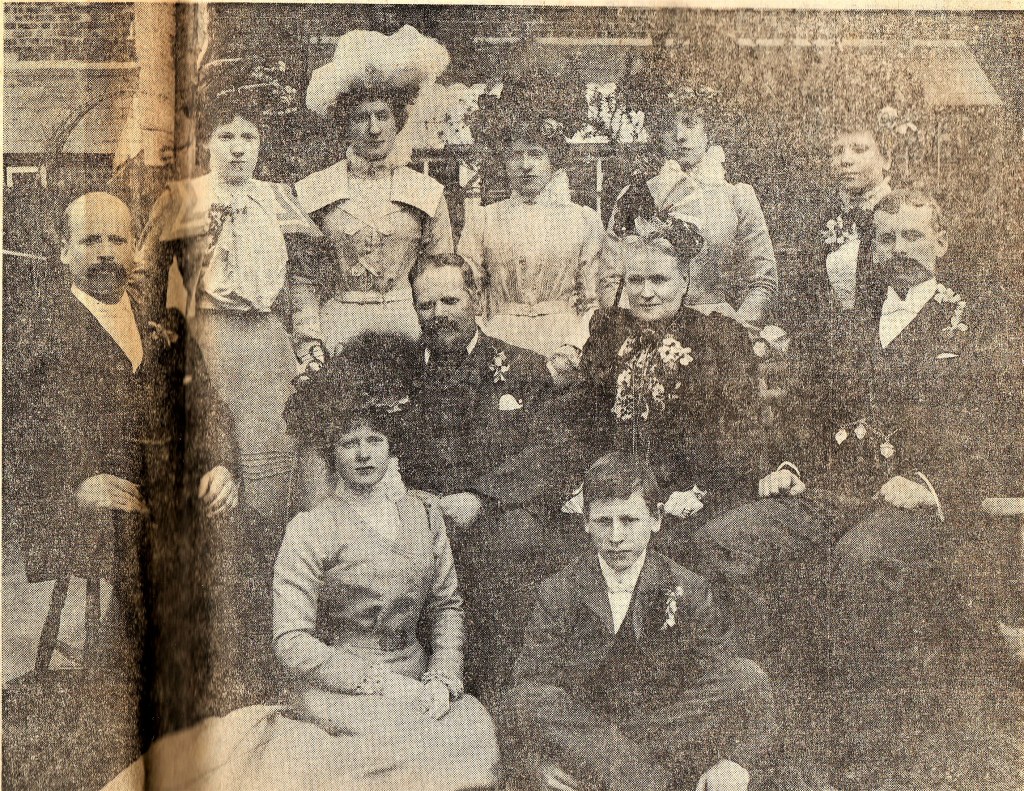
Ernest Edwin Hayball married Theresa Georgina Meads at St. Mark’s Church on July 19, 1899. Paul has a copy of the wedding photograph with an index of the pictured guests compiled by his mother (see below). The couple went on to have five children, Leonard, Ernest, George, Doris and Gladys (Paul’s mother).

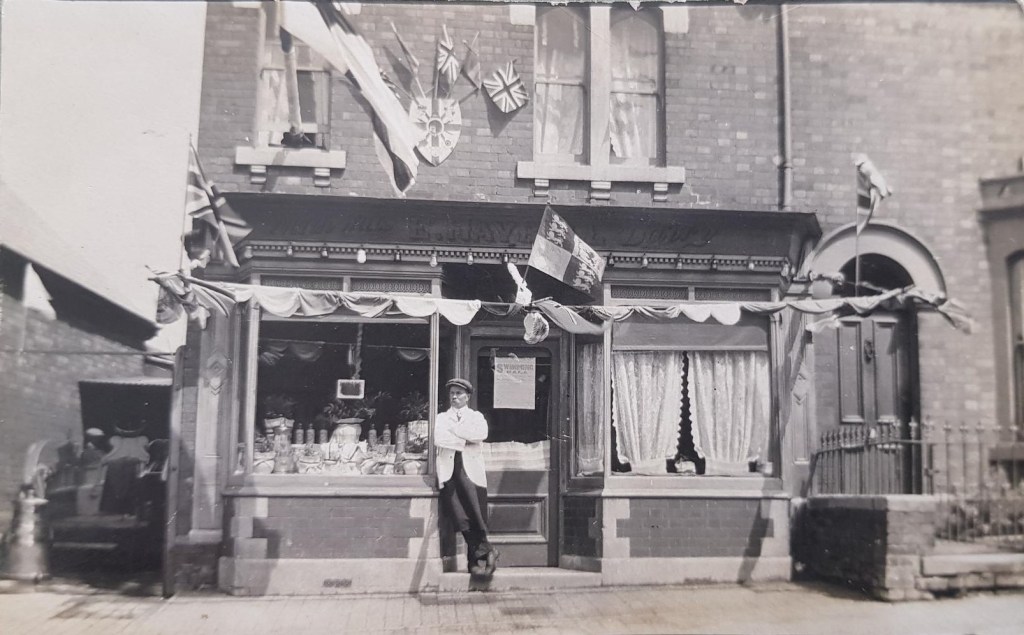
Ernest established his own dairy business in Hythe Road, later moving to 32 Bath Terrace, which became 71 Faringdon Road after renumbering and renaming in the early 1920s.

In 1932 the local press reported on yet another successful Children’s Fete where 35,000 people had celebrated in the GWR Park opposite the Hayball business. Organised by the Mechanics’ Institute, catering for the thousands of adults in attendance was undertaken by the Swindon Town F.C. Supporters’ Club with “40lbs of tea, nearly 4 cwt of sugar, and 40 gallons of milk, the latter being supplied by Messrs E. Hayball and Sons, of Faringdon road, Swindon.”

A brief obituary in the local press following Ernest’s death in 1952 encapsulated his busy life.

Was dairyman for 50 years

Swindon Death

A former member of the committee of the Swindon Town F.C. Supporters’ Club, Mr E.E. Hayball (79), 71 Faringdon Road, Swindon, has died.

He had been in business as a dairyman for 50 years. Starting at 1 Hythe Road, he bought Mr H.J. Hulme’s business, and after staying there for nine years went into partnership with the late Mr G. Parkhouse in Commercial Road.

In 1914 he started on his own account at 71 Faringdon Road, where he continued until his death.

At one time he played skittles for Ashford Road and the Central Clubs.

He leaves three sons and two daughters.

Ernest died at his home on January 13, 1952. He was buried in grave plot E7749 with his mother Emma who was living with them at 32 Bath Terrace at the time of her death in 1918; his wife Theresa who died in 1937 and his daughter Gladys and son-in-law (Paul’s parents).

Here is a selection of Hayball family photographs published courtesy of Paul.

Ernest and Theresa’s wedding photo.

Back row 4th from left is Mathias William Beazley Hayball (father of the groom).

Middle row 6th from left standing behind the bride and groom is Emma Hayball (mother of the groom).

A family photograph celebrating Ernest and Theresa’s Silver Wedding Anniversary.

Left to right standing:- Doris, Leonard, Ernest and George

Gladys stands between her seated parents Theresa and Ernest

Ernest standing outside the shop in Hythe Road.

71 Faringdon Road

Ernest and Theresa Hayball

The Hayball family grave in Radnor Street Cemetery following the funeral of Theresa Georgina Hayball in 1937.

Nash family – confectioners

The re-imagined story …

I used to love to go shopping. And do you know what my favourite shop was – Nash the confectioners, and not only when I was a child either. Sometimes I would call in when I was a grown up too, a young clerk in the Works, before I married and had children of my own. You don’t see sweet shops like that anymore, you don’t see sweets like that either, jars and jars of handmade confectionery.
It was a sad day when the last of the Nash family shops closed. Perhaps they couldn’t compete with the big manufacturers, the producers of those bags of gummy, plastic tasting sweets that tempt the children at the supermarket checkouts. Soulless places, those supermarkets. My granddaughter offered to take me to Asda Walmart on a shopping trip. Bah – that’s not a shopping trip, that’s a descent into Hades, I told her.

What I would give to take a walk down Regent Street again? Not the Regent Street of today but the old one, when ladies got dressed up to go down town. My first stop would be a wander around McIlroys and then a visit to Nash’s and a quarter of – now what would I choose, aniseed balls or pear drops, or maybe a bag of toffee, although my teeth are probably not up to that now. Happy days.

Regent Street

The facts …

William Nash was born on April 23, 1840 at Badbury the son of William and Jane Nash. His father died two months before William’s birth, leaving Jane to raise four young boys alone until she remarried in 1844. At the time of the 1851 census 11 year old William is living in Badbury with his mother, step-father William Jordan, his two brothers Thomas and George Nash and three half sisters Sarah, Ann and Emma Jordan.

William married at St. Mark’s Church on December 25, 1863. He was 23 and working as a labourer, his bride was 21 year old Elizabeth Hunt. The couple began their married life in London where their first child, Edmund William Nash was born. It seems likely that this is also where William saw the prospects of a career in the confectionery trade. Elizabeth’s brother and sister had both married into the Leach family, headed by Thomas Leach who had a confectionery business in Southwark.

On his return to Swindon William worked as a labourer in the railway works and Elizabeth as a mangler. In 1871 the couple lived at 2 Havelock Street with their growing family – Edmund 5, Clara 4, Thomas E. 2 and 8 month old Elizabeth M. It appears that the Nash couple were both prudent and focused, both working and saving to fulfil their ambition to open their confectionery business.

By the time of the 1881 census William had achieved this ambition. The family lived over their first shop at 32 Bridge Street. By then there were seven children, the youngest 4 month old Lily. Elizabeth’s sister Martha Hunt lived with the family working as an assistant in the shop.

And so the Nash empire expanded with shops at 64 and 65 Regent Street and 17 Regent Street as well as the original premises at 32 Bridge Street. Other family run shops opened at 104 Cricklade Road, 10 Wood Street, 32 Regent Circus and 167 Rodbourne Road, the last of the shops which eventually closed in the 1970s. The Nash family were famous for their award winning ice cream and also their bargain pack of assorted sweets – Penny Big Lots.

Death of Mr W. Nash – Mr W. Nash of Lypeatt House, Goddard Avenue, Swindon, died on October 29th after a long and painful illness. He will be remembered by many, having been formerly in business as a sweet manufacturer. He married a daughter of the late Mr Thomas Hunt, of Broad Town, who was well known in Primitive Methodist circles. He leaves a widow, six daughters and two sons. The funeral took place on Monday November 4th the cortege leaving Goddard Avenue at 3 o’clock for the Primitive Methodist Chapel, Prospect Place. The Rev. H. Pope Officiated at the chapel and also at the Cemetery.

Extracts from the North Wilts Herald, Friday, November 15, 1918.

William and Elizabeth Nash are buried together in plot E7604

Grateful thanks to Katie Brammer for sharing her family history research. Katie has been discovering the graves of her Nash family ancestors with the help of Radnor Street Cemetery volunteer Jon. This is the grave of William and Elizabeth Nash.

WANTED, a respectable GENERAL SERVANT, about 18, able to do plain cooking; sleeping out preferred; good character – Apply, Nash, Confectioner, Bridge Street, Swindon.

The Swindon Advertiser, Friday, September 2, 1904.

Season of mists – last day

Sadly, we have arrived at the last day of our virtual walk through Radnor Street Cemetery – it’s been fun, hasn’t it and the weather wasn’t too bad? It could have been worse. We conclude by stopping off at the grave of William Chambers.

Despite a shortage of readily available building land and a depression in the railway industry during the 1870s, Swindon enjoyed a building boom throughout much of the late Victorian period.  Many of our street names bear testimony to a number of local builders, George Street, Crombey Street, Colbourne Street, Ponting Street, Turner Street.

William Chambers lived and worked as builder and funeral director in the end house in Ashford Road, the one with the Calvary cross in the brickwork.  The silhouette of the shop sign can still be seen.  As we have already discovered William Chambers was building on the Kingshill estate in the 1890s.

William was born in Stroud in 1839 the son of Samuel, a handloom weaver, and his wife Maria.  In 1859 he married Sarah Tyler and the couple raised their family of eight children in nearby Bisley where William then worked as an agricultural labourer.

In 1871 he was working as a bricklayer and by 1884 the family had moved to Swindon where William established himself as a builder and contractor.  His four sons would eventually join him in the business, William and Alfred both bricklayers and Robert and Samuel who were joiners.
From 1884-1897 William was engaged in building projects in Stafford Street and Hythe, Kent and Maidstone Roads.  In the last decade of the nineteenth century William was also busy building in Ashford Road.

At the time of the 1891 census eldest married sons Alfred and William both had homes in Stafford Street.  Family folklore tells how so many relatives once lived in Stafford Street that it was known locally as Chambers Street.

William’s son Samuel took over the family business after his father’s death.  A 1906 trade directory entry describes the business at 1 Ashford Road as under new management – S. Chambers (late W. Chambers) builder & contractor, dealer in all kinds of building material, funerals completely furnished, repairs promptly attended to at moderate charges.

William died in 1901 and Sarah in 1926.  I think this stylish headstone befits a couple who spent their lives in the funeral business.

I’ve very much enjoyed your company this week. You may like to join us for ‘an in person’ cemetery walk this Sunday September 29. Meet at the chapel 1.45 pm for a 2 pm start.

Extracts taken from To Autumn by John Keats

William and Mary Hooper rock up at Stonehenge

The re-imagined story …

I have Swindon photographer William Hooper to thank for my appearance on Time Team.

As a nerdy little kid, I was already interested in archaeology (in particular the Neolithic period) and the inspiration for my obsession was all down to a photograph that hung in my grandpa’s study.

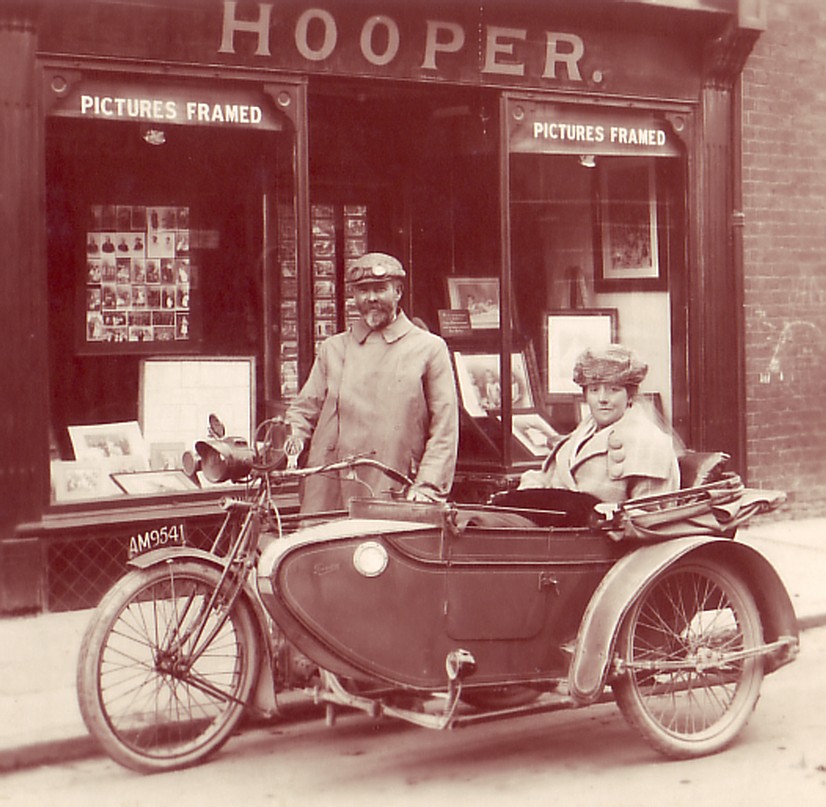
William Hooper has become famous for his Edwardian Swindon street scenes, but William and his wife Mary were not averse to getting on their bikes and venturing beyond Swindon. In the early days they travelled quite literally by push bike, graduating to a motor bike and sidecar as they travelled the Wiltshire countryside and beyond. Between 1905 and 1910 they took a series of stunning photographs of Avebury and Stonehenge.

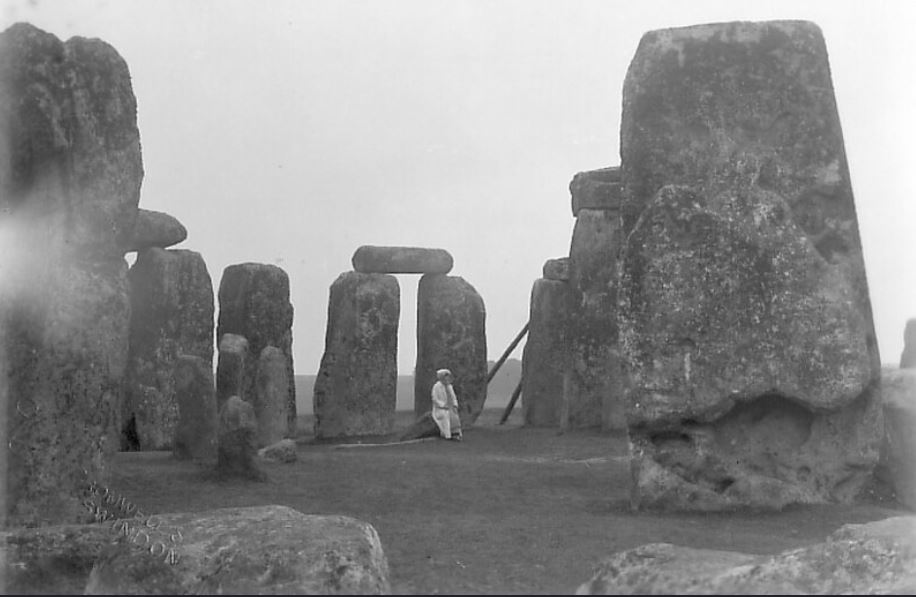
The photograph in my grandpa’s study was of an ethereal woman dressed in white, sitting on a fallen boulder within the stone circle. These days you have to have permission and a very special reason for being allowed access to the stone circle but in 1910 the historic monument was still in private ownership, the property of Sir Edmund Antrobus 4th Baronet. Perhaps anyone could rock up and take a few photographs.

This image has an empty alt attribute; its file name is stonehenge-4.jpg
Image published courtesy of P.A. Williams and Local Studies, Swindon Central Library

Skip on twenty years or so and with my degree in archaeology under my belt, I volunteered for a brand-new television programme that was thought by many to be doomed before it even made it to the screen. Television producer Tim Taylor had the crazy idea of making a programme featuring scruffy, hippy looking student types digging trenches in muddy fields. The premise of the programme was that the team would turn up at a site of archaeological interest, dig for three days and then reveal the history of that site. For twenty years Time Team brought archaeology to the masses and achieved viewing figures in excess of 2 million per episode.

I was a regular participant on the show, taking part on a number of digs, working alongside my university professor Mick Aston and national treasure Phil Harding. There are photographs of us in trenches and in various pubs mulling over the findings of the day’s dig.

I’ve recently moved to a cottage in Avebury (the magnetism of those stones still draws me) and it has long been my intention to pay my respects at the grave of William Hooper, the man who sparked my interest and gave me a lifelong love of history.

I’ve been told his grave in Radnor Street Cemetery is difficult to find. Now, where is John Gater and his geophysical wizardry when you need him?

This image has an empty alt attribute; its file name is william-and-mary-hooper-2.jpg
Image published courtesy of P.A. Williams and Local Studies, Central Library

The facts …

William Hooper was born in Windrush near Burford in 1865 and moved to Swindon and a job in the Works in 1882. In 1886 he was involved in a serious accident during which his leg was so badly crushed that he would eventually have it amputated at the knee.

William returned to his job in the railway factory where in 1891 he worked as a labourer and ten years later as a stationary engine driver. However, the work became too difficult for him and it was then that he decided to turn what had previously been a hobby into a business.

He opened his first photographic studio at 2 Market Street in around 1902, later moving to 6 Cromwell Street where he and his wife Mary remained until they retired in 1921.

Mary Stroud was born in Hereford where he father James worked as a Railway Guard. The family later moved to 22 Merton Street in Swindon. Mary and William married in 1890.

At the time of the 1911 census William, then aged 47, describes himself as a Photographer – Portrait and Landscape, his wife Mary as assisting in the business, but Mary did more than just ‘assist.’

In the extensive Hooper archive available online courtesy of P.A. Williams on the Swindon Local Studies flickr account, we glimpse Mary ‘assisting’ not only in the studio, but out on the road, travelling with her husband across Wiltshire on a variety of vehicles from a tandem to a motorbike and sidecar.

The couple never had any children of their own but were very close to Mary’s two nephews who also worked in the business with them from time to time.

William died in 1955 followed by Mary a short while later. They are buried here with Mary’s parents James and Ellen Stroud.

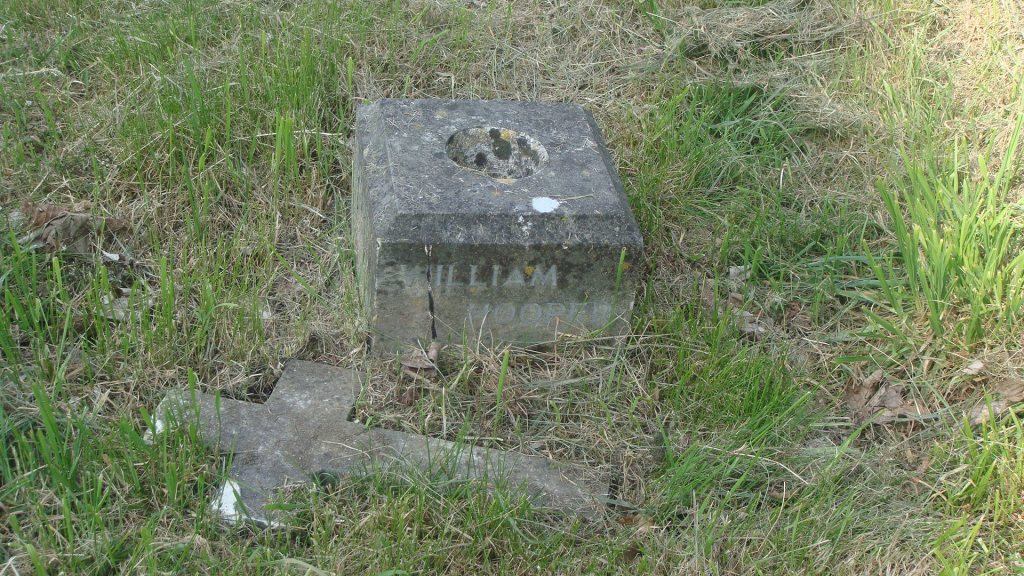
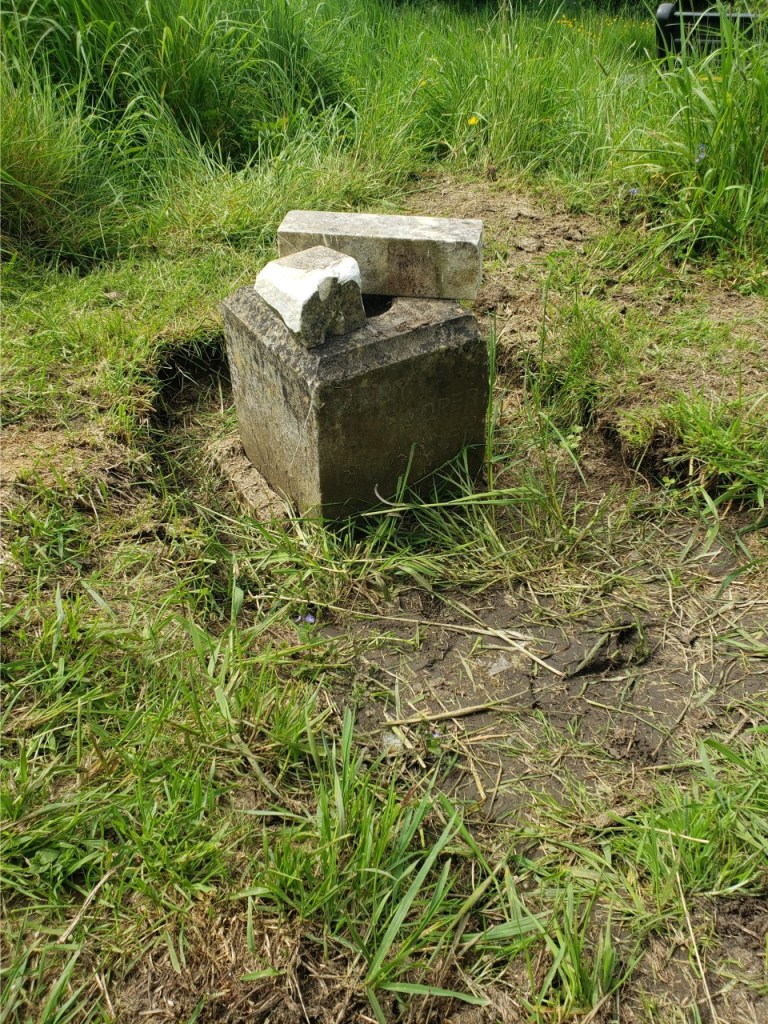
The modest memorial is a small cross on a plinth, sadly broken and difficult to find when the grass grows long. But the Hooper name lives on in the many photographs of Swindon William left us – with Mary’s assistance.

The Radnor Street Cemetery volunteers have revealed the battered William Hooper memorial and cleared the area around it. Unfortunately the cross is now badly broken.

You may also like to read:

Alice Kate Richards – smile please!

Eleanor Stroud

No place like home

At last there is some good news about the future of the derelict property on Victoria Road as published in yesterday’s Swindon Advertiser.

Unfortunately, a misinterpretation of my article No place like home has led to an erroneous link between the property and the suffragette leader Emmeline Pankhurst. This is not the case. There is no connection between the militant suffragette leader of the Women’s Social & Political Union and Oxford House, 57 Victoria Road.

But, you may like to read the story of this house and the remarkable Clarke sisters who lived there at the beginning of the 20th century.

Half way up Victoria Road, behind the bus stop called The Brow, stands an empty and derelict property and so it has been for many years. Last year, or maybe it was longer ago, the builders arrived and I was hopeful the property, called Oxford House, might be about to begin a new life. The roof was stripped and new dormer windows inserted. Then the builders left, the new windows were boarded up and the pigeons moved back in. And so it stands, dilapidated, unloved.

dsc05329-copy-2

At the time of the 1881 census the Clarke family lived at 17 Wellington Street.  William worked as an Iron Turner in the GWR Works, but he was an ambitious, intelligent and determined young man.

Ten years later William had moved his family up the social ladder and up the hill to a house in Victoria Road where he worked as a solicitor’s clerk.

When William died on December 16, 1898, the obituary in the Advertiser recalled how for many years he had been employed as a mechanic in the GWR Works. ‘But eventually [he] resigned his post to act as an accountant and debt collector.  In the latter capacity he has worked up undoubtedly the largest business of the kind in the county, and has been of great assistance to the business men of the town,” the report continued.

Oxford House dates from around the end of the 19th century when development at the northern end of Victoria Street began.  Known first as New Road and then later as Victoria Street North the road was eventually renamed Victoria Road in 1903.

dsc04980-copy-2

In 1903 Emmeline Pankhurst established the Women’s Social and Political Union at her home in Nelson Street, Manchester and at Oxford House, 57 Victoria Road, Swindon the three Clarke sisters, Rosa, Mabel and Florence, established their own financial business, as accountants and debt collectors.

The Institute of Chartered Accountants in England and Wales set up in 1880, discussed admitting females in 1895.  Sadly, Rosa died in 1904 and it would be another fifteen years before the first woman became a member in 1919.

The two remaining sisters kept Rosa’s initial letter R in the company name. While the campaigning suffragettes boycotted the 1911 census, refusing to be counted without representation, Florence and Mabel Clarke filled in their census form and are recorded still in business at 57 Victoria Road.

In 1918 Mabel died, leaving an estate of £2,609 4s to her surviving business partner and sister Florence.  Interestingly, when Rosa and Mabel died neither sister received the press recognition that their father had.

Florence carried on the business following Mabel’s death in 1918 but by 1920 the North Wilts Trade Directory records that H.T. Kirby, registrar of births and deaths, lived at 57 Victoria Road.

Mabel is buried in plot E8015 with her father William and mother Mary Anne Tilley Clarke.

clarke-family-from-oxford-house

During the 1980s architect Geoffrey Drew worked out of offices in Oxford House. Brian Carter sent me a photograph taken then and a few words about his father-in -law.

‘My reason for photographing it in 1983 was that the first floor was then the offices of Architect Drew. This was the business of my late father-in-law, Geoffrey Drew (and his secretary – my mother-in-law – Elisabeth Drew).

Geoff was born in Southampton in 1928, was evacuated to Corfe Castle during World War II, and started his working life in Ipswich. Later, he went into partnership in a business in Bristol. This brought him to Swindon for the first time in the 1960s (his first job in the town was working on the original BHS shop in Swindon town centre).

He set up a satellite office in Swindon and liked the place so much that he spent the rest of his life in Bishopstone, and married my future mother-in-law in 1972.

He set up in business on his own in 1981 – briefly in Newport Street, before moving to 57 Victoria Road. In about 1999, they vacated those premises and worked from home in Bishopstone.

Sadly, Geoff died in 2006, aged 77.’

57-victoria-road

Percy Albert Cook and the new Museum

Such a novelty is it to have our museum back in Swindon that I’ve already visited twice.

The Swindon Museum and Art Gallery at Apsley House closed with the advent of Covid in 2020 and never re-opened. Apparently there was (and possibly still is) a plan in the pipeline to build an all singing, all dancing building in Swindon’s ‘Cultural Quarter.’ But it was a very long pipeline; a ten year long pipeline.

But, to cut a long story short, we now have a new museum on the first floor of the Civic Offices in Euclid Street, and what a cracker it is!

And, of course, I went round with my notebook collecting names of those people who might be buried in Radnor Street Cemetery. I already knew that Charles Herbert Henry Gore, the first curator in post in 1928 was buried in grave plot B3248.

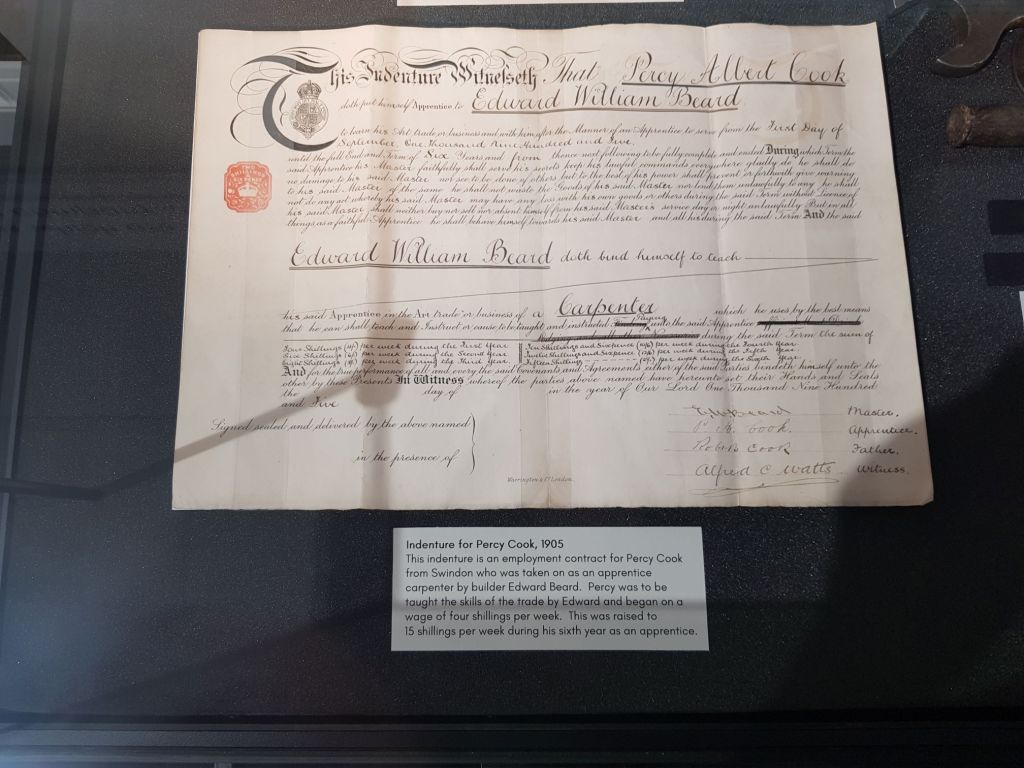
Then I came across an indenture between *Edward William Beard, builder, and 14 year old Percy Albert Cook.

Born in Fareham, Hampshire in 1891, Percy was the son of Robert Bray Cook (whose signature is on the bottom of the document) and Elizabeth Mary Cook nee Cable. The family first appear in Swindon on the 1901 census when they lived at 114 Commercial Road. Young Percy successively completed his apprenticeship and in 1920 he married Gertrude Hawkins. In 1939 the couple and their two sons were living at 13 Commercial Road where Percy describes his occupation as ‘Carpenter, Decorator and Jobbing Builder (Master).’

Gertrude died in 1963 and Percy in 1976 but unfortunately neither of them are buried in Radnor Street Cemetery.

Percy’s father Robert had worked at a variety of jobs. Perhaps this is why he wanted Percy to have a trade and a secure future. By 1911 the family were living at 13 Commercial Road, the property where Percy was living in 1939.

Robert died that same year. He is buried in an unmarked public grave, plot B2332 which he shares with his son Barlett Alfred Cable Cook who died aged 24 in 1909.

* The firm founded by Edward William Beard is still in operation and is presently working on the Health Hydro building in Milton Road.