Samuel Chappell – boot maker and Minister of the Gospel

The re-imagined story…

We always bought our shoes and boots from Mr Chappell’s shop in Bridge Street. I say ‘always’ as if it were a weekly event. Buying shoes and boots in our family was a big occasion and only done after much forethought and deliberation.

Father patched up our footwear until it was beyond repair and the new purchase was only embarked upon at the moment of absolute need, never on a whim or a fancy.

My sister always chose a dainty pair of shoes with buckles and bows. Of course these were never the ones she ended up with. I was just happy to have a pair of boots that kept my feet dry and didn’t scrunch up my toes.

My sister told me that Mr Chappell was born in America; New York, she said, but I knew that couldn’t be true. He didn’t look American and he certainly didn’t sound American. And why on earth would you leave New York and move to Swindon?

She also said he was a Minister of the Gospel and I didn’t believe that either. Why would he sell boots and shoes if he was a man of God?

Girls have some funny notions.

invoice from Chappell

The facts …

This is the final resting place of Samuel Chappell, master shoemaker, boot and leather seller and as inscribed on the headstone, 40 years a Minister of the Gospel.

Samuel was the eldest son of Eli and Ann Chappell.  His father was born in Castle Combe where he worked for many years as a tailor.

Samuel, however, was born in New York in 1847.  By the time of the 1851 census the Chappell family were back in Wiltshire and living in Hullavington where Eli was working as a Master Tailor.  Living with him were his wife Ann, 8 year old daughter Ann who was born in Castle Combe, obviously before the family’s big American adventure, and a baby son John, born in Hullavington on their return.

Samuel appears to have been raised in Castle Combe by his aunt and uncle, Susanna and William Chappell.  William was a master shoemaker and in 1861 Samuel was working as his apprentice.

The 1871 census has two entries for Samuel, one living in Stratton St Margaret with his parents and two brothers. The other entry shows him lodging with the Keylock family at 5 Albert Street in Old Swindon.

Samuel opened his own boot and leather shop at 26 Bridge Street in 1872. In 1874 he married Sarah Ann Sainsbury.  On the 1911 census Samuel and Sarah Ann are living at 68 Eastcott Hill and state that they had six children, four of whom were still living.

This photograph shows Samuel and his eldest son William outside the shop in the early 1900s.  According to a family member who kindly sent me this photograph, the shop remained open until the 1950s. 

Samuel Chappell

Samuel died at his home in Eastcott Hill and was buried in plot A2560 in Radnor Street Cemetery on January 19, 1926.  He shares the grave with his wife Sarah who died in 1916 and their youngest son Samuel, who died aged 24 in 1909 following a leg injury sustained whilst playing football. 

Timothy Job Mills – a highly respected citizen

The family story is that Timothy Job Mills bought the Astill printing works that once stood at the corner of Victoria Street and Bath Road. His son Arthur Stanley Mills had married Amy, one of the Astill daughters and family historian Rhonda sent me the follow anecdote.

Image published courtesy of Local Studies, Swindon Central Library.

Arthur’s father Timothy Job Mills eventually purchased the Astill Printing Works and kept all the existing employees on.  He also bought tea in complete chests and the family used to spend ‘happy’ evenings bagging it up for sale to friends and neighbours.  It was his proud boast that he made one farthing profit on every bag… 

The enterprising Timothy Job Mills was born in Marston Maisey in 1845, the son of William and Helen Mills. By 1861 14 year old Timothy had moved to Swindon where he lodged with a family in Broome and worked as an agricultural labourer. In 1871, newly married to Ellen, he lived at Bradwick in Buckinghamshire where he worked as a painter’s labourer. By 1881 he was living in Upper Stratton and working as a commercial traveller. In 1891 he was living at 35 Bath Terrace, one of several terraces in the Farringdon Road area, where he continued to work as a commercial traveller. By 1901 he was living at 15 Devizes Road where he worked as a house furniture dealer, an enterprise his son Arthur Stanley Mills continued. In 1911 he was again working a a commercial traveller, this time dealing in cattle food. His acquisition of the Astill printing works followed but when his tea dealing enterprise took place remains unknown.

Timothy married twice – first to Ellen Reynolds by whom he had at least 7 children. Ellen died in 1893 and is buried in grave plot A965. Her details are recorded incorrectly in the Radnor Street Cemetery registers where it is stated she was 64 years old when she was actually 43.

Timothy married again in 1895. By then aged 50 his second wife was 23 year old Ada Kate Rosier. This marriage was a short one as Ada died the following year. She was buried with Timothy’s first wife in plot A965.

The Late Mr T.J. Mills

Funeral in Swindon

The funeral of the late Mr Timothy Job Mills, which took place on Friday, was marked by unusual demonstrations of sorrow and sympathy. The first part of the service was conducted at the Regent Street Primitive Methodist Church, where deceased had for so many years been a regular worshipper. He had filled many offices, including that of choirmaster, and he was also a circuit steward and a member of the Brinkworth District Committee, and had represented the church at District meetings and the district at annual conferences.

Appropriate music was rendered by the organist, and two of deceased’s favourite hymns were sung, “Give me the wings of faith” and “There is a land of pure delight.” The Revs. A.R. Wightman and C.H. Shawe officiated at the graveside in the Cemetery.

An Appreciation

In the course of the service at the church the Rev. F.W. Harper gave an address. He said Mr. Mills had lived a long life and had been a highly respected citizen of the town and a member of that church. He was a Free Churchman from principle and a regular worshipper at Regent Street church, and he had attended many important conferences as their esteemed representative. His very presence in the sanctuary, with his ever radiant smile and his jocose manner, brought to bear upon them the brightness of a spring-time morning. It was hard to think of Regent Street church without Mr. Mills. His cordiality was genuine, and he was ever out to do good for his fellow creatures. He always prayed simply, but persuasively and with great fervency, and he always joined heartily in the singing and loved the old Methodist hymns. Mr Mills’ child-like faith in the goodness of his Heavenly Father was one of the most beautiful traits in his character. He served his Lord and Master from a sense of duty as well as gladness. He was no weakling, and the church and denomination mourned the loss of a good man. Mr Mill had been an inspiration to preachers, to laymen as well as ministers.

Extracts from North Wilts Herald, Friday, March 2, 1923.

A Communion table & chairs were presented to the church by the family of T.J. Mills

Timothy Job Mills of 11 Devizes Road died on February 19, 1923. Probate was awarded to his two sons John Edwards and Arthur Stanley Mills when his effects were valued at £11,145 10s. He was buried on February 23 in grave plot A965 with his two wives, Ellen and Ada.

You may also like to read:-

The Astill Dynasty

The Astill Dynasty continued

Continuing the Astill family story

Continuing the Astill family story

In recent weeks I have been telling the story of the Astill family with the help of Rhonda and the recollections of the late Eric and at our recent cemetery walk I stopped at the Astill grave.

I have now discovered the grave of Amy Maud Astill born on June 27, 1871 one of Robert and Margaret’s elder daughters and one of the 8 children baptised at Christ Church on February 1880.

She married Arthur Stanley Mills on April 18, 1902, a house furnisher, at Christ Church and the couple went on to have four sons. By 1911 they were living at 15 Kent Road with their sons Edward 8, Wilfred 6, Arthur 4 and 8 month old Leslie.

Rhonda kindly provided the following family anecdote – Arthur was assistant to Mr Merricks of Gilbert’s Furniture shop in Newport Street, Swindon in 1900.  Became a partner in the business in 1923 and moved the shop to Bridge Street, Swindon and renamed it Mills and Merricks.  (Perhaps Arthur and James Merricks became partners in an independent venture.) After retiring to Sandbanks Road, Poole, made the business over to sons Edward and Arthur.  Arthur’s father Timothy Job Mills eventually purchased the Astill Printing Works and kept all the existing employees on.  He also bought tea in complete chests and the family used to spend ‘happy’ evenings bagging it up for sale to friends and neighbours.  It was his proud boast that he made one farthing profit on every bag.  Wilfred’s son Michael Mills, a pharmacist for many years at 123 Commercial Road, wrote to me 20+ years ago from his retirement in Poole, providing me with this information and sending me my copy of ‘Swindon In Old Photographs’.  

Rhonda has also supplied this photograph from the family archives labelled ‘Mills family’

Sadly, Amy died in 1919 and lies alone in grave plot E7466 where she was buried on March 6.

Arthur married Gertrude Hedges in 1920 and the couple had a son Leonard John and lived at 13 Croft Road. Arthur eventually moved to Poole where he died in 1975.

You may also like to read:

The Astill dynasty

The Astill dynasty continued

James George Merricks

James George Merricks has already appeared on our radar, thanks to Rhonda and her Astill family history research.

She tells us that Amy Maud Astill’s husband Arthur Mills was assistant to Mr Merricks of Gilbert’s Furniture shop in Newport Street, Swindon in 1900, becoming a partner in the business in 1923 and moved the shop to Bridge Street, Swindon and renamed it Mills and Merricks – of course Gilberts is still trading in Newport Street to this day, perhaps Arthur and James became partners in an independent venture.

Now I need someone to fill in a few more gaps, such as how did James end up in South Africa in 1891 and what was Alice doing there?

In 1881 Alice was working as a governess for farmer Walter G. Cloke at Wiltshire Farm in Wokingham. Meanwhile James was working as a draper’s assistant in Bath. But by 1891 they were getting married in South Africa where three of their four sons were born, Eric George in 1892, Edward Alfred in 1893 and Lionel Marten in 1896. A fourth son, John Gordon was born in Swindon on June 14, 1900.

James George Merricks

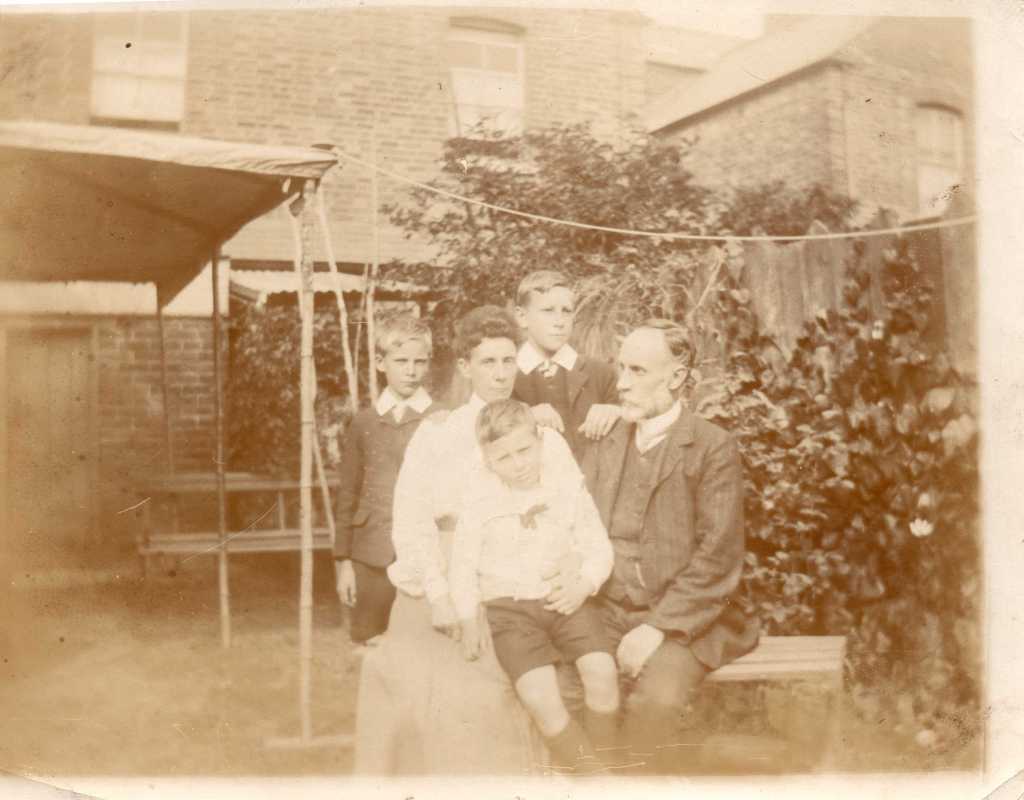
By the time of the 1901 census James and Alice were living at 42 St. Margarets Road, possibly where this photograph was taken in the back garden.

James George Merricks was a member of the Baptist Tabernacle, acting as Treasurer for 21 years. In 1934 shortly before his death, Mr J.G. Merricks presented a complete set of individual Communion bread plates to fit the cups previously given by his great friend and associate Mr. E.J. Lay. The two men are pictured together here.

There is still more to be learnt about this man. Especially how he came to spend such a lengthy spell in South Africa. Could this have been to do with the Baptist Tabernacle, I wonder?

James George Merricks died aged 75 years at his home 38 Devizes Road. He was buried on April 20, 1935 in grave plot E7574, joining his wife Alice who died in November 1923.

Honest John Arkell

Another day, another churchyard…

The Grade I listed church of St Margaret’s in Stratton St Margaret retains elements from the 13th century despite many later additions and a partial rebuild in the 19th century. The churchyard has also been extended several times, but I chose to take photographs in the oldest section around the church. Here I found the rather magnificent memorial to John Arkell, founder of the Kingsdown brewery, and his son Thomas buried with various members of their families in a large plot.

Last year the family brewery celebrated its 180th anniversary and with more than 80 pubs across Wiltshire, Gloucestershire, Berkshire and Hampshire, the Arkell name is well known. But it could have been a very different story.

Crippled by heavy taxation and an agricultural depression, John Arkell (1802-1881) gave up on farming and, with his cousin Thomas, left England in 1830 for pastures new.

The pioneering group, which included other members of the extended family, landed in New York during the winter of 1830/1, but their eventual destination was the uninhabited plains of ‘Upper Canada’.

Cousin Thomas stayed but John returned to England three years later. He established the Kingsdown brewery in 1843, and the rest, as they say, is history.

John died on October 21, 1881 aged 79 and is buried with his two wives and several of his children in the large family plot pictured below.

The Clifton Hotel

Any old building worth its bricks and mortar should have a spectral presence and The Clifton has long boasted one of its own. Supernatural sightings have included those of a hooded figure, possibly a nun, in keeping with the tradition that the pub was built on the site of an ancient priory. However, evidence to support this legend is lacking.

The surrounding area once comprised part of the former Kingshill Estate owned by John Harding Sheppard where around 300 houses were built along Clifton, Albion, William, Redcross (renamed Radnor) and Exmouth Streets between 1877 and 1880. The Clifton Hotel, complete with a tiled mural of Brunel’s Clifton Suspension Bridge, was built around 1878.

As with so many Swindon Streets, Clifton Street grew piecemeal across a number of years. Among the 19th century builders was Job Day who constructed an unspecified number of cottages in 1882 and Edwin Harvey who built eleven houses in the same year with further properties in 1883. W.H. Read designed Clifton Street Schools in 1884-6 and the Primitive Methodist Chapel, built in 1900, was designed by R.J. Beswick.

To date no documentary evidence of a priory has made an appearance, and neither has the nun. Apparently religious ghosts have slipped out of fashion in recent years.

Ghostly goings on at The Clifton hit local news headlines during one busy Christmas Day celebrations when a poltergeist joined Christmas revellers.

Manager’s wife Mrs Blanche Chirgwin reported sherry glasses jumping from shelves behind the bar while her husband recalled an eerie presence in the beer cellar. Then there was the story of a previous landlord’s dog that went mad and a jammed attic window found open only to jam again.

One long serving landlord at The Clifton was Cardiff born Henry Jefferies and his wife Frances. Local trade directories place them at the pub in the mid 1880s and Frances was still there at the end of the 19th century.

During their occupancy of the pub, two of the couple’s sons died, Edwin in 1887 and Frank ten years later. Henry died in 1896 and was buried with his son Edwin Bernard Jefferies in Radnor Street Cemetery, grave plot A778. Frank died in 1897 and is buried in neighbouring plot A779. Frances returned to Cardiff where she married Isaac Edmunds in 1902. She died in 1920 and was buried back in Swindon with her son in plot A779.

The Paranormal Site Investigators (PSI) conducted an overnight investigation at the pub in March 2005. Despite a few bumps in the night the team failed to detect any ghostly activities. And still no sign of the nun.

Views of The Clifton Hotel in the 1950s and 60s published courtesy of Arkells and Local Studies, Swindon Central Library.

Frederick Augustus Powell – Draper and House Furnisher

Frederick Augustus Powell came from a large family of Primitive Methodists. Born in 1859 to Primitive Methodist Minister Edward Powell and his wife Martha, Frederick grew up first in Penzance and later in Llanguinder, Breconshire. By 1881 he was living with his uncle and aunt George and Mary Smith in Kennington, Lambeth where he describes himself as a Primitive Methodist Minister.

If Frederick served as a Primitive Methodist Minister he did so for a relatively short period. In 1882 he married Emma Ricks, a young draper’s assistant who lived in College Street, Swindon. By 1889 he had had a change of career and was living 25 Avenue Road where he worked as a commercial traveller. The 1891 census records that he and Emma had four children, Ethelwynne born in Devonport in about 1884, Garnet born in Teignmouth in about 1889 and Hilda 2 and Stanley 9 months old, both born in Swindon.

By 1901 they were living at 75 Hythe Road with two more children, Gladys and Morley, and Emma’s widowed mother Jemima Ricks. Frederick states that his occupation was Manager of a Music Shop and Secretary to a Property Company.

In 1911 the family were living at 8 The Mall. Frederick now worked as a Draper and House Furnisher. Emma states that they have been married 28 years and of their 7 children 4 were living and 3 had died.

Frederick Augustus Powell died aged 68 years at the Glenwood Nursing Home, Swindon on Tuesday November 6, 1928. He had survived four of his adult children. Edward Garnet died in 1900; Frederick Charles Stanley in 1901; Emma Ethelwynne in 1913 and Ernest Morley in 1914. The four siblings are buried together in Radnor Street Cemetery in grave plot C56.

Frederick was buried on November 8, in grave plot D262. Emma died in 1934 and was buried with her husband.

Death of Mr F.A. Powell – The death took place on Tuesday morning, at the Glenwood Nursing Home, of Mr. Frederick Augustus Powell, of 8, The Mall, at the age of 68 years. For some time Mr. Powell had not enjoyed the best of health, and on Thursday he underwent an operation. He was a native of Penzance, and came to Swindon when quite a youth. For a considerable time he was the musical instrument manager for Mr. L.L. Morse, of Regent Street. About 28 years ago he commenced business on his own account as a draper and furnisher in Commercial Road. He was a member of the Swindon Chamber of Commerce, and President of the Swindon branch of the Credit Traders’ Association. He leaves a widow and two daughters.

North Wilts Herald, Friday, November 9, 1928

Funeral of Mr F.A. Powell

The funeral of the late Mr F.A. Powell, who for many years carried on business as house furnishers, at 74 and 75 Commercial road, Swindon, took place at the Radnor street cemetery yesterday. Mr Powell, who was 68 years of age, only retired from business a short time ago. He is survived by his widow and two daughters. The service was conducted in the little chapel in the cemetery by the Rev. H. Baird Turner, Wesleyan Superintendent minister, who also officiated at the graveside.

The mourners were Miss Hilda Powell and Miss Gladys Powell (daughters), Mr A.S. Redwood (of Chippenham) Mr W.G. Selwood (who succeeds to the business) Mr H.G. Ford and Miss Woolford (representing the staff at Commercial road), Mrs W.H. Trowbridge, Messrs F. Winslow, L. Winslow, A.W. Hamilton, B. Adams, W.S. Wiltshire and H. Bristow. There were many beautiful wreaths sent, including one from the Swindon Chamber of Committee, [Commerce], of which deceased had been a member for many years.

North Wilts Herald, Friday, November 9, 1928.

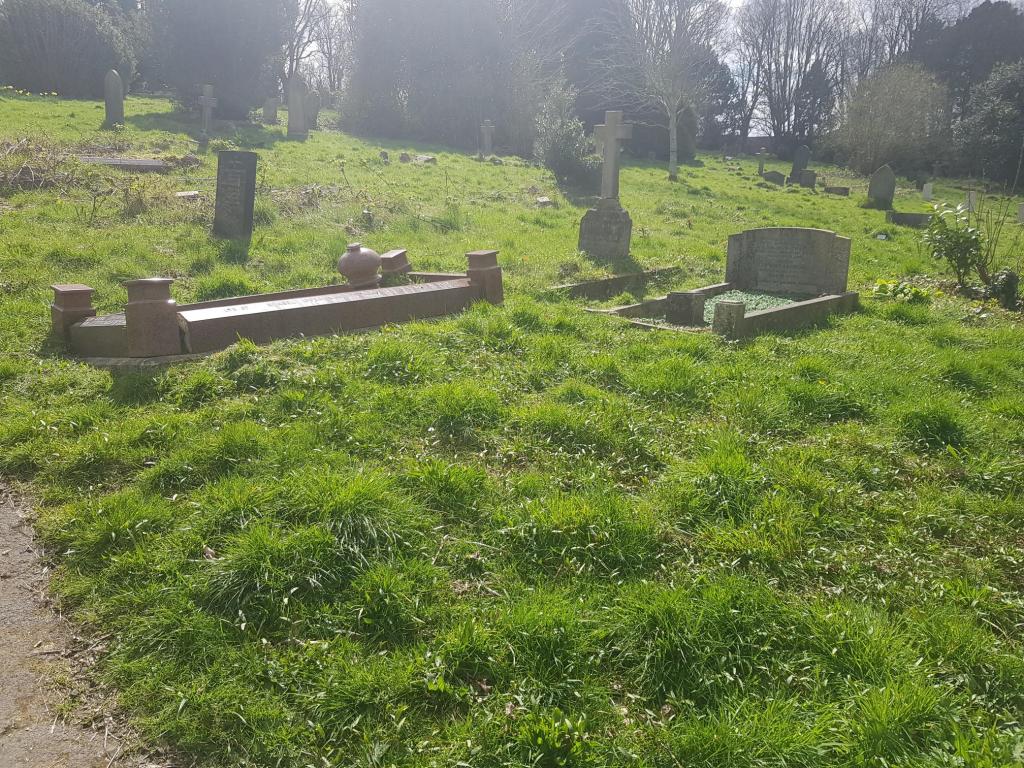
Sadly, the two Powell family graves are unmarked.

Frederick and Emma Powell are buried in this area.

The four Powell siblings are buried in this area.

Swindon Photographers

Swindonians were an adventurous lot, embracing new ideas and new inventions. In the early 19th century photography exploded in a blaze of magnesium and by the 1860s the popular carte de visite had become affordable to all but the very poorest in society.

In 1861 Richard Keylock Passmore, one of the first Swindon based photographers, was established at Victoria Street. By 1895 there were six local photographers listed in Kelly’s Directory with two in Regent Street and one in Regent Circus.

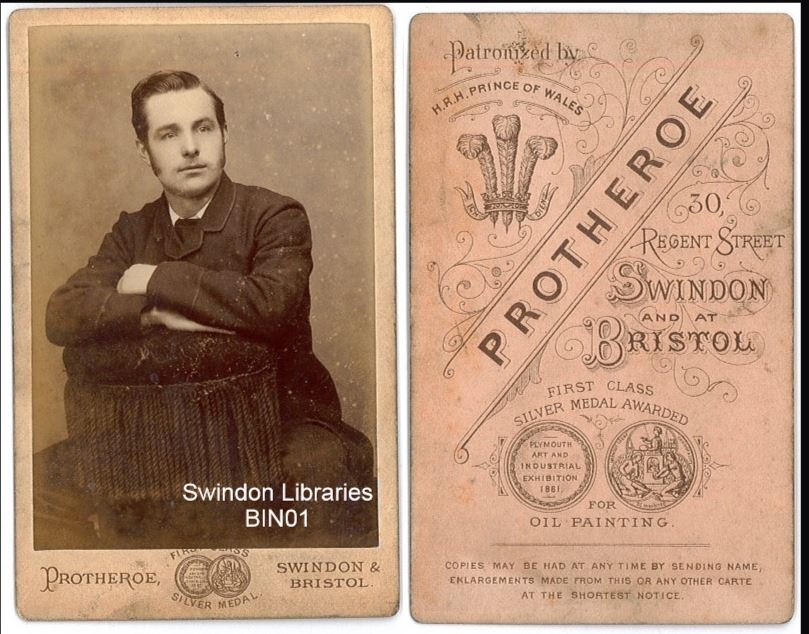
In 1889 James Smith Prothero had a studio at 30 Regent Street where he worked alongside his nephew Thomas Henry Simons who eventually took over the business. James Prothero died in Mumbles, Glamorganshire in 1929 and is buried in Radnor Street Cemetery. You can read more about him here.

Perhaps the most ‘famous’ of Swindon’s photographers is William Hooper who began his business following a disabling accident in the GWR Works which led to his dismissal on medical grounds. Hooper’s photographic career spanned more than 20 years and today his collection is managed by his descendent Paul A. Williams. William Hooper died in 1955 and is buried in Radnor Street Cemetery. You can read more about him here.

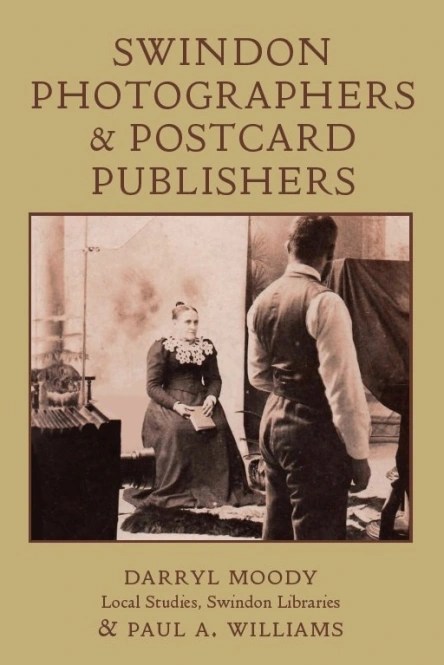
You might also like to read Swindon Photographers & Postcard Publishers by Darryl Moody and Paul A. Williams available from the Library Shop.

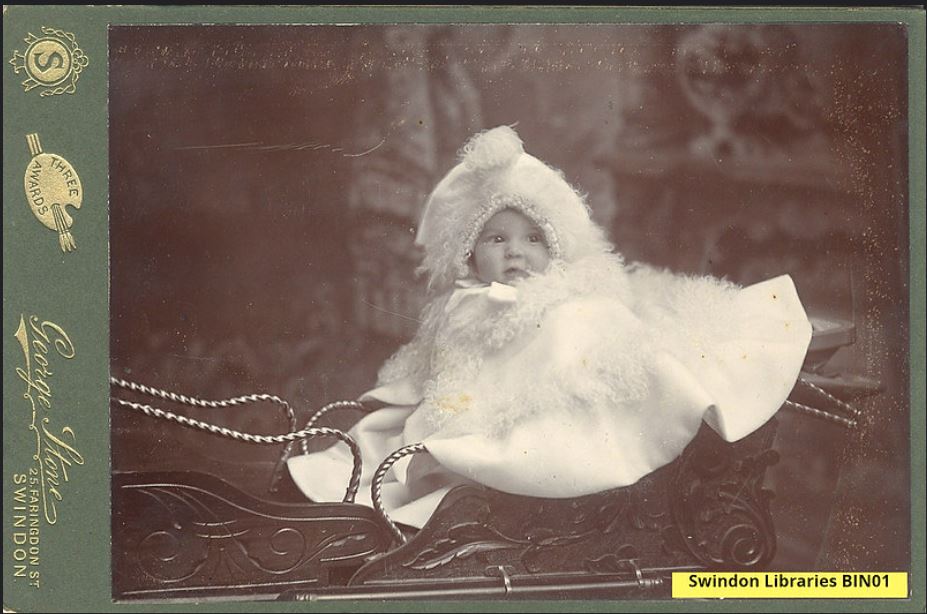
Carte de visite and cabinet card photographs survive in great numbers but sadly, unless in a family collection, most are identifiable. Local Studies at Swindon Central Library have reproduced some of their collection on their website. Here are just a few, people I am sure must now lie in Radnor Street Cemetery, if only I knew their names.

Hubert John Deacon – jeweller and watchmaker

Image of Hubert John Deacon published courtesy of Deacons website

I’m sure the name Deacon will be familiar to many, but did you know Hubert John Deacon was also a leading figure in the Baptist Church, Swindon.

The jewellers at 11-13 Wood Street was founded in 1848 by George Deacon who was later joined in business by his two nephews Hubert and Joshua.

Hubert John was born in Trowbridge in 1846 and joined the business in the late 1860s, during what was a period of considerable expansion for the family firm.

In the online company history Hubert is described as an entrepreneurial figure.  He was the first President of the Swindon Chamber of Commerce in 1893 and was responsible for supplying Swindon’s first public clock on the Town Hall.  He also brought the plot of land on which Deacon Street was built and named in his honour.

By 1881 he and his wife Susan had moved in over the Wood Street shop where they lived with their six children, cousin William Nash who was a watchmaker apprentice, Ann Shackleton, a jeweller’s shopwoman and two young servant girls. The Deacon children would eventually number ten.  The youngest, a daughter was named Dorothy Decima.

Hubert was succeeded in the business by his only surviving son George. Today the family firm is in the hands of Richard Deacon and his sister Sara, the 6th generation

Image of Deacons store published courtesy of Deacons website

Death of Mr H.J. Deacon

50 Years a Resident in Swindon

Public Activities

The death took place on Thursday at Margate of Mr Hubert John Deacon, who was associated with the public life of Swindon for over half a century. Mr Deacon, who was 81 years of age, had been in delicate health for some time, and succumbed to an attack of bronchitis.

For many years Mr. Deacon carried on business as a jeweller and watchmaker in Wood Street, a business that was established by his uncle, Mr George Deacon, nearly a century ago. On the death of his uncle, Mr. Deacon succeeded to the business. His son, the late Mr. George Deacon, entered the business, but died at a comparatively early age, and it is now carried on by the widow, Mrs Mildred Grace Deacon, under the style of Deacon & Son.

The late Mr. Deacon first married Miss Lay, of Harwell, Berks, who predeceased him soon after they celebrated their golden wedding when they resided at “Grovelands”, Springfield Road. They had a family of two sons and eight daughters, and two daughters survive. Deceased married again when he went to Margate to reside.

An ardent worker for many years in connection with the Baptist Church in Swindon, Mr Deacon was a member when the old church was in existence at the corner of Bridge Street and Fleet Street. He took a prominent part in the scheme for building the Tabernacle 40 years ago, and gave liberally to the church funds. On the retirement of the late Mr. W.B. Wearing as superintendent of the Sunday School, Mr Deacon succeeded to that post, which he filled with success for many years. He was also a member of the Baptist Union of Great Britain and Ireland.

Interest in Public Work

Mr Deacon was associated with many enterprises in the town, notably the Swindon Permanent Building Society, of which he became successively vice-chairman and chairman, and witnessed a wonderful advance in that society as the town grew.

The public work and interests of the town always commanded his attention, and his greatest interest. He was for a number of years a member of the Local Boards, and afterwards of the District Councils of Old and New Swindon, and was also one of the first members of the Corporation, when Mr. G.J. Churchward was Mayor. He also devoted some years to Poor Law work as a member of the Swindon and Highworth Board of Guardians.

Of the Swindon Horticultural Society he was a great supporter, and his lovely garden and grounds at “Grovelands,” which he frequently lent for social gatherings in connection with churches in the summer months, were evidence of his love for flowers.

Mr. Deacon also interested himself greatly in the Victoria Hospital, with the establishment of which he was associated, as well as with its opening in Queen Victoria’s Jubilee year. For some years he was vice-chairman of the committee of management. He was one of the founders of the Old Swindon Traders’ Society, which was the forerunner of the Swindon Chamber of Commerce. Of the latter body Mr. Deacon was the first President. He was also a former chairman of the Swindon Plate Glass Insurance Society and for some years chairman of the Southern Laundry Company.

Bowls was his only out-door sport, though he did not play that extensively. He was a member of the Westlecott Club, and was instrumental in its formation.

In various other spheres the deceased did good work in the town.

Extracts from the North Wilts Herald, Friday, January 28, 1927.

This is the last resting place of Hubert, his wife Susan, their daughters Honoria Edith and Winifred Elsie and their son also named Hubert John. Susan died in Swindon in 1920 aged 73.  Hubert died in 1927. 

Charles and Annie Baghurst – Rodbourne grocers

Like so many other town centres, Swindon’s has lost its way. Built on a mid-Victorian industrial new town model, its retail heyday is long past and even the big High Street chain stores that arrived a century later have also gone.

In 2006 the Rodbourne Community History Group published Walk Down the Lane, a celebration of the enduring commercial viability of their neighbourhood where business has continued to survive and thrive for more than 140 years.

Take, for example, 178 Rodbourne Road on the corner of Jennings Street, opposite the Dolphin. In 2006, at the time Walk Down the Lane was published, it was a Tool Hire Centre. By 2009 MotoShop had recently closed and the shop was boarded up, available to rent, but this premise in such a prime location wouldn’t remain closed for long. In 2012 it was operating as The Furniture Box and four years later the Second Skin Tattoo parlour. Today it is the Beauty Base – Salon and Nail Academy.

Number 178 Rodbourne Road was built in 1884 for Mr T. Phipps and by 1891 the grocer’s shop and accommodation above was occupied by Charles Baghurst and his wife and their large family of eight children. On the census returns of that year Charles states his occupation as both carpenter and grocer. His wife Annie is also credited with the job of grocer as it was probably she who did the lion’s share of the work in the shop while Charles was employed full time in the Works. By 1901 the family had moved on and John and Elsie Wise had taken over.

Charles and Annie Baghurst moved first to 1 Milton Road and later to 220 Country Road where Annie died in 1908 aged 56 years. Just five months later her 19 year old son Harold Fawlk Baghurst died. Charles later moved to Euclid Street where he died in 1919 aged 65. Annie, Charles and Harold are buried together in Radnor Street cemetery in grave plot D1466.

178 Rodbourne Road – Beauty Base – Salon & Nail Academy

published courtesy of Rodbourne Community History Group

Charles Baghurst

Annie Baghurst