In a blogpost last year I mentioned that there were very few old photographs of the cemetery. There were only three pre-dating the 1920s and two of these were taken by William Hooper. And then when I looked more closely into the work of this prolific Swindon photographer I found another taken at the funeral of his mother-in-law Eleanor Stroud.
Eleanor (sometimes known as Ellen) was born in Aldbourne in 1834, the daughter of agricultural labourer Thomas Brind and his wife Mary. She married James Stroud, also from Aldbourne, a railway guard, in 1864.
In 1871 Eleanor and James lived in Leominster with their two little daughters, Mary Jane 3 and Alice Kate 1. By 1881 the family had moved to 22 Merton Street, Swindon. On census night James and his daughters were at home. Eleanor, meanwhile, was employed as a monthly nurse at number 10 Merton Street where Annie Hacker had given birth three days previously.
In 1891 Mary Jane married William Hooper, a stationery engine driver with a passion for photography.
Two years later James Stroud was involved in a fatal shunting accident at Tetbury Road station when he was crushed between a waggon and the goods shed. He was brought to the GWR Medical Fund Hospital in Swindon but sadly died as a result of his injuries the following day on January 14, 1893.
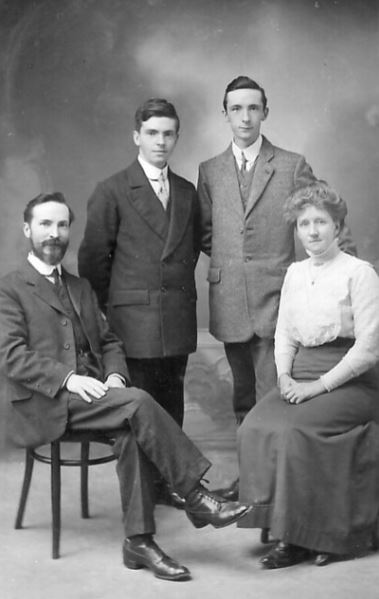
After the death of her husband Eleanor lived with her elder daughter Mary Jane and her husband William Hooper. By 1911 William was working full time as a Portrait and Landscape Photographer. Eleanor is pictured here with William and Mary in their roof garden at Cromwell Street.
Eleanor Stroud died at her daughter’s home 6 Cromwell Street. She was buried on April 29, 1915 in grave plot A823 alongside her husband. William took this photograph at her funeral.
Three brothers died in the First World War, another returned with his health compromised. But what was it like for the two brothers who never went to war but stayed at home?
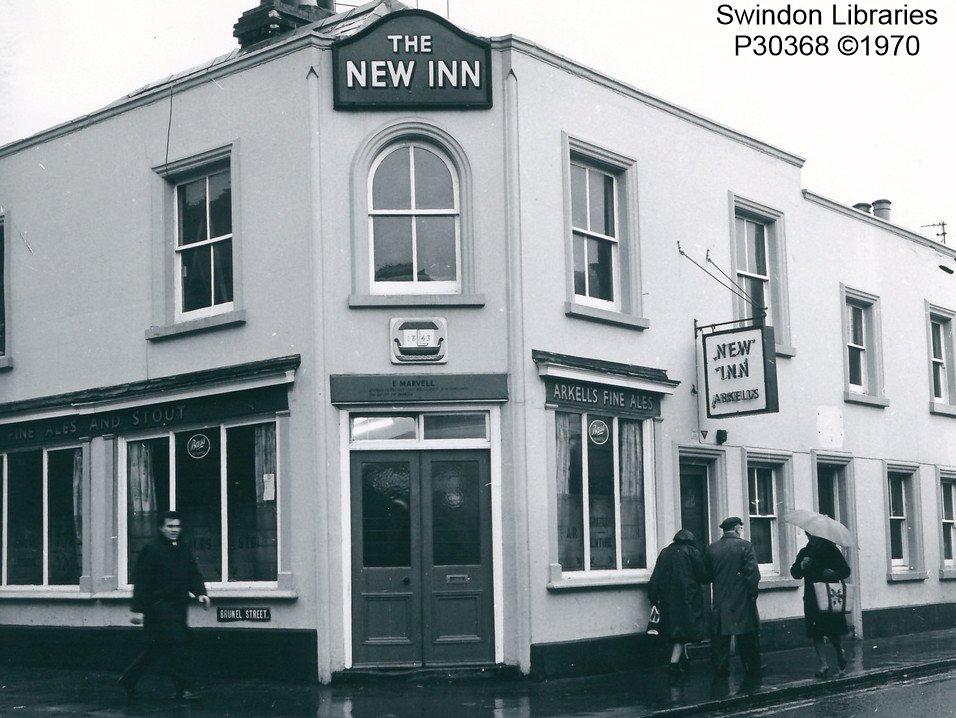
At the beginning of the 20th century the busy Preater family were running two businesses. Charles Preater ran first a haulage business before becoming licensee at the New Inn in Cromwell Street with his wife Mary Jane.
Harry Charles Preater was born on April 25, 1880 and baptised at St. Mark’s Church on May 27. He was the eldest of Charles and Mary Jane Preater’s nine children. In old photographs of Swindon you will see H.C. Preater’s garage at the Whale Bridge close to where the Leonardo Hotel now stands. Harry became a prominent business man and a Freemason. During the Second World War Harry was Secretary of the Swindon Penny a Week Fund, which raised £16,500 towards supporting prisoners of war. Harry died in 1968 and is buried in grave plot D65A.
Second son Jesse John Preater was born on April 2, 1882 and baptised at St Paul’s Church on May 14. By 1901 Jesse, then aged 18, was working alongside his father in the haulage firm. Ten years later his younger brothers Charles and John had joined him in that side of the family business.
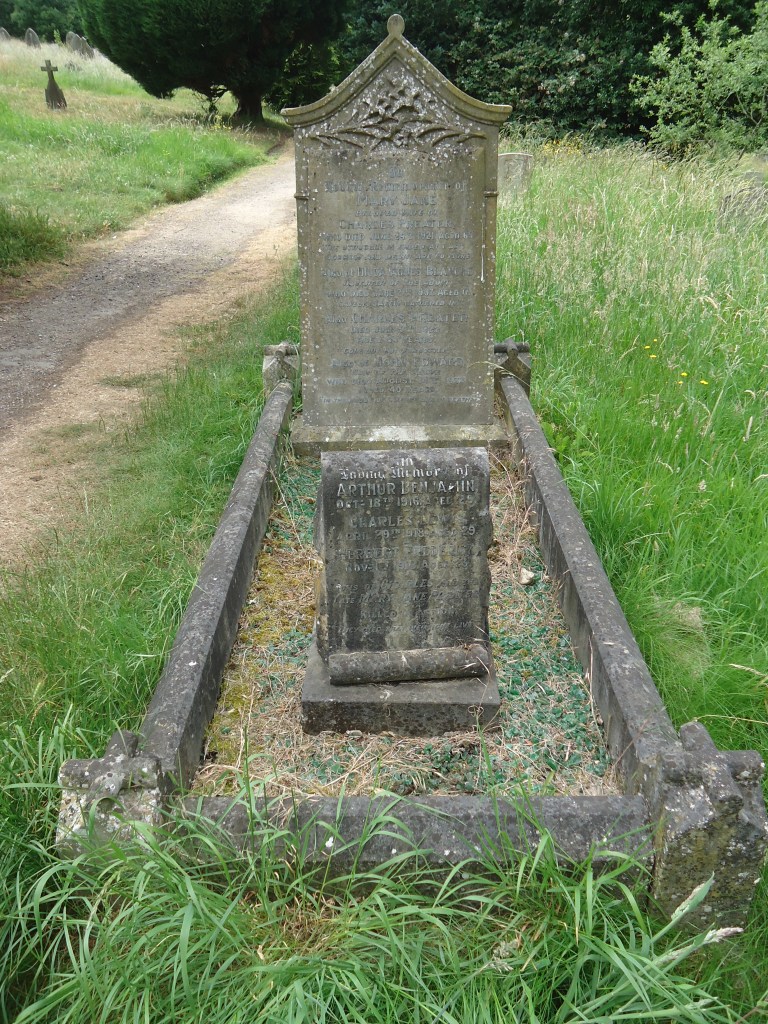
Arthur Benjamin Preater, Charles Lewis Preater and Herbert Frederick Preater were all killed in action, Arthur in 1916 and Charles and Herbert in 1918. John Edward Preater served and returned home.
Why did neither Harry nor Jesse go to war? I’m sure their parents were relieved to save these two sons, but what was life like for them during and in the aftermath of the war. They shared their fate with many other men, but that couldn’t have made it any easier. Today we have a name for this condition ‘survivor guilt.’
Jesse married May Wallis at St Mark’s Church on October 4, 1915. Their son Charles Wallis Jesse was born in 1922. They are buried together in grave plot B2693 close to the grave where Jesse’s parents, his sister Hilda and John Edward, the brother who survived the war, are buried. A separate memorial commemorates the three brothers who were killed in action.
When you have a professional photographer in the family you can be guaranteed some super snaps – and Alice Kate Stroud had one of Swindon’s best.
Alice Kate Stroud was born in Hereford on February 27, 1870 the younger of James and Ellen’s (Eleanor) two daughters. The family lived at 49 Portland Street, Hereford where James worked as a railway guard. It was probably inevitable that they would eventually end up in Swindon and in 1881 they were living at 22 Merton Street, a property they shared with Edwin and Louisa Brittain.
In 1892 Alice married railway clerk Thomas Richards and by 1901 Alice, Thomas and their two sons Leslie & Stanley were living at 15 Medgbury Road, next door to Alice’s in-laws. But by 1911 they were living at 10 London Street where they would remain for the rest of their lives.
So, who was this talented photographer of whom you speak, I hear you ask?
Well, in 1890 Alice’s elder sister Mary Jane Stroud married William Hooper.
Ah, now you understand.
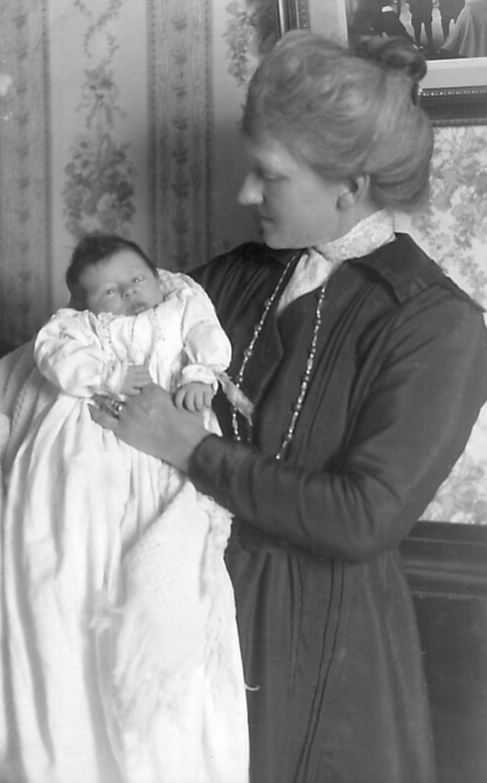
Alice was photographed by Hooper as a young woman and appears frequently in many Hooper family photographs. We see her with her sister on a boat on Coate Water; with her husband and two sons; cradling her little granddaughter Mary and we watch her grow old alongside Mary Jane and William Hooper.
Alice died in 1958 at Kingsdown Nursing Home and was buried in grave plot D1030 which she shares with her in-laws Maria and Richard Nathaniel Richards. Thomas Richards died at 10 London Street and was buried with his parents and his wife on October 14, 1959.
Images are published courtesy of P.A. Williams and Local Studies, Swindon Central Library.
In 2013 Graham Carter, Mark Sutton and I began our great magazine publishing adventure. During five years of publication we produced twenty editions of Swindon Heritage, including one special publication to mark the 75th anniversary of the Battle of Britain.
One of the first people we interviewed was Janet Flanagan. Jan is a well known figure on the local history circuit with her legendary knowledge of the Wilts & Berks Canal but we didn’t know that she was also researching the brickmaking industry of Swindon.
Jan told us how in the 1870s the Swindon Brick and Tile Company’s yard in Spring Gardens was the largest brickworks in Wiltshire with a Hoffman kiln (beneath where the Range stands today) capable of firing 25,000 bricks a day.
Jan’s ongoing research revealed 19 brickworks in the town and district, including the well known Thomas Turner works in Drove Road, now the site of Queens Park.
And of course the brickmaking industry employed a lot of people.
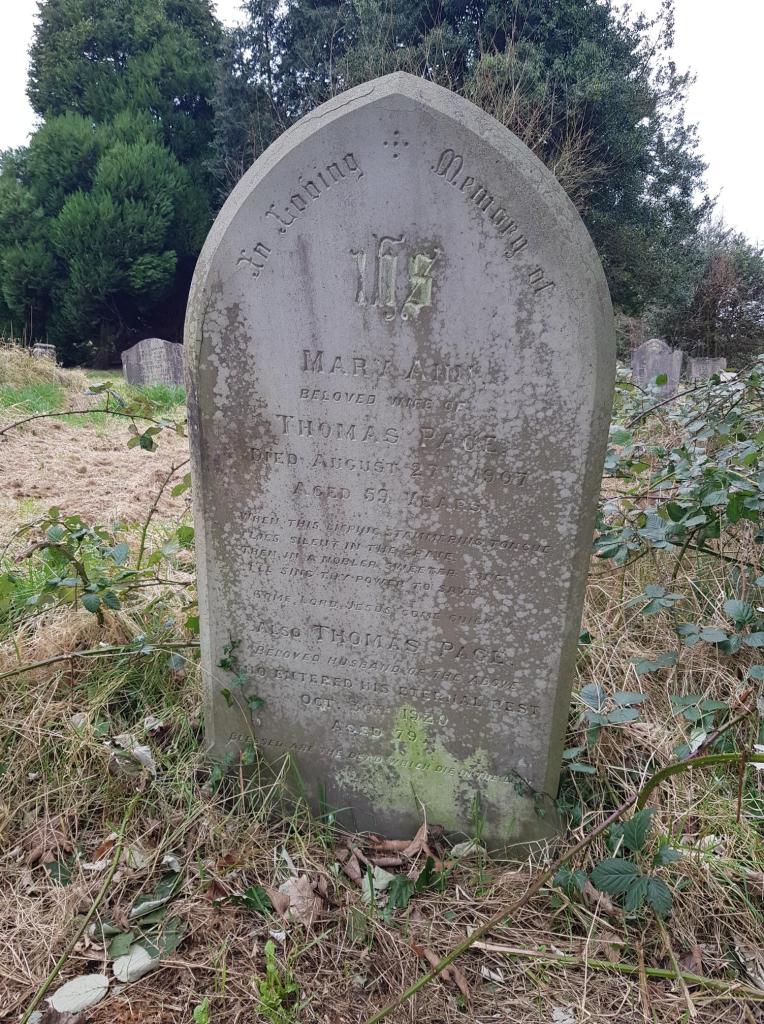
This is the last resting place of Thomas Page, born in Stratton in c1842, the son of a brickmaker, who spent a lifetime working in the industry.
In 1867 he married Mary Ann Painter, the daughter of another brickmaker, William Painter. In 1871 the couple lived at Brick Kiln Cottages in Wroughton. In 1881 they lived in Stratton Green where they also ran a General Shop & Outdoor Beerhouse. This was probably Mary Ann’s concern as Thomas was still working as a brickmaker.
They later moved to Trowbridge and in 1901 they were living and working at the Cockhill Brickyard. Their 15 year old son Moses also worked as a brickmaker and Thomas’ widowed brother-in-law William Weller, another brickmaker, lived with them.
By 1907 Thomas and Mary Ann had returned to Swindon where Mary Ann died at 80 Chapel Street, Gorse Hill on August 27. Thomas died 13 years later. The couple are buried together in grave plot B2708.
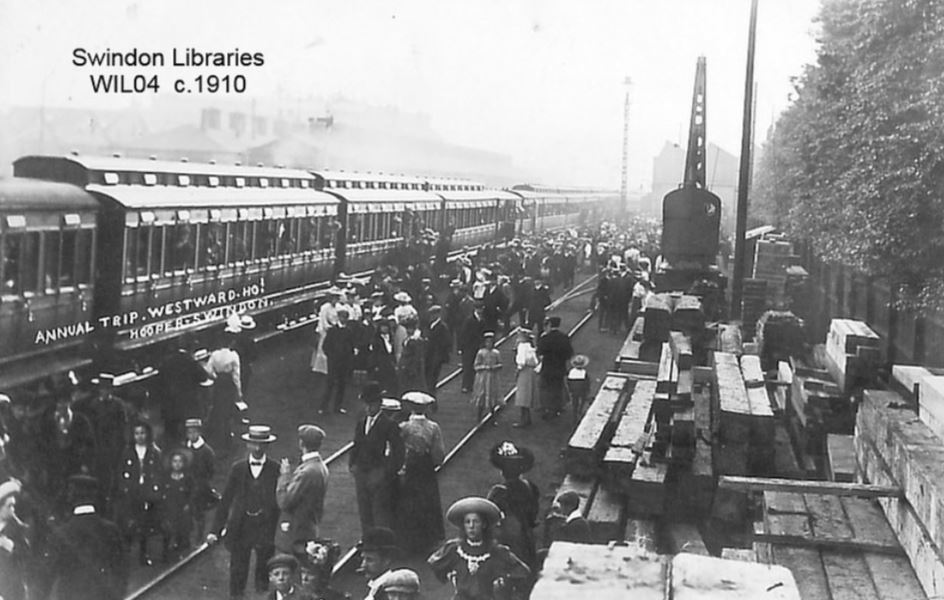
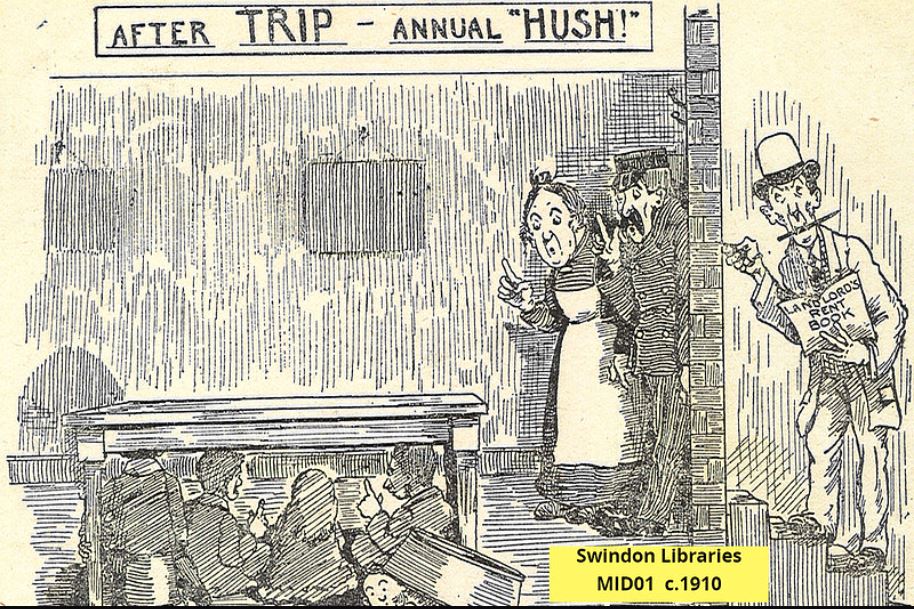
If you worked for the Great Western Railway in the Swindon Works, you joined the Mechanics’ Institution. The requirement was pretty much essential and the benefits extensive and if you weren’t a member you could not go on TRIP. Not a trip or the trip but TRIP.
TRIP began with a day’s outing to Oxford in 1848 for some 500 members of the Mechanics’ Institution. At its peak in 1924 29,000 people travelled in 31 trains numbering 520 coaches to seaside (and other) destinations across the UK.
It’s fair to say Swindon pretty much emptied during TRIP. With the Works closed, some shops cut their prices, others cut their opening hours. But who would have guessed that TRIP would impact upon a funeral.
Robert Dibbs, the landlord of the Red Cow Inn in Princes Street, died suddenly during the night of 11/12 July 1888 and was found by his daughter sitting in his armchair in the bar-parlour ‘quite dead.’ An inquest returned a verdict of ‘death from heart disease’.
Before moving to Swindon Robert Dibbs had previously served in the Mounted Police in London. He had subsequently joined the Swindon Troop of the Wilts Yeomanry where he held the rank of sergeant and as such was accorded a military funeral. However, there was a problem – it was TRIP week.
The Swindon Advertiser reported in the Saturday edition July 21, 1888:-
The mortal remains of the late Mr Robert Dibbs were interred with military honours on Monday afternoon. Deceased had been a member of the Swindon Troop of the Wilts Yeomanry ever since its re-establishment, five years since, having been promoted to the rank of sergeant. Previous to his coming to Swindon, Mr Dibbs had been in the Mounted Police in London for several years. Not only did the members of the Swindon Troop of Yeomanry attend the funeral, but also as many members whose service could be enlisted of the Swindon Companies of Rifle Volunteers. And it was most unfortunate, from more than one point of view, that the funeral should have occurred during the Great Western “Trip” week, seeing that the greater part of the Volunteers were away from the town, and were thus prevented from attending. Every endeavour was made to obtain the services of a band, but without success, for only portions of the various bands of the town were available, and the consequence was that the musical part of the military funeral service had to be dispensed with. Notwithstanding that the circumstances were against a good muster turning out to pay respect to their late brother in arms, yet the numbers, both of the Yeomanry Cavalry and the Volunteers, were far in excess of what might have been expected.
Image published courtesy ofLocal Studies,Swindon Central Library.
Robert Dibbs was buried on July 16, 1888 in grave plot E8312 which he shares with his son George Dibbs who died in 1895.
Clayton Walter Joyce was born in Moredon in 1863 the second son of Charles Joyce, a mason and builder, and his wife Pamela. Clayton started work in the GWR Works and when he married Emily Jones in 1888 he stated that his occupation was that of mechanic. But inevitably he went into the building trading, working as a bricklayer from at least 1891.
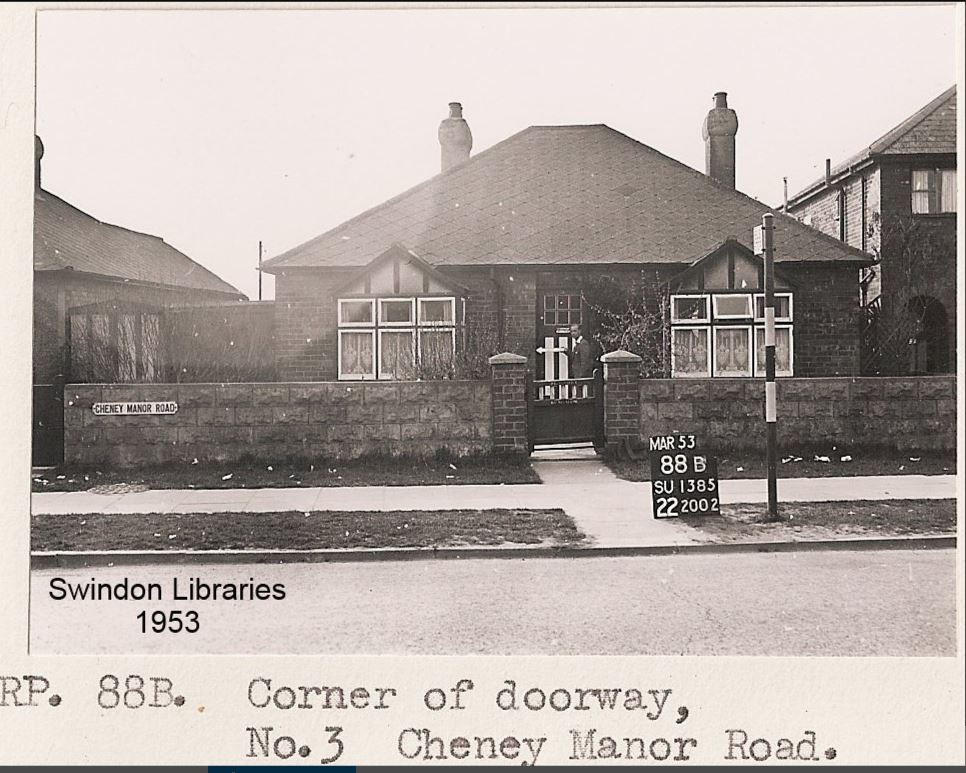
In 1925 Clayton began work on properties in Telford Road, Rodbourne Cheney. He built two bungalows both completed in 1926. That same year he built a bungalow for Mr Keene and began work on a house and shop completed in 1927. In 1927 he went on to build four bungalows, one for Miss Perry, one for Mr Walker and two for Mr G. Mabberley, the man who commissioned his first build in 1925. In 1928 he built a bungalow (nearest shop) and then in 1932 another bungalow in Telford Road for Mr A.J. Thorne in the recently renamed Cheney Manor Road.
This image is published courtesy of Local Studies, Swindon Central Library from the Ordnance Survey Revision Point series of photographs. Could this be one of Clayton Joyce’s bungalows?
By the 1920s Telford Road in Rodbourne Cheney had become a desirable residential area. Builders active in the area include Tydeman Bros who built a house for Mr Keefe in 1928. Our friend James Hinton (who owned the land on which the cemetery was laid out) was also busy in the area and had been for sometime, according to an entry in Architects and Building Craftsmen with Work in Wiltshire Pt 2., James Hinton – Swindon Telford Road, Harcourt Road, Cobden Road, Ferndale Road, new streets and back roads 1905.
Another view of Cheney Manor Road courtesy of Local Studies, Swindon Central Library. Could the bungalow on the right be a Clayton Joyce build?
In 1928 the Swindon Borough boundary was extended to incorporate Rodbourne Cheney and Telford Road was renamed Cheney Manor Road.
Clayton’s wife Emily died in 1925 and was buried on January 31 in grave plot D210. At the time of the 1939 census Clayton was living with his son and his family at 9 Suffolk Street. He died at Ogbourne Hospital in 1945 aged 82 and was buried with Emily on February 7.
There was no lengthy obituary published in the local newspapers following the death of Stephen Chequer, just a brief death notice submitted by his family.
Chequer – March 17, at Westcott Place, New Swindon, after a long and painful illness born with great christian fortitude, Mr Stephen Chequer, butcher, aged 67. His end was peace.
Swindon Advertiser, Saturday, March 26, 1887.
So many of the inscriptions on headstones in Radnor Street Cemetery include a religious reference. In the increasingly secular age in which we now live, what sustains us at the end of our life?
When Stephen Chequer married Elizabeth Iles at St Mark’s Church in 1847 his occupation was that of labourer. Both he and Elizabeth made their mark in the marriage register, indicating they were not sufficiently proficient in writing to sign their names. Stephen obviously worked extremely hard to establish his own business with all the paperwork that involved.
By 1851 Stephen and Elizabeth were living in Westcott Place with their four children and Stephen’s widowed mother Mary. Stephen was 37 years of age and working as a farm labourer. It wasn’t until the 1871 census that we discover Stephen working as a Butcher in Westcott Place.
Stephen Chequer died aged 67 years and was buried on March 23, 1887 in grave plot E8466 which he shares with his wife Elizabeth who died in 1883.
Today Westcott Place is much altered and barely recognisable from this 1976 photo published courtesy of Local Studies, Swindon Central Library.
Stephen and Elizabeth’s daughter Emma Jane married Charles Edward Hall. You may like to read more about her family here.
Swindon’s Oldest Man? Ooh it was a bold claim to make – even with the qualifying question mark. You can bet there was someone willing to challenge George.
George was born in 1834 in Wootton Bassett, one of Robert, an agricultural labourer, and his wife Jane’s eight children. At the time of the 1851 census he was 16 years old and described as a ‘scholar,’ meaning he was still at school, which was pretty unusual for the son of an agricultural labourer.
In 1853 he married Jane Baker at the parish church in Wootton Bassett. They both state that they are minors (under the age of 21) and both made their mark in the marriage register indicating they were unable to sign their names.
By 1871 George and Jane along with George’s 15 year old nephew were living at 1 Union Street, Swindon, where together they ran a beer house and grocers shop. And here they stayed in Union Street, all be it living at different houses, until we meet George in 1929.
George died on October 5, 1929 and left effects valued at an impressive £1,694 8s 7d. But was he the oldest man in Swindon? I suppose we’ll never know!
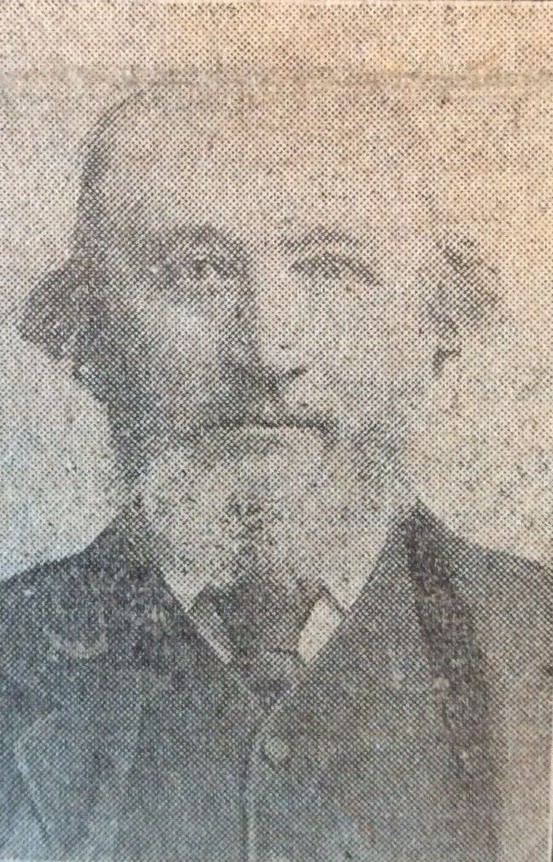
Swindon’s Oldest Man?
Mr George Hunt, of Avenue Road, Swindon, who has just celebrated his 95th birthday. He is believed to be the oldest man in Swindon.
Sadly, George Hunt died within weeks of the story appearing in the local newspaper. He was buried in grave plot E8155 on October 10, 1929. He joined Jane Hunt, his wife, who died at 7 Union Street aged 83 and was buried on March 6, 1917.













 Radnor Street Cemetery