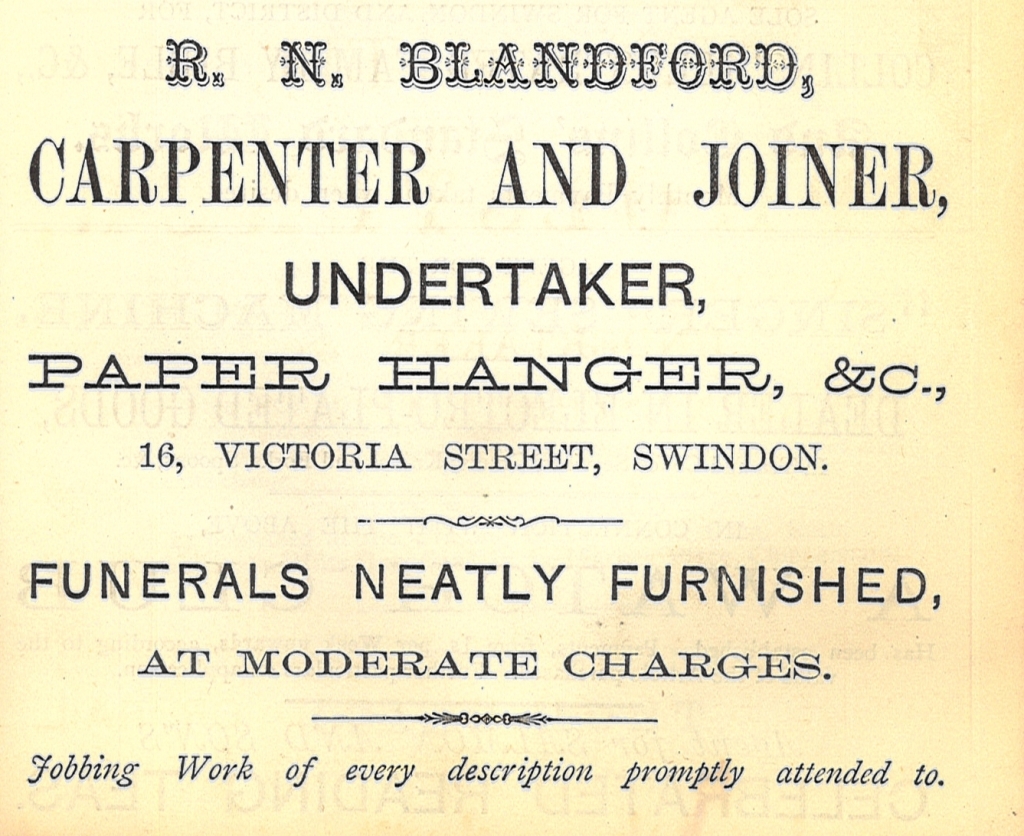
John Glover Norman – builder

John Norman and his wife Eliza Loveday had a very long courtship. John appears on the 1891 census as boarding with the Loveday family at 26 Victoria Street North. John is 25 and working as a carpenter, Eliza Jane is also 25 and working as a dressmaker. The couple didn’t marry until the winter of 1906.

John Glover Norman was born in Chedworth, Gloucestershire in 1863 the son of Isaac Norman, a woodman and agricultural labourer, and his wife Mary. He completed his carpentry apprenticeship with a Chedworth carpenter but by the end of the 1880s he had moved to Swindon where he set up in business as a builder.

In 1898 and 1899 he was working in Goddard Avenue. He also built several properties in Westlecot Road and in 1906 he built 13 houses in the Mall. John built some classy properties but business was not straightforward and in the Spring of 1909 John Glover Norman was declared bankrupt.

At the time of the 1911 census, following his bankruptcy, John and Eliza are living in Victoria Road with a whole clutch of Loveday relatives. Eliza’s widowed mother lives with them as does two of Eliza’s nephews – Frederick Wm Loveday aged 22 a Law Clerk who describes himself as out of work, and Ernest Albert Loveday who was 24 and a carpenter, so most probably working with John. John and Eliza had two children, Beryl and a son Garnet.

John recovered from the bankruptcy crisis of 1909 and was soon back in business in Gorse Hill where he built a lot of properties including 44 houses in Caulfield Street and between 1926 – 1933 he built more than 60 houses in a road that would eventually bear his name – Norman Road.

John died in the Westlecot Manor Nursing Home in February 1954. He is buried in grave plot E8331 with his wife Eliza Jane, her mother Jane and 14 year old Dorothy Frances Reason the daughter of Eliza’s sister Mabel.
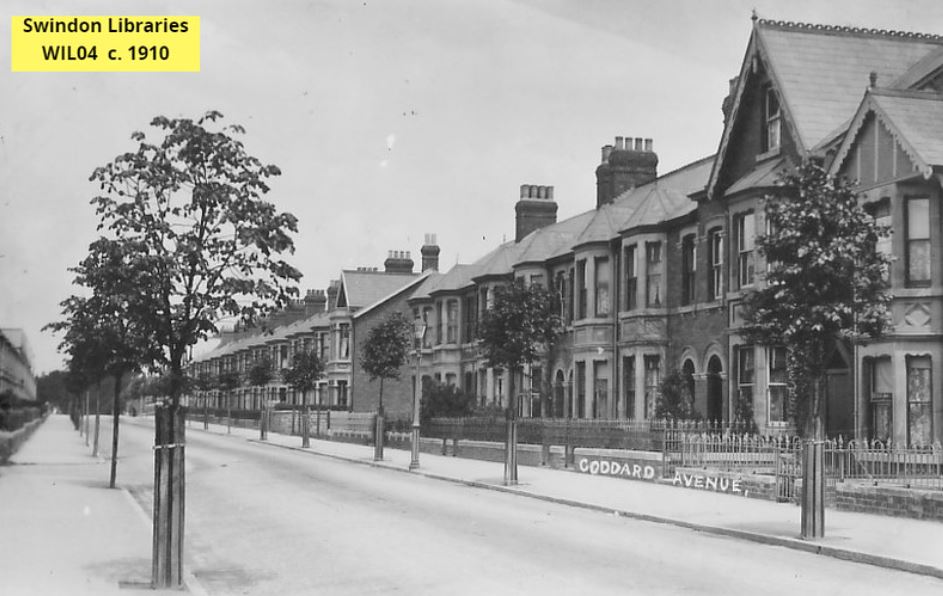
William Hooper image of Goddard Avenue taken around 1910 and published courtesy of Local Studies, Swindon Central Library.

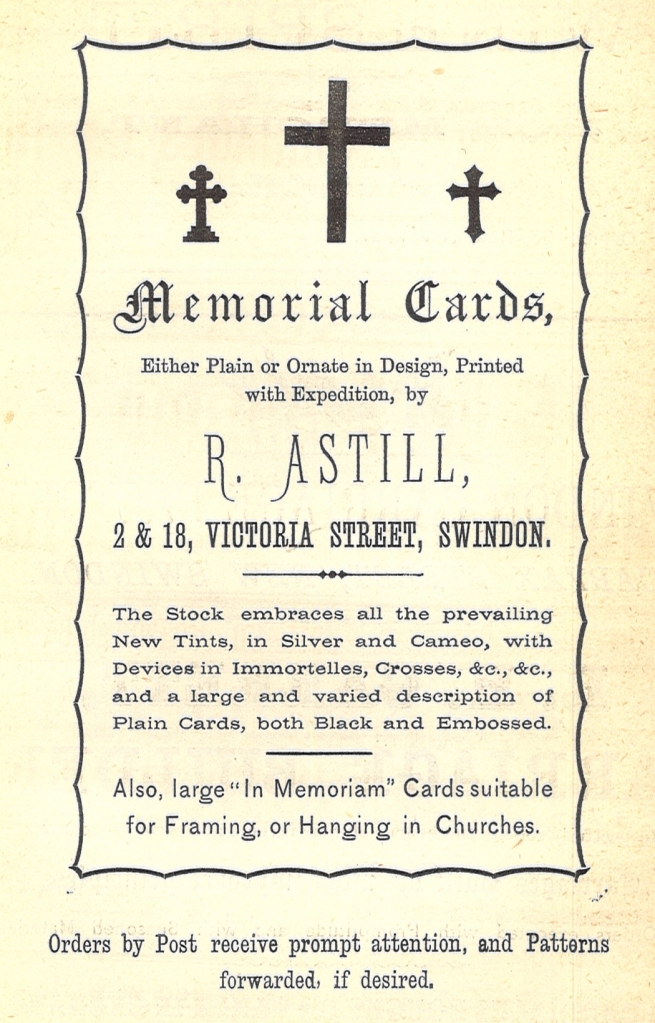
Skerten family undertakers

The Skerten family of undertakers had a presence in Swindon for more than 75 years. For most of that time they were busy in Radnor Street cemetery and the early burial registers reveal the many funerals they performed there.

Carpenter and joiner Richard Skerten married Ann Brown at St Paul’s Church, Bristol in 1844 and by 1851 they had moved to Swindon and a home at 32 Reading Street with their three young daughters.

By 1871 Richard was established as both a joiner and an undertaker but his business very nearly came to an end when a disastrous fire totally destroyed his Regent Street workshops. It happened on Friday June 15, 1877 when it was believed the heat of the sun ignited oils in the workshop. Neither the buildings, the stock-in-trade nor the workmen’s tools were insured.

However, Richard re-established his business at 1 Queen Street where his wife Ann and younger son Richard continued to run the family firm after his death in 1886.

Meanwhile, by 1881 elder son Arthur had established his own business at 5 King Street. On April 29, 1887 Arthur had the sad task of burying his twin baby sons Richard and Joseph just 3 and 4 days old respectively. Perhaps surprisingly the babies were buried in a public plot with three others – burial conventions were different then.

Probably the most extraordinary funeral Richard Skerten junior arranged was that of gipsy patriarch Timothy Buckland. For about a month the terminally ill Timothy camped in a field near the Wharf, Drove Road with some nine other vans and tents and 50 members of his family.

According to the Swindon Advertiser the funeral attracted several thousand spectators to the churchyard at Christ Church.

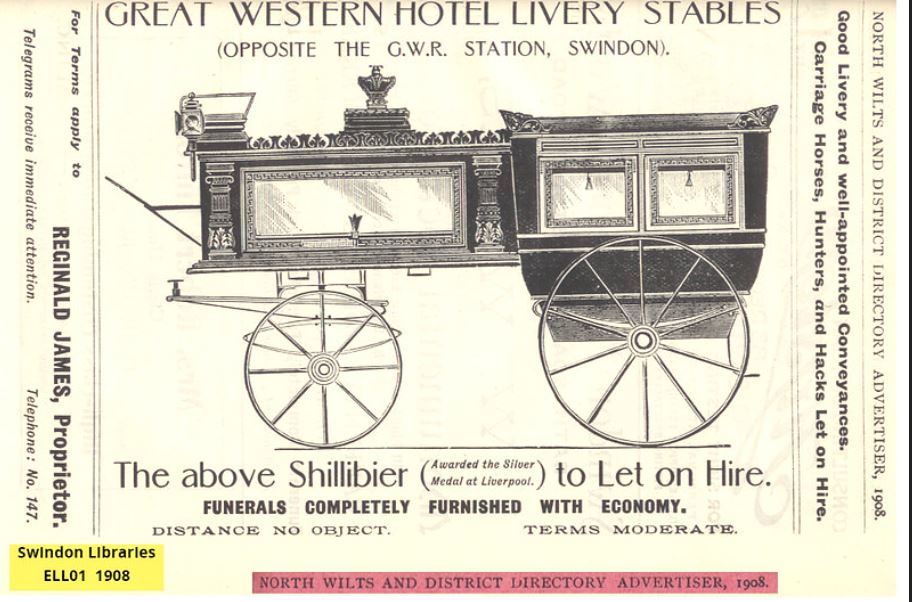
For the funeral the arrangements were placed in the hands of Mr Richard Skerten, undertaker, of New Swindon, and a hearse and eleven mourning coaches were engaged, the adult members of the family occupying the latter. The coffin was of French polished oak, with brass fittings, and bore the simple inscription on a brass plate “Timothy Buckland, died 8th Nov. 1890, aged 70 years.

Extract from the Swindon Advertiser, Saturday Nov 15, 1890.

When their time came all three Skerten undertakers were buried in Radnor Street Cemetery, which seems very fitting.

Richard Skerten senior was buried on May 20, 1886 in grave plot E8434 where he was joined by his wife Ann who died in 1902.

His son Richard was buried on December 11, 1911 in grave plot D1319 where his wife Ann joined him in 1936. Buried with them is their son-in-law Leslie Ernest Adams, their daughter Annie Amelia’s husband, who died at 1 Queen Street in October 1959.

Arthur Skerten was buried on February 9, 1934 in grave plot C1785 joining his 12 year old daughter Isabella May who died in 1907 and his wife Betsy who died in 1930.

When funerals were big business

The new Swindon Cemetery opened in August 1881 and by the end of that year 94 funerals had taken place.

The first burial was that of Frederick Gore whose funeral was furnished by Richard Skerten. With premises at 1 Queen Street, New Swindon, Richard Skerten was a Joiner and Undertaker employing three men and one boy in 1881. His son Arthur, based at nearby 5 King Street, was also a carpenter, joiner and undertaker (these occupations frequently went hand in hand.)

Edward Hemmings at 22a Fleet Street looked set to be busy with the opening of the new cemetery until his own unfortunate demise when he became the 5th person to be buried there in August 1881. His brother Frederick took over the business in 1882 and makes a regular appearance in the registers thereafter.

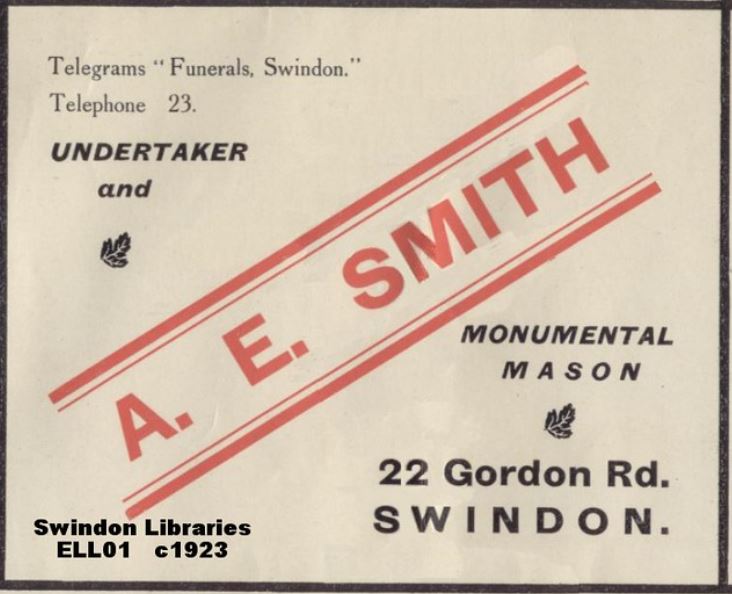
Probably the undertaker most associated with Radnor Street Cemetery is Henry Smith and the family business he established. Omnipresent in the cemetery from the 1880s and throughout the 20th century, the firm of A.E. Smith continues in business to this day with premises at Queens Drive, Swindon.

And then there were Memorial Cards and mourning attire and monuments and memorials and yes, there was a Swindon business to provide all of these services.

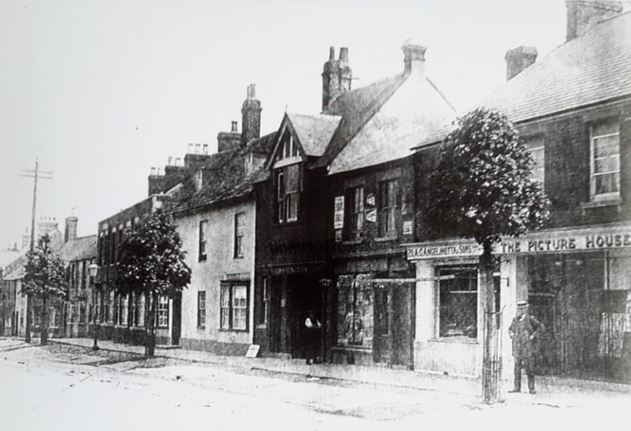
Walter J. Spear and The Picture House

Walter J. Spear was a dairyman and then in 1913 he opened a picture house in Wootton Bassett – not an obvious career progression.

Walter Spear came from a railway family, as most people did in Swindon in the latter half of the 19th century. In 1901 the family lived at 81 Radnor Street where Walter’s father Charles and his three brothers Charles, Henry and William, all worked as Steam Engine Makers & Fitters. Even 14 year old younger brother Frederick claimed to be working as a fitter although at such a young age it was highly unlikely he had such a skilled occupation, but you can appreciate his aspirations.

However, Walter aged 17 had bucked the familial trend by becoming a milkman. In 1911 he married Edith Frances Mary Elms and the couple set up in a dairy business at 37 Commercial Road.

Walter’s involvement in The Picture House was over by 1920 and just five years later he died.

Opening of Picture House

On Monday evening the new Picture House of which Mr W. Spear is the proprietor, was successfully opened, and Mr Spear is to be congratulated on his new enterprise.

Beyond local efforts, little has been done in Wootton Bassett in the past to cater for the amusement of the public. This new venture will not only add to the amusement of the public, but may also be made an educative help to the public. The Hall, which has been fitted with all the latest improvements, will seat over 200 people, and the whole arrangements are excellent.

The cinematograph is housed in an iron room, and the light provided by a petrol dynamo. The operator is Mr W. Hicks, and the pianist Mr Lewis.

The opening ceremony was performed by Mr H. Horsell supported by most of the Parish Council. Mr Horsell said that no doubt they would appreciate the enterprise and public spirit of Mr. W. Spear in embarking on that enterprise. He sincerely hoped it would turn out a success for him. He thought this and similar agencies tended to make the people more sober, and, personally, he believed more in counter-attraction than in legislation as a means to promote sobriety. He hoped that it would be such a success that it would have to be enlarged so as to permit of other meetings being held there, which would be a boon to the town. He heartily wished Mr Spear every success.

The exhibition was then proceeded with, and was heartily appreciated by the crowded audience. The programme was as follows:- “The Cattle Ranchers,” “The Redskin Raiders,” “The Adventures of a Timid Young Man,” “The Clifton Zoo,” etc. There will be exhibitions every evening.

Extracts from The Swindon Advertiser, Friday, March 7, 1913.

Walter Spear aged 43 years died at his home 37 Commercial Road. He was buried on December 18, 1925 in grave plot E7843 where he lies alone.

Florence L. Clapham – a case of mistaken identity

It’s not very often I find an error in the Radnor Street Cemetery burial registers, but this one could have proved rather confusing.

Florence Louise Few was baptised on August 27, 1888 at St. Mark’s Church, the eldest child of John Henry Few, a butcher and his wife Kate. John must have been a very enterprising young man as he was already in business at the age of 19 when he ran a butcher’s shop at 26 Prospect Hill. By 1891 he had moved the business down to New Swindon and a premises in Bridge Street. In 1891 he was based in at 59 Fleet Street and by 1911 he was at 61 Fleet Street (possibly some renumbering of Fleet Street had taken place).

In 1911 Florence was working as a shop assistant in the butchers. Her younger sister Freda was employed at ‘housework’ while 18 year old Gladys Elizabeth also worked in the shop. Younger brother Jack was still at school. Another brother, Harold Bastable Few, was born the following year.

Florence married Frederick Clapham, a Fitter, on November 17, 1913 at St. Mark’s Church and began married life in Weston Super Mare. She died there in January 1917 aged just 28 years of age.

Florence’s remains were returned to Swindon where she was buried on February 5, 1917. Her name is recorded in the burial registers as Florence Louise Clappen, which could cause confusion for those researching both the Few and the Clappen families. William Clappen had a Tailor and Outfitters shop in Wood Street, Old Swindon and another at the junction of Fleet Street and Bridge Street in New Swindon. This became known as Tram Centre where the tram drivers would check their departure times by the clock set in the shop front.

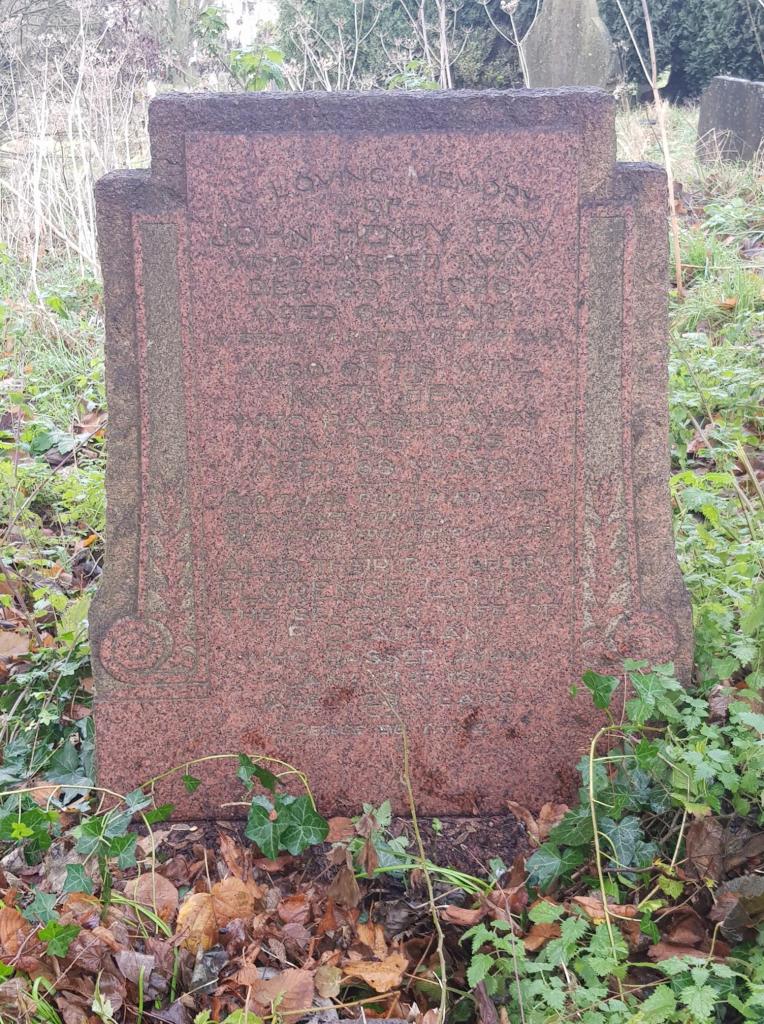
Florence lies in grave plot C2017. Her mother Kate was buried with her following her death in 1933, but there may yet be another mystery to solve. Although John Henry Few is remembered on the headstone, he is not buried in this plot. Only Florence and her mother Kate are buried here.

The Late Mrs F. Clapham – The funeral took place on Monday at Swindon Cemetery of Mrs F.L. Clapham, the wife of Mr F. Clapham, of Weymouth, eldest daughter of Mr and Mrs J.H. Few, of 61, Fleet Street, Swindon. The cortege left the residence of the deceased’s parents at 1.45 p.m. and proceeded to St. Mark’s Church (where the first part of the service was read), and thence to the Cemetery.

There were many beautiful wreaths and expressions of sympathy sent by relatives and friends. The coffin was made of polished elm with brass fittings and was inscribed: “Mrs Florence L. Clapham, aged 28 years, died Jan. 31st, 1917.” – Mr F. Clapham and Mr and Mrs J.H. Few desire to express their sincere thanks for the many expressions of sympathy received during their recent sad bereavement.

Extracts from North Wilts Herald, Friday, February 9, 1917.

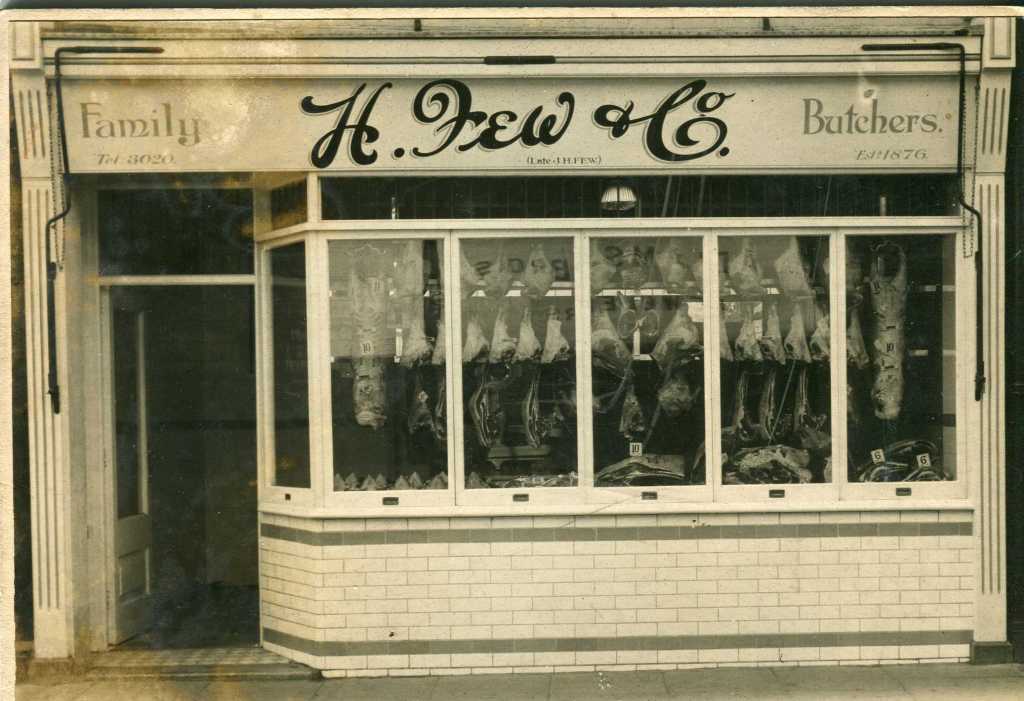
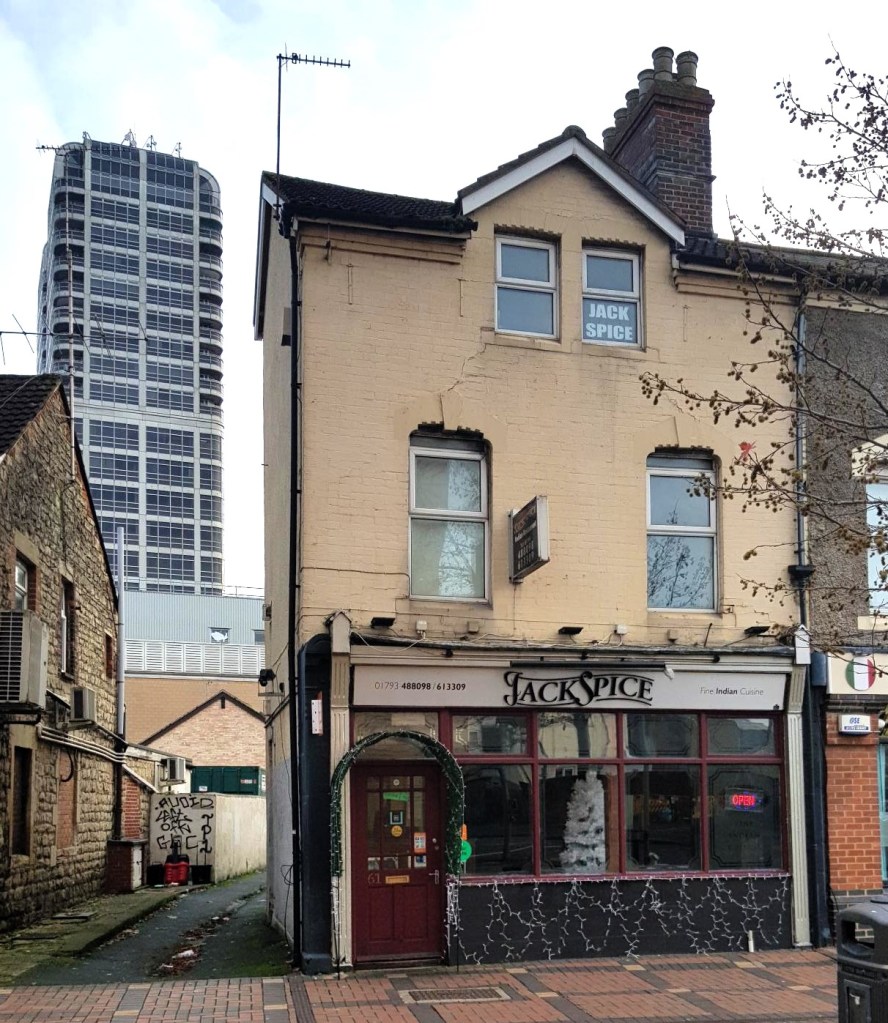
John Henry and Kate’s youngest son took over the business; the butchers’ shop is pictured here and we are able to confirm that the shop still survives.

Then …

and now

No 61 Fleet Street with the iconic David Murray John Tower in the background.

George and Clara Bosley – drapers

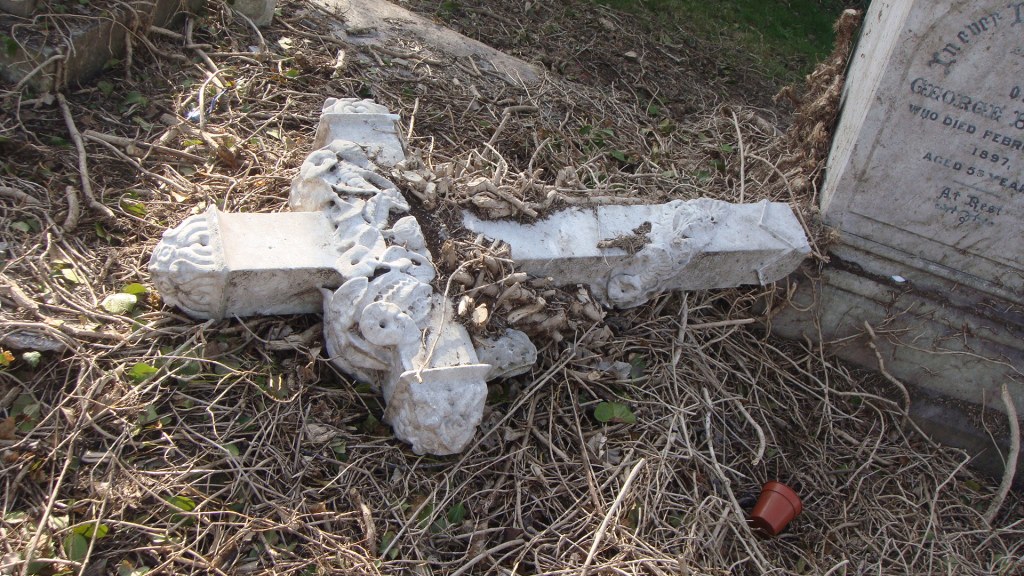
How magnificent must this memorial have looked when first installed?

In 2010/11 Swindon Borough Council conducted a major tidy-up at the cemetery. Memorials and monuments that had been hidden by ivy and brambles were seen again, possibly for the first time in years. And so the Bosley memorial was revealed, although unfortunately the ornate cross had already tumbled down.

The Bosley family ran a drapers shop in Fleet Street – an area of the town centre that has been significantly redeveloped (though not improved) in the 20th century. Their shop was numbered 55 and 57 so maybe renumbering took place even earlier.

Clara ran the business following George’s death and in 1911 she employed Charles Hiskins as manager.

Clara died on February 28, 1917. Administration was awarded to her daughter Clara Edith Burrows (wife of George Burrows) and her effects were valued at £7948 5s 8d.

Death of Mr G. Bosley – The hand of death has been busy amongst Swindon tradesmen during the last few months, as our columns have shown week by week. Today our obituary column contains the announcement of the death of Mr George Bosley, draper, who had been in business in Swindon for the past 23 years. Mr Bosley, who was 52 years of age, died somewhat suddenly at the residence of his brother-in-law at Ealing last Friday. Mr Bosley had suffered for many years from asthma, and left Swindon about three weeks ago to consult a London specialist. He had paid several visits to his doctor from Ealing, and it was thought he was improving, but he died somewhat suddenly in the presence of his wife and other members of the family. Deceased leaves a widow and nine children. The funeral took place at Swindon Cemetery on Wednesday last.

The Swindon Advertiser, Saturday, February 13, 1897.

This seemingly large burial plot contains the remains of just George who was buried on February 10, 1897 and Clara who was buried on March 5, 1917.

George Pakeman – regimental tailor and Crimean Veteran

During more than 100 years in business, Pakeman Brothers advertised themselves as a Civil and Military Tailor, which is hardly surprising!

Founder George Pakeman was born in Uxbridge, Middlesex in 1822, the son of John, a tailor, and his wife Jane Pakeman. He followed his father into the tailoring business, but not the family firm. In 1859 he married Sarah Philpott and by 1863 the couple had moved from Canterbury, Kent and set up in business at 22 High Street, Old Swindon.

But prior to that George can be found on the 1851 census as ‘Master Tailor in the Regiment’ at Ashton Barracks, Hartshead, Ashton Under Lyne, Lancashire. However, it was only when I searched for George’s obituary that I discovered the full extent of his military career.

The remains of Mr George Pakeman, one of Swindon’s Crimean veterans, were on Wednesday interred in the Cemetery, Swindon. Deceased, who had served in the trenches before Sebastopol, and had been engaged at the battles of Alma and Inkerman, left the army with the rank of sergeant, after having acted for about ten years as master tailor in the depot of the 50th Regiment at Canterbury.

The Western Daily Press, Bristol, Thursday, November 3, 1904.

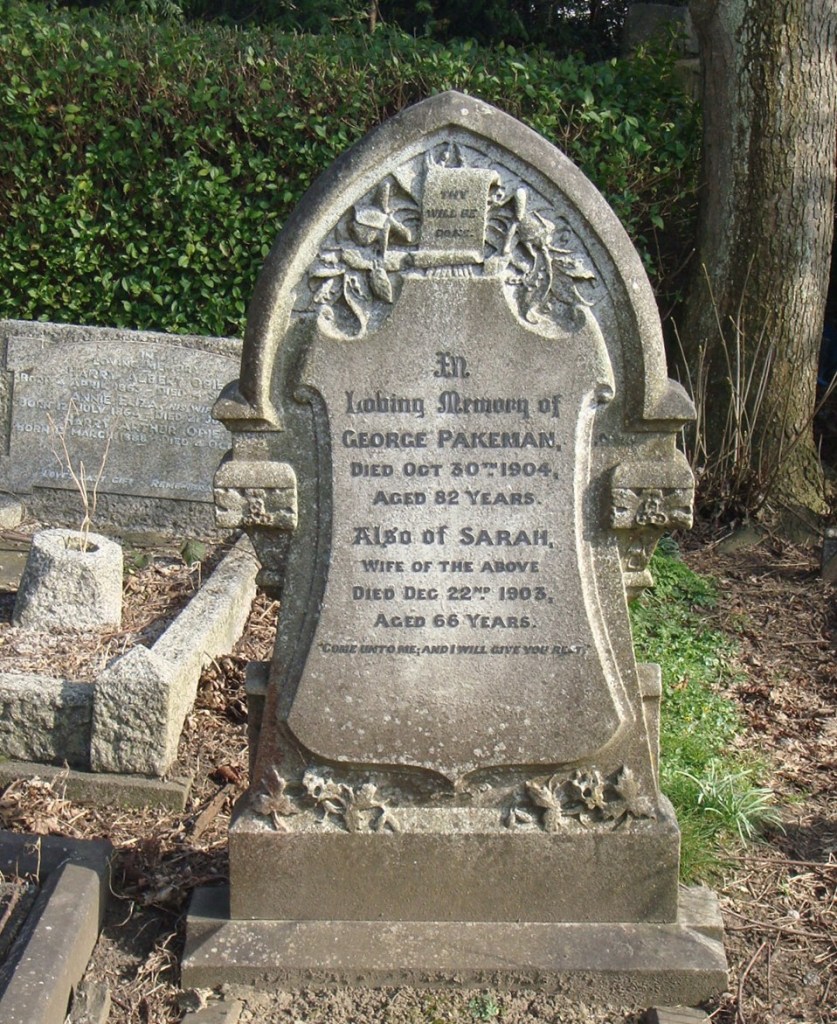
George died at his home (appropriately named Inkerman) 129 Goddard Avenue, on October 30, 1904. He was buried on November 2 in grave plot E8617 joining his wife Sarah who died the previous year.

This newly discovered history reveals George Pakeman as a member of the growing number of recently located Crimean veterans buried in Radnor Street Cemetery.

The life and times of Richard and Ada Jones

Today’s story has been revealed by an enquiry through the Radnor Street Cemetery Facebook page and two newspaper articles.

When Hilda Lawes was interviewed by the Swindon Advertiser in 1995 she spoke with affection about her childhood, living in Faringdon Road above her parents’ fish shop.

It had taken Ada and Richard Jones a long time to get to Swindon.

Ada was born in 1879 in Canton, Cardiff the daughter of Edward Barrow, a stonemason, and his wife Mary. She married Richard William Amhurst Jones in Cardiff in 1897. Their daughter Ada was born that same year in Cardiff. In 1899 a second daughter Emma was born followed by son Richard William in 1902 when the family lived in Tilehurst, Reading where Richard worked as a Ferryman. The family were soon on the move again and Edna was born in 1905 and Hilda in 1907 in Southampton. They eventually arrived in Swindon where Matilda was born in 1910. By 1911 the family were living at 26 Commercial Road where Richard worked as a fish dealer. The census of that year informs us that they have been married for 14 years and have 6 children who are all living. Their last child, Freda, was born in Stratton St. Margaret in 1912.

Their family complete, their business established, Richard and Ada might have thought they were settled.

The Great War was raging when Richard enlisted in Swindon in November 1915.  He was 41 years of age with a family of seven children to support. His military records reveal that he served in the RAMC as a Motor Driver and Mechanic from 1916 to 1919 in what was then known as German East Africa. During 1916 he was injured in a bomb explosion suffering wounds to his left leg. That year he also contracted malaria. He remained in East Africa until the end of the war, returned to England in January 1919 when he was declared 30% disabled, but still transferred to the Reservists List.

Hilda, then aged 12, remembers him returning from the war and how the family moved to new premises at Faringdon Road.

Despite his injuries, work carried on apace for Richard, but family life sounds as if it was rather fun.

In June 1931 Richard and Ada’s youngest daughter Freda entered the Carnival Queen competition organised by the Evening Advertiser. She was crowned by popular actress Evelyn Laye (who had a Swindon connection) and was presented with a silver rose bowl.

The Swindon Advertiser report includes a fantastic photograph of Richard riding his motorbike with Ada sitting in a wicker sidecar. The second photograph is a grainy picture taken from the North Wilts Herald of their youngest daughter Freda crowned Carnival Queen in 1931.

Ada died aged 63 at 39 Faringdon Road. Her funeral took place on October 13, 1937 when she was buried in Radnor Street Cemetery in grave plot C4490. Richard died aged 65 at 176 Pinehurst Road, the home of his youngest daughter Freda, and was buried with Ada on November 24, 1939.

Many thanks to Helen Diggens

George Watson – greengrocer and florist

Local farmer Elliot Woolford kept a daily diary for more than 50 years and I’m transcribing it for the Friends of Lydiard Park online Lydiard Archives project.

The diaries in which Elliot records life in the small rural parish of Lydiard Tregoze constitute an important social document. Here he discusses everything from the vagaries of the weather to crop failures; from church festivals to village goings-on; the death of Queen Victoria and the end of the war in South Africa. His writing is unaffected and his voice colloquial, the diary was written for his reference only.

In 1911 Elliot brought his produce to Swindon market and delivered to shops in the town centre. One of his regular customers was George Watson who ran a greengrocers and florists at 21 Cromwell Street. In his diary Elliot records their transactions.

Friday April 7: Received 10/6 of Mr G. Watson for rhubarb delivered last week.

Monday May 15: 1 doz Pea sticks to Swindon for Mr G. Watson.

On Friday September 22 it was Mrs Watson who greeted Elliot, paying him £1 10/- for 20 dozen cabbage.

On Saturday September 23 Elliot writes in his diary: Mr G. Watson died last night after a short illness.

George Watson was buried in Radnor Street Cemetery in grave plot E7394. Two days later Elliot writes: Received 43/- of Mrs Watson for cabbage & turnips delivered.

Annie Watson continued to run the shop after the death of her husband.

Saturday October 28: 7/6 worth of cabbage to Mrs Watson and 9 old hens @ 1/3 each.

Annie and George were both in their 40s when they married; there were no children to carry on the business.

In time Annie moved in with her sister and brother-in-law, Susan and George Fowler at 23 Salisbury Street. When George Fowler died in 1929 he was buried in grave plot E7394 with Annie’s husband. Annie died in 1945 aged 80. She was buried with both the Georges.

George Watson’s shop pictured during flooding in Swindon July 25, 1909 published courtesy of Local Studies, Swindon Central Library.
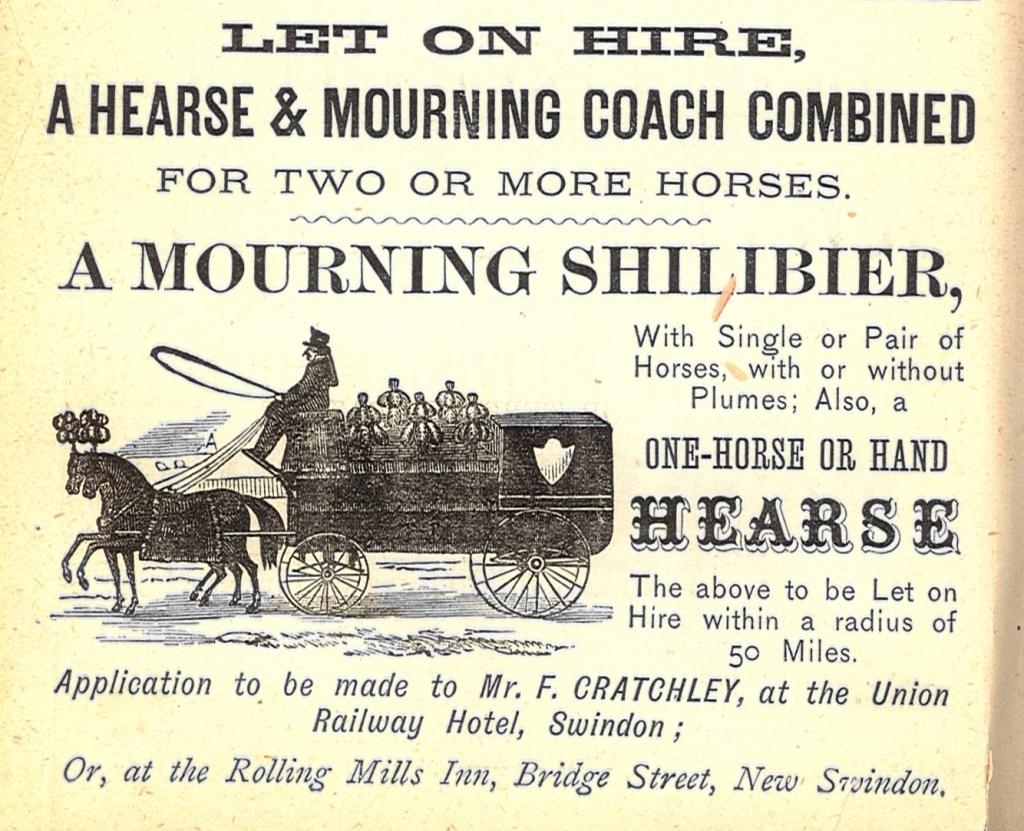
Death of Mr. G. Watson, – At his residence, 21, Cromwell Street, on Friday night, Mr. G. Watson suddenly passed away. Deceased, who was 52 years of age, was a florist, and he had recently been under medical attention for heart trouble, though the end came quite unexpectedly. Mr Watson had lived in Swindon during the last nine years, and was on the executive of the local Horticultural Society. He was also a member of the Ancient Order of Foresters. He leaves a widow, but no children.

The funeral took place on Wednesday afternoon. The procession left the house at 3 o’clock and wended its way to St Paul’s Church where the first portion of the service was conducted by the Vicar (the Rev. H.H. Rackham). The cortege then proceeded to the Cemetery, where the Rev. T.L. Mackesy read the concluding portions of the service.

The floral tributes were numerous and handsome and included two artificial wreath inscribed “A token of respect to George Watson from stallholders, shopkeepers, friends and neighbours RIP” and “a tribute of respect from members of the Queenstown Club.”

Extracts from the North Wilts Herald, Friday, September 29, 1911.

Ernest Henry Cousens – butcher

This stylish art deco headstone marks the grave of Ernest Henry Cousens. Ernest was born in Little Coxwell in 1885 the son of William Cousens, a carter, and his wife Annie. In 1891 they appear on the census living in the village of Lyford in Berkshire. Ernest has an 11 year old sister Edith Emma and a brother William aged 8.

In 1901 Ernest was lodging at 30 Hythe Road with Henry J. Keen, a butcher’s assistant. Sixteen year old Ernest was a butcher’s apprentice, so probably worked alongside Henry.

In 1908 he married Laura Young and the couple had four children; Irene born in 1912, Ernest born in 1916, Cecily 1918 and Eric 1922. At the time of the 1911 census he was living over his butchers shop at 15 Bridge Street with his wife Laura who is described as ‘assists in business’. The couple were aged 27 and 25 and had been married for three years. The first of their four children was born the following year. Living with them on census night was Ernest’s uncle James aged 59, a widower who worked as a general labourer.

Ernest Henry Cousens of 14 and 15 Bridge Street, Swindon died on March 28, 1939, aged 54. Probate was declared in London on June 15 and effects valued at £7,443 1s 8d were left to his widow Laura and his eldest son Ernest William Cousens, a chartered accountant. He is buried alone in grave plot C4708.