Ivy Colborne and Colbourne Street

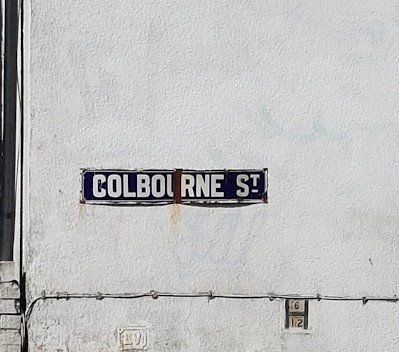
During the First World War Colbourne Street was the site of a munitions factory known locally as the Powder Works. The street is believed to be named after builder Arthur Joseph Colborne who had premises in nearby County Road, but why is Colbourne Street spelt this way? The spelling acquired an additional U when allocated to the new street in 1902. Did no one notice at the time (Swindon has form for this.) Or is the street named after someone (or some place) totally different? I suppose we’ll never know.
Arthur Joseph Colborne, was born in Midsomer Norton in 1870, the son of Thomas Colborne, a builder and timber merchant who by 1873 was established at the Cross Roads, Stratton St. Margaret. Between 1876-1940 the Colborne family built a staggering number of properties in Swindon, despite being on the verge of bankruptcy more than once.

But this is the story of a Colborne wife, and as usual, there is only a little information to be found about her.

Arthur Joseph’s eldest son Arthur Kenneth Colborne married Ivy Berry in 1925. The couple had two sons, Michael John born in 1927 and Richard Graham in 1931. Sadly, Ivy died on July 21 1938, aged just 36.

Death of Mrs A.K. Colborne

Wife of Swindon Business Man

By the death of Mrs Ivy Colborne, who was buried on Monday, the family has suffered its ninth bereavement in the last two years. For in this short period no fewer than nine members and relations of the families of Mr Colborne and his wife have died.

Mrs Ivy Colborne, who died last Thursday after a long illness, was the wife of Mr Arthur Kenneth Colborne, of 33 Croft-road, Swindon. She was 36 years of age.

Mr Colborne is a member of the Building and Public Works Construction Co. Ltd., Swindon. There are two sons one aged 11 and the other aged 6. Mr. Colborne’s brother, Alan, died about two years ago.

Mrs Colborne was a member of Swindon Baptist Tabernacle and used to be a keen worker for the YMCA Boys Club. Before her marriage she was a Miss Berry.

At the funeral service at the Baptist Tabernacle, on Monday, the Rev. C.H. Cleal and the Rev. P. Tomlinson officiated.

There was a large congregation of mourners. Mr A.E. Ford presided at the organ, and the hymns sung were “The morning flowers display their sweets” and “Jesus lives.” The organist also played “O rest in the Lord” and other appropriate music.

The interment took place in the Radnor street cemetery, the Revs C.H. Cleal and P. Tomlinson again officiating.

Extracts from the North Wilts Herald, Friday, 29 July, 1938

Ivy Colborne aged 36 years of 33 Croft Road was buried on July 25, 1938 in grave plot E8627. Arthur Kenneth Colborne remarried in August 1939. When he died in 1963 he was buried with Ivy.
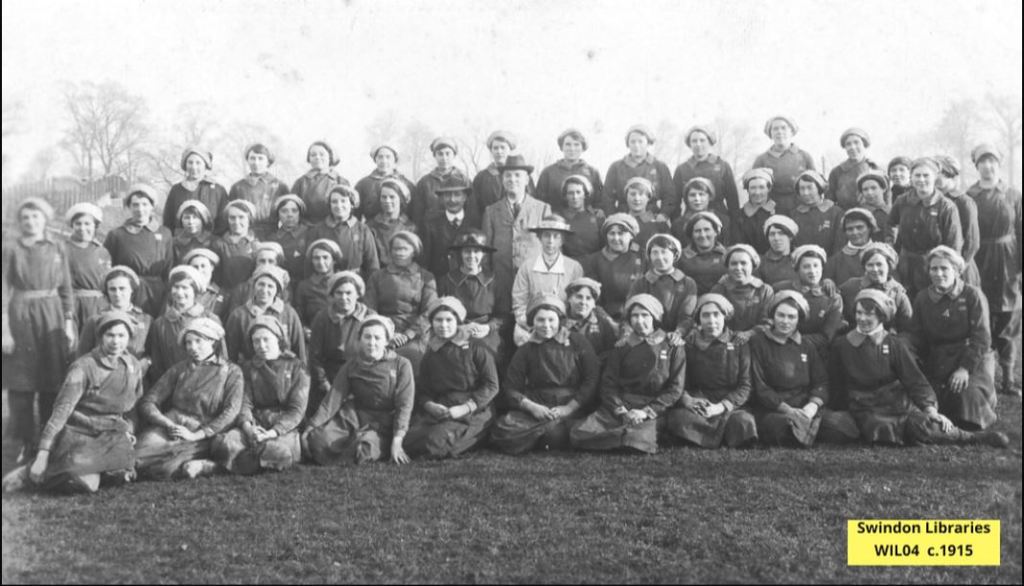
Munitions workers at the Powder Works, Colbourne Street pictured c1915. Tesco now stands on the site. Image published courtesy of Local Studies, Swindon Central Library.

Alfred Bartlett – stonemason

If you look carefully as you walk around the cemetery you will see the name Bartlett on many of the headstones, usually inscribed discreetly on the kerbstone surround.

Alfred was born in Cricklade in 1865 the son of William Bartlett, a master stonemason, and his wife Mary Ann.  In 1881 16 year old Alfred was employed as a pupil teacher at the National School in Cricklade, perhaps with the intention of making teaching his career. But maybe the death of his father in January 1889 compelled him to take up his father’s occupation. In 1890 he married Leah Annie Brown when he states that his occupation is that of stone mason.

By the mid 1890s Alfred had established his business as a monumental mason in Bath Road where it remained for many years. Today the firm has premises on Victoria Road.

Alfred’s end was a sad one as his death in 1916 reveals he was a patient at the Wiltshire County Asylum in Devizes. It is recorded that between 1915-1920 there were high levels of TB and dysentery at the Asylum; perhaps one of these illnesses was the cause of his death.

Leah Annie never remarried and lived out her days at 22 Bath Road.  She died in 1934 and left effects worth £265 10s 4d to her executors, her sons William Alfred and Charles Bartlett, both monumental masons.

Alfred Bartlett died aged 51 years. He was buried here in plot C2021 on October 7, 1916. Leah Annie Bartlett died aged 66 years and was buried with her husband on March 28, 1934.

The lubbly jubbly Fred Kiddle

I wonder what Fred Kiddle looked like. I imagine him as the loveable rogue Del Boy Trotter from the 1980s sitcom Only Fools and Horses, complete with medallion and sheepskin coat.

Fred had numerous jobs, including that of a ship brokers clerk, a traveller, pub landlord, shopkeeper, greengrocer but he is probably best remembered as a Turf Commission Agent – a bookies runner. Infact, we know he even had a nickname ‘Speedy.’

Fred’s great nephew David contacted me with a chapter from the Fred Kiddle story:

‘Most of Fred’s money came from bookmaking – both on course and off, with Duart House (his home) being furnished with antiques and silver ‘redeemed’ from unlucky gamblers in lieu of their debts. I understand Fred gloried in being nouveau-riche, owning many cars, from the windows of which he liked to scatter coins for local boys to run after! At the start of WWII he donated premises for the local Red Cross to use as their HQ – a wise investment, as they had preferred access to petrol, and made sure his car was never without, despite rationing.’

Now that is pure Del Boy.

Frederick Charles Kiddle was born in Gloucester in 1879 the son of Charles Kiddle, a railway foreman, and his wife Harriett. He first married Dora Henrietta Stephens in 1903. I’ve been unable to discover what happened to this marriage (or to Dora) In 1921 Fred married his second wife Ethel Maud Dunn but by that date they already had two children, Hugh born in 1914 and John in 1916. Their daughter Marcia Mary was baptised at St. Mark’s on February 13, 1922. During this period the family lived at 13 Cambria Bridge Road where Fred had a grocer’s shop.

By 1939 Fred was recorded as a Turf Commission Agent with premises at 26 Clarence Street, Gloucester and 2 College Place, Cheltenham. He died on died March 25, 1943. Probate was awarded to William Edward Kiddle (his younger brother) and William Canniford, insurance officials and Joseph Thomas Weston commission agents clerk and secretary. He left effects valued at £18,623 13s.

Fred was buried in grave plot C4878 in March 1943 where he joined his son John who had died in 1939. The inscription on the grave reads – ‘To my dear Speedy who I loved/No tongue can ever tell what we would give to have you back.’ Ethel died in 1964 and was buried in the neighbouring plot C4879. She is buried with the couple’s daughter Marcia, well known for her charitable works during the war, who died in 1994.

Robert Astill – Commercial and General Printer

Window bills, confectioner’s bags and sermons are just a few of the seemingly endless list of printing services produced by Robert Astill at his works in Victoria Street.

Born in Coventry in 1833, Robert Astill married Margaret Delphi Considence Hall in 1866 and by 1871 the couple were living at 18 Victoria Street with their two young children. Employed as foreman at the printing works established by auctioneer William Dore, Robert Astill later became proprietor probably after Dore’s death in 1877.

Astill’s premises occupied the large corner plot at the top of Victoria Street where Queen Victoria House now stands. With a Victoria Street frontage measuring 93ft (28.3 metres), the area was known locally as Astill’s corner. Astill had bought the property in 1885, signing a conveyance between Charles Richards Plummer and his wife Mary (most probably the former Mary Dore and daughter of Astill’s former employer, William Dore).

By the turn of the century Robert was widowed, the youngest of his eleven children, Lily Blanche, had recently emigrated to Australia where she worked as a domestic servant in the Brisbane/Gold Coast area. With the business now in the hands of his sons, Robert was preparing to retire to Zeals, a small village near Warminster.

The whole complex was placed on the market in 1903 when it was described as being ‘suitable for any Large Business or Offices with Stable, Coach House, Out Buildings, Yard and Garden ground.’

The 1903 sale catalogue describes a complicated arrangement of domestic and workplace accommodation. On the ground floor there were two entrance lobbies, one opening on to Bath Road and the other on to Victoria Street.

The Breakfast Room facing Victoria Street was used by Astill as a ‘Stationery and Fancy Shop’ while W.H. Bush used the Drawing and Reception Rooms on the Bath Road side as a ‘Hairdressing Establishment.’ The stables and use of the yard were let to Mr Greenman on a weekly tenancy.

A selling feature was made of the bressummers (strong beams supporting the superstructure of the building) thus enabling a conversion into two shops if the purchaser so desired.

With a dining room, seven bedrooms, a dressing room, WC and linen closet on the two upper floors, this building presented a serious undertaking.

A short account of the auction was reported in the Swindon Advertiser.

Sale of Property – An exceptionally large and influential gathering of property owners and speculators assembled at the Goddard Arms Hotel last (Monday) evening to witness the disposal by public auction of that very desirable corner freehold block of buildings situate in Bath Road and Victoria Street, and for many years in the occupation of the owner Mr Robert Astill. Mr T. Hooper Deacon was the auctioneer, and after a short introductory speech, the bidding was started by Mr James Hinton at £2,000, who became the new owner at £2,600. The solicitors for the vendor were Messrs Kinneir and Co.

Swindon Advertiser, Tuesday, February 17, 1903.

Kelly’s Directory of 1915 reveal that the Astill brothers still occupied the premises, then described as 103 Victoria Road after renumbering of the built up road linking former Old and New Swindon.

Margaret Delphi Considence Astill died in December 1899 and was buried in grave plot E8601 where her husband joined her on June 19, 1915. The last burial to take place in this plot was that of their daughter Ellen Victoria Astill who died in 1946 and was buried on April 12.

If there was ever a memorial on the Astill family grave here between the Thatcher and Chum family plots, it is no longer visible. We fully appreciate the financial constraints upon Swindon Borough Council – that the coffers are depleted and there is barely enough money to pay for essential services. But it is such a shame that an important heritage site such as Radnor Street Cemetery receives so little maintenance. Here lies, quite literally, the history of our town – remembering the ordinary people of Swindon.

Albert Edward Tunley

Tunley might be another familiar name to local people.  This firm of builders’ and decorators’ supplies had a town centre shop for more than a hundred years.

Albert Edward Tunley was born in 1873, the first of William and Matilda Tunley’s family to be born here in Swindon. Albert married Eliza Snell in Swindon in 1892 and by 1901 they were living at 73 Gloucester Street.

William, a plumber and decorator, opened his shop on the corner of Milford and Cheltenham Street in 1880.  Although the business was established by William the shop bore the name A.E. Tunley, the initials of William’s son and later that of his grandson as well.  This photo dates from around 1890.

The Tunley’s business continued to expand, as did their shop.  In 1900 they applied for planning permission to build a stable and warehouse on Milford Street.  Further additions were made in 1905 and 1910.  By 1929 their premises stretched into Gloucester Street.

The business moved to 40-41 Fleet Street where it remained until relatively recently.

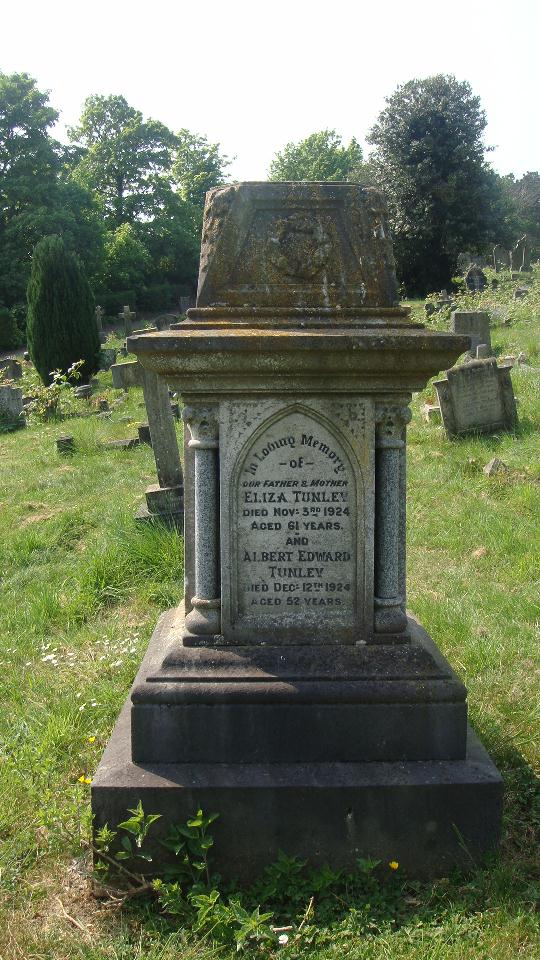
This distinctive monument is the final resting place of Albert Edward Tunley and his wife Eliza.  Albert died on December 12, 1924, not at his home, 8 Wellington Street, but at 7 Mandeville Place, Manchester Square in London.  His wife Eliza had died just six weeks previously.

James Smith Protheroe – no busier man in Swindon

From local dignitaries and Victorian edifices to pageants and poets, photographer James Smith Protheroe and his partner Thomas Henry Simons captured them all.  But it could have turned out very differently.

One of tailor Thomas Protheroe’s eleven children, James was born in 1858 over the shop in Goat Street, Swansea, next door to the public library.  By 1871 13 year old James was already working alongside his father, described as ‘young tailor’ in the census of that year. 

But his artistic leanings had the support of his elder brother Thomas, an artist, who left Wales following his marriage to Emma Chapman in 1872.  Thomas moved to Bristol and by 1876 had his own photographic studio at 33 Wine Street and encouraged James with his ambitions.

Thomas remained in Bristol, while James established himself at 30 Regent Street, New Swindon.   In 1881 the Protheroe studios won a first class silver medal for oil painting at the Plymouth Art and Industrial Exhibition and proudly declared royal patronage by HRH Prince of Wales.

Image published courtesy of Local Studies, Swindon Central Library.

Towards the end of the century Prothero’s sitters included Queenstown School teacher Edith New who would shortly leave Swindon to join the Women’s Social and Political Union and the fight for Votes for Women. And in 1903 the GWR Hammerman poet Alfred Williams took his bride Mary Peck along to the Regent Street studio to pose for their wedding photograph.

By then James had taken his nephew into the business, Thomas Henry Simons, the son of his sister Elizabeth and her husband Henry, a commercial shipping clerk.  James married Fanny Jane Redman, a dress mantle maker, in 1894 and the new century saw the family photography firm based at 96 Victoria Road. 

Although the Protheroe name still headed the firm it was Thomas who increasingly took care of the day to day business as James involved himself with the public life of Swindon. 

Conductor of the Baptist Tabernacle choir, Justice of the Peace and Wiltshire County Council member, Chairman of the Swindon and Highworth Board of Guardians and member of the Swindon Victoria Hospital Committee are among just a few of the organisations on which James served.

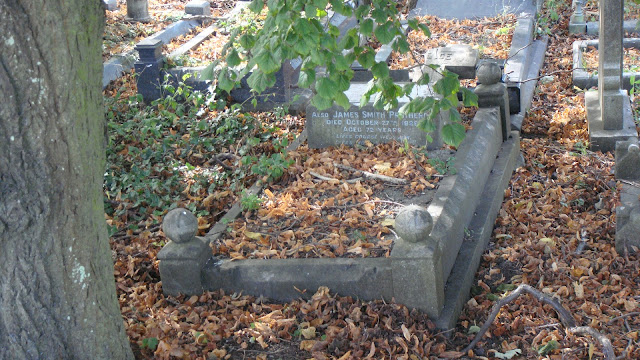
James died at Eirianfa, Newton Villas, Mumbles, overlooking Swansea Bay, in October 1929 aged 72. His body was returned to Swindon for burial in Radnor Street Cemetery.

His obituary published in the North Wilts Herald declared that ‘there was no busier man in Swindon, and few who will be more missed.’

James Smith Protheroe was buried on October 30, 1929 in plot D34A, a plot he shares with his wife Fanny who died in 1925.

Horder Bros – Drapers, Milliners, Mantle Makers and Costumiers

Albert Horder was born in Donhead St Mary in 1831, the son of a farmer William and his wife Sylvia. As the couple’s sixth son, Albert realised he was unlikely to inherit the 200 acre Lower Wincombe Farm, so he carved out a career for himself in the drapery business, and never looked back.

The 1861 census finds him living above his shop in the High Street, Shaftesbury with his sister Mary who acted as his housekeeper, a house servant and four assistants. In 1865 he married Mary Ellen Jeeves and the couple had four children.

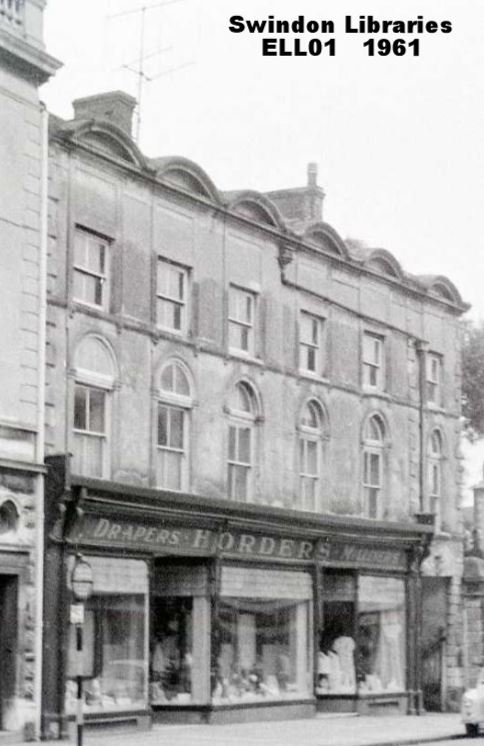
Image published courtesy of Local Studies, Swindon Central Library.

In the early 1870s Albert and Mary Ellen moved to Swindon and set up business in premises in the High Street once occupied by Thomas Strange. Business flourished and the autumn and winter fashions of 1882 included “a good assortment of Tailor-made Ulsters, Jackets, Dolmans in Plain & Broche Cloth, Velvet, Sealskin & Fur” where “an inspection was respectfully solicited.” By the 1890s Horder Bros, Drapers, Milliners, Mantle Makers and Costumiers boasted an expansive three-bay shop frontage.

Having handed over the reins to his son Edward Jeeves Horder, Albert and Mary Ellen retired to a house in Devizes Road, which they named Wincombe after the family farm.

The Horder’s store eventually closed shortly before the firm’s centenary and the building was subsequently demolished. The Pinnacle, a block of apartments, stand on the site of Albert’s drapery business, his name immortalised in the access road, Horder Mews.

Swindon

Death of a well-known resident – The death took place late on Sunday night, at his residence, Wincombe, Swindon, of Mr Albert Horder, who for many years carried on a successful drapery business in the High-street. He was an active member of the Congregational church, having been deacon at the Victoria-street Chapel for many years. Deceased, who was born at Winchcombe, Dorset, nearly 73 years ago, leaves a widow, three sons, and one daughter.

The Wiltshire Advertiser, Thursday, March 27, 1902.

Albert died aged 72 in 1902 and was buried in a large double grave plot E8032/33. He is buried with his wife Ellen, their son Edward Jeeves Horder and his wife Alice Emma.

Charles Hurkett’s distinctive memorial

Charles Hurkett was born on August 3, 1888 and baptised at St. David’s, Carmarthen on August 26. Charles was the son of John Hurkett, a Bat. Sergt. Maj. 3rd Brigade, Welsh Div R.A., and his wife Frances. At the time of Charles’s birth the family were living at Glen Cross Villa, Johnstown, but by 1891 they were living at Lympstone in Devon and by 1901 they had arrived in Swindon.

Charles died in 1907 and his grave is marked by a very distinctive memorial. I thought that perhaps Charles was employed in the GWR Works and that maybe colleagues had made this unusual memorial. However, when you look at the back you can see it has the imprint of Affleck and I think it is more likely that Charles worked at the Affleck foundry in Old Town.

William Affleck was born in Gateshead and served his engineering apprenticeship at Hawkes & Son, a large engineering works and iron foundry in the town. He later joined the prestigious Lambeth based engineering firm of Maudsley and Field before moving on to a job with the Great Western Railway at Paddington and eventually coming to Swindon. By 1853 William had struck out on his own, establishing a foundry and engineering works in Prospect.

While there is still more to discover about the Hurkett family it seems we may have solved the mystery of the unusual memorial.

Charles died on April 25, 1907 aged 18 years of age. He is buried in plot B2607 with his parents.

James Sweeper – Ostler

James Sweeper was born in Marlborough in about 1824 the son of William and Harriett Sweeper. On December 8, 1845 he married Jane Gilbert at the church of St. Peter, Marlborough.

By 1851 James and Jane with their two young children Eliza 2 and 2 months old George, lived above the stables at the Queens Hotel, Swindon. He was 28 years old and employed as a post boy – a job description open to interpretation. Sometimes described as a mail carrier, a post boy was also a person who rode one of the horses pulling a carriage. The two roles could be, and frequently were, combined.

In 1861 James and Jane and their 5 children lived at the Queens Hotel Tap, Railway Station, Swindon. In 1871 James, now widowed, lived at the Queens Hotel Stable with daughter Eliza and sons George, Henry and William. However, sorting out the various town centre Queens Hotels is confusing.

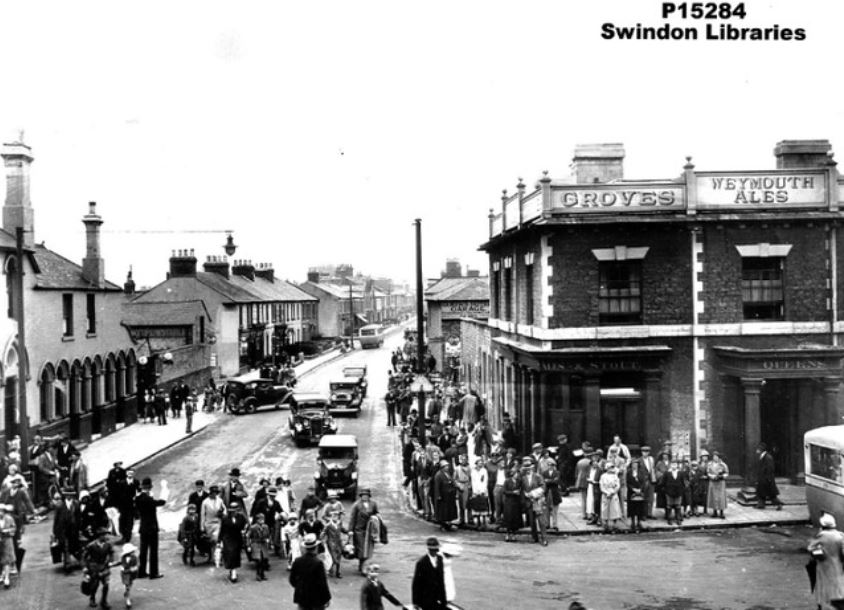
The Queen’s Tap pictured on Trip day 1934 published courtesy of Local Studies, Swindon Central Library.

Swindon Junction Station (now called Swindon Station) was built in 1841-42 by J.D. & C. Rigby. A far more impressive building in those days, it originally consisted of 2 separate 3 storey buildings straddling either side of the railway line and linked by a footbridge. These buildings contained the infamous refreshment rooms and the Queen’s Royal Hotel. Was this where James worked as a post boy and later an ostler (a man employed to look after the horses of people staying at an inn)?

The second candidate is an inn built in 1841 that once stood at the bottom of Corporation Street close to the Whitehouse Bridge. It later became known as The White House and was demolished in 2002, but in James’s day it was called the Queen’s Arms Hotel.

Finally, we have the only one left standing, the Queen’s Tap, opposite the station on the corner of Wellington Street and Station Road.

So where did James live and work between 1850-1870. My money is on the Queens Arms Hotel but then again perhaps he worked at all three hotels at various times.

Jane Sweeper died in April, 1868 aged 44 years and was buried in St. Mark’s churchyard. James married for a second time in 1875 when he was working as a horse dealer in East London. James married Lucy W. Hunt, a widow, at St Leonard’s Church, Bromley and by 1881 had returned to Swindon where they lived at 22 Holbrook Street with James’s son Harry.

It has been much easier to establish James’s last resting place here in Radnor Street Cemetery! He died in 1887 aged 65 and was buried on December 7, in grave plot E8582 with Lucy who had died earlier that same year.

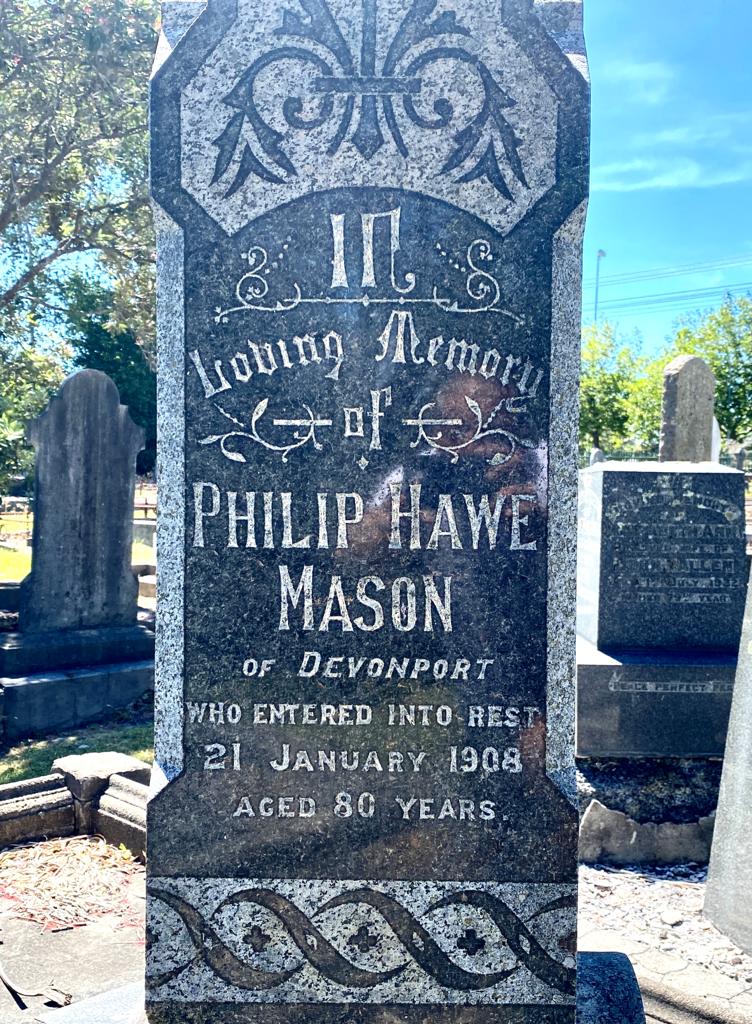
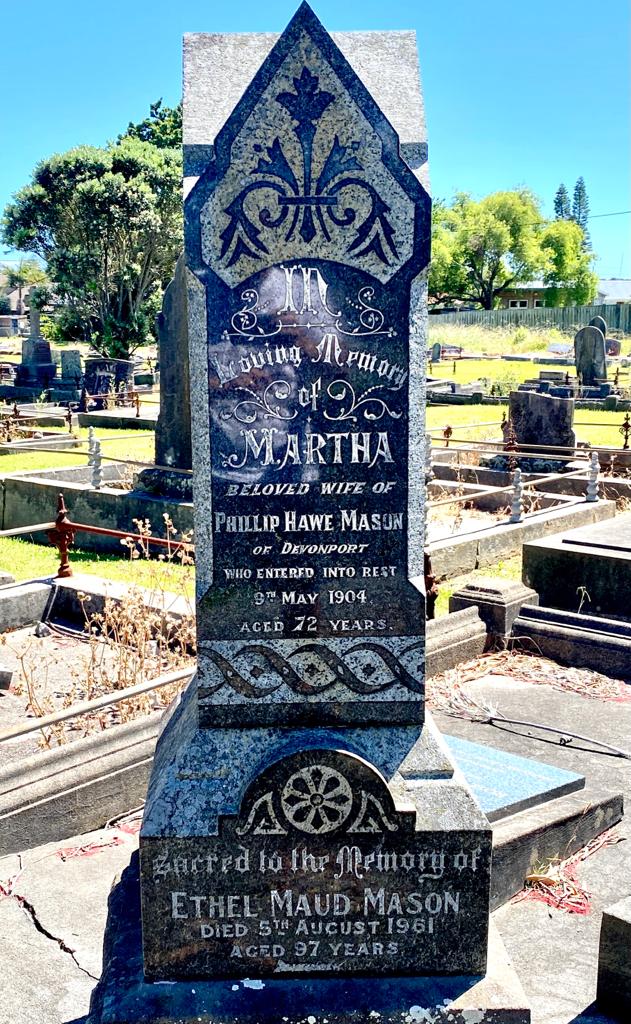
Philip Hawe Mason – businessman

In which our roving researcher Noel goes to great lengths to follow a Swindon story.

Philip Hawe Mason was born on December 5, 1827, the son of Wesleyan Minister John Mason and his wife Anne. His baptism appears in the Methodist Register of Births & Baptisms as having taken place on February 1, 1828 at his father’s house in Saint Luke’s Parish, London, performed by John Stephens.

An enterprising young man, Philip had arrived in Swindon by 1851 when he has his own grocer’s shop in the High Street. He later opened a second shop in Regent Street and by 1871 he is no longer living over his business premise but at Sanford House, a sizeable property on the corner of what is now Springfield Road and Croft Road. In 1871 he describes himself as a Grocer and Provision Merchant employing 15 men and 5 boys. Philip was an active member of Swindon’s society serving as Chairman of the Swindon School Board and heavily involved with the Wesleyan Church in Swindon, when tragedy struck.

His wife Martha, whom he had married in 1853, took ill (possibly worn down by 10 pregnancies). Medical advice was to move to a warmer climate so in the 1880s Philip, Martha and several of their children, moved to Devonport, Auckland, New Zealand.

Here too Philip took an active part in the local community, serving as an elected Councillor of the Borough of Devonport.

Martha died in 1904 aged 72 and Philip in 1908 aged 80.

Death of Mrs P.H. Mason

The news of the death of Mrs P.H. Mason, at Devonport, Auckland, New Zealand, will be received with undisguised feelings of regret in Swindon by those who were acquainted with that lady and her family during their residence in the old town.

According to a cablegram received by the deceased lady’s daughter, who resides at Bristol, Mrs Mason’s demise took place last Monday, May 9th. The first intimation of the sad event was conveyed to Swindon in a letter addressed to the Mayor (Ald. James Hinton), by Miss Mason. The letter supplies a pathetic fact as to the suddenness of the news, for Miss Mason states that a letter intimating that Mrs Mason was quite well arrived simultaneously with the cablegram announcing her death.

Some little time must necessarily elapse before a further letter explaining the cause of Mrs Mason’s sudden demise can be expected.

The deceased lady, who was 72 years of age, was highly esteemed during her residence in Swindon. She was a prominent Wesleyan, and took an active interest in the welfare of that body. Mr Philip Hawe Mason was also held in high esteem. He held the position of Chairman of the School Board, and was Circuit Steward in connection with the Wesleyan body for many years.

Mr and Mrs Mason left Swindon in 1881 and such was Mrs Mason’s state of health that she had to be carried on to the boat.

During the time she was abroad, Mrs Mason enjoyed excellent health. It is only recently that Mr and Mrs Mason celebrated their golden wedding.

The Swindon Advertiser, Friday, May 20, 1904.

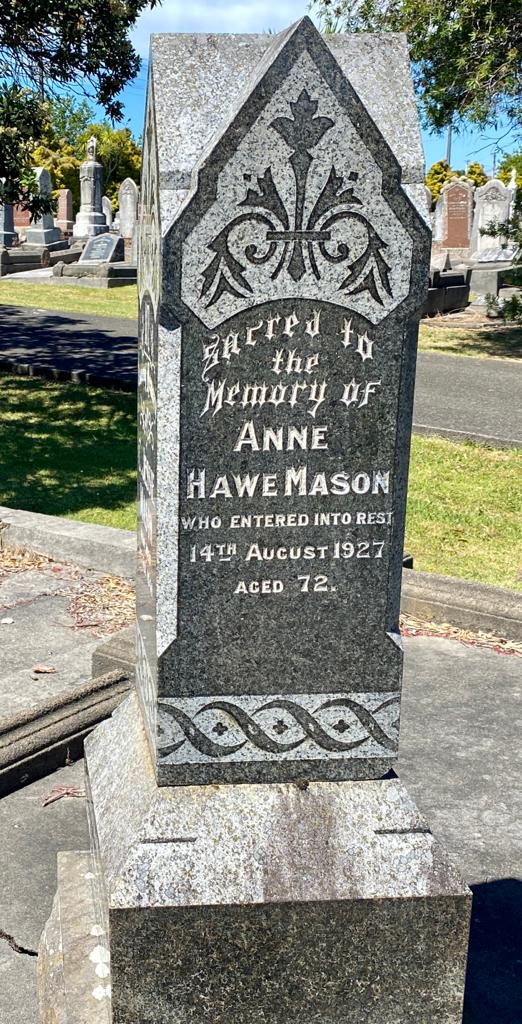
Their daughters Anne Hawe Mason died in 1927, Catherine Jessie Mason in 1940 and Agnes Martha Mason in 1944.

Thank you Noel – you can come home now.