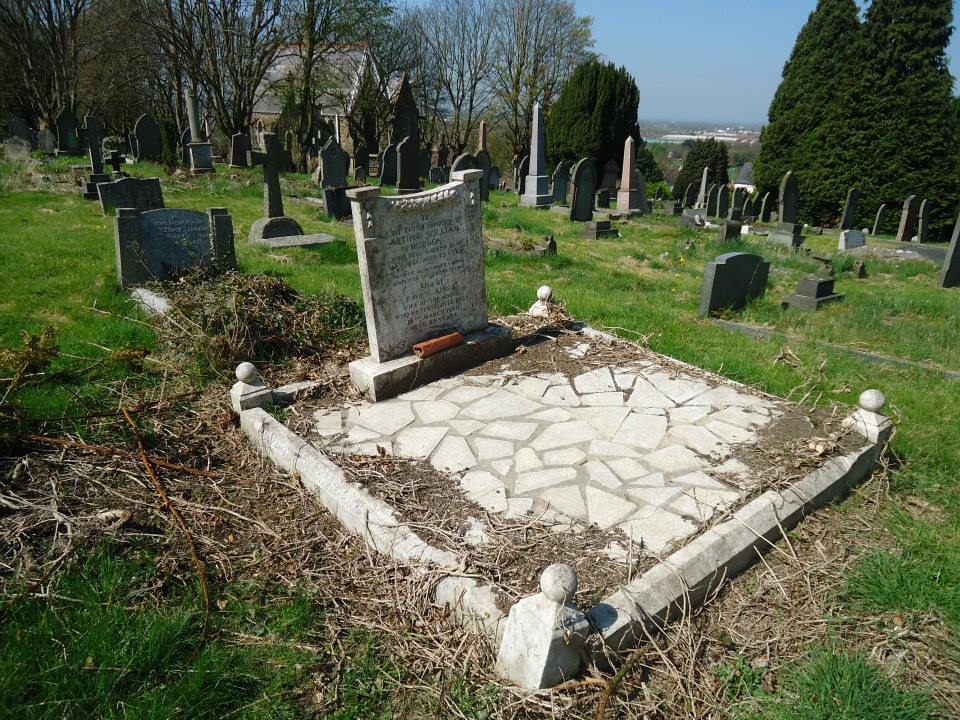
The Jefferies family – Wesleyan Methodists

I chose to research this grave because I liked the typeface and all the funeral symbolism on the headstone.
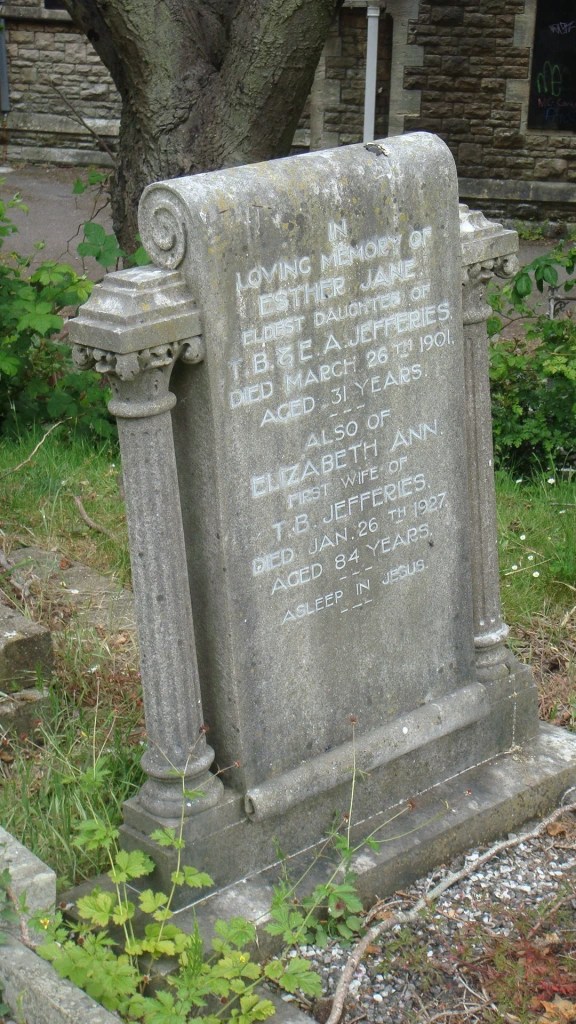
A scroll can mean a number of things in headstone iconography including a love of learning and a religious belief, which is very appropriate for this family. It can also mean a life cut short with the past rolled up and the future yet to unfurl. This would make sense when you note that Esther J. Jefferies, the first person buried in this grave, was only 31 when she died. The pillars either side suggest an entrance and this symbolises an entry into heaven. At the top of the pillars are acanthus leaves, which have several interpretations symbolising the prickly journey of life to death and also enduring life. So, there’s a lot going on with this headstone.

Elizabeth Ann was born in Cricklade in 1843. She worked in service as a young woman before marrying Thomas Bennett Jefferies, a slater and plasterer. Their first home was in Wootton Bassett where Thomas was born. By 1891 they had moved to 18 Union Street, Swindon where the elder sons were now apprentice plasterers.

The 1911 census finds them at 165 Victoria Road and on this census we get some more details about the family. Thomas and Elizabeth had been married 42 years during which time they had 10 children, four of whom had already sadly died. And then I found a fantastic photo of the couple’s five sons, thought to have been taken at the wedding of their sister Ellen to Harry Frederick Keene in 1906. They are pictured in order of seniority left to right – Joseph, Thomas, John, Winfrith Frederick (usually referred to as Fred) and Charles Wesley.

Eldest son Joseph Page Jefferies emigrated to Australia with his family in around 1913. Following his wife’s death, he married for a second time in 1936 in Sydney, where he died in 1939. The couple’s third son, John Nelson became the assistant borough surveyor here in Swindon and in 1903 lived at 2 Hunt Street.

Death of Mrs T.B. Jefferies

With the death of Mrs Elizabeth Ann Jefferies, of 1 Durham Street, there has passed away one of the best known figures in Wesleyan Methodism in the town. Mrs Jefferies, who was 84 years of age, was a native of Cricklade, being the daughter of Mr and Mrs Joseph Page. She married Mr Thomas Bennett Jefferies at Purton Parish Church on September 26th, 1868, and the couple came to live in Swindon 46 years ago. Mr Jefferies is the oldest local preacher on the local Wesleyan plan, and although he has been preaching for over 60 years he continues to take appointments.

Mrs Jefferies was taken ill with influenza, and pneumonia supervened with fatal results. The funeral took place at the Central Mission Church on Monday, and was conducted by Pastor A.E. Stocking, assisted by the Rev. W. Kelson and the Rev. H.B. Turner. The committal rites at the Cemetery were performed by Pastor Stocking. Among the mourners were Mr T.B. Jefferies (widower), Messrs. Thomas Henry, John Nelson and Charles Wesley Jefferies (sons), Mrs Ellen Elizabeth Keene (daughter) Mrs Eliza Priscilla Jefferies (daughter-in-law), Mr Joseph Jefferies (son-in-law), Mrs Cottrill (half-sister), Mr Jesse Jefferies and Mr E. Jones (representing the local preachers of the Circuit).

North Wilts Herald, Friday, February 4, 1927.
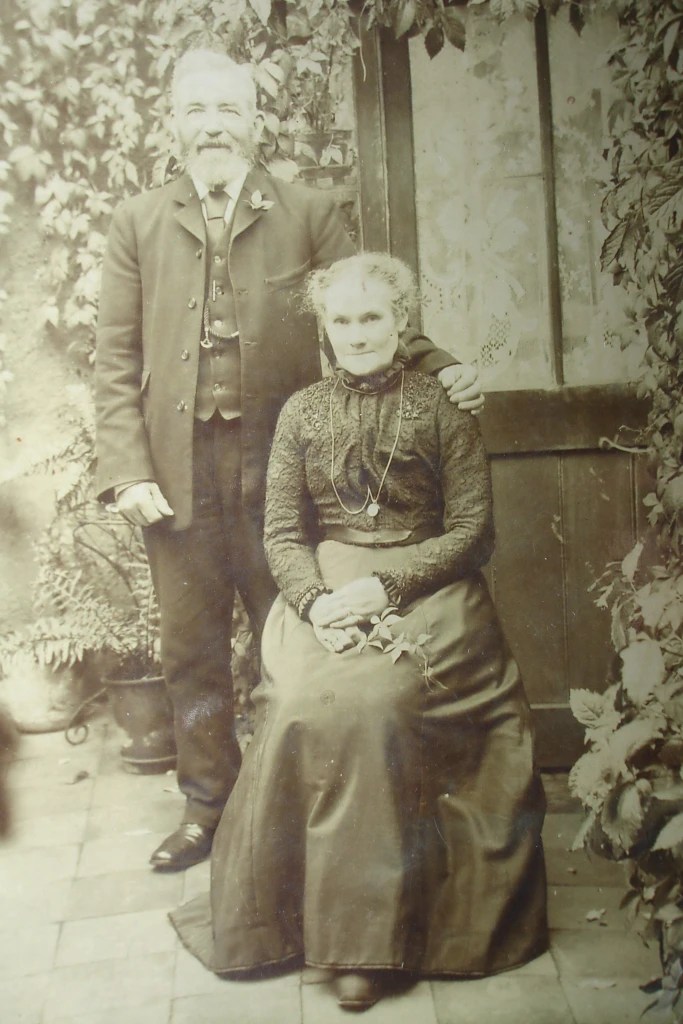
Thomas Bennett and Elizabeth Ann Jefferies

Esther Jane Jefferies (Thomas and Elizabeth’s eldest daughter) was the first person to be buried in grave plot D109. She died in 1901 aged 31 years old. Elizabeth Ann Jefferies (Thomas’s first wife) was buried with her daughter on January 31, 1927. Next came Ellen Jefferies (Thomas’s second wife) who died in 1931 and finally Thomas Bennett Jefferies who was buried on April 18, 1932.
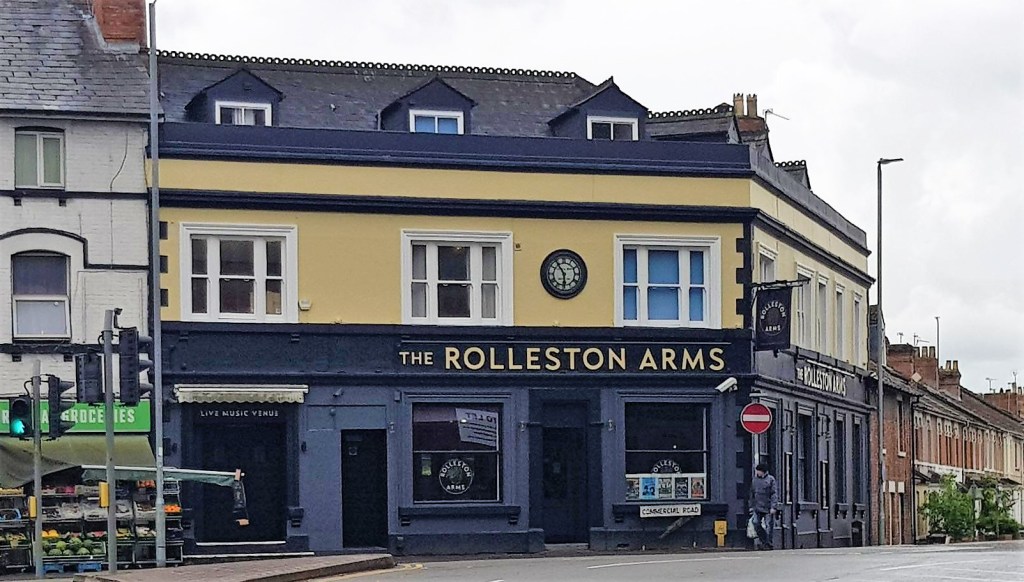
Charles Edward Iles – licensee of the Rolleston Hotel

Today the Rolleston Arms is looking very smart with a new coat of paint and new signage. John Horsell, responsible for developing the new Rolleston Estate in 1890, was the first landlord. Charles Iles was landlord for more than 10 years until his death in 1938.

The Late Mr C.E. Iles

Funeral of a Swindon Licensee

The funeral of Mr Charles Edward Iles, licensee of the Rolleston Hotel, Swindon, who died after a long illness, on 21 March, took place last Thursday afternoon. The service at St Paul’s Church was conducted by the Vicar, the Rev. C.F. Harman, who also officiated at the interment in Radnor street cemetery.

Mr Iles, who leaves a widow, was a native of Swindon, and was 46 years of age. As a youth he was apprenticed as a boilermaker in the GWR Works, and served in the Royal Navy as an artificer from 1914 until 1920 when he was invalided out of the service.

He was licensee of the Foresters, Stroud, for three years, before taking over the Rolleston Hotel, where he has been for the last 12 years. Mr Iles was a member of the Western District United Service Lodge No. 2258 and Chapter Eliot.

The chief mourners were: Mrs Eva Iles (widow), Mr Charles E. Iles (father), Mrs Lawrence (aunt), Miss T. Gascoyne (friend), Mrs D. Kent (sister in law), Miss C. Warren (sister in law) Mrs Wenban (aunt), Mr A. Gerring (cousin), Mr H. Kent (brother in law), Mrs H. Kent and Mrs W. Harris (sisters in law), Mr Eli Mort, Mr J. Coster and Mr Harry Waters (uncles), Mr B. Menham, Mr W. Gascoyne, Mrs W. Gascoyne, Mr Johnson, Mr Cavel (representing Golden Carp Angling Association), Mr and Mrs C. Salmon, Mr Graham Davies, Mr Hayball, Mr J. Spackman and Mr N. Davies (representing Swindon Licensed Victuallers’ Association), Mr H.A. Reeves, Mr G. Beburn, Mr G. Wakefield, Mr F. Burchell, Mr Glass, Mr R. Matthews (representing Cirencester Brewery Co. Ltd.), Mr Halfpenny, Mr Charlie Baxter, Mr Watson and Mr Gilbey (representing A.S.E.).

Funeral arrangements were carried out by Messrs A.E. Smith and Son, 24, Gordon road, Swindon.

North Wilts Herald, Friday, 1 April, 1938.

Charles Edward Iles was buried in grave plot A352 on March 26, 1938. This was previously a public, children’s grave and two burials took place in the first year the cemetery was opened. Three year old Tom Wootton was buried here on October 20, 1881 and the following day Violet Lilian Murray aged 2 was buried in the same plot. The Iles family purchased the grave plot more than 50 years later when Charles died. His wife Eva remarried in 1941 and was buried with him when she died in 1979.

You may also like to read:

John Horsell – builder and licenced victualler

Lucy Clarice Dash – assistant to newsagent

Regular visitors to our cemetery walks will know my pet hate – the under recording of married women’s work on the Victorian census returns. Despite official instructions to the enumerator regarding the recording of women’s work e.g. ‘women who are regularly employed from home, or at home, in any but domestic duties to be distinctly recorded,’ much was lost in translation. Casual and seasonal work was frequently omitted, as was work in a family business, so often all we see here in on the census returns for railway dominated Swindon is, for example ‘boilermaker’s wife.’

The 1939 list compiled at the outbreak of WWII also reveals most married women described as being engaged only in ‘unpaid domestic duties’ – really! Well I have found an exception – Lucy Dash who was recorded as ‘assistant to newsagent’ at 3, Kent Road. Yes, it only tells half the story, but it’s an improvement.

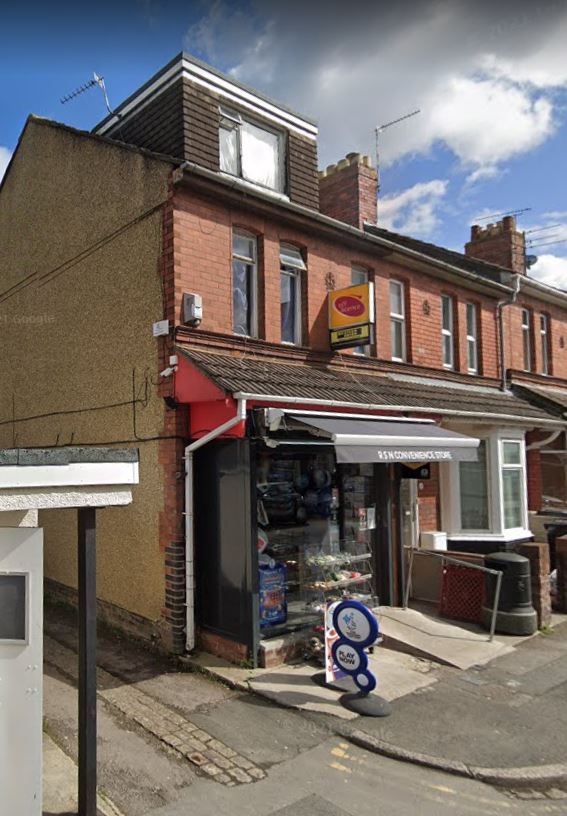
The newsagents in Kent Road where Lucy ‘assisted’

Lucy was born in 1893 in Gateshead, the third child of John, an engine fitter, and his wife Lucy Peters. The family arrived in Swindon sometime during the 1890s and a home in Stafford Street.

At the time of the 1911 census 17 year old Lucy was working as a Draper’s Assistant in Maidenhead, Berks and lodging with Mrs Edward and three other young, single women all employed in the drapery business (the occupation of single women was usually recorded). In 1923 she married Herbert George Dash and the couple went on to have four children.

In 1928 A.R. Leach occupied the newsagents at 3 Kent Road but by 1939 Herbert and Lucy (assisting, of course) were in residence.

Following their retirement the couple lived at 10 Grovelands Avenue, Swindon. Lucy died on October 14, 1955 and was buried in grave plot E7773 with her parents and her sister Phyllis.

You may also like to read:

Phyllis Mary Peters – Railway Clerk

The cost of a burial in 1894

Yesterday I published the story of William Barnes Keylock who died in 1955. Today I am sharing the documents concerning the burial of his father in 1894.

One of the most poignant revelations of reading the Keylock family burial documents was the cost of a basic burial in 1894, yet so many Swindon families were unable to afford even that.

The two accounts published here were issued by the Swindon Burial Board for Charges and Fees, for Interment at the Cemetery.

The first invoice is dated April 28, 1894, the day following William John White Keylock’s death (the burial board didn’t hang around!) and was addressed to his son Mr W.B. Keylock of 11 College Street.

The costs include 5s for a burial in grave plot A856. An additional charge of 2s 6d was for the services of the officiating minister and 3s for the Sexton. There was a 6d charge for a grave space indicator (presumably the terracotta markers seen about the cemetery today) and finally 1s to toll the bell. The cost of a burial (not the funeral itself) amounted to 12s, little more than 50p in today’s money, but so much more in 1894 – more than many Swindon residents could afford. But the Keylock family had not been such a family.

William John White Keylock was born in 1853 the son of John, a painter and glazier, and his wife Ann. He grew up in Albert Street and began work with his father. He married Susannah Ponting on July 20, 1872 at the Wesleyan Methodist Chapel, The Planks and by 1889 he was working as a beer retailer at 12 High Street, later known as the Baker’s Arms.

The second invoice addressed to Mrs S. Keylock was issued on January 31, 1895, some nine months after her husband’s death. Susannah has paid for the Purchase of Grant of Right or Burial in Grave Space No 855 & 856 Section A at a cost of £2 2s. She paid a further 2s 6d to have her husband’s details entered in the Burial Register. These are the registers vital to our research and it had never occurred to me that some names might be missing due to an inability of the family to pay. Finally, Susannah paid 2s 6d for a burial certificate. There is no entry for erecting a monumental stone so maybe there never was one. Susannah paid £2 7s (less than £2.50 today) but a big expense in 1895 and of course the funeral costs would be in addition to this.

William John White Keylock, retired publican, died on April 27, 1894 at 11 College Street. He left effects valued at £74 (worth around £9,000 today) to his wife Susannah.

Susannah remarried. She died aged 72 in March 1925 at the house she had shared with William. She was buried on March 21 in grave A856 with William and in the plot next to her son and daughter-in-law.

Finding these records that Rose so very kindly provided several years ago has been a thought provoking experience.

To be continued …

William Barnes Keylock – Railway Clerk and Licenced Victualler

After some 15 years of research the Radnor Street Cemetery archives are becoming quite extensive. Between us Andy, Noel and I have many hundreds of photos and items of ephemera and it was while looking through one of my boxes that I came across this cache of documents.

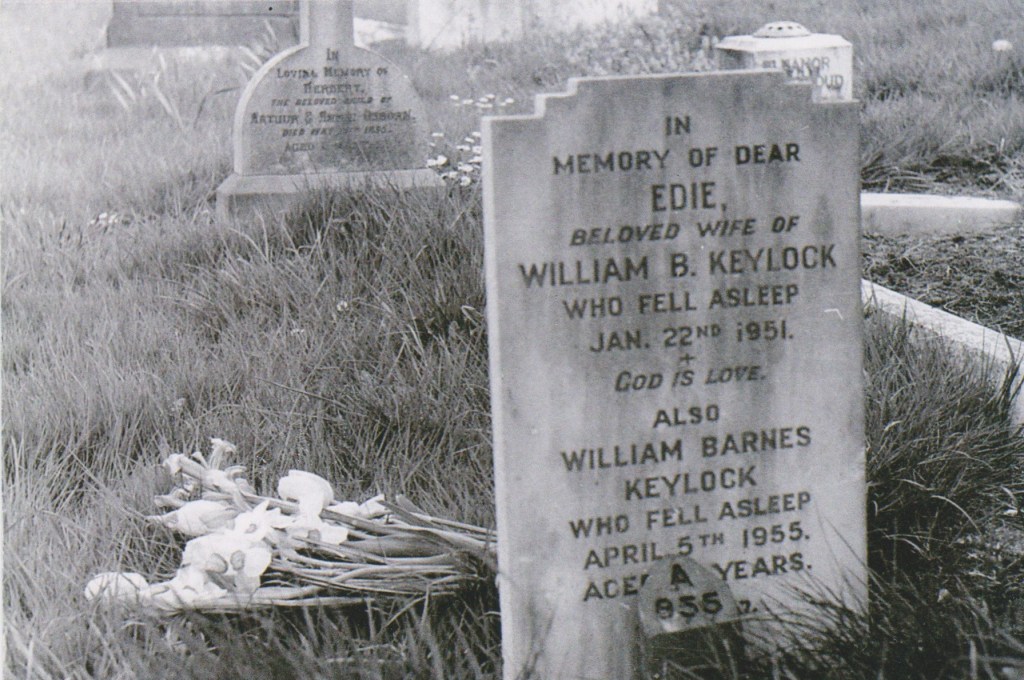
Rose contacted me some years ago as she feared her family headstones had been removed from the cemetery. The passage of time had seen the memorials sink and tilt and become very discoloured and almost unrecognisable, but I was able to confirm they were still there. At the time Rose provided me with family documents regarding graves and burials and several photographs including one of the grave of William Barnes Keylock and his wife Edie.

William was born on December 2, 1872 and baptised at Christ Church on December 10. He was the only surviving child of William John White Keylock and his wife Susanna. In 1881 William J.W., a pattern maker, Susanna and William B. were living at 9 Read Street. William B. started work as a Railway Clerk on April 2, 1888 and at the time of the 1891 census he was living with his parents at the Bakers Arms in the Railway Village where his father was the inn keeper.

William Barnes Keylock married Edith Prideaux Dymond on July 27, 1895 at the parish church in Porlock. The couple had two children, William Harold and Dorothea Edith May. Sometime after Dorothea’s birth in 1901 the family moved to London where William was licenced Victualler at the White Hart, Clerkenwell and later The Eagle in Woolwich.

By 1939 the family had returned to Swindon and William, Edie and Dorothea were living at 11 College Street.

Edie died aged 77 at the Victoria Hospital. She was buried in plot A855 on January 26, 1951. William died aged 82 on April 5, 1955 at St Margaret’s Hospital. He was buried here with Edie on April 9, 1955.

My thanks to Rose for providing so much information and my apologies for taking so long to publish her family story.

To be continued …

Photograph believed to be William Barnes Keylock as a boy – published courtesy of Ancestry

Edwin Harvey – builder

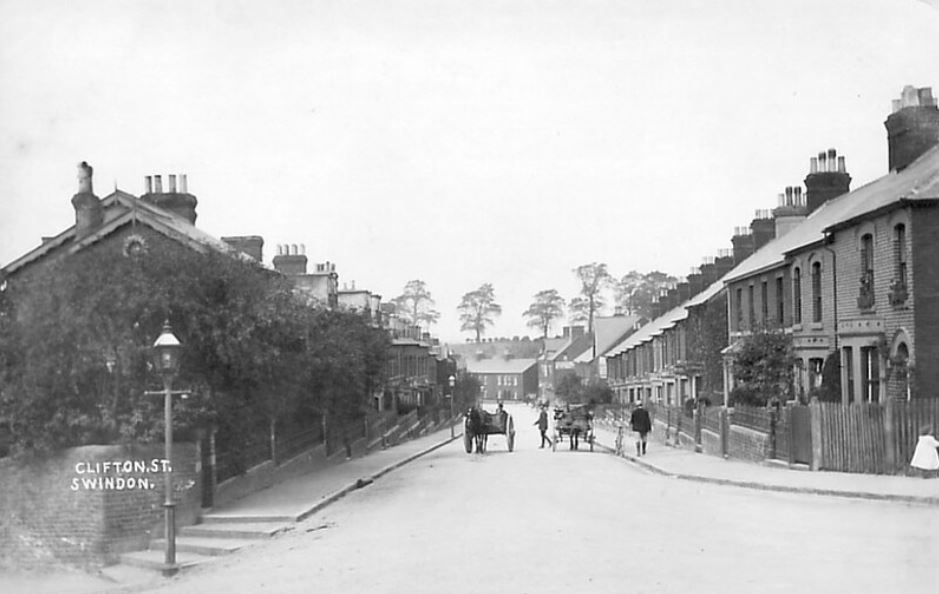
Clifton Street published courtesy of Mr P. Williams and Local Studies, Swindon Central Library.

It’s surprising that there is no road named after the entrepreneurial Edwin Harvey.

Edwin Harvey was born in Keynsham in 1843 one of William and Mary’s large family of 12 children. Edwin began his apprenticeship in the building trade working as a plasterer, most probably alongside his father, a plasterer journeyman. By 1871 aged 28 Edwin describes himself as a painter.

He married Alice Elizabeth Baker at St. Paul’s Church, Bath on November 26, 1878. Edwin, aged 36, then described his profession as Builder and his place of residence as New Swindon where he had already begun to make his mark!

In 1877 he was building a hotel and cottages on the Kingshill estate and in 1878 he built 4 houses and shops on Cambria Bridge Road with business partner William Crombey.

In 1879 he describes himself as builder and beerseller when he makes an application for a license to “Sell by Retail Beer and Cider, to be consumed on the House and Premises thereunto belonging, situate at William Street.” This beerhouse was most probably built by Edwin and occupied the corner plot of William Street and Cambria Bridge Road. It was owned by his deceased brother William and in 1879 by his widow Ann.

William Street and Park Hotel

Edwin was a busy man during the 1880s building houses in Albion Street, William Street, Clifton Street and Exmouth Street where he would eventually make his home. In addition to his building work he was elected a member of the New Swindon Local Board in 1885 and in 1887 a member of the Swindon Hospital Committee, acting on behalf of the Building Committee.

In 1881 he lived at William Street with his wife Alice and their baby daughter Ethel. By 1891 they had moved to 50 Exmouth Street where the family had grown considerably and then numbered 6 children. Edwin’s brother John lodged with them. By 1911 No 50 Exmouth Street (now named Glenthorne) was still a busy household with 4 twenty something children still living at home with Alice and Edwin, now aged 68 and retired.

Edwin Harvey died at his home in 50 Exmouth Street on October 21, 1925. He was 82 years old. The funeral took place on October 24 when he was buried in grave plot D1525 with his wife Alice who died in 1917.

With no street named in his honour, I’m hoping there will be a headstone on his grave when I find it.

You may also like to read:

William Crombey – builder

Ann Harvey – Inn Keeper

*Harvey Grove off Cheney Manor Road, was built in 1936 and named after Albert Harvey who once farmed at Manor Farm, but so far I haven’t come across a road named in honour of Edwin Harvey.

William Miles – chemist

This is the last resting place of the Miles family.

William Miles was born at 30 Reading Street in 1851, the son of William Miles, a modeler and pattern maker from Tredegar in Monmouthshire and his wife Mary.

By the mid 1870s William had left Swindon for Yorkshire where he worked as a chemist’s assistant in Scarborough and married Harriet Matilda Thompson.

William didn’t return to Swindon until the end of the 1890s when he opened a Chemist and Drug Store in Fleet Street.

William died in 1912. Harriet outlived her husband by nearly twenty years. She died in 1931 and is buried here with him. The couple’s only son, William Edward Vivian Miles and his wife May Till Miles are also buried here with their two young sons, William and John.

This magnificent monument is loaded with funereal iconography. With her outspread wings she represents a guardian angel, the five-pointed star behind her is symbolic of divine guidance and protection and the garland she carries is emblematic of victory in death. And in the world of 1980s New Wave pop music she is quite famous. She appeared in a pop video made by Swindon band XTC. The film accompanied their song In Loving Memory of a Name – a song about a soldier laid to rest in the churchyard he knew in childhood.

You might also like to read:

In Loving Memory of a Name

Richard James Leighfield – Master Builder

This is another magnificent pink granite memorial full of funerary iconography.  The fluted pillars or columns at the top symbolise the door to heaven and the passageway to eternity.  The letter L is displayed prominently passing through this entrance. The thorny acanthus leaves symbolise the prickly path of earthly life to death and eventual eternal life.

This is the last resting place of the Leighfield family. Firstly, of Elizabeth, ‘the devoted wife of Richard James Leighfield of Witney Street, Swindon who died after a long and painful illness after which she sweetly fell asleep in Jesus on February 2, 1910 aged 49 years.’ Elizabeth was buried with the couple’s second son David who had died aged just 3 weeks old in 1892.

The inscription on this memorial is the first verse of a hymn called The Christian’s Good Night – lyrics by Sarah Doudney and music by Ira D. Sankey.

Sleep on beloved sleep and take thy rest,

Lay down thy head upon thy Saviour’s breast.

We love thee well but Jesus loves thee best.

Good night, good night, good night.

Richard was born in Wootton Bassett in 1859 the son of postman James Leighfield and his wife Ann. At the age of 12 Richard was already working as a mason’s labourer, later becoming a bricklayer and by 1891 he was a Master Builder.

In 1887 he married Elizabeth Hunt and at the time of the 1891 census they were living at 83 Clifton Street with their two year old son James. 

Richard built houses on Clifton Street, Whitney Street* and Ponting Street. At the turn of the century, encouraged by the growth of New Swindon, he purchased a parcel of land on the east side of Whitney Street on which he built a house known as 1 Whitney Street. Behind the house he developed office accommodation, yard, stables and a workshop from which he conducted his business. On the rest of the land he built 6 cottages which he let, principally to members of his staff. Between 1901-1916 the family firm built 39 houses at St Mary’s Grove.

Following Elizabeth’s death, Richard married Clara Williams in 1913. The couple married at the Primitive Methodist Chapel in Regent Street where they were both members. Clara was a descendant of John and Mary Pike who opened their home on Eastcott Hill for meetings during the early days of Primitive Methodism in Swindon.

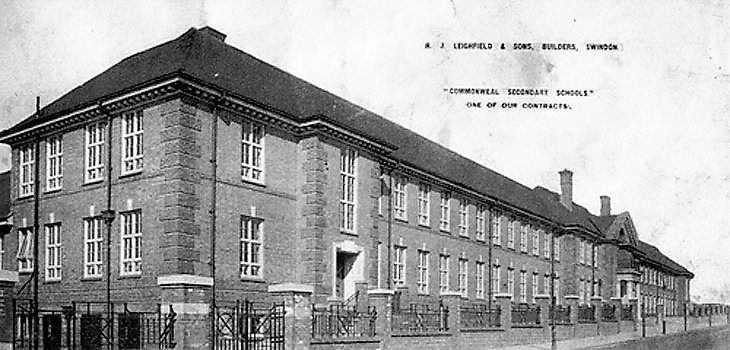
The Leighfield family firm continued to be busy during the 1920s and 30s when among their projects they built the Primitive Methodist Church at The Circle, Pinehurst; Commonweal School, The Mall, Old Town; the Co-op on Groundwell Road and the Swindon Corporation Electricity Dept showrooms at Regent Circus.

Richard died at his home 109 Bath Road in 1948 aged 89. His funeral took place on April 22 when he was buried in grave plot E8440 with his first wife and son. His second wife Clara died in 1964 and was buried in the family plot.

The Leighfield business continues today at the Coped Hall Business Park in Royal Wootton Bassett.

*The spelling of Whitney/Witney Street varies.

Arthur William Burson J.P. – Prominent Baptist

The photograph of the Burson family grave (see below) was taken several years ago. I now realise someone must have cleared and cleaned it around that time. When I tried to find it recently, thinking it would be an easy task, I was surprised to discover the memorial dulled and dirty. Is it the pollution in our air, less obvious than the smoke of factory chimneys and coal fires of the past, that causes such discolouration?

This is the story of Arthur William Burson who was born in Steventon, Berks, the son of farmer Richard Burson and his wife Louisa. In 1871 Richard was farming 140 acres and employing six labourers and two boys at Sutton Courtney, but Arthur appears to have been unwilling to follow in his father’s agricultural footsteps.

By 1881 Arthur had moved to Swindon and was working as a grocer’s assistant, living above the shop at 57 Bridge Street. In 1888 he married Emily Anna Solway and at the time of the 1891 census the couple were living at 52 Fleet Street where Arthur appears to have his own business.

Ten years later and the family business was at 94 Commercial Road. By now the couple have three daughters, Edith, Elsie and Hilda, fourth daughter Grace was born in 1903. The family later lived at 69, Bath Road.

When he died in 1934 a lengthy obituary published in the North Wilts Herald described him as ‘A.W. Burson J.P. – Swindon Business Man Who Once Owned Seven Shops.’

Death of A.W. Burson J.P.

Swindon Business Man Who Once Owned Seven Shops

A Swindon man who rose from a lowly position behind a grocer’s counter to become the owner of seven prosperous shops in Swindon, in one of which he had served as an assistant, is the history of Mr Arthur William Burson, of 69 Bath road, Swindon, whose death occurred last Friday.

There is however a poignant side to his death in that it has robbed him of the opportunity of seeing the completion of the Stratton Green Baptist Chapel, towards the building of which he had given £1,000 as a memorial to two of his children.

Mr Burson, who was well known as a prominent Baptist, died after an illness which had lasted more than three months. He was suffering from bronchial trouble, when heart trouble supervened.

Born at Steventon.

In 1861, Mr Burson was born at Steventon, Berks, and at an early age was apprenticed to the grocery trade at Reading. His connection with Swindon started in 1880 when he was engaged as an assistant in the grocery busines of H. Freeth and Son. For five years he remained in this position, and then made his first venture into business ownership. In partnership with the late Mr Thomas Harry, of Swindon, he opened a shop in Abergwynid, near Maesteg, South Wales, and this business was carried on by the two for five years.

Then, however, he returned to Swindon. With Mr Harry, he became joint proprietor of the business in which he had served as assistant – H. Freeth and Son, and conducted no fewer than seven shops in the town.

The business continued in their joint ownership for two years until the death of Mr. Harry, when Mr Burson assumed sole control. As proprietor of the firm of H. Freeth and Son he continued to take an active part in the conduct of the business until 1926 when he retired.

Gift to Town Gardens

In the year of his retirement, and more or less as a token of gratitude for the prosperity which he had achieved in Swindon, Mr Burson presented to the town the clock over the bandstand in the Town Gardens.

Though he was one of the oldest members of the Swindon Bench of Magistrates, having been a member since the Bench was first appointed in 1907, it was by reason of his religious activities that Mr Burson was better known. He was baptised in 1880 at the Baptist church which stood in Fleet street, and which is now demolished.

On returning to Swindon he continued his association with the Baptist faith in the town, and became connected with the Baptist Tabernacle, which had replaced the former church in Fleet Street.

For many years he was also superintendent of the Gorse Hill Baptist Sunday School, and was also treasurer, and teacher in Baptist Sunday Schools in Swindon for over 50 years.

Former Town Councillor.

At the time of his death he was one of the elders of the Baptist Tabernacle, treasurer of the Tabernacle Sunday School and held a similar post in connection with the Swindon Colportage Association. A prominent teetotaller since the age of 18, he was one of the oldest members of the Tabernacle Temperance Society.

He held a seat on the Town Council from 1900 to 1909, and again from 1911 to 1921 continuous.

While in Wales Mr Burson married a Miss Salway, who was a native of Somerset. Mrs Burson survives him. They celebrated the 46th anniversary of their wedding last Easter. There were four children, all daughters, of whom two are dead. One died in 1913, and the other two years ago. The two surviving daughters are Mrs Dadds, [Dadge] of Bath road, and Mrs Higgins, of Broome Manor lane.

Early this year Mr Burson came forward with an offer of £1,000 towards the cost of the new church at Stratton Green as a memorial to his invalid daughter, on whom the money had been settled as a future provision for her. Announcing his gift, Mr Burson said, “She had been taken and I should like her memory to be enshrined in the new building.”

The cheque for £1,000 was signed by Mr Burson and handed over to the Stratton Baptist officials about six weeks ago, during Mr Burson’s final illness. The Swindon Advertiser is informed, therefore, that the gift will not be affected in any way by the death of the donor.

It has now been suggested by those connected with the Stratton Church that, as a gesture of gratitude to Mr Burson for his gift, the new church shall contain a memorial window to the two daughters of Mr Burson who had pre-deceased him.

The Funeral

In the presence of a large congregation of mourners, the funeral took place on Wednesday afternoon.

The first portion of the service was conducted at the Baptist Tabernacle and the interment took place in the Radnor Street Cemetery.

Extracts from the North Wilts Herald, Friday May 25, 1934.

Arthur William Burson, 73 years, of 69 Bath Road was buried on May 23, 1934 in grave plot E7588. His wife Emily Anna died in March 1950 and was buried with him his this impressive grave plot.

Backswording and the Blackford family

The re-imagined story …

Of course, you are too young to remember Blackford’s the butchers. They used to have a shop on the corner of Wood Street and Cricklade Street, but that’s long gone. I can recall going to the shop in Bridge Street with my mother, although it could be quite a scary experience as old man Blackford was a bit erratic. He’d been a famous backsword player in his day and they said he’d been seriously injured several times during his fighting career.

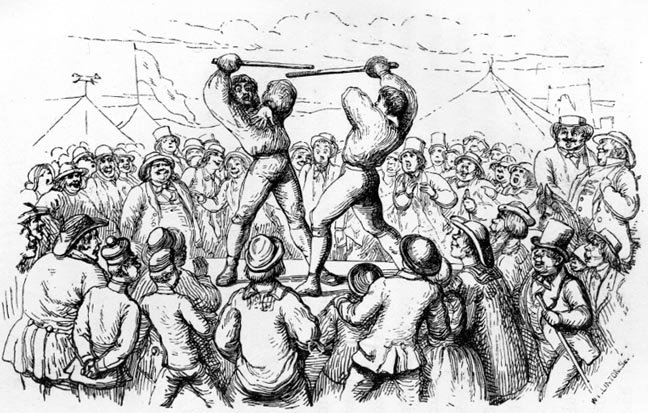
I don’t suppose you know what backswording is either; no one plays it anymore. It was a brutal sport. Players had one arm restrained and with the other they beat their opponent about the head with a wooden stick, the aim to land a blow causing the blood to run for one inch.

There was some decent prize money to be won mind and more if you liked to gamble. Those old gamesters were made of stern stuff but they paid a high price. Joseph’s father Robert suffered from the frequent blows to his head and died from an accidental drug overdose of the laudanum he used to manage the pain.

Joseph concentrated on the butchery business, though and by the time he was raising his family backswording was a thing of the past. Joseph named one of his sons Brave – perhaps he thought he had the makings of a gamester.

Backswording – wood engraving by Richard Doyle (1824-83)

The facts …

Joseph Blackford was baptised at Christ Church, Swindon on March 24, 1830 the younger son of Robert Blackford and his wife Anne. Robert came from a long line of butchers and at the time of the 1841 census the family were living in a property on the corner of Wood Street and Cricklade Street. In 1851 Joseph was running the butcher’s shop on Bridge Street with his sister Mary. He married Mary Ann Holdway and by the time of the 1861 census they were living in the railway village at 10 High Street [later named Emlyn Square] with their two children William and Mary Ann. A third child, Elizabeth, was born in 1864. Mary Ann died in August 1865 and was buried in the churchyard at St. Mark’s.

Robert died in 1867 probably as the result of injuries sustained during his backswording career. The verdict of the coroner’s court was that he had “died from taking an overdose of laudanum, whilst labouring under a fit of temporary insanity.”

On February 27, 1867 Joseph married Rosanna [Rosina] Woolls, a widow who describes herself as a butcher. The couple set up home in Purton where they raised their family.

Joseph died in September 1906 aged 76 and was buried in plot D1447 with his son Harry Bath Blackford who had died just weeks before him. Rosina died in 1923 and their daughter Alda Priscilla Bamford died in 1932 joining her parents and brother Harry in plot D1447.

The Blackford family grave

Newspaper proprietor William Morris was particularly opposed to the sport of backswording, writing in his newspaper The Swindon Advertiser:-

And I recollect that this was particularly the case at the New Swindon sports. The left arm and side and thigh of one of the players was so cut and bruised that it had the appearance of raw meat, and although the man himself kept on, and always came up to time, the spectators became so alarmed at his terrible condition and lacerated appearance that some attempt was made to get him to leave the stage and insisted that a medical man should be requested to attend him …

Shrivenham was one of the places noted for its backsword players, and I have been told that on one occasion a player in that village continued to play after one of his eyes had been cut out and lay on his cheek, and slices of flesh had been cut off his arms. Of course, such a one would receive much encouragement from the spectators as being a “good plucky fellow,” and the flow of pence into his basket at the close of each bout would be most liberal…

The Popular Amusements of our Grandfathers -The Swindon Advertiser, Saturday December 6, 1884.