Clara Edna Susan Chappell – fallen angel

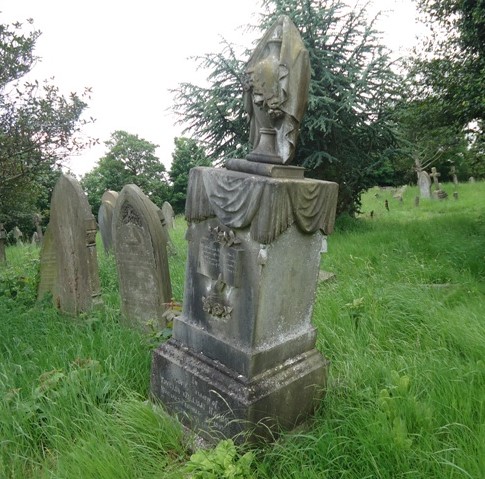
The fallen angel with her broken arm and wing would have once been a majestic memorial standing close to the cemetery chapel. Now her predicament symbolises the sorrow of this grave and those buried here.

When Clara Edna Susan Smith married Joseph Llewellyn Chappell in 1895 they had a bright future ahead of them. Joseph, who had begun work as a 15 year old clerk in the GWR in 1884 where he worked for more than ten years, had recently set up in business as a cycle agent. His business would prosper, but sadly not so his personal life.

His wife Clara died in 1908 aged just 35, leaving him a grieving husband with two young sons.

Death of Mrs J.L. Chappell – The many friends of Mr J.L. Chappell, of Fleet Street, and Fernleigh, Park Lane, Swindon, will learn with deep regret of the death, at the early age of 35 years, of Mrs Chappell, and will sympathise with the bereaved husband in the irreparable loss he has sustained. The deceased lady, Mrs Clara Edna (Dot) Chappell, was born at Wootton Bassett 35 years ago, and spent all her early life there until she was married to Mr Chappell 13 years ago. She was the daughter of the late Harry and Edna Smith, who were old and respected inhabitants of Wootton Bassett. Mrs Chappell suffered a long and painful illness, borne with great patience, and she passed peacefully away at noon on Saturday last. Deceased proved herself to be an ideal wife and mother, and was devoted to her home, her husband and her children. She leaves a sorrowing husband, and two sons to mourn her loss. The funeral will take place on Wednesday next. The cortege will leave Fernleigh at 2.45 for St Mark’s Church, and will reach the Cemetery at 3.30 p.m. Will all friends kindly accept this the only intimation.

The Evening Swindon Advertiser, Monday, September 14, 1908.

And then the following year their younger son, Leslie Cyril, died aged 4 years old. He was buried with his mother in grave plot D7A.

Joseph never remarried. At the time of the compilation of the 1939 List he had retired to Bournemouth where he lived at Rosemount, Headswell Crescent with his housekeeper, Emily Mitchell, who had worked for him since those first sad years following Clara’s death.

He died on September 9, 1942. The publication of his will revealed just how successful his business had been and his generosity and affection for Swindon.

Swindon and Bristol Bequests

Mr Joseph Llewellyn Chappell, of 17, Headswell Crescent, Bournemouth, Hants., who died on September 9 last, left £31,551 8s 9d gross, with net personalty £30,318 9s 10d (Duty paid £4,174).

He left, in addition to several personal bequests: £100 each to Swindon Victoria Hospital; Muller’s Orphanage, Bristol; RSPCA, NSPCC, St Dunstans, Baptist Tabernacle, Swindon; Wesleyan Church, Swindon; Primitive Methodist Church, Swindon; the vicar and churchwardens of Christ Church, Swindon (for charitable purposes); and to Harry Haskins, for any purpose he may think fit for City Road Church, Bristol.

Ethel Mary Franklin – undertaker’s daughter

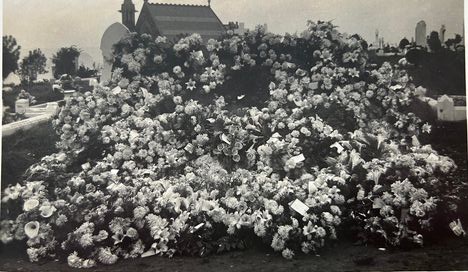
And this week I have received another old cemetery photograph taken at the funeral of Ethel Mary Franklin in 1925 – a beautiful display of floral tributes with the cemetery chapel in the background.

Ethel Mary was born in 1882, the seventh child of Henry Smith and his wife Emma. At the time of the 1891 census Henry was living at 12 Sanford Street with his large family. He would soon leave his job in the GWR Works and set up in business as a carpenter and undertaker. By 1901 he was living in Gordon Road where the firm of A.E. Smith had their premises for more than 50 years.

Ethel appears on the census of that year as an 18 year old pupil teacher. By 1911 she was 28 years old and living with her parents, her sister, her nephew and an elderly, widowed aunt, at 1 Clifton Street. Ethel was working as a school teacher at one of the Swindon Board Schools.

On April 26, 1913 she married railway clerk Arthur Henry Franklin at the Wesley Chapel, Faringdon Road. A daughter named Ruth Gertrude, was born in September the following year and a son Eric Sutton in 1919.

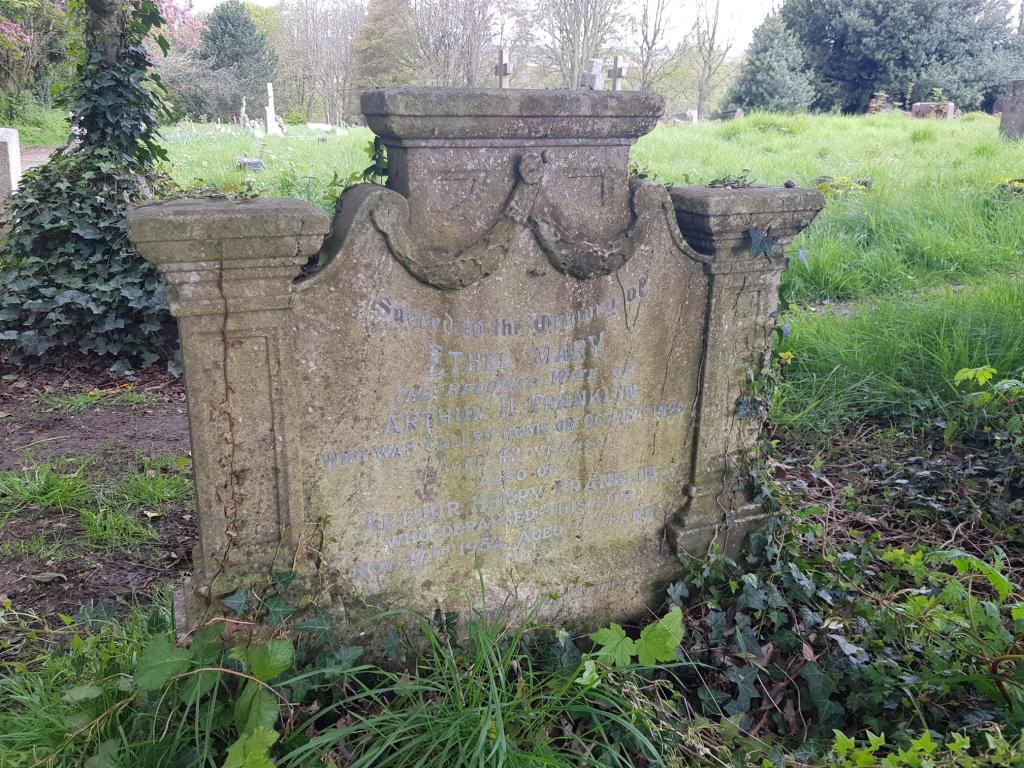
Arthur served in the war as a clerk in the Army Corps and returned safely to the family home at Langleigh, Kingshill Road. Ethel, Arthur, Ruth and little Eric settled down for the rest of their lives, but sadly it was not to be a happy ending. Tragedy struck when Ethel was admitted to the Victoria Hospital in 1925. Infection set in when a swab was accidently left inside her during an operation and Ethel died on October 18, 1925. Her funeral took place on October 22 when she was buried in grave plot D189 close to the grave of her parents.

Arthur remarried and when he died in 1954 he was buried with Ethel. Ruth, their daughter who was just 11 years old when her mother died, went on to become a nurse. Their son Eric became first an architect and then served at Dunkirk and Monte Cassino during the Second World War.

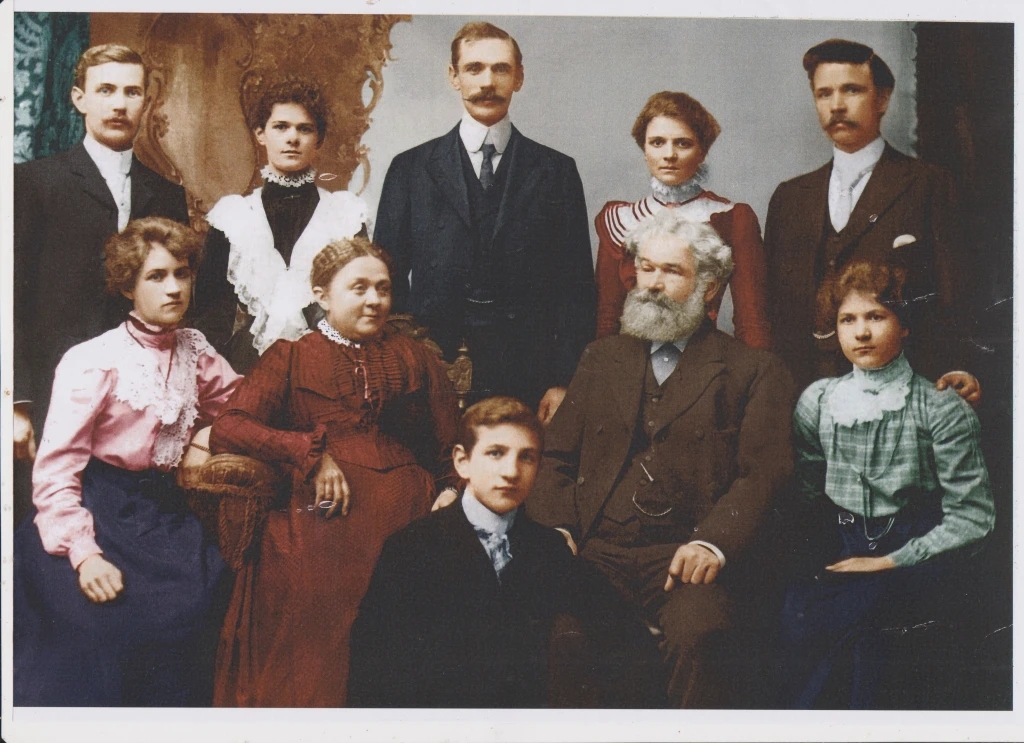
This photograph of the floral tributes on Ethel’s grave was sent to me by Steve, who also supplied the Smith family photograph when he attended one of our cemetery walks some years ago.

You may also like to read:

Henry Smith – undertaker and monumental mason

Jacob and Anne Elizabeth Wheeler and a family connection

I have come to think of those buried in Radnor Street Cemetery as belonging to one, very big, family.

This week I have been researching the life and times of Jacob and Anne Wheeler and fortunately I have been able to discover a lot about them – see below the accounts of their Golden Wedding anniversary and their obituaries published in the local press.

Then studying their family tree, a name suddenly jumped out at me. When Jacob Wheeler died in 1936 Probate was awarded to his son Richard Wheeler, a fitter and turner, and to his son-in-law Frank James Richman, a grocer.

My friend and colleague, Mark Sutton, military historian and author of Tell Them of Us – Remembering Swindon’s Sons of the Great War 1914-1918, would often talk about the two Richman brothers, killed in action during WWI.

Graham Carter, friend and co-founder of the Swindon Heritage magazine published 2013-2017 recently wrote about Mark:

‘Nobody ever did more for preserving the memory of Swindon war heroes than Mark, or knew more about their sacrifices. Whenever I spoke to him about it, it was almost as if he had been there with them. Swindon owes him a debt for what he did for those men.’

And so it was with the Richman brothers.

Frank was the elder brother of Archibald David and Alfred George Richman. He started work in the GWR offices at the age of 13. In 1909 he married Annie Mary Wheeler and at the time of the 1911 census they were living at 86 Kent Road with their baby daughter Phyllis. The couple went on to have more children and eventually Frank would take over the family’s grocery business. He didn’t go to war. Annie died in 1957 and Frank in 1969.

Swindon Veterans

Golden Wedding of Mr and Mrs J. Wheeler,

Family Re-Union

Mr and Mrs Jacob Wheeler, of 12 Deacon Street, Swindon, celebrated their golden wedding on Sunday. They were married on 30 December, 1879, at the old Baptist Chapel, at the corner of Fleet Street and Bridge Street, by the Rev. Frederick Pugh, who was the last Pastor at that Church, prior to the building of the Baptist Tabernacle, in Regent Circus.

Mr Jacob Wheeler is a Wiltshireman, being a native of Trowbridge, and his wife, Mrs Ann Elizabeth Wheeler, is eldest daughter of Mr Richard Harris, is a Swindonian and has resided in the town practically all her life.

Coming to Swindon in 1873, Mr Wheeler entered the service of the GWR Company and was for 38 years employed as a machineman in the Locomotive Department. For over 40 years Mr and Mrs Wheeler – Mr Wheeler is 78 years of age, and his wife three years his junior – resided in Haydon Street and removed to Deacon Street seven years ago. Mr and Mrs Wheeler have a family of four children – three daughters and one son – and 13 grandchildren.

Family Congratulations

There was a happy family re-union at her eldest daughter’s (Mrs Richman’s) home, 86 Kent Road, on Monday, and the aged couple have been the recipients of many congratulations and presents.

Mr Wheeler is one of the oldest members of the “Briton’s Pride” of the North Wilts District of the Ancient Order of Foresters. Both he and his wife have been for many years members of the Baptist Church.

During their long residence in Swindon they have witnessed the wonderful growth of the town. The district in which they now reside was green fields when Mr Wheeler came to Swindon.

North Wilts Herald Friday January 3, 1930.

looking down Deacon Street

Mrs A. Wheeler

Funeral of a Swindon Baptist Worker

The funeral took place on Saturday afternoon of Mrs Annie Elizabeth Wheeler, wife of Mr Jacob Wheeler, of 12 Deacon Street, Swindon.

Mrs Wheeler, who was 77 years of age had resided in Swindon practically all her life. She was the oldest member of the Baptist Church, having joined it when the services were held in the old church at the corner of Bridge Street and Fleet Street, many years before the Tabernacle was built. It is not long since Mr and Mrs Wheeler celebrated their golden wedding.

The first portion of the funeral service was conducted at the Tabernacle, where there was a large congregation of mourners. Mr. A.E. Ford was at the organ and played the “Dead March,” and the hymn “For ever with the Lord,” was sung.

The Pastor (the Rev. E.W. Probert) conducted the service and also officiated at the graveside in Radnor Street Cemetery.

Extracts North Wilts Herald Friday November 13, 1931.

The Late Mr J. Wheeler

Funeral of a Swindon Octogenarian

The funeral of Mr Jacob Wheeler late of 12 Deacon Street, who died at his daughter’s residence 31, Downs View Road, at the age of 84 years, took place on Monday afternoon. The service at the Baptist Tabernacle was conducted by Rev. C.H. Cleal, who also officiated at the interment in Radnor Street Cemetery.

Mr Wheeler, who was a native of the Westbury district, had lived in Swindon over 60 years and retired a quarter of a century ago from his employment as a machinist in the old G Shop of the GWR Works. For over 50 years he had been a member of the Baptist Church. He leaves a son and three daughters.

Extracts North Wilts Herald, Friday, 11 September, 1936.

Anne and Jacob Wheeler are buried together in grave plot A1095.

#MarkSutton

#TellThemofUs

Gabriel Morrell – well known licensed victualler

New Year’s Eve 1915 and a ferocious fire swept through an out building in Eastcott Hill. A local businessman, Gabriel Morrell lost his life. Neighbours and six police officers fought the blaze, passing buckets of water hand to hand. Despite numerous calls to the Fire Station in Cromwell Street, no help arrived. The newspaper account stated that “the system of fire calls in the borough appears to be antiquated.”

Eastcott Hill

Tragedy

Swindon Tradesman Burnt to Death

A Mass of Fire

Fire Brigade Hear Nothing of Calls

New Year’s Eve in Swindon was marked by a shocking tragedy in which a well-known licensed victualler lost his life, and in connection with which the public will demand an enquiry into the system of Fire Brigade calls in vogue in the borough.

The victim of the tragedy was Gabriel Morrell, living in Eastcott Hill, where he had carried on a grocery and off-licensed business for four and twenty years. At half-past ten on Friday night the police were informed that Mr Morrell’s premises were on fire whereupon P.S. Molden, with P.C.’s Harris, Cowley, Mitchell and Stoper, at once hurried to the scene, where they were quickly joined by other members of the force. They were taken to the back of the premises, where they found a shed, used for storing lumber, on fire. The seat of the outbreak was evidently inside the building, and P.C. Harris proceeded to force open the door. The moment he succeeded a huge mass of flames burst forth, forcing him and the other officers standing near to retire for some distance. The policemen, setting to work with a will, seized buckets and such other vessels as they could lay hands upon, and began to dash the water they found in the soft water butts upon the flames. When that supply was exhausted they turned to the slower method of filling the pails from the taps on the premises and in the adjoining houses,  work in which, under the guidance of Supt. Moore, who had now arrived, they were energetically assisted by a number of civilians.

A Shocking Discovery

Nearly half an hour passed by before they got the fire under control, and could venture into the shed. Then a shocking sight met their eyes. On the ground in the middle of the structure was a huddled up mass, which in spite of the dreadful manner in which it had been charred, was recognised as that of a human body. At once it was concluded that it was that of Mr. Morrell, who during this period of excitement not been seen, and further enquiries and search elicited the fact that he was nowhere to be found. A closer scrutiny showed that all the clothing had been burnt from the body except a belt which went round the waist. The body was lying on its back with the knees and arms tucked up over the trunk. The remains were carefully lifted on to sheets and blankets and removed by the police to the mortuary.

Calls for the Fire Brigade fail

In the meantime calls were made from the fire signal posts to the Fire Brigade, who, however, never arrived, but even if the Brigade had come upon the scene they would have been too late to save Mr. Morrell’s life, as there is little doubt that he was in a dead or dying condition at the time the police broke open the door of the burning shed.

After the removal of the body the shed, which was built of wood and had a slated roof, continued to burn until its existence became a source of danger. The remaining supports were then pushed away, and it collapsed. The building was 12ft long by 9ft wide, and 7ft or 7ft high at the eaves. It was not used for storing any of Mr Morrell’s stock-in-trade, but was employed for the storage of empty boxes, old newspapers, account books and rough lumber.

The Deceased Missing

It seems that at ten minutes past ten Mr Morrell took a candlestick to go out, as the family thought, to the lavatory – and thinking that his wife and two daughters, who were the only other occupants of the house, were going to bed, he wished them “Good night.” To this Miss Morrell replied. “We are not going to bed yet, dad; we are going to watch the old year out.” While Mr Morrell was out they had a light supper, after which they went upstairs to prepare for bed while witing for the passing of the old year. They noticed a slight odour of burning, but it was not until Miss Frances Morrell drew up the blind and saw smoke issuing from the shed that they were aware that anything was amiss. Mrs Morrell then called her husband, but got no answer. She and her daughters thereupon rushed out of the house seeking help, which promptly arrived. Some neighbours went to alarm the Fire Brigade, while others fetched the police.

Failing Health

The deceased, who was 57 years of age and a native of Chippenham, before coming to Swindon 25 or 26 years ago, was canteen steward to the Wiltshire Regiment, in which he enlisted many years ago at Swindon Fair. Having decided to settle in Swindon he went to work at the factory until he was able to secure a business suited to his taste. After a time he secured the license of the Railway Hotel; but he and Mrs Morrell did not care for the business and three months later removed to Eastcott Hill. Until recent years the deceased enjoyed good health, but latterly had complained of feeling unwell, and of pains in the region of the heart, telling his daughter on one occasion that no-one knew what he had suffered. He refused to see a doctor, saying that he could best doctor himself.

In addition to the widow and daughters living at home, there are two sons, both of whom are married and reside in distant towns.

The Brigade’s failure explained

With regard to the failure of the Fire Brigade to respond to the calls made by P.S. Pickard and others, our representative had an interview with Chief Officer J.N. Jefferies today. He said that he heard nothing of the matter until he reached the Town Hall this morning, and until he had made further enquiries could say nothing definite on the subject.

Other enquiries, however, have elicited the fact that the electrical call arrangements are in a condition far from satisfactory. Although calls were made from several stations the only one which proved to be in working order was that in Cromwell Street, which commenced to ring at 11 o’clock. The horse was got into the hose cart at the Fire Station and was ready to start, when an intimation was received that the fire was under control.

It is said that in process of time some of the wires of the alarm posts have become unreliable and that the recent storms have damaged overhead lines. The system of fire calls in use in the borough appears to be antiquated, and, judging by last night’s experience, and that of a previous occasion, when two motor-cars were destroyed, is unreliable and should give place to a better one.

Civilian Helpers

Amongst those who rendered valuable assistance were Mr. Walter Gregory, 7, Stafford Street, Mr Bernard Woodbridge, 129, Stafford Street, Mr William Gillett, 17 Dowling Street, Mr Johnson of the George Hotel, Eastcott Hill, Mr F.W. Trineman, greengrocer, Eastcott Hill, Mr William Rich, 10, Eastcott Hill, Mr Frederick Eagleton, 16 Eastcott Hill, Mr George Smith 42 Pembroke Street, and Mr Porter, hairdresser, Swindon Road.

Funeral of Mr Morrell

The remains of Mr Gabriel Morrell of Eastcott Hill, Swindon, who was burned to death in a shed on New Year’s Eve (as reported on page 2), were quietly laid to rest in Swindon Cemetery on Wednesday afternoon. The mourners – Mr Gabriel Morrell, Mr B.G. Morrell, Miss Morrell and Miss Frances Morrell (sons and daughters) Mr T.C. Boxall, Mr W. Boxall and Mr H.W. Coale (representing the Lamb Brewery, Ltd) – left the house at half past two, and met the hearse, which conveyed the coffin from the Mortuary to St. Saviour’s Church, where the service was conducted by the Rev. J.H. Kemmis, who also read the committal sentences at the graveside. Flowers were sent by the widow, the sons and daughters, Mr. and Mrs J. Franklin and family (Chippenham), Mr and Mrs A. Seale and family (London), Mr and Mrs Winchcombe and family, Mr T.C. Boxall and family, Mr J. Hill and family, Miss May Fowler, Mrs Smith and Miss Dolly Smith.

Since the sad occurrence it has become known that, at the time of his death, Mr. Morrell was wearing a coat in the pockets of which he carried recently-issued Treasury notes representing a considerable amount. These were, of course, completely destroyed, and it unfortunately happens that Mr. Morrell kept no record of them.

In November 1911, Mr and Mrs Morrell’s house was burglarously entered, and money and a quantity of goods stolen. It was after this that Mr Morrell, who had eccentric ideas concerning the banking of money, procured a revolver for self protection.

We understand that the question of the failure to get into communication with the Fire Brigade is being investigated and that a report will be presented to the Town Council in due course.

North Wilts Herald, Friday, January 7, 1916.

The Fire Brigade pictured outside the Cromwell Street Fire Station in about 1910. Published courtesy of P.A. Williams and Local Studies, Swindon Central Library.

Gabriel Morrell, aged 57, was buried in grave plot E7596 on January 1916. Frances, his daughter, married Percy William Martin later that same year. Percy died aged 25 and was buried with Gabriel on November 5, 1918.

A private, close knit family


The re-imagined story …

I’d walked past 10 Bath Road many times before. It was a pretty little house with a charming wrought iron porch, but it was very neglected. The woodwork badly needed a coat of paint and moss grew in the guttering and obviously hadn’t been cleared out in years. I never saw anyone go in or out, but then I don’t suppose you very often see the people who live in the houses you walk past.

I began training as a district nurse at the Victoria Hospital in 1956 under the supervision of the formidable Nurse Morris. Our first call that Monday morning was at 10 Bath Road.

“This is the home of Miss Mary and Miss Frances Wilton,” Nurse Morris explained. “Miss Frances had a fall several weeks ago and I’ve been dressing an ulcer on her leg.” She paused to look at me. “You’re not squeamish, I hope.”

I thought she was making a reference to the wound I was about to see.

“I’ll not make a very good nurse if I am,” I laughed, full of youthful audacity.

Nurse Morris raised her eyebrows. She wasn’t impressed. She said nothing.

We leant our bicycles against the garden wall and Nurse Morris knocked on the front door. We waited for what seemed like a very long time.

“No one in?”

“Miss Mary is over 80 years old,” she snapped back. I wasn’t making a very good impression. I pulled a face at Nurse Morris, behind her back, obviously.

Eventually the front door with the chipped paintwork opened a crack.

“Nurse, welcome, welcome. Do come in,” a soft voice greeted us.

“Good morning Miss Mary. I’ve brought a student with me today, hope that’s alright with you?” She turned back to me with such a glare, I wasn’t quite sure what I had done wrong this time. “Miss Mary, this is Linda.” I held out my hand and in the dark hallway the smallest, little wizen hand grasped mine.

“How nice to meet you, my dear. My sister and I seldom receive visitors these days.”

Miss Mary, when I could eventually see her in the murky hall, was as neat as a pin; until I looked again more closely. The little bird like figure was dressed in a long, dark dress, stained and stiff with dirt. Her long, white hair was tied up in a neat bun on top of her head but her wrinkled face was engrained with dirt. She had the twinkliest blue eyes and an engaging smile. She must have been a lovely looking young woman.

Now the smell inside the house hit me. It was indescribable. A cocktail of human excrement and cat wee and unemptied bins and something I couldn’t even put a name to.

I looked at Nurse Morris for some kind of explanation, but she clearly wasn’t disposed to give me one.

Miss Mary led us into what had once been an elegant dining room overlooking the front garden, but which now served as a bedroom for our patient.

“Good morning Miss Frances. How is the leg?”

At first I could barely see the old lady lying in the bed, so small was she. If Miss Mary was tiny, Miss Frances was skeletal, her face cadaverous. I tried not to stare, but I couldn’t help myself. I was shocked by the physical condition of these two sisters who were malnourished and filthy, their home dirty, unhygienic and neglected. A cat that had been sitting on the bottom of the bed suddenly sprang into the dark corner of the room where there was a sudden scurrying and a squeaking.

“This is looking much better, Miss Frances,” said Nurse Morris as she began to clean the ulcer on the lady’s shin.

“Would you two nurses like a cup of tea?” asked Miss Mary.

I dare hardly imagine the state of the kitchen, but before I could reply Nurse Morris shot me another warning glance.

“Thank you, Miss Mary, but we had a cuppa with our last lady. I’m fine, how about you Linda?”

“Yes, I mean no, no thank you,” I stuttered.

Nurse Morris maintained an easy conversation with the two women as she worked and soon our patient was settled back against the grubby pillows on the bed.

“Well I think that’s us done for today,” she said. “Is there anything we can help you with while we’re here? Shall we empty this commode?”

Please, please don’t ask me to do that, I thought. And where would we begin. They both needed a bath, the bedclothes needed changing, their clothes need washing and that’s before any attempt was made on the filthy house.

“No thank you nurse,” said Miss Mary with the sweetest, gentlest smile. “We’re just ticketyboo, aren’t we Fan?” She rested her claw like hand on her sister’s skinny shoulder.

The front door had barely closed on us when Nurse Morris laid into me.

“Before you say one word, young lady you must learn to disguise your emotions, especially your disgust. Those two ladies are perfectly aware of the conditions they are living in. They are old, not stupid.”

“But why would you put up with that?” The smell of the house clung to my clothes.

“Because they are proud and they don’t want to ask for help.”

“Someone should sort them out.”

“Have you got grandparents?”

I had and they lived in a tidy little terrace house in Gorse Hill. Was she going to make some kind of comparison?

“And would they appreciate someone barging in and telling them what to do, touching their things and clearing up and throwing things away?”

“No, but …”

“If you are going to be a good district nurse you must quickly learn compassion and empathy.” We pushed our bicycles side by side, back to the hospital.

“They value their independence. Would you take that away?”

“No, but …”

I could not argue with Nurse Morris, but I knew there must be some solution to the ladies’s predicament, some way of providing them with help without robbing them of their dignity. I learnt a valuable lesson that day and have Nurse Morris to thank for my long career in nursing. And of course the Misses Wilton.


The facts …

The imposing monument pictured below marks the grave of the Wilton family. The burial registers record that it covers plots D5a and D6a with six graves reserved in a brick built vault.

Elizabeth was the first to die and the dedication on the prominent face of the memorial is to her. What is interesting is the name of the property that was the Wilton home in 1905 – ‘Old Croft’ Bath Road. Research has revealed that Old Croft, 10 Bath Road was the family home for more than sixty years. In 1901 10 Bath Road was the home of Swindon architect William Henry Read, so unless some renumbering took place in the early 20th century it is possible to trace the house history of this property for almost 100 years.

George Wilton was a butcher by trade and for more than 30 years the family lived over the shop at 58 Fleet Street. He married Elizabeth Townsend at St Leonard’s Church, Broad Blunsdon on October 25, 1870. She was 37 years old and he was 49 so quite a mature couple for a first marriage. Their first daughter Mercy Joanna was born on October 31, 1871, followed by Ruth Edith on November 19, 1872, Frances Elizabeth on March 25, 1874 and finally Mary Townsend on March 15, 1875.

The Wilton family were a very private, close knit unit. The four daughters didn’t marry, didn’t have any children, or nephews and nieces to tell their story. How did they end their days? Mercy and Ruth both died in the 1940s but Frances and Mary lived on into the 1960s and extreme old age. Were they comfortably off, well provided for, well cared for? Were they fit and vital in their last years? Did they belong to clubs and societies? Did they have a wide circle of friends? Is my re-imagined story way off the mark?

George died in 1908 and the Faringdon Advertiser and Vale of the White Horse Gazette published the following obituary.

‘Death of Mr George Wilton – General regret will be felt at the news of the death of Mr George Wilton, which took place at his residence, Old Croft, Bath Road, Swindon on Tuesday morning. Deceased, who was in his 87th year, was born at Oaksey. He was the oldest butcher in the town, and in an unbroken period of about 35 years he conducted a successful business in Fleet Street, retiring a little less than three years ago. Mr Wilton was a purveyor of the old fashioned type, and his excellent judgment and the dependable character of his stock established for him the reputation of being the leading butcher in New Swindon for many years. Apart from his business, to which he was most devoted, Mr Wilton was in no sense a public man, and was, in fact, of a retiring disposition. His wife pre-deceased him about three years ago, but there remain four daughters to mourn a heavy loss. Although burdened by the weight of years, Mr Wilton was in his usual health until Boxing Day from which time the fatal illness really dated.’

All four sisters lived on a private income with Mary appearing to be the only one to have paid employment when in 1939 she was working as a Brewery Cashier.

When Mercy died in 1944 she left £2,611 6s to her sister Mary. Ruth, who died two years later, left more than £3,800, also to Mary. However, when Mary died in 1961 her effects were valued at just £411 19s which she left to the last surviving sister Frances.

All four sisters are buried with their parents.

Charles and Susannah Witts

This is the last resting place of Susannah and Charles Henry Witts. Susannah died first, in 1936 and Charles outlived her by more than 20 years.

Susannah was born in Stratford, East London, but grew up in West Ham where her father worked as a paperhanger and painter. In the 1901 census Susannah, then aged 20, was recorded as working with her father, also as a paperhanger and painter.

Charles Henry Witts was born at Stratton Green and was baptised at St Margaret’s Church. He was the son of Charles Neville Witts and his wife Caroline.

By 1891 the Witts family had moved to 68 Medgbury Road. Charles Snr had a job in the Works as a Boilermaker’s Assistant, but guess what I found 12-year-old Charles Henry doing? He was working as a paperhanger’s boy.

Charles Henry married Susannah Cleminson in 1905 in her home parish of West Ham, but they obviously decided they didn’t want to carry on the paperhanging and painting business. By this time Charles Henry was working as a stationer and the couple lived at 35 Curtis Street from the time of their marriage to Charles Henry’s death in 1958.

Susannah died on January 11, 1936 at Queen Mary’s Hospital in Stratford.

Now while I was researching this family on the Ancestry website I had a bit of luck. I found a family tree with photographs but unfortunately it was a private tree with the information withheld but I emailed the person who had set up the tree asking her if she could let me have a scan of the photo of Charles Henry and Susannah. Well she did better than that – she let me have access to the tree and permission to copy all the photos!

So here we have Charles Henry and Susannah with their two children, Winifred and George, and Susannah’s father (the paperhanger and painter). The second photo is of Charles Henry and Susannah in later life with a baby who is thought to be one of their grandchildren,

Look how women’s fashions changed during Susannah’s lifetime.

So, then I started searching the cemetery registers for other members of the family who might be buried here in Radnor Street. Charles and Susannah’s daughter Winifred died in 1988 aged 80 and she is buried here with her husband Victor in plot C1684. Then we have Charles Henry’s brother Ernest, he died in 1962 and is buried with his wife Ivy and two members of her family in E7909. Ernest also worked as a stationer. Here’s a charming photo of them with their baby son Peter.

This is Julia Crook nee Witts, Ernest and Charles Henry’s sister. Here she is with her husband Sidney Crook and two of their daughters. Their eldest daughter, Lilian Florence Crook, died aged just 4 months old and is buried in a public or pauper’s grave with seven others in C263. The second photo is of Sidney and Julia Crook in later life.

Sidney died in November 1967 and Julia in March 1968 and they are buried in plot C1685.

But that’s not the end.

This is Caroline and Charles Witts, the parents of Charles Henry, Ernest and Julia (plus at least three other children). Charles died in 1927 and is buried with Caroline who died in 1940 in grave plot D341 with another woman (possibly their daughter Annie Maria who died in 1935).

Martha Potter and the Schmidt family

It can only be wondered what life was like for the Schmitz family during the anti-German feeling of two world wars. It is to be hoped that Swindon, where most people were incomers, was a tolerant town in which to live.

Martha Sarah Potter was the daughter of Jasper and Mary Ann Potter and married Vincent Joseph Schmitz in the March quarter of 1898. Vincent was the son of John Henry Schmidt, a watch maker born in Prussia in about 1832.

Little can be discovered about John Henry Schmitz before he married Mary Ann Phillips in 1869 but by the time of the 1871 census he was living and working at a property at 47 Regent Street. Mary Ann and their 8 month old son Vincent Joseph were living with him along with a 14 year old domestic servant Ann Tuck. Also at the same premises was John Corbishley, a Roman Catholic Priest and Ellen Bennett housekeeper, who was probably working just for the priest and not the Schmitz family.

John Henry Schmitz remained in business in various addresses at Regent Street. In retirement he moved to Boscombe where he lived with his daughter Annie Markley and her husband John. He died in Boscombe on March 24, 1925 aged 93 years old. His body was returned to Swindon where he was buried in grave plot E7511 with his wife Mary Ann who died in 1905 and his son Bernard Francis who died in 1921

At the time of the 1901 census Vincent and Martha Schmitz were living with their baby daughter Dorothea at the High Street, Wroughton where Vincent worked as a hairdresser. However, ten years later the family had moved to 56 Princes Street where Vincent was a firewood producer and dealer and Martha a shopkeeper. They had been married for 13 years and had just the one daughter. Living with them was Martha’s widowed father Jasper Potter.

Martha died in 1920. Vincent outlived her by more than 20 years and died in the Victoria Hospital in 1943. He is buried in Radnor Street Cemetery but in the Schmitz family plot. Interestingly he is recorded as Joseph Smith.

Miss Beatrice Wall

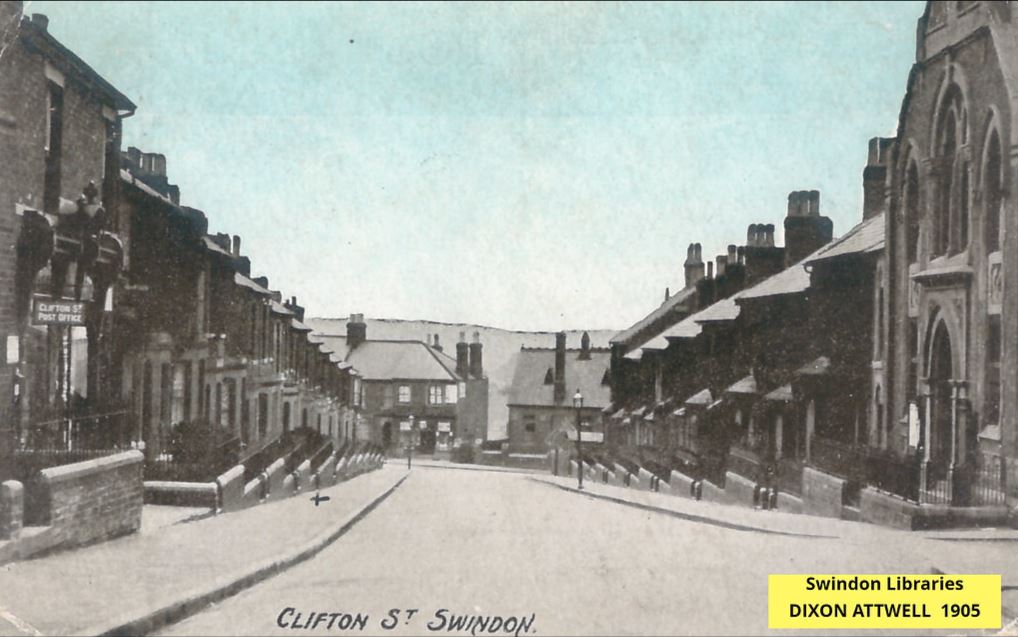
The shop in Clifton Street has had many different owners and many different shop fronts. In 1905 when Sarah Jane Wall was the Grocer and Subpostmistress it looked like this.

Swindon streets built in the 19th century grew piecemeal with each terrace built by a different builder. In 1883 E. Harvey was busy constructing eleven houses and a cottage in Clifton Street. James Hinton was also busy in this area of Swindon and in 1884 father and son firm, C. & G. Pettifer built a house and shop in Clifton Street. Could this be the premises the Wall family were living in at the time of the 1891 census?

Across the road once stood the Clifton Street Primitive Methodist Chapel. The original chapel was built in 1882 on land given by James Hinton. A much larger chapel was built in front of this in 1900, which can be seen in this photo. The chapel was still open in 1970 but was demolished soon after. Next to this are the Clifton Street gates to the cemetery.

This image has an empty alt attribute; its file name is clifton-street.jpg

Published courtesy of Local Studies, Swindon Central Library.

John Wall, Grocer and Dairyman moved to Swindon to run the General Shop in Clifton Street with his wife Sarah Jane and four of their six children. He died in 1899 and was buried in the cemetery just across the road from his shop. Sarah Jane carried on running the business with her two sons George and Charles and her daughter Beatrice.

Beatrice died in 1914 and was buried with her father in grave plot E8596. Sarah Jane died in 1935 and was buried with John and Beatrice.

The late Miss Wall – Residents in that district will miss the familiar figure of Miss Wall, of the Clifton Street Post Office, who has passed away after a long and painful illness.

The deceased lady was the daughter of the late Mr John Wall, who came to Swindon 30 years ago, and for a very considerable period she has been prominently identified with the business connected with the oldest sub-office in the town.

The funeral took place on Monday, the service at St. Saviour’s Church and the last rites at the Cemetery being conducted by the Rev. H.C. Brocklehurst.

A large number of friends assembled, and the principal mourners were: Mr and Mrs Loxwell Wall (Exmouth), Mr and Mrs Frank Wall (Swindon), Mr and Mrs Charles Wall (Swindon), Mr and Mrs Arthur Wall (London), Mr George Wall (Swindon), Mr W. Davis (Stonehouse), Mr V. Broadsmith (Cirencester), Miss E.J. Wall (Exmouth), Miss H.G. Wall (Swindon), Nurse Butcher and Mr. E. Higgins (Swindon).

Mrs Wall and family are very grateful for the loving sympathy extended during Miss Wall’s long and painful illness, and the kindness of neighbours is especially recognised.

Extracts from the North Wilts Herald, Friday, February 27, 1914.

The Clifton Street shop in 2023

Thomas William Harry – member of the Baptist Tabernacle

This impressive monument suggests to me it was originally meant to mark the final resting place of an entire family, but there is only one person buried here, Thomas William Harry.

Among some fine examples of Victorian funeral iconography there is the urn symbolising immortality, heavily draped signifying mourning.  Books are a reference to scholarly habits and religious faith.  There is a book beneath the urn and one opened on the first verse of a hymn – Hiding in Thee.

It reads:

O safe to the Rock that is higher than I

My soul in its conflicts and sorrows would fly

So sinful, so weary, Thine, Thine would I be,

Thou blest Rock of Ages, I’m hiding in Thee.

Written by William Orcutt Cushing with music by Ira David Sankey.

This is the last resting place of Thomas William Harry, born in Swindon in 1863 the eldest child of William and Mary Harry.  This young couple were among the advance guard that moved from South Wales when the new Rolling Mill opened at the Works.

It is likely their first home was in the Barracks, the unpopular lodging house in the railway village that became a Wesley chapel, then the Railway Museum and then a youth project called The Platform.

By 1871 the Harry family were living at 7 Cambria Place, a two up two down terraced house in to which they managed to squeeze William, Mary and their five sons, Mary’s mother, two nephews (both employed at the Works) and two nieces.

William and Mary eventually returned to Wales to run a pub in Jenkins Town near Swansea.  They took their four younger children with them but the four elder boys stayed in Swindon and lived at 12 Clifton Street.  Head of the household was young Thomas, aged 18 and an apprentice fitter at the Works.

Thomas eventually left the works to set up in business as a grocer in a shop on Park Lane.  He married in 1890 and in 1895 his son Cyril Arthur was born.  Sadly, Thomas died before the little boy was two years old.

Thomas’ brother Henry known as Harry (making him Harry Harry) took over not only Thomas’s business interests but in 1909 married his widow as well. 

Funeral of Mr T.W. Harry. – The funeral of Mr T.W. Harry, whose death was recorded in our last weekly issue, took place on Saturday afternoon at the Swindon Cemetery. The mournful cortege left deceased’s late residence, Bath Road, Old Swindon, at 2.15, the mourners being Mr H. Harry, Mr W. Harry, Mr C. Harry, and Mr A. Harry (brothers), Mr D. Harry and Mr Evan Harry (uncles), Mr F. Williams, Mr J. Williams, and Capt J.G. Morris (brothers-in-law), Mr A.W. Burson (partner), Mr G. Howells, etc. Upwards of 60 members of the Swindon Trader’s Association were present, including the president (Mr W.G. Little) and the secretary (Mr J.S. Protheroe), and representatives also attended of the deacons, the Sunday School, and the Christian Endeavor Society in connection with the Baptist Tabernacle, where deceased was a prominent member.

The bearers and representatives of the firm (Messrs Freeth & Son) included Mr Frank Burson, Mr Woolfrey, Mr Sutton, Mr Banwell, Mr Carver, Mr Hancock, Mr Strong, Mr Galpin, and others. A short service was held at the Tabernacle previous to the internment, the Rev F. Pugh (pastor) officiating. In addressing the large congregation Mr Pugh referred to his having baptised deceased as a member of the Church, and touched upon Mr Harry’s earnest and self-sacrificing labors on behalf of movements associated with the Tabernacle. He also paid a feeling tribute to deceased’s personal character and worth. Mr. Pugh conducted the service at the grave-side, which was witnessed by a large number. The coffin was of polished and panelled Canadian elm, with plain brass furniture, the brass plate being inscribed: “Thomas William Harry, died Feb. 2. 1897, aged 34 years.” Numerous floral offerings were received …

The funeral arrangements were efficiently carried out by Mr A.J. Gilbert, of Swindon. At the morning service at the Tabernacle on Sunday the pastor preached an impressive sermon on “The Passing of Jordan” from Joshua iii, 17, and made special reference to the circumstances of Mr Harry’s life and death. During the service deceased’s favourite hymns, “Hiding in Thee,” and “He fell asleep” were sung.

Extracts from the North Wilts Herald, Friday, February 12, 1897.

Read more about the Harry family on the excellent http://www.swindonbottles.co.uk/harry.html

Arthur Longman – a victim in the dark

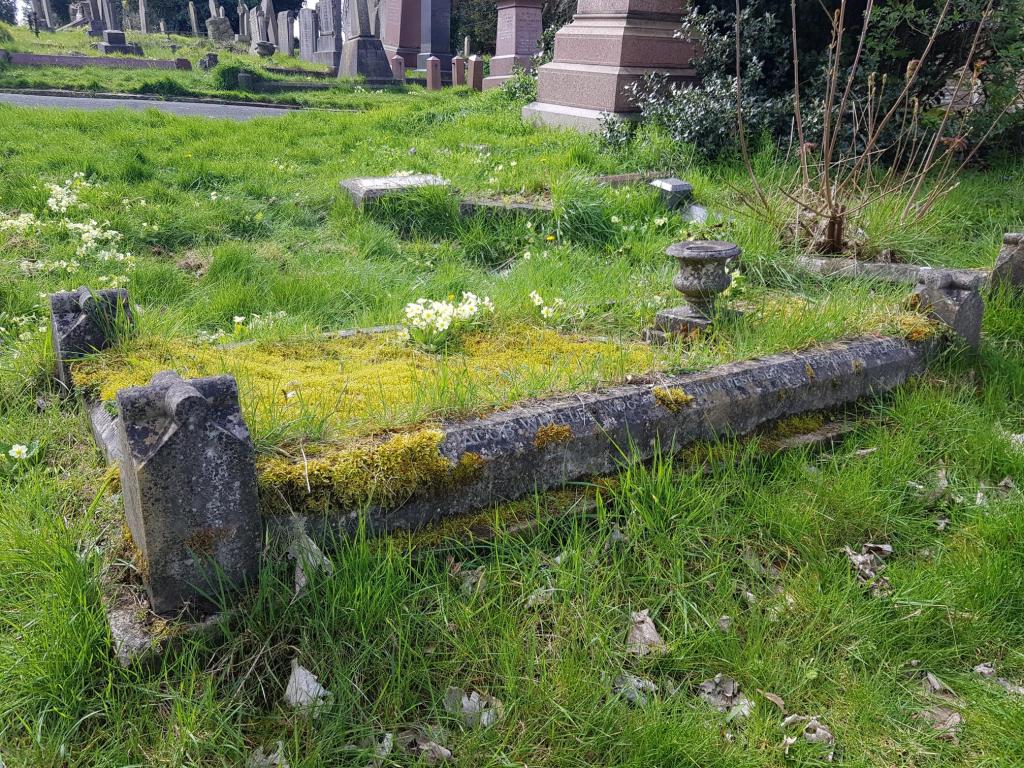
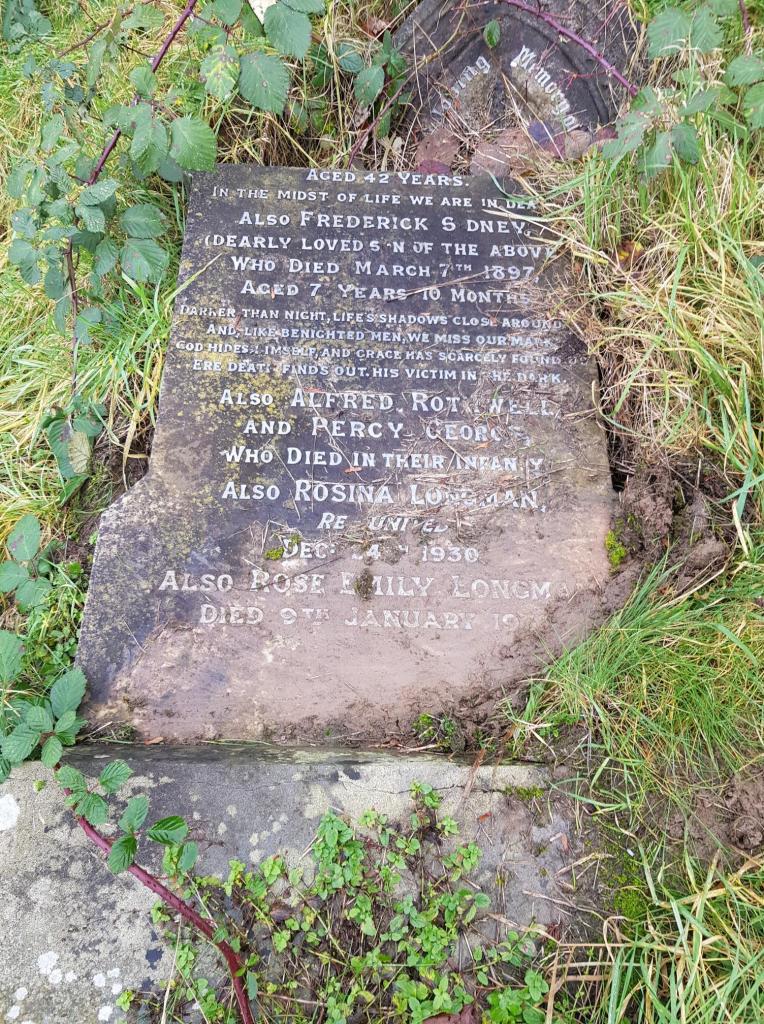
A fallen headstone, a neglected grave and a tragic story.

Arthur Longman’s family recognised the reoccurrence of his depression and anxiety. Arthur himself was obviously frightened and at the inquest it was revealed he had asked for help:

‘Deceased at one time expressed a wish to go to an asylum to be taken care of, but Dr Maclean considered that there was no necessity for him going there.’

Could there ever have been more damaging medical advice?

Arthur was born in 1850 in the village of Penselwood, Somerset, the son of Isaiah and Jane Longman. He married Rosina Flood in the March quarter of 1875.

At the time of the 1881 census Rosina was single handily running the family’s drapery business in Faringdon Street and caring for her five year old son. The census enumerator has written on the census form – Husband in Asylum. Arthur is recorded on that census as a patient in the Wilts County Lunatic Asylum, Devizes.

In 1891, the year before his death, Arthur states his occupation as Draper and Auctioneer. Rosina works as Draper & Milliner & Dress [maker]. Their eldest son Arthur 15, works as a draper & clothier’s assistant. There are a further four children, Charles 9, Rosina 7, Emme 3 and one year old Frederick. The couple have a heavy workload. But despite the family’s concerns little was done to help Arthur.

Sad Death of a Swindon Tradesman – On Monday morning Mr Arthur Longman, draper, of Faringdon street, New Swindon, committed suicide in his own house under painful circumstances. It is supposed that he rose about 4 a.m. according to his custom, and at 6.30 a.m., on his wife going downstairs she was horrified to find the body of her husband. Dr. Howse was at once summoned, but found life extinct. – An inquest was held at the Cricketer’s Arms, New Swindon, on Tuesday morning, by Mr. Coroner Browne and a jury, of whom Mr A. Adams was foreman, and the following evidence taken:-

Sidney Longman, a guard on the Midland and South Western Junction Railway, said deceased, who was 42 years of age, was his brother, and had been in business in Swindon about 20 years. He was sent to Devizes asylum about ten years ago owing to an attack of suicidal mania, being there about six months, when he came out practically cured. Deceased worried a great deal lately about a business which he had put his father-in-law into. He also worried a great deal about his new business at Gorse Hill, but witness thought there was no necessity for it. When he saw deceased last he told him that he had had a letter from his father asking him if he was any better in health, and told witness he wished he could say that he was.

Arthur Longman, deceased’s son, said he assisted his father in managing the business. He had noticed a change in his habits lately and he seemed depressed in spirits. Witness went out with him as usual on Sunday, and deceased went to church in the evening. It was nothing unusual for deceased to get up in the morning before any one else. On Monday morning witness got up about 6.30 and found deceased lying across the table in the kitchen. The room was not deranged in any way with the exception that the lamp on the table was knocked over. Deceased at one time expressed a wish to go to an asylum to be taken care of, but Dr Maclean considered that there was no necessity for him going there.- Dr Howse said he was called to deceased about 7 o’clock on Monday morning. He was quite dead, death being the result of haemorrhage caused by the wound in the throat.- The jury returned a verdict of “Suicide whilst of unsound mind,” and gave their fees to the Swindon Victoria Hospital.

Extracts from the Swindon Advertiser, Saturday November 5, 1892.

What happened to the family in the aftermath of Arthur’s violent death? Well, Rosina stayed in Faringdon Street and carried on with the business with the help of her son Arthur. She died on December 24, 1930 at 32 Faringdon Street and was buried with her husband and their young son Frederick Sidney who died in 1897 aged 7 years 10 months in grave plot A783 . The last person buried in this large plot was daughter Rose Emily Longman who died in 1953. Two young sons who died in infancy are also remembered on the headstone.

The inscription includes a verse from the hymn Hark! Hark, My Soul by Frederick W. Faber.

Darker than night, life’s shadows close around us

And, like benighted men, we miss our mark

God hides Himself, and grace has scarcely found us

Ere death finds out, his victim in the dark.