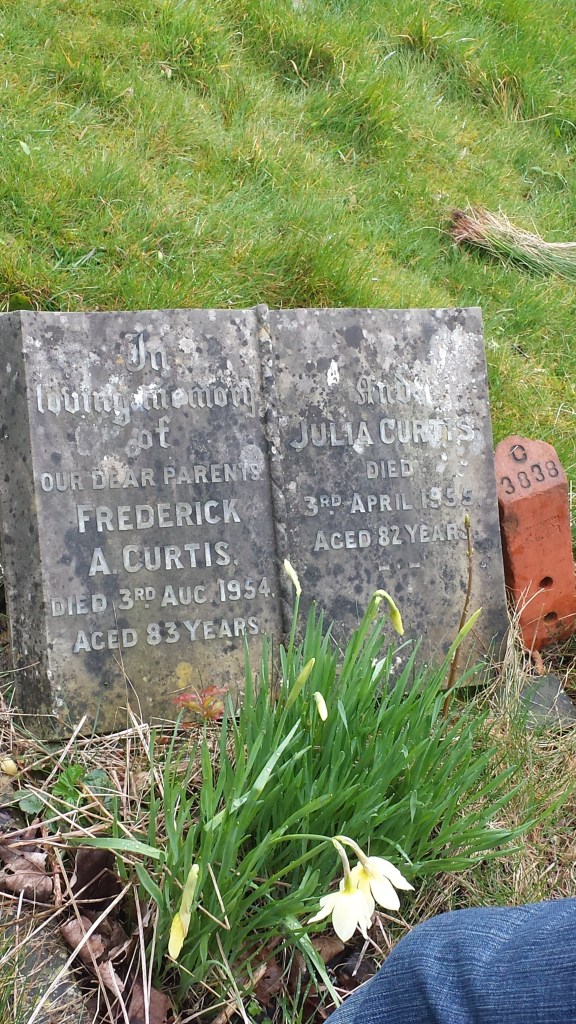
I am always thrilled to discover information from relatives about those buried in Radnor Street Cemetery. I recently received these details and photographs from Michelle who writes:
‘Please see attached images for Frederick Arthur Curtis and Julia Curtis who are buried in Radnor Street cemetery.
Fred and Julia came from Bristol and moved to Swindon between 1894 and 1896. In the 1901 census they are recorded as living at 31 Clifton Street and in 1911 at 163 Westcott Place and stayed there until they passed away. Their daughter Alice then lived there. Frederick was a shoemaker/boot repairer.
They had a 8 children of whom 3 died and we presume they would be in Radnor Street somewhere.
I hope the above and attached is of interest. If you have any information on whether Elsie Curtis who died aged 7 in 1906, Thomas Edward Curtis who died aged 14 in 1920 (we believe in some sort of vehicle accident and perhaps with a tram) or Frank Albert Curtis who died aged 8 in 1922 are buried in the cemetery we’d love to find them.
This is my husbands family and he grew up living next door to his grandmother at 164 Westcott Place. We now live on Kingshill Road and often take a walk around the cemetery and visit his great grandparents.’
Frederick was born in 1871, the son of William Curtis, also a boot maker, and his wife Ann. At the time of the 1891 census the family lived at 8 Bedford Place, Bristol. He married Julia Watts (dates seem to vary between various Curtis family historians) and by 1901 they had moved to Swindon.
I was able to tell Michelle that Frank is buried with his parents. Sadly, the other two children are in public graves, buried with (probably) unrelated people and with no headstone, but she was happy to receive the details and will now visit these graves as well.
The Chandler family was a large one and for many years the business of Chandler Brothers dominated the corner of Wood Street and Devizes Road.
Frank was born in 1860, one of John and Susannah Chandler’s large family and was running the business alongside his widowed father at the time of the 1881 census. He married farmer’s daughter Ada Keziah Edmonds at St Paul’s Church on June 10, 1890. He was 30 years of age and she was 23.
The couple’s first home was above the shop in Wood Street where a staff of eight boarded with them including three draper’s assistants, 2 dressmakers and a milliner.
Their only child, a daughter Ada, was baptised on April 21, 1891, at the church where the couple had married but sadly she died around the time of her first birthday.
At the time of the 1901 census Frank and Ada lived at South View, a house on the Sands in Old Swindon, just a short walk from the family business.
Death of Mr Frank Chandler
We regret to announce the death, which has taken place under painfully sudden circumstances, of Mr Frank Chandler, of South View, The Sands, Swindon, and a member of the firm of Messrs Chandler Bros., drapers and outfitters, 35, Wood Street, and Devizes Road.
The deceased gentleman, who was 46 years of age, and who leaves a wife, but no children, was recovering from a long attack of acute rheumatism. He went to Bournemouth, where he caught a chill, and he was compelled to return home. Unhappily, the chill was followed by complications which necessitated an operation being performed. Accordingly, on Saturday afternoon his medical attendant, Dr J. Campbell Maclean, accompanied him to London, where, at a surgical home, he was attended to. The operation took place on Saturday evening, but Mr Chandler, without recovering consciousness from the anaesthetic, died suddenly from syncope.
Mrs Chandler, who also accompanied her husband to London, and whose own health is by no means satisfactory, returned to Swindon soon after Mr Chandler’s demise.
Mr John Chandler proceeded to London very soon after hearing of his brother’s death.
The painful news was announced to a large congregation yesterday morning by Canon Estcourt before the sermon at the Parish Church, of which the deceased gentleman was a member, and the intelligence came as a severe shock to the many by whom Mr Chandler was intimately known.
The body will be brought to Swindon for interment.
By the death of Mr Frank Chandler, the town has lost an inhabitant who was held in the highest esteem. He was the youngest son of the late Mr John Chandler, and his long connection with the well known business in Wood Street brought him into contact with very many people. His gentlemanly and courteous bearing, his kindly disposition won for him a large circle of devoted friends to whom his sudden loss will occasion keen sorrow. What lends a further degree of painfulness to the event is the fact that, as stated by Canon Estcourt, the deceased gentleman was about to take over control of the whole of the important Wood Street business. Mr Frank Chandler never took any active part in the town’s affairs, though as a sterling business man he was warmly respected by all with whom he came into business contact.
At Swindon Parish Church on Sunday morning, the Vicar, Canon Estcourt, before commencing his sermon, referred to the sad death of Mr. Chandler. He said: As I was on my way to Church this morning I heard the distressing news of the death of Mr Frank Chandler, which took place after an operation which he underwent in London. He was, as you know, just about to take over the management of one of the large business establishments in the town. But God has seen fit to order things otherwise for him. I am sure today our sympathy and our prayers will go forth to his many relations, and to his wife especially.
The Evening Swindon Advertiser, Monday, November 19, 1906.
The Late Mr Frank Chandler
The Funeral
Amid every manifestation of deep sympathy and regret the funeral took place on Wednesday of the late Mr Frank Chandler, of the well known firm of Chandler Bros., Wood Street, Swindon whose sad death in London we announced last Monday.
The body was conveyed from Paddington by the train leaving there at 11.40, and arrived at Swindon GWR Station at 1.20 p.m. Thence it was removed to the Parish Church, where the first part of the funeral service was conducted by the Vicar (Canon E.W. Estcourt), who also officiated at the graveside.
The cortege, headed by a carriage laden with floral tributes, left the Church at 2.30, and proceeded to the Cemetery via Cricklade Street, Wood Street, Bath Road, Lansdown Road, and Kent Road.
Extract from the funeral report published in the Evening Swindon Advertiser Thursday, November 22, 1906.
The funeral took place on November 21, 1906 when Frank was buried in Radnor Street Cemetery in grave plot E8327. He is buried alone.
Image of Albert Street and Little London published courtesy of Local Studies, Swindon Central Library.
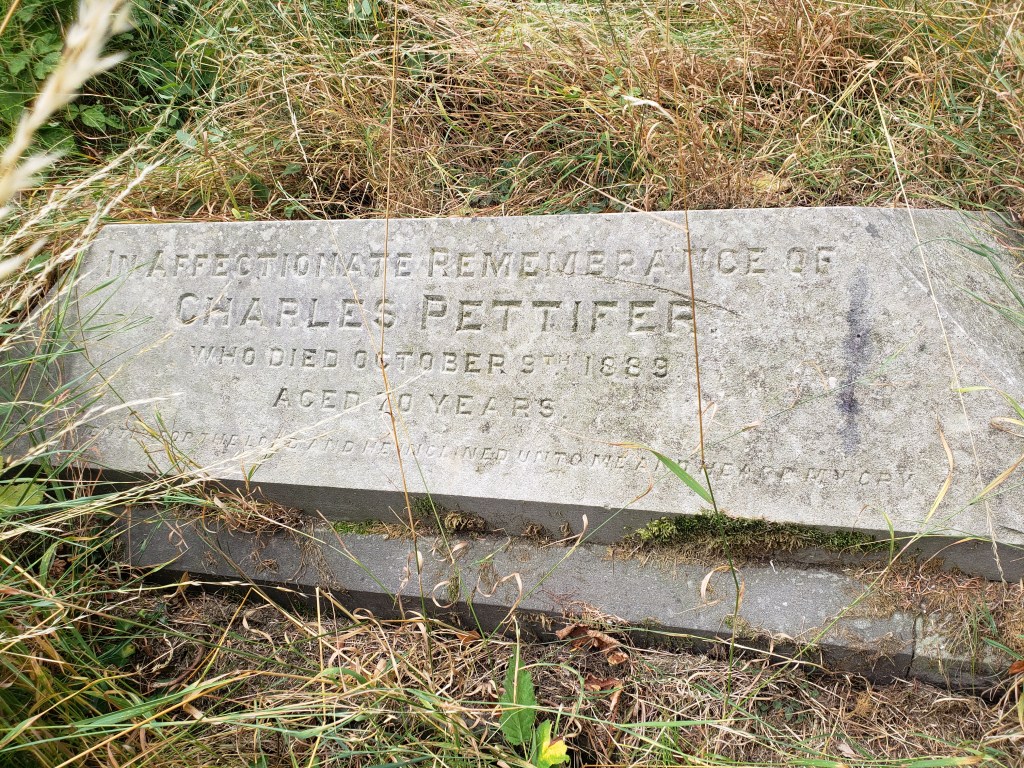
Charles Pettifer married Elizabeth Hawks in the summer of 1847. They were both born in Bampton in Oxfordshire and they set up home in the village at a house in Lavender Square where they were living at the time of the 1851 census. Isn’t that a lovely address – Lavender Square? I bet it’s all quaintly Cotswoldy now. In 1851 there was probably no running water, the privy was at the bottom of the garden and it was cold and damp.
Charles and Elizabeth first appear in Swindon on the 1871 census. Charles had previously worked as a cordwainer (a shoemaker) but once he arrived in Swindon he states that his occupation was that of a mason. That might sound like an astonishing career change, but as his father was a stonemason I’m guessing he had learned the trade alongside him. In 1871 Charles and Elizabeth were living with their two sons George 23, a bricklayer and Alfred 17, a bricklayer’s labourer, at 2 Eastcott Lane.
Charles had already set up in business by then and in 1875 he was joined by George. In the early days the Pettifers worked almost exclusively at the top end of Victoria Road, then called Victoria Street North. In 1872 they built houses and a workshop in that area and in 1877 they built a house, stable and workshop on the corner of Victoria Street North and King John Street and several cottages in Albert Street.
They continued in partnership until around 1881. Charles died in 1889 and was buried in grave plot E8304 on October 14.
George married Ruth Hill, a widow, in 1884. They were married for thirteen years when George died in 1897. They do not appear to have had any children. Ruth married again in 1900. Her third husband was George Popjoy, a joiner, so possibly a colleague of her second husband, George Pettifer. Ruth died on May 11, 1905 and was buried with George Pettifer (her second husband) in grave plot D33.
There is no entry for builder William Crombey in the comprehensive Architects and Building Craftsmen with Work in Wiltshire compiled by Pamela M. Slocombe and published by the Wiltshire Buildings Record in 2006. In that excellent book Roadways published in 1979 by Peter Sheldon & Richard Tomkins, Crombey Street is given a construction date of 1891 and a description that William Crombey was a local building speculator who developed much of the Rolleston Estate.
His death warranted just a brief mention in the Swindon Advertiser and so far I haven’t been able to discover an obituary, yet a search through the local newspapers reveal just how busy Mr Crombey actually was.
Crombey Street area of Swindon – Market bottom left
New Swindon Local Board
New Streets and New Buildings
The following plans were presented and passed:- Three new streets on the Rolleston Estate, to be known as Deacon Street, Curtis Street and Cromby Street; hotel and stable in the new road, for Mr W Cromby; nine shops and dwelling houses in Commercial Road for Mr W. Cromby; six houses in Lorne Street for Mr W. Bennett; one cottage in a new street at Gorse Hill for Mr C. Davis; alteration to the Three Cups Coffee Palace, Regent Street, for Mr S.B. Foss; additions to house in Dover street, for Mr E. Chamber; two new cottages in a new road abutting on to Rolleston Street and Eastcott Hill, for Mr E. Chambers; a house and shop and seven cottages in Maxwell Street, for Mr C. Williams; an assembly room for Mr A.E. Withy, to be erected near his house; one house in Gordon Road, Princes Street, for Mr J. Webb; eleven houses in Dean Street, for Mr T. George; fourteen houses in Deacon Street, ten in Cromby Street and two in Curtis street for Messrs Cromby and Horsell; additions at rear of 35, Regent Street, for Mrs S.J. Coleman; four houses in Victoria Road, for Mr H.C. Cook. One plan that of a house and shop to be erected in Groundwell Road, for Mr J.E. Campbell, was disapproved, owing to no sewer being shown on the plan.
Swindon Advertiser, Saturday, July 26, 1890.
So, why has William Crombey received so little attention in the history of the building of Swindon? Perhaps one reason could be that his day job was that of an Engine Driver.
William was born in Houghton le Spring, Durham in about 1825. He first appears in Swindon on the 1861 census when he was one of three boarders lodging at 15 Fleet Street. By 1881 he was lodging with Anne Elizabeth Harvey at Park Hotel, Cambria Bridge Road and in business with her brother-in-law Edwin Harvey. The partnership was dissolved ‘by mutual consent’ in March 1884. However, this was not the only partnership in which William was involved as he was also working with John Horsell. This partnership was dissolved on March 1, 1891, which is hardly surprising as William was obviously terminally ill and died on March 13.
His personal estate was valued at £1,463 1s 6d and probate was awarded to George James Harvey of Newport the son of his landlady Anne Elizabeth Harvey and nephew of his old business partner Edwin Harvey. William does not appear to have married or left any family. He was buried in Radnor Street Cemetery on March 16, 1891 in plot E8003.
William’s various properties came on the market on May 2, 1892 and were auctioned by Messrs Bishop & Day. These included No 1 Brunel Street ‘a freehold dwelling house and shop at the corner of Brunel and Cromwell Streets; adjoining Regent Street (the chief thoroughfare), and near the New Market; a spacious and lofty Building readily converted into Commodious Business Premises;’No 23 William Street which contained a ‘palisaded forecourt,’ a spacious Corner Shop, Bakery and Residence No 1, Cambria Bridge Road; A Capital Shop and Residential Premises, No 2, Cambria Bridge Road; A Capital Shop and Residence, No 3, Cambria Bridge Road and A Capital Shop and Premises, with a slaughter house, No 4. Cambria Bridge Road.
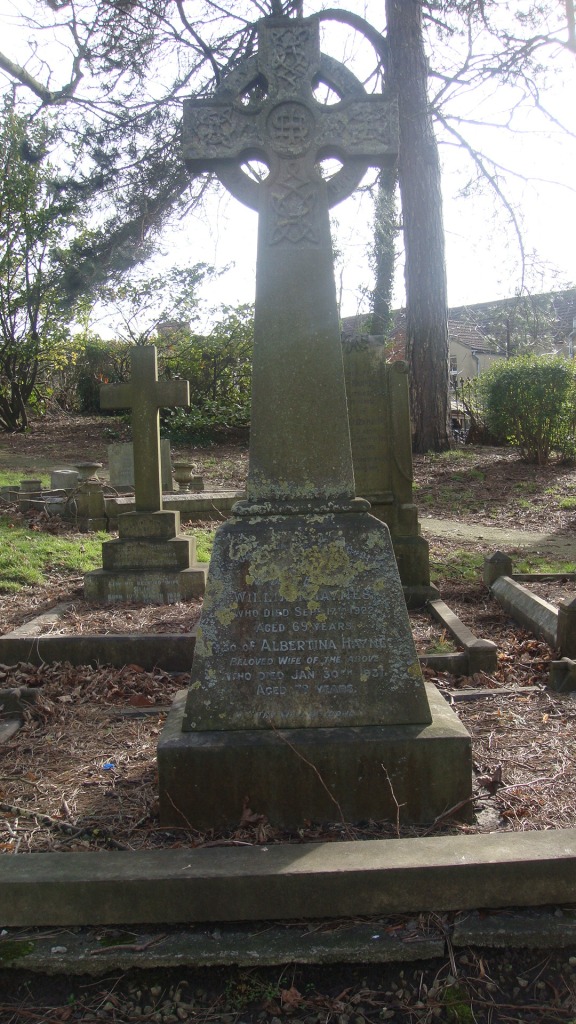
This magnificent Celtic Cross shouts wealth and must have been a pretty expensive monument in its time.
The Celtic Cross design combines the ancient Celtic circle symbol with the Christian cross, and was usually a free standing stone monument. In Ireland examples have been found dating back to the 7th century.
In the mid 19th century there was a Celtic Revival when monuments like this became extremely popular and the Celtic Cross has since become associated with graveyard memorials. The Celtic Cross on the Haynes grave includes the letters IHS symbolising the Greek spelling of Jesus Christ.
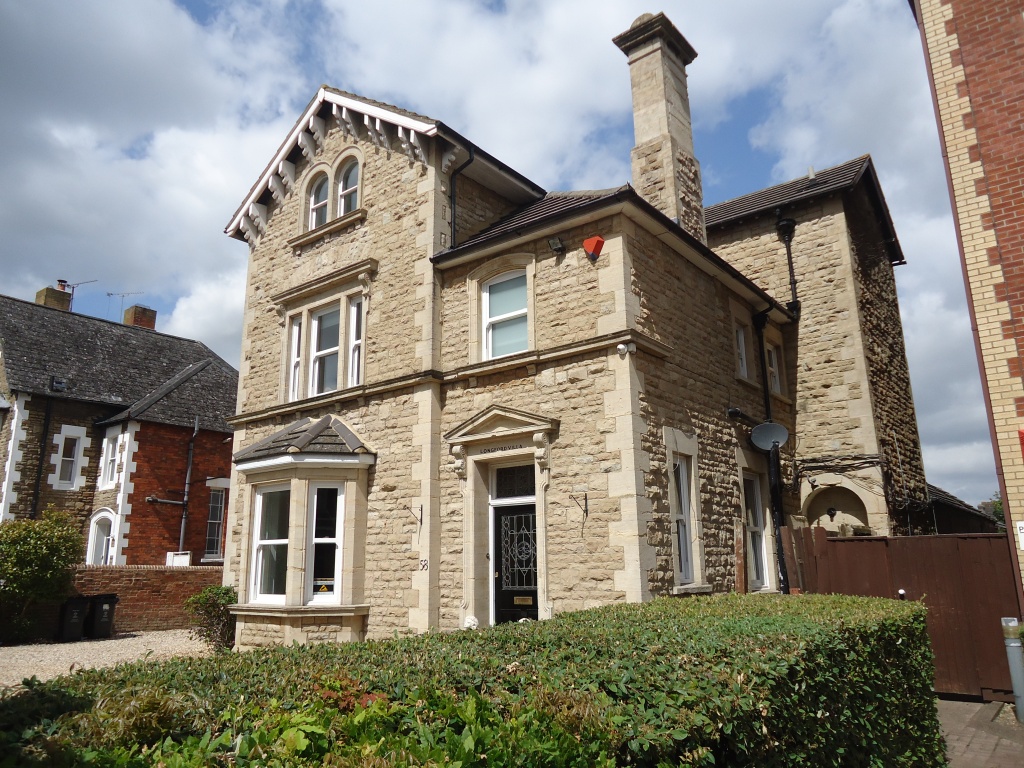
This is the final resting place of William and Albertina Haynes. In their retirement the couple lived at Longford Villa one of those impressive Victorian properties on Bath Road. William died on September 17, 1922 and Albertina on January 30, 1931.
William had grown up in Fairford where his father worked as a confectioner. He moved to Purton to begin an apprenticeship in Edward Kempster’s grocer’s shop, which is how he met his future wife. Albertina was the daughter of Richard Newman who was a Beer House Keeper in Purton.
The couple married in the summer of 1879 and by the time of the 1881 census they were living at 5 Westcott Place where they ran a grocer’s shop. William employed two assistants including his younger brother Hubert.
By 1891 the establishment had grown somewhat. The couple had six children and employed three grocery assistants and two domestic servants.
Researching the census returns I think the Haynes grocers shop was in the large premises on the corner of Westcott Place and Read Street, which has various signs outside today.
When William died in 1922 he left £65,473 9s 8d worth several million pounds today, an impressive amount of money for those post war times and more than enough to pay for this magnificent memorial.
You might like to visit Swindon Bottles for information about many other Swindon based firms.
The image of the Mechanics’ Arms is published courtesy of Mr D. New and Local Studies, Swindon Central Library.
The re-imagined story …
My dad used to drink in the Mechanics’ Arms so when he said they were looking for a barmaid I decided to apply. We lived just around the corner in Wellington Street, so not far to walk home at the end of the evening. Dad knew Mr and Mrs Leighfield well.
“They’re a nice couple. They’ll look after you well – won’t take advantage of you.” Dad knew most of the regulars, all men from the Works.
Mrs Leighfield told me to call in on Tuesday afternoon.
It was pandemonium when I got there, yet no one seemed to know what was going on.
“There’s been an accident.”
“Has anyone sent for Dr Swinhoe?”
“He’s on his way.”
“Do they need any help in there?”
“We could hear a woman screaming, but it’s all gone quiet now.”
I decided not to hang around. There was nothing I could do anyway.
The pub was closed that evening, but the news was already spreading. Dad couldn’t believe it.
“He was such a nice man. Always had a cheery word for everyone, even though his health was poor.”
I decided against applying for the barmaid’s job, although I felt a bit guilty. Mrs. Leighfield probably needed the help more than ever now, but I just couldn’t face going in that kitchen where it had all happened.
The facts …
Swindon
An inquest was held by the county coroner (Mr A.L. Forrester), at the Mechanics’ Arms Inn, on the body of Frederick George Leighfield, the landlord of the house, who committed suicide by cutting his throat. The evidence showed that deceased had been unwell and depressed. On Tuesday afternoon his wife found him in the kitchen in the act of cutting his throat. He had succeeded in inflicting a severe wound with a razor, and although he received immediate attention, he succumbed early on Thursday morning. The jury returned a verdict of “Suicide while temporarily insane.”
The Western Daily Press, Bristol Monday August 23, 1909
Funeral on Sunday
Impressive Service in Swindon Cemetery
The funeral of the late Mr Frederick G. Leighfield, of the Mechanics’ Arms Inn, Cheltenham Street, whose sad death was recorded in our columns last week, took place in Swindon Cemetery on Sunday afternoon, the mortal remains being laid to rest in the same grave as those of his father, the late Mr Alfred Leighfield, who died two and a half years ago.
The cortege left deceased’s late residence at 3 pm and proceeded direct to the Cemetery, where a short service was conducted in the Chapel by the Rev. F.C. Shellard, Baptist Minister, who also officiated at the graveside.
The coffin, which was covered with lovely floral tributes, was conveyed in a hearse, and the chief mourners were in four carriages, whilst a very large concourse of people in the Cemetery, but the best of order was maintained, and the roped enclosure was kept clear by a number of policemen, under Inspector Buchanan and Sergt. Millard.
A number of members of the Swindon and District Licensed Victuallers’ Association, of which Mr Leighfield was a member, also attended to pay their tribute of respect to the memory of deceased.
The coffin was of polished elm, with brass fittings, and the breast-plate bore the following inscription: “Frederick George Leighfield, died Aug 19th, 1909, aged 39 years.”
The funeral arrangements were satisfactorily carried out by Messrs H. Smith and Son, of Gordon Road.
Extracts printed from The Swindon Advertiser Friday August 27 1909
The store closed the day of Mr Levi’s funeral, as a mark of respect. That kind of thing seldom happens now, but things were different in those days.
I had only just started work at Morse’s in the summer of 1913. Drapery assistants worked a long day and as a new, young apprentice I was called upon to do the more menial tasks as I learned my trade. I remember doing a lot of dusting.
Morse’s had begun as a small draper’s shop in Stratton St Margaret, opened by Mr Levi’s father Charles, more than 50 years ago. It was Mr Levi who opened the Regent Street store where he proudly announced that you could furnish your house ‘cheaply and well.’
I often wondered how much of his own stock he used to furnish his big old house at The Croft where he entertained his political friends and held the large Primitive Methodist conventions. My mum told me not to let the manager at Morse’s hear me speak like that as I would soon get my marching orders.
The staff were gathered together when the announcement of his death was made earlier that week. Many were moved to tears. I hung my head but to be honest I didn’t know him, his days of calling into the store and overseeing the business had long passed. We opened late that day, after we dressed the store in black, trimming last used when the old Queen died.
That week in September everyone spoke about Mr Levi in hushed, reverent voices. I wondered if he was really that well liked, or whether this was just the ‘old order’ speaking; those who touched their forelock when the squire drove past in his carriage.
The end of an era, people said. At 16 you don’t really appreciate what that means. But a year later the world was at war. Nothing was ever the same again.
The facts …
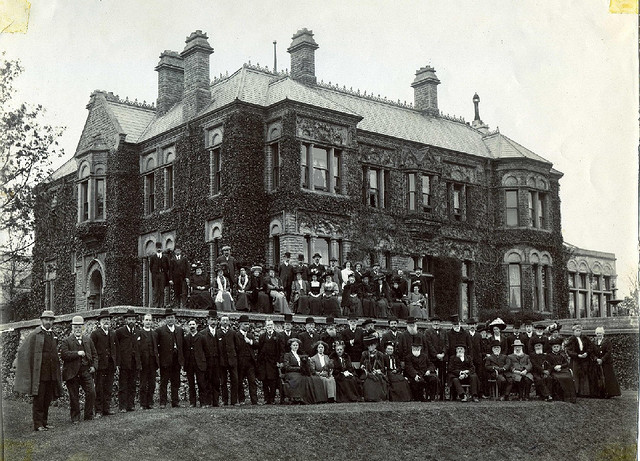
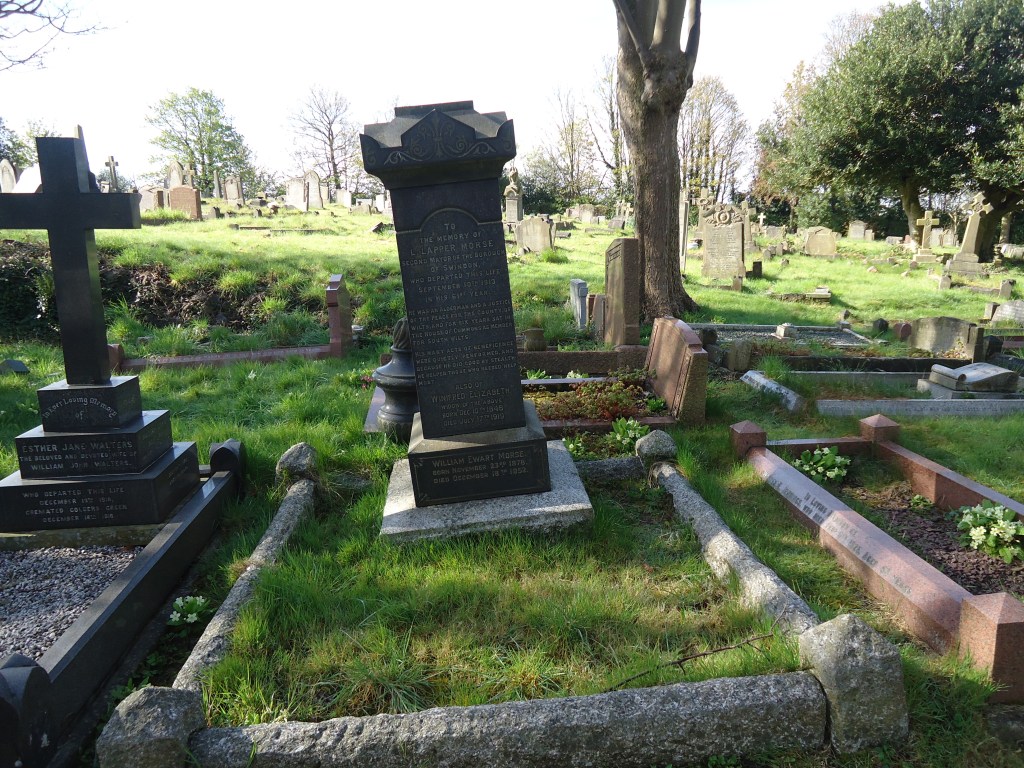
The remains of the late Mr Levi Lapper Morse were laid to rest at Swindon Cemetery on Saturday, when nearly 5,000 people witnessed the last rites.
The Cortege, on leaving The Croft, proceeded to the Regent Street primitive Methodist Church. It was headed by a posse of police under Inspector Winchcombe. Then followed the borough magistrates and the Mayor (Mr J.J. Shawyer). The deputy mayor (Mr G. Brooks), and the Town Clerk (Mr R. Hilton). Most of the members of the Corporation and representatives of the principal public bodies brought up the rear of the first portion of the procession. Two carriages laden with beautiful wreaths proceeded the handbier, on which the coffin was laid.
An imposing spectacle was made by the male and female employees of Mr Morse’s business, who came immediately behind the carriages conveying the family mourners. Next were the representatives of religious bodies, and finally about 200 friends and acquaintances who had attend to pay their last tributes of respect.
Besides the family wreaths were tributes from Sir William and Lady Hartley, the members of the Swindon Primitive Methodist circuits, the North Wilts Liberal Association, Members of the second Methodist circuit quarterly meeting, the business staff etc.
A Friend’s Tribute
An impressive panegyric was delivered by the Rev T.M. Pinnock, who described the late alderman as ‘my faithful and true friend for 40 years.” Speaking with evident emotion, the reverend gentleman referred to Mr Morse’s generosity to the Church both locally and in the connexion generally. Without him it would have been impossible for their church in Swindon to be what it was that day. Reference was also made to Mr Morse’s unobtrusiveness and natural business talent, which latter quality he made of immense serve to the Church. “He never forsook the friends of his youth,” added the speaker, “and he died fearing God. He sought to make God’s will the rule of his conduct, God’s service the joy of his heart, and God’s glory was the aim of his life.”
Another brief but earnest tribute was given by the Rev J.D. Thompson (general committee secretary), who said the sympathy of Primitive Methodists all over the country went out to the bereaved.
During the service the hymns “O God our help in ages past” and “Rock of Ages” were sung.
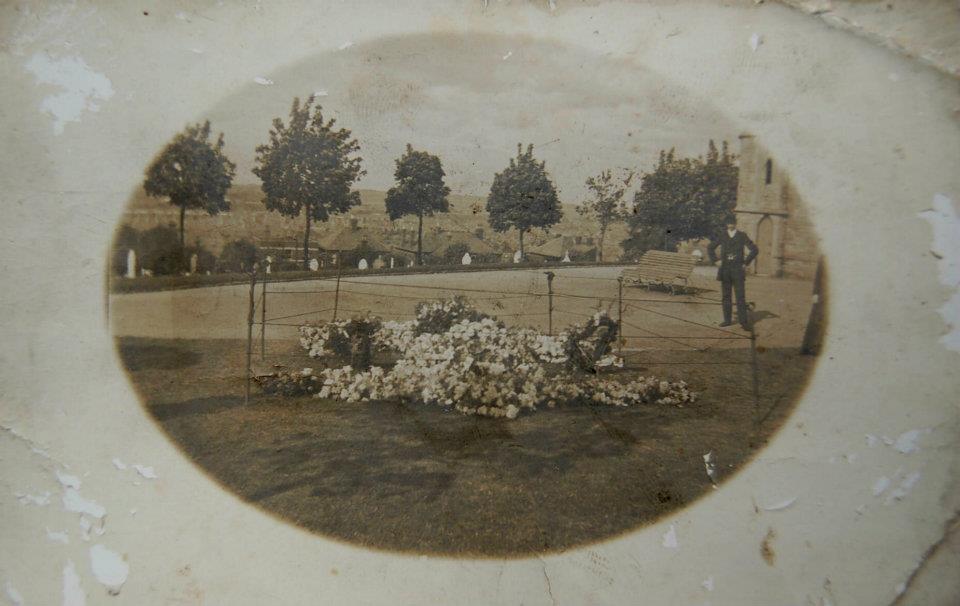
A cordon of police had been drawn round the chapel, on the west side of which was the grave, lined with the deceased’s favourite flowers – red roses – and many other beautiful blooms. Large and sympathetic crowds witnessed the final rites, conducted by the Revs. J.D. Jackson and J. Dobson.
A memorial service was conducted by the Rev T. Mostyn Pinnock (formerly of Swindon), at the Regent Street Church on Sunday night.
Extracts from The Wiltshire Times Saturday published September 20 1913
published courtesy of Local Studies, Swindon Central Library
The re-imagined story …
I will admit to having a grudging admiration for Mr. James Hinton, but I wouldn’t say I actually liked him. We’ve done business together on a couple of occasions and he’s very shrewd. He strikes a hard bargain and you have to respect him for that. And he works hard; the stamina of the man!
He’s been in the news most recently for offering up a piece of land on which to build the new cemetery. Some say he has gifted the land, but in fact he has sold it to the Burial Board. He’d probably like it to go down in history that he was a generous benefactor, but he’s sold it at a very competitive price. As the debacle of the cemetery question needs a quick resolution his fellow members on the Board were happy and grateful to accept the offer.
I’m quite surprised he didn’t win the contract to lay out the cemetery and construct the requisite buildings, but perhaps he didn’t put in a tender. Perhaps that would have been an audacious step too far. Next would have been a vote to name the new burial ground the James Hinton Municipal Cemetery.
But I will admit, I secretly quite admire the man.
The facts …
‘Mr Hinton stated that he would assure to the Board a free right of way to the proposed site for a cemetery over Stafford St., and Dixon St., and a right of way over Lansdown Road (from the Sands to cemetery over or 11 feet road) marked green on plan & over Radnor Street & Cambria Bridge Road to Fleetway.’
Swindon Advertiser July 1, 1880
The Cemetery – The Clerk reported that the Cemetery Committee had accepted the tender of Messrs Phillips, Powell and Wiltshire for laying out the cemetery and doing the necessary buildings for the sum of £5,390 10s. Detailed plans of the works were placed on the table and it was said the same was now in active operation.
Swindon Advertiser April 9, 1881
Death of Ald. J. Hinton
A painful sensation has been caused throughout the town by the news of the death of Alderman James Hinton, of The Brow, Victoria Road, Swindon…
For some time past it had been known that Mr Hinton had not enjoyed what may be termed the best of health, and on several occasions recently he had to resort to medical care, but no one, even those nearest to him, ever thought for one moment that he would be stricken down with such painful suddenness…
The deceased Alderman was 65 years of age. He was essentially a native of Swindon having been born in Newport Street in 1842. He had been for very many years intimately connected with the moving forces of the Borough, and took a keen practical interest in its commercial developments. There is not a class in the town, no matter what their religious or political opinions may be, but what will deeply deplore the loss of a public man whose best energies were given to the service of the community in which he lived.
The deceased Alderman’s career was one characterised by much interest, inasmuch as by his own industry and business acumen he rose from a somewhat humble position to one of comparative affluence…
The deceased Alderman became well known too, for his judicious speculative undertakings. Important estates, capable of considerable developments, were laid out by him, notable amongst which was the Kingshill building estate laid out in 1879. He became a large owner of land, enterprise dominated his thought and action followed; money flowed in and accumulated, and by dint of patience and perseverance Mr Hinton emerged from the obscurity with which Newport Street and the butcher’s shop had somewhat enshrounded him into the full light of prosperous, active life…
As Mr Hinton became absorbed in the growing interests of the town, further important undertakings came in his way. In conjunction with Mr Haines, he had the contract for constructing the Swindon and Highworth railway, which upon its completion was acquired by the GWR Co. During his speculative undertakings Mr Hinton did not at once relinquish the auctioneering profession, in which he was eventually succeeded by his son, Mr Fred Hinton…
It is about 30 years ago that he was elected on the then New Swindon Local Board, taking the place of the late Mr J. Armstrong, who was for some time Loco. Superintendent at the GWR Works, Swindon…
The old Local Board existed up to the year 1894, when the District Councils’ Act came into operation, and Mr Hinton then succeeded Mr T. Brain as the Chairman of the Council. He represented the East Ward, and did not suffer defeat until 1896, on which occasion he was touring in Australia, and was as a matter of fact unaware that his name had again been submitted to the electors…
In 1900 the Charter of Incorporation was granted to Swindon, and that august body, the Town Council, was constituted. Mr Hinton once again entered the arena of active local life, still representing the East Ward. He was elected a member of the Wilts County Council on its formation in 1889, and was a member of that body up to the time of his death. It was only the other week that he was returned unopposed for the East Ward. He was for four years a member of the Board of Guardians in the time of the late Mr William Morris, who was then the proprietor of the Swindon Advertiser. He was Swindon’s fourth Mayor, and it was, of course, largely in consequence of his associations with the almost phenomenal development of the town that his acceptance of the Mayoralty was invested with exceptional interest…
Mr Hinton was a Freemason, and was a member of the Gooch Lodge. He was also a Forester, being initiated an honorary member of “Briton’s Pride” Court at the Eagle Hotel during his year of Mayoralty…
He was raised to the Alderman’s bench on the same occasion that he was elected to the Mayoral chair. He was a man who possessed a broad and liberal mind, and by his death the town has lost a good and trusted and esteemed servant…
Extracts taken from James Hinton’s obituary published in The Swindon Advertiser, Friday, March 15, 1907.
James Hinton’s memorial in Radnor Street Cemetery
Coming next …
A Nice View – “It’s going to be an expensive business, getting buried in the new cemetery.”
published on Radnor Street Cemetery blog January 24 2019









 Radnor Street Cemetery