In the beginning Gorse Hill barely stretched from the railway line to St. Barnabas’s Church with the Duke of Edinburgh pub and Baptist and Methodist Chapels in between. Taking its name from Gorse Hill House which once stood on Cricklade Road, early development was called the Gorse Hill Farm Estate and began in about 1885.
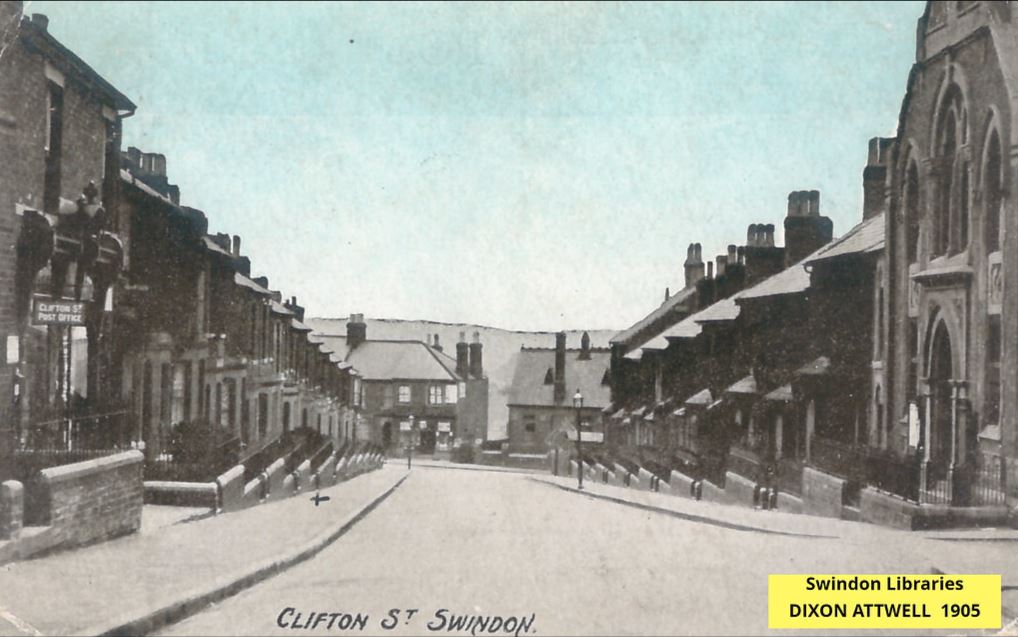
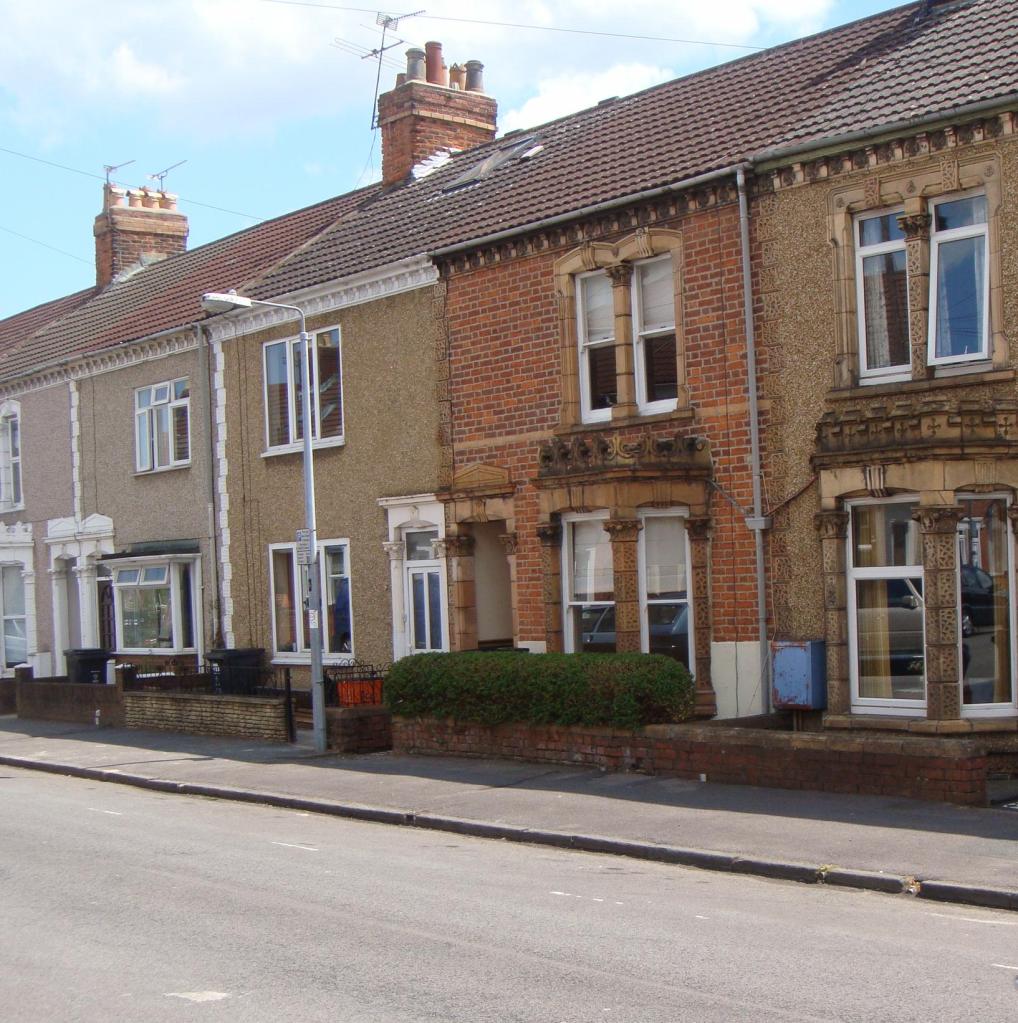
Building began in Clifton Street in about 1879. There were a lot of builders involved, Job Day, James Hinton, Richard Leighfield, which is why the houses all look a little different. There is the Clifton Hotel and 180 houses in Clifton Street; some detached, semi detached, some terraced. Some of them have extensions and loft conversions or porches and some have a name incised in the stonework above the front door, a remnant of a bygone era. There’s a blue house and another with a pink front door and a pink gate and artificial flowers and a heart in the window. The Clifton Stores, still there, stood opposite the the Primitive Methodist Chapel, long gone. There were probably other shops along this long street that stretches from the top of Kingshill to Radnor Street. And tucked away behind is the cemetery.
In the 19th century Clifton Street was home to a lot of railwaymen and their families, now all gone as well.
You might like to read about some of the former residents of Clifton Street who now reside in the cemetery.
These Uzzell family stories seem to be popular. I am enjoying reading all the comments on Facebook. More to follow … and watch out for some of Duncan’s photos.
In 1982 a story grabbed the Swindon headlines, which struck a chord with Swindonians, especially rock band XTC.
In the 1970s Swindon town centre was one big building site (nothing changes). Residents of a length of Westcott Place and all of Westcott Street were given notice to quit their homes, which were due for demolition. By 1975 most of them had gone but one couple refused – Richard and Betty Uzzell were going nowhere. Their house was paid for and after more than 20 years they had got it just how they wanted it.
Swindon band XTC attacked the redevelopment of Swindon at the expense of people’s homes in their song Ball and Chain released in 1982. Don’t Want demolition/Don’t want your compensation./It’s not just bricks and mortar/We are lambs to slaughter. Their record sleeve showed a picture of Richard and Betty’s home, supported by two bricked up houses either side.
After more than a decade of battling the local authority the couple eventually settled for an undisclosed amount of money. I don’t know where Richard and Betty Uzzell moved to after their long battle – but I think know where they came from!
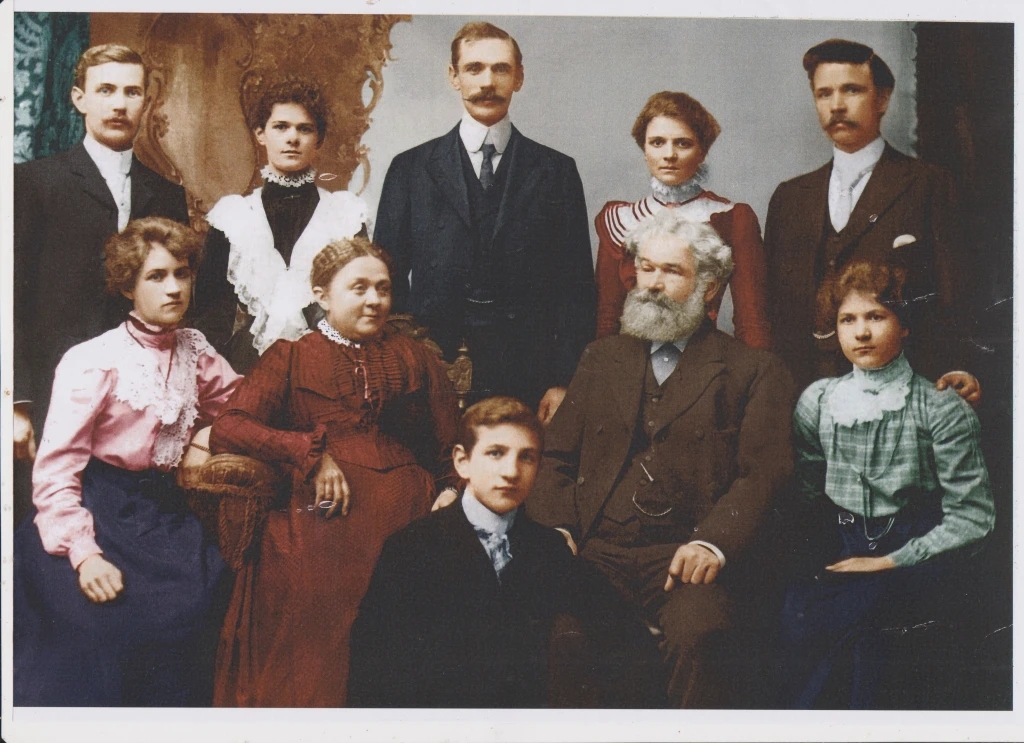
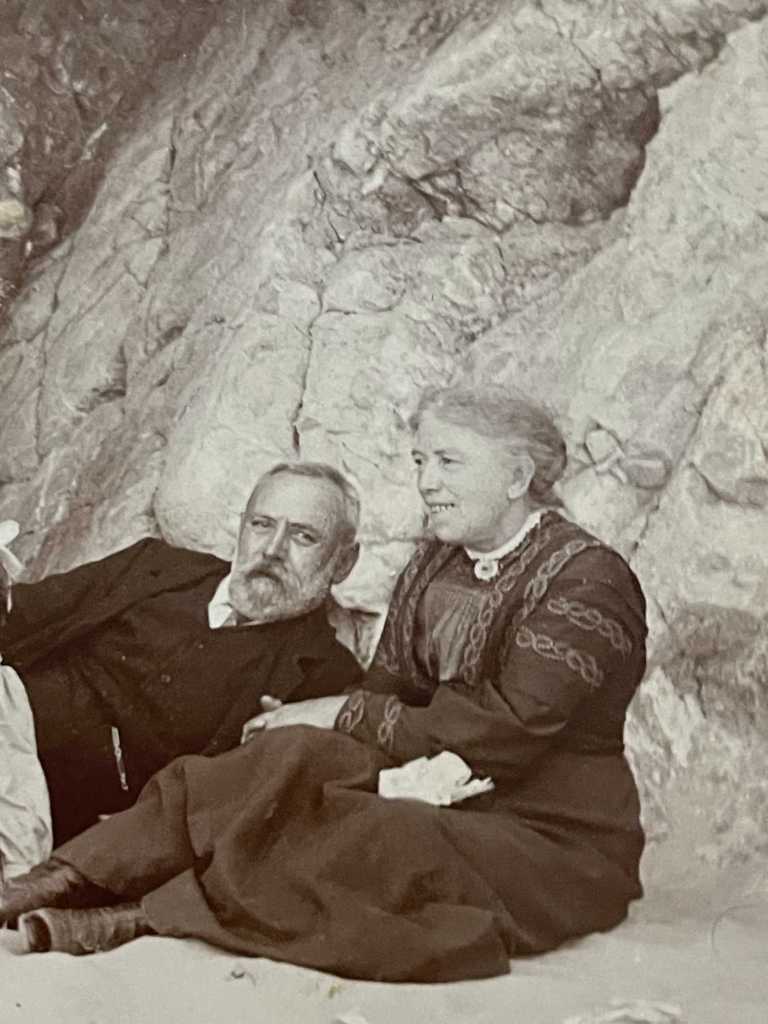
Born in 1923 Richard was the son of Winifred Violet Maud Uzzell. He could trace his family tree back to David and Fanny Uzzell, friends of the First World War Poet Edward Thomas. The photograph above shows four generations of the Uzzell family possibly including Fanny and perhaps that is baby Richard on his mother’s lap. Can anyone confirm?
Many thanks to Ali Keating who has identified the people in this photograph.
Fanny’s daughter Kate is standing at the back & I believe the younger lady is her daughter Ruth holding her baby William.
Maurice Uzzell, who was buried in grave plot D64A, has been relatively easy to research. He has a pretty unusual surname and his branch of the family kept in close contact, which all helps the researcher.
Born in 1868 in Christian Malford, Wiltshire, Maurice was the fourth child of Henry and Hannah Uzzell. In 1871 aged 2 years old he is living in the village with his parents and two elder brothers. By 1881 the family was complete – a daughter and two more sons – and they all lived at 35 Leigh Cottages, Christian Malford. The two elder sons Charles 17 and Stephen 15 were working as agricultural labourers, Maurice 13, was still at school.
Drawn to the bright lights of Swindon, by 1891 Charles 27, Maurice 22 and Fred 19 were boarding with Jesse & Mary Scott (formerly Uzzell and their elder sister) at 67 Jennings Street, Rodbourne. Charles and Maurice worked as labourers and Fred as a blacksmith’s labourer, so probably fair to assume they were all employed in the GWR Works.
In 1896 Maurice married Louisa Worts – so let’s have a look at Louisa. Born in 1855 in Leyton, Essex by 1891 Louisa was living with her widowed mother and her sister and brother-in-law in Colebrook Road, Walthamstow where she worked as a laundrymaid.
In the 1901 census Maurice is living at 61 Clifton Street where he works as a Wood Turner in the GWR Works. Living with him are Louisa, his brother Fred and – hello – a niece – Lily Uzzell aged 10 born in Walthamstow.
An Uzzell family search found all his brothers (and Ellen) and it seemed none of them had ever lived in Walthamstow. Only Louisa (nee Worts) had lived in Walthamstow. Was young Lily her daughter, born before her marriage to Maurice?
In 1911 Maurice and Louisa lived alone at 61 Clifton Street. Louisa declared they had been married for 14 years and had no children.
But what happened to little Lily? Did she die in childhood? If so she is not buried with Louisa and Maurice. Did she marry? I can’t find a name or place that matches.
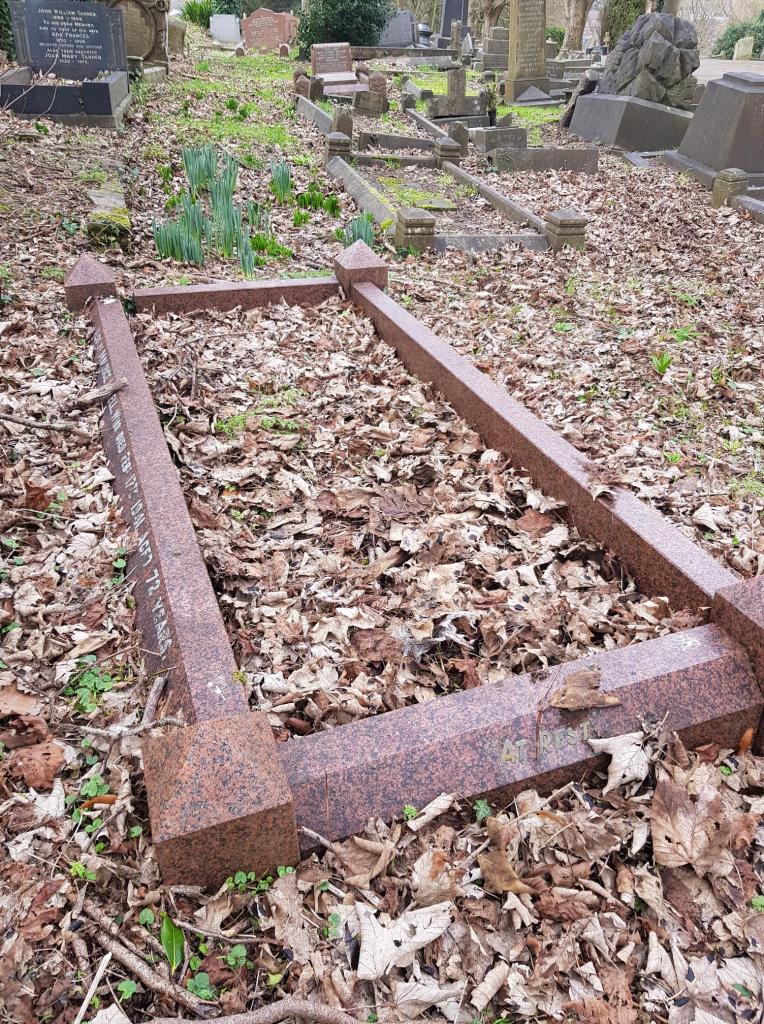
Louisa died in 1931 and is buried in the area close to the cemetery chapel with this discreet pink memorial. Maurice died in 1941. Probate of his estate was awarded to William Scott, railway clerk, most probably the son of Jesse and Mary Scott who Maurice lodged with in Jennings Street as a young man. Maurice is buried here with Louisa.
Fred Uzzell, Maurice’s younger brother who lived with him in 1901 and then moved to Kingshill Road, was buried close to him in the cemetery in grave plot D234.
This branch of the Uzzell family has been relatively straightforward to trace. But what happened to little Lily? I’d love to know.
It was a blustery Monday at the cemetery with a chill in the air and rain on the wind, but it didn’t prevent me from stopping at my favourite bench.
There are four benches (I’m honour bound to keep the 4th one secret) in the cemetery; but this is my favourite one with a view across what was previously known as New Swindon, a railway town.
Here the eye is drawn to the housing development built in the early 2000s on the site of the ‘A’ (Erecting) Shop. A Shop covered more than 11 acres (coincidentally the same size as Radnor Street Cemetery) and was one the largest covered workshops in the world. The red brick apartment blocks, clearly seen from the bench, and the surrounding houses are named in honour of George Jackson Churchward Locomotive Works Manager at the GWR Swindon Works 1902-1916 and Chief Mechanical Engineer from 1916 until his retirement in 1922.
From this bench you can see what remains of the 19th century railway works, more familiar to a younger generation as the McArthur Glen Designer Outlet Village and the railway village, the company houses once home to the early workforce. So many of those railway men and their families moved up the hill to rest in peace in this cemetery.
It was at this bench that I composed the ghostly story of Edie and her soldier son – a tribute to one Swindon family, yet typical of so many others.
This is my favourite bench. Perhaps we’ll meet here one day.
The architectural details on houses in Dean Street differ considerably even though it is basically another long road of red brick terrace houses – a familiar sight in Swindon. Building began in about 1890 with a number of Swindon builders working there, the first of them Thomas George in 1890 who was later joined by his brother John on further work in 1892 and 1894.
One Swindon family obviously enjoyed living there, within easy reach of the railway factory – and each other.
Harry Edward Davis was born in 1850 when his parents were living at New Bread Street, Bristol. He married Louisa Miller in 1868 and they soon moved to Swindon where their son Harry James Davis was born, the eldest of their 13 children. They first made their home in the railway village living in Taunton Street and Exeter Street between 1871 and 1881. In 1891 they were living at 15 Cambria Place, a small cottage built in the 1860s, with 10 of their children aged 8 months to 20 years old.
Sometime before 1901 they moved to 115 Dean Street where Harry was working as a Railway Storekeeper. They still had 6 children living at home aged between 12 and 25 years and Louisa’s widowed father James Miller – oh, and a lodger.
Three doors down their son Harry James Davis lived at No 118 with his wife Rose Ann and their two sons Harry John and Cyril George.
And when the family took up residence in Radnor Street Cemetery they were near neighbours again.
Harry Edward Davis died at his home in 1922 and was buried in grave plot D25A where he joined his daughter Louisa Maud who died in 1920. Harry’s wife Louisa Elizabeth died in 1924 and was buried with them.
Eldest son Harry James Davis died in 1954 and was buried in grave plot D75A, just a stone’s throw from his parents. He is buried with his wife Rose Ann who died in 1930, his son Harry John Davis who died in 1961 and his wife Gwendoline Sarah Katherine Davis who died in 1972.
Then just towards the back of this section alongside the chapel, Hard Edward’s son Wilfred Charles Davis lies in grave plot D45A. Wilfred died in 1964 and is buried with his wife Kathleen who died in 1968.
Harry Edward and Louisa Elizabeth. I rather think this family photograph was taken on TRIP – what do you think?
Two views of Dean Street named after William Dean Chief Locomotive Engineer at the GWR Swindon Works 1877-1902.
The grave of Harry Edward Davis, his wife and daughter.
Harry Edward Davis’s grave to the bottom of the photo and behind it that of his son Harry James Davis and his family.
When Joseph Horne returned from South Africa for a visit in 1931 the North Wilts Herald reported:
‘It has often been said that Swindonians can be found in almost every part of the globe.’
In 1894 Joseph Horne embarked for South Africa where he first worked as a carpenter in a goldmine and later lived in Johannesburg and the Transvaal. He was the eldest of five brothers who had at various times joined him in South Africa. At the time of his visit he was in business with his brother George in a general printing press they had established in 1914. Youngest brother William, a builder, was still living in Maritzburg in 1931. David had spent just three years in South Africa before returning to Swindon and a job in the GWR.
The adventurous Horne brothers were the sons of Herbert and Sarah Ann Horne who married at St. Martin’s Church in Birmingham on Boxing Day 1865. By 1881 they had moved to Swindon and were living at 14 Gooch Street.
How difficult must it have been to wave those sons off to South Africa? Did Herbert and Sarah Ann suspect they might never see them again? Perhaps they hoped their boys would eventually return home, and of course David did.
Herbert died in 1927 but Sarah Ann lived to see her eldest son Joseph on his return to Swindon in 1931. She died in 1934 aged 95 when the North Wilts Herald published another instalment in the Horne family history.
Believed to be Swindon’s oldest inhabitant, and certainly the oldest follower in the Borough of the Baptist faith, Mrs Sarah Ann Horne died on Friday at 26 Cheney Manor Road, the residence of her son, Mr. David Horne.
Mrs Horne, was 95 years of age, having celebrated her 95th birthday on 5 September last.
Death has given the finishing blow to her hopes of living longer thanher grandfather, who, having served in the Battle of Waterloo, lived to within five days of his 100th birthday.
Mrs Horne was active to the last and in full possession of all her faculties. In fact, she did her own mending without the aid of glasses.
Married in Birmingham
She was a native of Frome, and in December 1865, at Birmingham, she married Mr. HerbertHorne, who died at the age of 87, seven years ago. He was, in his time, the oldest railway guard in Swindon, being a link with the old days when, before the introduction of sandboxes, the guards had to be on the footplates and throw sand under the wheels of the engines.
They were married on a wage of 13s a week, and came to Swindon to live first in Gooch Street.
Mr Horne was a prominent official, and at one time the president of the Amalgamated Railway Servants’ Union, now the NUR.
On his retirement, they lived for 20 years at Lower Stratton, until nine years ago, when both cameto live with their son in Cheney Manor Road.
Mrs Horne prided herself on a wonderful memory, and used to recall an incident which occurred when she was a girl in Bath.
For a wager, a man sailed down the Avon in a tub drawn by swans. As he passed under Bath Bridge, the crowd rushed to the opposite parapet to see him. The strain was too great and the parapet gave way, resulting in several spectators being drowned in the river.
Old Age Pensioner
A recipient of the old age pension since its introduction, she saved all of it up until she had sufficient to buy the land in Radnor Street Cemetery for her grave.
She always protested that she would not “liecomfortable” at Stratton Cemetery which she claimed was damp, but that in the sand of Radnor Street Cemetery she would rest peacefully.
She was buried there, with her husband, in the grave she purchased for them both.
Therewere five children of the marriage – all sons and four of them today are in Africa. Mrs Horne also had 14 grandchildren, and 19 great grandchildren.
Her final illness lasted only a few days.
North Wilts Herald, Friday, 19 January, 1934.
Sarah is buried with Herbert in grave plot E8676 where they were later joined by their son David who died in 1954 and his wife Emily who died in 1956.
I wouldn’t wish to question the redoubtable Mrs Horne, but I don’t think the soil is ‘sandy’ in Radnor Street Cemetery.
A short while ago I mentioned a plaque inserted above the houses on Rodbourne Road inscribed Lucknow Terrace. The naming of this terrace was to commemorate the Siege of Lucknow and published here is the obituary of George Mozley who served in India during the defence of Lucknow.
George Mozley/Mosley was born in Bristol in about 1831 and enlisted with the 32nd (Cornwall) Light Infantry in 1846 serving in India from about 1848 to 1858.
At the time of his death The Swindon Advertiser was given details of his military career which was published along with an account of his funeral in the Saturday, January 22, 1887 edition.
Following his discharge from the army George married Amelia Ann Dann in Plymouth in 1862. By 1870 George and his young family had arrived in Swindon where they lived in Quarry Cottages at the time of the 1871 census. By 1881 they had settled in No 3 Stanley Terrace, Rodbourne where George was working as a Watchman in the GWR Works.
He died at his home 11 Linslade Street, Rodbourne in 1887. After serving his country during a long military career, George was buried in Radnor Street Cemetery in a public grave plot B1314, which he shares with four others.
Military Funeral – An old pensioner, named George Charles Mosley, having died at his residence, Linslade-street, Rodbourne Road, orders were issued to the members of the F and G Co’s (New Swindon) Rifle Volunteers to attend the funeral, which took place on Saturday, at the Cemetery. The volunteers assembled at the Drill Hall at 2.15 and in addition to the two companies mentioned, there were also present a number of the K and M Co’s (Old Swindon). The band of the Battalion under Bandmaster J.H. Lay, were in attendance. The men, under the charge of Sergt. Instr. Holman, having been marched to the late residence of the deceased, the funeral cortege – the mourners being the widow and family – proceeded to St. Mark’s Church, where the first part of the burial service was conducted. The Rev. H.D. Butler (curate) officiated, and he also concluded the service at the cemetery. During the journey from the deceased’s late residence to the church the band played Beethoven’s ‘German Dead March.’ Whilst from the church to the cemetery the ‘Dead March,’ in ‘Saul’ was played. The thoroughfares through which the procession passed were lined with spectators, and hundreds of persons witnessed the interment. The usual three volleys were fired over the grave, the firing party of twelve men being in charge of Sergt. Daniels and Corpl. Bull.
The deceased, who had been a pensioner for many years, and was late of the 32nd Duke of Cornwall’s Light Infantry, had had a remarkable career. He enlisted on Feb 29th, 1846 in the 32nd Regiment Light Infantry under the command of Col. Carmichael. He was present with the Mooltan Field Force, under the command of Major General White, C.B., in the first siege operations in September 1848; at the action at Soori Roond, Nov. 7th, 1848; at the taking of the suburb of Mooltan on 27th December, 1848, the storming of the city, January 2nd, and the surrender of the fortress on January 22nd, 1849. He was present at the surrender of the fort and garrison of Chenote, February 9th, 1849; joined the army of the Punjaub, under the command of General Lord Gough, commander in chief, February 20th, 1849; was present at the battle of Goojerat, February 21st 1849; served against the Othman Kheil tribes in the Ranzee Valley, under Brigadier General Sir Colin Campbell, C.B., in the months of March, April, May and June 1852; and was present at the action of Chinhut, June 30th, 1857. He was at the defence of Lucknow from July 1st to November 22nd; at the battle of Cawnpore on the 6th December; and at the capture of Forts Deigham and Tyrhoole in July, and Dondpore in October, 1858.
He was discharged after 24 years service, with a pension of 1s 2½d per day, having received three war medals, one medal for good conduct and long service, and a gratuity of £5. For 18 years since his discharge deceased had been employed in the GWR Works at Swindon.
We are asked to state that the relatives of deceased desire to return thanks to Major Dean for sanctioning the funeral under military honours, and also to the volunteers for their attendance.
The Swindon Advertiser, Saturday, January 22, 1887.
This image of Linslade Street is published courtesy of Local Studies, Swindon Central Library.
George’s wife Amelia died in 1919 and is buried in grave plot C3516 with her son George Henry, his wife Elizabeth and their daughter Violet.
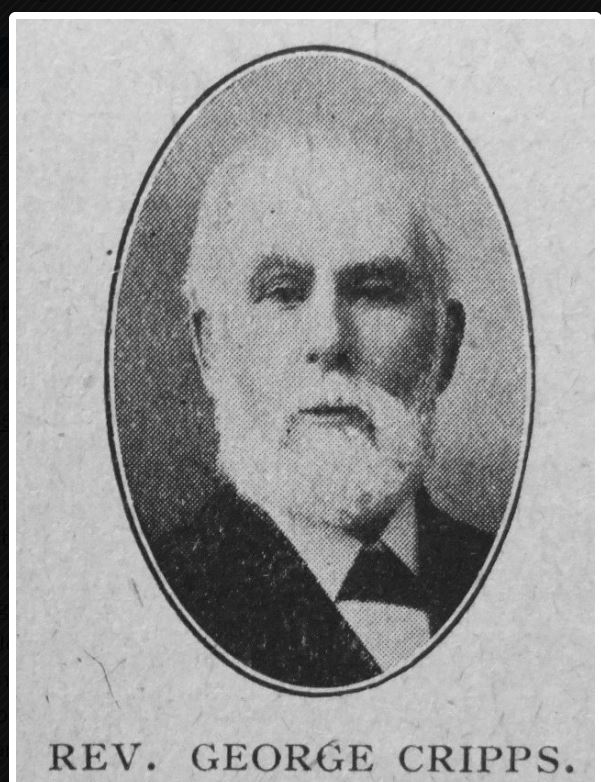
George Cripps was born on May 2, 1839 in Badbury and baptised on May 26 at Chiseldon Parish church. He was the son of James and Sarah Cripps and when aged just 15 he dedicated himself to a life of Christian service. Within months of his conversion he was preaching on the local circuit and embarked upon a long career as a travelling preacher. He began his ministry in Witney in 1861 travelling the country and serving in various circuits including those at Andover, Thetford and Ipswich before returning to Swindon in 1897.
In 1866 he married Ursula Ellen Bayman and the couple had six children, two of whom had sadly died before 1911. Their son Raymond George Cripps married Beatrice Maud Raggett, a member of another prominent local Primitive Methodist family, and went on to become Mayor of Swindon in 1938-39.
George retired to Swindon where he worshipped at the Prospect Place Primitive Methodist Chapel. In 1901 he and Ursula were living at 134 Goddard Avenue. George died at his home on August 25, 1920 and was buried in grave plot D300 which he shares with Ursula who died in 1918.
A lengthy obituary written by Joseph Burton was published in the Primitive Methodist Magazine in 1920 – extracts can be read below:
After a period of further preparation, involving much thought and prayer, he commenced his life’s work as a minister of the glorious gospel of our Lord and Saviour Jesus Christ in 1861. The Witney Circuit pledged him, and he laboured with considerable success and acceptance on the Sturminster Newton, Faringdon, Andover, Newbury, Basingstoke, Thetford, King’s Lynn, Wangford, Ipswich, Tunbridge Wells and Guildford Circuits.
There were many preaching places on most of these circuits, covering a wide area, and sometimes necessitating a walk of fifteen or sixteen miles each way. Besides the ordinary week-night work, our brother frequently preached three and four times on the Sabbath. He built five chapels and reduced debts on others. It seemed to be his lot to have to grapple with such cases, but with indomitable perseverance and tact, he generally succeeded. At Ipswich, where I first formed his acquaintance, he waited upon a gentleman with the intention of getting financial help, but was unable to see him. He called again—twenty times—before he was granted an interview. The gentleman said: ‘‘I believe you have been before.” Our brother replied that he had called twenty times, and should call again unless he got what he desired. The gentleman bade him sit down, and retired to another room. Presently he brought a cheque for £20—a pound per visit—as a reward for his pertinacity, and, told him whenever he needed help, he could call again.
The same zeal was in evidence for winning souls. Well do I remember as a probationer, the Saturday evening open-air services, with sometimes opposition, sometimes police interference; but if we were moved from one place it was to begin again elsewhere: the singing and exhortations went on, and, we had reason to believe, were made a blessing to souls.
He got the Free Church ministers to join him in a mission in connection with our Rope Walk Church, and as they proceeded down the Rope Walk, headed by a brass band, it was the signal for a tremendous opposition that required the whole of the town’s police, except two, to quell. But not before much damage was done. They smashed the windows of the chapel, brick-ends falling on to the platform, and those who had ventured inside the chapel had to be got out by the back door and through the caretaker’s house. Happily no one was seriously hurt. The windows were boarded up, and the mission proceeded for some weeks, leading ministers and friends of other Churches taking part. The riot was due to a misapprehension that the Salvation Army were beginning their mission in the town, but it turned out for great good, many souls professing conversion.
It was while on the Tunbridge Wells Circuit, under the strain of heavy chapel liabilities, and special services—including mid-day services to men during their dinner hour—that his health broke down. His condition was so serious that his medical adviser ordered a sea voyage to New Zealand on a sailing vessel. In a crisis of this kind, one sometimes discovers that: some of God’s servants have been watching the struggle. It was so in his case. One friend secured his passage, others sent useful presents for his comfort on his voyage, and almost weekly, during an absence of eleven months, never failed to minister to his wife and family. On his return it was found there was very little improvement in his health. The Conference of 1887 stationed him at Guildford, from whence he superannuated in 1892, having travelled thirty-one years. He settled down in Swindon. Though broken in health and a great sufferer, he served nine years on the Swindon Board of Guardians, and preached in nearly all the, Free Churches in the town. His wife, never strong in health, but a great helpmate on his circuits, ideal in the home, hospitable and very kind, predeceased him in 1918. Most of the time after her death he was obliged to remain indoors, and latterly was confined to his room suffering from a complication of diseases—uncomplaining, bright, cheerful and hopeful in spirit, and heartily responsive to prayer and spiritual conversation.
Samuel James Christelow was born in 1883 the son of John Christelow,- a boilermaker, and his wife Priscilla. He was baptised at St Mark’s Church on November 30, 1879 and grew up at 42 Wellington Street, a property that remained the family home for more than 70 years.
After several years working in the railway factory, Samuel Christelow travelled to Zimbabwe where he was ordained. In 1938 the Rev Christelow returned to Swindon for an extended holiday with his family. A reporter from the North Wilts Herald interviewed Rev Christelow at the home of his sister and brother in law in Goddard Avenue.
Home From South Africa.
Archdeacon’s Five Months’ Leave
Native of Swindon
After a trip from South Africa aboard the Llanstephan Castle, the liner inwhich a mystery illness caused four deaths on the way, Archdeacon SamuelChristelow, of Southern Rhodesia, has arrived in Swindon on five months’ leave.Swindon born and bred – he is an old Sanford-street scholar – ArchdeaconChristelow has been working in the mission field in South Africa for 30 years,that time being spent in periods of five years in the Dark Continent broken upby spells on leave.
Plenty of Travel.
The diocese of Southern Rhodesia includes part of Bechuanaland, Mashonalandand Matabeleland, and the Archdeacon is also Director of Missions for the wholediocese. This mission work affords him plenty of travel – chiefly by car –throughout the whole territory in which are one and a half million natives and65,000 whites. The whites are chiefly concentrated in Salisbury and Bulawayo.A good deal of translation work occupies Archdeacon Christelow’s attention,for he has an excellent knowledge of the languages of the country. He speaksChishona, the language of Mashonaland, Zulu in Matabeleland, and Sechuana,which is spoken in Bechuanaland.“I learned the languages fairly quickly,” he told me. “I used to have to gooff on trips lasting several weeks with natives who could not speak a word ofEnglish, so of course I had to learn. Most of my journeys then were done onfoot, although I sometimes had a horse, but these animals were inclined to gethorse sickness. We had to take all food with us to last for journeys of severalhundred miles, covering about 25 or 30 miles each day. Occasionally, of course,I was able to shoot some game.”
Native Problems
Of the changes which had taken place in his 30 years’ experience of thecountry, Archdeacon Christelow said: “The attitude of the Government towardsmission work has changed. It is much more sympathetic and shows it in variousways; among them it has started a scheme for providing medical aids for thereis very little medical work indeed, most of it having been done by themissionaries, who also had to fill the roles of dentists, builders andcarpenters.“The Government has also begun a series of clinics.Extracts from the North Wilts Herald, Friday, 4 March, 1938.
Widowed and retired he returned to Swindon where he lived with his sister Rosa at 125 Goddard Avenue. He died in St Margaret’s Hospital in 1972 and is buried in plot D1587.
You might also like to read:
Up at the Castle











 Swindon born and bred – he is an old Sanford-street scholar – Archdeacon
Christelow has been working in the mission field in South Africa for 30 years,
that time being spent in periods of five years in the Dark Continent broken up
by spells on leave.
Swindon born and bred – he is an old Sanford-street scholar – Archdeacon
Christelow has been working in the mission field in South Africa for 30 years,
that time being spent in periods of five years in the Dark Continent broken up
by spells on leave.
 Widowed and retired he returned to Swindon where he lived with his sister Rosa at 125 Goddard Avenue. He died in St Margaret’s Hospital in 1972 and is buried in plot D1587.
You might also like to read:
Widowed and retired he returned to Swindon where he lived with his sister Rosa at 125 Goddard Avenue. He died in St Margaret’s Hospital in 1972 and is buried in plot D1587.
You might also like to read:
 Radnor Street Cemetery