For a certain generation of Swindonians the name Wise will be synonymous with the bakery at Headlands Grove, established in 1938 and which went out of business in 2001. However, this Wise family are railway through and through.
Charles Wise was a Railway Signal Inspector. In 1903 he is recorded in the UK Railway Employment records as having been employed by the GWR for 30 years.
Born in Ufton, Berkshire in about 1848 he married Jane Smith at St Mary’s Church, Reading on December 29, 1874. Their first child Charles was born in Wargrave and their second Thomas in Devizes. By 1879 they had arrived in Swindon where they were living at 14 Sanford Street, their home for more than 10 years.
A daughter Alice Mary who died aged just a year old in 1880, before the cemetery opened, was buried in St Mark’s churchyard and is remembered on this headstone.
Their youngest daughter Gertrude Grace trained as a teacher before marrying in 1917. Her husband was architect Granville Walter Henry George the son of local politician Reuben George.
Jane Wise died at her home 62 Eastcott Hill in August 1920. She was buried in grave plot A238 which she shares with her small son Sydney George who died in 1886 aged 3 years 4 months and her husband Charles who died in 1933 aged 85. Their fallen headstone has been cleared and cleaned by our volunteers.
Members of the 18th Scouts join us every year for our Remembrance Day Service at Radnor Street Cemetery. I wonder if they know that a very significant man in the history of the scouting movement in Swindon is buried in the cemetery.
William Rowland Bird was born on August 19, 1865 and baptised at St. Andrew’s Church, Chippenham in September 1865. His parents were Robert, at that time employed as a Switchman with the Great Western Railway, and Frances. William was the eldest of their five children and spent part of his childhood at 13 Atchley Street, Bristol, but by 1891 the family had moved to Swindon and a home at 73 Albion Street.
William started work in the railway works aged 14. He later transferred to the laboratory where in 1900 he was appointed chief chemist.
William never married. In 1901 he was living at 125 Goddard Avenue with his unmarried sister Edith. By 1911 it looks as if the rest of the Bird family had moved in as well! William shared the house with sister Amy, brother James and his wife and two children, an aunt and a servant.
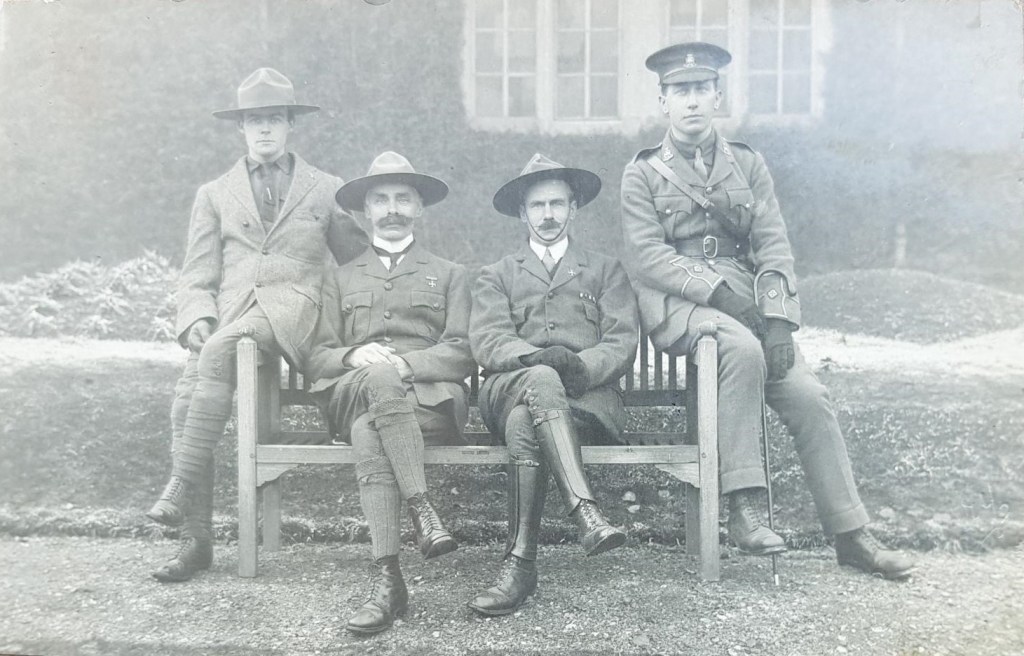
William’s life was equally fully. He was appointed Scout Master of Swindon Troop 2 in 1909 and the following year hosted Baden-Powell at a scout rally in the GWR Park. He served as Scout District Commissioner for North Wilts (including Swindon) from 1910 until his retirement in 1945 when he was appointed vice president of Wiltshire County Scouts. And that wasn’t all! He was one of the founding members and secretary of the Swindon and District Football League. He was a referee and a member of St. Mark’s Young Men’s Friendly Society. He gave lectures at the Mechanics’ Institute on a variety of topics and in 1920 was a member of the Swindon Museum Committee.
In this 1915 image District Commissioner W.R. Bird is seated 2nd on the left
Former chief chemist at GWR dies
A former chief chemist and superintendent of the GWR laboratory at Swindon, and for many years Boy Scout District Commissioner for North Wiltshire, Mr William Rowland Bird (85), of 125 Goddard Avenue, Swindon, has died.
A native of Chippenham, Mr Bird came to Swindon as a boy and entered the service of the former Great Western Railway Company when he was 14 as a fitter and turner. He attended the Mechanics’ Institute evening classes and won the Gooch prize, the premier award.
After serving his time in the shops, Mr. Bird was transferred to the laboratory, and in 1900 was appointed chief chemist. For 32 years he served on the Dangerous Goods and Chemists Committee of the Railway Clearing House. He was one of the first chemistry lecturers at the Mechanics’ Institute.
Church Interests
One of the promoters and first assistant secretary of St. Mark’s Church Young Men’s Friendly Society, he also helped found St. John’s Church Club.
The Boy Scout and Church Lads’ Brigade found a staunch supporter in Mr Bird and other deserving causes always commanded his sympathy.
He was a founder and vice-president of the North Wilts Field and Camera Club, a member of the first committee of the Swindon GWR Engineering Society, of which he became a vice president, a member of the Toc H executive and a vice-president of the GWR St. John Ambulance Association.
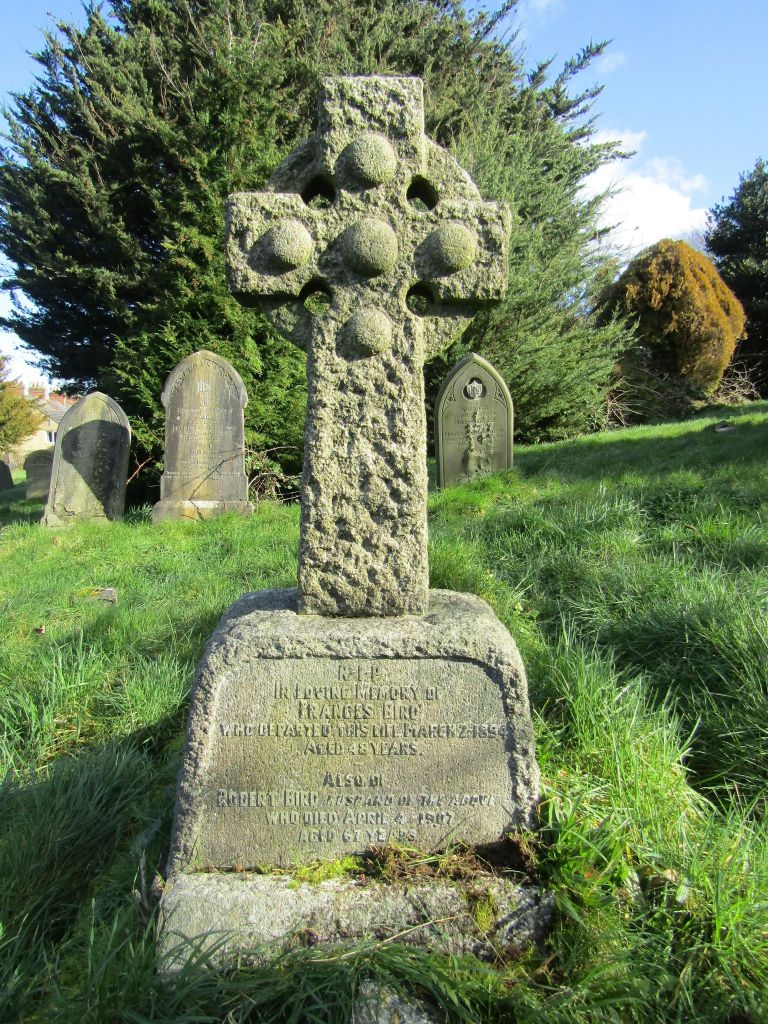
William Rowland Bird died on July 1, 1951 aged 85 years. He was buried on July 4 in grave plot A857 which he shares with his mother Frances who died in 1894 and his sister Maria May who died in 1972. His father Robert is remembered on this headstone but is buried in grave plot E7798 with other members of the Bird family.
My thanks to Steve Milner, Scout Leader at Wootton Bassett, who is presently working on an account of the life and times of William Rowland Bird and can be contacted by messaging via this blogpost.
Hubert Cyril Littleton Haggard was born on May 23, 1889, the second of William and Sarah Haggard’s two sons. He began work with the Great Western Railway aged 15 as a ‘lad clerk on probation’ in the stores department before transferring to the laboratory as an assistant analysist on the junior staff then progressing to the senior staff. Hubert was a conscientious and meticulous student; sadly, it was this attitude to work, which contributed to his fragile mental health. In 1908 Hubert was signed off work and ‘on the club’ – ‘required to be indoors at half past five in the evening.’ Today we have a better understanding of mental health but even now young people like Hubert are failed by an overburdened system.
Swindon Lad’s Sad End
Chemical Student’s Body found in the Canal
Promising career cut short
An exceptionally sad affair has occurred near Swindon. Last (Wednesday) evening a boy walking along the path by the side of the canal in the neighbourhood of Hay Lane, near Swindon, noticed a body in the water. He at once gave the alarm, and a man succeeded in getting the body out. It was apparent that life was extinct. Enquiries proved that deceased was Hubert Cyril Littleton Haggard, of 29 Chester Street, Swindon.
Our reporter made enquiries at the deceased’s home, where the news of the discovery of the body had come as a terrible shock.
Hubert, who was 19 years of age, was one of the brightest and best liked lads in the chemical laboratory in the GWR Factory. He was a lad full of promise, and most attentive to his work. He had been in the GWR laboratory as an analyst for between three or four years, and his exceptional progress and general aptitude for difficult and delicate work impressed those under whose directions he laboured. He held several certificates, and had won scholarships for efficiency in chemical science, being one of the foremost pupils when at the Swindon and North Wilts Technical School. Latterly he had exhibited signs of suffering from debility, which was attributed somewhat to an over application to his duties, for the father stated to our reporter that “Hubert was an extremely sensitive lad; he was conscientious to a degree, and once he applied himself to any piece of work he would stick at it until it was done to his best satisfaction.” The debility was not by any means acute, but it was decided that Hubert should take up no subjects this season, and he was himself agreeable to this. He placed himself under medical care, and being “on the club,” as the saying goes, he was required to be indoors at half past five in the evening. Before then, however, he generally managed to get in a little stroll.
On Tuesday afternoon he went for his usual stroll. He appeared quite fresh and happy when he went out. When he did not return at the usual time, some anxiety was felt, and as the night came on and he still did not return, the police were informed, and all night a search was kept up without avail, until the news came late on Wednesday afternoon that his body had been found in the canal. The deceased, apart from his work, was a cheerful, pleasant lad. He was a member of St. Mark’s Church, and was well liked and warmly respected by all who knew him. Much sympathy is felt with the relatives in their bereavement.
The inquest was held this afternoon and a verdict of “Found drowned” was returned.
Swindon Advertiser, Thursday, November 26, 1908.
Hubert was buried on November 30, 1908 in grave plot E7727. The burial registers include the comment – Found in Wilts & Berks Canal. His mother Sarah died in 1923 and was buried with him. William Haggard died in 1938 aged 85 years and was buried with his son and wife.
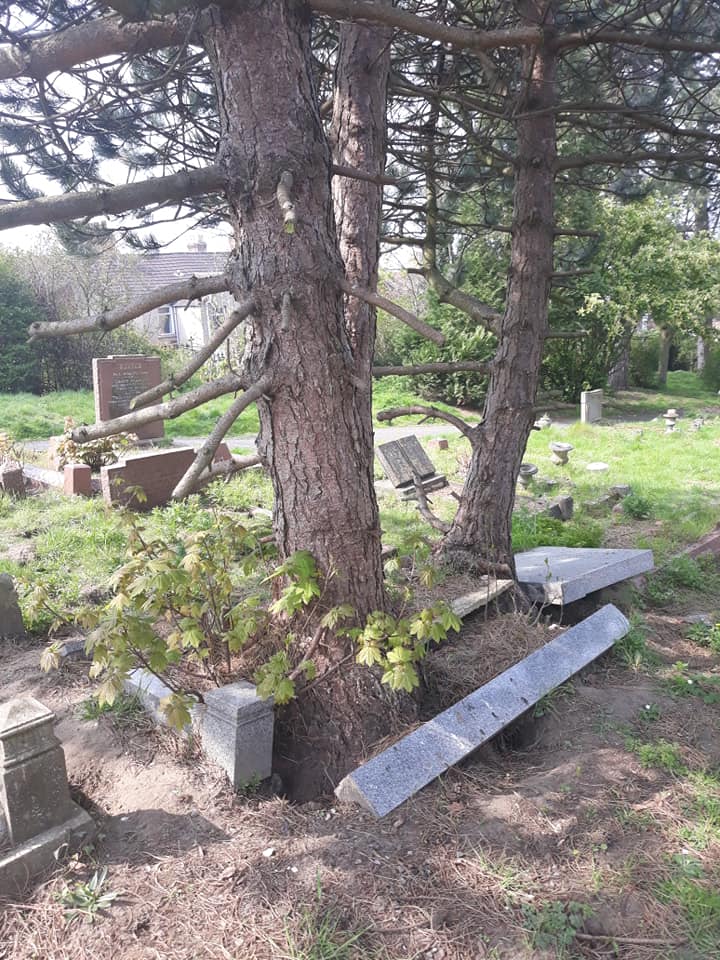
Could the person who planted this tree have imagined how big it would grow? Or perhaps it wasn’t planted but had self seeded and then grown to enormous proportions. This tree has quite literally burst open the grave.
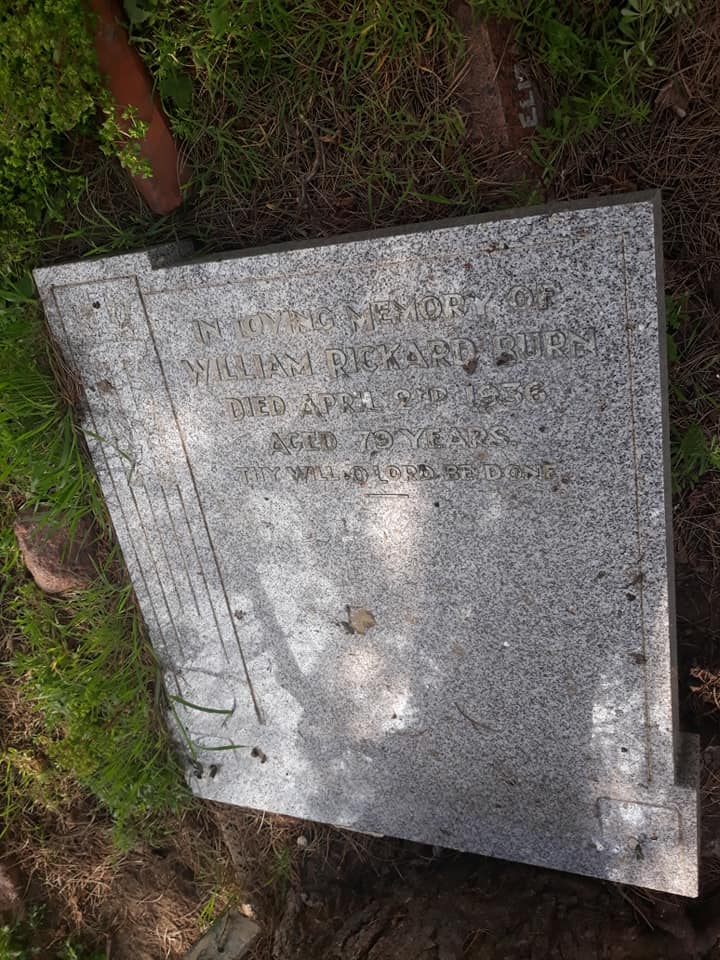
This is the grave of William Rickard Burn who lies alone in a privately purchased plot, surmounted by an attractive kerbstone memorial complete with elegant art deco headstone.
William Rickard Burn was born in Tavistock in about 1857 the son of John Burn, a copper miner, and his wife Mary. William married Lavinia Cross in 1880 and the couple would go on to have a family of seven children.
By 1901 the family had arrived in Swindon and were living at 2 Cambria Bridge Road, but by 1911 something had gone awry. Lavinia was living in Bristol. That year she filled in the census form including the names of her seven children, but later crossed it through. Someone in officialdom had also edited the details with a the stroke of a red pen. Meanwhile, William was lodging in Swindon with his two youngest sons, Charles 14 and John 12. What had happened?
Lavinia died in 1927 aged 70. Her death was registered in the Devizes area. Where was she living at that time? Could she have been a patient at the Wiltshire County Mental Hospital? Further research is required.
William died on April 2, 1936 aged 79 years. He is buried alone in grave plot D442.
Today it is so easy to begin your family history research. With a couple of clicks of a laptop mouse you can enter a whole world of internet possibilities. Of course, there are pitfalls one of which is mis-transcriptions with websites such as Ancestry and Find My Past littered with them. I came across some examples such as Rasticand and Reastreamy when researching the surname Restieaux.
George Francis Restieaux was just sixteen years old (the newspaper report says 18) when he died in 1881. George was born in Neath, Glamorgan but Restieaux was definitely not a Welsh name. He was the son of coachbuilder/painter Edward Alban Restieaux and Susannah Matthews. Edward was employed in the GWR Works and in 1881 the family lived at 2 Bristol Street. Edward and Susannah had married in 1854 at St Pancras Church when they both lived in that London parish. By 1861 they were living in Neath, Glamorgan where George was born in 1865. His father Edward states that his own place of birth was Norwich in Norfolk and I wondered how the Restieaux family had ended up there.
With a few clicks of that laptop mouse I was able to find Edward’s parents Joseph Restieaux and Elizabeth Tidman who married in St John de Sepulchre, Norwich in 1804. Back one more generation and I arrived at the French connection; Andre Restieaux born in Bordeaux about 1740 who married Marguerite Magdalaine Mignot on January 6, 1766 at St Anne’s, Soho.
There is, however, only so far you can get with internet research and at some point you have to look at original documents. It would be interesting to discover what Andre’s occupation was and how he and Marguerite ended up in London, but that is a task for someone else out there. But beware of the pitfalls.
The first burial service in accordance with the rites of the Roman Catholic Church in the new cemetery was performed on Saturday last by the Rev Father Eikerling and the members of the St. Cecilia Society, of which deceased was a member. The body of deceased, George Restieaux, aged 18 years, having been removed from the house of his parents to the Roman Catholic Chapel in Regent Street, the service, which throughout was choral, commenced, lasting close upon an hour, when the body was removed to the hearse and conveyed to the cemetery, accompanied by the Rev Father Eikerling and his attendant acolytes, the relatives and friends and members of the choir and society. At the cemetery chapel the service was resumed by the singing of the Requiem aeternam of Cacciolini, at the close of which the officiating priest preached a brief sermon, in course of which he reviewed the life of deceased and his connection with the St. Cecilia Society. The procession having been reformed, the corpse was borne to the grave, the choir singing the “Miserere,” concluding with the Requiem aeternam. At the grave the singing, which was particularly effective, was brought to a close by the singing of the anthem “I know that my Redeemer liveth.”
The former Roman Catholic Chapel painted by local artist George Puckey in 1890
Despite a rather elaborate funeral service, young George was buried in Radnor Street Cemetery in a public grave, plot A353, where he lies alone.
His father Edward died 14 years later in 1895 and his mother Susannah in 1912. Both were buried in separate, public graves. Edward in B2434 and Susannah in B1609. George’s brother John Valentino Restieaux died in 1928 and was buried in grave plot C61, another public grave.
John Betjeman (Poet Laureate 1972-1984) wrote an essay for a book entitled Studies in the History of Swindon published in 1950 to celebrate the fiftieth anniversary of the incorporation of the Borough. Betjeman’s ‘short architectural study of Swindon’ provides some examples of architecture (and yes, we still have some) but he also gives credit to the construction of the familiar red brick terraces, describing Swindon as ‘more interesting than many towns which are more beautiful.’
Much of 19th century Swindon, old and new, was built piecemeal in short terraces by individual builders; houses that are different styles and different sizes. Occasionally a terrace name survives in brick work such as Albert Terrace in Dixon Street.
Betjeman talks about ‘artisan buildings’ for ‘mechanics and handicraftsmen built consciously as such’ ‘well built and weatherproof,’ and he mentions Hawkins Street, Thomas Street, Charles Street and Manton Street in Rodbourne.
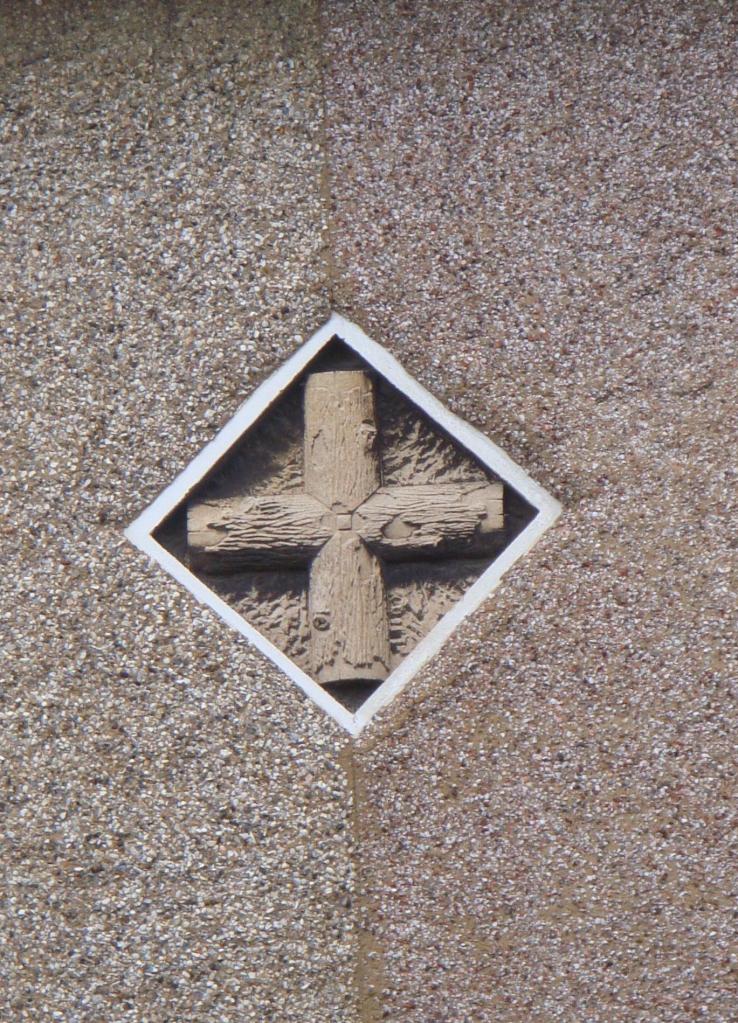
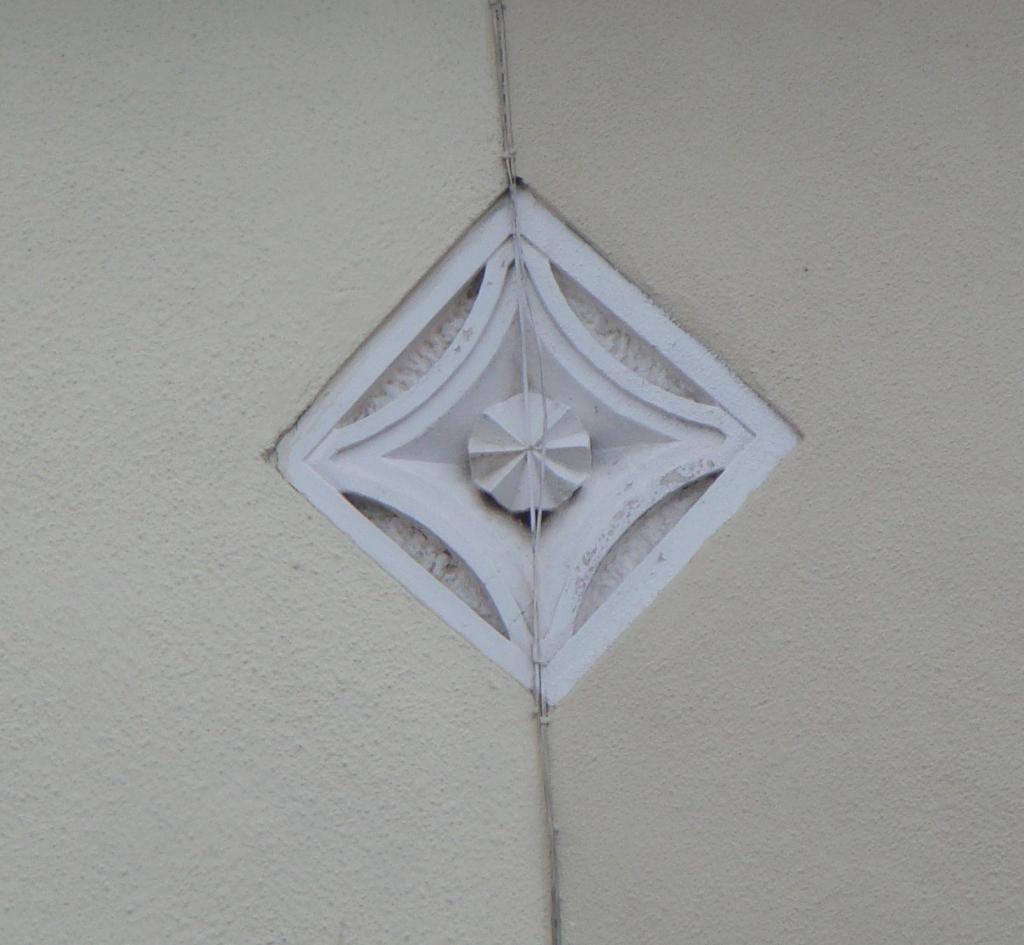
And more than 70 years later there are still interesting features to be found; the trick is to look up! Take a wander down any street in Rodbourne and you will see decorative plaques beneath the eaves. On the terrace between Linslade Street and Jennings Street there is a plaque – Lucknow Terrace 1880 – named to commemorate the Siege of Lucknow in 1857. Perhaps the builder, TP, was a veteran of that war?
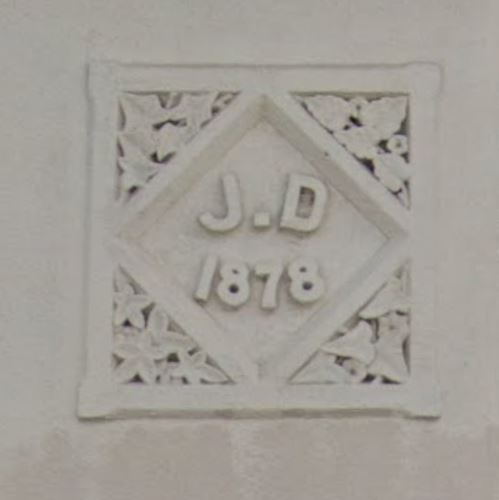
Closer to the cemetery is Albion Street where building dates from 1877. Between house numbers 9 and 10 there is situated a decorative plaque enclosing the initials JD and the date 1878.
Three years later, at the time of the 1881 census, Joseph Deacon, a carpenter and joiner, lived in number 9, (a property he probably built along with number 10) with his wife Eliza and their three young children Sarah Jane 3, Harry 2 and one month old baby William James.
For more than 70 years the Deacon family lived at numbers 9 and/or 10 Albion Street. In 1901 Eliza ran a general shop at number 10 where she later died in 1917 and youngest daughter Julia died at No 9 in 1955.
Joseph died in 1925. He was buried on June 4 and shares grave plot C3415 with his wife Eliza and daughter Julia.
The Skerten family of undertakers had a presence in Swindon for more than 75 years. For most of that time they were busy in Radnor Street cemetery and the early burial registers reveal the many funerals they performed there.
Carpenter and joiner Richard Skerten married Ann Brown at St Paul’s Church, Bristol in 1844 and by 1851 they had moved to Swindon and a home at 32 Reading Street with their three young daughters.
By 1871 Richard was established as both a joiner and an undertaker but his business very nearly came to an end when a disastrous fire totally destroyed his Regent Street workshops. It happened on Friday June 15, 1877 when it was believed the heat of the sun ignited oils in the workshop. Neither the buildings, the stock-in-trade nor the workmen’s tools were insured.
However, Richard re-established his business at 1 Queen Street where his wife Ann and younger son Richard continued to run the family firm after his death in 1886.
Meanwhile, by 1881 elder son Arthur had established his own business at 5 King Street. On April 29, 1887 Arthur had the sad task of burying his twin baby sons Richard and Joseph just 3 and 4 days old respectively. Perhaps surprisingly the babies were buried in a public plot with three others – burial conventions were different then.
Probably the most extraordinary funeral Richard Skerten junior arranged was that of gipsy patriarch Timothy Buckland. For about a month the terminally ill Timothy camped in a field near the Wharf, Drove Road with some nine other vans and tents and 50 members of his family.
According to the Swindon Advertiser the funeral attracted several thousand spectators to the churchyard at Christ Church.
For the funeral the arrangements were placed in the hands of Mr Richard Skerten, undertaker, of New Swindon, and a hearse and eleven mourning coaches were engaged, the adult members of the family occupying the latter. The coffin was of French polished oak, with brass fittings, and bore the simple inscription on a brass plate “Timothy Buckland, died 8th Nov. 1890, aged 70 years.
Extract from theSwindon Advertiser, Saturday Nov 15, 1890.
When their time came all three Skerten undertakers were buried in Radnor Street Cemetery, which seems very fitting.
Richard Skerten senior was buried on May 20, 1886 in grave plot E8434 where he was joined by his wife Ann who died in 1902.
His son Richard was buried on December 11, 1911 in grave plot D1319 where his wife Ann joined him in 1936. Buried with them is their son-in-law Leslie Ernest Adams, their daughter Annie Amelia’s husband, who died at 1 Queen Street in October 1959.
Arthur Skerten was buried on February 9, 1934 in grave plot C1785 joining his 12 year old daughter Isabella May who died in 1907 and his wife Betsy who died in 1930.
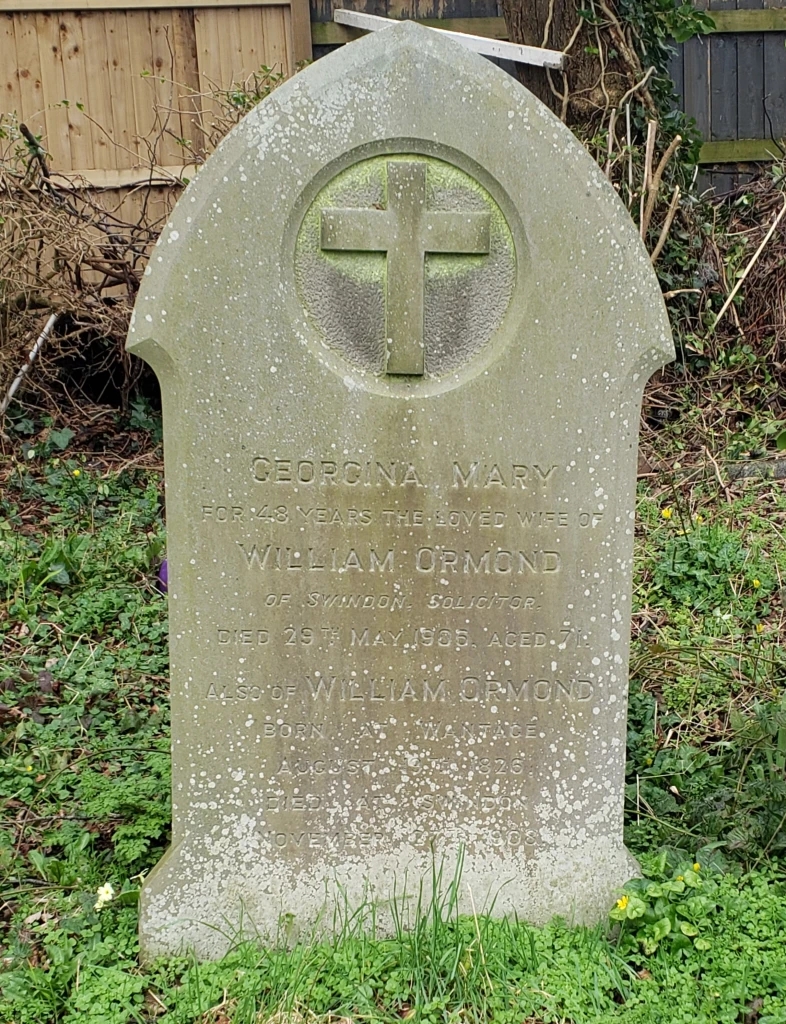
This fulsome account of the life of William Ormond pretty much says it all. However, in 1890 William and his wife Georgina were at the centre of the much publicised case of their daughter Marion and the scandalous Rev Newton Ebenezer Howe, Vicar at Christ Church, which you may like to read here.
Death of a Swindon Solicitor
Mr W. Ormond passes away at the age of 82
A well known and highly esteemed gentleman, who practised as a solicitor in Swindon for many years, has just passed away, in the person of Mr William Ormond, at No. 1. Devizes Road, or, as it is now known, Croft Road. The deceased gentleman, who attained the advanced age of 82 years on the 1st of last August, had been in failing health for some time past. Still he was able to get out and about, and displayed almost wonderful vitality right up to the end.
About three weeks ago, however, weaknesses incident to old age became more and more pronounced and eventually Mr Ormond was compelled to take to his bed, although even then he expressed his intention of getting up and attending Church only last Sunday, when he was obviously in an unfit condition to do so. The wiser counsels of those about him prevailed, and Mr Ormond remained at home. His condition became perceptibly worse, and at times he exhibited a tendency towards delirium and was at other times oblivious to things about him, bordering on unconsciousness. On Thursday it was observed that the end was not far off, and at 6.50 this morning Mr Ormond passed peacefully away.
The deceased gentleman was born at Wantage, in Berkshire, on the 19th August, 1826, and it is a fact worth recording that, until old age compelled him to lay up, he had never, to the knowledge of his family spent one day of illness in bed.
In the month of October, 1849 he went to Abingdon, where he settled down as a solicitor, workingup a good practice, which he continued to hold until 1855.
In March of that year he removed to Swindon, entering into partnership with Mr J.C. Townsend, and taking offices in High Street. Many years after he was in practice by himself, with offices in Victoria Street.
In May, 1858, Mr Ormond married, at North Road, Cheshire, Georgina Mary Lamprey, formerly of Marchwood, Southampton, and the newly married pair, after the honeymoon, returned to Swindon. Eight children were born to them – one son and seven daughters.
The son served his country in South Africa. He became a Lieutenant of the Imperial Light Horse, and died a soldier’s death at the hands of the Boers at Naaupoort on Jan. 5th, 1901.
Of the seven daughters, four are living. The second daughter died in 1861; and the youngest daughter, Winifred, who became the wife of Mr Frank Chapman, of the firm of Messrs Spencer, Chapman, and Co., solicitors of London, died on the 21st May, 1907.
Mrs Ormond passed away two years ago.
The deceased gentleman never took any active interest in public affairs. He was somewhat of a retiring disposition, and was highly esteemed and greatly liked by all who enjoyed the privilege of his acquaintance.
He retired from active professional work about seven years ago. The deceased gentleman was one of those who performed many acts of real charity in a quiet and unostentatious manner – even in a secret. In a word, he delighted in doing good by stealth as many can testify. The last striking example of this was in his recent gift of £400 to the Parish Church for a Men’s Club, which was referred to as recently as Wednesday night by Canon Estcourt at the Parish tea.
The funeral will probably take place on Tuesday, and the family desire, in deference to the deceased gentleman’s expressed wish, that no flowers should be sent.
The Swindon Advertiser, Friday, November 27, 1908.
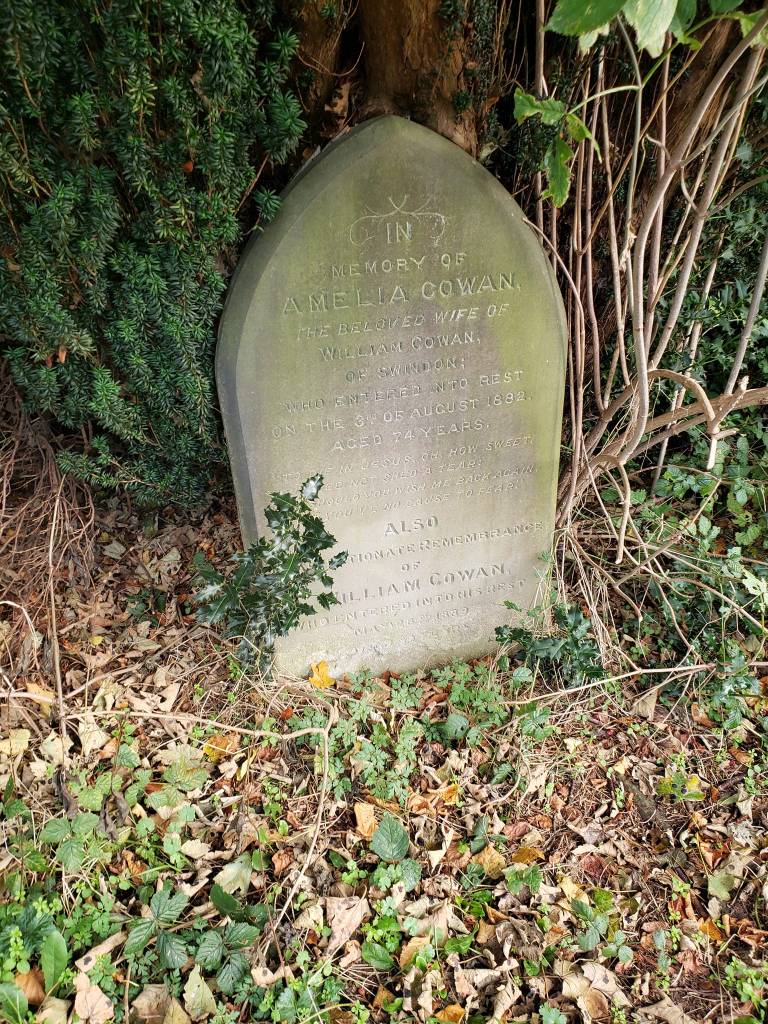
William Cowan married Amelia Roberts at the parish church in Corse, Gloucestershire in 1879. It was a second marriage for both of them.
William had previously been married to Frances Weston who appears to have arrived in Swindon via Brixton after a few stops along the way (much as I have). She died in 1870 and is buried in Reading Cemetery.
Amelia had lived her entire life in the Gloucestershire parish of Ashleworth where she married John Roberts, a farmer of 40 acres, in 1827.
At her second marriage Amelia describes her status as that of ‘Gentlewoman’ an old fashioned term which has slipped out of usage but one I’d like to see revived! The definition of a gentlewoman is a woman who belongs to a high social class; one who is kind, polite and honest, cultured, educated and well mannered. Aren’t we all, ladies, aren’t we all?
Amelia and William’s marriage was of a relatively short duration, which was probably unsurprising given their ages – William was 79 and Amelia 70 when they married.
Amelia died at her home, 23 King William Street, and was buried on August 7, 1882 in grave plot E8636. William died in 1889 aged 89 years and lies buried with Amelia.
Without a budget to purchase civil registration certificates and wills my research is dependent on local and online resources and sometimes it does involve a bit of detective work. Take for example Thomas Anne Fergusson who died on March 5, 1886 at 9 Rolleston Street, Swindon. Consulting the work of family historians on Ancestry, I was fortunate to come across this photograph of Thomas Anne. A clue to her movements is in the name of the photographer – Robert H. Preston, Penzance.
The Swindon link to this woman is her daughter Sophia Catherine Fergusson with whom she lived at the time of her death. Both women were born in Ireland and it would seem that Thomas Anne was probably known as Florence, using her official name on formal documents only.
Thomas Anne married Benjamin Tierney Fergusson at St Peter’s, Dublin on October 21, 1847. Sophie Catherine was born in Dublin in 1851 and just three years later her father died. The whereabouts of Thomas Anne and her young daughter between 1851 and 1881 are yet to be discovered. Sophia Catherine married Martin Etheridge in St. Mary’s, Penzance in 1883. On the entry in the marriage register her father is recorded as Benjamin Fergusson (deceased). The photograph of her mother, then aged 75, was taken in a Penzance photographic studio.
In 1886 Sophia and Martin lived in Swindon where Thomas Anne died. Both are mentioned as beneficiaries on Thomas Anne’s will. By 1891 Sophia and Martin and their three young children were living in Prestbury, Cheltenham where Martin worked as a Market Gardener.
The Etheridge family kept on moving and Sophia died in 1923 in Crickhowell, Breckonshire. Anyone researching Thomas Anne’s Swindon family (like me) would come up against a bit of a brick wall as there wasn’t one.
Thomas Anne Fergusson was buried on March 8, 1886 in grave plot A1062 where she lies alone.











 Radnor Street Cemetery