Mr Nicholas Webb Baker – A Veteran Forester

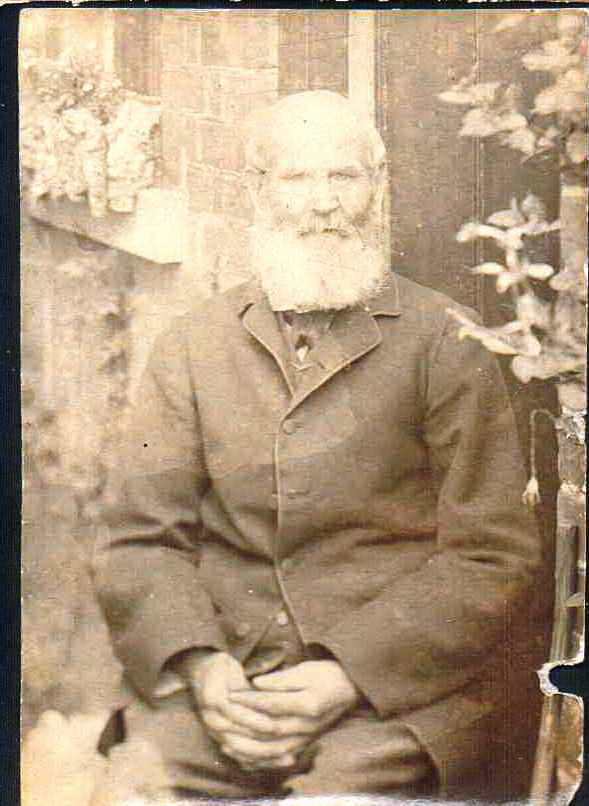
The cemetery volunteers have been busy this weekend and Kevin has discovered another interesting character and a rather magnificent memorial by the chapel. Mr Nicholas Webb Baker is buried in a ‘black-lined brick grave’ according to the newspaper report.

The Late Mr N.W. Baker

A Veteran Forester

The Funeral

The numerous friends of Mr N.W. Baker of 33, Rushey Platt, Swindon, will deeply regret to hear that he passed away suddenly on Friday morning, at his residence. He had been ailing for some time, but was not seriously ill. Had he lived till to-morrow he would on that day have celebrated his 73rd birthday.

For the long period of 44 years, Mr Baker was time-keeper in the GWR Works, retiring from that post about six years ago.

By members of the AOF deceased was well known and highly respected throughout North Wilts. For a great number of years, he was Treasurer of the North Wilts District AOF which position he held at the time of his death. He was Secretary of Court “Briton’s Pride,” AOF for 36 years, and only retired from that office a month ago, owing to failing health.

Deceased leaves a widow and seven grown-up children – five sons and two daughters – for whom the deepest sympathy will be felt.

Bro. Baker was elected to the post of Treasurer of the North Wilts District, AOF, just 20 years ago, viz., in 1883 he succeeding Bros. J.W. Painter. Prior to that time, Bro. Baker was for a few years – from 1876 to 1879 – District Secretary, retiring in 1879 when Bro. T. Hill was elected.

The funeral cortege left deceased’s late residence, No 33 Rushey Platt, at four o’clock. The coffin, which was covered with beautiful wreaths, was conveyed in a hearse, the chief mourners following in carriages, while there was a large and representative number of Foresters, representing Courts in Swindon, Aldbourne, Avebury, Faringdon and Highworth.

The officiating minister was the Rev J. Jones (Primitive Methodist Superintendent), and the Foresters’ Burial Service was most impressively read by Bro. Tom Smith, PD.C.R. and District Trustee.

The remains of deceased were interred in a black-lined brick grave, and the breast-plate on the coffin bore the following inscription:

Nicholas Webb Baker,

Died July 31, 1903,

Aged 72 years.

Extracts from the Swindon Advertiser, Friday, August 7, 1903.
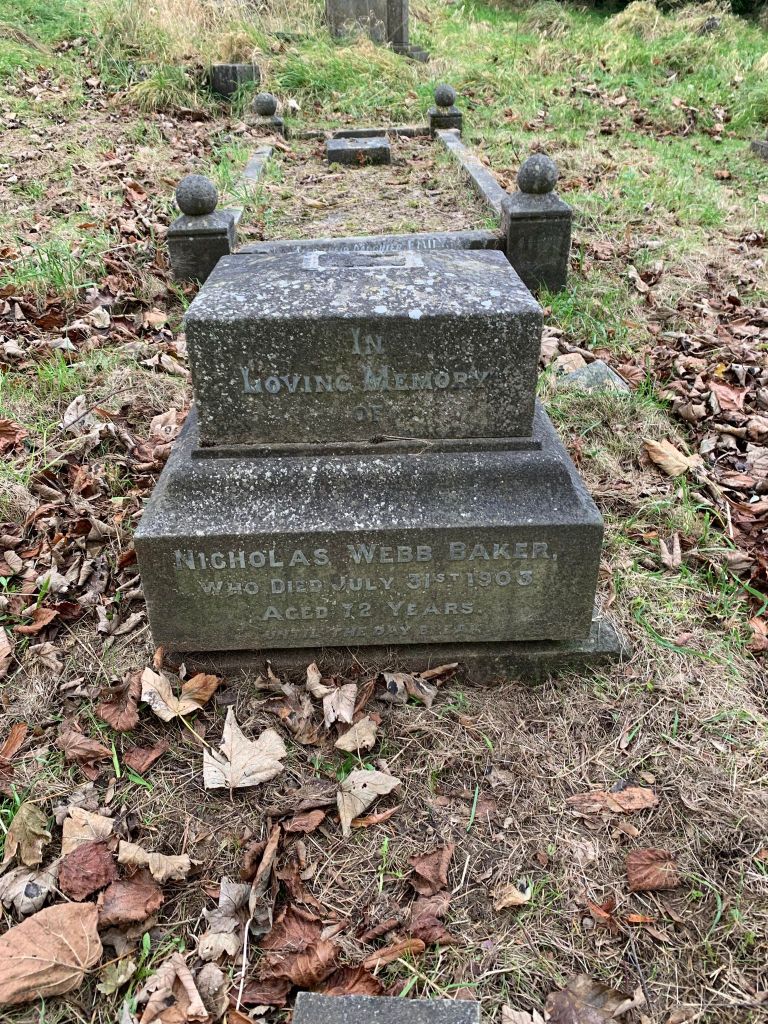
And it seems likely this was the former home of Mr Baker.
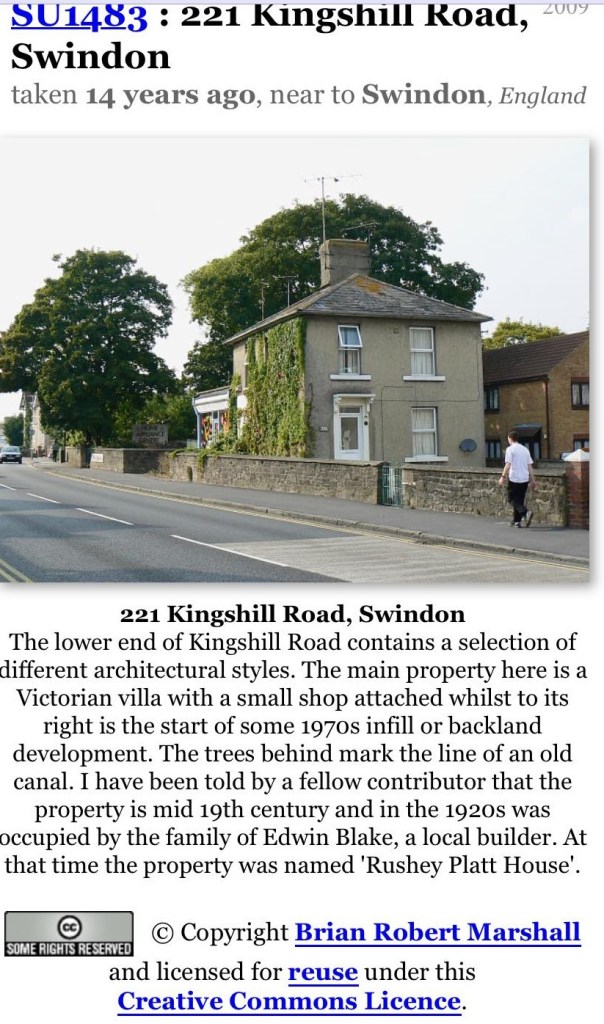
Nicholas Webb Baker died at his home, Rushey Platt House, on July 31, 1903. He was buried on August 4 in Radnor Street Cemetery in grave plot D1557, which he shares with his wife Elizabeth.

A different story altogether

Sometimes the story I set out to research becomes a different one altogether…

I was first drawn to the attractive and unusual design of this small headstone, which marks the grave of George and Annie Hanks and their daughter Dorothy Daisy Elsie Westwood.

Dorothy Westwood died on February 3, 1937 and was buried in grave plot B3083. George Hanks was a member of the Loyal Order of Moose, a fraternal organisation supporting worthy causes. The organisation known today as Moose International meets at the Moose Hall, Eastcott Road. He died at his home 2 Shelley Street and was buried alongside his daughter on August 22, 1938 in grave plot B3084. George’s wife Annie survived him by 25 years. She died aged 92 in Guildford but was buried here with George and their daughter on August 19, 1963 in grave plot B3084.

But these weren’t the first people to be buried in this double plot B3083/4. Like so many plots in the cemetery, this was originally a public grave – a plot for those unable to afford the purchase of their own grave.

Plot B3083 was first the grave of Ellen Little who died aged 63 at her home, 47 Cambria Bridge Road and was buried on March 25, 1909.

Plot B3084 was first the grave of Robert and Georgina Wallbridge.

Robert Wallbridge married Georgina Tryphena Eliza Woodward at Christ Church on August 5, 1903. He was 24 years old, a hairdresser who lived at The Fountain Inn, Devizes Road at the time of his wedding. Georgina was 25, the daughter of George Woodward, a joiner, and lived at 9 Newport Street.

A daughter Irene May was born the following year and another, Vera Maude in 1906. The young family lived first at 181 Rodbourne Road and later at 9 Prospect Hill. But family life was cut short when Robert died in the spring of 1909. He was 29 years old. He was buried here in plot B3084.

At the time of the 1911 census Georgina was living at 9 Prospect Hill where she worked as a Beer House Keeper. Living with her were her two daughters, Irene 6 and Vera 5 and her brother Arthur 20, a cycle maker.

Just two years later Georgina died aged 35 years old. She was buried with Robert in plot B3084 on March 5, 1913.

But what happened to the two little orphaned girls then aged 7 and 9 years old.

I discovered the two sisters on the 1939 census living at 1 Kinnoull Mansions, Rowhill Road, Hackney. Vera was working as a ‘Book Keeping Typist.’ Irene’s details have been redacted. It appears that neither sisters married but their whereabouts between 1913 and 1939 is still to be discovered. The sisters returned to the Swindon area. Irene’s death was registered in February 1985 and Vera died February 9, 1987 at 2 Foundry Rise, Chiseldon.

Sometimes the story I set out to research becomes a different one altogether…

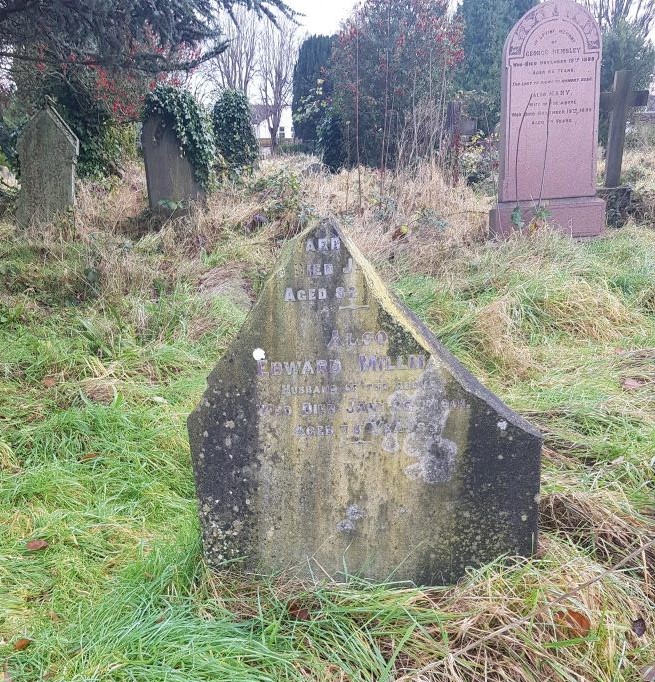
The story of the broken headstone

I’ve had this broken headstone on my to-do list for a very long time. I thought it might prove something of a challenge. I had long wondered who Frederick Millman’s lost wife was and once I discovered her, she pieced together a large Radnor Street Cemetery family history.

Delia Spry was born on December 25, 1805 in Ninfield, Sussex and was baptised in the parish church there on March 26, 1806. In 1829 she married Richard Veness at the Church of St Peter the Great, Chichester.

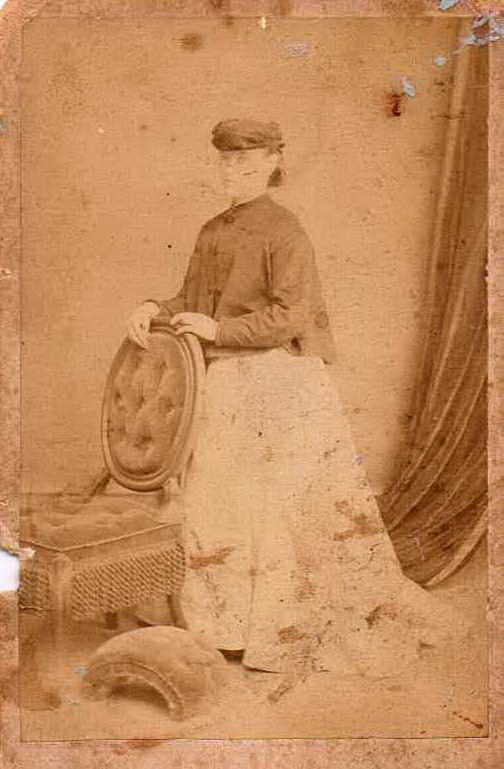
Delia Millman formerly Veness born Spry

I discovered Delia on the 1841 census returns, the first complete census available online. She is living in Hartlebury, Worcestershire, a widow with 5 young children – Maria 10, Jane 9, Thomas 7, Alfred 5 and 3 year old Louisa.

Needs must and it would not be long before she married again. Her second husband was Edward Millman, a bricklayer, and in 1851 the family were living in Wolverhampton. Delia’s two sons by her first marriage have taken their stepfather’s name and Delia has three children by her second marriage – Edward 6, Elizabeth 4 and 2 year old Mary.

Thomas Veness

By 1881 Thomas Veness, married with four children – Thomas, Alfred, Harriet and Reginald, had arrived in Swindon and the family were living at 30 Sheppard Street. You can read their story (especially that of their daughter political activist Harriet) here.

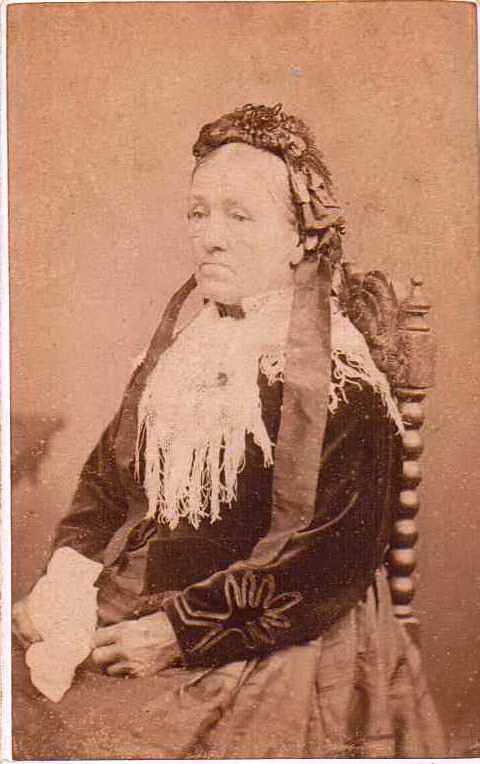
The death occurred at Worcester, on May 21st, of Mr. Thos. Veness, a retired foreman from the Locomotive Department at Swindon, at the ripe age of 87. Mr. Veness was one of the founders of the Swindon branch of the GWR Temperance Union, and as a member and chairman of the branch Committee rendered great service in the early days of the Union. He was an abstainer for over 60 years and an earnest worker. He was for many years connected with the Band of Hope movement, the Church of England Temperance Society, and the Good Templars. After the formation of a branch of the GWR Union in Swindon he gave himself whole-heartedly to forwarding the work and influence amongst the railway staff.

Great Western Railway Magazine August 1920

By 1881 Delia and Edward had returned to Bexhill but they would soon make there way to Swindon. Delia died at her home, 72 Bridge Street and was buried on January 6, 1887 in grave plot E8430 – the headstone broken and her name missing. Edward died 14 years later, at his daughter Mary’s home, 83 Victoria Road. He was buried with Delia on January 30, 1901.

Edward Millman

Elizabeth Millman had also made her way to Swindon by 1881. She had married Frederick Benjamin Hook, another bricklayer, and in the census of that year was living in Upper Stratton with Frederick and her family of six children. You can read the sad story of Ben Lawson Hook who died in an accident in the Works here.

Elizabeth Hook nee Millman

Elizabeth died in 1892 and is buried in grave plot B1711 with her husband and her 16 year old daughter Nora who died in 1909.

And finally, (or is there more to discover) there is Mary Millman, Delia’s youngest daughter born in 1848. After working in domestic service as a nurse she married builder Henry William Bennett and by the mid-1870s they were also living in Swindon. (It was at Mary’s home that her father Edward died in 1901).

Mary Bennett nee Millman

Mary died in 1922 and is buried in grave plot C3672 with her husband Henry William, her son Aleck and daughter-in-law Sarah Annie.

My thanks go to family historians Ellen Magill and S.C. Hatt who have generously shared so much of their family history and photographs on Ancestry and Local Studies, Swindon Central Library enabling me to tell all these Swindon stories.

James and Annie Gardner – 5 Montagu Street, Rodbourne

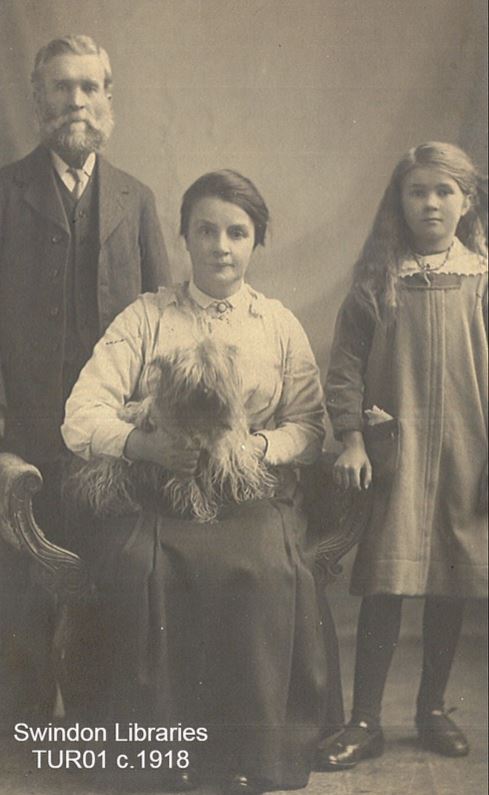
They say every picture tells a story and I love these photos of the Gardner family shared on the Swindon Local Studies Flickr page. Meet James Gardner and his wife Annie pictured in their garden at 5 Montagu Street, Rodbourne taken in about 1935. I’d love to know what was said just before the camera shutter clicked.

Annie was James’s second wife. They married in St. Swithins Church, Walcot, Bath on December 27, 1905. James was 52 and Annie 39. James had several children by his first wife Sarah and presumably Florence Gardner was the daughter of one of these. She appears on the 1911 census aged 3 years old living with James and Annie and Annie’s mother Margaret at 5 Montagu Street.

These two charming photos of Florence appear with those of James and Annie.

James died at his home in Montagu Street in 1939 aged 86 years old. Annie died in 1947 aged 82. Her last address was Ford Street, just a stone’s throw away from Rodbourne. Perhaps she ended her days living with Florence?

James and Annie are buried in grave plot C639, Radnor Street Cemetery.

Nellie and William James Bacon – a Gorse Hill story

In the 1970s and 80s West Swindon was built as a cluster of village centres – it seemed to be a plan particularly favoured by Swindonians. In the 1840s there was the Railway Village followed by development in Even Swindon and then a satellite suburb Gorse Hill built in the late 1890s and 1900s. And it seemed that once people put down roots they seldom moved away. Take, for example, Nellie Bull, daughter of George and Maria Bull.

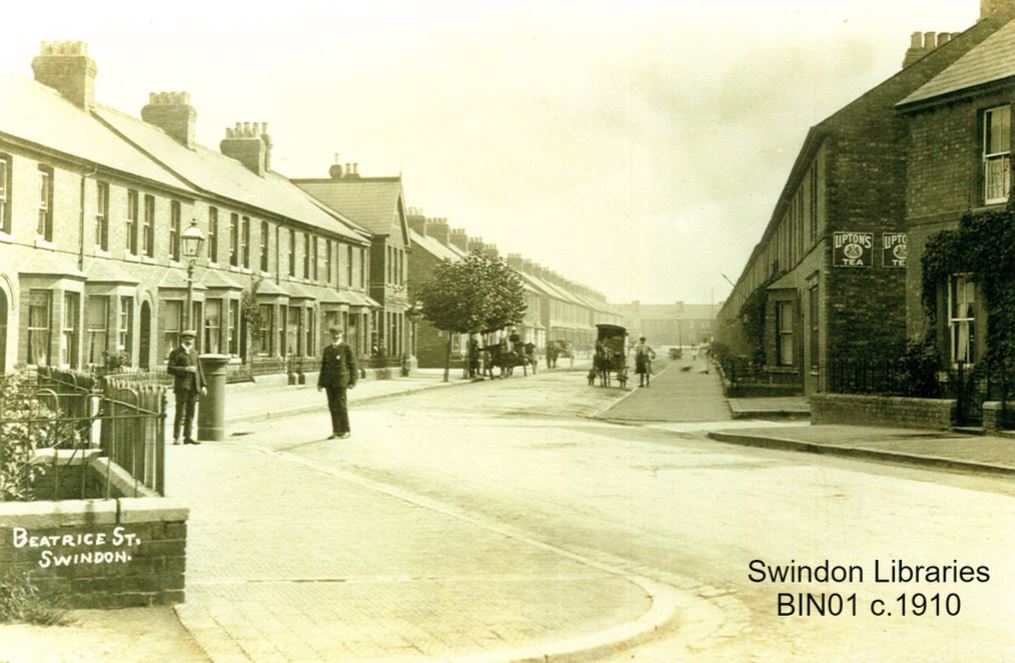
This image of Beatrice Street taken in around 1910 is available to view with a selection of Gorse Hill photos at Local Studies, Swindon Central Library.

Nellie and her brother George grew up in spanking, brand new Gorse Hill in the 1890s. In 1891 they lived at 70 Hinton Street, built in 1890 by entrepreneur James Hinton, Swindon Mayor in 1903/4 who also once owned the land on which the cemetery was built. By 1901 the family had moved to 119 Beatrice Street, another new build, and it was here that William George Bacon came to lodge with them. On Christmas Day that same year he and Nellie were married at St. Mark’s Church.

The young couple continued to live with Nellie’s parents in Beatrice Street where their baby daughter Nellie Gladys was baptised at St. Barnabas’ Church in 1902. They were still living at 119 Beatrice Street when Berty was born two years later, although he was baptised at St. Luke’s Church, Barton Hill, Bristol. By 1909 the family were at 7 Suffolk Street, just around the corner, when George Stanley was baptised at St. John’s the Evangelist. In 1939 William and Nellie were living at 33 Beatrice Street with their daughter Nellie and her husband Percival and Anna (Maria) Bull.

This stylish headstone with discreet art deco features marks Nellie and William’s last resting place, the only time they left Gorse Hill. William James Bacon died on June 18, 1948 at his home, 33 Beatrice Street. Nellie died March 2, 1956 at 33 Beatrice Street.

If you’d like to know more about Swindon’s 1980s West Swindon development – West Swindon – What the eye doesn’t see by Angela Atkinson, Roger Ogle and me is available from Hobnob Press, Bert’s Books, Amazon and other Swindon bookstores.

Benjamin Messiter – Swindon’s story

If ever a family provides a snapshot of life in Swindon at the turn of the 20th century, it is the Messiter family. A story of Swindon’s growth and the development of the railway works encouraging migration from across the country; a story of non-conformity and close family ties. Even Benjamin’s death took place during that iconic event in the Swindon calendar – the GWR Trip.

Image published courtesy of Local Studies, Swindon Central Library.

Benjamin was born in Trowbridge in 1845 and began his working career as a wool worker, arriving in Swindon in the 1860s for a more lucrative job in the railway works. He married Ann Ferguson in 1869 at the Wesleyan Methodist Chapel ‘near the market place, Swindon’ (the Planks).

The young couple began married life at the newly built Cambria Place living with Ann’s parents and six siblings at No. 34. Her father Charles was a fitter who had moved down from Scotland in the 1860s to a job in the railway factory. Ann and her brothers and two of her sisters were all born in Scotland.

Benjamin and Ann’s only daughter Louisa Ann, was born in 1872 and at the time of the 1881 census they were all still living with Ann’s parents in Cambria Place.

By 1901 Benjamin and Ann had moved to 11 Deacon Street where they lived with their married daughter Louisa, her husband Frank and their 5 year old son, Stanley.

An old and highly respected resident of Swindon, in the person of Mr Benjamin Messiter passed away with painful suddenness at Bristol early in the evening of last Saturday. Mr. Messiter had been spending his “Trip” holidays with his sister at 31, Hayward Road, Barton Hill, Bristol, and, not desirous of coming back to Swindon with the “Trip” train on Friday, he had arranged to return on Saturday evening.

After having completed all the preparations for his return, Mr Messiter was partaking of tea at half past five o’clock, when he collapsed and passed away immediately.

With all speed, medical aid was summoned, and in less than five minutes from the sad occurrence a doctor was in attendance, but could only pronounce life extinct.

News of the occurrence was immediately despatched to Mr. Messiter’s relatives at Swindon, his son-in-law, Mr. Matthews, at once leaving for Bristol

A Coroner’s inquiry touching the death was held on Monday, when a verdict of “Death from syncope” was returned.

Mr Messiter, who had been ailing for the past two years, was a native of Trowbridge and was 64 years of age. Coming to Swindon from his native town some 32 years ago, the deceased gentleman had since that time followed his occupation in the GWR Saw Mills.

During his many years’ residence in Swindon, he had gained the warmest esteem and respect of a very large circle of friends amongst the older generation of Swindonians, among whom the news of his death will occasion the keenest regret. He had a large number of relatives in Swindon, who have been the recipients of many tokens of sympathy in their sad bereavement.

Extracts from The Swindon Advertiser, Friday, July 16, 1909.

Swindon’s storyphotograph taken from Radnor Street Cemetery

Benjamin Messiter was buried on July 15, 1909 in grave plot E7956 which he shares with his wife Ann who died in 1902 and his son-in-law Frank Matthews who died in 1935 and daughter Louisa Matthews who died in 1958.