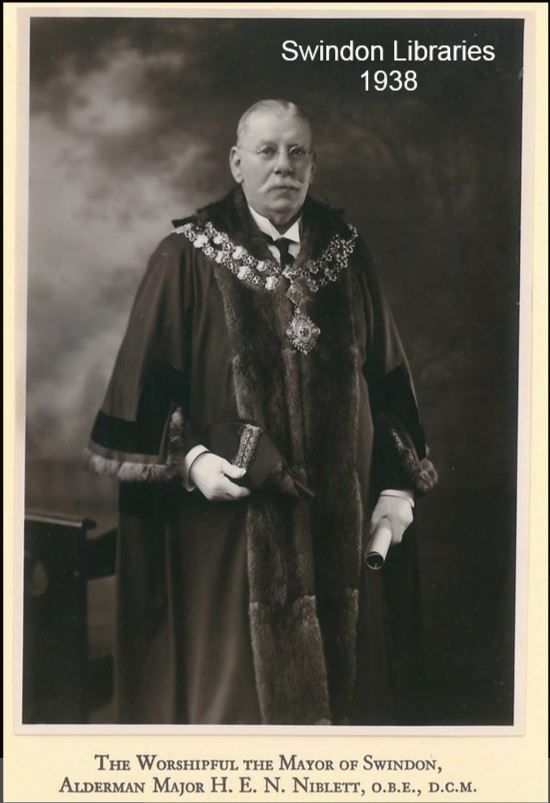
Major H.E.N. Niblett – A Fine Record of Public and Military Service

Sometimes I come across such a detailed obituary there seems little I could add to the subject’s life history. Not wishing to rewrite this fulsome account, here is the story of Major Henry Edward Newton Niblett – Mayor of Swindon 1937-38.
Death of Major H.E.N. Niblett

A Fine Record of Public and Military Service

Major H.E.N. Niblett, gallant soldier, an ex-Mayor of Swindon, friend of the poor and the blind, and lover of children, died early on Saturday at the age of 78. He had been ill for just about a month.

Though prominent in many spheres of public and social life in Swindon – and he proved his ability as a local administrator on the Town Council – he was first and last a soldier.

He disliked fuss and show, although he was a stickler for conformity to established rules and proper observance of traditional ceremonial.

He never wanted praise. He disliked it. In fact, it was his last wish that there should be no flowers, no mourning, and no paeans of praise – he knew well that they so often lack sincerity.

He leaves a widow, two sons and two daughters. The sons are Mr A.H. Niblett, who was disabled in the Great War, and Mr R.N. Niblett who lives at Stratton. The daughters are Mrs B.H. Brewer, of Stratton, and Mrs D. Tasker of Andover.

26 Years in India

Born in September, 1861, Major Niblett entered the Army when 22 years of age and remained in the service until April, 1912. During this time he spent 26 years in India and was recalled at the outbreak of war in 1914. It was on 29 May, `920, that he retired with the rank of Major.

His military life was a varied and distinctive one. He served in the Nile Expedition 1884-85 with a Camel Corps and was present at the relief of Gordon.

From 1895 to 1898 inclusive, he was on the Indian frontier and served throughout the Great War.

His honours and medals make a formidable list. They comprise the OBE (military) awarded at the end of the Great War, Distinguished Conduct Medal awarded in 1885; Egyptian medal with bars for Nile, 1884-85, Abou Klea; Indian frontier with bars for Chitral, 1895, Punjab frontier 1897-98, and Tirah.

In the Great War he saw a deal of service in Mesopotamia, where he remained from 1916-1920. His distinctions in this connection comprise two medals with Palms. He also had the Indian Coronation medal 1912, the Good Conduct Medal, Meritorious Service Medal and the Khedive’s Star 1884-85. On four occasions he was mentioned in despatches – once from Egypt in 1885, again from the Indian frontier in 1898, and twice during the Great War.

Masonic Honours

Equally imposing were his honours in Freemasonry and which were: P.M. Lodge, “St. John 486 E.C.,” Calcutta, 1896; D.G.S.B. Bengal, 1896, Royal Arch; P.Z. Holy Zion, Calcutta, 1898, D.G.D.C., Bengal, 1898, also member of Mark Masters and Ark Lodges; founder of first lodge in Baghdad, Iraq.

His early days were spent at Minchinhampton Common and in London. He was in Ireland on eviction and protection duty during the boycott trouble in 1882.

He was a member of the Swindon Town Council for nearly 14 years. Mayor of Swindon 1937-1938, it was during his term of office that the Duke of Gloucester opened the new Civic offices.

One of the oldest and most popular members of Ashford-road club, Major Niblett did work of immense value among the poor, the blind, and the children of the town. He took a keen interest in the hospital, the carnival, and ex-Servicemen, and was an active worked for “The Swindon Advertiser” Poor Kiddies’ Outing.

Major Niblett will be sadly missed and widespread sympathy goes out to Mrs. Niblett, who does much good work in the town, and to her family.

The Funeral

Friends, neighbours, and representatives of various local organisations, attended the funeral on Wednesday.

He was buried with military honours. His coffin, carried on a gun carriage drawn by an Army tractor, was enshrouded with the Union Jack, and bore only one floral tribute – that of a cross shaped wreath of lilies. Six Army Warrant Officers acted as bearers. The service was held at St. Saviour’s Church, Ashford-road, Swindon, and the interment was at Radnor-street Cemetery. The Rev. J.F. Tickner officiated. At the graveside, a bugler played the Last Post and Reveille.

Family mourners were: Mrs. S.J. Niblett (widow); Mr A.H. Niblett (elder son); Mr R.N. Niblett (younger son); Mrs. D. Tasker (elder daughter); Mrs. B.H. Brewer (younger daughter); Mrs N. Boulton (sister-in-law); Mr B.H. Brewer (son-in-law); Mrs R.N. Niblett (daughter-in-law); Miss J. Niblett (grandchild); Miss D. Boulton (niece).

Public Mourners

Representing the Swindon Town Council were: The Mayor (Counc. H.R. Hustings); Messrs. T.C. Newman, J. Belcher, H.H. Wheeler, F.E. Allen, T. Manning, F.E. Drinkwater, A.J. Gray, A. Snow, C. Macpherson. G.H. Hunt, L. Dodson, Mrs May George, D. Murray John (Town Clerk).

The Swindon Conservative Association were represented by: Sir Noel Arkell, and Mr. P. Smith. Representing the Swindon branch of the British Legion were: Lieut.-Col. B.L. Birley, DSO. Messrs R.W. Rice, W.H. Marshall, H.C. Preater, and Corporal Smith.

The Swindon branch of the South African War Veterans’ Association: Messrs. H. Warman, J. Stanton, G. Payton, F. Little, and P. Scott. The Old Contemptibles’ Association: Mr JA. Cresswell and E.M. Ockwell. The local Blind Association by R.L. Robins (president) and Petty Officer J. Walters, of the Royal Navy; Mr K.N. Knapp (Swindon and North Wilts Victoria Hospital); Mrs McGregor Johnson (Women’s branch of the Swindon Conservation Association).

Representing the Junior Imperial League of the Constitutional Association were Messrs. Coun. C.W.J. Streetly, W. Gregory, Mr and Mrs James, and Mr Fred Bishop. Ashford Club: Messrs G. Cottrell and A. Collins. Representing the Gloucestershire Regiment Association was Mr T. Twitchell.

The Mayoress, Mrs H.R. Hustings, and Mrs D. Murray John represented the local branch of the NSPCC.

Among numerous other mourners were: Mr C.A. Plaister, Mr H. Watkins, Mr T.J. Gay, Mr W.H. Masters, Mr H. Baker, Mr W. Clark, Mr G. Hays, Mr W.J. Mantell, Mr D.W. Jones, W. Seaward, C. Parkhouse, W.O. Lavington, F. Pointer, Sergeant-Major T.F. Culley, Mrs. A.C. Booth and Major A. Wingfield.

North Wilts Herald, Friday, 15 March, 1940.

George Stanley Morse – a life cut short

The re-imagined story …

They are bringing him home tomorrow.

The grand entrance hall at The Croft is made ready with vases of white roses and arum lilies on every polished surface. The sweet scent of jasmine drifts in through the open window. His coffin will stand here until the funeral on Saturday. Friends and family are expected to call and pay their last respects.

lilies and roses

I would like to keep a vigil throughout the night. I don’t want him to lie here alone. I would like to sit next to him, rest my hand upon the coffin, speak to him. But this would not be allowed.

I would like to bear the weight of him on my shoulders as his body is borne to the graveside. I would throw myself into the open grave and lie with him through eternity. No one knows the depth of my love for him. No one knows my sorrow, there are others who have more right to mourn than I, my loss is of little consequence.

We had no future, we had no past. I loved him in silence and in secret. There is no one I can confide in, no one I can tell how much I loved him, how much I miss him, how it will always be so.

They are bringing him home tomorrow.

jasmine

The facts …

George Stanley Morse was born in Stratton St Margaret in 1880, the third child and second son of Levi Lapper Morse and his wife Winifred. In 1891 the growing Morse family lived at Granville House, Bath Road but by 1901 they had moved to The Croft, a property set in more than four acres of land with a paddock, fountain and a tennis lawn. The grounds also contained flowerbeds and terraces with ornamental trees. The magnificent house was approached by a lengthy carriage way and opened on to a spacious, domed hall.

In 1906 George Stanley Morse MRCS LRCP was house surgeon at the Metropolitan Hospital.

Inquest

A Fatal Scratch – Young Surgeon’s Sad Fate

Dr Wynn Westcott held an inquiry this week at Hackney respecting the death of George Stanley Morse, aged twenty-six, house surgeon at the Metropolitan Hospital.

Mr Levi Morse of The Croft, Swindon, MP for the Southern Division of Wilts identified the body as that of his son. He was a healthy young man, and had been at the Metropolitan Hospital about nine months. Witness heard that he had poisoned his finger while making a post mortem examination, and while he lay ill in the hospital he told witness that the affair was purely accidental.

Dr Harry Overy, pathologist at the Metropolitan Hospital, deposed that the deceased gentleman assisted at a post mortem examination on the body of a child who had died from meningitis following ear disease. He had the misfortune to prick one of his fingers, and subsequently he had a fit of shivering, and became ill. Witness saw him on the following day, and found him with a high temperature, shivering, and with some tenderness of the finger. The glands of the shoulder were also tender.

Beyond Help

He was also seen by Dr Langdon Brown and Mr Gask, a consulting surgeon, and some small operation was performed on the finger. ‘In spite of all that could be done, the temperature kept up almost to the end. Death was due to septicaemia, resulting from the prick of the finger.’

The coroner remarked that Dr Morse was held in great respect as a rising young practitioner. The case showed the dangers to which the doctors were exposed.

A Juror: Would it not be reasonable to anticipate awkward results from pricking the finger, and to take steps to render it harmless if possible?

Dr Overy: Mr Morse washed his finger and took the ordinary precautions, immediately after the accident.

The jury returned a verdict of accidental death and expressed their sympathy with the father.

Herald Saturday June 16, 1906.

Funeral of Dr Stanley Morse

The funeral of Dr Stanley Morse, second son of Mr L.L. Morse MP for South Wiltshire, whose death under sad circumstances was reported in our last issue, took place at Swindon Cemetery on Saturday afternoon. The coffin containing the remains of the deceased was conveyed by train to Swindon on the previous Thursday and rested at The Croft until the time of the funeral. The coffin, which was of panelled oak with massive silver-plated furniture, bore the inscription:-

George Stanley Morse MRCS LRCP Died 12th June, 1906 Aged 26 years

At the foot of the coffin were engraved the words “At Rest.” The first part of the service was held at the Regent Street Primitive Methodist Church, the service being conducted by the Rev W.J.T. Scruby assisted by the Rev George Hunter. After the opening passages of the burial service had been read the hymn “Rock of Ages” was sung, and then the Rev George Hunter read the 90th Psalm. The second hymn was “Oh God, our help in ages past,” and the first part of the service closed with prayer. The congregation stood as the assistant organist, Mr Arthur Barrett, played the “Dead March” in Saul. The concluding portion of the service at the graveside was conducted by the Rev W.J.T. Scruby, in the presence of a very large number of mourners.

A large number of beautiful wreaths and crosses were sent, including tributes from the Residents of the Metropolitan Hospital and Mr Harry Overy; the Medical and Surgical Staff of the Metropolitan Hospital; the Nurses; the Committee, Metropolitan Hospital; the Matron and the Sisters, Metropolitan Hospital; and the Junior Staff and Students of St Bartholomew’s Hospital.

Extracts from The Salisbury and Winchester Journal and General Advertiser published Saturday, June 23, 1906.

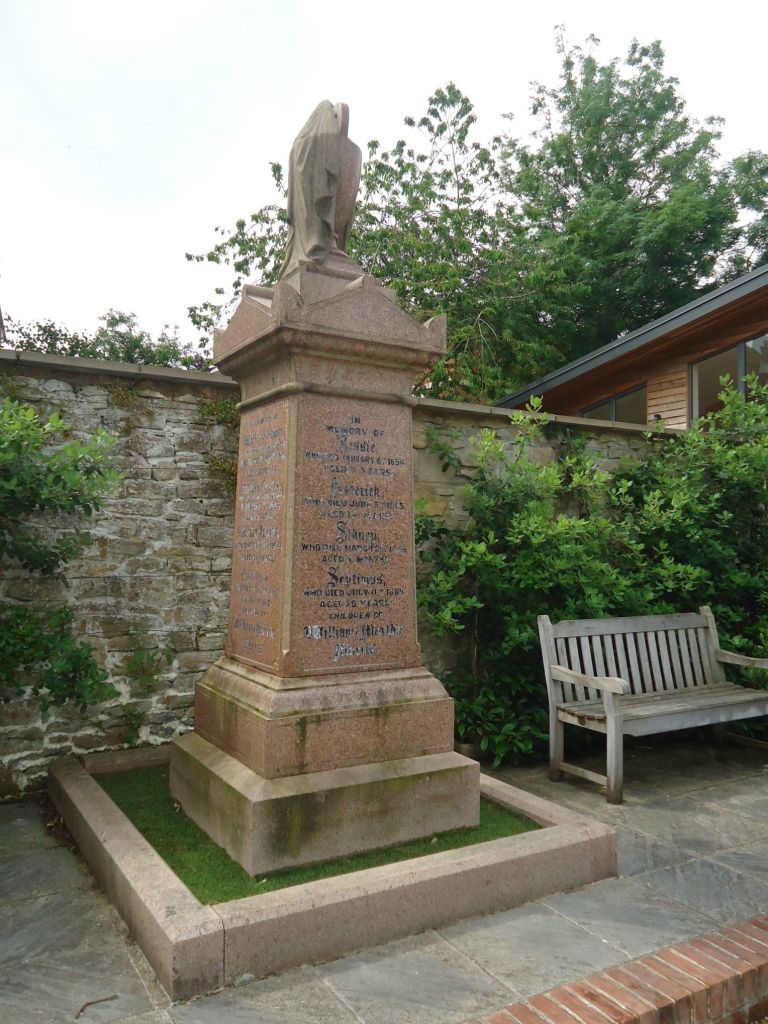
George Stanley Morse is buried alone in a double plot E8181/2 in Radnor Street Cemetery. A note in the burial register states “one grave in 2 spaces.” The memorial is a broken column, symbolic of a life cut short.

George Stanley Morse (5)

George Stanley Morse (4)

You might also like to read

Mr Levi Lapper Morse – the end of an era

Winifred Morse – founder of the Women’s Missionary Federation

Regent Street Primitive Methodist Chapel

W.H. Read – local architect

The re-imagined story …

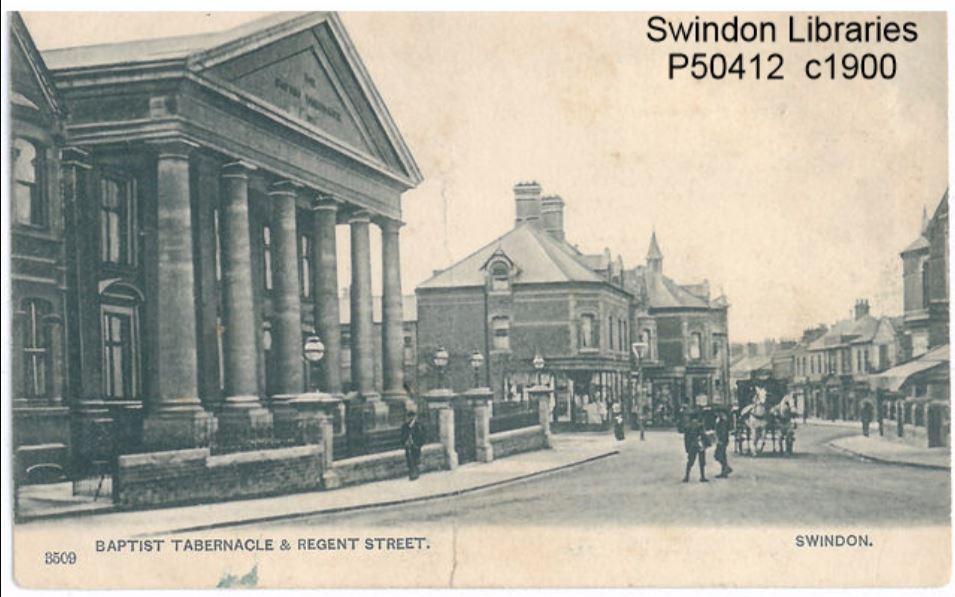
They began dismantling the Baptist Tabernacle as if it were a child’s construction kit. The classically designed building dominated the top end of town but not everyone was a big fan. Some said it was too posh for Swindon and that it didn’t sit well among the other red brick buildings in the town centre.

Gran was a Sunday School teacher at the Tabernacle and insisted we grandchildren attend. My sister and I were reluctant bible students. I’d have rather been up the Rec playing football with my mates and my sister was terrified the building would fall down about our ears. Any number of pictures and paintings would fail to cheer up that dank schoolroom and my sister was forever watching out for falling lumps of masonry.

Baptist Tabernacle

Demolition of the Baptist Tabernacle published courtesy of Local Studies, Swindon Central Library.

And that’s what sounded the final death knell for the building. It wasn’t demolished by the Council as everyone has repeated for the last forty or more years, but by the Baptist church itself. The congregation was too small and the reduced income not enough to pay for the vast amount of repair work necessary.

Today it is difficult to imagine a magnificent, classically designed building with a colonnade of six Tuscan columns and a flight of stone steps the width of the building lording it over the shops in Regent Street.

I would have liked to have one last look around inside, for old times’ sake. I’d have liked to have stood in the pulpit, forbidden to us as children. Neither were we allowed to hang over the gallery to see who sat below us, we soon felt the warmth of Gran’s hand if we stood up in our seat.

Funnily enough my sister wouldn’t have stepped inside that building again if you paid her.

Baptist Tabernacle 2

The Baptist Tabernacle in its heyday – published courtesy of Local Studies, Swindon Central Library.

The facts …

William Henry Read was a popular and prolific local architect whose commissions included the Victoria Hospital, the Anderson’s Almshouses in Cricklade Street and the Baptist Tabernacle.

He was born at Croft House, Swindon in 1850 the son of surveyor William Read and his wife Louisa and educated at Henry C. Lavander’s Grammar School in New Park Street, Devizes. The family later moved to 31 Wood Street and William Henry married Susannah Elizabeth Chandler, the girl who lived next door, in 1876.

The couple lived at Moravia, 10 Bath Road where they raised their family of four sons, William, Kenneth and Norman, and a daughter Grace.

William died at his Bath Road home on Sunday November 3, 1901. The announcement in the local press noted that ‘although a prominent townsman [he] took small part in local government.’

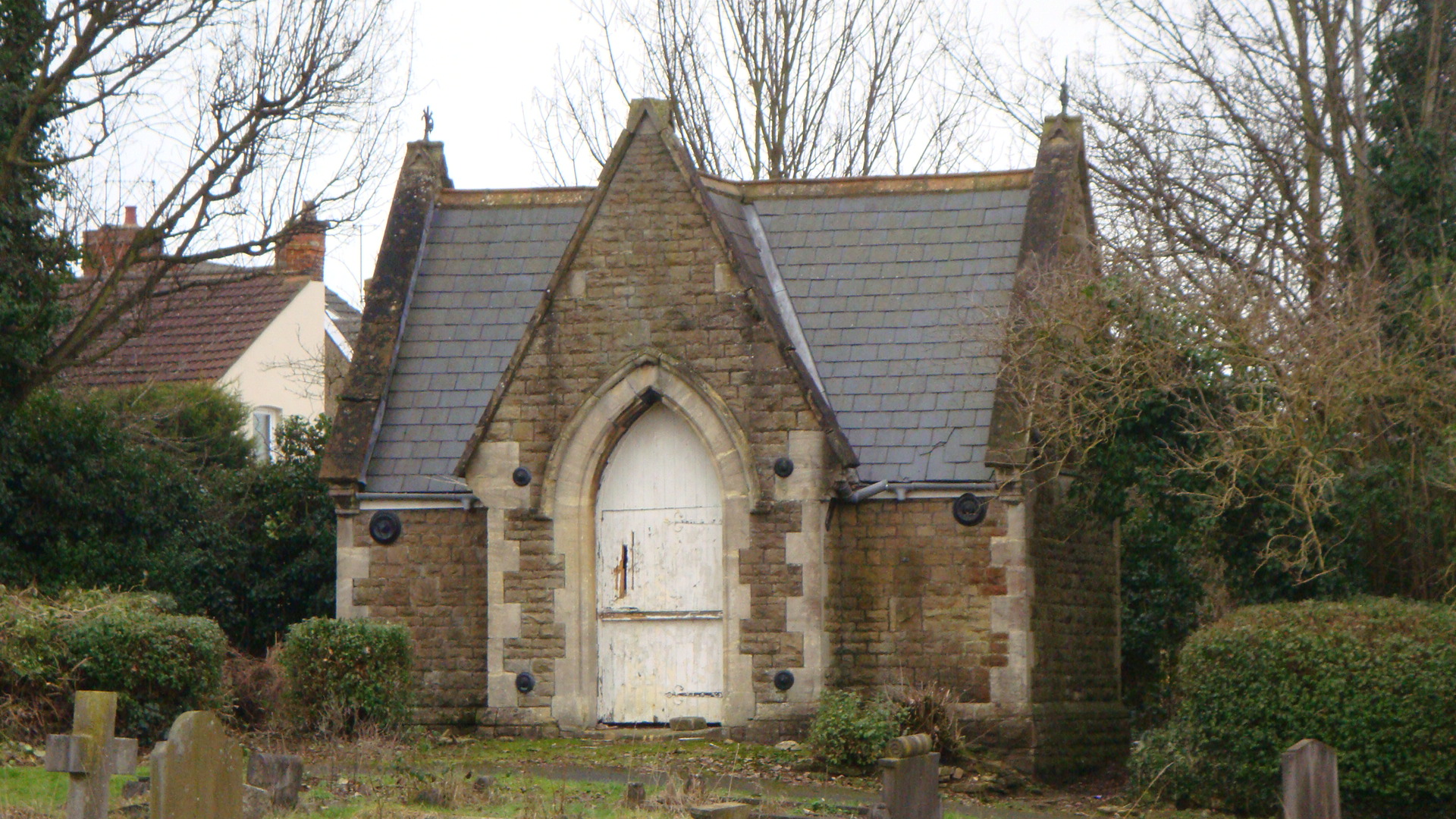
mortuary

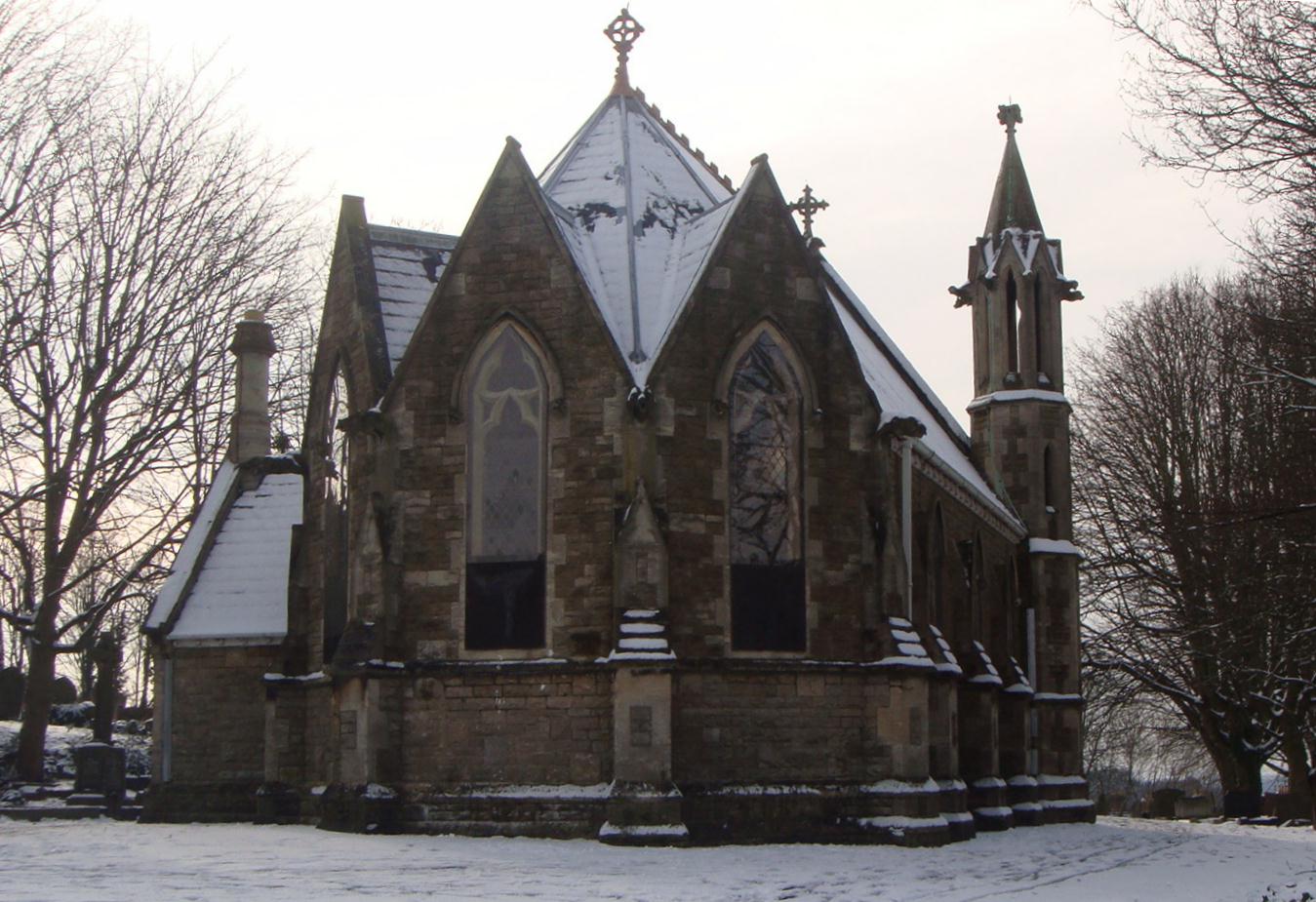
William designed the chapel, mortuary building and caretakers lodge at Radnor Street Cemetery in 1881 where he was buried twenty years later. He must have liked how it all turned out! Susannah died on March 21, 1903 and is buried with her husband.

chapel in the snow

The best bits of the Baptist Tabernacle building materials were sold off. The portico was bought by artist Stanley Frost, the columns, bases and façade wall went elsewhere. People had big plans, which sadly never came to fruition. Then in 2006 Swindon Borough Council bought back the remains at a cost of £360,000 but so far their plans to incorporate them into a town centre regeneration project have failed to materialise and these remain in storage.

William Henry and Susannah Read


Alfred and Amy Haynes

Alfred William Haynes served as Mayor of Swindon 1917-18. It must have been a particularly difficult time to be a local politician as the Great War drew to a slow and painful conclusion.

Alfred William Haynes was born on October 13, 1862 and was baptised on December 7 at St. Leonard’s Church, Eynsham. Eynsham is an ancient village about 5 miles north west of Oxford. He spent his early childhood at Crown Crescent, (the site of a serious outbreak of typhoid in 1875) Acre End Street, with his parents John, a sawyer, his mother Ann (d 1874) and his four younger siblings, George, Florence, Arthur (d. 1874) and Frederick.

In 1880 Alfred married Rosa Major at St. Mark’s, Old Street, Shoreditch where he stated his age as 21 when in fact he was only 18. The newly married couple returned to Wantage where they lived with Rosa’s parents Frederick and Amy Major. Sadly, Rosa died on January 30, 1885 and was buried in Chain Hill Cemetery, Wantage.

At the time of the 1891 census Alfred was boarding with James White at 20 Regent Street and was employed in the Works as an Engine Fitter.

Alfred married for a second time on April 18, 1892 at St. Friedswide, New Osney, Oxford. His bride was Amy Whiting who worked as a domestic servant at the time of their marriage.

Alfred served as a councillor for the Kings Ward from around 1911 and was appointed an Alderman in 1915. He was appointed Mayor in 1917. In 1924 he was awarded the OBE in King George V’s Birthday Honours list for his work as Chairman of the Swindon, Chippenham & District War Pensions Committee.

He died on July 31, 1935 and was buried in grave plot C1820 where Amy joined him 10 years later.

The area in Section C where Alfred and Amy are buried.

Martha Morris – for 41 years the faithful and devoted wife of William Morris

During our Swindon Suffragette festival in 2018 I led a guided walk around Christ Church churchyard, visiting some of the notable women buried there.

There is a lot known about William Morris, founder of the Swindon Advertiser. He was outspoken and challenging in the columns of his newspaper. He was a member of the Local Board of Health (the local authority of his day). He travelled widely and wrote several books.

But it is less easy to find out what his wife did. Maybe she belonged to clubs and served on committees, in keeping with her husband’s status in Swindon, but it is difficult to find out how she spent her time. That is, if she had any to spare.

Martha was baptised in Wroughton on July 14, 1823, the daughter of shopkeeper James Howe and his wife Mary. At the time of the 1841 census Martha worked as a servant at Salthrop.

Martha and William married in the parish church at Walcot, Somerset on September 8, 1845. William described his occupation as Printer. He was under the age of 21 and Martha was two years older.

At the time of the 1851 census the couple lived in Victoria Street. William described himself as a Letter Press printer employing two men. He was 25 and Martha 27. They had been married less than six years and Martha already had three children. Jessie 4, William 3 and Frederick 1. (Jessie died in 1853 and was buried in Wroughton, most probably in a Howe family grave). Also living with them was William’s brother and sister. Henry Morris was 14 and described as a letter press printer and 12 year old Elizabeth was described as a servant. Obviously family members had to pull their weight.

By 1861 Martha had had another five children – Walter 9, Samuel 7, Valentine 5, Jessy 3 (named after the daughter who had died) and 7 month old Edwin. And that wasn’t the end – by 1871 Martha had had another three children – Kate 9, Septimus 7 and Mark 4 – 11 children in all.

Martha died on December 14, 1886 aged 64. I was hoping to find an obituary in William’s paper. There is a death notice, but again it’s all about William rather than Martha.

It reads:

For 41 years the faithful and devoted wife of William Morris (Editor and Proprietor of the ‘Swindon Advertiser’).

He also publishes a rather flowery poem by G.J. Davis, but the last few lines are rather nice.

Oft to the worthless, men memorial raise,

To keep their memories fresh. Beneath the sun

Our love will never die, thou gentle one!

Administration of Martha’s will was left in the hands of her son William Edwin Thomas Morris and her effects were valued at £151 8s 3d.

She was buried in Christ Church churchyard on December 18 and is remembered on the Morris family memorial there.

The Morris family memorial in Christ Church

Henry Fox Townsend

Another story from Christ Church churchyard.

Swindon solicitor Henry Fox Townsend was feeling as fit as a fiddle when he boarded the 3 pm train for Paddington on Thursday December 13, 1894.

The purpose of his London visit was to bid farewell to his brother Charles, a tea planter, who was returning to India the following day.

The brothers had a table booked at the Holborn Restaurant on the Friday but Charles was to report that Henry failed to turn up.

Upon the arrival of the train at Paddington it was noticed by one of the railway officials that Mr. Townsend was in an insensible condition, apparently suffering from a fit, reported the Swindon Advertiser. He was at once removed and conveyed to St. Mary’s Hospital, where he died shortly afterwards without regaining consciousness.

His death at the early age of 34 shocked all who knew him. His friends told how he had recently purchased a property called the Firs in Wroughton where he intended settling down and enjoying what appeared to be, in all probability, a long and prosperous career.

The following week the Advertiser reported on the verdict of the inquest where coroner Dr. Danford Thomas heard how railway porter William Lovesey found Townsend lying on his face on the floor of one of the compartments. Dr. Poynton told how Townsend was unconscious and breathing stertorously upon arrival at St. Mary’s Hospital. Both pupils had become dilated and the unfortunate gentleman remained insensible till his death, which took place at a quarter past nine the same evening.

A post mortem examination showed that the cause of death was compression of the brain, the result of an apoplectic seizure, continued the report.

The funeral took place the following Tuesday with the coffin covered in wreaths, and carried on a hand bier the short distance from Townsend’s offices at 42 Cricklade Street to the parish church.

Chief mourners were the deceased’s sister Annie Louise and brothers Southcote and Charles. Others present included Ambrose Goddard and his son Capt. Fitzroy Pleydell Goddard, Henry’s partner Edward Tudor Jones and rival solicitors Henry Kinneir and his son Walter.

Among the many wreaths was one with the sad message From his mother with tender love and unutterable sorrow.

Unbelievably Annie Townsend had lost her husband James Copleston Townsend in identical circumstances when returning from London on the evening of March 26, 1885, he was noticed to totter and fall as he alighted from the train.

He was carried to the Refreshment Rooms and then to one of the bedrooms, where he momentarily regained consciousness but died at around 10 pm.

Image published courtesy of Duncan and Mandy Ball.

George Henry Stevens – Swindon Mayor 1928-29

Today I am publishing the first of a two part family story. George Henry Stevens devoted his life to public service – as did his eldest daughter Edith Harriett Stevens. George was described as ‘a foremost figure in trade union and Labour movements’ while Edith was a lifelong member of the Communist Party.

George was born in Mumbles, Swansea, the eldest child of Samuel and Eliza Ann Stevens. By 1851 the Stevens family had moved to Clifton where Samuel worked as a gardener.

In 1881 22 year old George was lodging at 27 Sheppard Street, Swindon with William and Mary West and working as an Engine Turner in the GWR Works.

He married Harriette Nash on March 24, 1883 and the couple went on to have six children.

Death of Mr G.H. Stevens

A Former Mayor of Swindon

Funeral Tributes

A former Mayor of Swindon, Councillor George Henry Stevens, J.P., of 62 County road, died on Saturday morning after a long illness.

His passing, at the age of 74 years, is a great loss to the town, for Mr Stevens’ record of public service was a notable one and he was a man who was swayed by the broadest sympathies and interest in all phases of the town’s administrative life.

Councillor Stevens’ devotion to his work is emphasised by the fact that he was a member of the Town Council for 18 years without a break and was honoured with the Mayoralty in the year 1928-29. His career was crowded with activity for the benefit of his fellow men.

46 Years’ Service

Born at Mumbles, Swansea, Mr Stevens came to Swindon in 1881 when 23 years of age, having served his time as a fitter and turner at Bristol. For 35 years he was a chargeman in W Shop at the GWR Works and retired in January 1928, after 46 years’ in the service of the company. For eight years he was a member of the council of the Mechanics’ Institute and for a quarter of a century was secretary of Swindon No. 3 branch of the AEU.

His first entry into the public life of the town was in 1914, when he was elected a member of the Town Council for King’s Ward. Later he represented the ratepayers of North Ward and continued to do so up to the time of his death. For seven years he held the position of chairman of the Electricity Committee and at the time of his death was a member of that committee as well as of the Works and Streets Committee, the Lighting Sub-Committee, the Staff and Stores Sub-Committee, the Finance and Law Committee, the Wages, Salaries, Superannuation and Loans Committee and the Rating and Valuation Committee.

Employed by Admiralty

During the war he served under the Ministry of Munitions for twelve months and afterwards was in the employ of the Admiralty as Labour Regulation officer for the North-Western area, stationed at Liverpool. He also served on the National Advisory Services Committee in Swindon, and was one of the first members elected on the National Health Insurance Committee for Wilts, serving in that capacity for 12 years.

Another important service he rendered was in connection with the Labour Exchanges for the South-West of England, and on that body he was the only Wiltshire representative during a period of three years.

Mr Stevens had been a member of the Ancient Order of Foresters for more than 60 years, and was one of the founders of the Swindon Brotherhood.

Trade Union Interests

He had been associated with the local Trades and Labour Council since its inception following upon a visit to Swindon of Mr. John Burns in 1885, and generally had been a foremost figure in trade union and Labour movements.

Extracts from North Wilts Herald Friday June 17, 1932.

George was buried in grave plot D1125 where he joined his wife Harriett who died in 1928 and two of their children – Stanley George who died aged 28 years in 1914 and Edna Gertrude who died in 1921 aged 25.

Read about Edith Stevens here tomorrow.

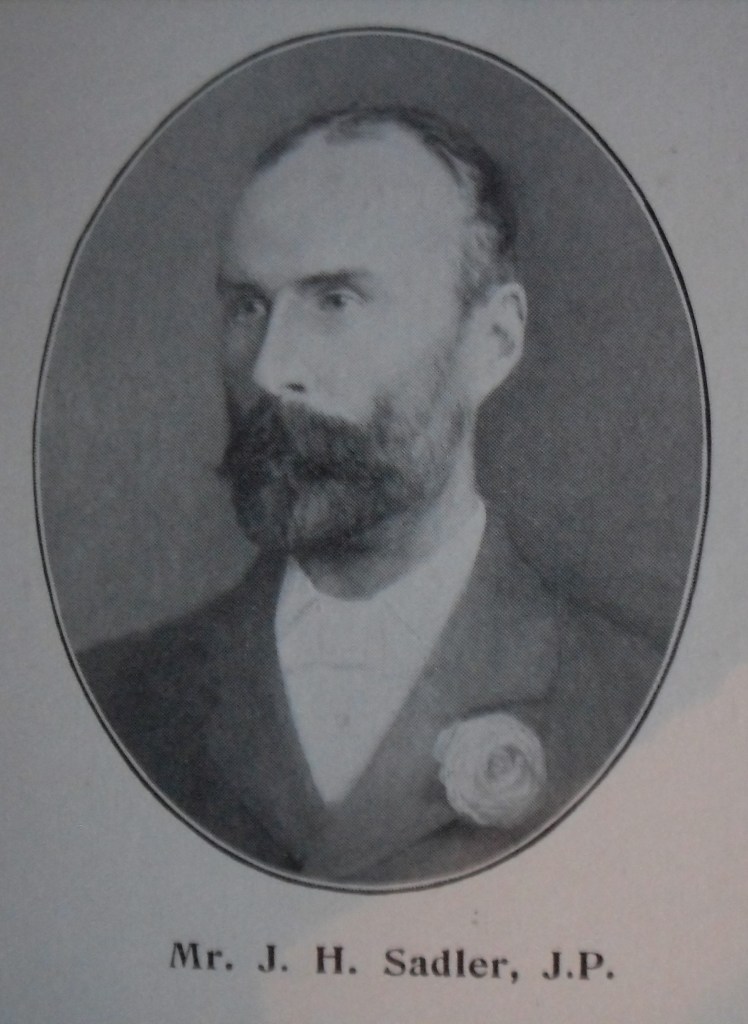
James Henry Sadler – much respected

Most of the time I am entrenched in Radnor Street Cemetery – but occasionally I venture out, sometimes to neighbouring churchyards and cemeteries. And sometimes my work with the Friends of Lydiard Park collides with Radnor Street Cemetery. I am presently transcribing the diaries of Hook farmer Elliot Woolford. On March 30, 1929 Elliot writes:

Saturday March 30, 1929

I went to James Henry Sadler Esq funeral at Lydiard Millicent this afternoon he was taken to Church on a farm wagon there was a lot followed he was much respected.

A short biography is published in the ‘Wilts Book’ discovered by Radnor Street Cemetery friend and colleague Mark Sutton.

Sadler. – James Henry Sadler, J.P., Lydiard House, near Swindon; son of the late Samuel Champernowne Sadler, J.P., F.R.C.S., of Purton Court, Wilts; born at Purton, August 17th, 1843; educated at Hoddesdon, Herts, and Royal Agricultural College, Cirencester. Landowner and agriculturist, farming some of his own property; Justice of the Peace for Wilts; member of the Wilts County Council since its formation, representing the Purton Division; Captain, Royal Wiltshire Yeomanry (retired); Chairman of the Cricklade and Wootton Bassett Board of Guardians, and Rural District Council; formerly, and for some years Chairman of the Purton and Lydiard Millicent Parish Councils, North Wilts Liberal Association, and Swindon Chamber of Agriculture. Recreations: hunting, and shooting. Married, in 1879, Ann Matilda, daughter of the late T.P.W. Butt, of Arle Court, Cheltenham.

Photograph published courtesy of Duncan and Mandy Ball.

Hubert John Deacon – jeweller and watchmaker

Image of Hubert John Deacon published courtesy of Deacons website

I’m sure the name Deacon will be familiar to many, but did you know Hubert John Deacon was also a leading figure in the Baptist Church, Swindon.

The jewellers at 11-13 Wood Street was founded in 1848 by George Deacon who was later joined in business by his two nephews Hubert and Joshua.

Hubert John was born in Trowbridge in 1846 and joined the business in the late 1860s, during what was a period of considerable expansion for the family firm.

In the online company history Hubert is described as an entrepreneurial figure.  He was the first President of the Swindon Chamber of Commerce in 1893 and was responsible for supplying Swindon’s first public clock on the Town Hall.  He also brought the plot of land on which Deacon Street was built and named in his honour.

By 1881 he and his wife Susan had moved in over the Wood Street shop where they lived with their six children, cousin William Nash who was a watchmaker apprentice, Ann Shackleton, a jeweller’s shopwoman and two young servant girls. The Deacon children would eventually number ten.  The youngest, a daughter was named Dorothy Decima.

Hubert was succeeded in the business by his only surviving son George. Today the family firm is in the hands of Richard Deacon and his sister Sara, the 6th generation

Image of Deacons store published courtesy of Deacons website

Death of Mr H.J. Deacon

50 Years a Resident in Swindon

Public Activities

The death took place on Thursday at Margate of Mr Hubert John Deacon, who was associated with the public life of Swindon for over half a century. Mr Deacon, who was 81 years of age, had been in delicate health for some time, and succumbed to an attack of bronchitis.

For many years Mr. Deacon carried on business as a jeweller and watchmaker in Wood Street, a business that was established by his uncle, Mr George Deacon, nearly a century ago. On the death of his uncle, Mr. Deacon succeeded to the business. His son, the late Mr. George Deacon, entered the business, but died at a comparatively early age, and it is now carried on by the widow, Mrs Mildred Grace Deacon, under the style of Deacon & Son.

The late Mr. Deacon first married Miss Lay, of Harwell, Berks, who predeceased him soon after they celebrated their golden wedding when they resided at “Grovelands”, Springfield Road. They had a family of two sons and eight daughters, and two daughters survive. Deceased married again when he went to Margate to reside.

An ardent worker for many years in connection with the Baptist Church in Swindon, Mr Deacon was a member when the old church was in existence at the corner of Bridge Street and Fleet Street. He took a prominent part in the scheme for building the Tabernacle 40 years ago, and gave liberally to the church funds. On the retirement of the late Mr. W.B. Wearing as superintendent of the Sunday School, Mr Deacon succeeded to that post, which he filled with success for many years. He was also a member of the Baptist Union of Great Britain and Ireland.

Interest in Public Work

Mr Deacon was associated with many enterprises in the town, notably the Swindon Permanent Building Society, of which he became successively vice-chairman and chairman, and witnessed a wonderful advance in that society as the town grew.

The public work and interests of the town always commanded his attention, and his greatest interest. He was for a number of years a member of the Local Boards, and afterwards of the District Councils of Old and New Swindon, and was also one of the first members of the Corporation, when Mr. G.J. Churchward was Mayor. He also devoted some years to Poor Law work as a member of the Swindon and Highworth Board of Guardians.

Of the Swindon Horticultural Society he was a great supporter, and his lovely garden and grounds at “Grovelands,” which he frequently lent for social gatherings in connection with churches in the summer months, were evidence of his love for flowers.

Mr. Deacon also interested himself greatly in the Victoria Hospital, with the establishment of which he was associated, as well as with its opening in Queen Victoria’s Jubilee year. For some years he was vice-chairman of the committee of management. He was one of the founders of the Old Swindon Traders’ Society, which was the forerunner of the Swindon Chamber of Commerce. Of the latter body Mr. Deacon was the first President. He was also a former chairman of the Swindon Plate Glass Insurance Society and for some years chairman of the Southern Laundry Company.

Bowls was his only out-door sport, though he did not play that extensively. He was a member of the Westlecott Club, and was instrumental in its formation.

In various other spheres the deceased did good work in the town.

Extracts from the North Wilts Herald, Friday, January 28, 1927.

This is the last resting place of Hubert, his wife Susan, their daughters Honoria Edith and Winifred Elsie and their son also named Hubert John. Susan died in Swindon in 1920 aged 73.  Hubert died in 1927. 

Who would live in a house like this?

Come and take a peep behind the shutters and find out what was going on in these desirable residences.

Frampton Villa, Devizes Road.

Read all about William Edwin Morris – a man of inexhaustible energy

The Limes, Croft Road

Read all about Mrs Ormond passed away two years ago

Mannington Farm

Read all about The Old Congregational Church

Oxford House, Victoria Road

Read all about No Place Like Home