The Rev George Hunter was buried in Swindon on June 14, 1916. The inscription on his headstone reads ‘For 55 years a Primitive Methodist Minister.’ Born in South Cave, Yorkshire in 1834 the Rev George Hunter married Mary Thompson and had two daughters. Rosanna and Edith. This is her story.
In 1911 the widowed George was living with his daughter Edith here in Swindon at 75 Morris Street, Rodbourne.
Edith married shortly after her father’s death in 1916. Perhaps her role as her father’s housekeeper had prevented her from marrying when she was younger and then his age and infirmity had been an obstacle when she was older.
Edith was 46 when she married widower Charles Edward Hall. Charles was born in Hook in the parish of Lydiard Tregoze. He was a boilermaker in the Works. His first wife Emma died in 1915 and a year later Charles married Edith. When Charles died in 1935 he was buried in grave plot D951 with his first wife Emma Jane.
Although Edith would never have children of her own, she became stepmother to Charles and Emma’s son Arthur Edward Hall, who by the time of her marriage to his father had already made his mark on history. You can read his story here published tomorrow.
George died in 1916 aged 82 and is buried here with his two daughters. Rosanna who died in April 1930 and Edith who died in 1941.
George Hunter was born in 1834 in South Cave, Yorkshire. At just 9 years of age he was working as an agricultural labourer to help support his widowed mother. At the age of 17 he converted to Primitive Methodism and spent the rest of his long life in God’s service.
George was described as ‘a splendid visitor, and a true friend and practical helper in cases of distress’ who ‘in the pulpit was earnest, simple, practical and good. He aimed not at display. He preached not to please the ear and tickle the fancy, but to touch the heart and reach the soul. His sole ambition was to save souls.’
He married Mary Thompson and the couple had two daughters, Rosanna born 1868 and Edith Mary born 1870.
In his retirement he made his home in Swindon with his younger daughter Edith where he continued to assist with the work of the Primitive Methodist church. He lived at 75 Morris Street, Rodbourne, where he died in 1916. A long obituary was published in the North Wilts Herald of which the following is an extract.
George Hunter
Death of the Rev G. Hunter
55 Years in the Primitive Methodist Ministry
The Rev. George Hunter, who was for 55 years a Primitive Methodist minister, died at his home, 75 Morris Street, Swindon, on Sunday. He was born in Yorkshire in 1834 and was 82 years of age. The greater part of his ministry was spent in the South of England, and when he retired from active service five years ago he came to reside at Swindon, and for some time continued to assist in Church work.
The funeral took place on Wednesday afternoon. The first portion of the service was conducted at the Primitive Methodist Church, Regent Street, by the Rev. S.A. Barron, who also committed the body to the earth at the Cemetery.
The Funeral Address was delivered by his old friend the Rev. J.H. Cotton …
As a pastor George Hunter had few equals. He knew his people, sympathised with them in their sorrows, advised them in their difficulties, comforted them in their sickness, and encouraged them as they drew near the eve of the great change. In the sick room nothing was more striking than his beautiful sympathy and tender handling of stricken souls. He could not refuse to help in a case of need, and often had made the widow’s heart dance with joy. Twenty years ago he heard friends talking about Mr Hunter’s kindness to the aged poor. In many circuits he would long be held in affectionate remembrance, though the majority of those who benefited from his ministry preceded him into the Great Beyond.
The great sorrow of Mr Hunter’s life was the passing away of the devoted wife who for over 35 years had lovingly shared his ministry. That was in 1900, during his second term at Stewkley.His elder daughter had to look after an aged aunt at Exeter; but the younger, since her mother’s death, had devoted herself to her father beyond all praise. During the coming years it would give to her deep and abiding satisfaction to know that she gave herself so lovingly to bring joy and comfort into her father’s life during his declining years. To these ladies in their intense bereavement and sorrow their sympathy went that day.
Advancing years ripened and mellowed Mr Hunter’s character, and considerably broadened his views. He was not sure that he was a man of the eventide after all. He often felt while in contact with him that he was a man of the morning. He passed away, after a brief illness, in the full confidence that death would be to him the gateway to a deeper, richer, and fuller life. To him, indeed, there was no death.
The Rev. W.L. Taylor said he knew Mr Hunter for a very long time. He often met him in the Brinkworth District and other circuits in which he laboured. He had that day seen some documents relating to his coming into this part of the country in 1861; and the people who had known Mr Hunter were thankful to the Hull Conference that day for having sent him. His work was a great success in the agricultural districts and his labours were equally successful in the industrial circuit in South Wales in which he spent a short period of his ministry. He asked the daughters of Mr Hunter to accept, in the sorrow which had overtaken them, the sympathy of the circuit he represented.
Extracts from the North Wilts Herald, Friday, June 16, 1916.
Rev George Hunter died aged 82 years at his home, 75 Morris Street. His funeral took place on June 14, 1916 when he was buried in grave plot C2016.
You can read more about the Rev Hunter and his family here:-
Members of the 18th Scouts join us every year for our Remembrance Day Service at Radnor Street Cemetery. I wonder if they know that a very significant man in the history of the scouting movement in Swindon is buried in the cemetery.
William Rowland Bird was born on August 19, 1865 and baptised at St. Andrew’s Church, Chippenham in September 1865. His parents were Robert, at that time employed as a Switchman with the Great Western Railway, and Frances. William was the eldest of their five children and spent part of his childhood at 13 Atchley Street, Bristol, but by 1891 the family had moved to Swindon and a home at 73 Albion Street.
William started work in the railway works aged 14. He later transferred to the laboratory where in 1900 he was appointed chief chemist.
William never married. In 1901 he was living at 125 Goddard Avenue with his unmarried sister Edith. By 1911 it looks as if the rest of the Bird family had moved in as well! William shared the house with sister Amy, brother James and his wife and two children, an aunt and a servant.
William’s life was equally fully. He was appointed Scout Master of Swindon Troop 2 in 1909 and the following year hosted Baden-Powell at a scout rally in the GWR Park. He served as Scout District Commissioner for North Wilts (including Swindon) from 1910 until his retirement in 1945 when he was appointed vice president of Wiltshire County Scouts. And that wasn’t all! He was one of the founding members and secretary of the Swindon and District Football League. He was a referee and a member of St. Mark’s Young Men’s Friendly Society. He gave lectures at the Mechanics’ Institute on a variety of topics and in 1920 was a member of the Swindon Museum Committee.
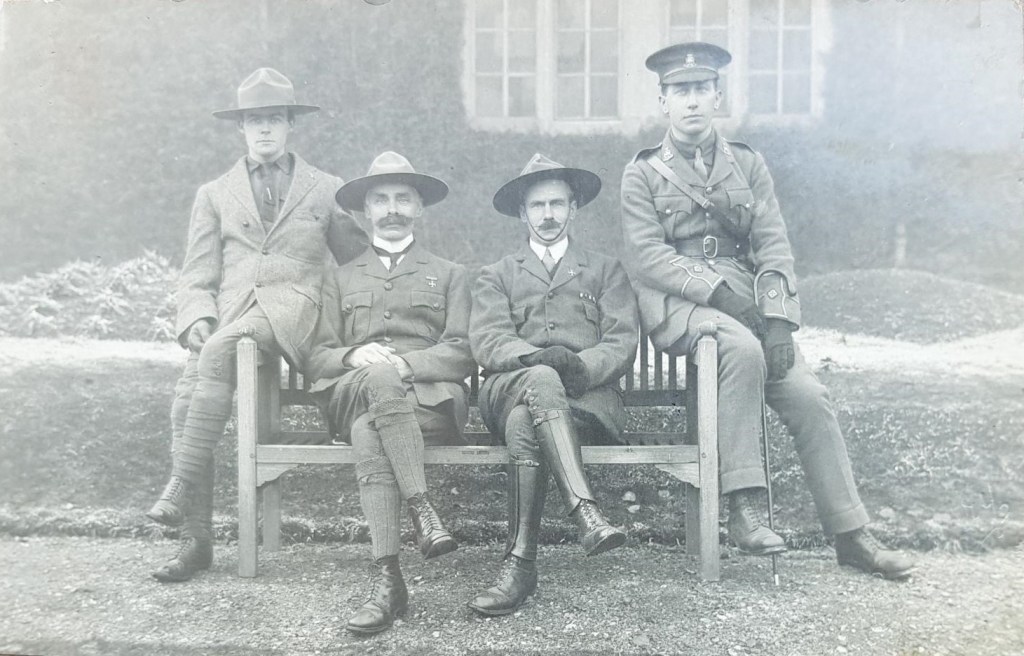
In this 1915 image District Commissioner W.R. Bird is seated 2nd on the left
Former chief chemist at GWR dies
A former chief chemist and superintendent of the GWR laboratory at Swindon, and for many years Boy Scout District Commissioner for North Wiltshire, Mr William Rowland Bird (85), of 125 Goddard Avenue, Swindon, has died.
A native of Chippenham, Mr Bird came to Swindon as a boy and entered the service of the former Great Western Railway Company when he was 14 as a fitter and turner. He attended the Mechanics’ Institute evening classes and won the Gooch prize, the premier award.
After serving his time in the shops, Mr. Bird was transferred to the laboratory, and in 1900 was appointed chief chemist. For 32 years he served on the Dangerous Goods and Chemists Committee of the Railway Clearing House. He was one of the first chemistry lecturers at the Mechanics’ Institute.
Church Interests
One of the promoters and first assistant secretary of St. Mark’s Church Young Men’s Friendly Society, he also helped found St. John’s Church Club.
The Boy Scout and Church Lads’ Brigade found a staunch supporter in Mr Bird and other deserving causes always commanded his sympathy.
He was a founder and vice-president of the North Wilts Field and Camera Club, a member of the first committee of the Swindon GWR Engineering Society, of which he became a vice president, a member of the Toc H executive and a vice-president of the GWR St. John Ambulance Association.
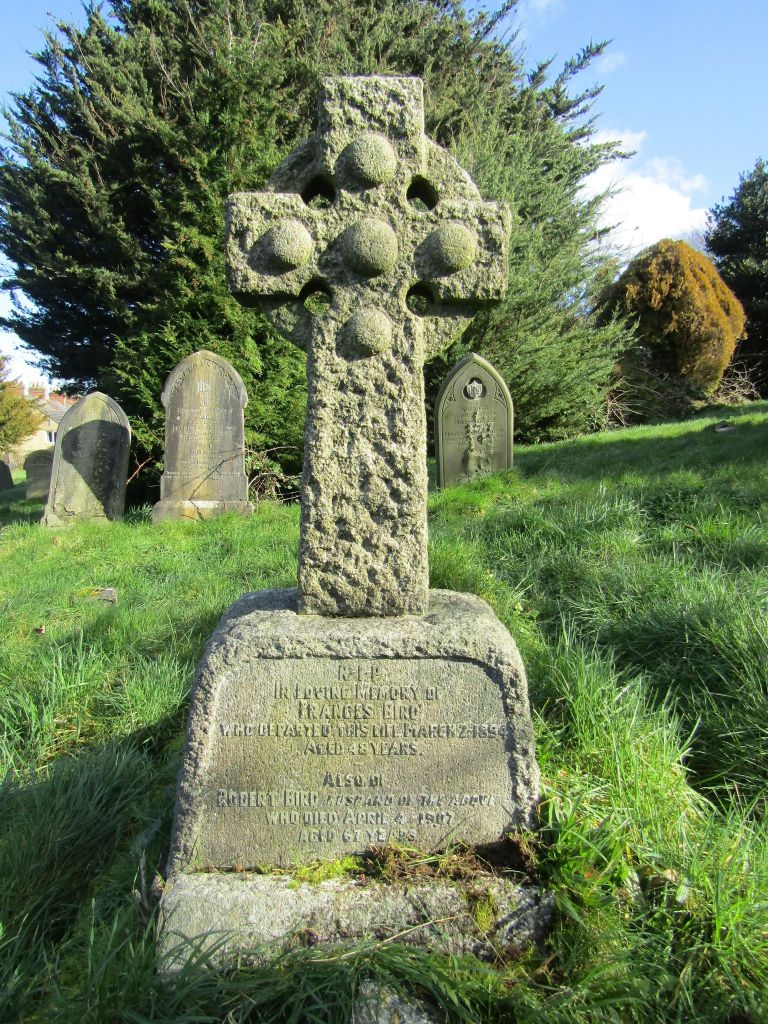
William Rowland Bird died on July 1, 1951 aged 85 years. He was buried on July 4 in grave plot A857 which he shares with his mother Frances who died in 1894 and his sister Maria May who died in 1972. His father Robert is remembered on this headstone but is buried in grave plot E7798 with other members of the Bird family.
My thanks to Steve Milner, Scout Leader at Wootton Bassett, who is presently working on an account of the life and times of William Rowland Bird and can be contacted by messaging via this blogpost.
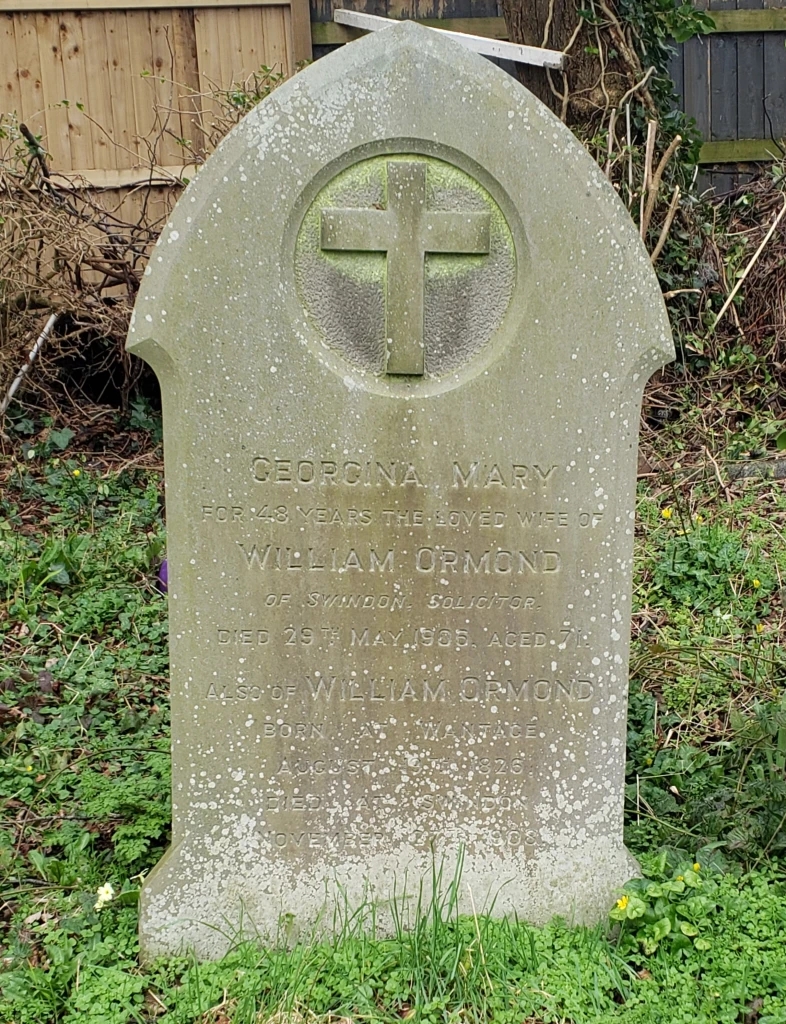
This fulsome account of the life of William Ormond pretty much says it all. However, in 1890 William and his wife Georgina were at the centre of the much publicised case of their daughter Marion and the scandalous Rev Newton Ebenezer Howe, Vicar at Christ Church, which you may like to read here.
Death of a Swindon Solicitor
Mr W. Ormond passes away at the age of 82
A well known and highly esteemed gentleman, who practised as a solicitor in Swindon for many years, has just passed away, in the person of Mr William Ormond, at No. 1. Devizes Road, or, as it is now known, Croft Road. The deceased gentleman, who attained the advanced age of 82 years on the 1st of last August, had been in failing health for some time past. Still he was able to get out and about, and displayed almost wonderful vitality right up to the end.
About three weeks ago, however, weaknesses incident to old age became more and more pronounced and eventually Mr Ormond was compelled to take to his bed, although even then he expressed his intention of getting up and attending Church only last Sunday, when he was obviously in an unfit condition to do so. The wiser counsels of those about him prevailed, and Mr Ormond remained at home. His condition became perceptibly worse, and at times he exhibited a tendency towards delirium and was at other times oblivious to things about him, bordering on unconsciousness. On Thursday it was observed that the end was not far off, and at 6.50 this morning Mr Ormond passed peacefully away.
The deceased gentleman was born at Wantage, in Berkshire, on the 19th August, 1826, and it is a fact worth recording that, until old age compelled him to lay up, he had never, to the knowledge of his family spent one day of illness in bed.
In the month of October, 1849 he went to Abingdon, where he settled down as a solicitor, workingup a good practice, which he continued to hold until 1855.
In March of that year he removed to Swindon, entering into partnership with Mr J.C. Townsend, and taking offices in High Street. Many years after he was in practice by himself, with offices in Victoria Street.
In May, 1858, Mr Ormond married, at North Road, Cheshire, Georgina Mary Lamprey, formerly of Marchwood, Southampton, and the newly married pair, after the honeymoon, returned to Swindon. Eight children were born to them – one son and seven daughters.
The son served his country in South Africa. He became a Lieutenant of the Imperial Light Horse, and died a soldier’s death at the hands of the Boers at Naaupoort on Jan. 5th, 1901.
Of the seven daughters, four are living. The second daughter died in 1861; and the youngest daughter, Winifred, who became the wife of Mr Frank Chapman, of the firm of Messrs Spencer, Chapman, and Co., solicitors of London, died on the 21st May, 1907.
Mrs Ormond passed away two years ago.
The deceased gentleman never took any active interest in public affairs. He was somewhat of a retiring disposition, and was highly esteemed and greatly liked by all who enjoyed the privilege of his acquaintance.
He retired from active professional work about seven years ago. The deceased gentleman was one of those who performed many acts of real charity in a quiet and unostentatious manner – even in a secret. In a word, he delighted in doing good by stealth as many can testify. The last striking example of this was in his recent gift of £400 to the Parish Church for a Men’s Club, which was referred to as recently as Wednesday night by Canon Estcourt at the Parish tea.
The funeral will probably take place on Tuesday, and the family desire, in deference to the deceased gentleman’s expressed wish, that no flowers should be sent.
The Swindon Advertiser, Friday, November 27, 1908.
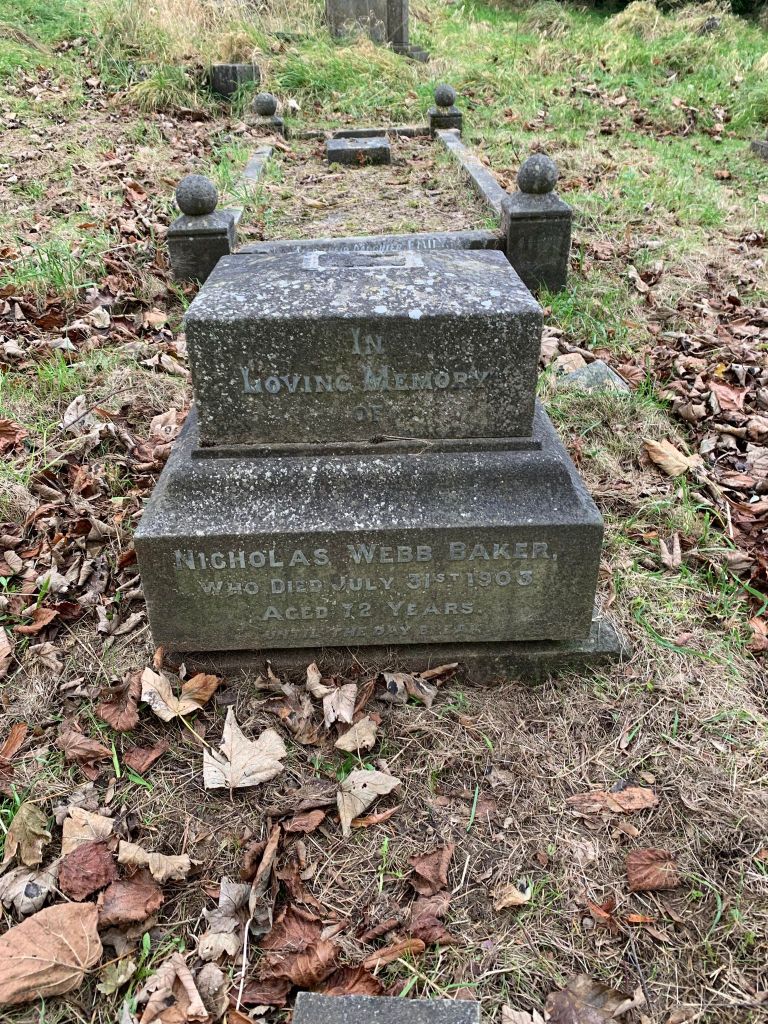
The cemetery volunteers have been busy this weekend and Kevin has discovered another interesting character and a rather magnificent memorial by the chapel. Mr Nicholas Webb Baker is buried in a ‘black-lined brick grave’ according to the newspaper report.
The Late Mr N.W. Baker
A Veteran Forester
The Funeral
The numerous friends of Mr N.W. Baker of 33, Rushey Platt, Swindon, will deeply regret to hear that he passed away suddenly on Friday morning, at his residence. He had been ailing for some time, but was not seriously ill. Had he lived till to-morrow he would on that day have celebrated his 73rd birthday.
For the long period of 44 years, Mr Baker was time-keeper in the GWR Works, retiring from that post about six years ago.
By members of the AOF deceased was well known and highly respected throughout North Wilts. For a great number of years, he was Treasurer of the North Wilts District AOF which position he held at the time of his death. He was Secretary of Court “Briton’s Pride,” AOF for 36 years, and only retired from that office a month ago, owing to failing health.
Deceased leaves a widow and seven grown-up children – five sons and two daughters – for whom the deepest sympathy will be felt.
Bro. Baker was elected to the post of Treasurer of the North Wilts District, AOF, just 20 years ago, viz., in 1883 he succeeding Bros. J.W. Painter. Prior to that time, Bro. Baker was for a few years – from 1876 to 1879 – District Secretary, retiring in 1879 when Bro. T. Hill was elected.
The funeral cortege left deceased’s late residence, No 33 Rushey Platt, at four o’clock. The coffin, which was covered with beautiful wreaths, was conveyed in a hearse, the chief mourners following in carriages, while there was a large and representative number of Foresters, representing Courts in Swindon, Aldbourne, Avebury, Faringdon and Highworth.
The officiating minister was the Rev J. Jones (Primitive Methodist Superintendent), and the Foresters’ Burial Service was most impressively read by Bro. Tom Smith, PD.C.R. and District Trustee.
The remains of deceased were interred in a black-lined brick grave, and the breast-plate on the coffin bore the following inscription:
Nicholas Webb Baker,
Died July 31, 1903,
Aged 72 years.
Extracts from the Swindon Advertiser, Friday, August 7, 1903.
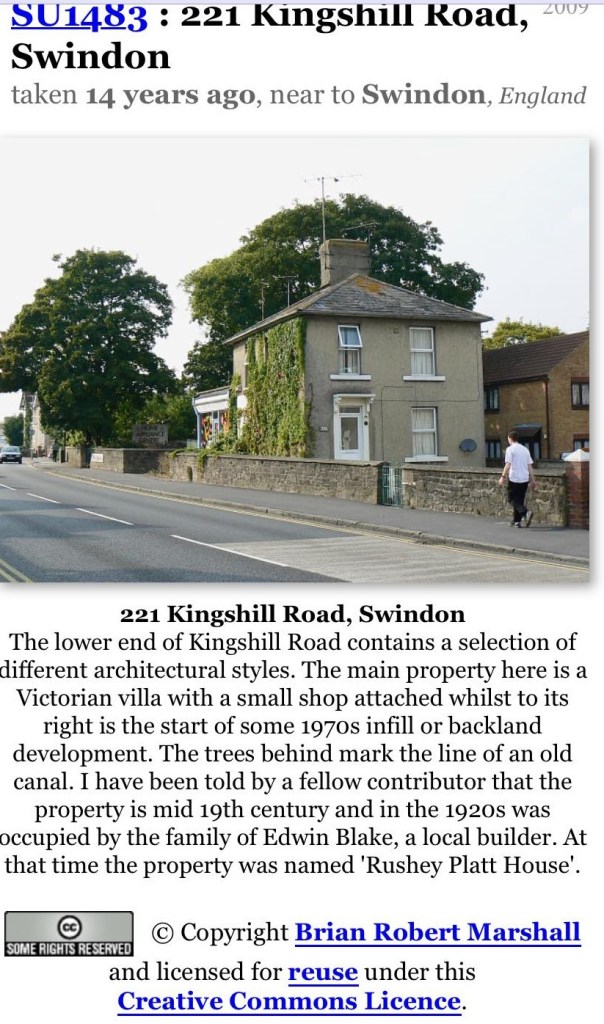
And it seems likely this was the former home of Mr Baker.
Nicholas Webb Baker died at his home, Rushey Platt House, on July 31, 1903. He was buried on August 4 in Radnor Street Cemetery in grave plot D1557, which he shares with his wife Elizabeth.
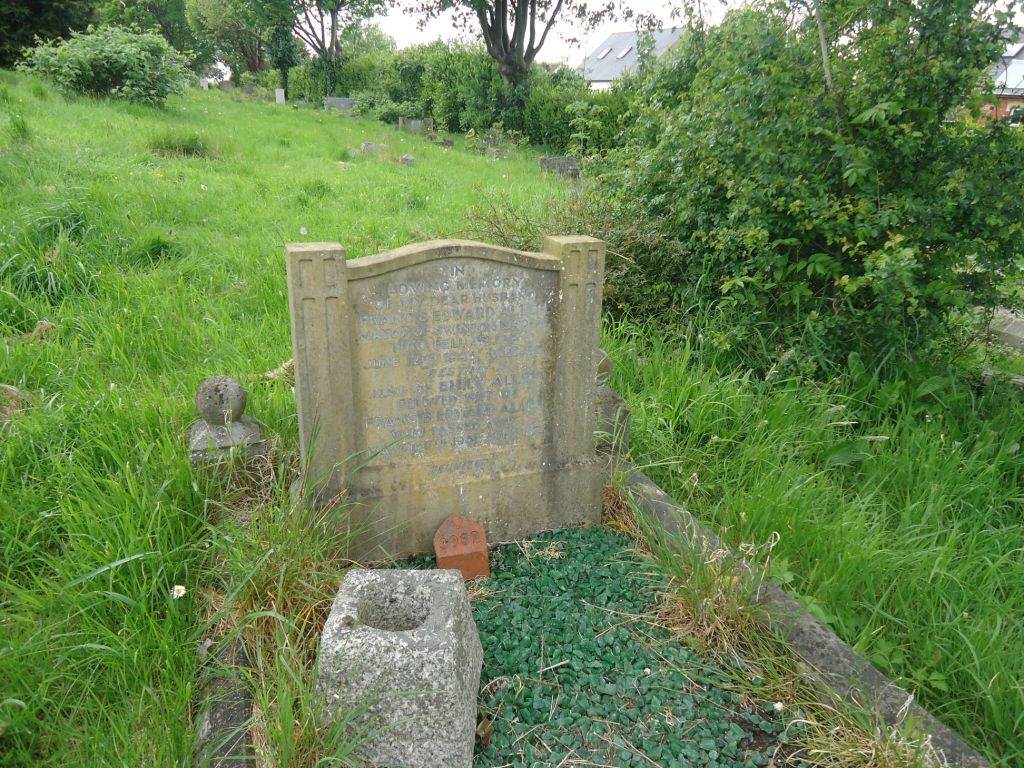
Francis Edward Allen was 77 years of age when he served as Mayor of Swindon during one of the difficult years of the Second World War, 1940-1941. Among his numerous duties during that year he launched Swindon Food Week, an initiative to help housewives make better use of rations; he lent his support to a national flag day on behalf of the air raid distress fund and he welcomed evacuees to the town.
Francis Allen was born in 1863 and baptised in the parish of Widcombe, Somerset, the son of stonemason Joseph Allen and his wife Mary Ann. By the 1880s he was living in Swindon where he married Emily Brooks on December 25, 1883 at the church of St. Paul’s. The couple went on to have 9 children and lived for all of their married life in the Rushey Platt/Wootton Bassett Road area.
Ex Mayor of Swindon’s Sudden Death
Alderman Francis Edward Allen Mayor of Swindon in 1940-41, died suddenly at his home, 9, Wootton Bassett road early this morning. He was 80 years of age.
Mr. Allen was born at Bath and came to Swindon as a young man to taken up employment in the GWR Works. He rose to chargeman of the gas works and retired about 18 years ago, after 42 years service.
On his retirement Mr Allen took up public life and was returned to the Town Council as councillor for the East Ward. Later he was made an alderman and was elected Mayor in 1940-41.
Mr Allen was well-known for his work in connection with the North Wilts district of the Ancient Order of Foresters, of which he was senior trustee at the time of his death. As recently as Wednesday evening he attended a Foresters’ meeting in Swindon.
Mr Allen also made a name for himself by his interest in horticulture. In the days of the old Swindon Flower Show, then held in the Town Gardens, he was a most successful exhibitor and was also a very competent judge of flowers.
He had taken innumerable prizes in local club flower shows, and at one time was on the committee of the “Evening Advertiser” Flower Show.
He was a former treasurer of the Swindon Division Liberal Association.
Mr Allen leaves a widow, three sons (two living in Australia and one in Swindon) and six daughters. All the sons and daughters are living and married.
The Evening Advertiser, June 13, 1943.
Funeral of Ald. F.E. Allen, Former Mayor of Swindon
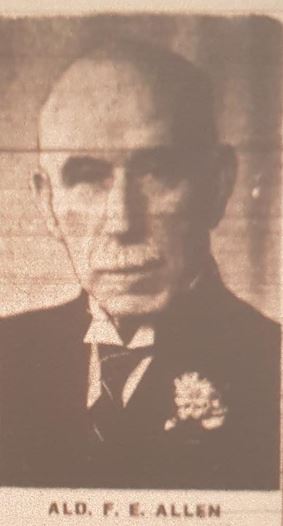
Ald. F.E. Allen
Alderman Francis Edward Allen, aged 80, Mayor of Swindon in 1940-41, of 9 Wootton Bassett road, who died last Saturday, was buried with civic and forestry honours yesterday.
The Mayor (Ald. A.J.B. Selwood), wearing his chain of office, attended the funeral service at Wesley Church, Faringdon road, and the Foresters’ burial service was read at the graveside in Radnor street cemetery by Bro. F.J. Franklin, District Trustee.
The service at Wesley Church was conducted by the Rev. A..E. Banks, who, in the course of a short address, referred to the integrity and steadfastness of purpose with which Ald. Allen had served the town, and said the qualities of character he had shown in his public work had won for him a warm place in the hearts of his fellow citizens.
Extracts from the Evening Advertiser, Thursday, June 17, 1943.
Francis Edward Allen died at his home 9, Wootton Bassett Road, aged 80. He was buried on June 16, 1943 in grave plot B3130, which he shares with his wife Emily who died in 1951. The couple are buried with Emily’s sister, Elizabeth Hannah Wilden who died in 1910.
Albert Street, built in around 1848 and named after Queen Victoria’s virtuous husband, was the red light district of mid Victorian Old Swindon. At the centre of this maelstrom of depravity was the Rhinoceros public house, once described in court as ‘the most notorious house in town.’ The first landlady at the Rhinoceros when it opened in July 1845 was Lucy Rogers, a former dressmaker. Frequently the scene of bad behaviour where landlords flaunted licensing laws and one was even accused of the manslaughter of his mother in law.
One person who tried to make a difference in this den of iniquity was Angelo Vitti. Born in Settefrate, a small village in the Province of Frosinone, just south of Rome, Vitti stopped off in France before moving to England in the early 1890s. He purchased the former Rhinoceros, by then a lodging house, and eventually bought up the adjoining cottages as well.
Angelo Vitti married Mary/Maria Carter in 1895. In 1901 they were living with their three young children at the Lord Raglan public house, Cricklade Street where Angelo was the licensed victualler.
The 1911 census lists them as living at 22 Albert Street where Angelo worked as a lodging house keeper and grocer. He and Maria had been married for 21 years and sadly, five of their 11 children had previously died.
‘Swindon has lost a colourful and romantic personality by the death of Mr Angelo Vitti,’ the North Wilts Herald reported following Angelo’s death on Sunday April 21, 1940. As a lodging house proprietor he became the friend, and earned the respect, of thousands of men and women, a genuine family man and a friend of poor people.
Death of Mr A. Vitti
Long Residence In Swindon
Swindon has lost a colourful and romantic personality by the death of Mr. Angelo Vitti, lodging house proprietor and provision merchant, of Albert-street, Swindon which took place on Sunday night.
Mr Vitti, who would have been 79 on 10 May next, was born at Settefrate, Italy, and as a young man left his home and his country to carve out his own career. He arrived in France, but after a short time in that country, came to England nearly 50 years ago.
He claimed many adventures before coming to settle down in Swindon in 1893.
Friend of the Poor
As lodging house proprietor he became the friend, and earned the respect, of thousands of men and women, for he had the happy knack of combining a sense of strict efficiency with a genial personality. He helped many men on their way and, had he wished, could have told many stories of the thousands of wayfarers who sought refuge under his roof. One man who claimed his hospitality was stated to have been a remarkably fine linguist, being a fluent speaker of five languages; another told how he had placed the whole of his £5,000 fortune on a horse which had finished down the course!
Angelo Vitti was a genuine family man, and it was his one desire that all his children should ever remain close by his side. All six children – two sons and four daughters – are now married, but they have respected those wishes by making their homes within a stone’s throw of their father’s premises.
Mr Vitti’s parents were both centenarians. His mother died at the age of 108 and his father in his 101st year. He leaves a widow and six children, and there are eight grandchildren.
The Funeral
Following a requiem mass, the funeral service took place on Wednesday at Holy Rood Church.
The interment was at Radnor-street cemetery, Swindon.
The funeral arrangements were carried out by Messrs. A.E. Smith and Son, 24, Gordon-road, Swindon.
Extracts from North Wilts Herald, Friday, 26 April, 1940.
Angelo Vitti was buried on April 24, 1940 in grave plot C4709 where he lies with his wife Mary/Maria who died in 1944.
This pristine art deco gravestone proudly boasts the achievements of Thomas Charles Newman, Alderman and Mayor of Swindon in 1923.
Mr Newman served on the council for 32 years and during his Mayoral year welcomed King George V and Queen Mary on their first visit to Swindon.
Other less glamorous duties he performed that same year including opening the sewage works at Rodbourne and the hard tennis courts at Town Gardens.
Thomas Charles Newman was born in Swindon in 1878 and was educated at Sanford Street Schools.
He began his career in the printing trade as a printer’s devil (an apprentice who runs errands in a printing office) and went on to become a master printer and proprietor of the Borough Press Ltd.
He was chairman of the committee in charge of the new Civic Offices built close to his old home in Euclid Street and he had many interests outside of politics. He was involved with Swindon Town Football Club and the Wiltshire Football Association along with many other local organisations. He enjoyed gardening, singing and various sports, in particular angling.
Thomas Charles Newman died on October 14, 1941 and an obituary published in the Advertiser described him as an extremely popular and generous man who assisted in every way the town’s many causes, and took a special interest in housing and unemployment questions.
His funeral took place at Sanford Street Congregational Church on Saturday, October 18. A prominent freemason, Masonic honours were accorded at his funeral and 60 Freemasons headed the funeral cortege from Sanford Street up here to Radnor Street Cemetery.
Thomas was buried with his daughter Sybil who had died ten years previously aged 15. They were later joined by his wife Frederica who died in 1963, their son Leslie who died in 1989 and his wife Doris who died in 1983. The last member of the family to be buried here was grandson John Charles Newman who died in 2005.
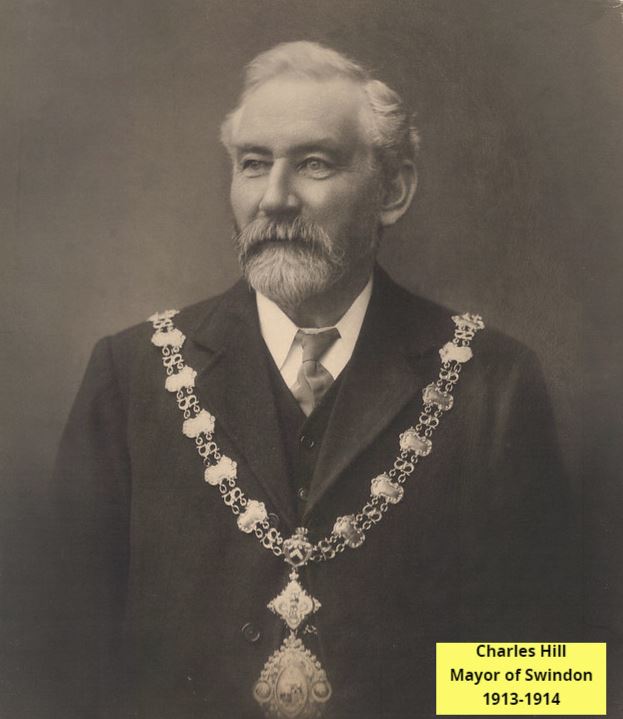
I was recently asked by a blog reader why so many of Swindon’s ‘worthies’ were members of the non-conformist faith. Charles Hill is another such example.
Referring to the obituary published in the North Wilts Herald, Rev. A. Brown said it was a fine resume of the life of Mr Hill and could have gone on for another two or three columns had there been space.
Charles Hill was born in Newton Abbot in 1853. He married Elizabeth Ann Spackman in 1878 and the couple had three children, Mabel, Elsie and Percival. The story of his life follows here:
image published courtesy of Local Studies, Swindon Central Library.
Death of Mr C. Hill, J.P.
Former Mayor of Swindon and Chairman of the Education Committee for 12 Years.
The news of the death in the early hours of Saturday of Mr Charles Hill, of 32 Victoria road, Swindon, will come as a severe shock to thousands of people in Swindon and Wiltshire who knew him so well.
The news will be the more unexpected in view of the fact that right up till Friday he was apparently in his usual health and good spirits, and as recently as Thursday was seen walking in the streets of Swindon, and, indeed, recorded his vote in the municipal elections.
It was only last month that he retired from the many public offices he held in the town.
Foot Amputated.
Mr Hill underwent a severe illness about 18 months ago and had his foot amputated, but though this entailed a temporary retirement from public duties, he returned to them zealous as ever on his recovery.
Mr Hill’s life is the romance of the orphan of a farm, who, by dint of hard work combined with good spirits and geniality, rose to become the Mayor of the town of his adoption, and a magistrate of the county in which he came to live and work.
In April, 1853, he was born near Newton Abbot, and spent his early years working as an orphan boy on a Dartmoor farm. He came to Swindon in 1872, and obtained employment as a porter on the GWR station, later going into the factory.
Then when the old broad gauge track from Swindon to South Wales was converted in 1872, he was a member of what was known as a transport.
Then he went into the R Shop, where he worked for 12 years, first as a labourer, then as a machineman, and finally as chargeman. Leaving the Works, he became a part time agent for several insurance agencies, and in 1896 he was appointed local superintendent of the Sceptre Life Insurance Society.
Service on the Council
In 1894 Mr Hill was elected as a member of the New Swindon Urban District Council and on the incorporation of the borough in 1900 he was elected a councillor. With the exception of one year – 1896 – he completed, on his retirement for the council a week or two ago, 40 years’ continuous service.
There had been 13 Mayors of the borough before Mr Hill became Mayor, and he had served under every one of them. Then in 1913-14 he became Mayor himself, during the year the great war broke out.
For many years he had also served on the Wilts County Council, and until last March, when he retired, had held an aldermanic seat on the County authority for 21 years. His work also extended to the Wilts Standing Joint Committee, and though he had severed his connection with the County Council, he still held a seat on the County Small Holdings Committee.
Work for Education
But it was his work for education which had made him best known. He was appointed to the Education committee when it was established in 1903, and served continuously since that time until he retired about a fortnight ago, being vice-chairman from 1913 to 1919, and chairman since 1922.
In that position he won the affection and respect of his colleagues, and the hearts of children in the schools. He was a familiar visitor to all the schools, and at each of them he had some quaint little story, or a knotty problem with which to amuse the children.
At the time of his death he was the principal and director of C. Hill and Co., insurance agents.
In politics Mr Hill was a progressive Liberal. He was hon. secretary of the North Wilts Liberal and Radical Association, and took part in the winning contest of 1898, 1900 to 1906.
He had been one of the pillars of Methodism and for some 40 years was superintendent of the Sunday School connected with the Regent Street Primitive Methodist Church – now the Methodist Church. He was for some time secretary of the church trustees.
The Funeral
Many public bodies were represented at the funeral service at Regent Street Methodist Church, on Wednesday afternoon.
Mr Hill requested that there should be no flowers and no mourning, and amongst his papers there was found a message asking that those who thought of sending floral tributes should send instead a donation to the Mayor’s Unemployment Distress Fund.
Extracts from North Wilts Herald, Friday, 9 November, 1934.
Charles Hill died at his home, 32 Victoria Road, aged 81 years. He was buried on November 7, 1934 in grave plot E7419 which he shares with his wife Elizabeth Ann who died in 1921 and his daughter Mabel Emma who died in 1965.
Clara Acton was born in 1864. She married Rueben George in 1887 and the couple had three sons, Herbert, Granville and Stanley. By 1901 they were living at 132 Goddard Avenue.
Reuben George came from humble beginnings and spent a lifetime working for the good of the poor man. He became a local politician and founder of the Swindon branch of the Workers’ Education Association. Clara was described as being deeply interested in her husband’s work for the WEA and served on the Executive Committee for a number of years. Clara supported her husband as Mayoress during his mayoral year and reference is also made to the fact that she was connected to the Co-operative Society and also served on the Education Committee for some years.
But as we remember the great and many good works both Rueben George and Clara performed, there is no mention of the son they lost during the First World War. Their eldest son Herbert Gladstone George was a Battery Sergeant Major in the Royal Field Artillery, 6th Bde and serving in Lahore in 1917 when he took his own life. His military records state that he ‘Committed Suicide on May 7, 1917 whilst temporarily insane.’
Suicide, along with soldiers shot for military offences, was frequently seen to have brought disgrace upon their families. Today we are able to bring some humanity and compassion to the situation and on November 7, 2006 the British Government granted posthumous conditional pardons to all soldiers executed in WWI for military offences. It remains unknown whether Reuben and Clara were informed of the cause of their son’s death, and if so whether they would have been able to share that knowledge with anyone. The grief was probably too great.
Reuben George died in June 1936. Clara attended her husband’s funeral at Christ Church against the advice of her doctor. Just hours after the funeral on June 10 she was admitted to the Victoria Hospital where she lay seriously ill for several days. An emergency operation to amputate her arm was undertaken but Clara died hours later. She died on June 20, 1936, just 16 days after her husband.
Former Mayoress of Swindon
A large number of mourners attended the funeral, yesterday, at the parish church, Swindon, of Mrs Clara George, a former Mayoress of the borough, who died in Swindon Hospital exactly a fortnight after her husband, Alderman Reuben George, who died in the same hospital.
Mrs George was buried in the same grave as her husband. Both were 72 years of age, and had been closely identified with the Workers’ Educational Association and other social movements in the town.
The chief mourners were deceased’s two sons, Mr Granvill George, of Manchester, and Mr Stanley George, of Swindon; also a sister (Mrs Symonds) and three brother-in-law, all from Gloucester, of which city Alderman and Mrs George were natives.
Mr A.E. Douglas Smith represented Bristol University and the WEA (Bristol Centre), and Mr A.H. Shipman represented Sir James and Lady Currie.
Letters of condolence were received from the Archbishop of York and Mr Ramsay MacDonald, also from Miss May Morris of Kelmscott, daughter of the late William Morris.
Western Daily Press and Bristol Mirror, Thursday, June 25, 1936.










 Radnor Street Cemetery