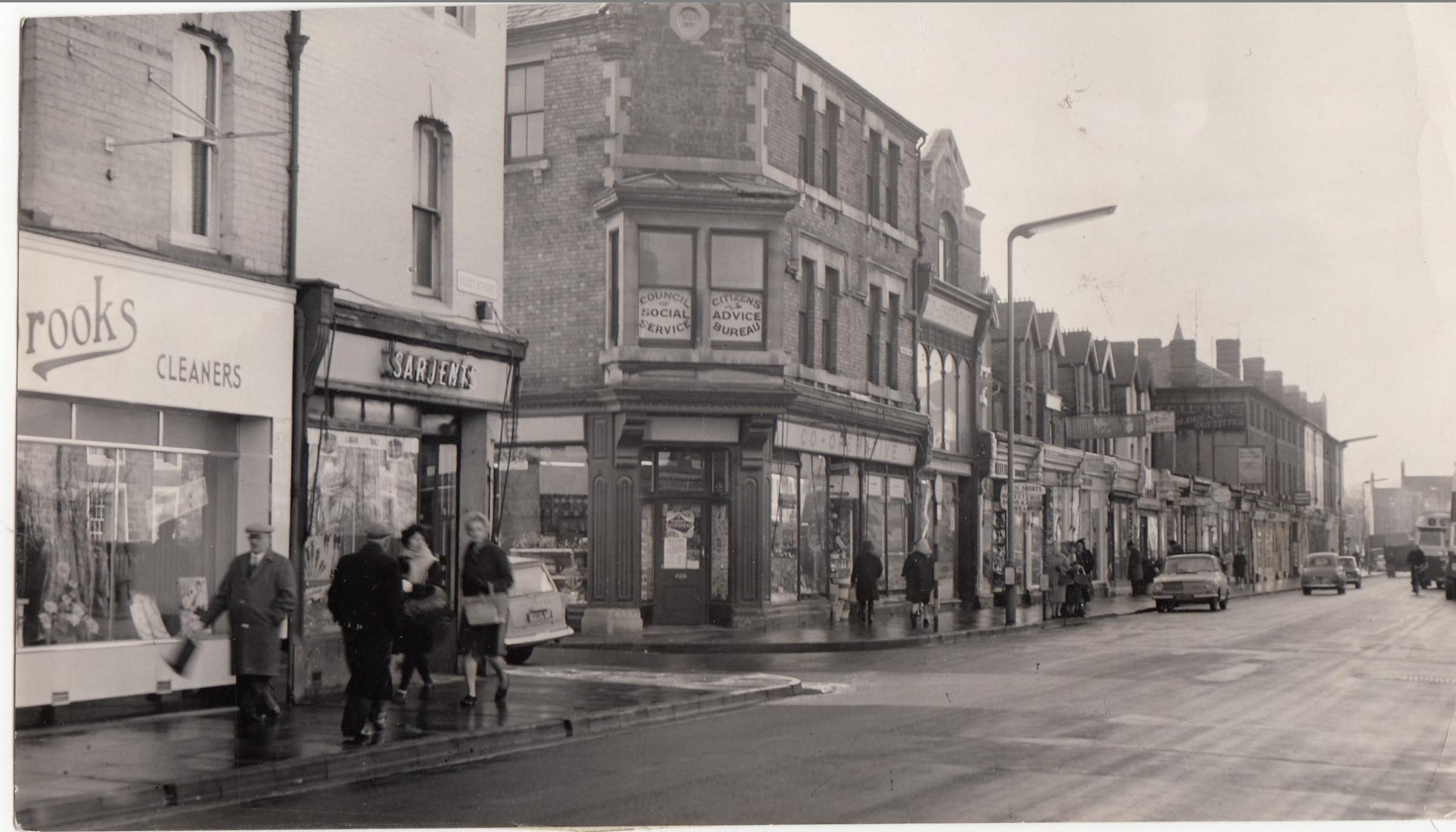
W.G. Little’s shop on the corner of Fleet Street and Catherine Street.
William Graham Little left a legacy that lived long in Swindon’s history.
William Little was born in Chippenham in 1856, the son of George Little, a linen and woollen draper, and his wife Dinah. William was the fourth of eleven children.
He moved to Swindon when he was 18 and began business as a door to door salesman. His first shop was at 32 Fleet Street where he sold clothes and fabrics.
At the time of the 1881 census he was living at 31/32 Fleet Street, his home for more than 40 years, where he employed his 19-year-old brother Albert as a tailor and cutter and his sister Sealy Anne 23, as his housekeeper.
As the business prospered he was able to build a shop in Faringdon Road. The ghost of an advertisement on the side of the building can still be seen – WGL 1892 draper, milliner.
Little served as a Councillor, a JP and an Alderman during the same period as Reuben George and James ‘Raggy’ Powell.
William Little died in 1927 aged 72. He left an estate of more than £56,000 worth today in the region of £2.5 million.
Little never married and seemed to be distanced from his family. He left his sister Frances (who had been his housekeeper at one point) £100 and the rest of his estate he left to Swindon. His family unsuccessfully contested the will but in 1932 the WG Little Scholarship and Band Concert Fund was established. His money was left in trust ‘for the promotion and advancement of education and recreation among the youth of the town.’
In 1965 an article in the Swindon Advertiser said that grants of £52,000 had been made since 1938. In 2012 a grant of £6,000 was paid to help recreate the Children’s Fete at Faringdon Road Park.
In the past, grants have gone towards helping support students at university but more recently payments have been made to buy uniforms for children of needy families transferring from primary school to secondary school.
William Graham Little was buried on May 10, 1927 in plot D47A Radnor Street Cemetery.
Tonight I shall raise a glass to Mr William Drew, although sadly not in The Lamb and Flag, a favourite watering hole of mine back in the day. When it came to pubs William Drew knew what he was talking about.
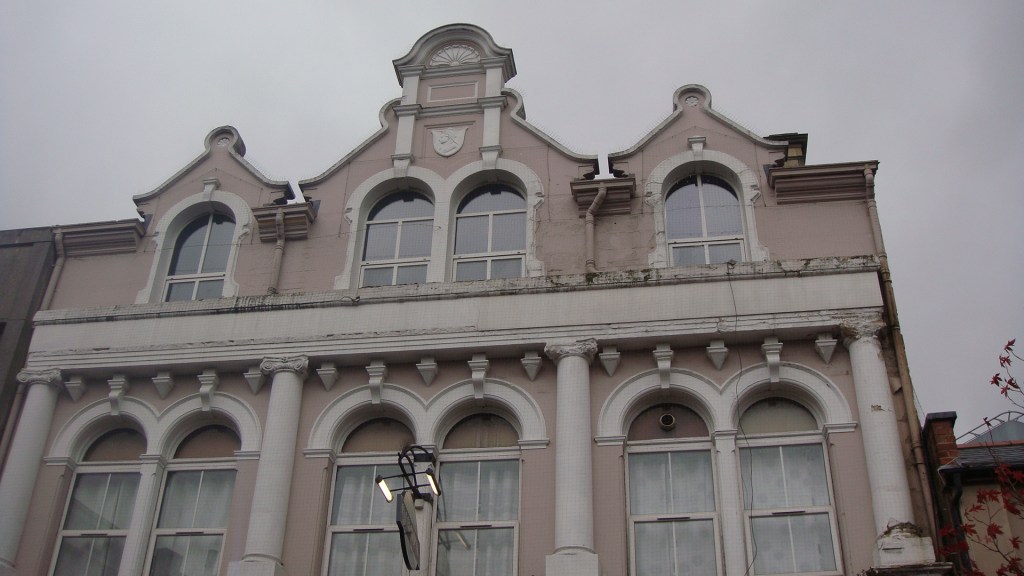
You youngsters might remember The Litten Tree in Fleet Street but of course that building was never designed as a pub, oh no, that property began life as the North Wilts Conservative and Liberal Unionist Club. It was built by Charlie Williams in 1897, the year of the old Queen’s Diamond Jubilee. You can see the commemorative plaque if you look up – past the blocked gutters and peeling paint.
They say some developer has got a plan for the building – well, they all have don’t they?
Death of an Architect. – The death occurred at Swindon on Monday of Mr William Drew, senior member of the firm of Messrs W. Drew and Sons, architects and surveyors. The deceased gentleman was at one time a very familiar figure in Swindon and the neighbourhood, but during the past three or four years he has more or less been confined to his house by illness.
Deceased was in his 68th year, and was one of the oldest members of the Society of Architects, having been admitted in 1887. He commenced practice at Highworth, where he remained for 12 years, and then removed to Swindon, where he has always earned and received the esteem and regard of his patrons and of all with whom he has had business or social relations. As a hotel valuer he was known over a wide district, while the results of his skill as an architect are to be seen in many large buildings in Swindon and the surrounding neighbourhood.
For over 30 years he has held the responsible position of architect to Messrs T. and J. Arkell, of Kingsdown Brewery, and he designed the majority of that firm’s licenced houses at Swindon, Faringdon, Lechlade, Cirencester, and many other towns and villages in the district.
Amongst other large buildings for the plans of which Mr Drew was responsible were the Clarence Street Schools (at that time amongst the finest in the west of England), the Rodborne Road Schools and enlargements, the Gorse Hill Schools (the first in the district conducted on the central hall principle), the Upper and Lower Stratton Schools, the Rodborne Cheney and Haydon Wicks Schools, Mr E. Arkell’s residence at Kingsdown, the Conservative and Unionist Club in Fleet Street, Faringdon Post Office, the Primitive Methodist Chapels at Rodborne Road and Stratton St. Margaret, the Cricklade Road Baptist Chapel and many others. Mr Drew prepared the plans of the original sewage tanks at Rodborne for the New Swindon Local Board; he developed the Kingshill Estate for Mr J. Hinton, the first street laid out being Clifton Street; and he also laid out and developed the Even Swindon Estate for Mr J. Morrison. –
The deceased gentleman has been assisted in the conduct of his business by his sons, Messrs Edward and William Drew, and they will continue to act in the same capacity as their late father.
The Faringdon Advertiser, Saturday, May 20, 1905.
*Rodborne is a spelling error in the original text.
As a valuer his services were constantly in demand, and no man was more conversant with the growth and growing importance of Swindon during the past forty years.
Deceased never took any part in the public life of the town, preferring a quiet life. In politics he was a staunch Conservative, but the only occasion on which he took an active part in the political arena was in support of the late Sir Daniel Gooch, when he was returned for the old Cricklade Division.
Mr Drew leaves a widow and family of nine children:- four sons and five daughters – for whom the deepest sympathy will be felt in their bereavement.
Some few years ago deceased took into partnership in his business two of his sons, Mr Edward Drew and Mr William Drew, by whom the bulk of the work has been carried on during their father’s long illness.
The Funeral
The mortal remains of the late Mr William Drew, were laid to rest in the Swindon Cemetery on Thursday. The funeral cortege left deceased’s late residence in Victoria Road at half-past three. Deceased was a man of great weight – considerably over 20 stone – and the remains were enclosed in an elm shell, within a coffin of immense size, of polished oak, with massive brass fittings. The inscription on the breast-plate was as follows:- “William Drew, born 29th October, 1837; died 15th May, 1905.”
The coffin was conveyed in a hearse, and there were six mourning carriages.
At the graveside there was a large assembly of sympathising friends, the funeral service being conducted by the Vicar of Swindon, the Rev. Canon Estcourt.
The funeral arrangements were satisfactorily carried out by Mr J. Williams, of Bath Road, Swindon, assisted by his son, Mr Fred J. Williams.
Extract from the obituary published in The Swindon Advertiser, Friday, May 19, 1905.
For more and better photographs of this building you might like to visit Duncan and Mandy Ball’s website.
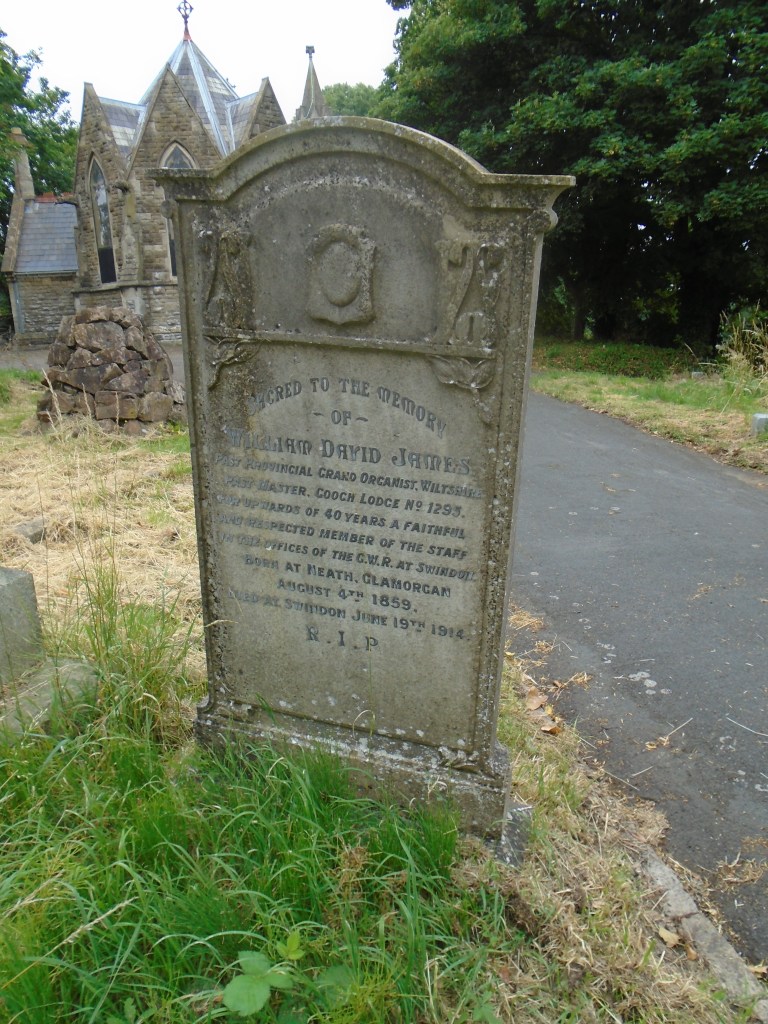
There can be no doubt about who is buried in this grave.
Mr James had led a very interesting and eventful life, as you will read in the detailed obituary published in the North Wilts Herald, but I do have one quibble. Well, not just one. In the obituary there is but a passing reference to the wife who predeceased him. She is however, mentioned on the kerbstone of this elaborate headstone along with her mother. Sadly, both sides have sunk into the heavy clay soil and are almost lost.
Death of Mr. W.D. James
A Well-Known Swindon Musician
The death has taken place, at the age of 55, of Mr William David James, of Victoria Road, Swindon, a member of a well-known family of musicians and one of four brothers who have achieved considerable renown in musical circles.
Deceased was, perhaps, the least famous of the quartet, but there were few more accomplished violinists in the West of England, and there is little doubt that, had he chosen, he would have made his mark, as his brothers have done.
What he knew about music he learned from his uncle, Mr. William Hawkins, of Wellington Street, Swindon, who for nearly a quarter of a century was bandmaster in the 2nd Battalion Wilts Volunteers and for many years musical director to the GWR Mechanics’ Institute. Mr. Hawkins took his nephews in hand when they were quite youngsters, and under his tuition they soon became proficient. Deceased played the trombone, both in the Regimental Band and the New Swindon Amateur Minstrels, which was an orchestra of 40 performers, and of which Mr. Hawkins was also conductor.
Subsequently, heleft the GWR Works to enter the musical profession, and for a short period he played first violin in the Royal Aquarium Orchestra at Brighton, but family considerations induced him to return to Swindon, and he took up his old position as a clerk in the Locomotive Department at the Great Western Works.
Practically the whole of Mr James’ life was spent in Swindon. As a boy he sang in St. Mark’s Church choir, his uncle being choirmaster, and in later years his services as a violinist were in great demand at local concerts. On many occasions he played first violin at performances given by the Swindon ChoralSociety and the Cirencester Choral Union, and, following in the footsteps of his uncle, he conducted an excellent orchestra of his own. Devotees of dancing invariably found it a pleasure to indulge in their favourite pastime to musicfurnished by Mr. James’s orchestra, and for many years it has been one of the best known in the district.
Deceased’s three brothers – Messrs. Edwin Fred James, Frank G. James and Wilfred G.T. James – are all at the top of the tree in their profession, being members of the King’s Private Band and also professors of the Royal College and the Royal Academy of Music. At one time and another they have been engaged at all the principal musical festivals in the country, and some time ago they visited the United States with the London Symphony Orchestra, under the direction of Arthur Nikisch. Mr. Frank James plays the trumpet, and the other two brothers are the principal bassoon players at Covent Garden Opera and all the great London concerts. It was as a old employe in the Great Western Works that Mr. Wilfred James gained a scholarship at the Royal College ofMusic, and from Swindon he went to London and quickly made a name for himself in the profession. At the present time he is the principal bassoon player in the Queen’s Hall Orchestra, under Sir Henry J. Wood.
The late Mr. James, in addition to being a well-known musician, was prominently identified with Freemasonry in Swindon. He was initiated into the Gooch Lodge in 1896, and, having passed the various degrees, was 10 years later made Worshipful Master of the Lodge. Latterly, his health had not been robust. He had a seizure some time ago and was compelled to go into a convalescent home at Weston-Super-Mare. After treatment at that institution he returned to Swindon, much improved in health, but some months back he had a second stroke, from which he never really recovered, and on Friday he passed away, to the regret of a wide circle of friends and acquaintances in Swindon and the neighbourhood.
Mr. James’s wife pre-deceased him some years ago. He leaves four sons and one daughter.
Extracts from the North Wilts Herald, Friday, June 26, 1914.
The Weight family were a restless bunch – well some of them were anyway.
In 1911 Albert John Griffiths Weight aged 59 made the decision to emigrate to Canada. With his wife Emma and their daughter Elsie Pauline, a teacher aged 25, they boarded the Royal Edward setting sail from Bristol for Montreal on May 3. Albert’s name appears on the Manitoba, Saskatchewan and Alberta, Canada Homestead Register dated 1872-1930. Emma died in 1937 at Shamrock, Saskatchewan and Albert died in 1942.
But it would be their son Clifford who led the most memorable of lives and left his mark on the art world.
Clifford Seymour Weight was born in 1891, the youngest of Albert and Emma Weight’s four children. In 1901 the family were living at 17 William Street and Albert worked as a Saw Mill Machinery Fitter in the GWR Works. By 1911 they had moved up the social ladder to Old Town and lived at 32 The Mall. Just weeks after the census was taken in 1911 Albert, Emma and Elsie left for Canada.
Clifford remained in England, leaving two years after his parents when he set sail from Liverpool to Maine on the MS Canada. He spent some years in California where he trained as an architect and in around 1925 he travelled to Mexico where he met Diego Rivera and Frida Kahlo.
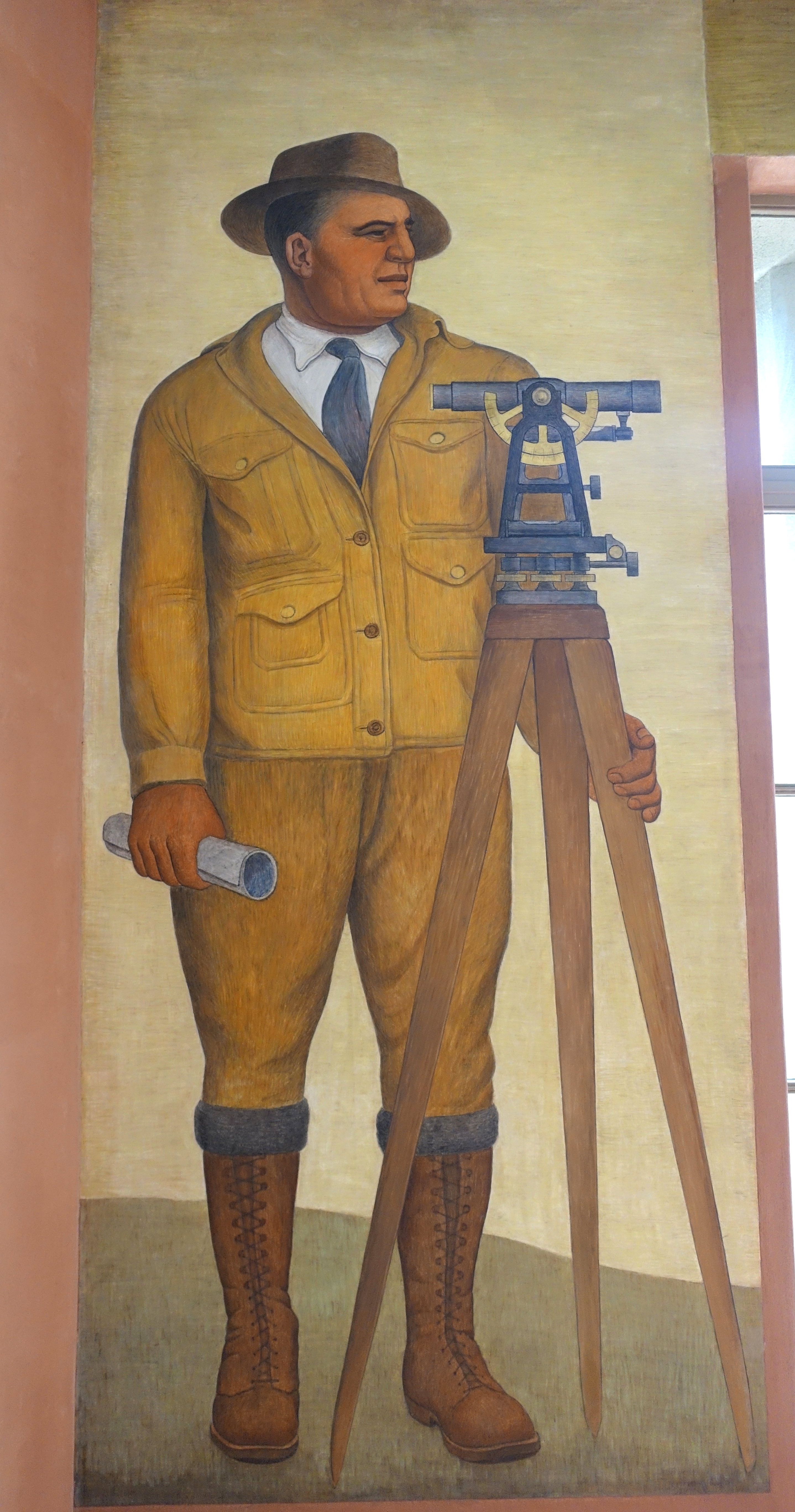
By 1929 he was better known as Clifford Wight. Whether the name change was a deliberate decision remains unknown, just another facet of this man’s extraordinary life. At this time he was working as a technical assistant, translator and secretary to the Mexican muralist Diego Rivera. Clifford worked on murals for the Detroit Institute of Arts, the Rockefeller Centre in New York (later destroyed) and the Coit Tower in San Francisco.
Surveyor by Clifford Wight – Coit Tower, San Francisco.
Clifford led a fascinating life, full of action, adventure and political intrigue. Read more on the Swindon Library website and the Syracuse University website.
Clifford’s death, like his life, is shrouded in mystery. He died on May 7, 1961 at the Hospital Clinico Barcelona Spain, apparently having fallen from a tram. Or was he pushed?
But getting back to the Weight family in Radnor Street Cemetery …
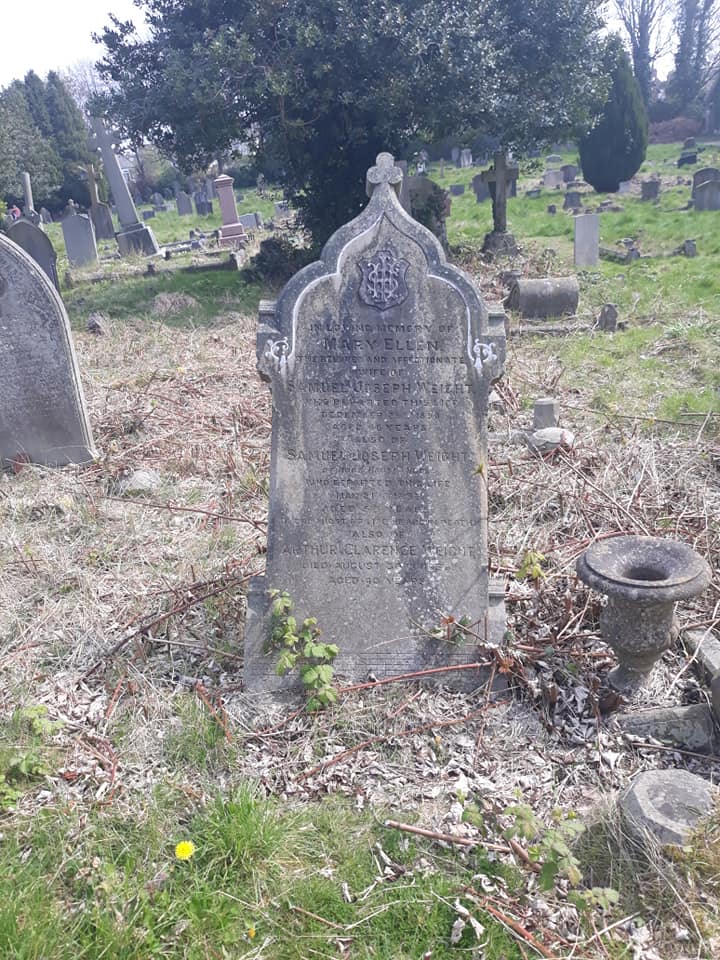
This is the grave of Samuel Joseph Weight and his wife Mary Ellen, a more settled couple.
Samuel J. Weight was typical of most newcomers to Swindon. Born in Gloucestershire in about 1839 he came to New Swindon in the 1860s to a job in the Works. At the time of the 1861 census he was lodging with his brother John and his family at 17 Reading Street where both brothers worked as fitters and turners in the railway factory.
Two years later Samuel married Mary Ellen Ford at St Mark’s Church on July 16, 1863. By 1871 the couple were living at 5 Cromwell Street with their five year old son Ozias Enoch, Samuel’s widowed mother Mary and nephew Albert John, the son of Samuel’s brother John.
By 1881 Samuel had left the Works and was licensed victualler at the Golden Lion Hotel, a pub on the Wilts and Berks canal, which lent its name to the iconic Golden Lion Bridge. It was here that Mary Ellen died on December 26, 1890. At the time of the 1891 census Samuel was still living at the Golden Lion Hotel with his sons Ozias, Bertie and William and daughter Emma, but soon after this he retired to Hook House in the parish of Lydiard Tregoze where he died on May 21, 1897.
Only one of Samuel and Mary’s children remained in Swindon – Bertie Charles Weight. Ozias ended up in Liverpool where he died in 1922, Samuel jr moved to Balham while William died in Bromley in 1960. Daughter Emma married and died in Heston in 1912. Little Polly, a baby daughter who died at the Golden Lion in 1881 aged three weeks old, was one of the first burials in the new Radnor Street cemetery on August 18.
Although Arthur Clarence Weight is remembered on Samuel and Mary Ellen’s headstone their grandson is not buried with them. He lies in plot E8548 with his parents Bertie Charles and Edith Eleanor and a brother Reginald Charles Frederick. A branch of the restless Weight family who stayed put.
published courtesy of Local Studies, Swindon Central Library
The re-imagined story …
I will admit to having a grudging admiration for Mr. James Hinton, but I wouldn’t say I actually liked him. We’ve done business together on a couple of occasions and he’s very shrewd. He strikes a hard bargain and you have to respect him for that. And he works hard; the stamina of the man!
He’s been in the news most recently for offering up a piece of land on which to build the new cemetery. Some say he has gifted the land, but in fact he has sold it to the Burial Board. He’d probably like it to go down in history that he was a generous benefactor, but he’s sold it at a very competitive price. As the debacle of the cemetery question needs a quick resolution his fellow members on the Board were happy and grateful to accept the offer.
I’m quite surprised he didn’t win the contract to lay out the cemetery and construct the requisite buildings, but perhaps he didn’t put in a tender. Perhaps that would have been an audacious step too far. Next would have been a vote to name the new burial ground the James Hinton Municipal Cemetery.
But I will admit, I secretly quite admire the man.
The facts …
‘Mr Hinton stated that he would assure to the Board a free right of way to the proposed site for a cemetery over Stafford St., and Dixon St., and a right of way over Lansdown Road (from the Sands to cemetery over or 11 feet road) marked green on plan & over Radnor Street & Cambria Bridge Road to Fleetway.’
Swindon Advertiser July 1, 1880
The Cemetery – The Clerk reported that the Cemetery Committee had accepted the tender of Messrs Phillips, Powell and Wiltshire for laying out the cemetery and doing the necessary buildings for the sum of £5,390 10s. Detailed plans of the works were placed on the table and it was said the same was now in active operation.
Swindon Advertiser April 9, 1881
Death of Ald. J. Hinton
A painful sensation has been caused throughout the town by the news of the death of Alderman James Hinton, of The Brow, Victoria Road, Swindon…
For some time past it had been known that Mr Hinton had not enjoyed what may be termed the best of health, and on several occasions recently he had to resort to medical care, but no one, even those nearest to him, ever thought for one moment that he would be stricken down with such painful suddenness…
The deceased Alderman was 65 years of age. He was essentially a native of Swindon having been born in Newport Street in 1842. He had been for very many years intimately connected with the moving forces of the Borough, and took a keen practical interest in its commercial developments. There is not a class in the town, no matter what their religious or political opinions may be, but what will deeply deplore the loss of a public man whose best energies were given to the service of the community in which he lived.
The deceased Alderman’s career was one characterised by much interest, inasmuch as by his own industry and business acumen he rose from a somewhat humble position to one of comparative affluence…
The deceased Alderman became well known too, for his judicious speculative undertakings. Important estates, capable of considerable developments, were laid out by him, notable amongst which was the Kingshill building estate laid out in 1879. He became a large owner of land, enterprise dominated his thought and action followed; money flowed in and accumulated, and by dint of patience and perseverance Mr Hinton emerged from the obscurity with which Newport Street and the butcher’s shop had somewhat enshrounded him into the full light of prosperous, active life…
As Mr Hinton became absorbed in the growing interests of the town, further important undertakings came in his way. In conjunction with Mr Haines, he had the contract for constructing the Swindon and Highworth railway, which upon its completion was acquired by the GWR Co. During his speculative undertakings Mr Hinton did not at once relinquish the auctioneering profession, in which he was eventually succeeded by his son, Mr Fred Hinton…
It is about 30 years ago that he was elected on the then New Swindon Local Board, taking the place of the late Mr J. Armstrong, who was for some time Loco. Superintendent at the GWR Works, Swindon…
The old Local Board existed up to the year 1894, when the District Councils’ Act came into operation, and Mr Hinton then succeeded Mr T. Brain as the Chairman of the Council. He represented the East Ward, and did not suffer defeat until 1896, on which occasion he was touring in Australia, and was as a matter of fact unaware that his name had again been submitted to the electors…
In 1900 the Charter of Incorporation was granted to Swindon, and that august body, the Town Council, was constituted. Mr Hinton once again entered the arena of active local life, still representing the East Ward. He was elected a member of the Wilts County Council on its formation in 1889, and was a member of that body up to the time of his death. It was only the other week that he was returned unopposed for the East Ward. He was for four years a member of the Board of Guardians in the time of the late Mr William Morris, who was then the proprietor of the Swindon Advertiser. He was Swindon’s fourth Mayor, and it was, of course, largely in consequence of his associations with the almost phenomenal development of the town that his acceptance of the Mayoralty was invested with exceptional interest…
Mr Hinton was a Freemason, and was a member of the Gooch Lodge. He was also a Forester, being initiated an honorary member of “Briton’s Pride” Court at the Eagle Hotel during his year of Mayoralty…
He was raised to the Alderman’s bench on the same occasion that he was elected to the Mayoral chair. He was a man who possessed a broad and liberal mind, and by his death the town has lost a good and trusted and esteemed servant…
Extracts taken from James Hinton’s obituary published in The Swindon Advertiser, Friday, March 15, 1907.
James Hinton’s memorial in Radnor Street Cemetery
Coming next …
A Nice View – “It’s going to be an expensive business, getting buried in the new cemetery.”
published on Radnor Street Cemetery blog January 24 2019





 Radnor Street Cemetery