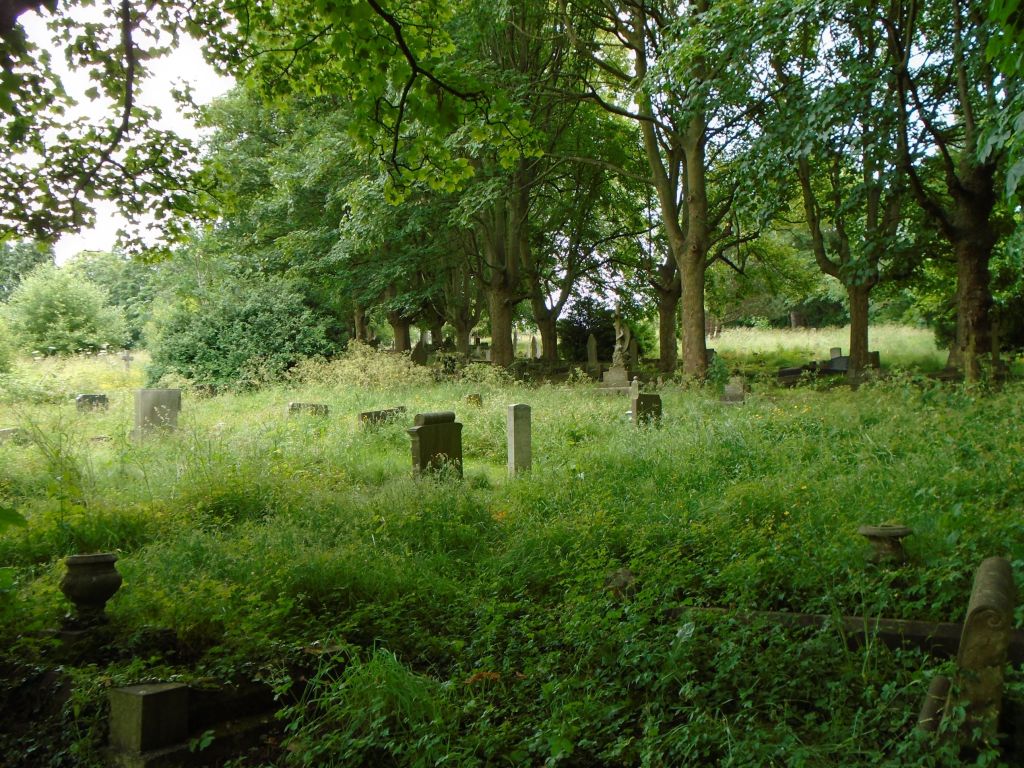
Welcome to Radnor Street Cemetery – a celebration of the working-class history of our town.
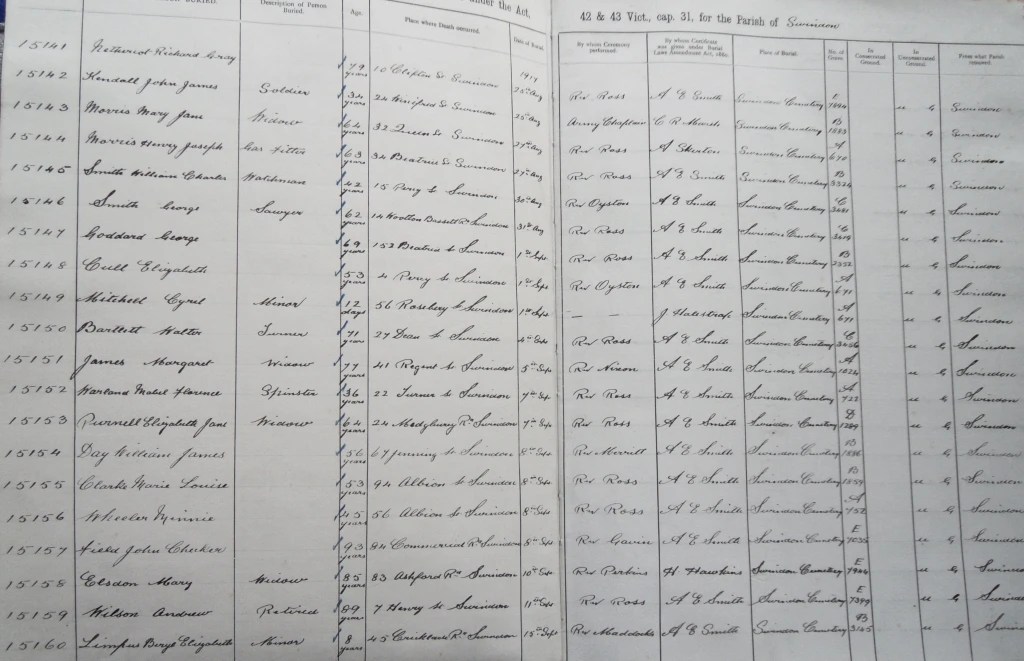
The Radnor Street Cemetery burial registers along with those relating to other Swindon cemeteries, are held at the Kingsdown Crematorium and are available for consultation by appointment. The Radnor Street Cemetery burial registers are in remarkably good condition, especially considering the different places they have been stored over the years. Rumour has it that they were once left in the cemetery chapel. Thankfully they didn’t suffer the same fate as the stonemason’s records, which were used to ignite a fire some years ago.
One set of registers are compiled chronologically, the other alphabetically and you need to have the full and correct name of the person for whom you are searching and the date of their death. There is also a set of grave plot registers with details of those buried in each grave.
The style of handwriting changes over the years and can take some getting used to, although it has to be said that the earlier volumes written in copperplate are often the easiest to read.
So, whose task was it to enter the details in these large tomes? The first caretaker appointed when the cemetery opened in 1881 was Charles Brown so perhaps it was his job to fill in the paperwork. Or could it have been the job of the Clerk to the Burial Board, Mr J.C. Townsend? Unlikely, as James Copleston Townsend was a solicitor and headed a busy legal practice based at 42 Cricklade Street.
The details in the registers reveal the various funeral directors at work in Swindon and the numerous ministers who attended at the committal. And fascinating facts about long forgotten terraces of houses, the name subsequently abandoned when construction on the street was completed. So many of these town centre streets now lie beneath modern developments – for example Canal Side, Brunel Street and Cromwell Street.
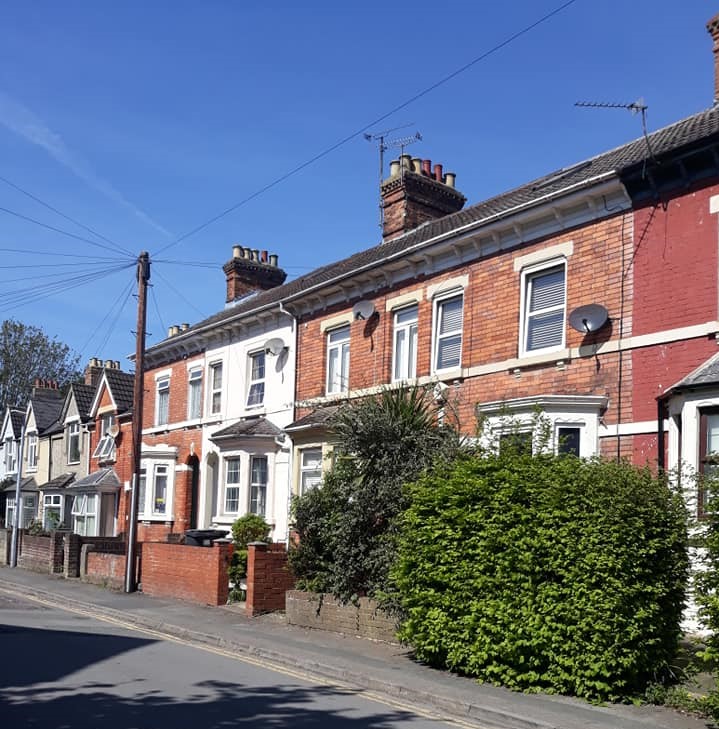
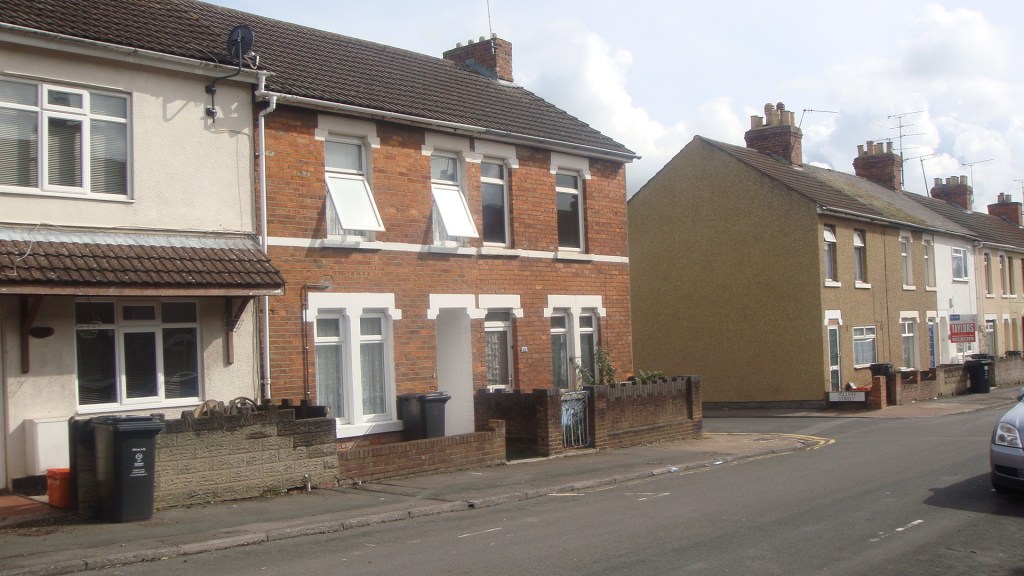
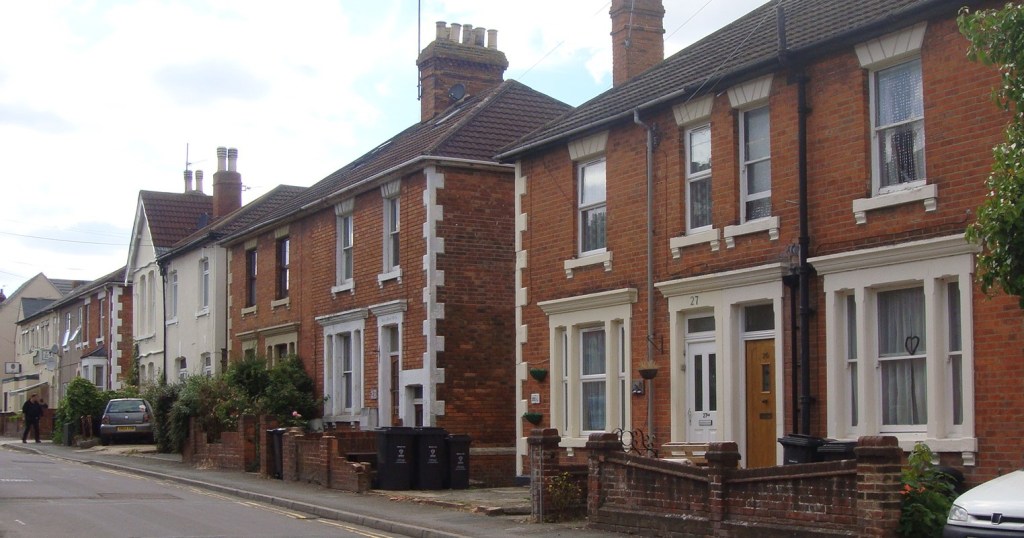
Examples of the work of different builders on Dixon Street today.
Two Welsh brothers arrived in Swindon during the 1880s and left their mark on the town.
Thomas and John George were born in the village of Boverton, Llantwit Major, Glamorganshire. Thomas was born in 1853 the elder son of Thomas and Margaret George; his younger brother John was born in 1866. Their father worked throughout his life as an agricultural labourer and in 1881 John was also working as a farm labourer. Thomas became a stonemason, a trade which would help the brothers establish themselves in Swindon’s late Victorian building boom.
Thomas arrived in Swindon in the 1880s where he quickly got to work, building a property in Rodbourne Road in 1887. By 1891 Thomas was living at 26 Dean Street with his wife Emma and their two young children Minnie 2, and 1 year old Thomas when his brother John joined him. This is the year in which Thomas and John would begin work on a street that would bear the brothers’ name – George Street.
The two brothers worked together throughout the 1890s building properties in Butterworth Street, Dean Street, Dixon and Deacon Streets. During the final year of the century they were engaged in projects in Wells Street, Gladstone Street, Ponting Street, Manchester Road and Groundwell Road.
At the time of the 1901 census the brothers were living at 69 and 71 Eastcott Hill. John was also married by then and had three sons Alfred 8, Bernard 7 and Albert 4 all born in Swindon. But ten years later and everything had changed. Then living at 169 Victoria Road John, aged 44 describes himself as a retired builder. Thomas would carry on the business alone building houses in Wells Street, Lincoln Street and Portsmouth Street in 1914/5.
By 1918 John and his family had moved to London. At the time of the compilation of the 1939 list John and Emma were living in Addison Gardens, Kensington with their son Alfred George, a wholesale wine merchant’s clerk.
Thomas remained in Swindon and a home at 1 Okus Road where he died in August 1915, aged 62. He is buried in plot E7669, a grave he shares with his wife Emma who died four years later.
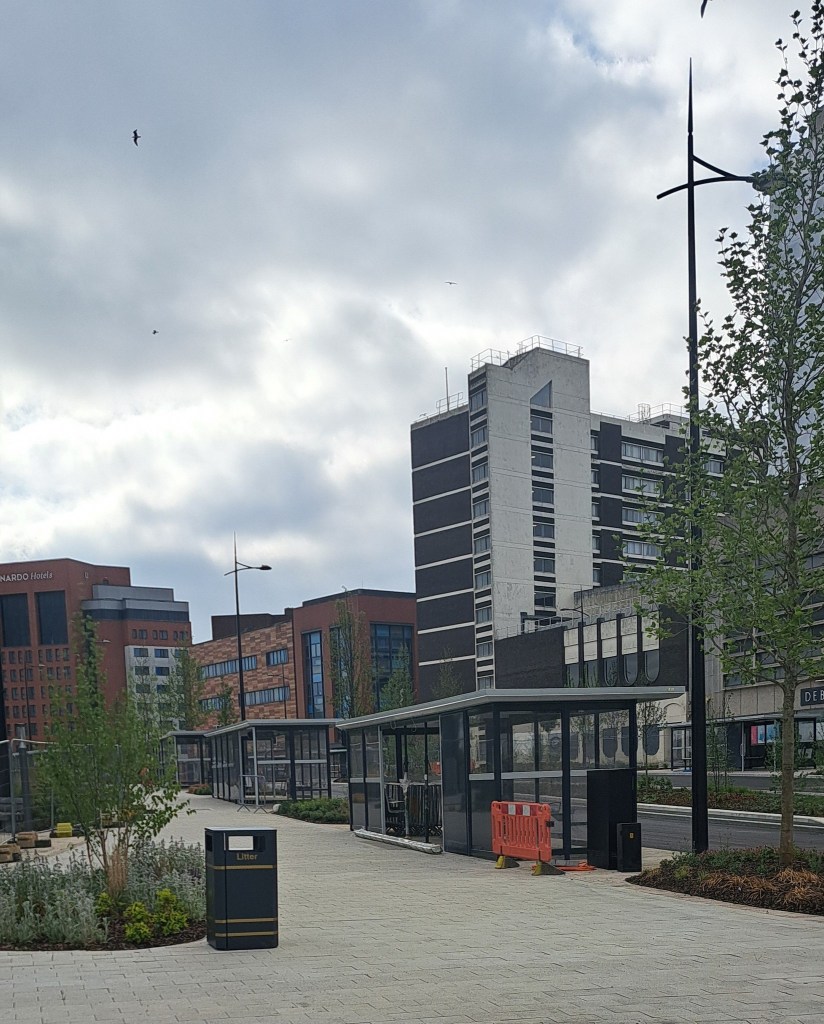
As Swindon’s long awaited bus boulevard nears completion, what lies in wait for the area that backs on to it?
In the 19th century this was recognised as a prime town centre location when the Oxford Building and Investment Co Ltd built 108 houses on the site. The Oxford Building Society was a relatively short-lived organisation registered in February 1866 and going into liquidation 17 years later.
When the company folded in 1883 it had an interest in 225 properties in Oxford and more than 100 Swindon.
The New Swindon properties were built on a parcel of land called Brierly Close, between the canal and Lower Eastcott Farm orchard, part of the extensive Rolleston Estate.
Named after Oxford City Centre locations, construction began on Merton Street in 1873 followed by Turl Street in 1874, Carfax Street in 1875 and Oriel Street in 1876 – an area that is unrecognisable now.
In 1881 the census enumerator who travelled from door to door collecting information seems to have struggled with the 34 households in Carfax Street. The census returns are covered in scrawled amendments and crossings out and could the details about No 21 actually be accurate? It would appear that 15 adults and four children occupied this small, terrace property, which can’t possibly be correct!
Head of the household was George Kinch aged 61. His occupation is given as Miller and he was born in Shrivenham in about 1820. At home with him in 21 Carfax Street on census night 1881 were his wife Sarah, his sister Charlotte, his stepdaughter Elizabeth, his 3 year old grandson William and his brother John. A pretty busy household – but then if the census is to be reckoned with there was also Albert Cove and his wife Lydia, John Williams and his wife Elizabeth, William Hibberd and William Watkins, his wife Ellen and their children William 4, Mary A. 3 and one year old Charles.
The terrace houses in Carfax Street were demolished in the 1970s and few photographs survive. It is, therefore, impossible to assess whether No 21 was actually a very large property or if 15 adults and four children actually squeezed into a more modest terrace house. Or perhaps the census enumerator recorded facts we cannot now unravel.
George’s wife Sarah died at No 21 shortly after the census was taken. She was buried in Radnor Street Cemetery on May 11, 1881 in a public grave plot A228. George died ten years later while still living at No. 21. He was buried with his wife on June 11, 1891. As in life so in death the couple shared their final resting place with a number of others. Hannah Scarrot who died in 1901, Frederick Boulton who died in 1918 and his wife Eliza Ann who died in 1944.
Sometimes the story behind a comprehensive headstone inscription can still take a bit of unravelling. Take the one on Arabella Dunbar’s grave.
In loving memory of
Arabella
Widow of the late
David Dunbar
Sculptor
(of London)
Who died December 27th 1885
At New Swindon
Aged 77 years
Thine eyes shall see the King in His beauty;
They shall behold the land that is very far off.
Isaiah 33
So, how did it happen that the widow of a celebrated Scottish born sculptor end up buried in Radnor Street Cemetery?
Arabella Riddiford was born in Uley, Gloucestershire, the daughter of Daniel and Susanna Riddiford and was baptised at the parish church on January 8, 1809. Little is know about her life before she married David Dunbar and even this evidence is confusing.
David Dunbar was born in 1793 in Scotland but when he married Arabella (his second wife) the details on their marriage entry are at variance with the other known facts. The couple were married at All Souls Church, St. Marylebone (where they are both described as living in the district) on July 15, 1844. David Dunbar describes himself as a widower and sculptor aged 28, the son of Stewart Dunbar a [stone] mason. Arabella Riddiford was also aged 28 a spinster the daughter of Daniel Riddiford Tea Grocer (deceased). Now by my reckoning David was at least 51 years old and Arabella 35.
At the time of the 1851 census the couple were living at David’s home, 9 Ranelagh Place and again the ages recorded are incompatible with other records.
The couple are difficult to locate on the 1861 census. They may have been living in Scotland at the time, where David died in Dumfries in 1866.
A lengthy obituary was published in national newspapers in both England and Scotland. (See examples below). His life’s work was obviously more important than his private life as there is no mention of a widow or any surviving children, however there appears to have been at least one son, David Dunbar Jnr who turns up in Swindon.
On June 25, 1849 David Dunbar a bachelor of full age (that is over 21) occupation Draper, address Ranelagh Place, father David Dunbar Sculptor, married Eleanor Cogdon at St. Peter’s Church, Eaton Square, Pimlico. The two witnesses to the marriage were John Cogdon (presumably Eleanor’s father) and Arabella Dunbar (presumably David’s mother).
Later that year there is a Notice of Indenture of Assignment published in The Wilts and Gloucestershire Standard, Tuesday, January 3, 1850 (see below) which names David Dunbar, Linen and Woollen Draper of Swindon and David Dunbar, Sculptor. All this adds weight to why Arabella ended up in Swindon where she died. Or does it?
The clue to this mystery is Charles Thomas, a 5 year old boy who is visiting Arabella at the time of the 1871 census when she lived in Stonehouse, Gloucestershire.
Charles Riddiford Thomas was the son of William Thomas, a beerhouse keeper, and his wife Arabella, who lived in Swindon. The couple had married at Christ Church on September 30, 1854 where we discover that Arabella’s maiden name was Riddiford and that she was the daughter of Charles Riddiford. Charles Riddiford was born in Uley, Gloucestershire the son of Daniel & Susanna Riddiford and was therefore Arabella Dunbar’s brother.
At last the connection is made between Arabella Dunbar, widow of a famous sculptor, and why she ended up buried in Radnor Street Cemetery. She was living in Swindon with her niece Arabella at the time of her death.
The entry in the burial registers record that Arabella was living at 6 High Street, New Swindon in 1885, (before it was renamed Emlyn Square). Her funeral took place on December 30, 1885 and she lies in plot A1039. The inscription on her headstone says it all, well nearly!
The facts …
The Late Mr David Dunbar, Sculptor
It is with deep regret we record the death of this genial and talented gentleman, which sad event took place here on Sabbath morning last, after a very short illness. We cannot allow so eminent a fellow-townsman to pass away without some tribute to his memory, and record of his active life.
While serving his apprenticeship as a stone-mason with his father, he shewed symptoms of that taste for sculpture which ultimately led to the adoption of that art as his profession. So great was his reputation as an ornamental carver among the building trade that he obtained an engagement in his seventeenth year to execute the capitals and other decorative parts of Lowther Castle, then in course of erection, at a wage of 7s per day. After following for a few years this, the lightest and most elegant part of the masons’ trade, he had his early aspirations of seeing Rome and studying in Italy realised through the kindness of some friends who had long watched with sympathetic interest the budding genius of the embryo sculptor.
During his sojourn in the “land of poetry and song,” he diligently pursued his studies in the fine arts, and on the eve of his return to England the Royal Academy of Cararra elected him a member of their body in recognition of his artistic genius – his “diploma study” being the “Sleeping Child,” a charming work, which long adorned the vestibule of St Michael’s, calling forth the admiration of countless visitors.
On his return to this country, he entered the studio of Sir Francis Chantry, where, during a number of years, his services were of great importance to that distinguished sculptor. Upon leaving London, he began business on his own account in Newcastle on Tyne, and during a lengthened residence there executed many works of great excellence. It was at this period he carried out a series of “Fine Art Exhibitions,” two of which were held at Dumfries, and contributed to the development of a taste for the plastic arts that was then arising among the people. Carlisle, too, was much indebted to Mr Dunbar for a healthy stimulus it received in favour of popular education; and so marked were his services in connection with the foundation of a Mechanics’ Institute in that city, that the principal inhabitants presented him with a substantial token of their gratitude and esteem.
During the last few years of his career he found employment for his chisel in various parts of the country, and it was while engaged upon some classic work in Edinburgh, that he took a journey to his native town for change of air and relaxation, of which he stood in much need: it was his last visit – he returned only to die – and his latest breath was drawn among the kindred he loved so well.
His best works are busts from the life; and some copies in marble, from the antique, one of which we lately saw in Carlisle (which was executed nearly half a century ago), and was to our enamoured sense truly a thing of beauty. He was honoured with sittings from Earl Grey, Lord Brougham, Lord Durham, and other eminent statesmen; and he executed a much admired bust of Grace Darling, which was several times reproduced in marble for the Bishop of Durham and other admirers of the heroine. The statue of Sir Pulteney Malcolm at Langholm, also by the deceased artist, is a fine memento of his genius and skill.
Mr Dunbar was full of emotional warmth, generous, and benevolent. He had a rich fund of anecdote and humour, and great stores of general information, from which he could draw at pleasure to delight the social circle. On all these accounts the announcement of his demise will be received with deep regret by numerous friends in Dumfries and other parts of the kingdom.
Dumfries and Galloway Standard and Advertiser, August 15, 1866.
Dunbar’s bust of Elizabeth Stephens, better known as Mrs Gaskell, author of Cranford, Mary Barton & North and South.
Notice is hereby given, that by Indenture of Assignment bearing date the 24th day of December, 1849 David Dunbar, of Swindon, in the Country of Wilts, ‘Linen and Woollen Draper, (trading under the firm of Dunbar and Company) assigned all his Estate and Effects unto William Ford, of No. 282, High Holborn, in the County of Middlesex, Line Draper, and David Dunbar of No 9, Ranelagh Place, Pimlico, in the County of Middlesex, Sculptor, upon trust for the benefit of all the creditors of the said David Dunbar, of Swindon aforesaid, who should Execute the said Deed, as therein mentioned. And that the said Deed of Assignment was duly executed by the said David Dunbar, of Swindon aforesaid, on the said 24th day of December, 1849 by the said William Ford, on the 27th day of December, 1849, and by the said David Dunbar, of No. 9, Ranelagh Place aforesaid, on the 1st day of January, 1850, in the presence of and attested by Richard Marriott Freeman, of No. 4, Great James Street, Bedford Row, in the County of Middlesex, Attorney at Law, at whose office the said Deed of Assignment now lies for execution by the Creditors. – Dated this 2nd day of January, 1850
R.M. Freeman, Solicitor to the Trustees,
4 Great James Street, Bedford Row.
The Wilts and Gloucestershire Standard, Tuesday, January 3, 1850.
The Katherine Losh mausoleum in the church at Wreay, Cumbria. Katherine was the sister of Sarah Losh, architect and designer.
David Dunbar, sculptor 1797-1866
When the opportunity arose in February, 1845, for carving the most prestigious statue in Victorian Cumberland, David Dunbar was staying at Woodside. He wrote to the committee offering to execute the statue of the Earl of Lonsdale in either bronze or marble. On discovering that his one-time pupil, Musgrave Lewthwaite Watson, was competing for the memorial, he wrote again offering ‘to resign any pretensions of mine in favour of that gentleman’. At Woodside he was probably engaged in sculpting the statue of Katharine Losh which was to be placed inside the mausoleum at Wreay. His hand would be guiding the chisel, but it would have been Sarah Losh’s imagination which was creating the image. He had once been an artist of rare ambition and considerable energy. David Dunbar had been born in Dumfries in 1793, the son of a stonemason. His father had taught him his craft, but he displayed an exceptional aptitude. At the age of seventeen he went to work on the building of Lowther Castle, one of the greatest building projects of the age. Paul Nixson, from Carlisle, employed him in carving the capitals which graced the inner court of this extravagant Gothic fantasy. Dunbar’s ambition took him to London where he married and became one of several assistants in the Pimlico workshop of Francis Chantrey, the most successful and accomplished sculptor of his day. There he acquired exceptional skills and began to exhibit at the Royal Academy. He left this promising situation to return to work for Paul Nixson in Carlisle in 1820. Nixson had a monumental workshop in Finkle Street, but offered little demanding work for the young sculptor beyond the carving of funeral monuments and marble fireplaces. However, Dunbar, Nixson and a young painter, Matthew Nutter, began The Carlisle Academy of the Arts. Their aspirations were embodied in the sculpture of the Genius of Carlisle which stood above the workshop entrance. Dunbar busied himself with carving the busts of local professionals and industrialists and occupied himself in educating the working men in the city and promoting a remarkable series of eight annual art exhibitions. In the small provincial city of Carlisle, Dunbar was showing works by the great masters from Titian to Rubens and Rembrandt and displaying plaster casts of sculptures from the antique and after Renaissance masters. He was also attracting exhibits from leading contemporaries throughout the country, including Edwin Landseer, John Varley, Frederick Watts, James Ward and members of the Norwich School, and from a school of proficient local artists. In 1826, he went on an extended tour of Italy, visiting the workshops of Thorwaldsen and Joseph Gott, among others, in Rome and being deeply impressed by the work of the late Canova in Possagno. On his return, he sought to extend his reputation. When he was refused entry to the Newcastle Exhibition because his statue of Musidora was considered indecent, he took the unprecedented step of staging a one-man exhibition in the city and then a second one in Durham. He found work among the liberal and radical community in the North-east. He sculpted the young Elizabeth Stephens, who in later years became the novelist Mrs Gaskell. He was also commissioned to make busts of Earl Grey and of James Losh, but the leading commissions did not come his way. His work lacked the individuality and imagination of Lewthwaite Watson. It was probably at this time, in 1832, that he carved busts of Sarah and Katharine Losh. Dunbar’s bust of James Losh was placed in the library of the Literary and Philosophical Society in Newcastle, but it was also used as a model for John Graham Lough, then working in Rome, to create a full-length statue of Losh in a Roman toga. It was Lough’s work which took pride of place on the staircase of the society. In 1839, he sought money and reputation by making the first bust of Grace Darling and selling plaster casts of the popular heroine of the Islands. His work and his income declined. In his last years he was a peripatetic stonemason and carver, repairing the stonework on colleges and churches. He died visiting his home town in 1866. His most popular and admired work was an image of his infant daughter, Elizabeth, which he made shortly after her death in 1822. There is a copy in Carlisle Cathedral, but he was prepared to sell the original even after he had donated it to his home church in Dumfries. His statue of Katharine Losh was recreated from the image of the bust he had already created from the life, from Sarah’s drawing and from Sarah’s memories and imagining. He rendered in marble that sense of gentleness, of sweet compliance, that sense of love between two sisters so embracing and so essential to each that they never thought of being apart. In carving the statue of Katharine, David Dunbar was touched by an art more profound than he had known before.
David Dunbar was born in 1793. He was the son of Thomas Dunbar, Stonemason and his wife Janet Johnstone. David Dunbar married first Ann Stokes and second Arabella Riddiford. He died at Academy Street Dumfries on the 12 of August 1866. His nephew George Dunbar registered his death
Grace Darling, the daughter of a lighthouse keeper who rescued the survivors of the shipwrecked Forfarshire in 1838 and gained national fame.
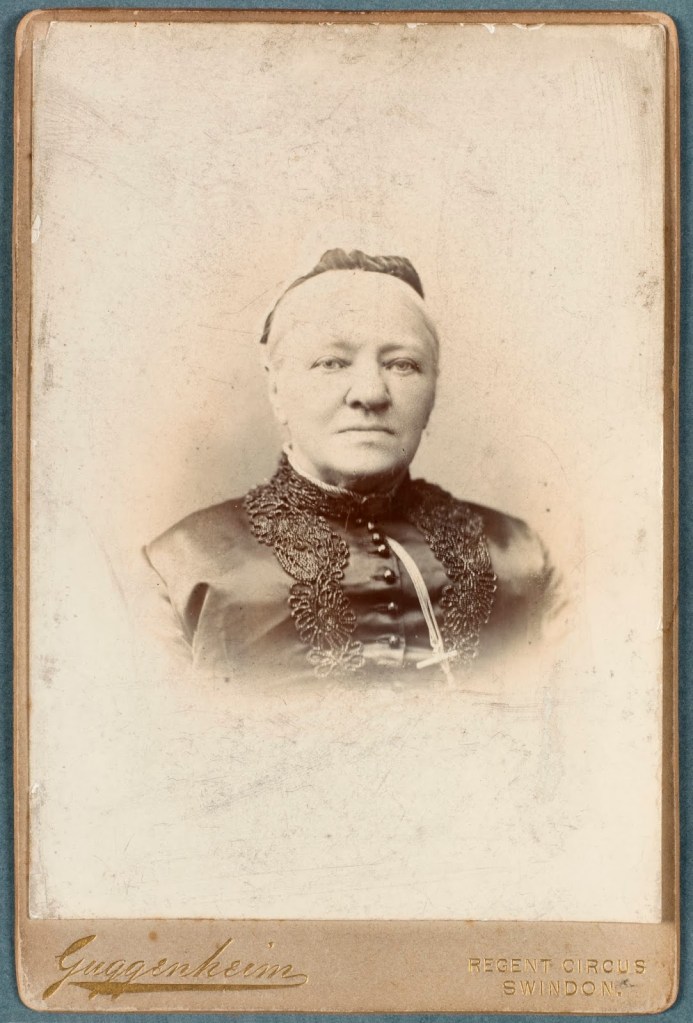
Portrait of Charlotte Wilsdon by Guggenheim, Regent Circus, Swindon
The re-imagined story …
When dad took ill last January, Mrs Andrews sat with him through the night to give mum a break. She hadn’t lived in Spring Gardens for very long, but already we had a lot to thank her for.
She moved in with her daughter a few months ago and quickly became one of those women neighbours called upon in an emergency; although not many people could boast that they had a nurse who had served in Scutari Hospital under Florence Nightingale.
There were some who didn’t believe the stories, but I did, especially after she nursed dad through the deliriums of his illness. She was methodical and well organised and scrupulously clean, all habits she had learned from Miss Nightingale, she said. She told me about the awful conditions in the Scutari Hospital when the nurses first arrived and how more soldiers were dying on the wards there than on the battlefields during fighting in the Crimea War.
Listening to her talk I thought that somebody should be recording her stories. Surely we should be celebrating the life of this extraordinary woman.
Mrs Andrews was for me an inspirational character. I didn’t become a nurse, that was not to be my vocation, but I studied history and now I write and record the lives of amazing women like Charlotte Andrews.
The facts …
In June to August 1854 20% of the British Expeditionary Force in the Crimea fell sick with cholera, diarrhoea and dysentery. Almost 1,000 men died before a shot was fired in what was then called the Russian War.
On September 30, 1854 The Times correspondent in Constantinople reported that there werenot enough surgeons and nurses; not enough linen for bandages; that wounded soldiers often waited a week before being seen by a doctor on board ship from Balaclava to Constantinople.
It was news reports such as these that galvanised Florence Nightingale into applying her nursing skills where they were so desperately needed.
Together with a group of 38 women volunteers Florence left London Bridge Station early on October 23, 1854. From Folkestone the women boarded the Boulogne packet; then they travelled via Paris and Lyons to Marseilles where they took the mail steamer Vectis to Scutari. The journey lasted 13 days. Among these women was Charlotte Wilsdon, a woman born in Abingdon, who would end her days living in Spring Gardens, Swindon.
At the outbreak of war in 1854 Charlotte was living in Oxford with her two young daughters. She had been married and widowed twice and was then working as a tailoress, taking in lodgers to make ends meet. In October of that year Charlotte responded to Florence Nightingale’s appeal for nursing volunteers. Charlotte was recommended by Dr Henry Wentworth Acland, and it is likely she gained her nursing experience during the cholera epidemic that had swept through Oxford earlier that year.
Florence Nightingale and her corps of nurses arrived in Turkey on November 4, on the eve of a major Russian attack at Inkerman.
Following the battle the Rev Sidney Godolphin Osborne described conditions at Scutari, a former military building where those wounded at Inkerman were brought, as being totally unfit to serve as a hospital. Patients were lined up along the corridors, their beds mere thin stuffed sacking mattresses and rotten wooden divans. There was a shortage of medicines and food. Charlotte and the other newly arrived nurses began work immediately, attending to hundreds of casualties where deaths numbered 20-30 a day.
Florence Nightingale’s nurses were paid 12–14 shillings (60-70p) a week, which included their keep and a uniform, rising to 18-20 shillings (90p-£1) following a year’s good conduct. Drunkenness proved a big problem among the unqualified women and several were dismissed. However, it was with regret that Florence had to send the invalided Charlotte back to England.
In a letter to Lady Cranworth, a member of the management committee, dated June 7, 1856 she writes:
‘Charlotte Wilsdon, I regret to say, I was obliged to invalid home 23 May by the advice of the medical officers. She is a kind, active and useful nurse, a strictly sober woman. And, I consider, well entitled to the gratuity of the month’s wages, promised by the War Office, and which I venture to solicit you grant her. I have directed her to apply to you.’
After more than a year of working in such dangerous and challenging conditions, her health compromised, Charlotte returned home to Abingdon.
Charlotte was born in Abingdon in 1817, the daughter of Stephen Cox, a carpet weaver, and his wife Ann. She married and outlived three husbands. Her first was William Higgins, a carpet weaver, who died leaving Charlotte a widow at the age of 26 with two young daughters, Harriet and Selina, to support. She married William Wilsdon two years later but by the age of thirty-three Charlotte was widowed for a second time. In 1859 Charlotte married William Andrews. Widowed for the third time in 1869, Charlotte lived independently for many years until old age and infirmity caught up with her. Sometime during the early 1890s she moved to Swindon to live with her daughter.
She died on March 22, 1896 at her daughter Harriet’s home, 3 Spring Gardens, Swindon. She was buried on March 27 in Radnor Street Cemetery in plot C772 which she shares with Hannah Richards who died in 1944 and is probably a family member.
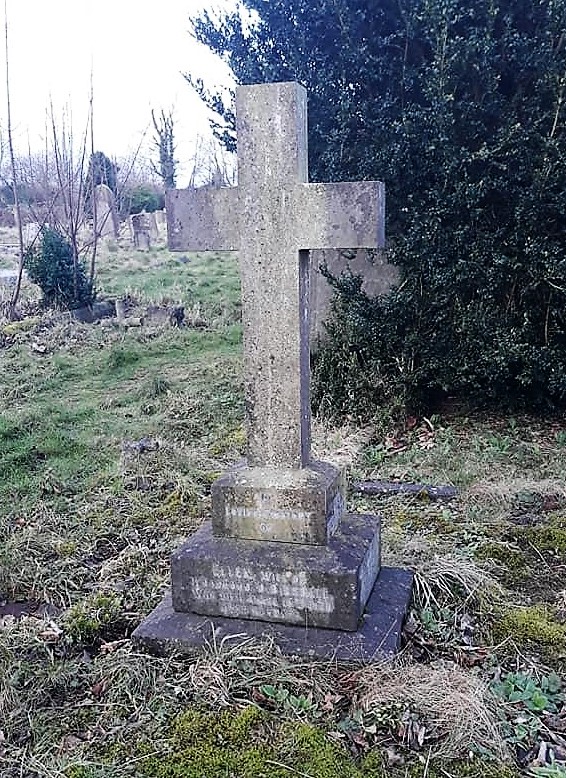
This magnificent cross is a memorial to members of the Dibsdall family.
Susan Dibsdall is the first member of the family to be buried here. Susan was baptised on November 8, 1809 one of James and Susanna Pope’s six children to be baptised in the parish church at Sherborne, Dorset. Susan married Thomas Dibsdall at the parish church in Bedminster on May 13, 1830.
At the time of the 1841 census the couple were living in Cheap Street, Sherborne with their seven children where Thomas worked as a smith. By 1851 they were living in the Parade, Sherborne where the couple’s eldest three sons, Thomas, Charles and William, worked alongside their father as smiths. The family now comprised 11 children, but Thomas would die shortly after the census was taken that year.
In 1861 Susan was living at Green Hill with her two youngest sons Henry and Godfrey. Ten years later she was working as a housekeeper for Mary Thomas, described on the census as ‘Lady’.
By 1881 she had left Sherborne, her home for more than 60 years, to live with her son Woodford Dean Dibsdall. Woodford, who was married with his own large family, had lived for a few years in Camberwell. It is thought he moved to Swindon and a job in the Works in about 1874.
The Dibsdall family have a double size burial plot in Radnor Street Cemetery and a large memorial. Edward Dean Dibsdall died in the University Hospital London aged 19 and was buried on April 30, 1902 alongside his grandmother Susan in plot E7039. Ellen, Woodford’s wife, died in 1920 aged 81 years and Woodford in July 1928 aged 83. They are buried together in plot E7040.
Susan Dibsdall – Personal Estate £966 3rd August.
The will as contained in Writings A and B of Susan Dibsdall late of 8 Vilett Street New Swindon in the County of Wilts Widow who died 1st January 1882 at 8 Vilett Street was proved at the Principal Registry by Thomas Dean Dibsdall of 28 Lambeth road Lambeth in the County of Surrey Blacksmith Henry Pope Dibsdall of 22 Denmark Street St Giles in the Fields in the County of Middlesex Carpenter and Woodford Dean Dibsdall of 8 Vilett Street Engine Fitter the Sons the Executors
Dibsdall, Woodford Dean of 4 Sheppard Street, Swindon, Wiltshire died 18 July 1928 Probate Salisbury 20 August to Arthur George Dibsdall railway works inspector Effects £1089 12s 4d.
The Rehoboth Chapel following damage during major redevelopment at Regent Circus in 2014.
The dissenting congregation in Swindon was a relatively small one until the GWR Works came to town, attracting workers from across the country, many of whom were non-conformists.
By the end of the 19th century it could seem as if every street of red brick terraces had a chapel.
Many of these buildings still survive, some used as community halls, some occupied by small businesses and others converted into private dwellings. Perhaps even more surprisingly some continue to be used as a place of worship.
One of these chapels came under threat when the Regent Circus development shook the foundations of the Rehoboth Chapel at the bottom of Prospect Hill and almost caused its demolition.
The Chapel was closed for more than two years while the Regent Circus developers ISG undertook the extensive repairs needed on the 132 year old building. One of the corners of the chapel had subsided and had to be rebuilt while 38 new piles were driven into the foundations to which the walls were fastened.
The chapel reopened in 2016 and today looks good enough to last another 130 years.
Opening of a New Baptist Chapel
A new Baptist chapel which has been erected at the top of Rolleston-street, in an admirable position between Old and New Swindon, by a section of the Strict Baptist denomination, which seceded some four or five years ago from the church worshipping in Prospect, was open for public worship on Wednesday. Since the split the seceders have held their services in a hall in Bellevue-road, which has, however, become too small to accommodate the worshippers. The new edifice, which is a small, plain structure, in the Gothic style of architecture, will seat 200 persons, and is a light and well ventilated building. A considerable portion of the cost has yet to be raised. The opening proceedings commenced by a short religious service in the chapel, after which the worshippers adjourned to the Central-hall (which had been placed at their disposal by Mr C. Hurditch, of the Evangelistic Mission) where three sermons were preached in the course of the day to full congregations by Mr C. Hemington (Devizes) Mr W.S. Ford (Bath), and Mr A.B. Taylor (Cirencester). A tea meeting was held in the afternoon.
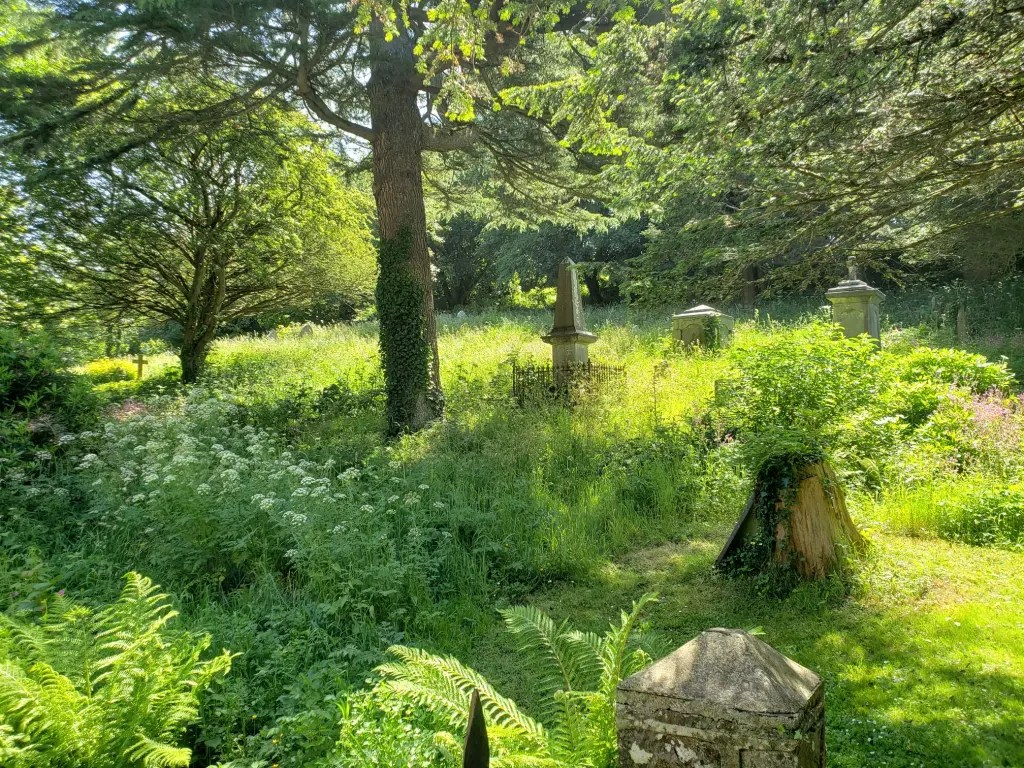
A trip away from Swindon is a good excuse to go cemetery crawling and during a visit to Pembrokeshire I managed to squeeze in a quite a few.
The church of St Ishmaels was founded in the mid 6th century by the son of a Cornish prince. A notice in the church tells how Ishmael and two of his brothers along with SS Teilo and Aidan founded a monastery at St. David’s. The small church has been much enlarged across the centuries. A short walk leads to Monk Haven cove, named after a monastic settlement that once existed here.
St Ishmael’s churchyard was very overgrown but it was still possible to catch a glimpse of some of the headstones. Online parish registers are available dating back to 1761 but I wasn’t able to see any memorials that old.
One that did catch my eye was a headstone dedicated to Margaret Davies who died in 1869. Someone had made sure that it was mentioned on her headstone that she was ‘Late of Great Hoaten.’ Great Hoaten Farm has been associated with the Davies family since at least 1792 and a mortgage drawn up by Joseph and Dinah Davies.
The last census on which Margaret appears is the 1861 when she was living at Little Haven and described as a retired farmer. Living with her was her 12-year-old son Thomas, the youngest of her 10 children.
Margaret was born at Penally Court Farm in about 1810, the daughter of Rev Thomas Rowe and his wife Patty (Martha) Cornock. Margaret married farmer Thomas Davies in the church of St. Ishmaels on August 17, 1829 and after several years living at Gilton Farm, Walwyn’s Castle, the family make their appearance at Great Hoaton Farm on the 1841 census. The establishment at Great Hoaton comprised approximately 140 acres and in 1841 Thomas employed four female servants, two male servants and a governess to teach his rapidly growing family.
When Margaret died in 1869 her last address is given as Bicton. Despite having such a large family, the sole executor of her will was William John, a grocer from Quay Street, Haverfordwest.
However, the Davies family connection with Great Hoaten Farm continued and in 1939 Margaret’s grandchildren were running the farm. Thomas 55 and his brother Claudy 51 along with their sisters Maud 54, who was housekeeper and Elsie 40, who worked as a dairymaid.
I’m not convinced that this headstone has not been moved. It looks as if it is leaning up against the tree rather than being in situ.
Reminds me how lucky we are to have access to so much information regarding Radnor Street Cemetery.
It was a stupid thing to do, something I realised immediately. As I furiously pedalled home on the stolen cycle, I wondered what to tell my mum. Should I add to the litany of lies I had already told her or should I dump the cycle and the £5 note in a hedge somewhere?
As it turned out I was spared the dilemma as I had been seen climbing out of the window of a house in Tydeman Street and stealing the cycle – by a police constable.
My poor mum was beside herself with worry and shame. She struggled to raise four unruly sons alone after my dad was killed in the war. Just feeding us and putting clothes on our back was difficult enough without the trouble we kept bringing to her door. But this was the first time the police had been involved.
By the time I appeared at the Police Court we were both quietly resigned that I would end up in juvenile detention.
My mates all commiserated, but in fact it was the most fortunate thing that could have happened to me, and as a result, to my brothers as well.
My mum was heartbroken. She felt she had failed me, failed as a mother. She feared for my future. Borstal was seldom the cure-all for youthful miscreants. More often it set them on the path of a lifelong criminal career.
She was in the court room when I appeared – she looked small and broken, sitting there wringing her handkerchief in her hands.
The court officials all looked as I had expected them to – old, serious and not short of a bob or two. How could they possibly understand my life, the life I lived with my mum and my brothers?
Then I noticed the woman sitting at the solicitor’s table – the only woman, and I guessed that must be pretty unusual in itself. And she was knitting! While the men pontificated and poured derision on me and my family, that woman sat quietly knitting, barely paying attention, or so I thought.
It was Mrs Whitworth who saved me. She saved my mum and gave her the confidence to carry on being the best mum she could to us boys. She gave my brothers a wake up call and saved them as well. And she saved countless other lost boys, not just in Swindon and not just in that time.
She said I was an intelligent boy and I should use that intelligence to help others. I hope I have. Over the years I have sat in court rooms just like that one and looked at boys just like me and I’ve helped give them a second chance. And every time I do so I think of Mrs Whitworth – and her knitting!
Dixon Street, Swindon
The facts …
Edith Dawson and her husband Albert Whitworth were not from this neck of the woods. Both of them came from Lancashire. Albert was born in Rochdale and Edith in Bury, the daughter of John Thomas Dawson, a cotton merchant. In 1881 Edith was living with her widowed father at 129 Manchester Street, Heap.
Edith and Albert married in Bury in 1886 and in 1891 were living in Monmouth. In the 19th century most people moved to Swindon for a job in the GWR Works, but Albert was not a railway man. By the time the family moved to Swindon he was working as a Tailor and Draper’s Traveller. The couple had eight children and sadly by 1911 two of them had already died.
The family lived first at 109 Dixon Street, then at 112 Dixon Street and at the time of Edith’s death in 1925 they were at 26 Dixon Street.
The census returns of 1901 and 1911 tell us nothing of Edith’s occupation.
So, let’s run through a few of Edith’s accomplishments! From 1908 she served in a role described as ‘lady police court missionary’ later becoming a magistrate in 1921. In the obituary that appeared in the North Wilts Herald she was described as having a ‘broad minded disposition that fitted her eminently for the post’ and that there were ‘many young men and women in the town today who have reason to bless the name of Edith Whitworth.’ During the First World War she was heavily involved with the YMCA and working with the ‘Comfort for Soldiers’ volunteers. She was later awarded the MBE for her wartime work.
After the war Edith Whitworth continued to work with war widows and orphans and was a member of the local War Pensions Committee. She also worked for the welfare of the blind alongside Mr E. Jones who later became Mayor.
Edith Whitworth died at her home in Dixon Street following a short illness. She was 59 years old.
A Social Worker
Death of a Swindon Lady
Mrs. E. Whitworth
After a few days’ illness, Mrs. Whitworth, J.P., M.B.E. of 26 Dixon Street, Swindon, who was one of the best known social workers in Swindon, died on Saturday morning at the age of 59 years. She attended a concert at the Empire Theatre on the previous Sunday in aid of the British Legion’s Christmas tea and entertainment for the fatherless children of ex-service men. Next day she was taken ill, and collapsed whilst making preparations for a journey to London.
Medical assistance was called and Mrs Whitworth was found to be suffering from inflammation of the lungs. On Saturday morning she was found dead in bed by her married daughter, Mrs. Marsh.
Mrs. Whitworth was appointed a magistrate in July, 1921, the honour being conferred upon her, after she had relinquished the post, in recognition of her services as lady police court missionary under the Probation Act. It was in the latter capacity, perhaps, that Mrs. Whitworth was best known. Regularly, for 13 years, from the coming into force of the Probation of Offenders Act in January, 1908, she attended the police courts at Swindon, where, seated at the solicitors’ table, she could be seen industriously applying her knitting needles, but all the time following the cases closely, and there are many young men and women in the town to-day who have reason to bless the name of Edith Whitworth.
Mrs. Whitworth will also be remembered for the valued work which she accomplished during the war. Her activities at the Y.M.C.A. in looking after the comfort of the soldiers were very well known, and after the termination of hostilities they were rewarded by the award to Mrs. Whitworth of the M.B.E.
Since the war, Mrs. Whitworth had devoted a great part of her time to the welfare of widows and fatherless children of Swindon men who made the supreme sacrifice, and as a member of the local War Pensions Committee she rendered much useful service. The women’s section of the British Legion also claimed her interest and attention, and she worked wholeheartedly in co-operation with Mr. E. Jones, J.P., for the welfare of the blind, being one of the Swindon representatives of the Wilts County Association.
In the cause of temperance she was also an ardent worker, while in politics she served for a number of years on the Executive of the local Library Association.
Sympathetic references to the death of Mrs. Whitworth were made at Swindon Borough Police Court on Monday.
The Chairman (Mr. G.H. Marshman) said the Bench had lost a valuable colleague, and one who always did her utmost to help suffering humanity. All would mourn her loss.
The Magistrates’ Clerk said the public had lost a very able, experienced and loving public servant.
The Deputy Chief Constable (Supt. Brooks) associated himself with all that the Chairman and Clerk had said.
The Funeral
The funeral took place on Tuesday. The route of the procession to and from deceased’s late residence was lined with spectators, who stood with bowed heads as the cortege passed.
The Trinity Presbyterian Church, Victoria Road, where the first part of the service was conducted, was filled with a congregation of mourners. The Rev. J.H. Gavin, B.D., conducted the service, and special hymns were sung, “O, God, our help in ages past,” and “Now the labourer’s task is o’er.”
Miss Baden presided at the organ and played the Dead March in “Saul” as the mourners were leaving the church.
In a brief address Mr. Gavin paid feeling tribute to the work which deceased had always identified herself with, and said Mrs. Whitworth was a woman with a great heart. If he had to write a modern version of Bunyan’s “Pilgrim’s Progress,” he would describe Mrs. Whitworth as “Mrs. Great Heart.” She was the friend of widows and orphans of our soldiers who gave their lives in the war, and no-one could number the many acts of kindness on her part during that troublesome time in succouring the depressed and distracted. Ever doing good amongst her fellows, she had now passed to the Great Beyond, where he was sure she would receive the “Come, blessed of My Father.”
The interment took place in the Cemetery in the presence of a large number of people, the Rev. J.H. Gavin again officiating.
North Wilts Herald, Friday, December 18, 1925.
Cemetery volunteers have recently rescued Mrs. Whitworth’s headstone and restored it to it’s correct position on her grave.
Mother liked to favour Mr Pocock with all her butchery requirements. She said he knew a thing or two about beef, which you would rather hope so, as a butcher and a farmer, but my sister thought there was more to it than that.
My sister believed that Mother might be ‘sweet’ on Mr. Pocock.
“He does have very twinkly eyes – for a butcher,” she added.
My brother and I looked up from the copy of the newspaper we were perusing at the kitchen table.
“Father passed away several years ago and Mr Pocock is also a widowed gentleman. There would be nothing inappropriate in a ‘friendship’ developing.” said my sister. “And as the eldest I think you should suggest that she invite him to Sunday lunch,” she declared.
“Yes,” my brother piped up. “I think you should take the bull by the horns.”
I remember mother being very upset when Mr Pocock passed away. Perhaps my sister was right after all.
The facts …
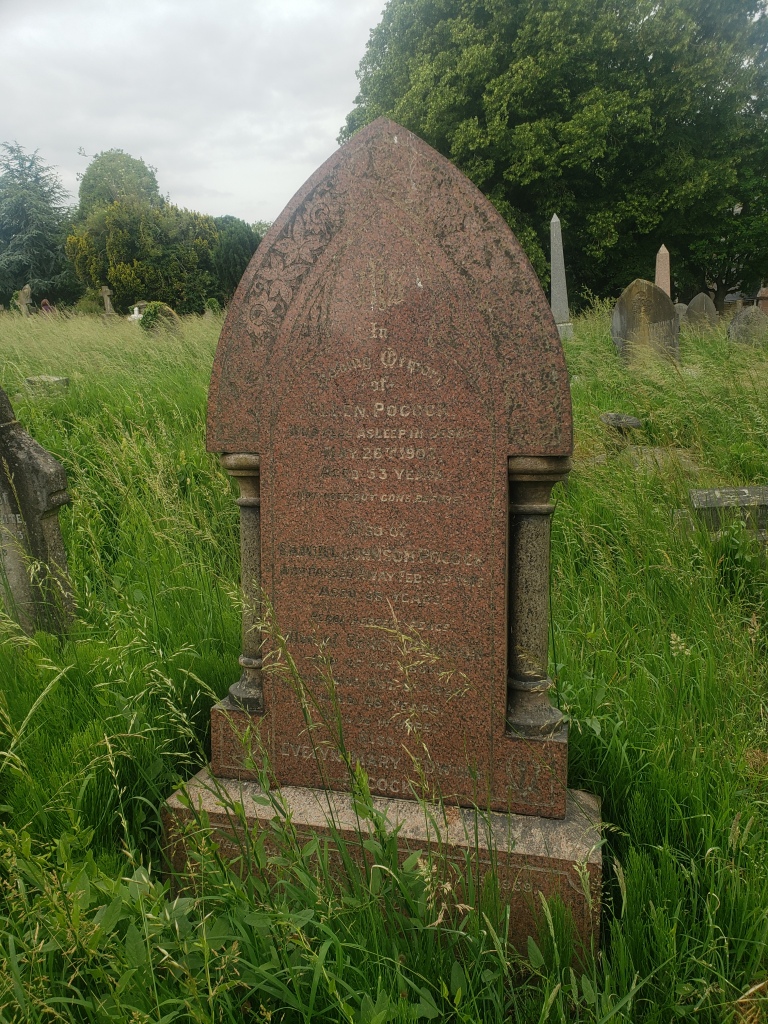
Death of Mr S.J. Pocock
Swindon has lost a well-known resident by the death of Mr. Samuel Johnson Pocock, who passed away at his residence, 17, Wood Street, on Saturday night.
Mr Pocock, who was 68 years of age, came of a well-known family of farmers in West Wilts, and more than half a century of his life was spent in that part of the country. In 1900 he came from Melksham to Swindon, and in conjunction with is son, Mr Percy Pocock, took over the old-established purveying business of Keylock & Co. The deceased was acknowledged to be one of the best judges of cattle in the district, and his services as an adjudicator were greatly in request at the Christmas shows. He was the first president of the Swindon Master Butchers’ Association.
Some six months ago Mr. Pocock’s health showed signs of failing, and it became necessary for him to go to London to undergo an operation. This proved so far successful that the patient experienced considerable relief and was able to return to Swindon. He did not, however, resume business pursuits, but for a while took up his residence with some friends at Corsham. Eventually he came back to Swindon, and it has for some time been apparent that his life could not be prolonged. He finally took to his bed about a fortnight since.
Mr Pocock, whose wife pre-deceased him 14 years ago, leaves a son and a daughter.
North Wilts Herald, Friday, February 9, 1917.
Burial Registers
Samuel Johnson Pocock 68 years 17 Wood Street burial 7th February 1917 grave plot E7508
He is buried with:-
Evelyn Mary Edwina Pocock 81 years died St Margaret’s Hospital, Stratton – home 72 Croft Road, Swindon. Burial 5th November 1969.
Percy Johnson Pocock Butcher 48 years 17 Wood Street, burial 11th October, 1925.
Ellen Pocock, wife of – Pocock 53 years 17 Wood Street, burial 29th May 1902.














 Radnor Street Cemetery