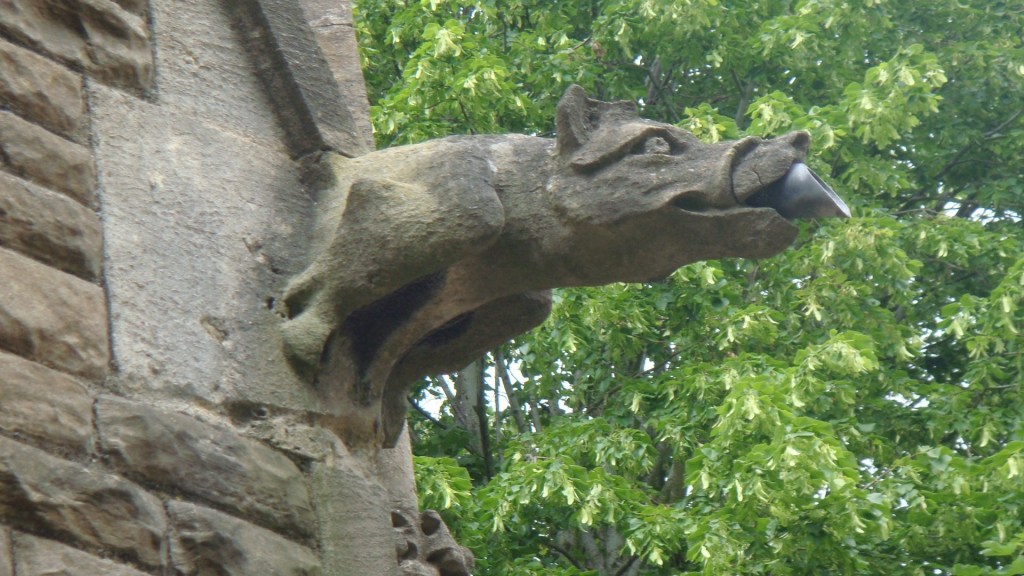
People who attend our walks do so for a variety of reasons. Sometimes it is to visit the cemetery they remember from childhood when they accompanied a parent to visit a family grave. Some join us because they’ve only just discovered there is a cemetery in the centre of town. Then some years ago a visitor joined us to see if the pig on the chapel still survived. The pig (although I think it is probably a boar) is a gargoyle on the east facing wall and remains in good condition, as you can see here.
The same visitor then cast her eye around the lush, summer cemetery and mentioned that one of the grasses dated back to ‘the time of the dinosaurs.’
Now I’m no horticulturalist, but Andy and Noel were able to identify the grass as the horsetail. The RHS website describes the horsetail as ‘an invasive deep rooted weed with fast growing rhizomes (underground stems) that quickly send up dense stands of foliage.’
The fir tree like plants can grow up to 60 cm (2ft) tall with roots as deep as 2m (7ft) making them difficult to dig out. Fortunately there are no such triffid like examples in the cemetery and before too long the grass cutters will be out to cut them down and minimise the spread. But what about the claim that the horsetail dates back to the time of the dinosaurs.
Apparently ancient civilizations used the horsetail to stop bleeding and heal wounds. Although the plant is believed to have medicinal properties there is not sufficient research to confirm that it is safe and effective for human use.
And then, trawling through weed related pages on the internet I came across a ‘prehistoric’ reference on a Wikipedia page.
‘Equisetum is a ‘living fossil’ the only living genus of the entire subclass Equisetidae, which for over 100 million years was much more diverse and dominated the understorey of late Paleozoic forests.’
So our visitor was right. I learn something new every day spent in the cemetery.
Samuel Gray was born in the village of Shaw and baptised on October 19, 1879 at All Saints Church, Lydiard Millicent. Samuel was the eldest son of Samuel Gray, a labourer in the GWR Works, and his wife Harriet. The family lived in the Elms, Shaw at the time of the 1881 census.
Samuel married Harriet Ellen Pile in the March quarter of 1903. By the time of the 1911 census the family were living in Shanklin on the Isle of Wight where Samuel worked as a Baker. In 1916 the family returned to Swindon.
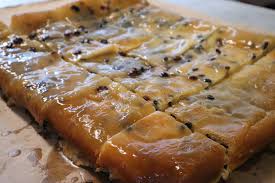
Three years later Samuel bought a small property at 9 Bridge Street for £500 where he established his bakery and the legendary lardy cakes (see Miss Lorna Dawes and a life ‘inside.’) In the 1940s Grays had seven shops employing 120 staff.
Harriett died at the Cheriton Nursing Home, Westlecot Road on December 4, 1947 and was buried in Radnor Street Cemetery in plot C4898. Samuel died on April 19, 1963 aged 83 and was buried with his wife.
Deaths
Gray. – April 19, 1963, at 9 Downs View Road, Swindon, Samuel Gray aged 83 years. Funeral Wednesday, April 24: service at Immanuel Congregational Church, Upham Road, at 3.15 p.m.; interment Radnor Street Cemetery. Flowers to Smith’s Funeral Chapels, Gordon Road. (Tel. 22023).
Freemason founder of Swindon bakery concern is buried
The funeral of a prominent Swindon baker, Mr. Samuel Gray (83), took place at Immanuel Congregational Church, Upham Road, Swindon, yesterday.
Mr. Gray, managing director of Grays (Swindon) Ltd., of Bridge Street, and the Downland Bakery Ltd., died at his home 9 Downs View Road, Swindon.
For many years a member of Westlecott Bowling Club and a former president of Swindon Master Bakers’ Federation, Mr Gray founded the bakery firm 44 years ago. Since then it has grown into a large family concern.
He was a Freemason and was Past Master of Pleydell Lodge, Past Master of the Swindon Keystone Lodge of Mark Master Masons, a member of Wiltshire Chapter and Preceptor of Chiseldon Freemasonry Class.
The service was conducted by the Minister at Immanuel Church, the Rev. F. Ross Brown and was followed by interment at Radnor Street cemetery, Swindon.
Extract taken from The Swindon Advertiser, April, 1963.
Samuel’s son Cyril worked in his father’s bakery from the age of 13 and in the 1980s he was recorded as being the oldest working baker in Britain by the National Association of Master Bakers. In 2013 he gave his recipe for Gray’s famous lardy cake to Mark Child for publication in The Swindon Book where you can find it on page 145. As Cyril instructed – lardy cake is best eaten on the day it is made.
The recipe for the lardy cake is said to originate from Wiltshire although neighbouring West Country counties also lay claim. References to the lardy date back to the mid 19th century and as the name suggests is a lard based cake.
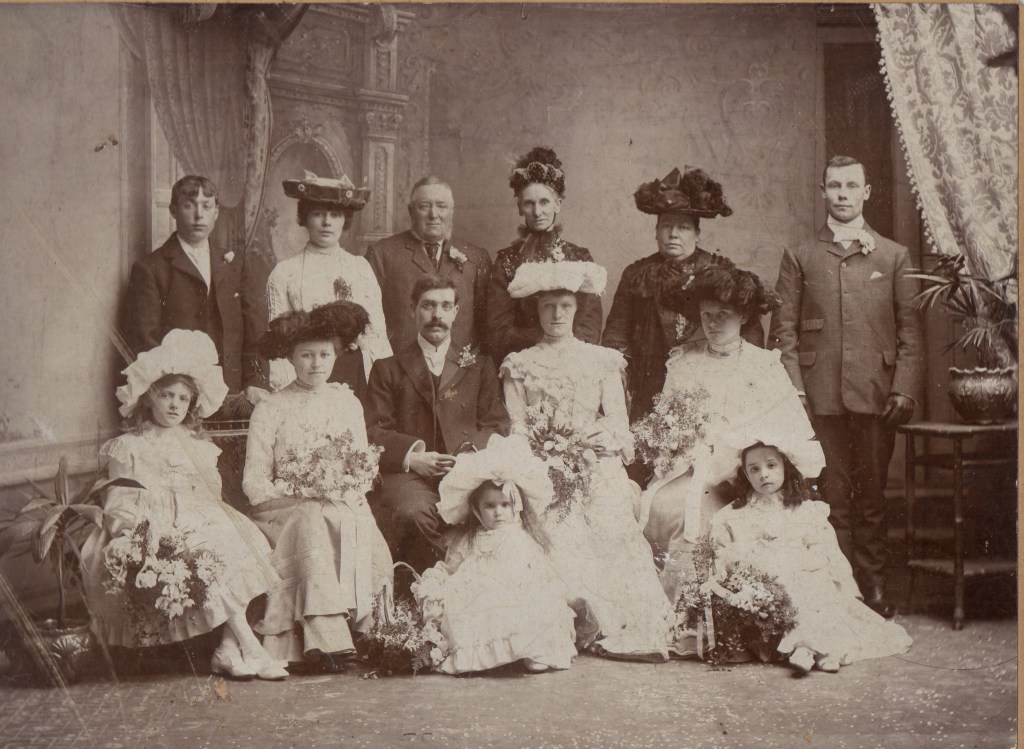
I have recently been contacted by Robert Gray, Samuel’s grandson, who has kindly sent me the following photographs of Samuel and (Harriett) Ellen.
Mr Sykes asked me to sing All Things Bright and Beautiful. He listened very carefully; his head tilted on one side. There was a brief pause after I stopped.
“Well Ada,” he said, “I’m sure we can find a place for you in the chorus.”
I was so excited I could have given him a big hug, but that would have been entirely inappropriate. You didn’t hug a gentleman like Mr. Sykes.
My ma said I was born to sing. She said that I sang even as a baby in my crib. “You never wailed or screamed like the other babies,” she said, “you sang.”
I’ve been singing ever since. I especially love to sing in church. My favourite hymn is Rock of Ages, I love the rise and swell of the music. And I sing at my work, but I try not to be too enthusiastic as Mrs Morse has delicate hearing and she usually asks me to close the green baize door while I’m in the kitchen.
But I had never sung in public before and I never dreamed I would one day stand on the stage at the Mechanics’ and sing before an audience. I could scarce believe Mr. Sykes might even consider me.
It was my best friend Polly who suggested I audition for the chorus in the Mechanics’ Institution pantomime that year – Babes in the Wood, or Harlequin and the Cruel Uncle.
Opening night was just days away and this was to be our dress rehearsal. “Let’s put you next to Letitia, just follow her lead,” Mr Sykes had said at our last rehearsal. Letitia Jones was one of the principal singers in the chorus. She had a beautiful voice, a bit on the quiet side, I always thought, but melodious none the less.
Polly was waiting in the wings when I arrived. She was in conversation with Letitia and had her back towards me, but I could hear them talking as I approached.
“I hope Ada Firebrace doesn’t stand next to me again. She quite puts me off,” said Letitia.
“I never expected Mr. Sykes would engage her,” I heard Polly say. “I hoped he might tell her … you know … tell her what an awful voice she has. Then perhaps she would stop singing morning, noon and night.”
I stood stock still. Letitia had seen me walk across the stage and was grimacing and nodding at Polly with the intention of warning her that I approached. It was too late.
I never spoke to Polly again and I didn’t take part in the Mechanics’ Institution pantomime that year either. But I did save up my pennies and took some singing lessons with Mrs Sykes.
Ma says my voice is more beautiful than ever now. I have no desire to sing before an audience anymore, but I will always have kind memories of Mr Sykes.
The facts …
The Late Mr Albert Sykes
In accordance with the recommendation in the report, Mr Spencer proposed that a large portrait be obtained of the late Mr Albert Sykes, and placed in the Reading Room. Mr Sykes, he remarked, was a man who in his day and generation did a great work for New Swindon, and many men had been indebted to him for his musical tuition. Mr. Sykes was a useful man on the Council of the Institute, a capital librarian during the time he held that position, and he was also the father and founder of music in Swindon.
Mr A.W. James seconded the proposition, which was carried unanimously.
Mr Morris said he was pleased to know that the Council were thus going to recognise Mr Sykes’ services, and he hoped the same course would be adopted with regard to the late Mr J.H. Preece and the late Mr F.G. O’Connor.
The Swindon Advertiser, Saturday, May 5, 1894.
The two Sykes brothers were born in Leeds – Albert in 1823 and Joah in 1824. On the 1841 census they are living in Hunslet where their father John worked as a surveyor of roads. Albert was working as a mechanics’ apprentice while Joah was a potter’s apprentice.
Albert began work as a fitter and turner in the GWR factory in September 1847 later working as a shop clerk.
The 1851 census shows Joah still living in Hunslet with his wife and baby daughter. He is working as a whitesmith (someone who works with tin). Joah joined his brother in New Swindon around 1853 where he worked as a blacksmith in the railway factory. At the time of the 1861 census he is living with his wife and their five children at 1 East Place in a property they share with Peter Vizard, his wife and two daughters; Thomas Toombs, his wife and their three children and a lodger by the name of Jeremiah Walker!
By 1871 Joah and his family are living at 25 Reading Street, which remained his home until his death in 1910.
On first coming to New Swindon Albert lived in Westcott Place. Then he spent 20 years living in Fleet Street before moving to Victoria Road where he and his wife opened a music school.
Both Joah and Albert were talented musicians. Joah played the oboe and both brothers were involved with musical events at the Mechanics’ Institute where Albert conducted the Mechanics’ Institutes’ Choral and Orchestral Union.
The two Sykes brothers are typical of those early settlers who left their home, their family and friends to move to New Swindon and once here immersed themselves in the life of the community.
Albert died on February 27, 1894. His funeral took place on March 3, 1894 and he is buried in plot E8362 with his wife Mary Hannah, son Albert and nephew Herbert Francis Sykes – Joah’s son.
Joah was elected to the Council of the Mechanics’ Institution in 1870. He was a member of the Liberal Association with a reputation for being a radical and he was a member of the Methodist Chapel in Faringdon Road.
Joah died on February 17, 1910. He is buried in plot E8364 close to his brother Albert, with his wife Ellen and two of their daughters. Emily is described on the 1901 census returns as being an ‘imbecile from birth’.
Some said John Riley was an intimidating character, but I never found him so. Yes, after a drink or two he could get a bit lairy, but I knew how to handle him. I suppose I had a bit of insight into what he had been through.
I don’t think anyone came back from the war the same person they had been before it. I’d argue with anyone who said they hadn’t known fear, hadn’t seen sights that made their stomach churn, done things that haunted them.
John Riley had known a fear and a horror the like of which few experienced and the only way to blot it out was to drink.
Aged just twenty, John had left the safety of a job as a storeman in the Works to join the army and have an adventure. Mostly all John saw were the bowels of the earth, like a rat in a sewer.
John liked to drink and he liked to gamble. His life was one big gamble. Would he be blown to pieces or buried alive? Would it happen today or tomorrow? The odds weren’t good.
The facts …
John had little time for military protocol, he was outspoken and insubordinate and for this he was awarded Field Punishment No. 1. Sounds pretty innocuous, doesn’t it, but it was a torture metred out to rebels, those who wouldn’t abide by regulations. It was used to set an example to others who baulked at military discipline.
In September 1917 John went missing. He was absent while on active service for 34 hours and 55 minutes, and was charged with breaking out of camp at 9.30 pm on September 14 and breaking back in at 8.55 am on September 16. His punishment was to forfeit three days pay and 14 days Field Punishment No. 1.
So, what was Field Punishment No 1? The soldier found guilty was placed in fetters and handcuffs (sometimes spread eagled in a form called ‘crucifixion’) and tied to a fixed object such as a gun wheel or fence post, for one hour in the morning and one hour in the afternoon. Although this punishment was supposed to take place behind the front line in a field punishment camp, it was sometimes applied within range of enemy fire. When a unit was on the move, the unit itself would administer the punishment.
It wasn’t the first time John had been so punished. In September 1915 he had been ‘awarded’ as if it was an honour, 96 hours Field Punishment No 2 for “when on active service missing 8 am parade.” Field Punishment No 2 was a lesser punishment and involved the prisoner being placed in fetters and handcuffs, but not attached to a fixed object. Both sentences included hard labour.
In the summer of 1918, he was sentenced to 7 days Field Punishment No 1 for ‘misconduct’ on 24 August and on 31 August he received a further 7 days Field Punishment No 1 for leaving the lines without leave and missing a Medical Board as a consequence.
And a final insult, 12 days after the guns were silenced, John was demoted to Private by his Commanding Officer for “Neglect of duty.”
John’s audacious and fearless attitude, the qualities that made him a good tunneller, were the very characteristics that frustrated his Commanding Officers.
No one was more surprised than John when he survived the war and returned to the same job in the Works that he had left behind in 1914.
Did he enjoy the security, the safety, the daily routine? Surely, he didn’t miss the claustrophobia of the tunnels.
When John enlisted it was for three years or the duration of the war. It turned out to be a life sentence.
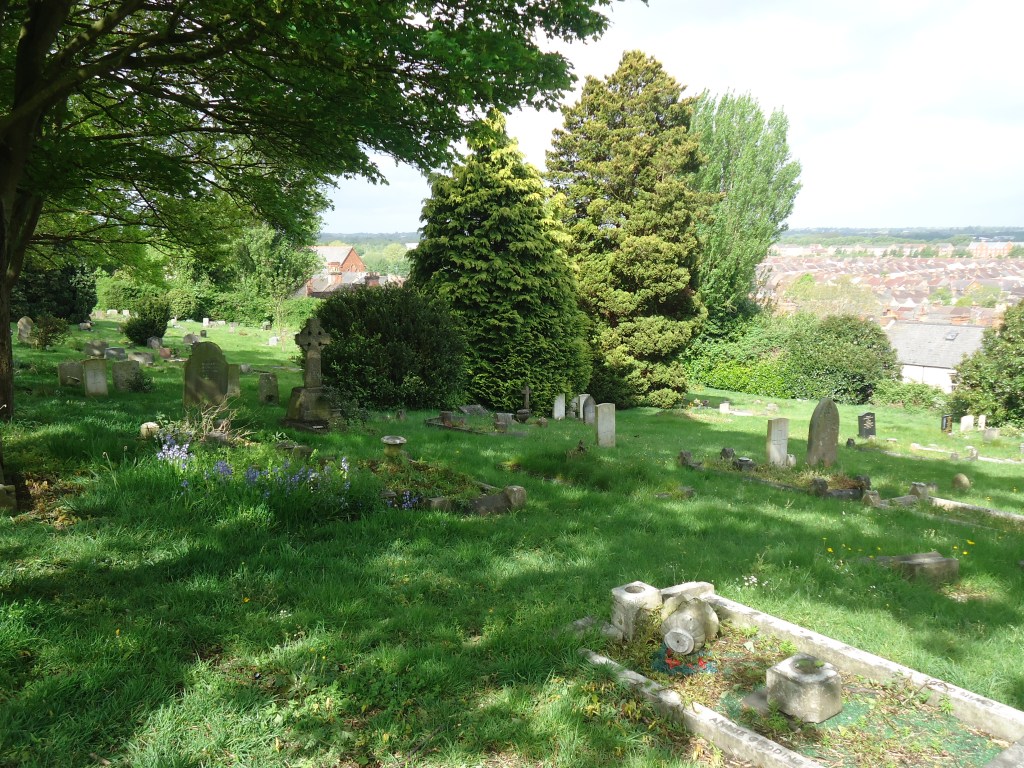
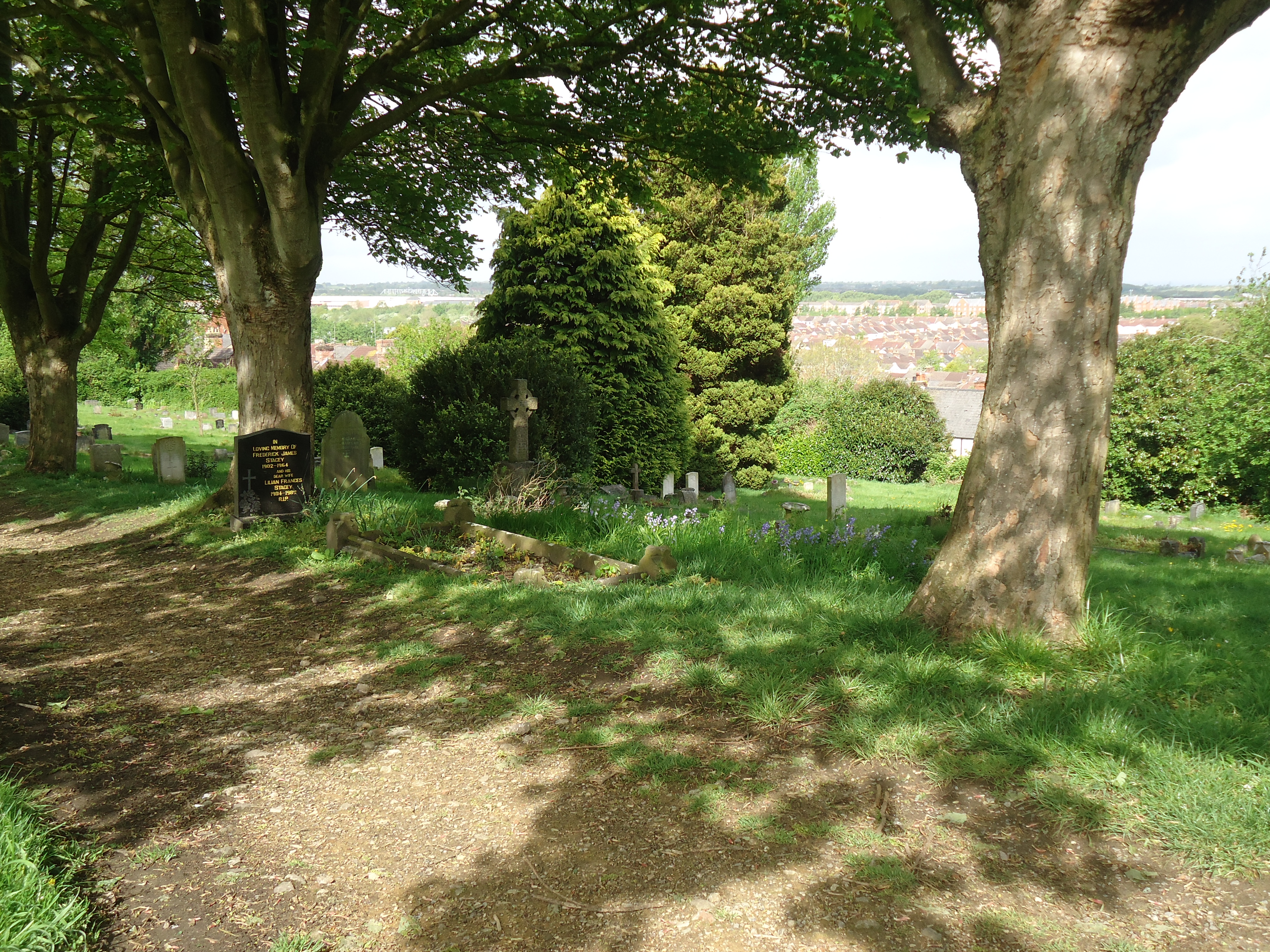
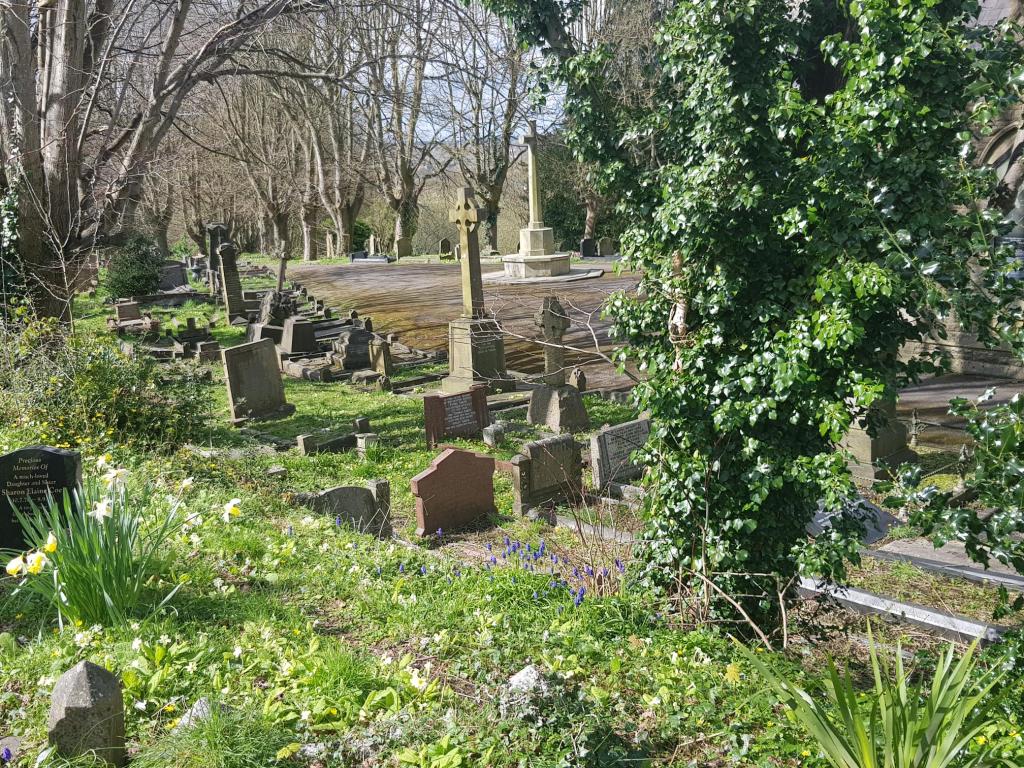
View across Section C where Edwin John Riley is buried.
(Edwin) John Riley was born c1895 in Rodborough, Gloucestershire, the only one of John and Sarah Jane’s three children to survive to adulthood. By 1901 the family had moved to 11 Folkestone Road, where John’s father worked as a builders’ plumber.
As a sixteen-year-old John worked as a fishmonger but by 1913 he had secured a job as Storeman in the Works
John enlisted in the 1st Battn Grenadier Guards at Caterham on December 19, 1914, aged 20 years and 34 days. His military records reveal that following eight months service at home John joined the Expeditionary Force in France from August 11, 1915 until January 10, 1918. By May 1916 John was attached to the 177th Tunnelling Coy RE (Permanent) Authy. For more information about the work of the tunnelling companies and the 177th see https://en.wikipedia.org/wiki/177th_Tunnelling_Company.
He married Daisy Sweeper in 1919. John was discharged on demobilization on March 31, 1920 and their daughter Stella was born in 1922. A second daughter Jose was born in 1927.
In 1939 John was working as a Stores’ Issuer in the Railway Works and living in Harcourt Road, Gorse Hill with Daisy and their two daughters Stella and Jose.
Edwin John Riley died in October 1945 and was buried in plot C1678 on October 16.
I can’t help but think those in authority found this boy an irritant. It looks as if he had been in trouble since a young child, receiving the birch at the age of just 11. He was obviously such a nuisance no one could be bothered to get his name right, and when he unexpectedly died the verdict was ‘food poisoning’ – probably!
Singular Death of a Reformatory Boy – An inquest was opened by Mr. Coroner Sylvester on Saturday as to the death of a youth named William Edward Archer, aged 15, belonging to Swindon. – Deceased was at the Reformatory. He was not strong, and had been medically attended off and on. He complained of feeling unwell on Friday, and was sent to bed, and told that if he felt worse a doctor should be sent for. His temperature was taken twice, and was normal; and he was seen during the night by Mr. Crichell, one of the labour masters, who asked him if he was in pain or wanted anything. He replied that he wanted nothing. When Crichell went through the ward shortly before six next morning he found him dead. Dr. Hubert Willcox said death was due to the presence of an irritant in the intestines, the exact nature of which could not be stated till the contents had been analysed. The inquest was adjourned till the 9th inst. for an analysis to be made.
Two jurymen remarked that they had other engagements for that date, Mr. W. Papps being a delegate at a Foresters’ meeting at Devizes, and Mr. E. Foreman having an engagement as market for a Yeomanry prize meeting. The Coroner declined to alter it, and summoned all to attend on the date named.
The Wiltshire Telegraph, Saturday, October 7, 1905.
Is this the same William Archer, aged 11, who was found guilty at the Petty Sessions in 1900 along with Henry Love 8, of stealing a tin of salmon from a grocer’s shop? The younger boy was bound over to be of good behaviour, while Archer was ordered to receive three strokes with the birch rod. The same day Archer was charged with two other lads with stealing a money-box from the top of the harmonium of a blind street musician. Further strokes of the birch were added to his punishment.
Edward William Archer was 15 years old when he died in 1905 at the Wiltshire Reformatory for Boys in Warminster. The subsequent verdict of the inquest was that the County Analyst, Dr Dyer, had made an exhaustive analysis of the stomach contents and could find no trace of any poison, irritant or otherwise, suggesting the cause of death might be ptomaine poisoning (food poisoning). The Coroner questioned whether the lad had eaten some fungus in mistake for a mushroom and said that the most suitable verdict would be that death was caused by acute inflammation of the stomach and intestines. The jury accordingly returned a verdict to this effect.
The boy who died in the reformatory is identified as Edward William Archer, the son of William James and Martha Archer. Between 1891 and 1909 the Archer family lived at various addresses in Gorse Hill. William James Snr worked as a general labourer and Martha as a laundress. At the time of the 1901 census the family lived at 21 Hinton Street. Eldest daughter Elizabeth 16 was a housemaid and Louisa 14 a tailoress. There were four younger boys William James 13, Edward William 11, Frederick George nine and five year old Arthur Walter.
Edward William Archer aged 15 is recorded as being buried on October 4, 1905 in grave plot C1646. The Radnor Street Cemetery index register records his home address as 21 Hinton Street; the chronological register includes his place of death as Warminster Reformatory. Edward William is buried with his sister Louisa who died in May 1905. She was 18 years old and her address is also given as 21 Hinton Street. Buried with them is their father William James Archer, aged 53 who died at the GWR Hospital and was buried on March 6, 1909. His home address was given as 1 Edinburgh Street, Gorse Hill. There is one other burial in this unmarked, public plot.
The Wiltshire Reformatory for Boys was inaugurated at a meeting of magistrates and other figures of authority at Devizes Town Hall in September 1855. The Reformatory in Warminster comprised 20 acres of land (later increased to 40 acres) where the boys received between 10 to 15 hours of education a week, spending the rest of the time working the land and growing produce that partly supported them. By 1902 additional phases of building had increased the accommodation capacity from 30 boys to 100. The Reformatory closed in 1925.
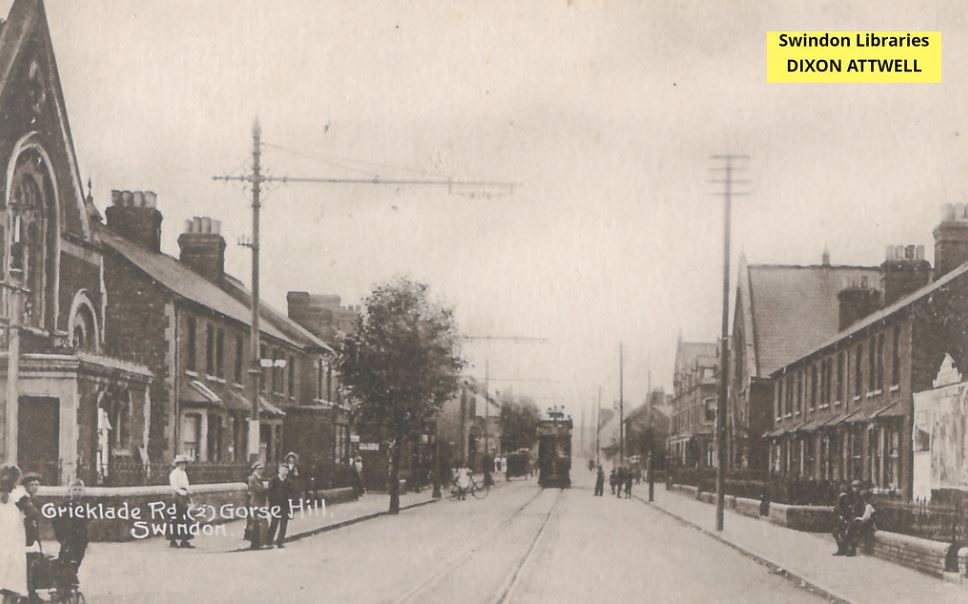
Gorse Hill images published courtesy of Local Studies, Swindon Central Library.
When my much anticipated visit to Gloucester History Festival was scuppered by a total train wipeout, I was determined not to give up on my planned day out.
If, like me, you’ve enjoyed a visit to Avebury and a walk around the stones, take my advice and join a guided tour. National Trust volunteer guide Keith treated us to a master class. He posed (and answered) the questions we all want to ask but are too embarrassed to do so. Like, why was the henge built? No one knows! It wasn’t for defensive purposes, nor was it a place of burial (no evidence so far found). How many people did it take to move the stones? (Loads!) Experimental archaeology has suggested at least 200 were required to shift a single stone pulling it on a sledge. Now I’m not giving away any more answers – you’ll have to join one of Keith’s tours.
Sadly, Avebury Manor remains closed following devastating flooding in January 2024. However, the gardens are open where there is a sculpture exhibition running until October 20,10 am – 5pm.
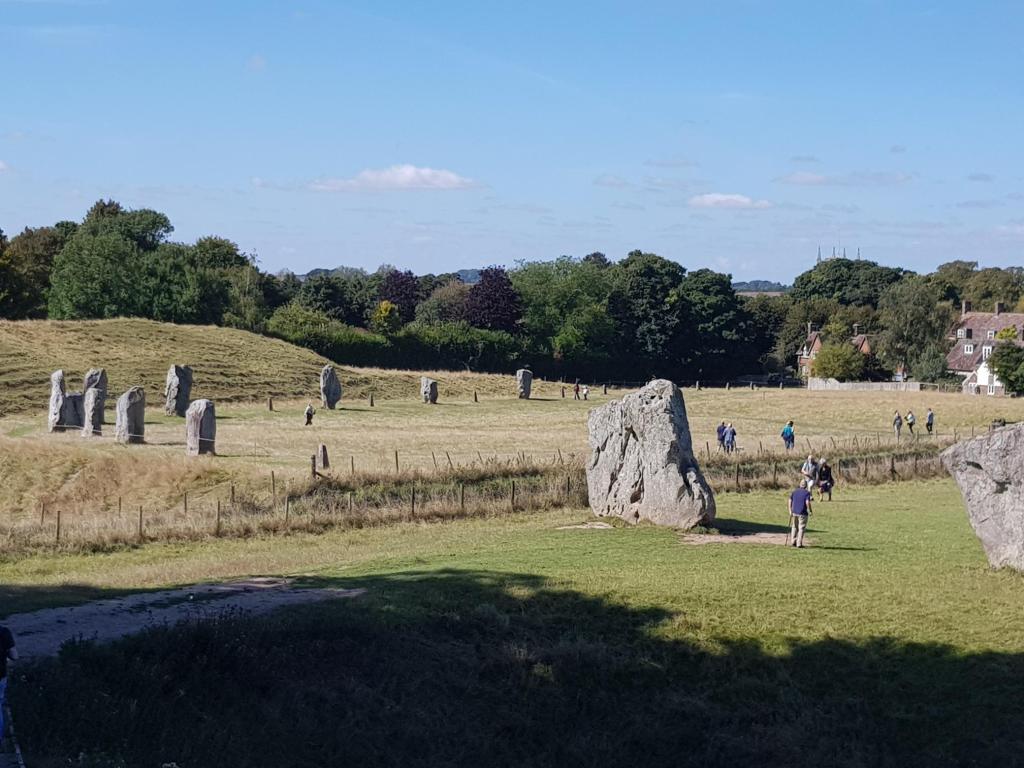
Keith and the Swindon Stone, a portal stone, one of a pair of two at one of the entrances to the henge. The second one had disappeared by the 17th century.
The blacksmith’s stone discovered by Alexander Keiller beneath a blacksmith’s forge.
One of several Cove stones built in alignment with sun rise at the summer solstice/
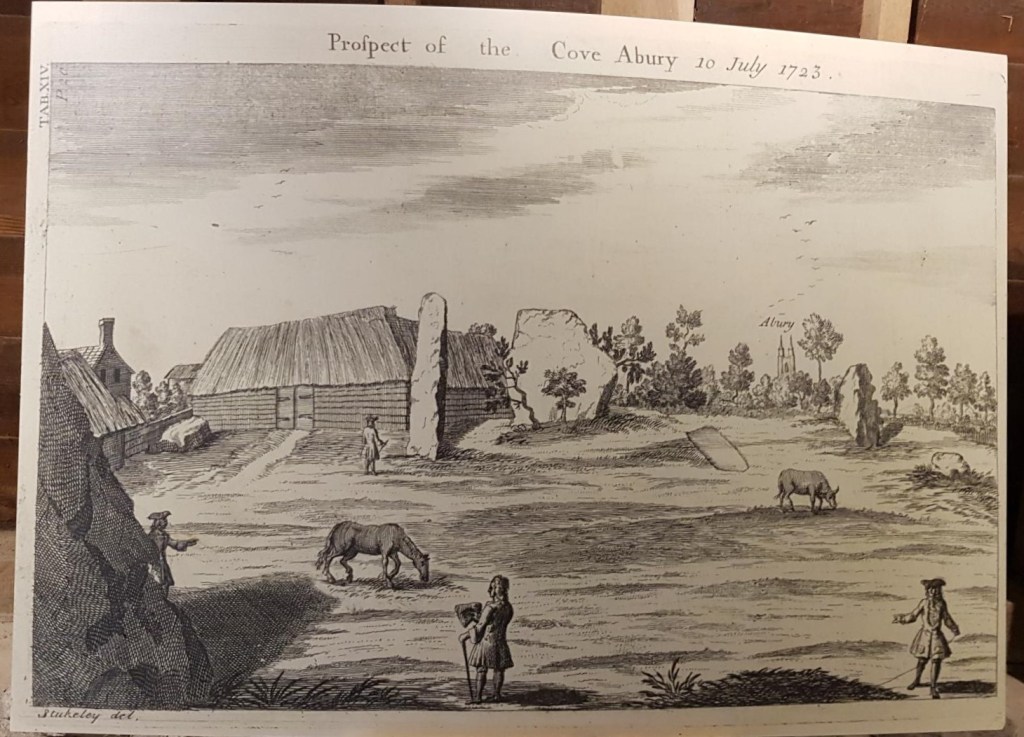
William Stukeley’s ‘Prospect of the Cove Abury 10 July 1723.’
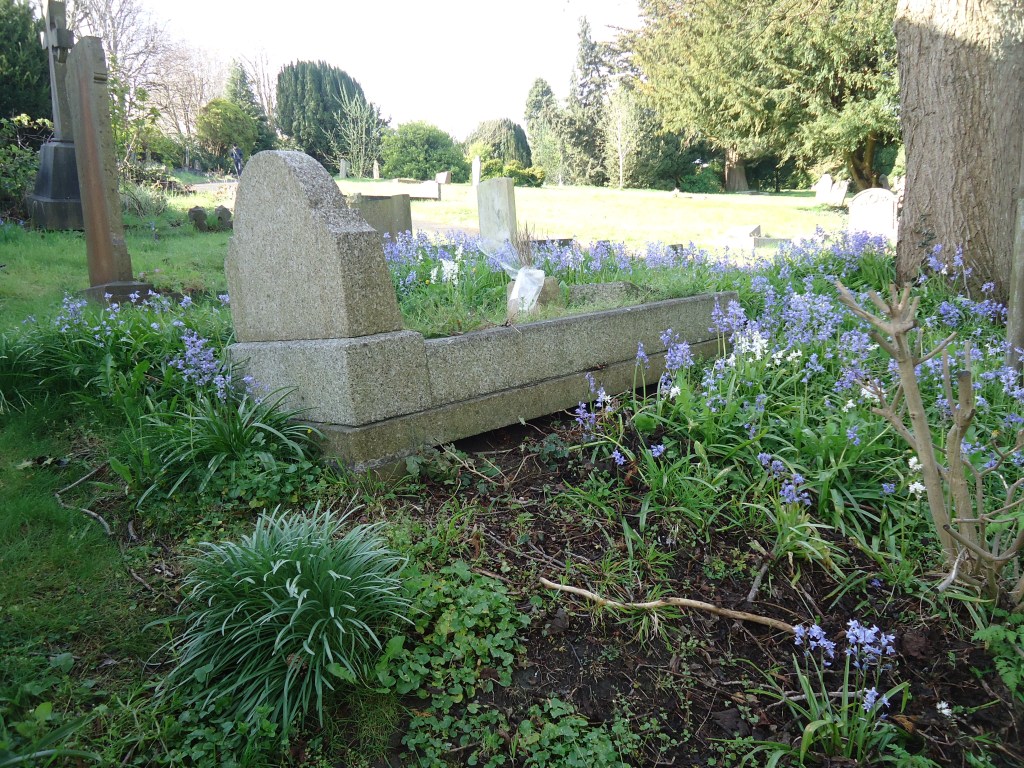
This grave always looks particularly beautiful at this time of year, although sadly my photographs don’t do it justice. This is the grave of Eliza Chirgwin and her husband Richard James Chirgwin, just by the Dixon Street cemetery gate, close to their former home at No. 27. I have long meant to research this couple and every year when the bluebells bloom I resolve yet again to see what I can find out about them, and there is a surprisingly extensive amount.
Richard James Chirgwin was born on September 20, 1850 at Phillack, Cornwall, the youngest child of George, an engineer, and his wife Honor. He married Eliza Callaway in 1873 and by the time of the 1881 census the couple were living at 19 Read Street where Richard James worked as an Engine Fitter in the GWR Works.
You can read more about Eliza and Richard in the obituaries published in the North Wilts Herald (see below) and if you should pass through the Dixon Street gate while the bluebells are in bloom you might like to pause awhile, as I usually do.
Death of Mrs R.J. Chirgwin – Mr Richard J. Chirgwin, J.P., of 27 Dixon Street, has suffered a great loss by the sudden death of his wife. The deceased lady was 77 years of age. She was about the house as usual on Wednesday, although her health had not been good of late. Early in the evening she went upstairs, intending to take a short rest, but she had a seizure, and before her husband, who was downstairs at the time, could reach her she had passed away. Dr. Lavery was fetched, but he could only pronounce life extinct. Both Mr and Mrs Chirgwin have been well known residents in Swindon for the past half a century, and they celebrated their golden wedding on December 23rd last. They are both natives of Cornwall, and came to Swindon 50 years ago. Mr. Chirgwin was for many years employed in the GWR Works but has been living in retirement for a number of years. There are two daughters. One is the wife of Mr Joseph Williams, who holds an appointment on the United Havana Railway in Cuba. The other daughter is Mrs. Anderson, wife of Mr Walter Anderson, Headmaster of Lethbridge Road Schools. The funeral will take place tomorrow.
North Wilts Herald, Friday, November 28, 1924.
A Swindon Social Worker
Death & Funeral of Mr R.J. Chirgwin, J.P.
Public Tributes
While on a visit to Exmouth, Mr Richard James Chirgwin of 2[7], Dixon Street, Swindon, passed away in his sleep, and the town has thus lost a devoted worker in social and religious causes. He had been in indifferent health for some time, and on medical advice had recently given up a number of his activities.
Mr Chirgwin was a native of Cornwall, but early went to live in South Wales, and after staying there six years came to Swindon in 1873, as an employee in the GWR Works. He gradually worked his way up, and at the time of his retirement four years ago was a leading foreman.
He was a very active Liberal, and had taken a prominent part in the work of the Party in Swindon and district for many years. He was a borough magistrate for a number of years, and was a very regular attendant at sittings of the Bench. Mr Chirgwin was well known in educational circles, and at one time was a tutor at the science classes before the Technical School was built. He was keenly interested in the work of the Workers’ Educational Association, and attended the meetings of the local branch until quite recently. He was also very fond of their summer rambles, and was a lover of long walks.
The deceased had occupied every position open to a layman in the Wesleyan Methodist Church. He had been a local preacher for 55 years, and last year, in company with Messrs. T.B. Jefferies, W. Chilton, E. Ransome, J. Clark, J.P., and T. Hiscocks, he received a special certificate from the Connexional Local Preachers’ Association. He began preaching in Cornwall in 1871, and frequently occupied the pulpit while in Wales. In Swindon he did service as a fully-qualified local preacher until 1924, when, on medical advice, he had to give up some of his preaching work. He was local secretary for the Aged Local Preachers’ Fund for 30 years, and also held the office of President of the Free Church Council for a time.
Mrs Chirgwin pre-deceased her husband three years ago, just after they had celebrated their golden wedding.
At Swindon Borough Police Court on Monday the Chairman (Mr. W.E. Morse) said he had to record the passing away of a member of their bench, Mr R.J. Chirgwin, who, as long as he (Mr Morse) could remember, had been a well-known citizen of Swindon. Five-and-a-half years ago he was appointed a magistrate, and he was always very regular in his attendance and diligent in the duties he was called upon to perform. He (Mr Morse) thought it would be the desire of the justices and the Court that a letter of condolence be sent to the members of the family of deceased.
This was carried in silence, all in Court standing.
The Funeral
The funeral took place on Wednesday in the presence of a large company at the Faringdon Street Wesleyan Church by the Rev. H.B. Turner (Bath Road).
The Rev W. Kelson (Superintendent Minister of the Swindon Wesleyan Circuit) conducted the service, being assisted by the Rev. W.B. Turner (Bath road), the Rev Montague Ashdown and Pastor Stocking.
The Hymns sung were “O God, the Rock of Ages,” and “Who fathoms the Eternal Thought.”
Voluntaries on the organ were played by Mr. Cassell.
Mr Kelson said when he first came to Swindon he and Mr Chirgwin were comparative strangers, but he had been able to enter into Mr Chirgwin’s life from the very first. Mr. Chirgwin had attained the most worthy objects in life. He was a man – a man after the type of the Supreme Man whom he came to know in his early years.
His religion was not merely an emotional one. It occupied all his heart, and also his mind. One could not wish to come into contact with a better character. His heart was warmed with the love of Christ, and his intellect had passed into his religion as well as his soul. He was not afraid to die.
His was a life of social and religious activity. There were a great many in Swindon who could speak of him with the highest appreciation of his services and all had a great esteem for him. His religion was comprehensive, a life embracing thing. They did not mourn for the life which had just been taken from them. Mr Chirgwin was a man who passed worthily through life: his end was peaceful, and his latter days were serene, which was fitting for one who took such an interest in life until the last.
Mr. Kelson referred to Mr Chirgwin’s debating powers, and added that although he regarded life seriously, he had learnt to smile at life’s troubles.
Not only the church with which he was so closely associated but also the town of Swindon would be greatly the poorer by his death.
The interment took place at the Swindon cemetery, the chief mourners being: Mr and Mrs Joseph Williams (son-in-law and daughter), Mr and Mrs Walter Anderson (son-in-law and daughter), Mr Kenneth Anderson, Miss D. Gibbs, Mrs C. Clack (niece), Mr and Mrs Ronald Clack, and Miss L. Symons (niece).
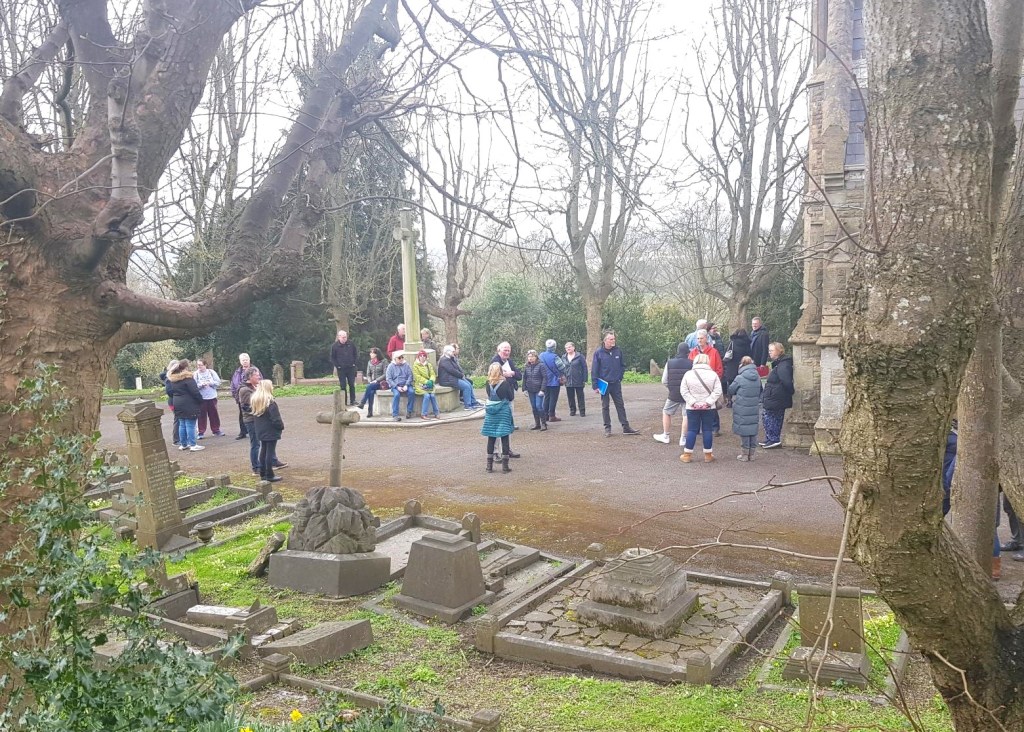
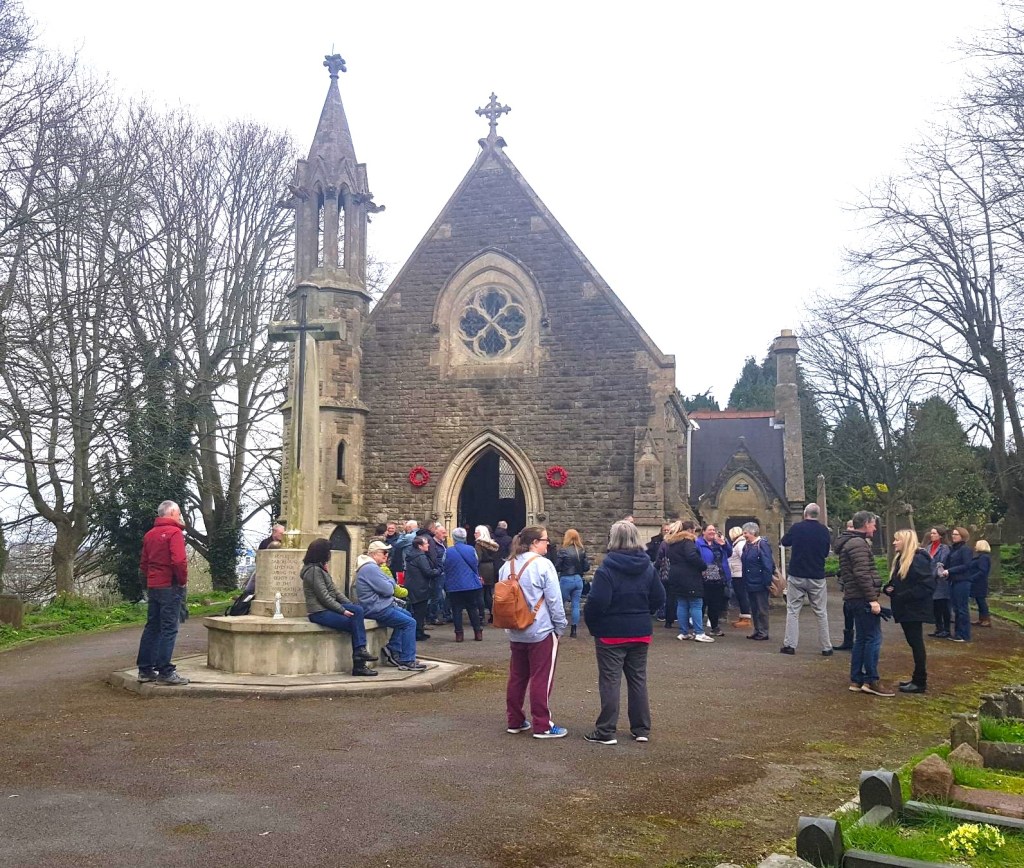
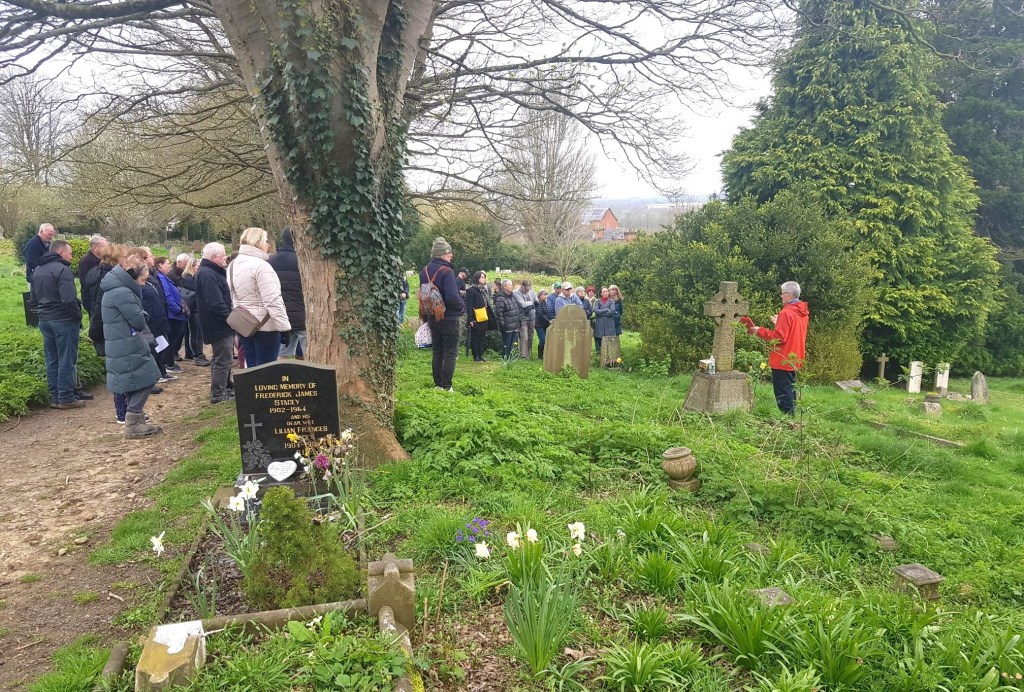
Many thanks to everyone who joined us for the first of this season’s walks. The weather was kind and the rain held off.
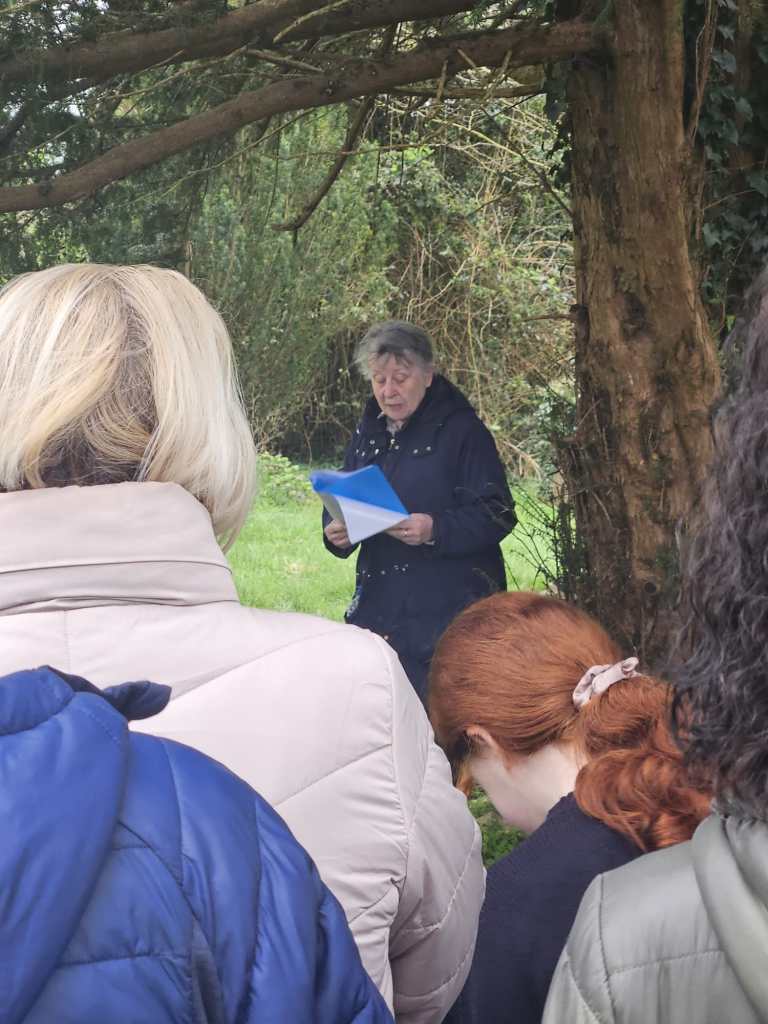
We were joined by members of the Menham family as Andy spoke about Swindon Town football legend Bob Menham. Kevin followed by telling us of the military career of his son Reginald Menham and reading a poignant letter taken from Mark Sutton‘s book Tell Them of Us.
There were lots of fascinating conversations as visitors shared their family history stories with us. It was lovely to meet Clare and I hope you found your family grave. I look forward to receiving your information and photographs to publish here.
Our next walk will take place on Sunday April 28. Meet at the chapel for 2 pm.
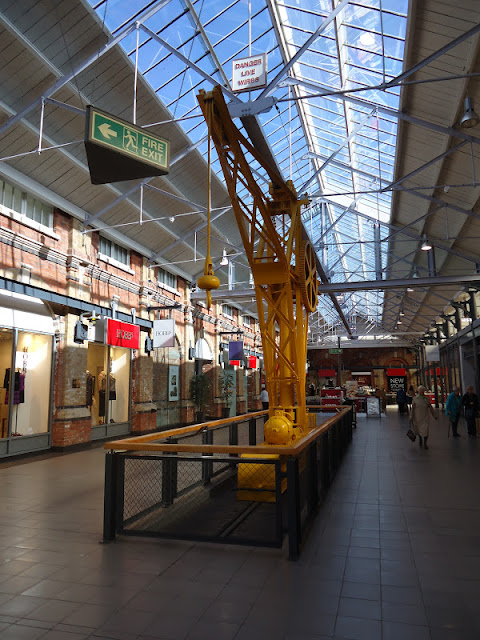
I’m having a rather expensive sandwich and a cup of tea (not many people drink tea now, I find it’s become an ‘old persons’ beverage) in a coffee bar which proudly boasts on the signage that it was ‘established 1999.’ It is situated in the former railway factory established slightly earlier – in 1843!
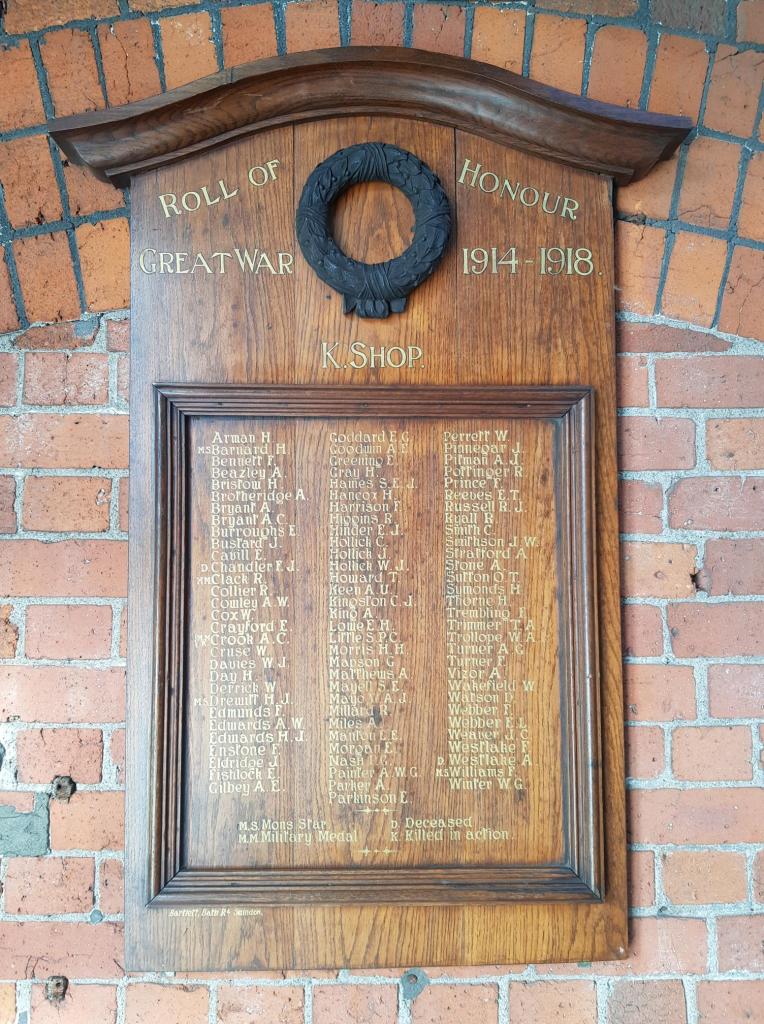
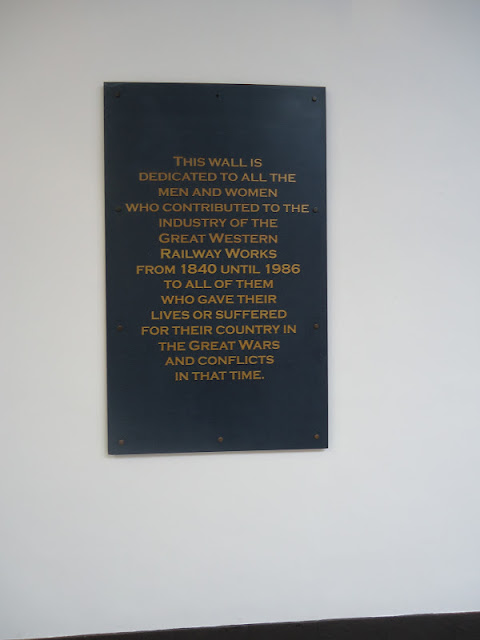
The model train has just done a circuit – a nod to the railway history of the McArthur Glen Designer Outlet Village. In all fairness there are plenty of reminders – machinery, overhead cranes and the war memorials to the railwaymen who gave their lives in two world wars.
There is still a generation of railwaymen around who can remember the Works when it closed in 1986 making 1,100 redundant. A far cry from the glory days of the 1920s when there were more than 14,000 on the payroll.
As I sit here enjoying my sandwich and (generous) mug of tea, listening to the hum of conversation around me, I think of all those men who spent a lifetime grafting within these walls.
You may like to read the stories of some of them – see below.
Today many families live at opposite ends of the country (and the world) and we tend to think of this as a modern phenomenon brought about by improved methods of transport. But people have always travelled to where there was work and Radnor Street Cemetery has many residents who came to Swindon and a job in the Great Western Railway Works.
Tom Tindle, or to give him his full name Tom Henry William Tindle, was born in York on April 18, 1855, the eldest of six children. In 1871 the family were living in Ashford in Kent, but when you look at the birth places of Tom’s siblings you can see they had also lived in Scarborough and London before settling down in Ashford, Kent.
Tom married Phillis Sarah J. Alderton, an elementary school teacher, at St George the Martyr in Southwark on April 24, 1878 when they both lived in the Old Kent Road area.
By 1881 the young couple were living in Stratton St. Margaret. Tom worked as a Coach Body Maker. He joined the Great Western Railway on May 23, 1887 as a Carriage Body Maker later becoming a foreman. By 1891 they had moved to 37 Regent Street where Phillis describes herself as a postmistress. In 1901 they lived at 10 Victoria Road with their four children. Phillis 18 and Nellie 14 were both working as pupil teachers. The boys Stuart 12 and Tom 5 were still at school. The 1911 census provides us with the additional information that Tom and Phillis had 6 children and that sadly 2 had previously died.
Tom lived in Swindon until at least 1920 when his address was 166 Victoria Road. He died in 1933 by which time he was living in Luton. The family returned the body to Swindon where he was buried with his daughter Phillis who died in 1905.
His wife Phillis out-lived him by eleven years. When she died in 1944 she was living in Bournemouth.
















 Radnor Street Cemetery