In which our roving researcher Noel goes to great lengths to follow a Swindon story.
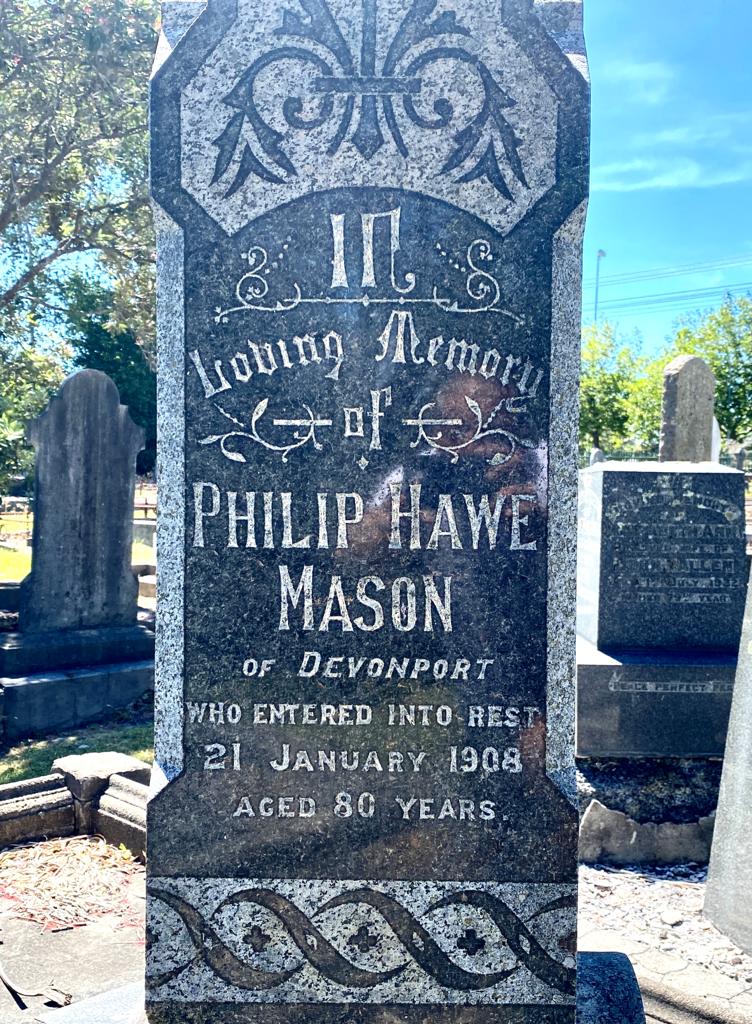
Philip Hawe Mason was born on December 5, 1827, the son of Wesleyan Minister John Mason and his wife Anne. His baptism appears in the Methodist Register of Births & Baptisms as having taken place on February 1, 1828 at his father’s house in Saint Luke’s Parish, London, performed by John Stephens.
An enterprising young man, Philip had arrived in Swindon by 1851 when he has his own grocer’s shop in the High Street. He later opened a second shop in Regent Street and by 1871 he is no longer living over his business premise but at Sanford House, a sizeable property on the corner of what is now Springfield Road and Croft Road. In 1871 he describes himself as a Grocer and Provision Merchant employing 15 men and 5 boys. Philip was an active member of Swindon’s society serving as Chairman of the Swindon School Board and heavily involved with the Wesleyan Church in Swindon, when tragedy struck.
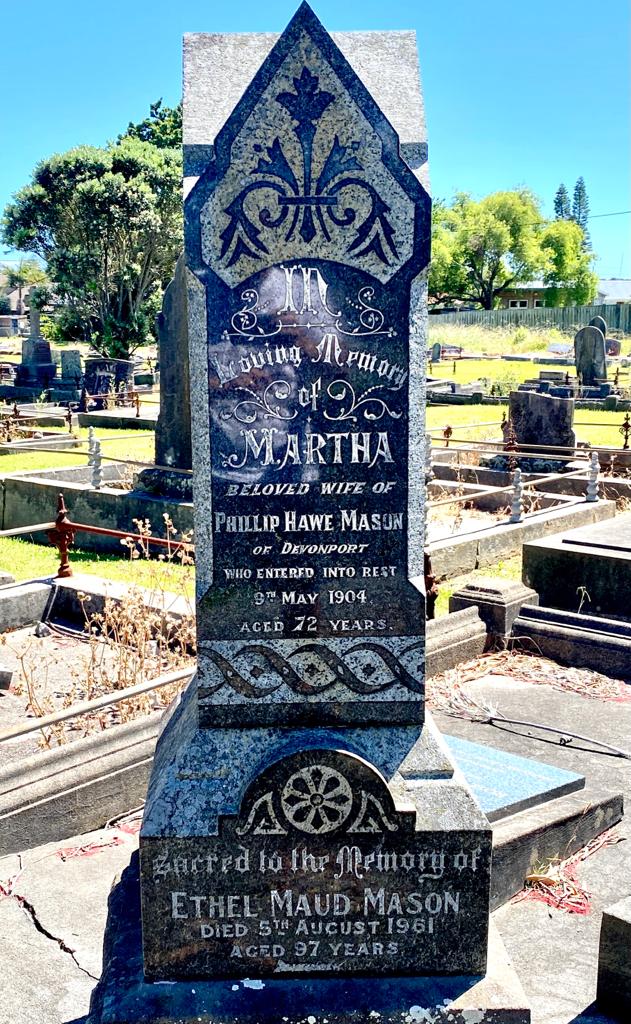
His wife Martha, whom he had married in 1853, took ill (possibly worn down by 10 pregnancies). Medical advice was to move to a warmer climate so in the 1880s Philip, Martha and several of their children, moved to Devonport, Auckland, New Zealand.
Here too Philip took an active part in the local community, serving as an elected Councillor of the Borough of Devonport.
Martha died in 1904 aged 72 and Philip in 1908 aged 80.
Death of Mrs P.H. Mason
The news of the death of Mrs P.H. Mason, at Devonport, Auckland, New Zealand, will be received with undisguised feelings of regret in Swindon by those who were acquainted with that lady and her family during their residence in the old town.
According to a cablegram received by the deceased lady’s daughter, who resides at Bristol, Mrs Mason’s demise took place last Monday, May 9th. The first intimation of the sad event was conveyed to Swindon in a letter addressed to the Mayor (Ald. James Hinton), by Miss Mason. The letter supplies a pathetic fact as to the suddenness of the news, for Miss Mason states that a letter intimating that Mrs Mason was quite well arrived simultaneously with the cablegram announcing her death.
Some little time must necessarily elapse before a further letter explaining the cause of Mrs Mason’s sudden demise can be expected.
The deceased lady, who was 72 years of age, was highly esteemed during her residence in Swindon. She was a prominent Wesleyan, and took an active interest in the welfare of that body. Mr Philip Hawe Mason was also held in high esteem. He held the position of Chairman of the School Board, and was Circuit Steward in connection with the Wesleyan body for many years.
Mr and Mrs Mason left Swindon in 1881 and such was Mrs Mason’s state of health that she had to be carried on to the boat.
During the time she was abroad, Mrs Mason enjoyed excellent health. It is only recently that Mr and Mrs Mason celebrated their golden wedding.
The Swindon Advertiser, Friday, May 20, 1904.
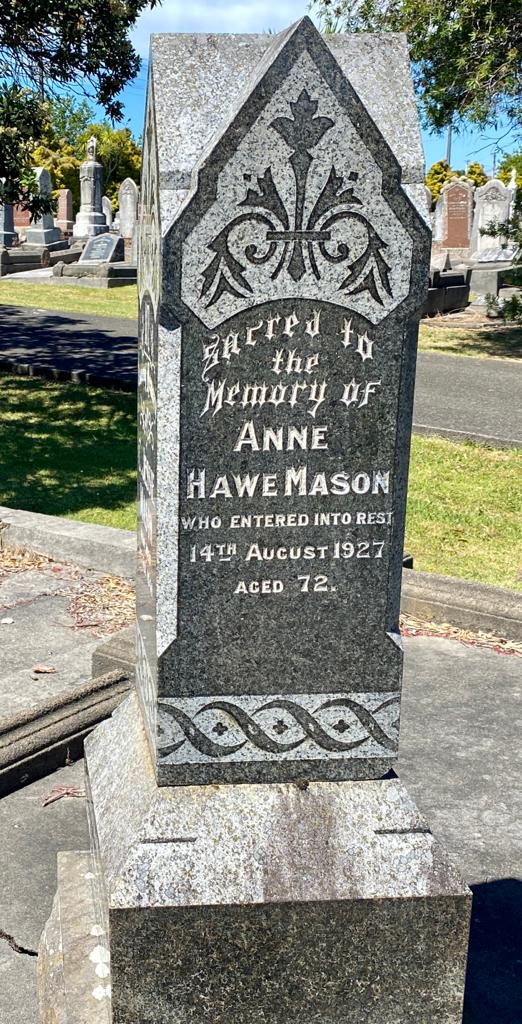
Their daughters Anne Hawe Mason died in 1927, Catherine Jessie Mason in 1940 and Agnes Martha Mason in 1944.
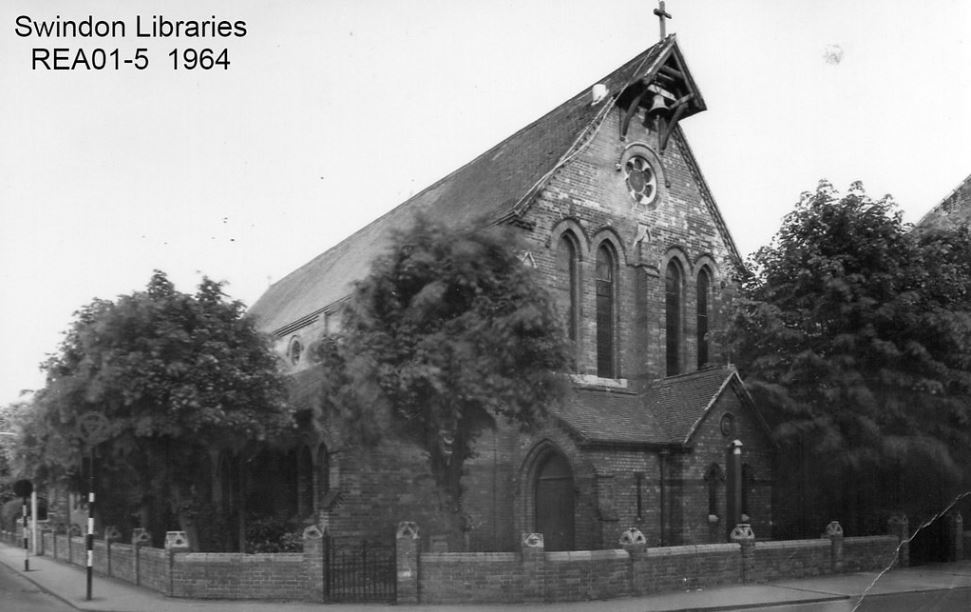
St Paul’s Church, Edgware Road, Swindon published courtesy of Local Studies, Swindon Central Library
You could be forgiven for never having heard of St Paul’s Church. It used to stand on the Woolworth’s site, although that won’t help you either as that store too has disappeared from Swindon’s town centre.*
The church of St Paul was designed by Edmund Ferrey and built in 1881 with a chancel added in 1883. St Paul’s served the myriad of town centre streets – Regent Place, Brunel Street, Gordon Gardens and others – all demolished during the 1960s re-development. An estimated population of 4,500 people were moved to housing estates on the outskirts of town and the prime retail site went on the market at £90,000. The church was demolished in 1965 when the valuable plot was acquired by F.W. Woolworth & Co. The St. Aldhelm’s Chapel stands on a small section of the former church plot.
The Rev Hanworth Hart Rackham arrived in Swindon following the death of Rev Douglas Ware in 1899. Born in Liverpool in 1860, Hanworth Hart Rackham was the son of Matthew Rackham, a Shipping Master Board of Trade, and his wife Katherine.
Swindon Clergyman’s Death
Rev. H.H. Rackham Passes Away in His Church
Death on Saturday evening carried away one of Swindon’s best-known clergymen, the Rev. Hanworth Hart Rackham, who had ministered as vicar of St. Paul’s parish for nearly 16 years. Happily there had been no long weary struggle for life, for the passing took place suddenly during vespers on Saturday evening in the church which he loved so well. It was a wonderfully peaceful end, and those who stood around the remains noted how the face was illumined with a happy smile.
Comparatively few of the congregation heard the sad news on Saturday night, and were greatly shocked with the intelligence which greeted them on reaching the church on Sunday morning.
Mr. Rackham, who was a native of Liverpool, was 55 years of age. He was educated at Worcester College, Oxford, where he took the BA degree in 1889 and the MA degree four years later. He was ordained deacon at Coventry, in the Worcester Diocese, in 1890, and priest in 1891. The first ten years of his ministerial life he spent as a curate at Kidderminster, where he had charge of a district church; but on the death of the Rev. D. Ware, he was presented by the Bishop of Bristol to the living of St. Paul, New Swindon, where he continued to labour until the moment of his death.
The late Vicar of St. Paul’s was a man of remarkable energy, which he displayed almost to the last, despite the fact that he suffered severely at times from disease of the heart. On taking charge of his parish he found its finances far from satisfactory, and he has left them thoroughly sound, besides building the Dowling Street Mission Hall and a new vestry to the church. This he accomplished owing to his splendid persuasive powers and his great faith in voluntary effort. He inaugurated in the parish a scheme of regular voluntary contributions, called the Sacred Treasury, to which members of the congregation undertook to subscribe week by week such sums as their means enable them to afford. The scheme soon became the backbone of the church’s finances in this thoroughly working-class parish. The outstanding feature of Mr Rackham’s work was not merely his energy, but his personal influence, which has been shown by the fact that his advice on spiritual matters has been sought by people living in all parts of England.
At St. Paul’s Church on Sunday morning, and again in the evening, when there was a large congregation, the Rev. H.J.W. Wrenford, in place of a sermon, made a short statement concerning the late Vicar’s passing. There was nothing in his condition to make one apprehensive that the end was coming. He was, as he had been on many previous occasions, obviously in pain and short of breath; but all through the day he was cheerful and bright, as he always was, surmounting all his pain and trouble. In the morning he was for a short time tending his roses in the garden, which showed that he was happy. Just before evensong, which he conducted in his usual bright and happy way, he came into the vestry, and we noticed that he paused for a moment, as he had often done before, to gain his breath. He went into the church to say evensong. He said the Confession and Lord’s Prayer. We noticed that he seemed in pain. We started the Psalms, and we had just finished the first of the Psalms for the evensong, which closed with the words “Put not your trust in man; put your trust in God, for vain is the help of man.” As soon as we had said these words he quietly collapsed on the floor. We did what we could to help him, but it was of no avail. It was God’s will; his time had come. I am sure of this – that he seemed to be conscious of no pain. It was certainly the most peaceful passing that one can imagine that one had ever seen. Immediately after he had passed from this world he lay with a smile on his face. I noticed that particularly, so I think we had great cause for thankfulness to God. We thank God that He gave him just the kind of death that he would have desired. Our Vicar, as you all know, would prefer to die in harness. I am sure there was no way in which he would sooner have passed from the world than in the presence of God in His Sanctuary.”
At the Cemetery
Thousand of people lined the streets as the coffin was taken up the steep declivity to the Cemetery, by way of Regent Circus, Eastcott Hill and Dixon Street. Such a funeral procession has probably never before been witnessed in Swindon. It stretched in a close line from St. Paul’s Church to the Town Hall.
The grave had been dug on the high ground near the Church of England chapel,** and in order to keep back the general public a large space was roped off and guarded by policemen.
Extracts from the North Wilts Herald, Friday, January 28, 1916.
Hanworth Hart Rackham 55 years old, priest of Edgware Road Vicarage was buried on January 27, 1916 in grave plot E7370 where he lies alone.
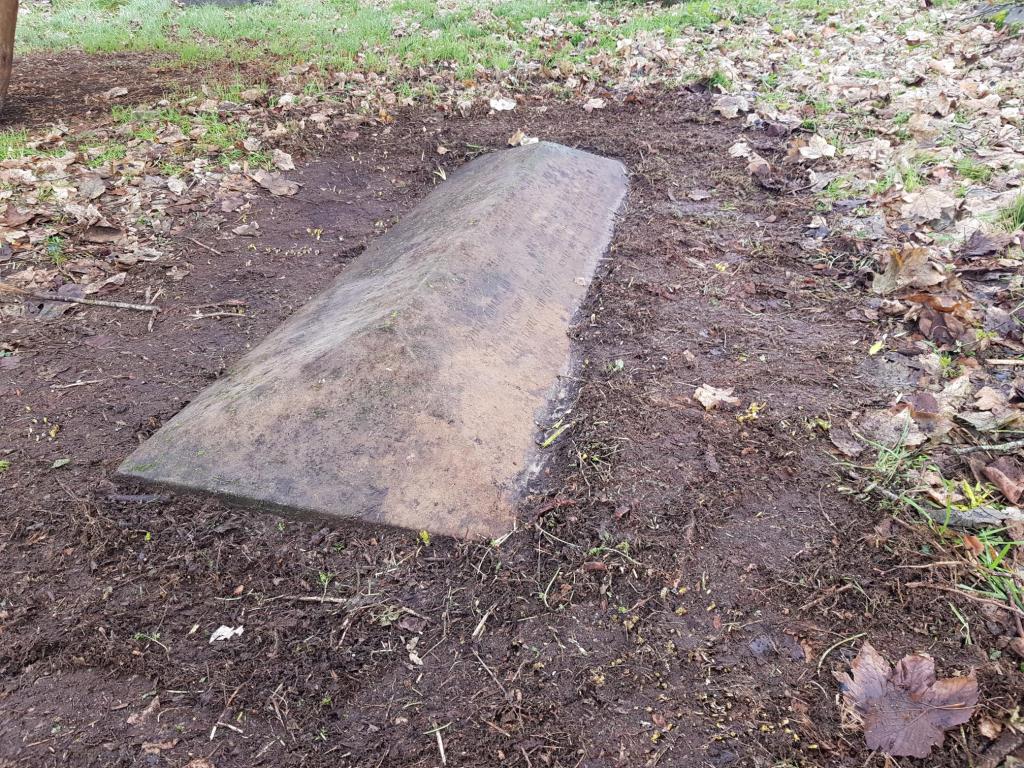
The Rev. Rackham’s grave has recently been rediscovered in Radnor Street Cemetery.
*The former Woolworth’s store is now occupied by OneBelow discount shop and Peacocks.
**The cemetery chapel was a non-denominational chapel.
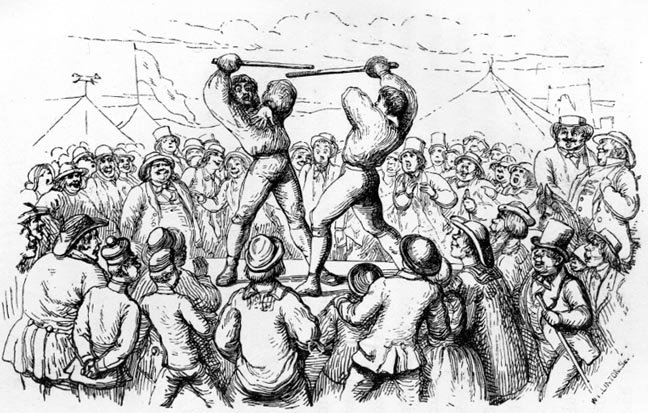
Of course, you are too young to remember Blackford’s the butchers. They used to have a shop on the corner of Wood Street and Cricklade Street, but that’s long gone. I can recall going to the shop in Bridge Street with my mother, although it could be quite a scary experience as old man Blackford was a bit erratic. He’d been a famous backsword player in his day and they said he’d been seriously injured several times during his fighting career.
I don’t suppose you know what backswording is either; no one plays it anymore. It was a brutal sport. Players had one arm restrained and with the other they beat their opponent about the head with a wooden stick, the aim to land a blow causing the blood to run for one inch.
There was some decent prize money to be won mind and more if you liked to gamble. Those old gamesters were made of stern stuff but they paid a high price. Joseph’s father Robert suffered from the frequent blows to his head and died from an accidental drug overdose of the laudanum he used to manage the pain.
Joseph concentrated on the butchery business, though and by the time he was raising his family backswording was a thing of the past. Joseph named one of his sons Brave – perhaps he thought he had the makings of a gamester.
Joseph Blackford was baptised at Christ Church, Swindon on March 24, 1830 the younger son of Robert Blackford and his wife Anne. Robert came from a long line of butchers and at the time of the 1841 census the family were living in a property on the corner of Wood Street and Cricklade Street. In 1851 Joseph was running the butcher’s shop on Bridge Street with his sister Mary. He married Mary Ann Holdway and by the time of the 1861 census they wereliving in the railway village at 10 High Street [later named Emlyn Square] with their two children William and Mary Ann. A third child, Elizabeth, was born in 1864. Mary Ann died in August 1865 and was buried in the churchyard at St. Mark’s.
Robert died in 1867 probably as the result of injuries sustained during his backswording career. The verdict of the coroner’s court was that he had “died from taking an overdose of laudanum, whilst labouring under a fit of temporary insanity.”
On February 27, 1867 Joseph married Rosanna [Rosina] Woolls, a widow who describes herself as a butcher. The couple set up home in Purton where they raised their family.
Joseph died in September 1906 aged 76 and was buried in plot D1447 with his son Harry Bath Blackford who had died just weeks before him. Rosina died in 1923 and their daughter Alda Priscilla Bamford died in 1932 joining her parents and brother Harry in plot D1447.
The Blackford family grave
Newspaper proprietor William Morris was particularly opposed to the sport of backswording, writing in his newspaper The Swindon Advertiser:-
And I recollect that this was particularly the case at the New Swindon sports. The left arm and side and thighof one of the players was so cut and bruised that it had the appearance of raw meat, and although the man himself kept on, and always came up to time, the spectators became so alarmed at his terrible condition and lacerated appearance that some attempt was made to get him to leave the stage and insisted that a medical man should be requested to attend him …
Shrivenham was one of the places noted for its backsword players, and I have been told that on one occasion a player in that village continued to play after one of his eyes had been cut out and lay on his cheek, and slices of flesh had been cut off his arms. Of course, such a one would receive much encouragement from the spectators as being a “good plucky fellow,” and the flow of pence into his basket at the close of each bout would be most liberal…
The Popular Amusements of our Grandfathers -The Swindon Advertiser, Saturday December 6, 1884.
In 2005 Radnor Street Cemetery was designated a Nature Reserve. A team of Rangers worked to promote the benefits to Swindon residents of having a green oasis on their doorstep. With an earlier band of volunteers they worked on a Garden of Remembrance close to the Radnor Street entrance. They plotted an area in which to grow meadow flowers. They organised events, installed bat and bird boxes and led guided walks. Then came the financial crisis of 2007-8 and subsequent cuts in council budgets and soon Swindon was relying on the work of volunteer rangers, and Radnor Street Cemetery became a casualty of those cuts.
For me, Radnor Street Cemetery is all about the people and the history of Swindon but Spring is most definitely in the air and every good cemetery guidebook (or website) has a section on flora and fauna. As a townie and non-gardener I’m probably not the best person to write this and there are many in our little band of volunteers who would make a much better job of it, but it will be selective, brief and beautifully researched. Please feel free to add your own more knowledgeable comments.
I’ll begin with the snowdrop – everyone knows the humble little Galanthus Nivalis that flowers in late winter and heralds the coming of spring. The snowdrop has inspired stories and poetry, music by Johann Straus II and Tchaikovsky and was a nickname for the US Military Police stationed in the UK during WWII.
The daffodil belongs to the Narcissus genus and is recognisable to even a horticultural ignoramus such as myself. The daffodil has migrated from North Africa and Southern Europe and was adopted by the Welsh as their national flower, although when and why seems largely unknown. The leek has a much older association with Wales, but to the best of my knowledge, we don’t have any in the Cemetery.
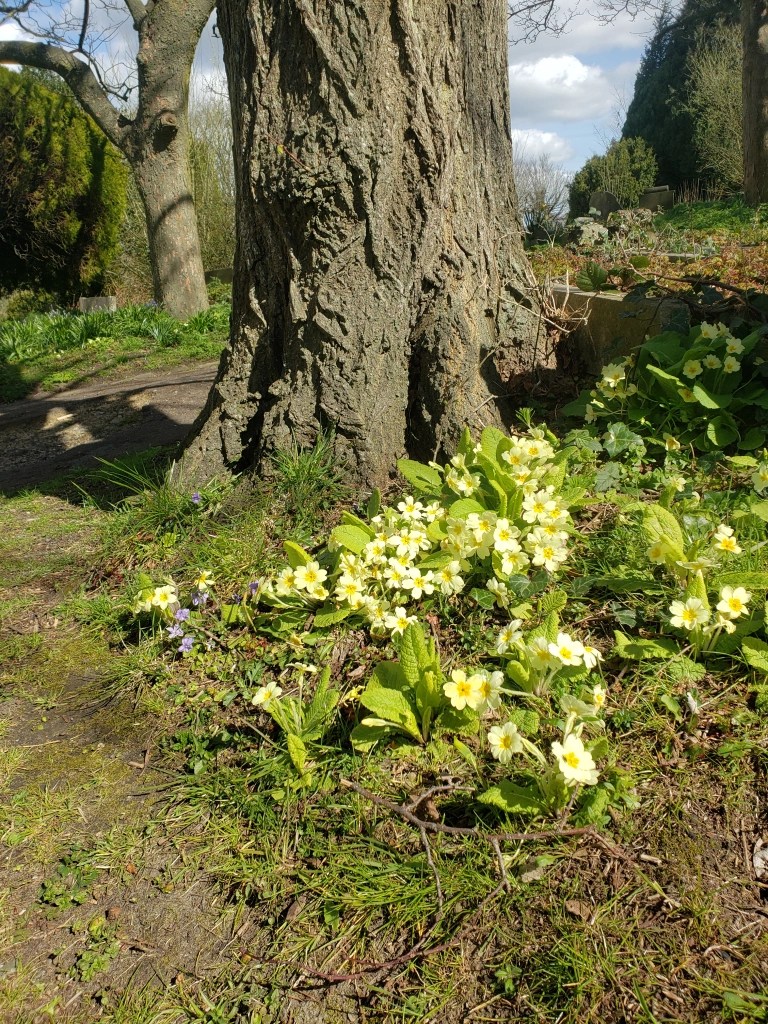
The Common Primrose, Primula Vulgaris, is to be found by streams, in orchards and woodland and grows in profusion in Radnor Street Cemetery. Edible, drinkable (primrose wine and tea) and the roots are considered to have an analgesic property – but don’t take my word for it. Apparently the primrose was Benjamin Disraeli’s favourite flower (Conservative Prime Minister in 1868 and 1874 to 1880).
And what about the Muscari Grape Hyacinth (are you impressed – I had to look it up?) The Wikipedia description is of a plant that produces “spikes of dense, most commonly blue, urn shaped flowers” so very appropriate for a cemetery. The Grape Hyacinth is one of the earliest garden flowers to bloom in the spring.
So that is probably the sum total of my flora and fauna knowledge. Is it too early for bluebells – probably? I’ll let you know when I see them. What else should I be looking out for? What are the names of the trees and shrubs – come on cemetery followers, help me out here.
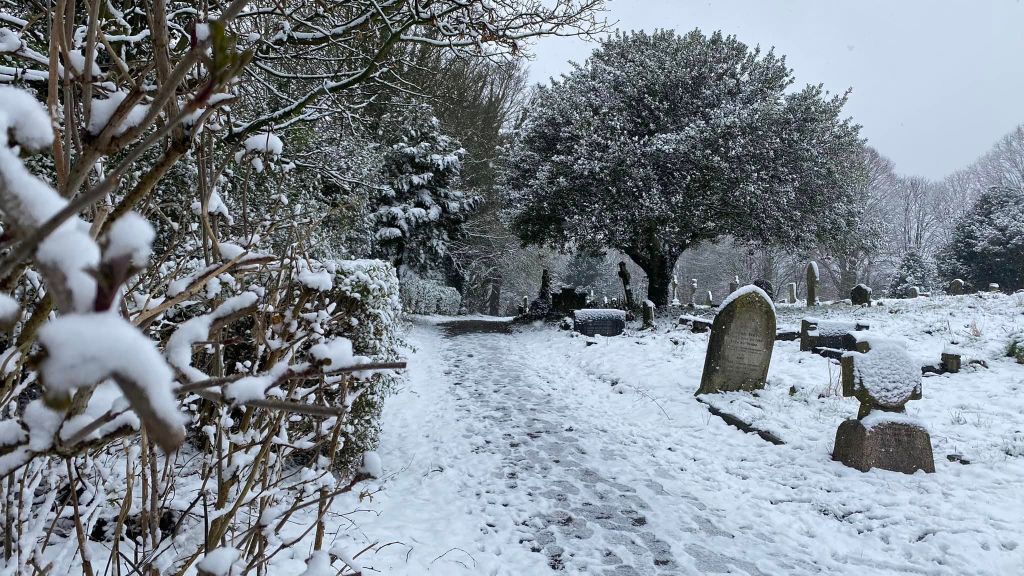
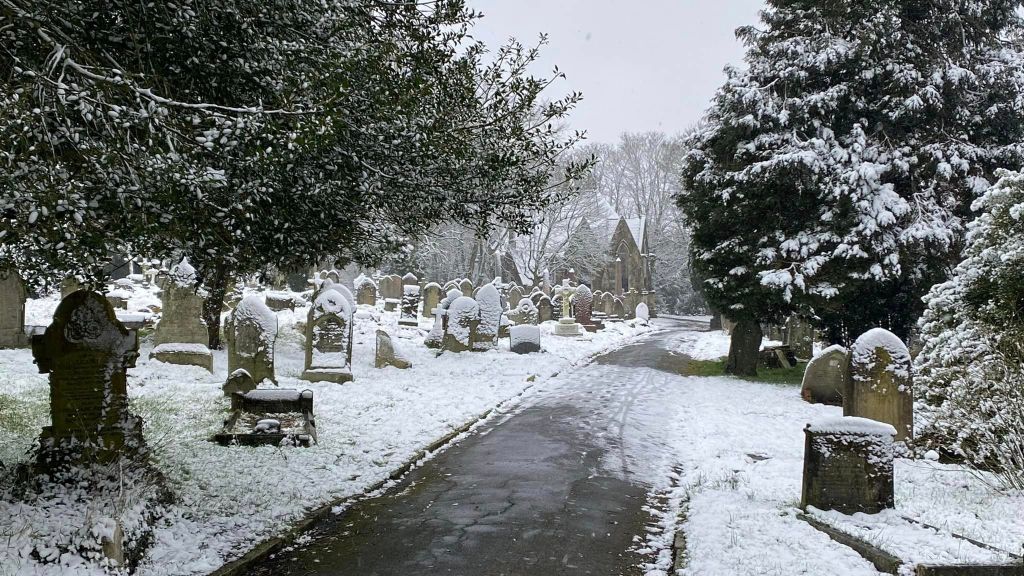
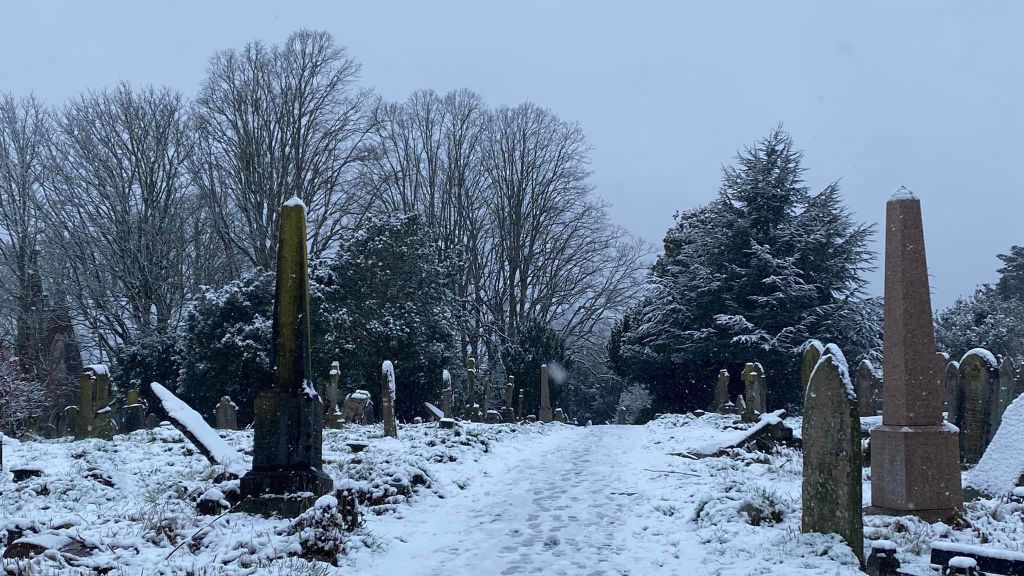
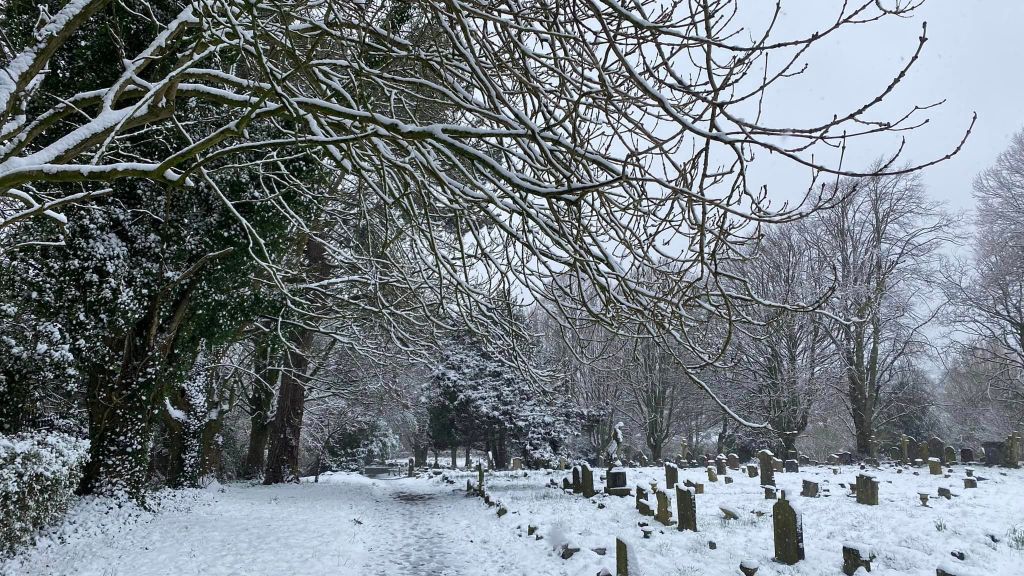
I didn’t manage to get up to the cemetery during the snow this week, but fortunately cemetery follower Paul Langcaster did. Thank you Paul for allowing me to publish your photographs here.
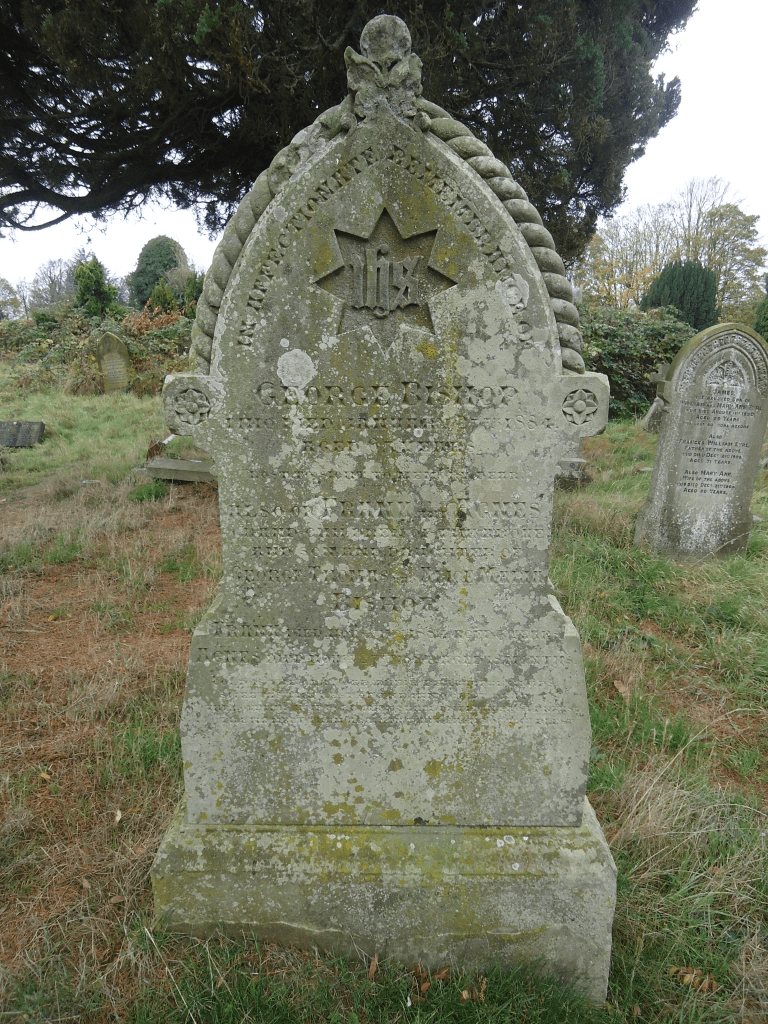
Sometimes a headstone can tell you a surprising amount of family history, although this one is becoming rather difficult to read.
Here is the story of a publican turned farmer and his two little grandchildren who were born and died during the 10 year gap between the 1881 and 1891 censuses.
George Bishop was baptised at the parish church in Wroughton on December 9, 1821, the son of Elizabeth Bishop, a servant, who did not provide a father’s name for the entry in the parish records. However, when George married Sarah Turner in 1846 he submitted his father’s details as George Gardener, a gardener.
Image of Bridge Street taken in c1925 published courtesy of Local Studies, Swindon Central Library.
At the time of the 1851 census George was recorded as a beerhouse keeper living on Eastcott Hill. A beerhouse was a premises licensed to sell only beer (no spirits). Beer could be brewed on the premises or purchased from a brewer. By 1861 George was landlord at a pub in Bridge Street, presently unidentified. (Could it have been the Sun Inn whose first recorded landlord was Robert Bishop – see Last Orders by John Stooke?)
George and his family were still at No 55 Bridge Street in 1871. It must have been a large establishment as the census records for that year show the names of six boarders living there on census night.
George Bishop had been a publican for more than thirty years when at the end of the 1870s he gave it all up to become a farmer. At the time of the 1881 census George was farming 10 acres at Nore Marsh Farm in Wootton Bassett where he died on January 27, 1884. The cause of death was recorded as ‘syncope owing to diseased heart.’
His personal estate was valued at £126 14s 2d, administration of which was left to his only son George Thomas (his wife Sarah died in 1872 and is buried in St. Mark’s churchyard.)
Just months after George’s death the family were to gather again for the funerals of two little children. Three year old Frank Bishop was buried with his grandfather on November 21, 1884 and just eight days later one year old Agnes joined them. Frank and Agnes were the children of George Thomas Bishop and his wife Alice.
Almost 80 years after the sad events of 1884, a fourth and final burial took place in the Bishop family grave plot. On November 20, 1963 William Henry Bishop was buried alongside his grandfather and the remains of his little brother and sister, Frank and Agnes. He was 85 years old.
James Lott opened his ironmongery business in around 1873. By 1881 he was living above the shop at 91 Regent Street with his wife Ellen and their four young children. However, the changeable fortunes of James Lott saw him forced to declare himself bankrupt in 1889.
But by 1891 business was booming again when James was based at numbers 50 and 51 Regent Street. In 1907 he was advertising “the most varied and up-to-date stock of Brushes, Copper Flower Vases and Kettles, Cutlery, Electro-plated Goods, Curb Fenders, Fire Irons and Brasses, Expanding Wood Trellis, Wire Netting, Garden Arches and Tools, General and Furnishing Ironmongery of every description.”
The 1911 census lists him as living above his shop at 5 Temple Street with his wife Ellen and youngest daughter Maud, an elementary school teacher. Temple Street today is unrecognisable from the busy shopping thoroughfare it once was linking Commercial Road with Regent Street. Temple Street has been the scene of several major reconstruction projects in the past 100 years. Today it is the site of work in progress on a Premier Inn due for completion later this year. Pictured below is the large gap left following the demolition of the Baptist Tabernacle.
This image of the site of the demolished Baptist Tabernacle is published courtesy of Local Studies, Swindon Central Library.
And it is still possible to find evidence of James Lott’s work in the pavements around town.
Death of Mr J. Lott
An Old and Respected Swindon Tradesman
The death has occurred of Mr J. Lott, head of the firm of Messrs. Lott & Sons, of Regent street, Swindon.
Mr Lott was one of the oldest tradesman in Swindon. Born near Holsworthy in Devon he came to the railway town in the early ‘70s, and by his energy and enterprise built up the present extensive business.
Mr Lott was connected with the Gooch Lodge of Freemasons, of which he was a Past Master, and was much respected in the town.
The funeral has been fixed for Monday. Mr. Lott was 76 years of age.
Swindon Advertiser Saturday, 10 December, 1921.
Late Mr J. Lott,
Masonic Funeral at Swindon Yesterday
The funeral of Mr J. Lott, of Swindon, took place yesterday afternoon. The Rev. J.E. Rogers officiated, and the masonic ovation at the graveside was delivered by the Rev. W.L. Waugh, Provincial Grand Chaplain.
The mourners were Mr. J.D. Lott and Mr C.R. Lott (sons), Mr E.W. Lott and Master Stanley Smith (grandsons), Mr J.W. Smith (son-in-law), Mr E.W. Daniel (Hendon) and Mr J. Daniel (nephews), Mr A.S. Deacon, Ald. E. Jones, Mr S. Chappell, Mr T. Butler, Mr F.C. Phelps, Mr A.R. Bray (Bristol), Mr W.E. Chappell, Mr J. Wilmer and Mr H. Mitchcock.
The Freemasons, of which deceased was a Past Provincial Grand Officer, were represented by Brs. A.E. Bottomley, D.C.A Morrison, H.J. Hamp, E.O. Twitcher, A.G. While, J.S. Protheroe, T. Mundy and D.A. Lane. Deceased’s employees also attended.
The floral tributes included one from the widow, and others from sons, sons and daughters-in-law and grandchildren, the Wiltshire Lodge of Freemasons and the staff at Regent street.
The image of the Mechanics’ Arms is published courtesy of Mr D. New and Local Studies, Swindon Central Library.
The re-imagined story …
My dad used to drink in the Mechanics’ Arms so when he said they were looking for a barmaid I decided to apply. We lived just around the corner in Wellington Street, so not far to walk home at the end of the evening. Dad knew Mr and Mrs Leighfield well.
“They’re a nice couple. They’ll look after you well – won’t take advantage of you.” Dad knew most of the regulars, all men from the Works.
Mrs Leighfield told me to call in on Tuesday afternoon.
It was pandemonium when I got there, yet no one seemed to know what was going on.
“There’s been an accident.”
“Has anyone sent for Dr Swinhoe?”
“He’s on his way.”
“Do they need any help in there?”
“We could hear a woman screaming, but it’s all gone quiet now.”
I decided not to hang around. There was nothing I could do anyway.
The pub was closed that evening, but the news was already spreading. Dad couldn’t believe it.
“He was such a nice man. Always had a cheery word for everyone, even though his health was poor.”
I decided against applying for the barmaid’s job, although I felt a bit guilty. Mrs. Leighfield probably needed the help more than ever now, but I just couldn’t face going in that kitchen where it had all happened.
The facts …
Swindon
An inquest was held by the county coroner (Mr A.L. Forrester), at the Mechanics’ Arms Inn, on the body of Frederick George Leighfield, the landlord of the house, who committed suicide by cutting his throat. The evidence showed that deceased had been unwell and depressed. On Tuesday afternoon his wife found him in the kitchen in the act of cutting his throat. He had succeeded in inflicting a severe wound with a razor, and although he received immediate attention, he succumbed early on Thursday morning. The jury returned a verdict of “Suicide while temporarily insane.”
The Western Daily Press, Bristol Monday August 23, 1909
Funeral on Sunday
Impressive Service in Swindon Cemetery
The funeral of the late Mr Frederick G. Leighfield, of the Mechanics’ Arms Inn, Cheltenham Street, whose sad death was recorded in our columns last week, took place in Swindon Cemetery on Sunday afternoon, the mortal remains being laid to rest in the same grave as those of his father, the late Mr Alfred Leighfield, who died two and a half years ago.
The cortege left deceased’s late residence at 3 pm and proceeded direct to the Cemetery, where a short service was conducted in the Chapel by the Rev. F.C. Shellard, Baptist Minister, who also officiated at the graveside.
The coffin, which was covered with lovely floral tributes, was conveyed in a hearse, and the chief mourners were in four carriages, whilst a very large concourse of people in the Cemetery, but the best of order was maintained, and the roped enclosure was kept clear by a number of policemen, under Inspector Buchanan and Sergt. Millard.
A number of members of the Swindon and District Licensed Victuallers’ Association, of which Mr Leighfield was a member, also attended to pay their tribute of respect to the memory of deceased.
The coffin was of polished elm, with brass fittings, and the breast-plate bore the following inscription: “Frederick George Leighfield, died Aug 19th, 1909, aged 39 years.”
The funeral arrangements were satisfactorily carried out by Messrs H. Smith and Son, of Gordon Road.
Extracts printed from The Swindon Advertiser Friday August 27 1909
Radnor Street Cemetery followers will surely recognize the name Cleo Laine. Jazz singer and actress, her long and illustrious 50+ year career took off when she joined the Johnny Dankworth Band in 1951. The couple later married and went on to co-found the charity The Wavendon Allmusic Plan and created the Stables theatre in the grounds of their home near Milton Keynes. Cleo Laine received an OBE in 1977 and was made a DBE in 1997.
But did you know that her grandparents, Charles and Elizabeth Hitchings, are buried in Radnor Street Cemetery?
Dame Cleo Laine
Clementine Dinah Hitchings was born in Southall on October 28, 1927, the daughter of a Jamaican father Alexander Sylvin Campbell and Minnie Blanche Hitchings who was born in Wiltshire. Alexander and Minnie were an unconventional couple. For a start they were unwed and it seems likely Minnie already had a husband when they first met.
Minnie Blanche Hitchings was born in 1889 in Cleverton,Wiltshire the daughter of Charles Hitchings and his wife Elizabeth. The 1891 census finds the family living at Cleverton where 27 year old Charles describes himself as a ‘farmer and dealer.’ The young couple have three children, Arthur 6, Ethel 4 and one year old Minnie.
By 1901 Charles had brought his family to Swindon where he ran a Grocer’s shop at 24 Little London. The 1901 census records him as Charles Hitchings 37, Grocer Shopkeeper born in Lea. His wife Elizabeth, also 37, was born in Fulham, London and they now had five children – Arthur 16, who worked as a clothier’s assistant, Ethel 14, Minnie 11, Emily 7 and four year old Frank.
Charles Hitchings
In 1903 the family lived at 38 Belle Vue Road where Charles died suddenly on Sunday July 5, 1903. Mr W.E. Nicolson Browne (county coroner) held an inquest where it was heard that the deceased complained of pains near his heart after which he shortly fell dead. A verdict of “Death from syncope” was recorded and on July 8, 1903 39-year-old Charles Hitchings was buried in Radnor Street Cemetery in plot A404.
Did Elizabeth move back to family in London? It was there just five years later that she died in the Metropolitan Hospital. Her body was returned to Swindon where she was buried in Radnor Street Cemetery in plot A784, a public grave, on December 4, 1908.
By 1911, then aged 22, Minnie was working as a waitress in an hotel at No. 1 Bridge Street run by Henry Moore. Perhaps this was where she met Frederick W.H. Bullock whom she married in 1913. The couple left Swindon and moved to Hounslow but the marriage soon ran into trouble and by 1921 Minnie had left Frederick. By 1925 Minnie had met Jamaican born Alexander and the couple had their first child.
Clementine Dinah (Cleo Laine) was born in 1927 before her parents married in 1933. Dame Cleo is recorded as saying it was only when she applied for a passport as an adult that she learned her parents were not married at the time of her birth.
Sir John Dankworth was created a knight in 2006. He died in 2010 aged 83. The couple have two children, their daughter Jacqui is a singer/actress and their son Alec is a bassist and composer. Their granddaughter Emily Dankworth is also a jazz singer/songwriter.
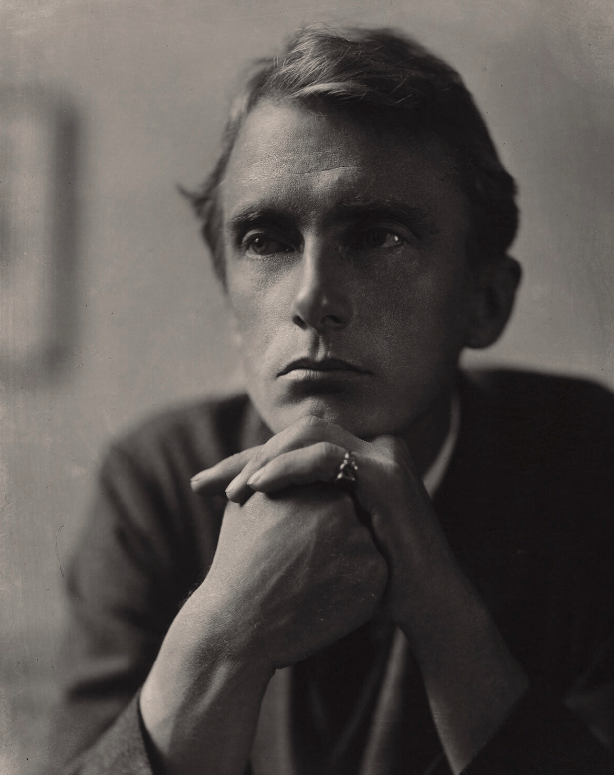
Edward Thomas was born in 1878 in Stockwell, South London. He began his writing career in 1906, working as a journalist, literary critic and book reviewer. Thomas began to write poetry in 1914 and today his name is associated with war poets Wilfred Owen and Rupert Brookes.
Edward Thomas enlisted with the Artists Rifles in July 1915 and was later commissioned into the Royal Garrison Artillery. He was killed in action at Arras on Easter Monday April 9, 1917 and is buried in the CWGC Agny Military Cemetery in the Pas de Calais region.
Thomas is mostly associated with South Wales where he maintained ties with his large extended family, and Steep in Hampshire where he lived with his wife and children (there is a study centre dedicated to him in the Petersfield Museum). His association with Swindon is perhaps less well known.
Edward Thomas’s father, Philip Henry Thomas was born in Tredegar in 1855, the son of Henry Eastaway Thomas an Engine Fitter. The Thomas family moved to Swindon in 1867 and appear on the 1871 census living at 5 High Street, later renamed Emlyn Square.
Henry Eastaway Thomas died shortly after the census was taken and was buried in the churchyard at St Mark’s on April 8, 1871. Sadly, the death of two of their sons occurred shortly afterwards, Daniel Eastaway Thomas in 1873 aged 12 years old and Edward Treharne Thomas in 1877 aged 11 years. Both boys are buried in St Mark’s churchyard though it is not know if they are together. According to this memorial (see below) youngest son Harry Eastaway Thomas died in South Africa in 1900.
By 1881 Rachel was living at 19 Cambria Place, which remained her home for the rest of her life.
Edward Thomas retained his close ties with Swindon, regularly visiting his grandmother Rachel at her home.
Death of Mrs R. Thomas. – A Swindon Octogenarian. – The death took place on Tuesday last, at her residence, 19 Cambria Place, Swindon, of Mrs Rachel Thomas, an old inhabitant of Swindon, who had attained to the great age of 86 years. She has been a widow since 1873. With her late husband, Mrs Thomas came to Swindon in 1867, from Tredegar, Mon., and Mr Thomas was employed in the GWR Works, which, like the town, was very small compared with its great extent today, and she lived to see many changes take place here. Mrs Thomas leaves a family of two children – a son and a daughter. The son is Mr P.H. Thomas, I.S.O., of the Board of Trade. It will be of added interest to our readers to know that a grandson of the deceased is Mr. Edward Thomas, author of the Life of Richard Jefferies, a work which has received most favourable notice in the London and Provincial Press. Mr Edward Thomas spent a whole summer in Swindon and district a year or two ago in collecting material for his work. Like Jefferies, he is a lover of nature, and when a boy used to live in Swindon with his grandmother.
Swindon Advertiser, Friday, December 31, 1909.
Rachel Thomas was buried on December 31, 1909 in grave plot C1609 where she lies alone.
On the reverse side of the memorial is the second verse of a hymn by Horatius Bonar.
Think truly and thy thought shall the world’s famine feed.
Speak truly and each word of thine shall be a fruitful seed
Live truly, and thy life shall be a great and noble creed
The plot has recently been cleared by Radnor Street Cemetery volunteer Jon.












 Radnor Street Cemetery