
Joshua Jackson’s obituary published in the Wiltshire Times and Trowbridge Advertiser Saturday 29 April, 1911 might be brief, but it provides a lot of information about the extraordinary life he led as a young man (see below).
Joshua was born in at Manchester on January 7, 1836, the second of James Jackson, an inn keeper, and his wife Hannah’s 8 children.
At the age of 19 Joshua joined the army and within two years he was serving in India with the 60th Rifles during the Indian Mutiny. As with most wars, the causes were several but a flashpoint came when the Sepoy soldiers of the Bengal Army were issued with the new Enfield rifle. The Enfield used cartridges that had to be bitten open, which both the Muslim and Hindu soldiers believed had been greased with animal fats, contravening their religious observances. This however was just one cause in a complicated situation which signalled a significant turning point in the relationship between Britain and India. Joshua was also involved in the Siege of Lucknow*, defending the garrison and the British Residency in that city from the Indian soldiers.
The outcome of the Mutiny was an end to the East India Company’s right to rule India. Britain made India a part of the British empire and instated a British Governor General. Twenty years after the war Queen Victoria became Empress of India and the Viceroy of India ruled in that country on her behalf.
From India, Joshua went to serve in China during the Second Opium War where in 1859 he saw action at the Battle of the Taku Forts.

But by 1865 he was back in England where on May 4 he married Sarah Ann Potts at St John’s Church, Frome in Somerset.
The 1871 census records the couple living in Frome with three children, Henry 5, Percy 3 and one-year-old Henrietta. By 1881 they had arrived in Swindon. The census of that year lists them as living at 47 Haydon Street. Joshua worked as an Engine Fitter in the GWR Works while Sarah raised their large family already numbering 7 children.
In 1891 the family were living at 28 Guppy Street, Rodbourne. Three sons had followed Joshua into the Works as apprentice fitters and turners while another three sons had been born in the intervening ten years. Guppy Street remained the Jackson’s family home where Joshua died in 1911 and Sarah in 1928. The couple are buried together in plot C301 with their only surviving daughter Henrietta who died in 1920.
It appears that the Jackson family were buried in a reused grave. The first person buried in this plot was John Meek who at the time of his death in 1897 was an inmate of the Stratton Workhouse. The grave was no doubt a public plot but purchased by the Jackson family at the time of Joshua’s death.
Death of a Mutiny Veteran
Funeral at Swindon
There was buried in Swindon Cemetery last Monday afternoon the mortal remains of Mr Joshua Jackson, an Indian Mutiny veteran. He was born at Manchester in 1836, and at the age of 19 years he enlisted in the old 60th Rifles, and two years later was drafted to India, seeing much active service in the Mutiny, but fortunately he escaped without a scratch. He also fought later in the China War, and was present at the taking of the Taku Forts. When he returned to England he left the Army in 1867 and settled down at Frome. Then he removed to Swindon and worked at his trade for many years in the GWR Works. He joined the Freemasons while at Frome 45 years ago, and when he came to Swindon he joined the Gooch Lodge, 34 years ago, becoming Tyler, a post he held till the time of his death, at the age of 75 years.
Deceased leaves a widow and ten children – eight sons and two daughters.
Besides the family mourners, a large number of Freemasons attended.
Wiltshire Times and Trowbridge Advertiser Saturday 29 April 1911.
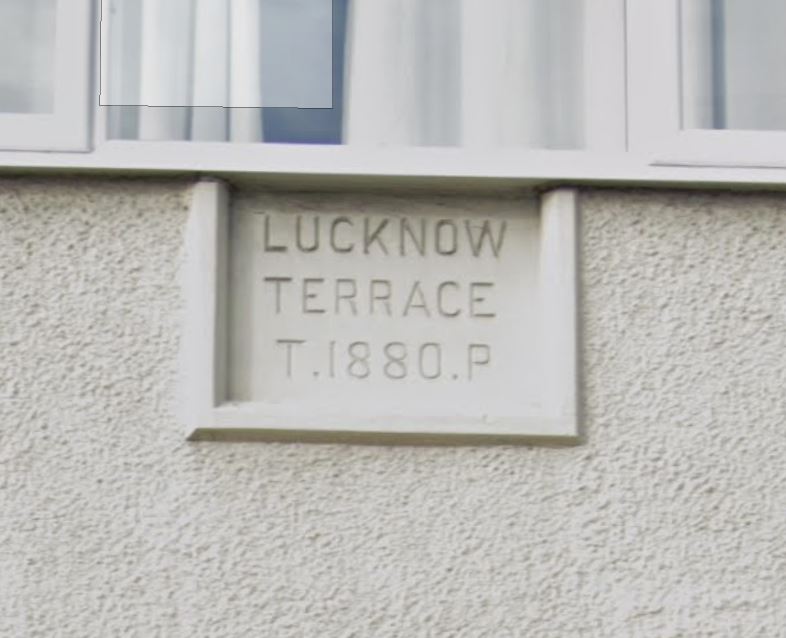
*As you walk along Rodbourne Road past Ron’s Stores, look up and above the terrace of houses you will notice in the brickwork an inscription that reads Lucknow Terrace.

 The re-imagined story …






 Radnor Street Cemetery