Georgina Frances Verschoyle Pt 2

Today I’m returning to the story of Georgina Verschoyle and although I am no nearer to understanding how or why she came to be living in Swindon, I do know more about her life here.

A view of St Mark’s Church taken from Radnor Street Cemetery

Following her death a lengthy obituary was published in the parish magazine of St. Mark’s Church.

Requiescat in Pace

Miss Verschoyle died on Dec. 20, and was laid to her rest in the Swindon cemetery on Sat., Dec. 23rd. Her health had been failing for several years, and though the end did not seem near to her friends, she was not strong enough to stand against a bad attack of Influenza, that scourge of our country at the present time.

Many who read these lines, perhaps far away now, will remember the time when she came to Swindon thirteen years ago. In those days Church life was just starting in S. Mark’s Parish. She threw herself with untiring energy into the work as a volunteer helper, and indeed continued as such to the end.

Before she had been in the parish many weeks she obtained the Vicar’s permission to commence a Bible Class for Men. The attempt was a decided success. A good number joined at once, and between 50 and 60 men have assembled, while on one of the last occasions when she presided over her Class at the new Parish Rooms, over seventy men were in attendance.

During the whole of the same period she has conducted a large Mothers’ Meeting, and for the last few years a Bible Class for Women at S. John’s. Unlike many of the kind, these classes have never diminished in the numbers of those attending them. People who have experience in such matters know well that classes such as these can only be kept together for so long a period by diligent and unceasing work and earnest prayer.

It is however in the District that we think that Miss Verschoyle’s work has chiefly been done. Well trained in Church work in earlier days at Clewer, Guildford, Market Drayton, S. Giles’, Reading, and S. Luke’s, Torquay, she had attained the habit of regular and systematic visiting. From early morning to late evening she was to be seen every day in all weathers going to all parts of the parish amongst the sick and the whole, bearing the message of comfort. Her daily visits to the dying were a striking feature of her work. Many a one in Paradise will, we believe, thank God for that regular earnest teaching which helped to bring the soul out of darkness into the light of Christ, while many a one living now, who may read these words will gratefully acknowledge that the turn in his life was due to her sympathy and help.

Miss Verschoyle knew the secret of success, viz., that no work for God can prosper unless His help is sought. She was regularly to be seen in her place at the daily Services of the Church, gathering strength into her own life, that she might be the better able to impart it to others. Indeed the Church was very dear to her; she enriched it with many costly gifts, and as each Festival came round, she spent time, money, and labour in decorating the Font with flowers.

We need scarcely say that she was beloved and respected by those amongst whom she worked. While we thank God for her work in the Parish, let us pray to Him to send to our Parish other such workers, and let us ask Him to give us grace to profit by her teaching and example, that when the great day comes, we may be found worthy to be on the King’s right hand among those to whom the word of comfort shall be spoken, “Come, ye blessed of my Father, inherit the kingdom prepared for you from the foundation of the world.

Inside St Mark’s Church, Swindon

The Late Miss Verschoyle.

Dear Friends,

It has been suggested to me that some of those who have known Miss Verschoyle and her work in the parish may like to place some kind of memorial to her in S. Mark’s Church, where she was so constant a worshipper. I do not think it would be suitable to have an organised collection for such a purpose as this, but if any of those who read these words like to send a contribution, great or small, I will very gladly receive it. The nature of the memorial must be decided by the amount contributed. Yours truly, Maurice Ponsonby.

Throughout the year fund raising updates appeared in the parish magazine until in November the Rev. Ponsonby declared it was probably time to close the account and think about how the money should be spent.

I wonder if anyone can tell us what kind of memorial was chosen for Miss Verschoyle and whether it still survives in St. Mark’s today.

Fr Toby from St. Mark’s has sent the following words and kindly offered to provide a photograph.

The memorial is a window in the south aisle depicting Matt 15.28. The dedication on a plaque underneath reads: “This window is given by many friends in grateful memory of Georgina Verschoyle who fell asleep on Dec. 20th 1893 after 13 years of unceasing labour for God in this parish. Requiescat in pace.” 

Clara Ellison – Head Teacher at Even Swindon Infants School

Clara Ellison had taught at Even Swindon School for 25 years when she resigned in 1908. Then aged 48 she might have expected to remain in post for a few more years. There is no mention that she was suffering from poor health so we have to ask did her husband’s bankruptcy case influence the members of the Swindon School Board?

Clara Illidge Shelton was born in 1860 in Birmingham, the daughter of William Shelton, a cab driver, and his wife Elizabeth. By the time of the 1881 census Clara was living in Eastbourne where she was employed as an assistant school mistress and lodged with William Cole and his family.

On December 1, 1883 Clara (by then living at 34 Wellington Street, Swindon) married John Ellison, a brass finisher in the Works, at St. Mark’s Church. Even Swindon Infant School was built in 1884, which is the earliest date at which Clara could have been teaching there. By 1891 the couple were living at 17 Linslade Street where John describes himself as a Brass Finisher and Clara as a School Board Teacher. They had two young sons, Gerald 6, and Wilfrid 4. Clara’s widowed mother Elizabeth lived with the family.

But was there a prejudicial attitude to Mrs Ellison prior to the events of 1908? In 1896 Mr Henry Day (Head Teacher at Even Swindon Mixed School) and Mrs Clara Ellison (Mistress at Even Swindon Infant School) both applied for an increase in their salaries. The School Management Committee initially recommended that they both receive a £10 annual increase whereupon Committee member Mr McRae immediately opposed both applications. In the case of Mr Day there was no seconder but Mr Keene also raised an objection in the case of Mrs Ellison. Some discussion followed when another member, Mr Sewell, entered a protest against Mrs Ellison holding the post, and ‘keeping a single girl out of work.’

But then came the matter of John Ellison’s bankruptcy in 1908 and a recommendation by the Teaching Staff Sub-Committee “that Mrs Ellison, head mistress of the Even Swindon Infant School be given three months’ notice to terminate her engagement.” Swindon Advertiser, Friday, May 22, 1908.

By August 1908 John’s bankruptcy examination was closed and Clara had resigned.

Even Swindon School published courtesy of Local Studies, Swindon Central Library

Presentation – On Wednesday afternoon, at the Even Swindon Infant School, Mrs Ellison, late headmistress, was the recipient of a very handsome pair of bronzes, given to her by the teachers (past and present) on the occasion of resigning her position as headmistress, which post she has held for 25 years. In making the presentation, Miss Witt said how very much they all felt the parting, but they hoped Mrs Ellison would be spared many years to enjoy the rest so thoroughly earned. – In reply, Mrs Ellison, thanking them, said how much she would value their beautiful present, and the very happy time spent amongst them would never be forgotten by her. She wished them every success, and trusted they would all work as happily together in the future as they had always done in the past.

Swindon Advertiser, Thursday, August 20, 1908.

Clara died the following year and was buried on October 1, 1909 in grave plot D128, a public grave, which she shares with her husband who died in 1924 and one other, probably unrelated, person.

Phyllis Mary Peters – Railway Clerk

The first woman to be employed in the Great Western Railway Swindon Works’ offices is believed to have been Elsie May Calladine. Elsie started work in the Mileage Office on January 1, 1912 aged 14. She is pictured far right at the end of the second row in this fantastic photograph taken in 1916 and reproduced in The Great Western at Swindon Works by Alan S. Peck. New mechanised account systems introduced in January 1913 and an expansion of office space saw increasing numbers of women clerks employed in the GWR Swindon Works’ offices, numbers which escalated during the years of the First World War.

I have been able to trace all of the young women pictured here in 1916 wearing their ‘uniform’ of smart long dark skirt and white high necked blouse with tie strings and bows.

In the second row, third from the right, is Freda Dening, one of two talented sisters about whom I have previously written. In the front row, seated third from the left, is Miss Gladys Florence Alice Noble, supervisor in the Freight Statistics, Addressograph offices and pictured in the centre of the back row is Mabel E. Carpenter, who married her second husband in 1973 when she was 74 years old and he was 89. Her husband was Frederick William Hawksworth, the last Chief Mechanical Engineer at the Swindon Works, who was previously thought to have never married. The couple lived at 30 Tithe Barn Crescent where Frederick died in 1976 and Mabel in 1982.

Pictured at the left end of the third row is Phyllis Mary Peters. Phyllis was born on November 14, 1899, the youngest of four children. Her father John was an engine fitter and the birth place of his children indicate his movement across the railway factories of the north east. Edgar was born in Newcastle and Lucy in Gateshead while Winifred and Phyllis were born after the family arrived in Swindon. Phyllis began work in the GWR Swindon Works’ offices on December 13, 1915, just after her 16th birthday.

At the time of the pre-war census in 1939 Phyllis was living with her widowed mother Lucy at 45 Goddard Avenue where she stated her occupation as that of Railway Clerk. As an unmarried woman Phyllis had been able to continue her career.

Phyllis died at St Margaret’s Hospital on April 14, 1957. She left effects valued at more than £10,000 (a legacy of her many years employed in the Works) to her two nephews, her sister Lucy’s sons.

Phyllis was buried in grave plot E7773, which she shares with her parents and her sister Lucy.

You may also like to read:

Miss Lorna Dawes and a life ‘inside’

Caroline Shaw – French polisher

Caroline was born in Trevethin, Monmouthshire in 1859. Her family moved to Swindon in the 1860s following the opening of the Rolling Mills where her father Thomas worked as a Puddler. The family lived first at Bath Street (later renamed Bathampton Street). At the time of the 1881 census Thomas and his wife Sarah lived at 45 Westcott Place with their 9 children. Caroline aged 21 was the eldest and states her occupation as ‘Polisher GWR.’ The youngest child was 3 months old James.

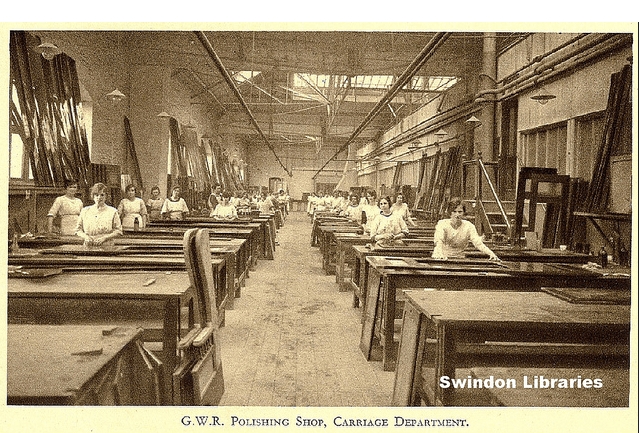
During 1874 and 1875 increasing numbers of women entered the GWR Works employed in the newly created upholstery department. Joseph Armstrong, Locomotive, Carriage and Wagon Superintendent 1864-77, had extended the Carriage Works on London Street and created a separate upholstery department for the employment of girls and unmarried women only. Caroline Shaw started work on November 3, 1875 as a French polisher. French polishing involved stripping back to the basic wood, making good any damage, brushing and sanding and building up the polish again. The women worked on anything made of wood from panels and partitions to toilet seats. Caroline was employed until July 1, 1887 – a week before her wedding on July 9.

Image published courtesy of Local Studies, Swindon Central Library.

Caroline married Henry Whale, a boilersmith, who also lived in Westcott Place, and the couple began their married life at 2 West End Terrace. Caroline never moved far away from Westcott Place, that long road that stretches from Faringdon Road to the bottom of Kingshill. The 1901 census records them living at 152 Westcott Place with their children Carry 12, Mabel 11, Harry 9, Milly 7 and five year old Polly. By 1911 they were at 165 Westcott Place, the home where Henry died in 1930 and Caroline in 1939.

Caroline and Henry are buried with Caroline’s parents Thomas and Sarah Shaw in plot C1107.

You may also like to read:

Celia Morkot – the first woman employed in the Works

Mrs Ormond passed away two years ago

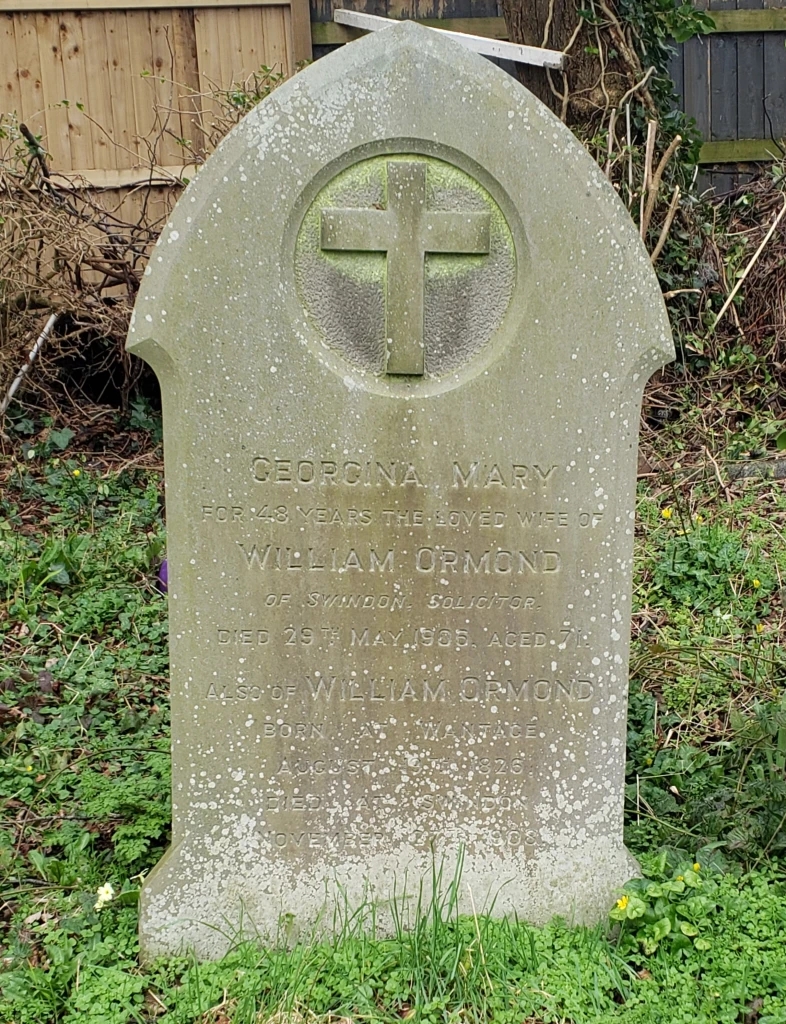
William Ormond, a solicitor, and his wife Georgina lived at a property called the Limes for more than 45 years. The road in which it stands has been variously known as Short Hedge, Horse Fair Street, Devizes Road and is now called Croft Road.

In the late 1880s Marion Ormond was at the centre of the scandalous case of the Christ Church vicar Rev. Newton Ebenezer Howe. Marion 23, one of Georgina and William Ormond’s large family (seven daughters and a son) was a Sunday School teacher and a district visitor.

Rev. Howe, a married man with a young son, arrived in Swindon to take up the post of vicar at Christ Church in 1887. Trouble began almost immediately. In 1889 there was a mishandling of money for the various Church and National School charities of which he was a trustee. Then came the accusations of misconduct involving a church volunteer, Marion Ormond.

The accusations against Howe intensified, yet despite all this Marion continued to visit the vicar and his wife, until eventually it was just the Vicar she was seeing. They began to meet in secret but they had been spotted.

On June 21, 1890 a notice of inhibition (an inquiry into the conduct of the vicar) was served on Howe while the matter was investigated.

For three consecutive evenings protesters gathered outside the vicarage, shouting and throwing missiles. Of course, Howe had made sure he was out of town and Marion had also left Swindon and was staying in Reading.

A public inquiry took place at the town hall in Old Swindon on August 15, 1890 where Howe was charged with adultery and improper behaviour. The hearing took place in a packed courtroom and lasted 5 hours. Marion was called to give evidence during which she became very distressed and had to leave the courtroom to compose herself. Her letter to the court defending Howe was read out.

Following the hearing Georgina submitted a letter to the local press in support of her daughter.

The following letter has been addressed to the Editor of the Devizes and Wilts Advertiser by Mrs Georgina Mary Ormond:

Sir, – In the absence of a word in favour of my daughter Marion in Mr Bucknill’s address to the Commission of Friday the 15th inst I hope you will allow me space in your paper to state in justice to her that she is not the immodest girl she may have appeared. Her visits to the Vicarage were always made to Mrs Howe, by whom, against her parents’ expressed wishes, they were deliberately encouraged, as well as her visits to Mr. Howe at the Vestry room, and the girl’s disobedience no doubt paved the way for all that followed. Mr. Howe represented himself as a cruelly persecuted man, and my daughter believed it her duty to cheer and defend him, trusting him entirely, and utterly unsuspicious of evil in his attentions to her.

The letter read in Court was written impulsively in the hope of freeing Mr. and Mrs. Howe from the imputation circulated against him. In order to make some reparation to her family for the disgrace she has brought on them, and to atone in some measure for her deceit and disobedience, she wished to tell all at the enquiry, and did her best, but the sight of Mr. Howe’s face with its agonised expression (which she saw whenever she looked at the counsel addressing her) so unnerved her that it is hardly to be wondered at if at the moment she failed to give the concluding details of her evidence. Moreover, she had good reason to believe that that part of her evidence would be allowed to be given in writing. In the hope that your readers may see in these details some extenuation of my daughter’s fault, I have troubled you with them.

Devizes and Wilts Advertiser, August 28, 1890.

The case was referred to a Consistorial Court at the Chapter House of Bristol Cathedral where on December 12, 1890 Howe pleaded guilty to all the charges. The Bishop suspended Howe from all duties for 3 years and he had to pay the costs of the hearing.

But amazingly this wasn’t the end of the Rev. Howe. In late 1893 he returned to Swindon where he began another affair and moved Miss Mary Roskyll into the vicarage. He was delivered with a second notice of inhibition and eventually served a 12 month prison sentence with hard labour.

Marion’s last address was the Old Haslings Hotel, Warninglid, Sussex. She died on February 25, 1942 at the Haywards Heath Hospital.

Her mother Georgina died at her home on May 29, 1906 and was buried in Radnor Street Cemetery in plot E8626 on June 1. William Ormond was buried in the same plot following his death two years later.

Lydia Fry – For Services Rendered

Following the horrors of the First World War an increasing number of women began to take their place on the political stage at both national and local level.

Lydia Fry was already serving as a member of the Swindon and Highworth Poor Law Board of Guardians, before standing at the Town Council elections in December 1919.

Lydia was born in 1871, the fourth child and only daughter of agricultural labourer Richard Wilson and his wife Fanny.

She spent her childhood at Buscot, Berkshire but by 1891 Richard, Fanny and Lydia were living at 35 Bright Street in Gorse Hill. Richard worked as a platelayer labourer on the railway and Lydia was a shirt seamstress.

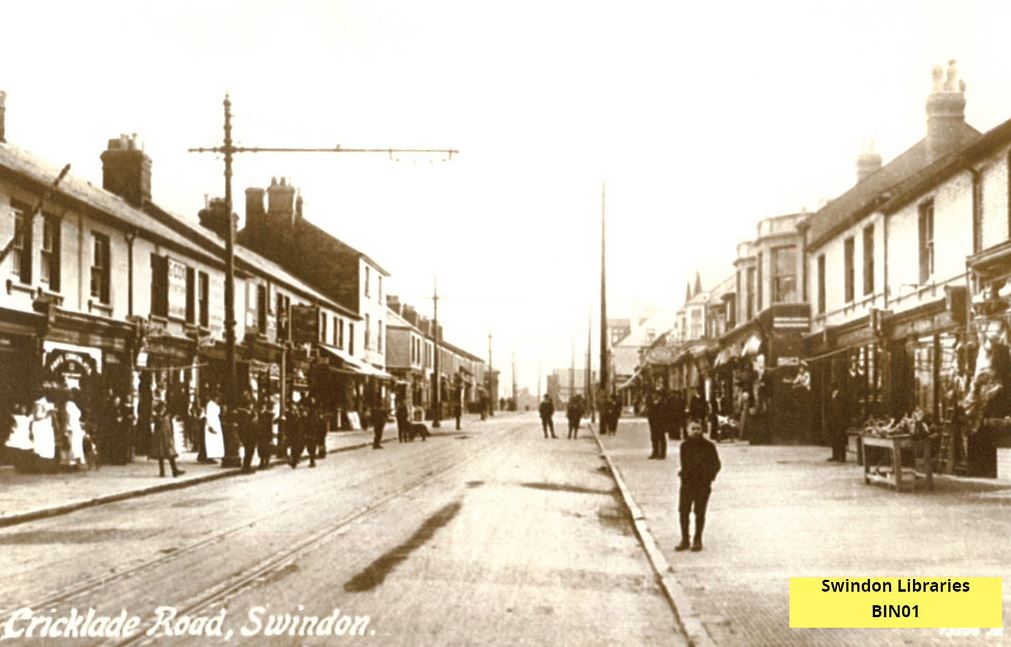
In 1892 Lydia married Silas Fry. Their first daughter Esther was born in December of that year. A second daughter Miriam was born in 1893. In 1901 the family lived at 110 Chapel Street and from around 1911 until the death of Silas in 1925 at 71 Cricklade Road.

Image of Cricklade Road, Gorse Hill published courtesy of Andy Binks, Local Studies, Swindon Central Library.

When Silas died in 1925 the North Wilts Herald published a fulsome obituary detailing his many accomplishments. However, when Lydia died on April 24, 1941 only a brief account of her funeral was published in the same newspaper. There was no mention of her political career or her public service. Fortunately, in 1924 the North Wilts Herald published this account of Lydia’s life and work, written by W. Bramwell Hill.

For Services Rendered

Mrs Silas Fry’s Good Record

By W Bramwell Hill

Public service of all kinds has its times of difficulty, and, frequently, of irritation. You are not your own. You are bought with the price of the lurid light of criticism, half truth, misunderstanding, and misrepresentation. Happily that is not the only state. Such work does on occasion know a transition into the realm of tangible reward, even though the true reward is in the race well run, and the game well played, with patience and imperturbability of fine motive as the fairy hand-maidens of high endeavour. For what they receive in the unalloyed joy of doing a great work, whatever the sphere, multitudes toil on and in their toil rejoice.

To such a band the subject of our brief sketch this week belongs.

Mrs Silas Fry, of Cricklade Road, Gorse Hill, wife of Councillor S. Fry, is a lady well known for a splendid record of faithful work in her own area. Her chief activities have been in connection with the Swindon and Highworth Board of Guardians (of which she has been a member for some 17 years, I believe) and the Cricklade Road Primitive Methodist Sunday School. It is quite possible – yea, it is more than probable – that the energy for the one task has been found in the service of the other. In the realm of the Sunday School she has put in no fewer than 26 years of successive service, and during the recent Sunday School rally held amid the sylvan setting of Bassett Down House (by kind permission of Mrs Arnold Forster) Mrs. Fry was presented with a diploma of honour, the gift of the Connexional Sunday School Union.

Mrs Fry’s record, by the way, is largely confined to one school – Cricklade Road. In young people’s work, in the choir, the Christian Endeavour movement, as a representative to the Quarterly Board, as well as being a most effective speaker, she is well known. In these times of women’s recognition a certain appropriateness is found in the projection of the good record of Mrs Fry, who, in co-operation with her husband, has put in a vast amount of unostentatious service for the public weal.

North Wilts Herald, Friday, June 6, 1924.

Lydia Elizabeth Fry died aged 69 years at 24 Dudmore Road. She was buried on April 27, 1940 in grave plot D808 she shares with her husband Silas.

The much married Martha Leyshon

Sometimes the information on a headstone leads to a story quite different to the one you thought you might find.

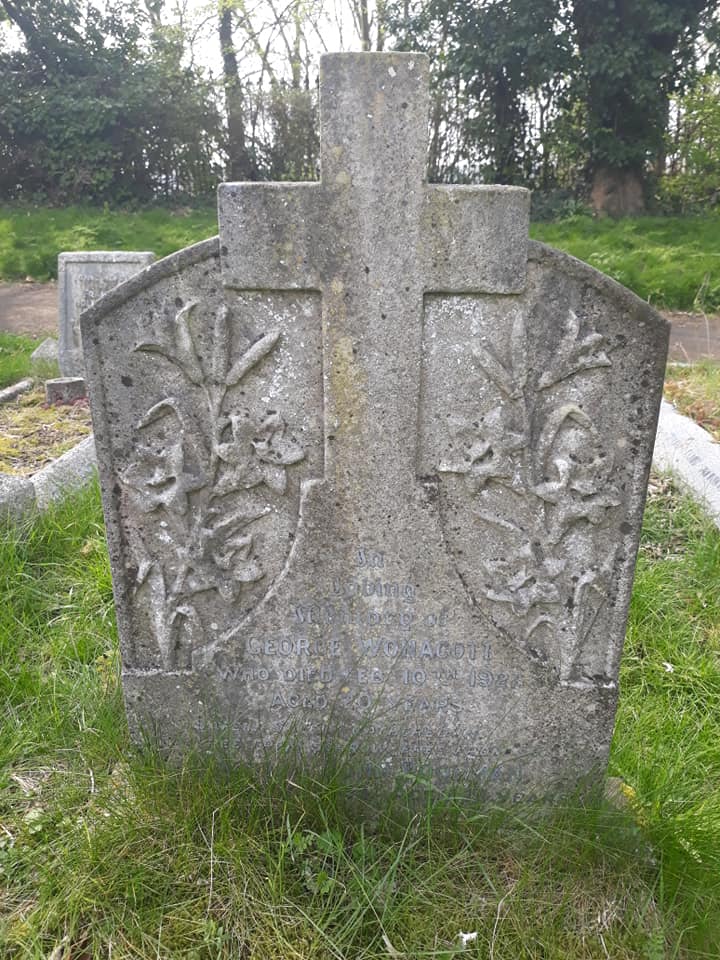
I was attracted to this stylish headstone with its central cruciform shape and Easter Lilies symbolising hope of the resurrection.

The first name recorded on the headstone is that of George Wonacott who died on February 10, 1927 aged just 20 years old. The only way to discover how he died would be to purchase the death certificate, but the cost is prohibitive on a project such as Radnor Street Cemetery with 33,000 burials.

So I turned to the available historical resources to see what I could discover but despite a search of the British Newspapers Archive I was unable to find any reports connected to young George. Next I searched the Ancestry website to find his family.

George’s mother was born Martha Lauretta Leyshon in 1878 in Burbage, a small Wiltshire village in the Vale of Pewsey. Martha was the youngest child of Evan A. Leyshon and his wife Mary. During the intervening years between the 1891 and 1901 census, the Leyshon family moved to Swansea. By 1901 Mary was widowed and living in two rooms at 30 Argyll Street, Swansea with her son William 26, a railway signalman, her 10 year old grandson Edmund Parsons and our Martha, then aged 20 who worked as a general domestic servant.

In 1905 Martha married Wallace Ackland Wonacott, a bottler, and at the time of the 1911 census they were living at 91 High Street, Swansea with their two children Dorothy 5 and four year old George.

The family moved to Swindon and a home in Princes Street but by 1920 Martha’s husband William had died. It’s difficult to imagine how Princes Street looked back in Martha’s day. Built in 1876 and named after Queen Victoria’s grandson Prince Albert Victor, Princes Street was long with shoulder to shoulder terraced housing stretching from Regent Circus to the Whale Bridge.

In the summer of 1920 Martha married the recently widowed John Poolman, a labourer in the GWR Carriage Works. The couple continued to live at 44 Princes Street where John died in January 1933.

Martha didn’t hang about and in the winter of 1933 she married for the third time. Her husband was George Higgins and the 1939 list describes him as a retired engine driver. The couple continued to live at 44 Princes Street, sharing their home with two lodgers, Alfred Andrews, a railway shop clerk and William Barnes, a general labourer in the Works.

Martha died in December 1942 and was buried with her son and second husband in plot D331. She was 64 years old. Her third husband survived her by 16 years. He died in 1958 but does not appear to be buried in Radnor Street Cemetery.

What began as a quest to discover how a young man died turned into the story of his much married mother, Martha Leyshon/Wonacott/Poolman/Higgins.

The Perkins family rediscovered

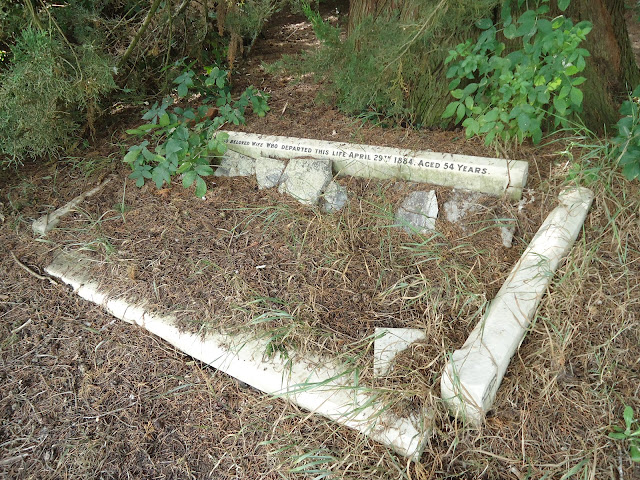
You may think that when a memorial is in this condition that it is impossible to discover who is buried there.

Aha! Not if you have access to comprehensive records such as the ones existing for Radnor Street Cemetery.

The burial registers for Radnor Street Cemetery come in various forms. There is a set of alphabetical indices plus a set of chronological volumes. I was able to check the date closest to Mary’s death on April 29, 1884 and soon found her surname and the date of her burial on May 3. The entry in the burial registers provided her address as 10 Bridge Street, Swindon and, helpfully, that she was the wife of John Perkins. From here I was able to search the grave plot register and discover with whom she was buried.

Then it was back to the Ancestry website to piece together the family history.

In 1881, three years before Mary’s death, the family were living at 10 Bridge Street. John aged 47, was born in Banbury, Oxfordshire and worked as an Iron Moulder in the railway factory. Mary was 51 and was from Burton upon Trent, Staffs. Living with them were their three children, Mary A. 23, Joseph 21 who also worked as an Iron Moulder in the Works, and Emily 16. They also had a year old baby living with them, Seth John Perkins who is described as John’s nephew and was born in Bristol. There appears to be some confusion concerning this baby as he is described on subsequent census returns as son and grandson.

Following Mary’s death, John married for a second time in 1886. The marriage took place in Brackley, Northamptonshire and in 1891 John is still living at 10 Bridge Street with his second wife Sarah 49 and Seth aged 11. By 1901 John, Sarah and Seth are living at 63 Curtis Street.

Sarah died at her home 39 Bathampton Street in February 1911 and was buried with Mary in grave plot A529.

John remained living at Bathampton Street until his death in 1915 aged 81 years old.  He was buried with his two wives.

And I bet they wonder who planted the blooming great tree next to their grave.

Henry John Spackman – boiler inspector

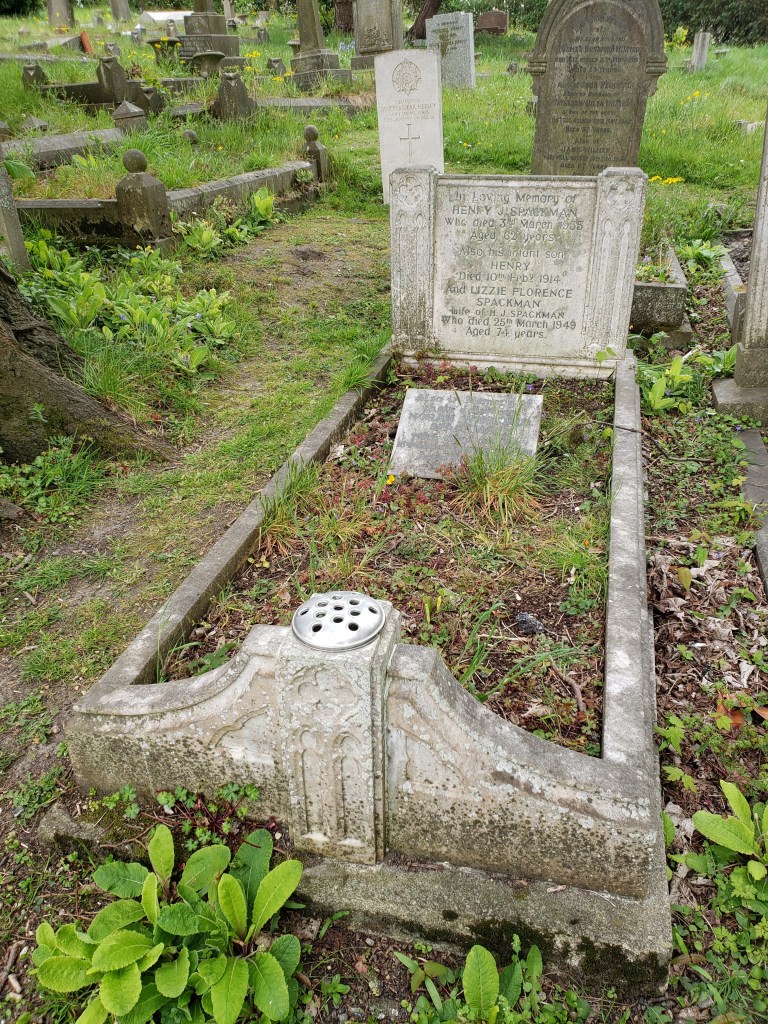
I can’t help wondering what kind of life Lizzie Florence Spackman had and whether she had much influence in the decisions made on her behalf. She grew up in a railway family and married a railway man, but could she have anticipated how her life would turn out.

Lizzie was born in 1874, the middle daughter of William and Elizabeth Richards’ three girls. By 1881 Lizzie’s mother had died and the three young sisters were living with their father and two elder half brothers in Carfax Street. In 1898 she married Henry John Spackman, a Boilersmith. He was 25 and she was 23.

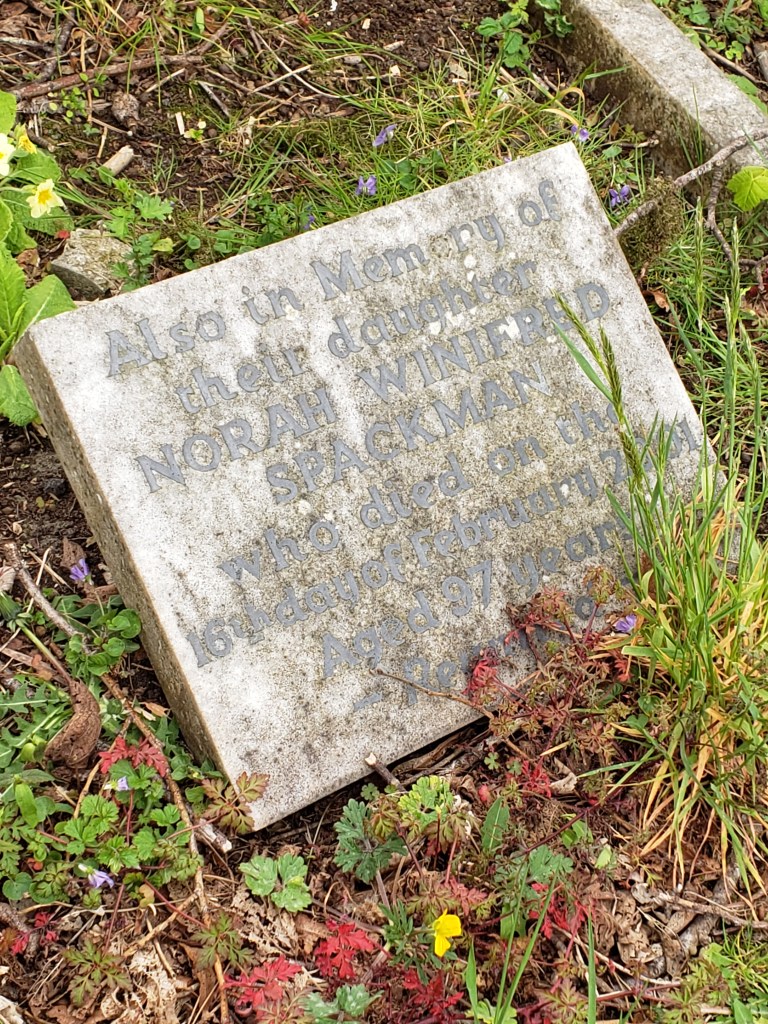
Henry and Lizzie lived at various addresses in Rodbourne and Westcott during the early years of their marriage. Their eldest daughter Dorothy was baptised at St. Marks’s Church on December 11, 1899 when the family lived at 22 Ford Street. Their second daughter, Norah Winifred, was baptised at St. Augustine’s on December 3, 1903 when they lived at 6 Bruce Street. Then at sometime around 1909 the family left for India where their third daughter, Marjorie Johanna was born in 1910 in Madras. Lizzie would live in India for the next 17 years until they returned to 13 Summer Street, Rodbourne in 1927.

What an adventure? Or was it a nightmare? Did Lizzie love India or was she homesick for Swindon? Once back in England the family settled down in Chiseldon, where Henry was obviously busy – but what about Lizzie? Did she enjoy her new life in the Wiltshire village or did it seem grey and lacklustre after the vibrancy of India? What was on the Spackman family menu – roast beef and Yorkshire pudding or curry?

There’s a lot about Henry in the following report, which is fair enough I suppose as it is his obituary. But I can’t help wondering what kind of life Lizzie had.

Photograph of the former railway works taken from the cemetery

A Broken Link,

Death at Chiseldon of Mr H.J. Spackman

The funeral of Mr Henry John Spackman, who died at The Gables, Hodson road, on Sunday, took place yesterday.

Mr Spackman, who was 62 years of age, was employed in the Great Western Railway Works, Swindon, as a young man. At the age of 25 he went to Madras as a boiler inspector and at a later date was appointed chief foreman. He remained in India until November, 1927, when he returned to England to go into retirement at Chiseldon.

Mr Spackman who had taken a great interest in the Chiseldon Hospital Carnival and in all forms of sport, played for Swindon Town on the Croft, and he was the possessor of a Wilts Cup medal. He gained this while playing for Trowbridge Town against Swindon. He leaves a widow and three daughters. Two of his daughters are married, they are Mrs C. Woods-Scawen, of Madras, and Mrs B. Lillie, of Shanghai. His other daughter, Miss Nora Spackman, resides with her mother at Chiseldon.

The funeral service at the Parish Church, Chiseldon, was conducted by the Vicar (the Rev. C. Foster Palmer) and the interment was in Radnor Street Cemetery, Swindon.

The family mourners were Mrs Spackman (widow), Miss N. Spackman (daughter), Mrs Webb (sister), Mr W. Spackman (brother), Mrs G. Tucker (niece), and Mrs A. Hunt (cousin).

Others present at the church were Mr. and Mrs H. Howell, Mr Hargreaves, Mr and Mrs H. Hewlett, Mr A. Hewlett, Mr J. Walters, Mr E. Walters, Mr H. Walters, Mr Phillips, Mr C. Frost, Sergt. A. Cook, Mr R. Culverwell, Mr R. Finn, Capt. Johnson, Mr H. Drewitt, sen., Mr H. Drewitt, Mr. C. Goldsmith (representing the 18 Overseas Club) Mr F. Blackford, Mr. Lucas, Mr H. Cavill, Mr F. Horsington, Mr A.A. Jarman, Mr and Mrs B. Davis, Mr C. Dommett, Mr D. Richards, Mr W. Long, Mr and Mrs W. Oakey, Mrs Beamish, Mr Gilbert Whiting, Mrs Dench, Mr Street and Mr A. Green.

The funeral arrangements were carried out by Mr John C. Liddiard, of New road, Chiseldon.

North Wilts Herald, Friday, 8 March, 1935.

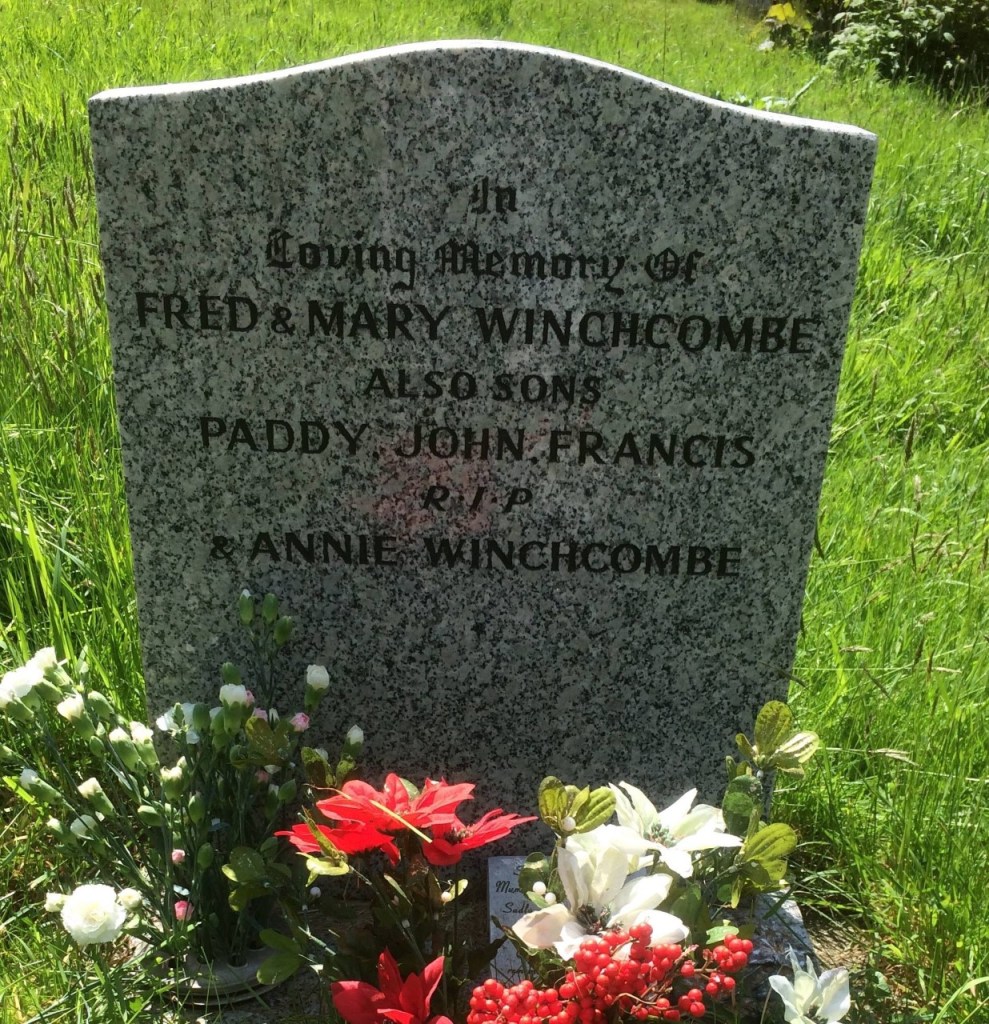
Fred and Mary Winchcombe

This is the last resting place of Fred and Mary Winchcombe who married in 1911 and had a family of six sons and two daughters. Mary died in 1951 and Fred in 1964.

Several years ago their granddaughter, Mary, joined us on one of our walks and kindly sent me the following information about her grandparents.

Fred Winchcombe worked in the GWR and walked in from Chiseldon each day. He and the men he walked in with had the habit of taking a quick pint in the Patriots Arms on the way in, and one day he met up with recruitment men from Kings Troop.

Grandad took the King’s Shilling and joined Kings Troop and was posted to Ireland. He was stationed just outside of Kilkenny and the only watering hole deemed safe for the troops to drink in (he was CofE) was Mastersons Hotel in Kilkenny High Street. This was owned by Mary Morrisey’s uncle, and she worked there. Mary was Roman Catholic.

They met, fell in love and Fred asked her to marry him. Her family were not opposed as long as Fred changed religion. He did, they were married in Holy Rood Church, Swindon.

They started married life in Chiseldon, but as Mary insisted on walking into Swindon every day for Mass, Fred moved them to 10 Union Street, Old Town where they raised their children in a two up two down terraced house with outside toilet and no bathroom.

Mary very much wanted to go back to Ireland to see her own parents and siblings, but both parents died before they ever managed to save enough money for her fare.