Ethel Mary Franklin – undertaker’s daughter

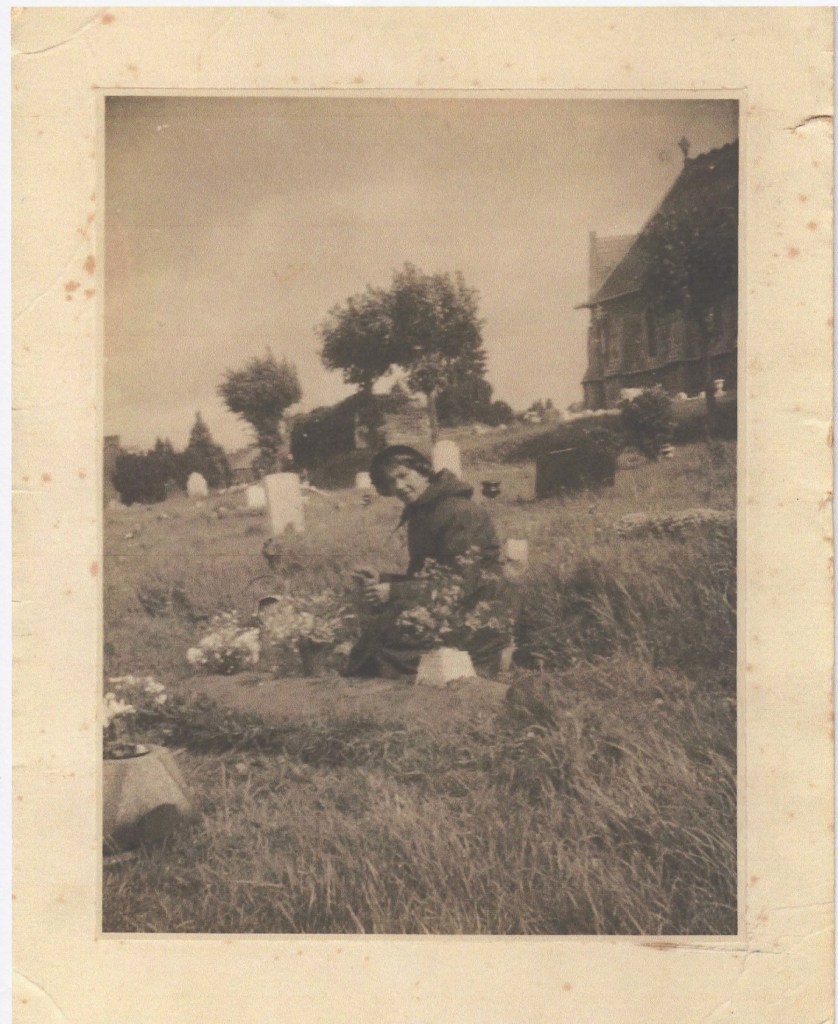
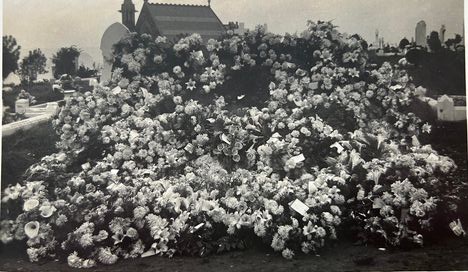
And this week I have received another old cemetery photograph taken at the funeral of Ethel Mary Franklin in 1925 – a beautiful display of floral tributes with the cemetery chapel in the background.

Ethel Mary was born in 1882, the seventh child of Henry Smith and his wife Emma. At the time of the 1891 census Henry was living at 12 Sanford Street with his large family. He would soon leave his job in the GWR Works and set up in business as a carpenter and undertaker. By 1901 he was living in Gordon Road where the firm of A.E. Smith had their premises for more than 50 years.

Ethel appears on the census of that year as an 18 year old pupil teacher. By 1911 she was 28 years old and living with her parents, her sister, her nephew and an elderly, widowed aunt, at 1 Clifton Street. Ethel was working as a school teacher at one of the Swindon Board Schools.

On April 26, 1913 she married railway clerk Arthur Henry Franklin at the Wesley Chapel, Faringdon Road. A daughter named Ruth Gertrude, was born in September the following year and a son Eric Sutton in 1919.

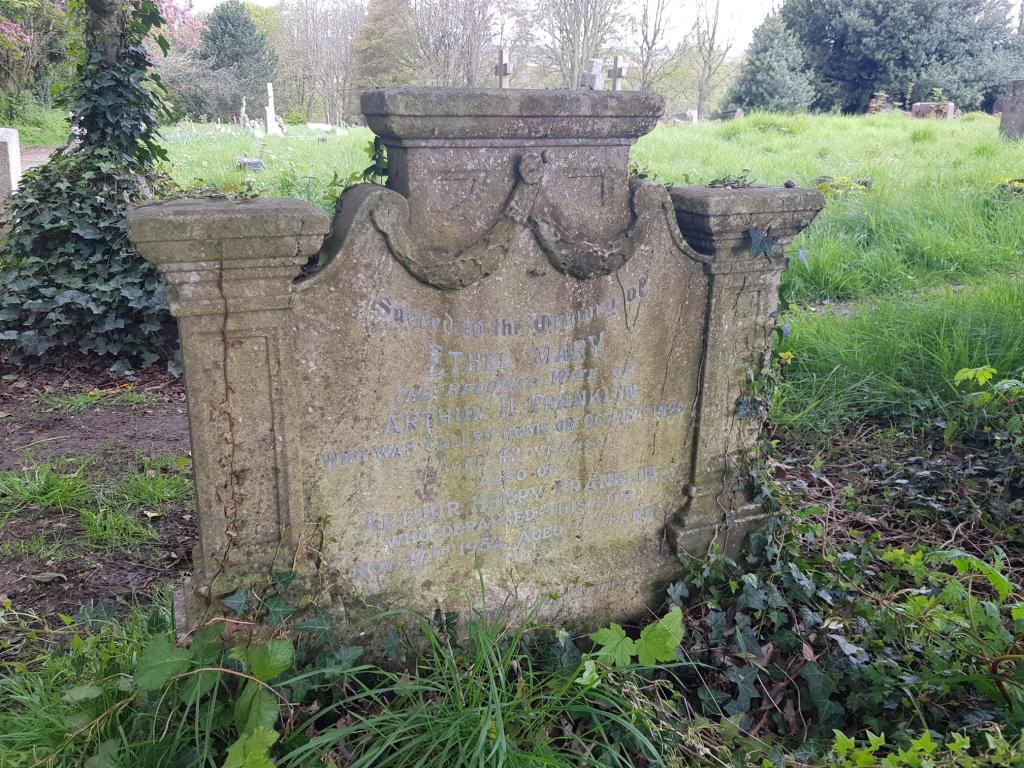
Arthur served in the war as a clerk in the Army Corps and returned safely to the family home at Langleigh, Kingshill Road. Ethel, Arthur, Ruth and little Eric settled down for the rest of their lives, but sadly it was not to be a happy ending. Tragedy struck when Ethel was admitted to the Victoria Hospital in 1925. Infection set in when a swab was accidently left inside her during an operation and Ethel died on October 18, 1925. Her funeral took place on October 22 when she was buried in grave plot D189 close to the grave of her parents.

Arthur remarried and when he died in 1954 he was buried with Ethel. Ruth, their daughter who was just 11 years old when her mother died, went on to become a nurse. Their son Eric became first an architect and then served at Dunkirk and Monte Cassino during the Second World War.

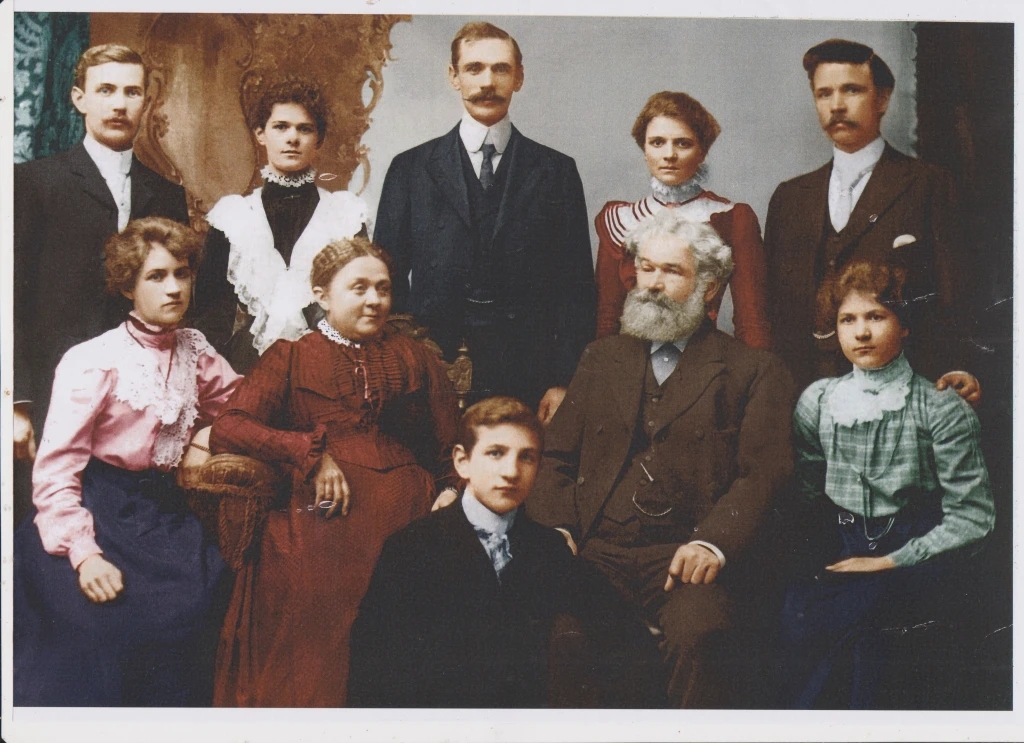
This photograph of the floral tributes on Ethel’s grave was sent to me by Steve, who also supplied the Smith family photograph when he attended one of our cemetery walks some years ago.

You may also like to read:

Henry Smith – undertaker and monumental mason

John and Florence Sterry

Old photographs of the cemetery are rare and always prove very intriguing and we don’t come across them very often. This one was sent to me several years ago by Sue and pictures her grandmother, Florence Sterry attending the grave of her husband John.

John Charles Howard Sterry, a rail carriage examiner, married Florence Nellie Hiscocks in St. Mary’s Church, Rodbourne Cheney on February 19, 1912. They were both 22 years old. Some Sterry family researchers with Ancestry online family trees record that John Charles Sterry served as a Driver in the Royal Field Artilery (RFA) during the First World War. However, a local source informs me that railwayman John was in a reserved occupation and did not go to war. The couple had three sons, Albert born 1914, William 1916 and Ronald in 1920.

At the time the 1939 List was compiled the family were at 129 Albion Street where John and Florence would remain for the rest of their lives. John died in St Margaret’s Hospital 1954 and was buried in grave plot C598. Florence died in 1957 and was buried in the same plot.

When I frst saw this photograph I was surprised at how long the grass was in the cemetery and that everywhere looked rather unkempt. This came as a surprise to me as I was under the impression that these were the years when the cemetery was still busy and where a staff (although probably small) of groundsmen were employed. If anyone has any memories (or photographs) of the cemetery in the 1950s and 60s we would love to share them here.

An extremely interestisng feature of this photograph is the glimpse of a small building in the background opposite the cemetery chapel. This building has long gone but appears on the map of the cemetery as ‘urinal’ – see below.

Mayoress Mary Ann Butler and the Coronation

As the UK prepares for the Coronation of King Charles and his wife Camilla on Saturday May 6, how did it all go back in 1911? The Coronation of King George V took place on June 22, 1911 and it all went very well here in Swindon. In fact, the Mayor Tom Butler said as much when he thanked the people of Swindon in the pages of the Swindon Advertiser.

The Mayor’s Thanks

His Worship the Mayor (Mr Ald. Tom Butler) desires to congratulate the inhabitants of Swindon generally on the success with which the arrangements for celebrating the Coronation in Swindon on Thursday last were carried through, and on the enthusiastic yet orderly way in which the inhabitants generally showed their loyalty and so readily assisted in making the day such an enjoyable one to all concerned, and especially to the old folks and the children.

The Mayor also desires to express his high appreciation of the decorations and illuminations, which were so artistically and beautifully carried out in all parts of the own.

In tendering his warmest thanks to all, he would also like to acknowledge the patience and courtesy with which the police carried out their duties during a long and arduous day.

The Swindon Advertiser, Friday, June 30, 1911.

By the time the newspaper was published Mayor Tom Butler’s much loved wife Mary Ann had died.

The Late Mrs T. Butler

Funeral

Impressive Scenes

The sad death of the Mayoress of Swindon has keenly touched the hearts of Swindon inhabitants, and when the funeral took place yesterday there was a demonstration of sympathy and respect almost without parallel in the town. In the streets, in the chapel, and at the graveside thousands testified by their presence and sad demeanor the sorrow they felt at the great calamity which had befallen the Mayor and his family and also the community at large, and representative men and women of all ranks and professions accompanied the remains to their last resting-place.

The first part of the service was held at Faringdon Street Wesleyan Chapel, where the late Mrs Butler had been a worshipper with her husband for many years. The Cortege left Ramsey House, Victoria Road, shortly after 2.30, the streets being thickly lined with spectators. The official representatives, who had previously met at the Town Hall, included Messrs. L.L. Morse, A.W. Deacon, J. Clark, J. Longland, S.B. Cole, W.H. Stanier, C. Hill and A.W. Haynes borough magistrates), Mr T. Free (Mayor of Marlborough), Mr W. Small (Mayor of Chippenham), Mr W.H. Lawson (Deputy Mayor of Swindon), Mr R. Hilton (Town Clerk), Prebendary W.B. Pitt, Messrs W. H. Williams, W.W. Dickson, J. Henderson, J. Spackman, R.W. Menham, G. Brooks, H.D. Piper, F.W. Marillier, A.E. Harding. T. George, J. George, J.G. Cox, W.E. Morse, A. Church, W. Sloan, W.H. Kinneir, A.J. Gilbert, A. Balch, R. Evans, A.H. Wheeler, J. Powell, J.J. Brown, W. Johnson, W.J. Bray and H.J. Gregory (members of the Town Council) cont…

The service in Faringdon Street Wesley Chapel, where from her youth onwards the late Mayoress had been a constant attendant, was of a painfully impressive character. Long before the cortege had reached the entrance, the side aisles had been filled by members of the congregation, the central aisles having been reserved for the mourners and followers.

In his address the Rev W.J. Chant said – ‘They were in the presence of a very great sorrow, a bereavement which was very mysterious, which was beyond them. Their deceased sister seemed to have been taken away at that particular time when she was very necessary; necessary for the home, for the church and for the town. But they could not raise God’s hands, and could only ask Him to help them to trust in their darkness.’

He continued – ‘It was with pleasure and encouragement that they thought of the kindness of the late Mayoress – ever happy when she was thinking of other people, trying to help them. The Lord of kindness was in her heart. They thought of her evenness of disposition. She was always the same, no matter when one met her. They also thought of the great love which she had for her home, how the heart of her husband trusted in her and her children rose up and called her blessed. They thought of her specially during the last few months, more than ever before, when she had been called upon to serve the town, counting no effort too great, no sacrifice too much, and her efforts culminated in that wonderful day of rejoicing so recent as Thursday week, when she was one of the most active, faithful, and unselfish and devoted workers in connection with the Coronation festivities.’

The cortege then left for the Cemetery, and as the sombre procession moved down the aisle the organist played Handel’s Dead March in “Saul.” While the body was being carried away practically every eye was tear-dimmed.

On leaving the chapel the procession re-formed and proceeded to the Cemetery, where a considerable space round the grave had been roped off. A dense mass of people witnessed the brief concluding ceremony. Supt. Robinson directed the arrangements. The grave was at the east end of the chapel. The coffin of polished English oak had an elm shell and brass fittings, and the inscription was:-

Mary Ann Butler

Born 14 July, 1862

Died 28 June, 1911

The coffin was borne upon a hand bier and was covered with floral tributes. Five mourning coaches followed, the family mourners being the Mayor (Mr T. Butler) and three sons – Messrs. R.W., T.R. and F.G. Butler – Mr Turner (brother of deceased) and Mr W. Watts (cousin). Amongst others following were Mr and Mrs A.G. While. The final portion of the service was said by the Revs J. Rodwell and W.J. Chant. At the last moment the Mayor, who had borne up bravely, was quite overcome with grief.

North Wilts Herald, Friday, July 7, 1911 (Extracts)

Mary Ann was buried on July 3, 1911 in grave plot A1033. She lies with her two young children, Hilda Mary who died in 1898 aged 6 years and Denis Stanley a 3 month old baby who died in 1899.

Florence May Vivash – school teacher

The Swindon School Board formed in response to a growing demand for school places in the rapidly expanding towns of New and Old Swindon. In 1881 the Board began an impressive programme of school building. By 1892 11 schools with 26 departments were up and running with 2 more due to open at Westcott and Gorse Hill increasing the available accommodation to 6,500 children.

In 1894 Swindon Schools were all graded “excellent.” A report delivered by H.M. Inspector on the examinations of Board Schools for 1895 stated that “Queenstown – The infants are in very good order. They have been taught with great care throughout the year, and have made excellent progress.” At Even Swindon School, where extensive building work had taken place throughout the year, the report stated that teaching had been “carried on with considerable difficulty. But the teachers have worked very hard, and, under the circumstances, the infants may be considered to have made excellent progress.”

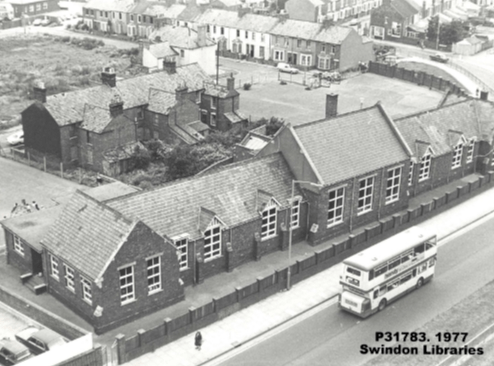
Photo of Queenstown School taken in 1977 and published courtesy of Local Studies, Swindon Central Library

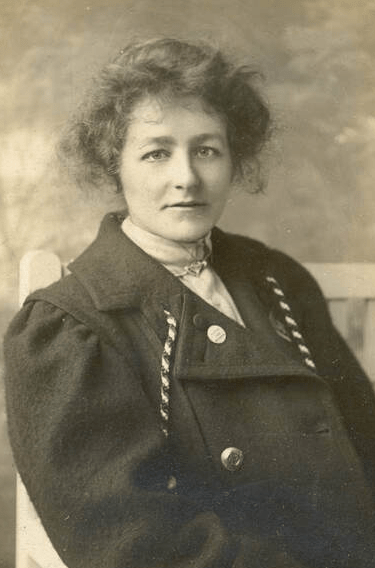
By 1897 there were more than 100 pupil teachers in Swindon Schools, a traditional route into teaching for bright children. Swindon Suffragette Edith New began her teaching career as a 14-year-old. This story is about Florence May Vivash, but there is a serendipitous connection to Swindon’s suffragette.

Florence May Vivash was the daughter of Jacob and Alethea Vivash. She was baptised at St. Mark’s Church on January 7, 1883. By 1891 the family were living at 9 Park Lane – Jacob, Alethea and their three children along with Alethea’s mother, Sarah Ann Bunce.

Florence began her teaching career as a pupil teacher at Even Swindon School. (The original building in Rodbourne was demolished in 2013. A new school with that name opened in 2007). In 1897 Florence passed an exam for Elementary School Teachers at the Swindon & North Wilts Technical School in Geometrical Drawing (Art). She later moved to Queenstown Infant School where she remained until her death in 1909.

Edith New was Assistant mistress at Queenstown Infant School from 1899-1901. Did their paths cross? Edith left Swindon for London in 1901 to teach in the deprived areas of Deptford and Lewisham. She resigned from teaching in 1908 to join the Women’s Social and Political Union and the campaign for Votes for Women. She returned to teaching in 1911, eventually retiring to Polperro, Cornwall where she died in 1951.

I’d like to think that Edith’s work and her involvement in the suffrage campaign were known to Florence. Sadly, Florence was unable to achieve her full potential. She died in 1909 as Edith was about to earn a place in history.

A Young Lady’s Death. – After a brief illness of a month Miss Florence May Vivash, of 9 Park Lane, Swindon, passed peacefully away in the early hours of Tuesday morning at the age of 26 years. The deceased was for some time a pupil teacher at Even Swindon School, and afterwards received two years’ training at the Home and Colonial College. She then became a teacher at Queenstown Schools, where she had been engaged for nearly six years. The funeral took place to-day.

Swindon Advertiser, Friday, May 28, 1909.

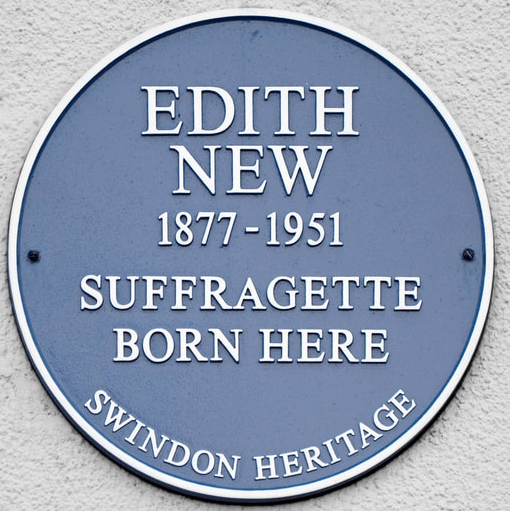
Swindon Heritage Blue Plaque installed at Edith New’s birthplace, 24 North Street, Swindon.

Florence May Vivash, School Teacher, 26 years, was buried on May 28, 1909 in grave plot C1326. She is buried with her grandmother, Sarah Ann Bunce, who died in 1903, her mother, Alethea who died in 1913 and her father Jacob who died in 1917. A baby sister Alice, who died in April 1881 aged 8 months old, is buried in the churchyard at St. Mark’s.

A private, close knit family


The re-imagined story …

I’d walked past 10 Bath Road many times before. It was a pretty little house with a charming wrought iron porch, but it was very neglected. The woodwork badly needed a coat of paint and moss grew in the guttering and obviously hadn’t been cleared out in years. I never saw anyone go in or out, but then I don’t suppose you very often see the people who live in the houses you walk past.

I began training as a district nurse at the Victoria Hospital in 1956 under the supervision of the formidable Nurse Morris. Our first call that Monday morning was at 10 Bath Road.

“This is the home of Miss Mary and Miss Frances Wilton,” Nurse Morris explained. “Miss Frances had a fall several weeks ago and I’ve been dressing an ulcer on her leg.” She paused to look at me. “You’re not squeamish, I hope.”

I thought she was making a reference to the wound I was about to see.

“I’ll not make a very good nurse if I am,” I laughed, full of youthful audacity.

Nurse Morris raised her eyebrows. She wasn’t impressed. She said nothing.

We leant our bicycles against the garden wall and Nurse Morris knocked on the front door. We waited for what seemed like a very long time.

“No one in?”

“Miss Mary is over 80 years old,” she snapped back. I wasn’t making a very good impression. I pulled a face at Nurse Morris, behind her back, obviously.

Eventually the front door with the chipped paintwork opened a crack.

“Nurse, welcome, welcome. Do come in,” a soft voice greeted us.

“Good morning Miss Mary. I’ve brought a student with me today, hope that’s alright with you?” She turned back to me with such a glare, I wasn’t quite sure what I had done wrong this time. “Miss Mary, this is Linda.” I held out my hand and in the dark hallway the smallest, little wizen hand grasped mine.

“How nice to meet you, my dear. My sister and I seldom receive visitors these days.”

Miss Mary, when I could eventually see her in the murky hall, was as neat as a pin; until I looked again more closely. The little bird like figure was dressed in a long, dark dress, stained and stiff with dirt. Her long, white hair was tied up in a neat bun on top of her head but her wrinkled face was engrained with dirt. She had the twinkliest blue eyes and an engaging smile. She must have been a lovely looking young woman.

Now the smell inside the house hit me. It was indescribable. A cocktail of human excrement and cat wee and unemptied bins and something I couldn’t even put a name to.

I looked at Nurse Morris for some kind of explanation, but she clearly wasn’t disposed to give me one.

Miss Mary led us into what had once been an elegant dining room overlooking the front garden, but which now served as a bedroom for our patient.

“Good morning Miss Frances. How is the leg?”

At first I could barely see the old lady lying in the bed, so small was she. If Miss Mary was tiny, Miss Frances was skeletal, her face cadaverous. I tried not to stare, but I couldn’t help myself. I was shocked by the physical condition of these two sisters who were malnourished and filthy, their home dirty, unhygienic and neglected. A cat that had been sitting on the bottom of the bed suddenly sprang into the dark corner of the room where there was a sudden scurrying and a squeaking.

“This is looking much better, Miss Frances,” said Nurse Morris as she began to clean the ulcer on the lady’s shin.

“Would you two nurses like a cup of tea?” asked Miss Mary.

I dare hardly imagine the state of the kitchen, but before I could reply Nurse Morris shot me another warning glance.

“Thank you, Miss Mary, but we had a cuppa with our last lady. I’m fine, how about you Linda?”

“Yes, I mean no, no thank you,” I stuttered.

Nurse Morris maintained an easy conversation with the two women as she worked and soon our patient was settled back against the grubby pillows on the bed.

“Well I think that’s us done for today,” she said. “Is there anything we can help you with while we’re here? Shall we empty this commode?”

Please, please don’t ask me to do that, I thought. And where would we begin. They both needed a bath, the bedclothes needed changing, their clothes need washing and that’s before any attempt was made on the filthy house.

“No thank you nurse,” said Miss Mary with the sweetest, gentlest smile. “We’re just ticketyboo, aren’t we Fan?” She rested her claw like hand on her sister’s skinny shoulder.

The front door had barely closed on us when Nurse Morris laid into me.

“Before you say one word, young lady you must learn to disguise your emotions, especially your disgust. Those two ladies are perfectly aware of the conditions they are living in. They are old, not stupid.”

“But why would you put up with that?” The smell of the house clung to my clothes.

“Because they are proud and they don’t want to ask for help.”

“Someone should sort them out.”

“Have you got grandparents?”

I had and they lived in a tidy little terrace house in Gorse Hill. Was she going to make some kind of comparison?

“And would they appreciate someone barging in and telling them what to do, touching their things and clearing up and throwing things away?”

“No, but …”

“If you are going to be a good district nurse you must quickly learn compassion and empathy.” We pushed our bicycles side by side, back to the hospital.

“They value their independence. Would you take that away?”

“No, but …”

I could not argue with Nurse Morris, but I knew there must be some solution to the ladies’s predicament, some way of providing them with help without robbing them of their dignity. I learnt a valuable lesson that day and have Nurse Morris to thank for my long career in nursing. And of course the Misses Wilton.


The facts …

The imposing monument pictured below marks the grave of the Wilton family. The burial registers record that it covers plots D5a and D6a with six graves reserved in a brick built vault.

Elizabeth was the first to die and the dedication on the prominent face of the memorial is to her. What is interesting is the name of the property that was the Wilton home in 1905 – ‘Old Croft’ Bath Road. Research has revealed that Old Croft, 10 Bath Road was the family home for more than sixty years. In 1901 10 Bath Road was the home of Swindon architect William Henry Read, so unless some renumbering took place in the early 20th century it is possible to trace the house history of this property for almost 100 years.

George Wilton was a butcher by trade and for more than 30 years the family lived over the shop at 58 Fleet Street. He married Elizabeth Townsend at St Leonard’s Church, Broad Blunsdon on October 25, 1870. She was 37 years old and he was 49 so quite a mature couple for a first marriage. Their first daughter Mercy Joanna was born on October 31, 1871, followed by Ruth Edith on November 19, 1872, Frances Elizabeth on March 25, 1874 and finally Mary Townsend on March 15, 1875.

The Wilton family were a very private, close knit unit. The four daughters didn’t marry, didn’t have any children, or nephews and nieces to tell their story. How did they end their days? Mercy and Ruth both died in the 1940s but Frances and Mary lived on into the 1960s and extreme old age. Were they comfortably off, well provided for, well cared for? Were they fit and vital in their last years? Did they belong to clubs and societies? Did they have a wide circle of friends? Is my re-imagined story way off the mark?

George died in 1908 and the Faringdon Advertiser and Vale of the White Horse Gazette published the following obituary.

‘Death of Mr George Wilton – General regret will be felt at the news of the death of Mr George Wilton, which took place at his residence, Old Croft, Bath Road, Swindon on Tuesday morning. Deceased, who was in his 87th year, was born at Oaksey. He was the oldest butcher in the town, and in an unbroken period of about 35 years he conducted a successful business in Fleet Street, retiring a little less than three years ago. Mr Wilton was a purveyor of the old fashioned type, and his excellent judgment and the dependable character of his stock established for him the reputation of being the leading butcher in New Swindon for many years. Apart from his business, to which he was most devoted, Mr Wilton was in no sense a public man, and was, in fact, of a retiring disposition. His wife pre-deceased him about three years ago, but there remain four daughters to mourn a heavy loss. Although burdened by the weight of years, Mr Wilton was in his usual health until Boxing Day from which time the fatal illness really dated.’

All four sisters lived on a private income with Mary appearing to be the only one to have paid employment when in 1939 she was working as a Brewery Cashier.

When Mercy died in 1944 she left £2,611 6s to her sister Mary. Ruth, who died two years later, left more than £3,800, also to Mary. However, when Mary died in 1961 her effects were valued at just £411 19s which she left to the last surviving sister Frances.

All four sisters are buried with their parents.
Lorna Dawes and the Pinnock family

Over the past three days I have been publishing the memories of Miss Lorna Dawes. Lorna was born on March 23, 1931, the daughter of Albert Dawes, an iron moulder, and his wife Mona Fanny Pinnock. Lorna lived in Tydeman Street all her life. I wished I had taken the opportunity to collect her memories of Gorse Hill.

Lorna’s maternal family originally came from Gloucestershire. Her grandparents, Emily Scales and Joseph Pinnock, married in St Mary’s Church, Tetbury on August 5, 1899. Joseph was a bricklayer, the son of Peter Pinnock, also a bricklayer. Emily was a dressmaker, the daughter of William and Anne Scales.

The couple began married life at 4 Haydon Terrace, Poulton Street where their first child was born. Victor Eric Pinnock was baptised at St. Barnabas Church, Gorse Hill. Their second son, Graham Joseph was baptised at St Mark’s on January 21, 1904. Mona Fanny (Lorna’s mother) was baptised at St John the Evangelist, Aylesbury Street (demolished in the 1950s). 111 Beatrice Street, Gorse Hill would be the Pinnock family home for more than 60 years.

Image of Beatrice Street taken around the time the Pinnock family moved into No. 111. Published courtesy of P.A. Williams and Local Studies, Swindon Central Library.

Emily Pinnock died in November 1918 and is buried in Radnor Street Cemetery in grave plot C3541. In 1920 Joseph married Emily’s elder sister Mary Scales. The family continued to live at 111 Beatrice Street – Joseph, Mary, Anne Scales (Mary and Emily’s widowed mother) and the three children Victor, Graham and Mona. Anne Scales died in December 1926 and was buried with her daughter in grave plot C3541.

Joseph Pinnock died in 1959 and was buried on March 3 in grave plot C3541 with his first wife Emily and his mother-in-law. Mary Pinnock died in the Princess Margaret Hospital May 1965. She was 93 years old. Her personal estate was valued at £1,102 and probate was awarded to her two stepsons/nephews Victor and Graham. She was buried in the family plot with her husband, mother and sister. Sadly, there is no headstone to mark the spot.

You may also like to read:

Miss Lorna Dawes and a life ‘inside.’

Lorna Dawes in her own words

Lorna Dawes – in her own words Pt 2

Lorna Dawes – in her own words Pt 3

Lorna Dawes – in her own words Pt 3

Today’s blogpost concludes a series of articles written by Miss Lorna Dawes about her time working ‘Inside’ the GWR Works. These pieces first appeared in the Wiltshire Family History Society newsletter and are published here with the kind consent of Yvonne Neal.

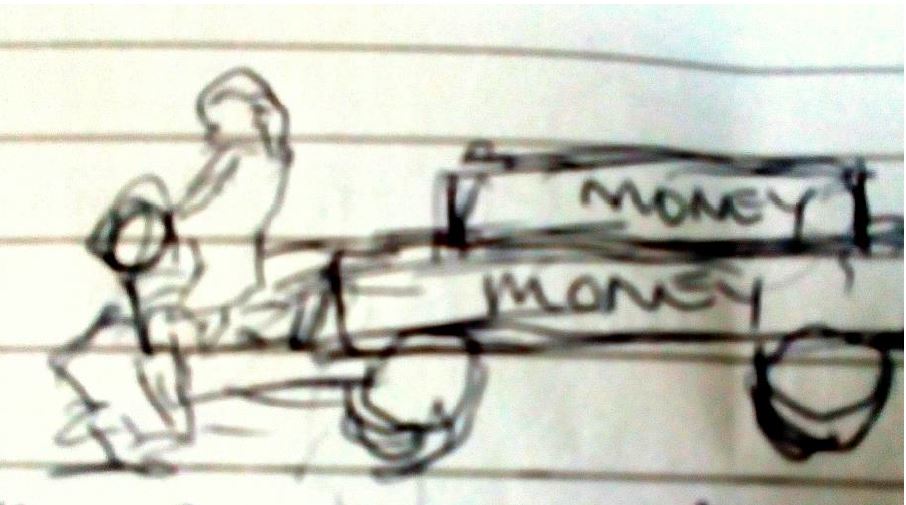
In later years wages were brought from the bank by a man on an open bogie pulling two large boxes contained the cash.

I never heard an attempt to rob.

Lorna’s own sketch

The workmen queued up to be paid but the foremen were paid individually, and I used to go one week to the Loco Works, one week to the Carriage Works, accompanied by a man carrying the box of envelopes and money. We had to go to every shop office and many were upstairs above the workshop. In one workshop on the Loco side the noise almost took your breath away, and had the effect of freezing movement. So much so that you almost couldn’t put one foot in front of the other. In fact, deafness affected quite a few of the workers there. On a wet day, we hated it being the Loco side because of the oil and water hazard. This also applied to the tunnel on a wet day.

Disciplinary hearings were held with all the legal representatives and full reports. I typed some myself.

Long service awards, laid down by years: various items to choose e.g. camera, watch etc. Can’t tell you when this began, but was another of my involvements. I do know there were sometimes upsets because ‘one day out’ meant no award. Large ceremonies took place in the Training School with the Works Manager present.

There was a team of office cleaners. Many were elderly women and some came through the Works from Rodbourne. There was quite a lot of brass to clean! These cleaners did two shifts, early morning, possibly starting at 6.00 a.m., and again in the evening. Seemed a lot – 2 shifts.

There were quite a few cats in the workshops and offices. Unbelievably, a cat had a little of kittens behind a moulding box in the Foundry. The men were really concerned and told everyone to be careful. My Dad was there at the time. When the Works were closed for Trip, it wasn’t unknown for men to gain access to fee the cats.

When the library at the Mechanics closed, the books were sold off and I bought three – about Tibet and Nepal.

In my early days I travelled to work by bus and there were special buses laid on at the Works entrance.

My Dad had no ‘fixed’ bathroom at home and went to ‘the Baths’ after working in the Foundry.

In later years air conditioning fans were introduced in the Foundry but, when my Dad worked there, the only aid, especially on a hot summer’s day, was buckets of water – with something added – BRAN.

Another job I had on Welfare consisted of finding lodgings for men attending Diesel Training School in Emlyn Square. At that time Swindon didn’t have much call for accommodation, apart from hotels, but we found nice places and two were in Beatrice Street.

I guess it was turpentine in those days as we dreaded the window cleaners (rail gang) coming. The smell hung on.

A man from Bristol came to service the typewriters but we had to do our own temporary repairs. One was to tie loose ‘type’ arms with cotton and it did work until the engineer came.

Spring was heralded when an older man messenger, who travelled the Works on a bicycle (such were the distances) came to us in the offices with bunches of pussy willows picked in the concentration yard.

Workers played all sports at the GWR Sports Ground in Shrivenham Road. Teams of clerks and workers against one another. Snooker and billiards were played in the Mechanics.

Weekly repertory meetings were also held in the Mechanics. One group did long spells of different plays each week.

Other activities included:

GWR Male Voice Choir

National Savings Group – a large silver cup was fought over

First Aid Classes and competitions – all lines competed.

Arts and Crafts (Mechanics) from all over the GWR.

GWR Music Festival

Mass x-rays

Blood donations

As for stationery – masses of ‘scrap pads’ were produced and available.

Women were employed in the sewing room, laundry, canteens, casualty centres as well as clerks.

I had to accompany new entrants, and female illness cases, to Park House and ‘sat in’. I also collected water samples and remember one ‘donation’ was in a large-sized HP sauce bottle – full up!

You may also like to read:

Miss Lorna Dawes and a life ‘inside’

Lorna Dawes – in her own words

Lorna Dawes – in her own words Pt 2

Lorna Dawes – in her own words Pt 2

‘At times there were items for sale at the General Stores and I purchased a cycle cape. I missed out on a GWR platform seat from Reading, which sold for £50.’ Read more about Lorna’s life working ‘Inside.’

GWR Memories Part 2

Carol concerts were held in many areas around the Works, including in the Drawing Office. A local band always attended and many office staff joined in.

The main tunnel was white-washed during ‘Trip’ week. Normally there would have been hundreds of people coming and going.

There would be weeks of overtime for Staff Office Typists, as well as clerks, when passes were written for ‘Trip’ trains. When trains departed, there was always a male clerk in attendance to check things, and sort tickets if there was someone without theirs. It did happen.

Long distance ‘Trip’ trains left overnight. We went to Tenby, arriving at 6.00 a.m. at our Lodge where the family would be up and waiting for us, and I still have contacts even after 80 years.

As the train proceeded west and people alighted at earlier stations, we all waved them off and wished them well. It was lovely.

I had nine years on accident reports and claims for compensation. A friend was shocked to see me staggering to my desk with huge piles of paperwork. Such was the volume of cases. As well as Park House and at least two doctors, there were casualty centres each side of the Works, ambulance boxes all over the Works and an Ambulance Inspector checking things as well as running exams. There were also ‘all line’ competitions with mock accidents and wounds.

There was a lovely well-equipped rest room for women in the Main Offices and we had a choice of colours for cloakrooms.

I was among clerks seconded from No. 13 Office to duties at the Works Book Office. There were three serving windows and women were put on the busiest … Bath, Cardiff, Weston, Bristol, Paddington and others.

The photo below was taken c. 1960, of the Works Booking Office Staff and their partners, on an outing to London. The staff were on regular duties at the Booking Office in between normal work in the Staff Office. Regular shifts of a week (?) at a time, but only certain hours.

To be there at the time the hooter blew was really terrifying. One minute it was absolute silence and then hundreds of men rushing out. The noise was over-whelming.

So many tickets issued that the racks ran out, but we had back-up from the men and they also cashed up. One penny out at 8.00 p.m. on a Friday night, and we had to check all again.

At times there were items for sale at the General Stores and I purchased a cycle cape. I missed out on a GWR platform seat from Reading, which sold for £50.

There were coal sales to staff, and also wood which consisted of off-cuts and old timber. It would be delivered, although you didn’t know what would come.

There were tales of a ghost in the tiled corridor of the Main Offices, near to the old part and close to the engine plaque on the outside wall.

Whilst on a welfare job I was partly involved with setting up a trolley service. It had always been dangerous for young girls carrying tea pots up the stairs (there were no lifts) and the hot water urn was also a hazard under one lot of stairs.

In one office we had ‘weigh day’ on Thursdays. All the girls went to a platform weigher used for goods and checked out the large pad.

Office staff were granted a day off and free pass for an outing. In January there would be suggestions for the venue, meals etc. and then the vote. Usually men and women separately. I’ve been to most places on the southwest coasts. If we went to eastern resorts, we went to a show in London afterwards. The men had barrels of beer on the train from Paddington and we travelled home by ‘Mails’ trains 10.00 – midnight, arriving home at 2.00 a.m. One time, two groups were caught at Westbury due to a problem, and I walked up the street at 5.00 a.m.

A group of office staff once did publicity shots of the Blue Pullman train, taken at Shaw sidings. I still have one of the pamphlets with photographs. We even had an actual tea laid on.

Fred Ferris, the Head Messenger, organised an evening trip on the Thames for all the office messengers. I think around 20 of us.

Just about everything had the GWR logo printed on it or moulded for identification, including pencils, paper, punches etc.

There was a ‘Helping Hand Fund’ raised by voluntary donations. At Christmas anyone with children received new toys via the Welfare Office at Paddington, and I delivered locally. One parcel I had to put on a different train, on a very snowy day, and I waited by the open fire in a station office.

The ‘Railway Benevolent Fund’ was raised by members’ contributions. The girls were asked to volunteer for flag days in the town and given sites for two at a time. In return for this couple of hours, we were allowed an extra half-day off.

No 13 Office was on the first floor over the Main Tunnel, so we could se the Wednesday groups of visitors. Also the ambulance, fire engine etc.

to be continued …

with grateful thanks to Lorna’s brother Ken and Yvonne Neal of the Swindon branch of the Wiltshire Family History Society.

You may also like to read:

Miss Lorna Dawes and a life ‘inside’

Lorna Dawes – in her own words

Lorna Dawes – in her own words

Last year I published on this blog an article about Miss Lorna Dawes and her memories of working ‘inside’ (that is inside the GWR Works). Yvonne Neal, of the Swindon branch of the Wiltshire Family History Society, has managed to collate the articles Lorna wrote for that Society’s newsletter and has kindly given me permission to print them here. Yvonne also contacted Lorna’s brother Ken who has supplied this photograph of his sister. So, published here in three instalments is a piece of Swindon’s history – Lorna’s story – in her own words.

GWR Memories – Lorna Dawes

Swindon Railway Works grew over many years and became the site of a fantastic organisation, with many sub-sections and with everything needed to support and organise the volume of work, i.e. possibly more than one locomotive a week. Even had its own window cleaners, clock man and master clocks connection to Greenwich time, ambulance, fire engine etc. all in situ.

As a shy 14 year old, I came for interview with my mother, but really wanted to work in a flower nursery, not that there was any work experience in those days.

I joined an army of boy and girl office messengers, some in the main offices and others in workshop offices, dealing with immediate personnel. I ended up in No. 13 Staff Office (see further information below); the hub of the Works and in control of quite a few events all over the West and Wales. One small element was the letting of railway houses and cottages, which included a crossing cottage in the west, which carried the comment ‘water in churns’. It set me wondering at the possible difficulties.

I’ve realised lately that, whilst someone must have introduced me to my job, I actually ended up running it all myself as regards programming. It was extremely busy and most of it physical as I went to so many areas and hardly stopped. It was a job I loved and led on to all kinds of interests, so I never regretted it and I’ve always had friends.

The whole background was a pride-based one and it wasn’t unusual for new engines to bring an admiring crowd along the lines.

The messengers went on to apprenticeships for the boys and office jobs for some of them also, as well as clerical posts for the girls.

I had already started shorthand and typing privately, and it became a condition of work to proceed so I went to night school three nights a week 7.00 pm to 9.00 pm at the college in Sanford Street, which included Commerce, English and Arithmetic. The work-related ones were sometimes taught by men (Clerks) from the Works. I managed 130 wpm shorthand and really loved it.

The only way I was ever given ‘instructions’ was as part of a bell system for individuals, and I was about four or five rings to go to an officer at post time. For instance:

Early morning:   sorted copies of last night’s post and distributed

Every morning:  Bank bags to Railway Bank on London Street

                                Sometimes called into the Railway Union Group in next street, or Railway Club, Bridge Street.

                                On return every day, collected Time Book at main entrance. This contained information on anyone leaving/returning from outside the Works.

                                Then round the offices obtaining signatures to cover reasons given i.e. dentist, surgery, etc.

                                Then made coffee, individual cups for about 25, and washed up downstairs.

I was responsible for obtaining and distributing dusters, towels, soap, string etc. to ‘my’ office, around 25, and sometimes to General Stores, which was between the Main Offices and the Station. It was a large building with three floors and I had to find the correct location.

The Stationery Office and another office was accessed by crossing all the lines in front of the Engine Shed where engines were being shunted and men cleaning. (Graded – cleaner, fireman and then driver.) The Stationery Office had typing paper, some water-marked, ink pens and also confetti from punch cards!

The Duplicating Office was in the wall of the Body Shop. Here there was the traverser hazard and I quite often had to divert. I had to go there a lot and quite often in a rush with special or urgent notices. Printing was slow and with a hand roller, one at a time, which meant I had to wait around.

At Park House I saw drivers with piles of coloured wool which were used to give vital eyesight checks. Yes!! Also went into the cellar for old files, some were accident originals.

At the Mechanics Institute, I had to transport books to and fro between ‘Officers’ who read and vetted books before they were put on display in the Mechanics Library (may be something no one knew).

I took ‘travellers’ to the Loco or Carriage Works and also interviewees to the Carriage Canteen.

Sometimes I was sent to the Loco Canteen, for clerks who needed sandwiches because they had unexpectedly to work overtime. The Loco Canteen was underground and in electric light.

The Works had its own Telephone Exchange – push/pull units.

The Head Messenger’s office, Mr Bill Ferris, was where the postal boxes were kept.

The Storehouse consisted of three floors and was to the rear of the offices. Very creepy there as it was quite often empty except for files.

I also had to go to the Laboratory at Church Place.

The Drawing Offices were on the third floor, main building – you could see Purton from the landings.

The above were my duties, and places I had to go in the mornings. In the afternoons:

                                Make tea and wash-up.

                                Get post signed and despatched – that was very busy

                                Works Cash Office

                                Visit to the fourth floor – no lift, exhausting!

                                Mileage Office – SPL, toilet for older women in this office!

                                Extra jobs would include advertisers and lardies

A little story: I was sent in search of saccharines (sweeteners) for a desperate officer one day after Bank duty!

These are all rough memories but my work seemed to get more and more interesting all the time.

I spoke before about No. 13 Office. The layout in 1945 was:

Boss of Staff Office – Percy Mills

Deputy – Ted Click – in the corner was my bit of desk and a cupboard

Four typists – I was one here, later. One of the typists was a big fan of WEA Hikers and I joined. Another was the daughter of Louis Page, Football Manager. She took me to the Isle of Man, with two others, when I was around 14½.

Then there were row of Clerks.

More than once I passed F.W. Hawksworth, Chief Mechanical and Electrical Engineer, in the tunnel. My wages in 1945 were 18/- a week. (approx. 90p).

I probably have enough to fill my own book with my very wide GWR experiences and, in fact, Rosa Matheson has used a lot of my information. I once gave an hour’s talk to the Railway Lounge Group.

To be continued …

You may also like to read:

Miss Lorna Dawes and a life ‘inside’.

Miss Beatrice Wall

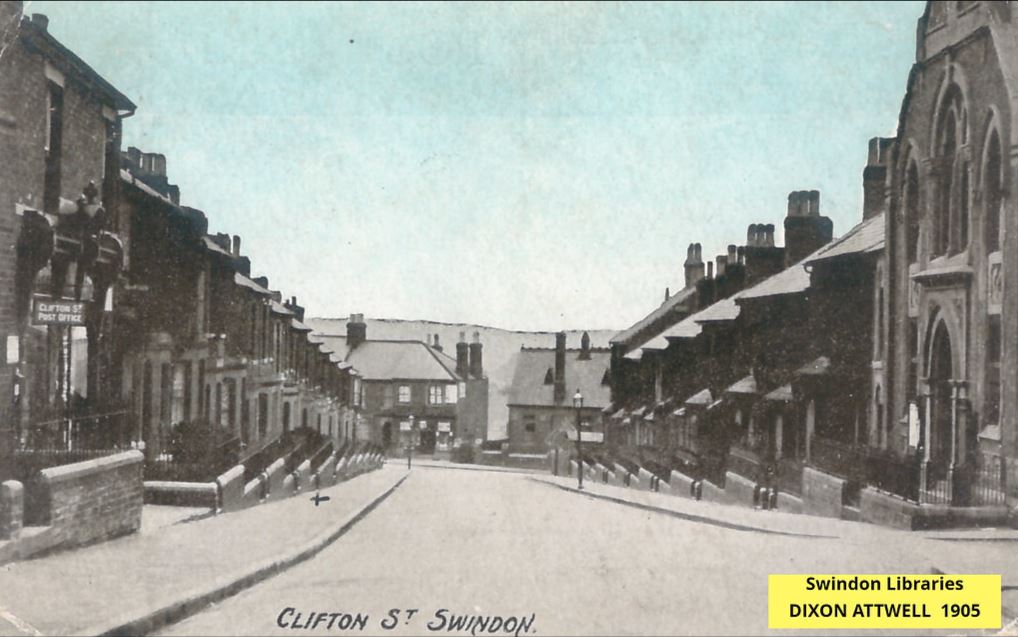
The shop in Clifton Street has had many different owners and many different shop fronts. In 1905 when Sarah Jane Wall was the Grocer and Subpostmistress it looked like this.

Swindon streets built in the 19th century grew piecemeal with each terrace built by a different builder. In 1883 E. Harvey was busy constructing eleven houses and a cottage in Clifton Street. James Hinton was also busy in this area of Swindon and in 1884 father and son firm, C. & G. Pettifer built a house and shop in Clifton Street. Could this be the premises the Wall family were living in at the time of the 1891 census?

Across the road once stood the Clifton Street Primitive Methodist Chapel. The original chapel was built in 1882 on land given by James Hinton. A much larger chapel was built in front of this in 1900, which can be seen in this photo. The chapel was still open in 1970 but was demolished soon after. Next to this are the Clifton Street gates to the cemetery.

This image has an empty alt attribute; its file name is clifton-street.jpg

Published courtesy of Local Studies, Swindon Central Library.

John Wall, Grocer and Dairyman moved to Swindon to run the General Shop in Clifton Street with his wife Sarah Jane and four of their six children. He died in 1899 and was buried in the cemetery just across the road from his shop. Sarah Jane carried on running the business with her two sons George and Charles and her daughter Beatrice.

Beatrice died in 1914 and was buried with her father in grave plot E8596. Sarah Jane died in 1935 and was buried with John and Beatrice.

The late Miss Wall – Residents in that district will miss the familiar figure of Miss Wall, of the Clifton Street Post Office, who has passed away after a long and painful illness.

The deceased lady was the daughter of the late Mr John Wall, who came to Swindon 30 years ago, and for a very considerable period she has been prominently identified with the business connected with the oldest sub-office in the town.

The funeral took place on Monday, the service at St. Saviour’s Church and the last rites at the Cemetery being conducted by the Rev. H.C. Brocklehurst.

A large number of friends assembled, and the principal mourners were: Mr and Mrs Loxwell Wall (Exmouth), Mr and Mrs Frank Wall (Swindon), Mr and Mrs Charles Wall (Swindon), Mr and Mrs Arthur Wall (London), Mr George Wall (Swindon), Mr W. Davis (Stonehouse), Mr V. Broadsmith (Cirencester), Miss E.J. Wall (Exmouth), Miss H.G. Wall (Swindon), Nurse Butcher and Mr. E. Higgins (Swindon).

Mrs Wall and family are very grateful for the loving sympathy extended during Miss Wall’s long and painful illness, and the kindness of neighbours is especially recognised.

Extracts from the North Wilts Herald, Friday, February 27, 1914.

The Clifton Street shop in 2023