Martha Hale – a small life

The re-imagined story …

I bought Martha’s little oak gate leg table that always stood in her hall. I remember a vase of seasonal flowers always stood there; daffodils in the spring, sweet peas in the summer, dahlias and chrysanthemums in the autumn and evergreens in the winter.

It would break her heart to see her home being picked over like this, but what else could he do. Martha’s youngest son Owen took over the farm after she died but now he was retiring and moving away. He was taking just a few personal possessions with him.

His six cows stood mournfully lowing in the stalls as the auctioneer sold off the livestock while the furniture gathered across generations of the Philmore family was examined by neighbours who barely remembered them.

The ten-acre farm on Hook Street had been home to the Philmore family for more than four generations and a hundred years. Martha had been baptised and married in St Mary’s Church and in turn had brought her babies there to be baptised. Her parents were buried in the churchyard and her husband and daughter next to them.

This image has an empty alt attribute; its file name is charles-hale-3.jpg

I sat by Martha’s bedside in the bedroom beneath the eaves of the thatched roof; the room where she had been born. Her life had been a small one, intimately interwoven with farm and church, family and friends. She had barely moved out of the parish throughout her life, but in death she was to be separated from all this. There were no more burial spaces in the churchyard, when Martha died, she was buried alone in Swindon Cemetery.

I never went to the funeral. It was just too sad, I couldn’t bear it. I offered instead to get a tea ready for the mourners. They would need something to revive their spirits, Swindon Cemetery was a bleak place in January. I put a small pot of snowdrops on the hall table, just as Martha would have done.

This image has an empty alt attribute; its file name is martha-hale-lydiard-tregoze.jpg

The facts …

Once part of the Midgehall estate, Creeches, the ten-acre holding close to the Old School House, belonged to the Earls of Clarendon until 1860 when the Clarendon properties at Lydiard Tregoze were sold to Henry Meux, head of the Meux brewery. In 1906 Lady Bolingbroke bought the farm for £995 9s 8d.

Creeches was included in the Lydiard Park Estate sale of 1930.  The farm was described as a very desirable small holding of rich meadow land, the house was built of stone with a thatched roof, six rooms and usual offices.  The farm buildings included a cowstall and yard, stable and cart shed.  The property was let on a Michaelmas Tenancy to Mr A.H. Lopes at a rent of £45 a year.

With no interested buyer, the farm was retained by the St John family until after the death of Lady Bolingbroke in 1940 when what remained of the estate went on the market.  A copy of the sale catalogue bears a pencilled note that the property sold for £1,275 although other sources say it was bought by Amy Woolford for £1,405.

Martha was baptised at St Mary’s on June 9, 1816. She married Charles Hale at St Mary’s on October 18, 1836. The couple had six children, Thomas, Ann, Mary, Charles, Jane and Owen.

After her marriage to Charles Hale the family lived first at Toothill Cottages and then in a cottage next to the Sun Inn at Lydiard Millicent before returning to Creeches to look after Martha’s elderly parents.

By the time Martha died in 1890 the churchyard at Lydiard Tregoze was closed, and the burial ground at Hook not yet opened. Martha was buried at Radnor Street Cemetery in Swindon. Her gravestone is exactly the same design as the one on her husband and daughter’s grave at St Mary’s.

The spelling of the  name of the 10-acre farm on Hook Street, close to the Old School House, varied across the 19th century cemetery. In 1805 it was known as Cruises, in 1828 as Cruches and by 1888 it appears in records as Creeches.

Creeches Farm pictured in the late 19th century published courtesy of Lydiard Park.
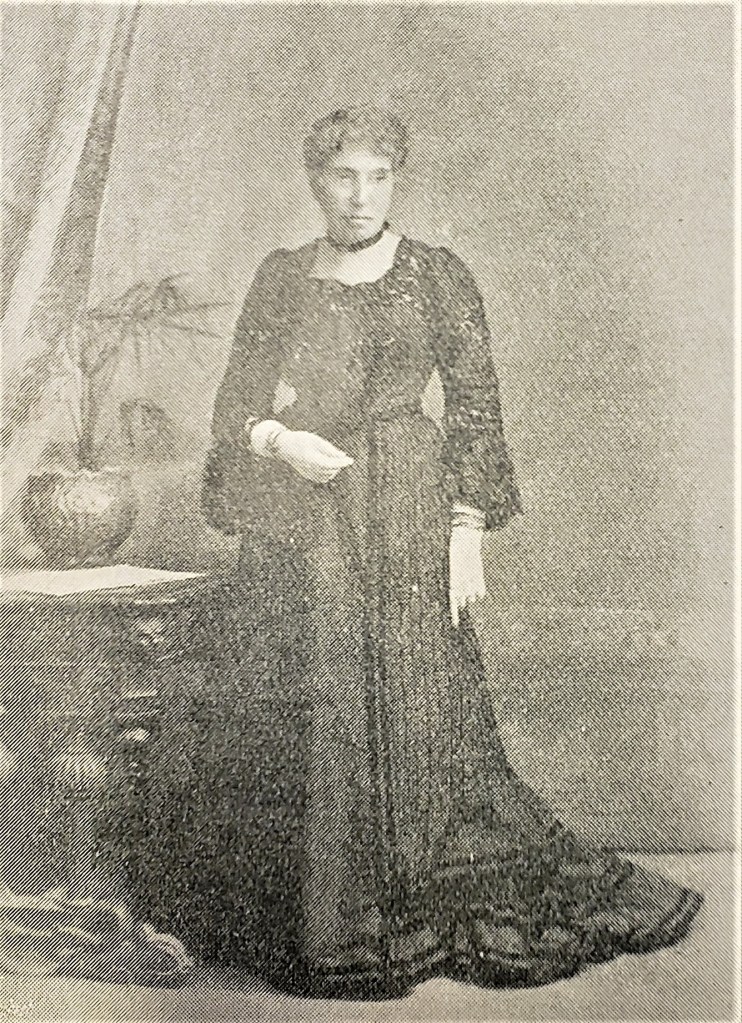
Winifred Edith Morse – founder of the Women’s Missionary Federation, Swindon branch

A comprehensive list of burial dos and don’t in Radnor Street Cemetery was published when the new burial ground opened in August 1881. The cost of a common grave was 5s (25p) but sadly, many working class families could not afford even this and there are numerous public graves in the cemetery where more than one unrelated persons are buried together. The cost rose considerably for a multi occupancy plot and a 9ft (2.7 metres) deep vault cost £4.4s (£4.20) while a brick or boarded grave for a single burial 9ft (2.7 metres) deep cost £1.1s (1.05). It is likely that the graves in the chapel area are vaults or brick lined, which would increase the cost.

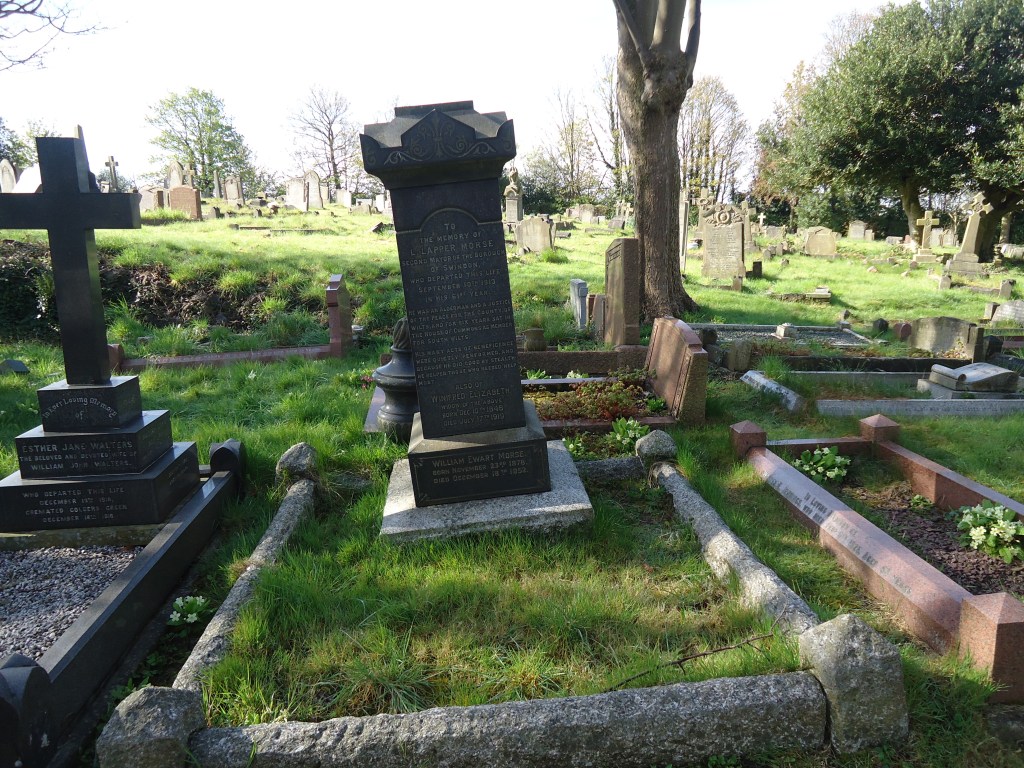
The Morse family grave is surmounted by a magnificent black, granite monument and occupies two plots, 27A and 28A in Section D.

This is the last resting place of Levi Lapper Morse and as the inscription explains he was a Justice of the Peace and served as an Alderman and the second Mayor of Swindon. He was MP for South Wiltshire for six years. He was an active and energetic member of the Primitive Methodists, serving as Circuit Steward of the Swindon II circuit from its formation until his death. He was elected chair of the Brinkworth District Meeting and Vice President of Conference in 1896 and also served as District Missionary Treasurer for about nine years. He was a lay preacher, Sunday school teacher and an accomplished organist. Levi played a prominent role in both the political, commercial and religious life of Swindon and there is plenty of information available about him, but what about his wife?

Winifred Elizabeth Humphries was born on December 10, 1848 the eldest child of Farmer Isaac Humphries and his wife Elizabeth. She grew up at Cockroost Farm, Broad Hinton where her father employed five men and two boys and a 17 year old governess to teach his growing family.

Charles Morse established a family retail business in Stratton St Margaret but his son Levi went on to accomplish far greater things. Levi opened one of Swindon’s first departmental stores, which until the 1960s stood on the present site of W H Smith’s in Regent Street, Swindon.

Levi and Winifred married in 1875 and set up home above the shop in Stratton Street, Stratton St. Margaret where he described himself as a grocer and draper, employing two men, two females and two boys. Winifred’s first child Ella Elizabeth was born in 1876 with seven more to follow. Levi states on the census returns of 1911 that he and Winifred had been married 35 years and that they have eight children, six of whom are still living while two have died.

Winifred supported her husband throughout his political career, but it was within the Primitive Methodist Church that she did most of her work. Winifred had been an active member of the Primitive Methodist Church since before her marriage and as a young girl played the organ at chapel services, often walking several miles from her home on a Sunday morning. The first Primitive Methodist Church in Regent Street was built in 1849. Further structural changes saw the church become the largest of the three Primitive Methodist Churches that formed the Swindon Circuit in 1877. It was also the focal point for the missionary activities of the Primitive Methodists in Swindon in the 1880s and where Winifred was the founder of the Women’s Missionary Federation Swindon branch in 1909.

The Morse family moved into The Croft in 1896, an elegant property that stood in four acres of land with paddocks, flower beds and ornamental trees, a tennis lawn and a fountain. William Ewart Morse, the couple’s son, remained in residence until his death in 1952 after which the house fell into disrepair and was eventually demolished. Hesketh Crescent built in 1957 now stands on the site.

Winifred died on 17 July 1919 following a long illness. Her funeral took place at the Regent Street Primitive Methodist Church with which she had so long been associated. The service was conducted by Rev F.W. Harper assisted by Rev J. Dobson, an old family friend. The Rev Dobson spoke in his address of Winifred’s good works and the loss which the church had sustained by her death.

You might also like to read

Mr Levi Lapper Morse – the end of an era

Regent Street Primitive Methodist Church

Amy Edna Riddick – life long member of the Primitive Methodist Church

International Women’s Day

I couldn’t let International Women’s Day pass without celebrating the life and times of two extraordinary Swindon women – Edith New and Mary Slade – even though, unfortunately, neither of them are buried in Radnor Street Cemetery.

Edith Bessie New was born in North Street, Swindon on March 17, 1877, the youngest surviving child of Frederick New, a railway clerk, and his wife Isabella, a music teacher.

Isabella raised her three children alone following the death of her husband in an accident while he walked along the railway line. Perhaps this example set by her independent mother and the struggles she encountered led Edith to spend her life campaigning for women’s rights.

Edith trained as a teacher at Queenstown School, Swindon before moving to London. Here she joined the Women’s Social and Political Union, becoming one of that organisations earliest militant members.

Following her retirement from teaching Edith moved to Polperro, Cornwall where she lived with her sister Nell. It was here that she died on January 2, 1951. She is buried with Nell in the cemetery there.

For more about Edith’s life and work you might like to read on…

Edith Bessie New

Mary Elizabeth Slade was born in Bradford on Avon on July 12, 1872 one of two children born to cloth weavers Frank and Susan Slade.

By 1901 she had moved to Swindon and a teaching position at King William Street School, boarding with builder’s foreman Edwin Colborne and his family at 64 Goddard Avenue. At the time of the 1911 census she was living at 63 Avenue Road with her widowed mother Susan.

At the outbreak of World War I Mary headed a team of volunteers who collected and dispatched comforts to members of the Wiltshire Regiment serving overseas. However, the dire plight of those soldiers taken prisoner of war soon came to the attention of Mary and her team and they directed their efforts to sending parcels to these men.

For more about Mary’s work you might like to read on… (please note that this article was originally written in 2014).

Mary continued to live in Swindon until her death on January 31, 1960. She died suddenly at her home in Avenue Road. She is buried in Christ Church churchyard, Swindon.