The trail blazing Maria Matthews

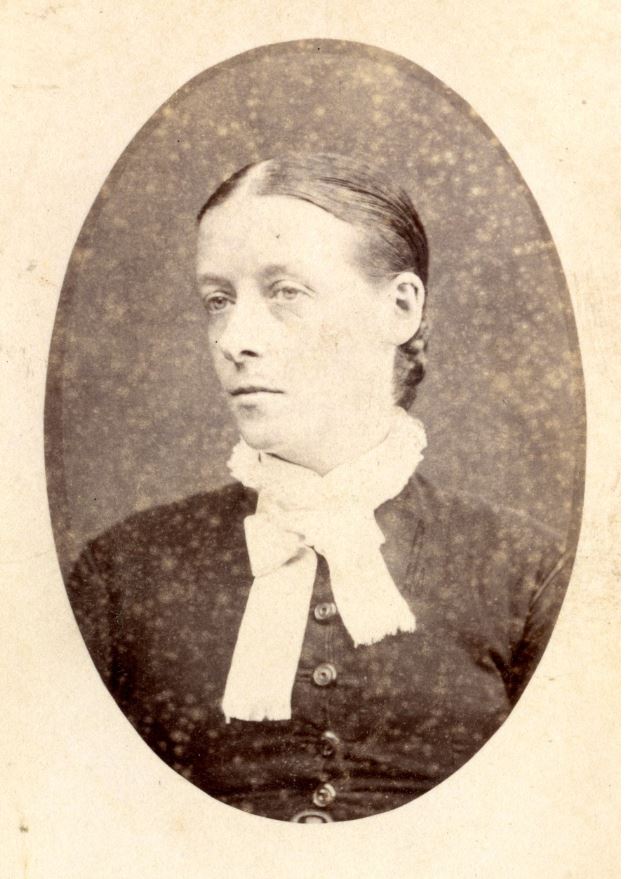
Maria

When Maria Matthews died in 1940 the local press reported that she was the first woman to serve on the Poor Law Board of Guardian but in reality, she was one of four trailblazing women so to do.

The Local Government Act of 1894 brought in reforms that allowed women to serve on parish and district councils. These reforms extended to the election of the Poor Law Board of Guardians and for the first time women were eligible to be guardians.

Elections took place in December 1894 and when the Poor Law Guardians met at the Stratton St. Margaret Workhouse on 2 January 1895 the names of four women were among their numbers.

Maria was the wife of master tailor Jesse Matthews. Together the couple ran two businesses, a tailor’s shop in Regent Street and a newsagent’s business in Fleet Street. Jesse had both a drink and gambling addiction and in 1886 was declared bankrupt. Maria headed their large family and business concerns alone after Jesse’s death in 1905.

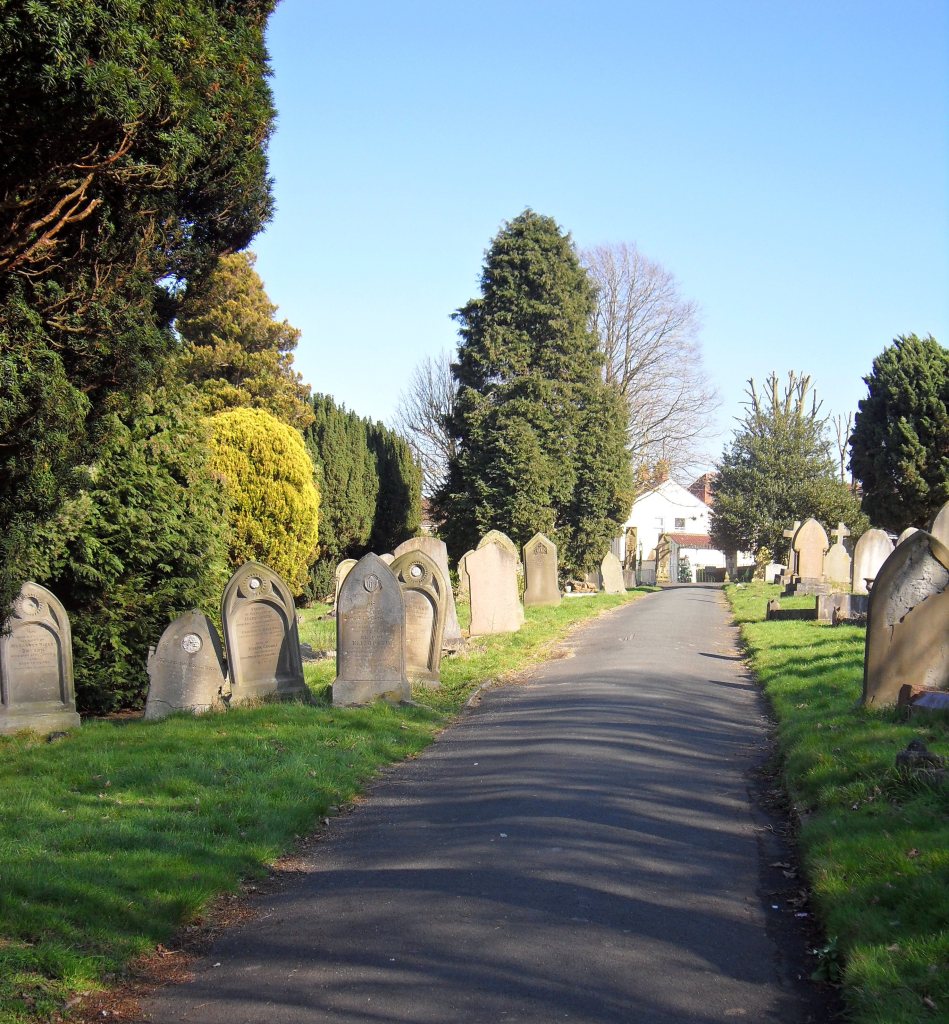
The funeral took place on March 2, 1940 of Mrs Maria Matthews who died at her home in Kent Road aged 97 years old. The Rev Joseph Coombes conducted the service at Mrs Matthews’ former home and afterwards at Radnor Street Cemetery. 

Matthews family

And then I was contacted by Shelley Hughes, a descendant of Maria’s, who supplied some of the above information.

Shelley writes: “I found Maria living with her Mapson (Mother’s brother) aunt and uncle in Wootton Bassett when she was just eight years old in 1841. I believe she was sent to live with them after her father died in 1838. Maria’s older brother (age 10), younger sister (age 6) and their grandmother continued to live with her mother in Cirencester. I just discovered on the 1841 census that Jesse Matthews and his family lived just a few houses away from Maria and her aunt and uncle. The age difference was considerable at the time with Maria age 8 and Jesse age 17, but they must have known each other.”

And in addition to this extra information, Shelley has sent me another fantastic photograph of Maria, Jesse and their family taken in around 1893, just a year before her election onto the Poor Law Board of Guardians.

You may also like to read:

The Matthews family

Elizabeth Williams – a forceful character

Boxing Day 1899

Continuing the story of Elliot Woolford, tenant farmer. December 1899 and Elliot spent his first Christmas at Hook Farm with his brother Rowland.

Tuesday December 26, 1899 St Stephen. Bank Holiday

Got a Gun Licence out for Rowl. 10/-                                        10.0

Gave Mother 10/- for Household Exs.                                      10.0

Sent £13. 15/- to Bank.

Went up to Mr Owen Hales. “Creeches Farm” shooting

Rowl shot two sparrows all told. Could not find a rabbit

Started 2 Blackbirds these escaped unhurt with the exception of a little fright & palpitation.

We spent the evening with them viewing photos of the family and indulging in a few games with the childrens playthings the Party broke up at 11.15 pm all perfectly sober.

Weather Dull foggy & raining all the forenoon

Very quiet Xmas Generally No doubt owing to the War

Image of Creeches Farm taken 1880-1890 is published courtesy of the Friends of Lydiard Park.

The day before Christmas

In 2025 I shall continue my research into the life and times of Elliot Woolford (farmer at Hook Farm) and the parish of Lydiard Tregoze based on his diaries. Selected volumes of the diaries can be viewed on the Friends of Lydiard Park website.

In 1899 Elliot Woolford moved to the village of Hook where he took over the tenancy of Hook Farm, part of the Lydiard Park estate. Elliot kept a meticulous diary recording daily work on the farm from 1899-1940. In this unique archive we learn about changing practices in agriculture as he continued to modernise and develop the farm. He writes about family members, friends and neighbours, social and national events and life on the declining Lydiard Estate.

Read about the day before Christmas 1902. Work carried on as usual but Elliot also records his sorrow at the sudden death of his much loved mother.

Tuesday December 23, 1902

Mother Died to Day at 2.40 o.clock P.M.

Cut 425 Sprouts 17 Bags Savoys etc

I went to Swindon & delivered vegetables received Cash  1 15 0

Bought fish 6d Butter 1/3                 1  9  

Paid Mobeys for their labour 9/- 9/- & 4/-        1  2 0

Gave Ellen 20/- to get mourning             1  0 0

                                                                 £2 13 9

                           2  3  9

Mother died this afternoon at 2.40 Rowl, Aunt Martha, Ellen, Fanny Matthews, & Father was there also Fred Woolford’s wife “Bessie” She died very happy & passed away without pain while in Rowls arms as he was trying to turn her over. We feel her loss to us we were so attached to her for she was most devoted to us all & ever studdying our well being & comfort and could never do enough for us. She asked to see Sam but he did not arrive till after she had been fallen asleep two hours. I went over in the Evening.

Weather Mild

Frances Ann and William Woolford are buried in St Mary’s churchyard, Purton. Image published courtesy of Duncan and Mandy Ball.

Pictured seated are Elliot and his wife Amy with their son Rowlie in the garden at Hook Farm.

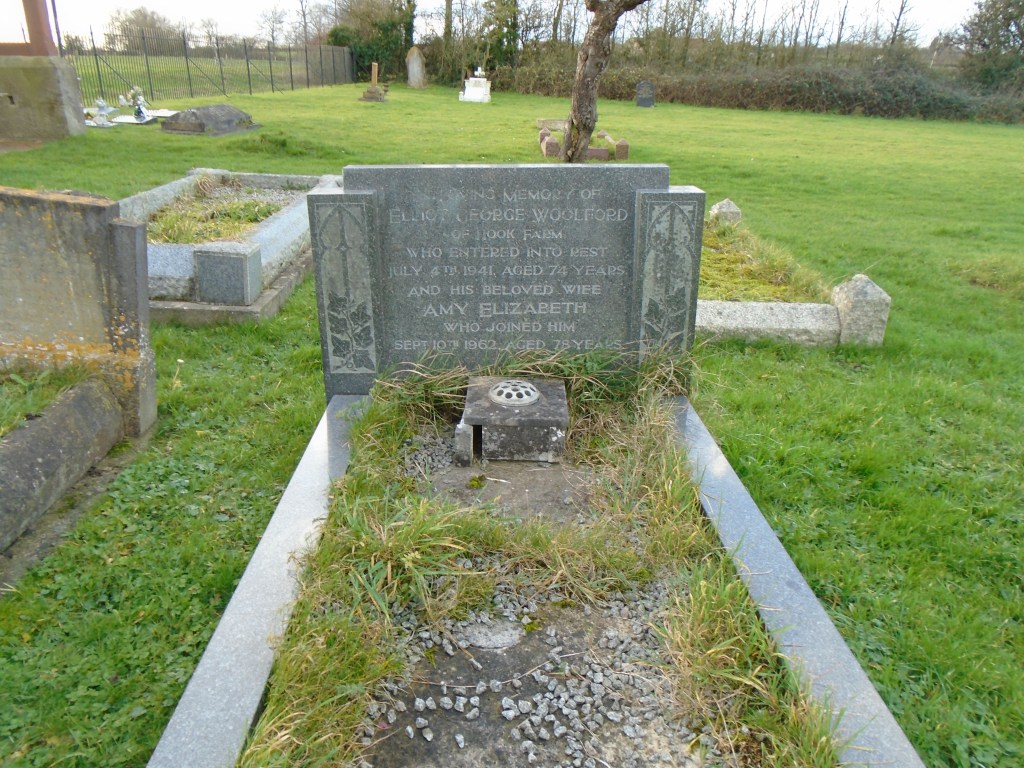
Elliot died in 1941 and is buried in Hook Cemetery with his wife Amy who died in 1962. Hook Cemetery was laid out in 1891 in a field gifted by Viscount Bolingbroke. This field, formerly called Ables, was once part of Hook Farm.

Highgate Cemetery

What better way to spend a wet and windy Friday than to go on a cemetery walk.

I recently went with two new cemetery loving friends on a trip to Highgate Cemetery. For many taphophiles Highgate ranks high on the list of must visit cemeteries and I can confirm it did not disappoint.

Highgate is a cemetery of two halves, bisected by Swain’s Lane. We were met at the entrance to the older, West cemetery by our guide Martin who conducted us on a ‘highlights’ tour and a masterclass in all things cemetery focused.

We first stopped at the grave of James Selby, a coachman who won a £1,000 bet by driving his coach and horses from London to Brighton and back in under eight hours. We marvelled at the enormous Otway vault with its mosaic floor, once visible through a glass topped cover while at the grave of Baronness de Munck, Martin told us the significance of the Pelican engraving on the headstone, symbolic of sacrifice and a mother’s love, and something I had never heard of before.

I never expected we would be able to enter the Terrace Catacombs but Martin unlocked the door and led us into this twilight world of burials. Badly vandalised in the 1970s there was still much to see and learn as we listened to the story of surgeon Robert Liston described as ‘the fastest knife in the West End.’

Amongst the ornate headstones and tombs and massive mausoleums (the Beer Mausoleum is bigger than my house!) the most moving grave for me was that of Highgate’s lost girls. Ten young girls and women, inmates of the Highgate penitentiary, a reformatory for “fallen women” are buried in an unmarked grave and remained forgotten and unknown until historians Rowan Lennon and Sam Perrin researched their stories in 2014. The first of the girls buried in the grave at the cemetery’s furthest boundary was 12 year old Emma Jones in 1862. The last was Agnes Ellis, 29 who died in 1909. The Lost Girls are now included on the official tours where their stories have a new “life”.

We three had our own personal mission – to get to the bottom of a burial that had once taken place in the Egyptian Avenue but whose coffin was reputedly no longer there.

Ellen Medex was the long suffering mistress of Henry, 5th Viscount Bolingbroke whose country seat was at Lydiard Park. Apparently his intention to marry the young Belgian born woman had been thwarted by her sister and it looks like Henry stopped pressing his suit thereafter. The couple sojourned on the continent for awhile before returning to London and a life lived as Mr and Mrs Morgan. They had four children, of whom only one, a daughter Ellen Rose, survived to adulthood before Henry took up with a servant from Lydiard, Bessie Howard. When Ellen died in 1885 Henry was overcome by grief, apparently! He chose the fashionable Highgate Cemetery as his preferred burial place for his “wife” and paid £136.10.0 to have Ellen interred as the Viscountess Bolingbroke. There is, however, no evidence that Henry ever married Ellen and even the entry in the burial registers describes her as “wife” (in inverted commas).

So why did I think Ellen had been removed? Well, someone told me she had. However, Nick at Highgate confirmed that she is still most definitely there and he includes her on his guided walks, which was lovely to learn.

The other mausoleums in the Egyptian Avenue have inscriptions by the door, but of course Henry didn’t do this for Ellen. He probably wasn’t brave enough to declare her status as Viscountess Bolingbroke in so public a place when there were many who knew she wasn’t.

One visit to Highgate is definitely not enough and my new found friends and I want to return. And now we have an ambitious plan to visit the remaining six cemeteries on the “Magnificent Seven” list. Look out Kensal Green – here we come!

The Egyptian Avenue, Highgate Cemetery

View from the Egyptian Avenue, Highgate Cemetery

The Egyptian Avenue where Ellen Medex is buried as Viscountess Bolingbroke

Cemetery map of the Egyptian Avenue – Ellen Medex (Viscountess Bolingbroke) is buried on the second right.

Ellen Medex – published courtesy of the Friends of Lydiard Park

Henry, Viscount Bolingbroke – published courtesy of the Friends of Lydiard Park

Miss Lorna Dawes and a life ‘inside’.

Some years ago, I attended a talk about life ‘inside’ given by Miss Lorna Dawes at the Central Community Centre. The talk was hosted by The Railwaymen’s Association who had been meeting regularly following the closure of the Works in 1986 with guest speakers delivering talks about all things railway related. To those of you unfamiliar with Swindon railway jargon ‘inside’ refers to working in the railway works and it has to be said it was a rare occasion to hear a woman talking about such a subject. The only other woman I had ever heard give such a talk was social and railway historian, Dr Rosa Matheson.

Lorna sat at a table at the front of the hall and without the aid of any photos or slides or whizzy technical gizmos, spoke about her time in the Works. Lorna had a small sheaf of notes in front of her and thus armed she set about informing and entertaining her audience. Of course, she knew all the railwaymen present and exchanged quips and jokes with them during the course of her presentation.

I soon gave up trying to take my own notes and just sat back and listened to this amazing woman.

Lorna was born on March 23, 1931, the daughter of iron moulder Albert Edward G. Dawes and his wife Mona and lived all her life in Tydeman Street, Gorse Hill. She started work as a messenger in the Works in April 1945, aged 14 years old.

Lorna had taken lessons in shorthand while still at school and later attained a certificate for 120 words per minute at evening school. However, her first job as a messenger presented few opportunities to sit down and take notes. She had to quickly learn her way around the vast railway factory, which in the 1940s covered 326 acres. Walking through the tunnel to access all areas was obviously the bane of the lives of the young women where the sludge and filth ruined their stockings.

Most days included a trip to Grays [bakery] in Bridge Street for small lardy cakes for the office staff and to collect the milk and make the drinks to go with those lardies.

Then there was collecting the absences book from the tunnel entrance, delivering the bank bag to London Street, taking messages to Bristol Street, Park House and the laboratory housed in the old school.

She then went on to describe the staff office work, which involved everything from filing accident reports in Park House to duties in the Booking Office and collecting rent owed on the company houses.

She mentioned the double length typewriters used to type charts of salaried staff promotions and wrote: “I enjoyed manipulating lines of names into spaces.” She was also able to fix minor repairs on the typewriters until the mechanic came from Bristol.

Lorna participated in the busy social life of the Works, playing tennis and badminton, representing the offices in tournaments.

Lorna was one of the earliest and most enthusiastic subscribers to Swindon Heritage, a local history magazine published between 2013-2017 with which I was involved. I would have loved to have told her story in the magazine but Lorna wasn’t ready then.

It was with great sadness that I learned about her recent death and regret that I had not captured her memories.

And then I had the good fortune to exchange emails with Yvonne Neal, a member of the Swindon branch of the Wiltshire Family History Society. Yvonne had been in touch with Lorna’s brother and quite remarkably the notes from that talk survive.

The handwritten notes cover more than 11 pages and include not only the big events but the more personal ones too, those of Christmas’s in the offices, weddings, birthdays and babies.

And then she wrote: “My story was due a book “Tempus” pub. but interviewer left post. Didn’t get published.” Perhaps she felt so let down she wasn’t going to go through the performance again with me.

I wish I had had one more conversation with Lorna, to thank her for her support and enthusiasm during the publication of Swindon Heritage and to persuade her to tell her story again. I’ve done my best here.

You may also like to read:

Lorna Dawes in her own words

Lorna Dawes in her own words – Pt. 2

Lorna Dawes in her own words – Pt. 3

Lorna Dawes and the Pinnock family

Elsie Annie Moody – Telephone & Telegraph Operator

The re-imagined story …

In the Spring of 1918 the Spanish flu began its insidious spread around the world, although we weren’t calling it that then – it was just influenza.

Transmitted by the movement of troops and exacerbated by malnourishment and poor hygiene somewhat surprisingly the virus preyed not upon the vulnerable young or the fragile elderly, but upon fit and healthy young adults. My friend Elsie took ill in October of that same year.

Elsie and I began work together in the Telephone and Telegraph Department in the Works on New Year’s Day 1912. We finished our training three weeks later and became qualified operators in the Engineers’ Office. We were both ambitious, but in point of fact there were few opportunities for promotion once inside the claustrophobic telephone exchange. I stayed there until I got married, and to be honest I wasn’t sorry to leave.

During two long years the Spanish flu killed an estimated 20-50 million people – 228,000 in Britain alone. Later it would be revealed that October 1918 would be the month with the highest mortality rate of the entire pandemic.

They published a little piece about Elsie in the Great Western Railway Staff Magazine. They said she passed away as a result of an attack of pneumonia following influenza.

The facts …

Elsie Annie Moody was born on March 25, 1896 the daughter of Caleb Charles Moody a painter labourer in the Carriage Works and his wife Ellen. Elsie was one of only two surviving children from their family of five.

UK Railway Employment Records 1833-1956

Elsie entered the GWR as a Telephone & Telegraph Learner on January 1, 1912. She completed her training on January 22 and worked as a qualified operator in the Engineers Office on a commencing salary of 4/- a week rising to 26/- shortly before her death.

Miss Elsie Moody, of the Staff of the Swindon Works Telephone and Telegraph Office, passed away on October 23rd, 1918, as the result of an attack of pneumonia following influenza. Her cheery disposition had made her very popular with the staff.

Great Western Railway Magazine

Radnor Street Cemetery Burial Registers

Moody, Elsie Annie 22 years 19 Islington Street 28th Oct 1918 (burial) plot E7824.

Elsie’s parents were later buried with her in the same grave.

The Pitt and Osman family – a life in service

Today few occupations can guarantee a job for life but in the 19th century it was quite different. In 1871 there were 1.4 million women in domestic service – 6.5% of the total female population. One in three girls between the ages of 15-20 worked as kitchen maids and housemaids – and one record breaking Swindon family notched up an incredible combined service of over 160 years extending across three generations.

In 1818 James and Elizabeth Pitt moved to their new home, one of three stone built tied cottages in Mannington Lane. An agricultural labourer, James was first employed by tenant farmer Richard Dore King at Mannington Farm and later by Richard Strange who in 1835 signed a 12-year lease on the 237-acre farm.

The Pitt couple had five daughters, Eliza, Leah, Jane, Mary Ann and Martha, all baptised at St. Mary’s Church, Lydiard Tregoze and of whom four were destined for employment at Mannington Farm.

Eldest daughter Eliza worked as a ‘house servant’ for over 24 years. In the 1860s the going rate for a housemaid was £14 per year, all found, the hours were long and the work hard. Leah served the Strange family at Mannington Farm for just two years due to her untimely death at the age of just 18. She died on October 26, 1841 in Cricklade where she was then working in service.  The cause of her death was given as ‘Visitation of God.’

Third daughter Jane put in an impressive 24 years’ service at Mannington Farm.  She began work in 1839, first as a house servant then after her marriage to groom Thomas Osman in 1859, as a dairymaid.  Fourth daughter Martha also began her working life as a house servant at Mannington. By 1871 she had been promoted to Lady’s Maid to Richard Strange’s daughter Julia.

Elizabeth Pitt died in 1871 and her husband James in 1882.  An elaborate and expensive memorial, probably erected by their appreciative employer, marks their grave in the churchyard at St. Mary’s, Lydiard Tregoze.

Julia Strange took over the running of the farm after her father’s death and by 1891 there was a whole host of Pitt descendants employed in the household, including Martha aged 52 and Jane Osman’s two daughters, 21 year old Julia who is a housemaid and Louisa 28, cook. The Mannington Farm tenancy changed hands in the late 1890s ending over seventy years of Pitt/Osman family service to the Strange family.

Julia Strange moved to Didcot. She died at Acland Home, Oxford in 1911 and was buried with her parents in Radnor Street Cemetery in a grave spanning three plots.

Jane Osman died aged 73 at her home, Mannington Cottage, in 1899 by which time the ancient churchyard at St. Mary’s was closed. Her husband Thomas died in 1909 and her sister Martha Pitt in 1909. All three are buried in Radnor Street Cemetery, close to the Strange family grave, neighbours in death as in life.

The Strange family grave

James and Elizabeth’s grave in the churchyard at St. Mary’s, Lydiard Tregoze.

You may also like to read:

The Old Congregational Church

Emily Read – killed in house fire

Today the frontage of number 76 Deacon Street is much altered. It is difficult to imagine the horror of that night in May, 1895 when fire broke out in one of the bedrooms.

It seems likely that the Read family had not long lived in Deacon Street. The census returns of 1891 list William and Emily as living at 38 Eastcott Hill.

Burning Fatality at New Swindon

Sad Death of a Woman

Narrow Escape of her Children

Considerable excitement prevailed in the neighbourhood of Deacon Street, New Swindon, at a late hour on Thursday night, by a fire which occurred at No. 76. It appears that the house is occupied by Mr Wm. Reed, an engine driver on the GWR, and his wife and two children.

Reed left home on Thursday morning to attend to his duties, telling his wife he should not be home again until Friday afternoon (yesterday), he having to go to South Wales with a train. Reed’s wife appears to have retired to rest with her children about the usual hour on Thursday night. By some means at present unexplained, the lamp which was used in the bedroom either burst when it was being blown out or fell over.

The room in which the mother and her children sleeping together was soon ablaze. A neighbour who had gone to bed about ten o’clock says he heard something like the fall or explosion of a lamp, but apparently the first alarm was given by a youth named Tipper, living in Curtis street, who was passing at the time. Assistance was promptly to hand, and ably rendered by Mr Dade and Mr Mercer, each of whom succeeded in rescuing a child by breaking the windows and effecting an entrance into the bedroom.

Firemen Munday and Flowers were on the spot within three minutes of the call being given, but prior to their arrival Mr Mercer had succeeded by the aid of buckets of water hand up to him, in extinguishing the fire although he was nearly choked in doing so by the dense volumes of smoke. The fire was put out in about fifteen minutes.

Mrs Reed, it appears, was in flames, and she ran downstairs with her youngest child. She went into a neighbour’s and there explained that she was in the act of turning down the lamp to blow it out, when it exploded and set the place on fire. The poor woman was burnt in a shocking manner, and though medical aid was sought and everything done for her the poor woman succumbed just before 2 o’clock yesterday (Friday) morning. One of the children was also very badly burnt.

An inquest was held on the body of the unfortunate woman yesterday (Friday) afternoon, at the Rolleston Arms hotel, before Mr Coroner Browne and a jury, of whom Mr Alfred Adams was foreman. After viewing the body and the scene of the (fire) the following evidence was taken.

George Wm Singler said deceased was his step sister and he lodged with her. The last time he saw her alive on Thursday was at seven o’clock in the evening. He was away from home when the fire occurred. He identified the bottom of the lamp produced as the one deceased always used to take upstairs with her when she went to bed.

Thomas Mercer, living next door to deceased, said that between 9.30 and 10.30 the previous evening, he was in bed when he heard a cry of “Fire”. He got out of bed and went downstairs. He got up outside the house and rescued one of the children out of the cot in the bedroom, bringing the child through the window. He could not see deceased. The room was all in flames. He called for water and put the fire out. There was one other child in the room. He heard a lamp burst just before he heard “fire” called out. The fire only lasted about a quarter of an hour. He did not know whether the lamp fell or was knocked over. The mother and youngest child had gone when he got in at the window. The fire was nearly out when the fire brigade arrived.

Sarah Beamish, living in the same street, said she was at her gate and heard something burst. She ran to the gate, and Mrs Read then ran down stairs. The door was locked, and they could not force it open. Some men broke the window and she got through. Deceased was in flames, but was burning round the neck only. Deceased walked into witness’s and said she turned the lamp down to blow it out when it exploded. She repeated this statement several times. Deceased thought the lamp was turned too low; it was not the blowing that made it explode. All her clothes were burnt off. By the foreman: It was not more than five minutes after the explosion that Mrs Reed was outside. She then sent for medical assistance, but she died at 1.50 a.m. that (Friday) morning. Both children were brought out of the bedroom window. Witness said everything was done for deceased that could be done.  Her husband (Mr Reed) left at 4 a.m. on Thursday, and would be back until that (Friday) afternoon.

The Coroner adjourned the inquest until Wednesday next, to enable an analysis of the oil to be taken and obtain the flashing point of same.

The Swindon Advertiser, Saturday, June 1, 1895.

Emily Read was buried in Radnor Street in plot B2426 on June 3, 1895. She lies in a public grave with two others, most probably, unrelated people.

William married the widowed Mary Jerome four years later. The 1901 census finds them living at 19 Gloucester Street with Mary’s 23 year old daughter, Seline Jerome and William’s two little girls who had survived the blaze, Winifred Emily, 11 and Elsie May, 9.

*Read is misspelt as Reed in some instances.
Freda and Irene Dening – winners of the Brunel Medal

The re-imagined story …

I always knew those girls would do well, especially little Irene. She was always so attentive and eager to learn.

Irene Dening

The turn of the century was an exciting time to be a woman; plenty of new opportunities to be had and women everywhere were pushing the boundaries that had constrained them for too many years.

I began my pupil teacher training at Queens Town Infants School in 1891. Among the girls who joined with me was Edith New who would go on to play a significant role in the Votes for Women campaign with Mrs Pankhurst and her daughters.

Queens Town School opened in 1880, an impressive red brick building built alongside the old canal. Perhaps not the most salubrious of settings, but the school served the Queens Town community well. By the time I began my pupil teacher training there ten years later a girls’ school had been built on the site.

However, there were still anomalies in the teaching profession. Women teachers who taught infants and girls were paid less than men who taught boys, an inequality that Miss New would later campaign to change. But the Swindon School Board was a progressive organisation that set high standards of which young Freda and Irene took best advantage.

When we gained our teaching certification Miss New moved to London, but I stayed closer to home. I followed the Dening sisters careers with great interest. So many of the girls I taught did well, but perhaps none more so than Freda and Irene Dening. I always knew those girls would do well, especially little Irene. Always so attentive and eager to learn.

Freda Dening

The facts …

Freda and Irene were born into a railway family. Their father Richard was a steam engine fitter and along with their brother Henry, the three children were all born in Swindon and grew up at 61 Hythe Road.

Freda entered the service of the GWR in 1912 when she was 15 and Irene joined the workforce in 1914 when she was about the same age.

Freda began work in the statistical section of the engineer’s office at Marlow House and was one of the first girls to be employed in the clerical department of the Swindon Works. She studied shorthand and typing at Swindon College, going on to become a shorthand typist in the Works. But her ambition didn’t stop there. She went on to study for three years covering accounting and business methods, the law of carriage by railway, the basis of railway rates and charges.

Her sister Irene was equally ambitious and worked as secretary to the Stores Superintendent. She also went on to study and both women won the prestigious Brunel Medal.

The Brunel Medal was awarded to Students in the railway department of the London School of Economics who, in not more than four years, obtained three first class passes in examinations held in connection with courses approved for the purpose.

The women’s elder brother Henry was also awarded the Brunel Medal, so they were a pretty extraordinary family.

In an interview with the Swindon Advertiser Freda said:

“I really loved my job and it opened many doors to opportunity that my sister and I would not of otherwise had. There were very few women in the railways in those days and it was a fascinating place to be.”

But there were sacrifices to be made. Neither women married nor had children. Of course, this may have been by choice. These days an ambitious woman would probably expect to be able to have it all – as an ambitious man can!

Freda retired early to care for her elderly parents while Irene had a career that spanned nearly 45 years.

Both sisters ended their days in the Cheriton Nursing Home. Irene died on February 25, 1982 aged 81 and Freda on March 18, 1994 aged 96. Their cremated remains are buried here with their parents.

My thanks go to Dr Rosa Matheson who first drew my attention to the Dening sisters in her magnificent book The Fair Sex: Women in the Great Western Railway.

Harriett Annie Veness – political activist

Although the Liberal dominance nationally was on the wane in the last decades of the 19th century, Swindon remained a Liberal stronghold and a hive of political activity with women playing an active role. One such woman was Harriett Annie Veness.

We might consider the term feminist to be a modern one but the word first came into usage in 1852 and Annie Veness was an exemplary role model, demanding women’s rights throughout her lifetime.

Annie was born in Macclesfield, Cheshire in 1869, daughter of Thomas Veness, a bricklayer and mason, and his wife Harriett. The family moved to Swindon in the early 1870s and appear on the 1881 census living at 30 Sheppard Street. Annie cut her proselytizing teeth supporting her parents with their work in the Church of England Temperance Society, later becoming honorary secretary of the British Women’s Temperance Society.

Annie joined the Swindon and North Wilts Women’s Liberal Association upon its foundation in 1893, becoming the first Honorary Secretary, a role she fulfilled for more than ten years. Neither did she restrict her campaign work to the Swindon district but travelled across the country canvassing in elections in her role as organizing secretary for the Women’s National Liberal Federation. She was an enthusiastic public speaker, described as giving a “spirited address” in Ebbw Vale whilst speaking for “nearly an hour” in Chelmsford

Following her mother’s death in December 1897 Annie and Thomas continued to live at 30 Sheppard Street where they employed a 15 year old domestic servant, Janet Hinder. Her three brothers Thomas, Alfred and Reginald would all emigrate to the USA.

Annie’s political campaigning appears to have come to an end in around 1908 when she resigned from the Women’s National Liberal Federation. Annie and her widowed father moved to Worcester where Annie got a job as a clerk in the Women’s Department at the Employment Exchange. At the time of the 1911 census Thomas Veness was a patient in Birmingham’s General Hospital while Annie stayed at the Cobden Hotel to be close to her father. Following a lifetime of independence, eventually and inevitably Annie was forced to accept the traditional female role as carer for her elderly father.

Thomas died on May 21, 1920. His body was returned to Swindon where he was buried with his wife in Radnor Street cemetery. After her retirement, Annie also returned to Swindon and a home at 59 Drove Road where it was recorded that she did “quiet, good work in the town in the Liberal interest and the temperance cause.” It is sad to think of the passionate, bold speaker reduced to quiet, good work.

Annie died at the Victoria Hospital on October 31, 1936, her life and death recorded in an obituary published in the Swindon Advertiser where it was commented on that “link with the days when Swindon was a strong Liberal constituency is snapped.”

The funeral service took place on November 4 at the Baptist Tabernacle followed by interment in the cemetery. Annie was buried in plot E8097 with her parents where today a fine headstone lies flat on the family grave.