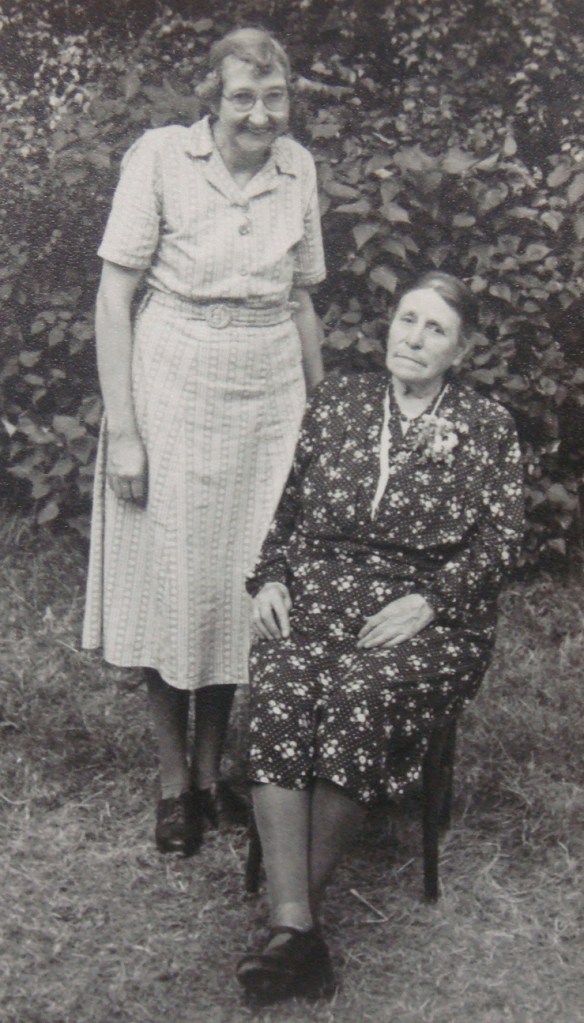
I had long wanted to find the grave of Mary E. Slade who died in 1960. I eventually discovered she was buried in the churchyard at Christ Church, but where …
The Swindon Committee for the Provision of Comforts for the Wiltshire Regiment was formed in 1914. More than thirty years later Mary Slade and Kate Handley would still be supporting the soldiers who had survived the horrors of the Great War and the families of those who hadn’t.
Mary Elizabeth Slade was born in Bradford upon Avon in 1872, the daughter of woollen weavers Frank and Susan Slade. Mary and her brother George grew up in Trowbridge but by 1899 Mary had moved to Swindon and a teaching position at King William Street School.
At the outbreak of war Mary headed the team of mainly women volunteers who were based at the Town Hall. Their work was much more than despatching a few cigarettes and a pair of socks to the Tommies on the Front Line and soon became a matter of life and death as the plight of the prisoners of war was revealed.
“When letters began to arrive from the men themselves begging for bread, it was soon realised that they were in dire need, and in imminent risk of dying from starvation, exposure and disease,” W. D. Bavin wrote in his seminal book Swindon’s War Record published in 1922.
The provisions the prisoners received daily was a slice of dry bread for breakfast and tea and a bowl of cabbage soup for dinner.
“Had it not been for the parcels received out there from Great Britain we should have starved,” said returning serviceman T. Saddler.
The team of volunteers co-ordinated supplies and materials with the support of local shopkeepers, schools and hard pressed Swindon families.
In the beginning the committee spent £2 a week on groceries to be sent to Gottingen and other camps where a large number of men from the Wiltshire Regiment had been interned following their capture in 1914. By October 1915 the committee was sending parcels to 660 men, including 332 at Gottingen and 152 at Munster. And at the end of July 1916 they had despatched 1,365 parcels of groceries, 1,419 of bread comprising 4,741 loaves, 38 parcels of clothing and 15 of books.
As the men were moved from prison camps on labour details, the committee adopted a system of sending parcels individually addressed. Each prisoner received a parcel once every seven weeks containing seven shillings worth of food. More than 3,750 individual parcels were despatched in the five months to the end of November 1916.
But their work did not end with the armistice on November 11, 1918. Sadly, the soldiers did not return to a land fit for heroes as promised, but to unemployment and poverty. Mary Slade continued to fund raise for these Swindon families through to the end of the Second World War.
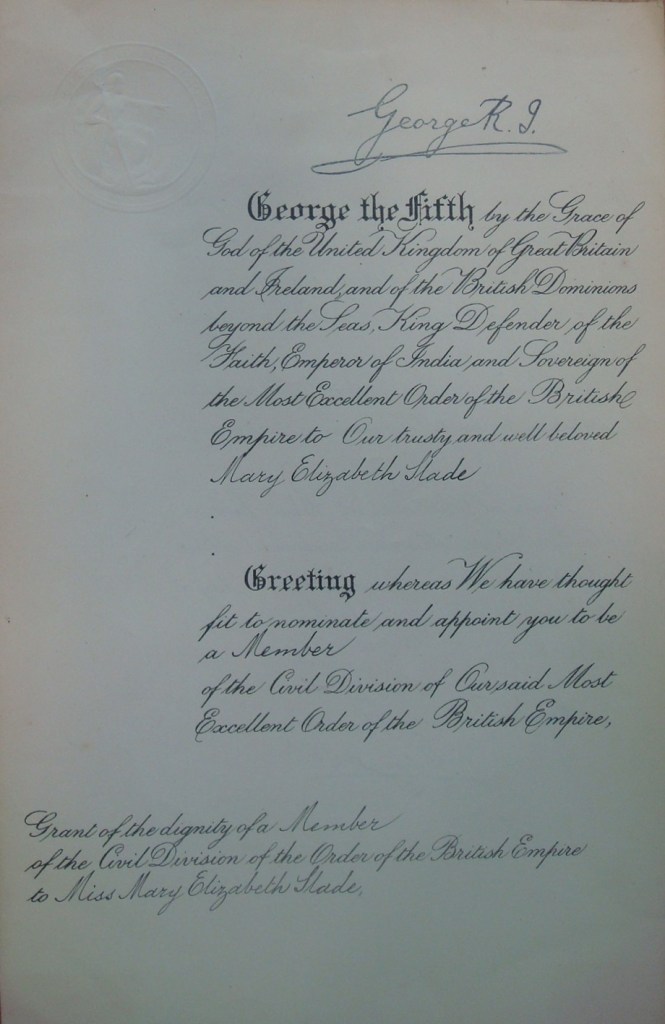
On July 25, 1919 Mary Slade and Kate Handley represented the Swindon Prisoners of War Committee at a Buckingham Palace Garden Party and in 1920 Mary was awarded the MBE.
Mary Slade died suddenly on January 31, 1960 at her home, 63 Avenue Road. She was 87 years old. The previous evening she had been a guest at the choir boy’s party at Christ Church.
Yesterday Noel and I visited the churchyard at Christ Church to pay our respects at the grave of our friend Mark Sutton. As we passed the Rose Garden on our way out I looked down and there was a plaque dedicated to Mary E. Slade. It was through Mark’s lifelong study of the Swindon men who served in the First World War that I first heard the story of Mary E. Slade.
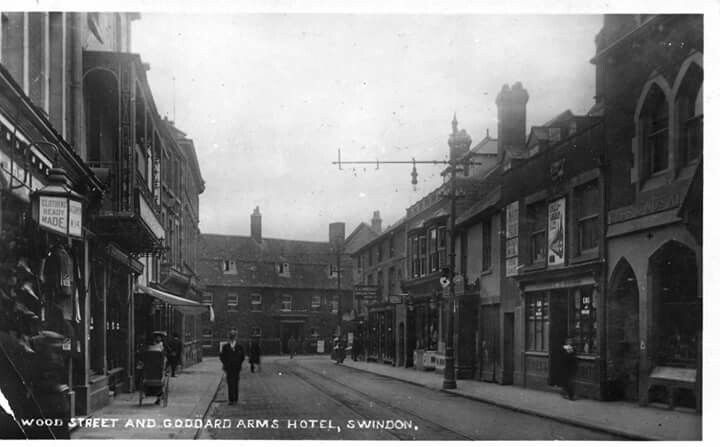
Goddard Arms Hotel published courtesy of Local Studies, Swindon Central Library
Two young women each murdered by a sweetheart ten years apart have some striking similarities but a very different response from people in the town where they lived.
Swindonians were shocked by the murder of 19 year old Esther Swinford in 1903 but when Frances Hunter was shot by her sweetheart in one of the outbuildings at the Goddard Arms Hotel they were shocked but for quite different reasons.
Walter James White was told that Frances had previously been in a relationship with a married man. He went to her workplace at the Goddard Arms Hotel and challenged her.
In his statement he said that Frances had confessed she had disgraced him and she hoped that God would forgive her. “I told her she would never deceive anybody else as I was going to kill her.”
White was found standing over the young woman’s body, a revolver in his hand. He coolly advised the manager of the hotel to send for the police.
White’s defence counsel pleaded that White was in “such a perturbed state he was not responsible.” A petition signed by 4,000 Swindonians, including that of the mayor and deputy mayor, was sent to the home secretary pleading for mercy, but White was found guilty and executed at Winchester prison on June 15, 1914.
Frances lies buried in an unmarked, pauper’s grave in Radnor Street Cemetery. There was no funeral fund for Frances, no impressive memorial on her grave site.
Esther Swinford’s story is well known here in Swindon. Frances’s story seldom gets a mention.
I knew what went on at No. 11; all of us girls did. And despite what our mothers believed we all knew what went on between a man and a woman as well; what we didn’t know was how to prevent the consequences. This was what led so many girls to come knocking on Mrs Stretch’s lodging house door, and not just girls either, women young and not so young, single and married.
But the case of Martha Scriven proved to be different. For one thing she didn’t live locally and she was a widow. It was only when the case came to court that the full details came out.
Martha Scriven was 27 years old and recently widowed when she came to Swindon in November 1895. With a three-year-old son and believing herself to be pregnant Martha was in a desperate situation. She travelled down from London shortly after the death of her husband to visit his family who lived at Can Court, a farm on the outskirts of Swindon.
You had to ask yourself why she didn’t stay with the Scriven family and not with Mrs Stretch but that was only one of many questions we asked each other.
She walked past our house a couple of times, usually in the company of a man, but it wasn’t what we all thought at the time. It turned out he was her late husband’s brother and he had put her in touch with Mrs Stretch who in turn knew Mrs Lazenby. We all knew Mrs Lazenby as well.
“There’s many a woman very grateful to Mrs Lazenby,” some said.
Not Martha Scriven, I can tell you.
Image published courtesy of Local Studies, Swindon Central Library
The facts …
Martha died on December 5, 1895. The cause of death was ‘exhaustion from peritonitis set up by punctured wound in the uterus and intestines.’ At the inquest the attending doctor thought it was unlikely Martha had been pregnant at the time the procedure was undertaken.
During the investigations a piece of slippery elm bark was found at 11 Queen Street. This was believed to be the instrument used to induce the abortion and which perforated Martha’s uterus.
Emily Lazenby was charged with the wilful murder of Martha Scriven and with ‘feloniously using a certain instrument.’ She was sentenced to seven years’ imprisonment in Aylesbury prison but apparently she did not serve her entire sentence. She was released on 13th September, 1900 to an address in New Swindon and a job as a French Polisher.
Mary Jane Stretch was sentenced to five years and sent to Aylesbury Prison. She was released on 18th May, 1899 to 29 Regent Street. Edwin Scriven, Martha’s brother in law who had made the arrangements, was also sentenced to five years imprisonment and sent to Parkhurst Prison. He was released early to take up a position as a groom.
Martha was buried in plot E7201 in Radnor Street Cemetery, a pauper’s grave. In 1902 Mary Jane Stretch was back in Swindon and living at 36 Catherine Street. She died in that same year and in a cruel ironic twist is buried in plot E7072 just a few rows away from Martha’s grave.
Now my Radnor Street Cemetery colleague Noel and I thought it was quite a coincidence when we realised we both had connections with the village of Eynsham in Oxfordshire, but imagine my surprise when I discovered the story of Mrs Watson, born and married (twice) in Eynsham but buried in Radnor Street Cemetery.
Emma Lavinia Goodwin was born on July 30, 1844, the daughter of Charles Goodwin landlord at the Royal Albert and brewer at the Crown Brewery, Eynsham and his wife Harriett. Emma was the couple’s fifth child and at the time of the 1851 census the family lived in Newland Street, a long street lined with stone built properties large and small, that ran from Mill Street and out of Eynsham to Cassington.
Emma married Harry Gibbons (farmer and butcher) by licence on June 4, 1861, shortly before her 17th birthday. Marriage by licence usually indicates a desire to marry quickly and unobtrusively and it looks likely that young Emma was already pregnant. Harry was the son of James Gibbons, farmer, grocer and another brewer with premises in the High Street. Was this a union of two brewing dynasties?
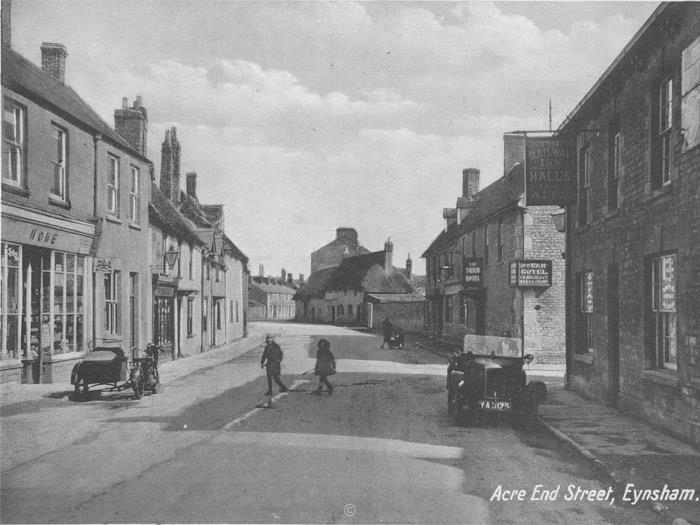
At the time of the 1871 census Emma was living at Acre End Street, Eynsham where today stone cottages rub shoulders with brick built ones crowding close to the narrow road leading to St. Leonard’s Church. By 1871 Emma was just 27 years old with five children, Harriet 9, Maria 8 (staying with her aunt and uncle on census night) Frederick 6, Sarah 4 and 3 year old Jane. She was already widowed, her husband Harry having died in 1867 aged 30. But Emma didn’t rush into a second marriage, which is quite unusual for the time. A young woman with five children to support often remarried within 12 months but perhaps Emma’s extended family helped to support her financially.
Maria Gomm nee Gibbons (Emma’s daughter) and her husband Thomas
Emma eventually married in the December quarter of 1873. Her second husband was carpenter and joiner George Watson. They continued to lived in Acre End Street where the Watson children soon began arriving! At the time of the 1881 census living with Emma and George were Jane Gibbons 13, Emma’s youngest child from her first marriage, and Augustus Watson 7, Lavinia Watson 4 and three year old Mary Watson.
Then, towards the end of the 1880s the family moved to Swindon where George most likely took up a job in the GWR Works. When the census was taken in 1891 they were living at 50 Clifton Street with their five Watson children, two of whom, William and Charles, had been born in Swindon.
When George completed the census returns in 1911 he made a bit of a mess of the form with numerous crossings out and alterations. The family were now living at 29 Tennyson Street and he records that he and Emma have been married 38 years and had 7 children all living. He lists Jane R. Gibbons, his stepdaughter, as being present on census night but then crosses out her name and adds ‘Croydon, Surrey’ so presumably this is where she was living in 1911. Staying with the couple on census night were their married daughter Lavinia Deans and her five year old daughter Ruth.
William Watson, Emma’s son – founder of Watson’s Typewriters Ltd., Glasgow.
Emma made Swindon her home for about 30 years and the funeral report indicates she contributed to community life at St. Mark’s Church.
Emma died aged 70 at her home in Tennyson Street on June 26, 1915 and was buried in plot E8626F on July 2. She shares the plot with her youngest son Charles Watson who died the following year aged 27. George Watson, Emma’s second husband, died in 1916 and was burried on December 6 in the neighbouring plot E8626E.
Death of Mrs G. Watson
The remains of the late Mrs G. Watson, of 29 Tennyson street, whose death occurred on the 26th ult., were laid to rest in Swindon Cemetery on Friday, July 2. Deceased, who was 70 years of age,was a daughter of the late Mr C.A. Goodwin, a brewer, of Eynsham. During her residence in Swindon she took a great interest in the life of St. Mark’s Church, and she will be greatly missed by a large circle of friends. The first portion of the service was held in St. Mark’s Church, Canon A.G.G. Ross officiating. The rites at the cemetery were performed by the Rev E.A.W. Topley (All Saints’’) and the choir were augmented by that of All Saints’ Church, deceased’s eldest son bearing the cross. The inscription on the breast-plate was: “Emma Lavinia Watson, died June 26th, 1915, aged 70 years.” The chief mourners were Mr. G. Watson (husband), Messrs A., E., W. and C. Watson (sons), Mrs. T. Gomm, Miss J. Gibbons, Mrs W. Robinson and Mrs E. Davies (daughters) Mrs and Mrs L. Deanes (son in law and daughter), and Mr E. Watson (grandson). A large number of friends were also present. There were numerous floral tributes.
The Oxfordshire Weekly News, Wednesday, July 28, 1915.
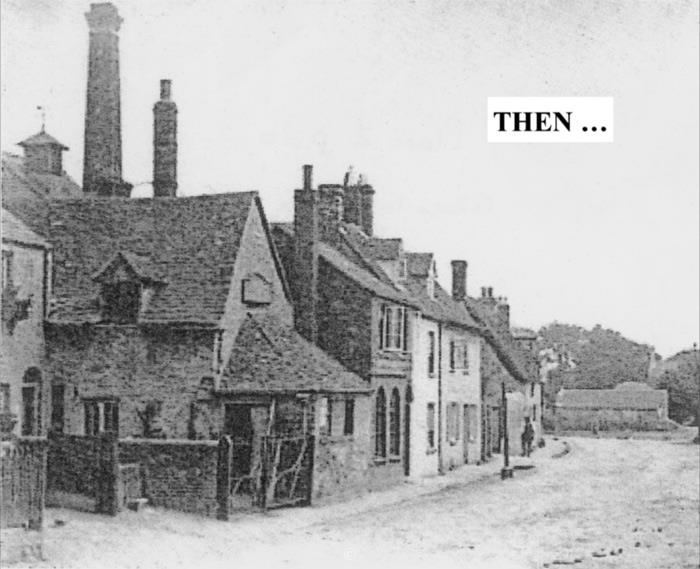
The tall chimneys to the left (High Street 25 Jan 1886) belong to Gibbons brewery –
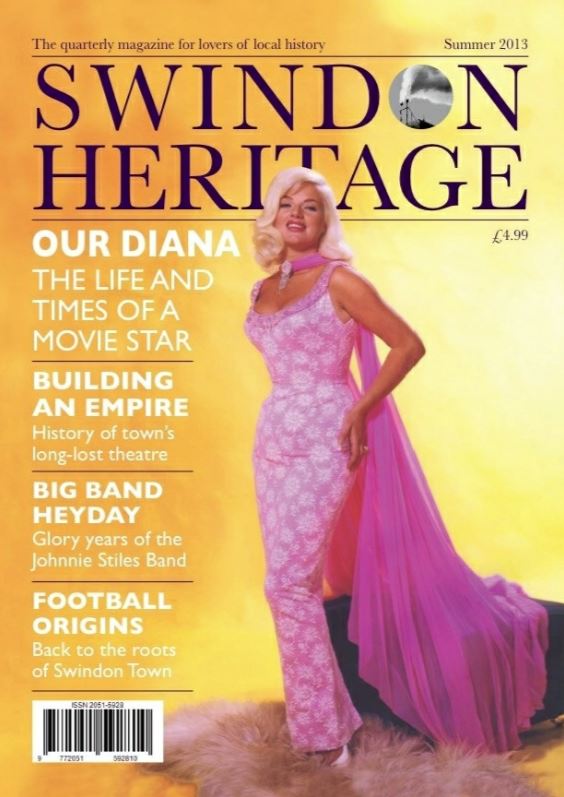
Witty, outrageous Diana Dors provided the media with a whole raft of risqué quotes. Born in Swindon in 1931 she went on to become our very own blonde bombshell, Britain’s answer to Marilyn Monroe. She was bold and brassy and lacked the vulnerability of Marilyn Monroe and sadly, today her sleazy lifestyle is better remembered than her considerable acting ability. But it could be said that Diana like Marilyn was a product of her success and the men who used and exploited her during a lucrative career in the 50s and 60s.
24th October 1953: Film star Diana Dors (1931 – 1984)
She seldom returned to Swindon having left the town behind and following the death of her parents there remains little trace of Diana. Or does there?
Diana’s mother, Winifred Maud Mary was born in Chewton Mendip, Somerset in 1890, the daughter of Mercy Georgina and Elijah Payne. Her first husband, William George Padget, was killed in action in 1916 during the First World War. In 1918 she married for a second time. Albert Edward Sidney Fluck was a railway clerk in the GWR Works. Their only child, Diana Mary Fluck, was born in a nursing home in Kent Road and grew up in a house in Marlborough Road. Her ambition to act, sing and dance became apparent at a very early age and was encouraged by her mother. Her precocious beauty and ambition saw her enrolled at the Academy of Music and Dramatic Art at just 14 years old. Diana would later say:
“They asked me to change my name. I suppose they were afraid that if ‘Diana Fluck’ was in lights and one of the lights blew …” A classic Diana quip. The surname Diana chose was her maternal grandmother’s maiden name, Dors.
Diana’s father Albert Edward Stanley Fluck was born on October 10, 1893 in Swindon and baptised on November 12 at St. Mark’s Church, Kingsholm, Gloucester, the church in which his parents had married in 1892. His father Albert Edward Fluck was a railway clerk and had moved to Swindon in around 1889 and can be found lodging with the Jones family at 40 Oriel Street at the time of the 1891 census.
November 1968: Diana Dors (1931-1984) with her husband Alan Lake in a car after their wedding. (Photo by Keystone/Getty Images)
By 1901 the Fluck family were living at 11 Poulton Street, Gorse Hill – Albert E. Fluck 35 a clerk at the GWR Works, Ada 34 and Albert E.S. aged 7. Lodging with the family was George J. Sarwell 37, a Church of England clergyman.
Albert Edward Fluck died on January 24, 1907 aged 40 years. His funeral took place on January 30 and he is buried in Radnor Street Cemetery in plot C1800.
The area in which grave plot C1800 is located
Ada went on to marry widower Albert Ausden a scaffolder employed in the GWR Works. At the time of the 1911 census the family were living at 19 Cambria Place with Albert’s three children Rupert, Florrence and George and her two children Albert, then aged 17, and Gweneva Fluck 7.
Ada died in 1948 aged 81 years and is buried with Albert Fluck in plot C1800. Their daughter Gweneva died in 1966 and is also buried with them.
There does not appear to be a headstone on the Fluck family grave. Probably back in 1907 there was not the money to pay for one. I suspected their granddaughter Diana Dors probably had something big and showy, but surprisingly she hasn’t. Diana died in 1984 aged 52. She was buried in Sunningdale Catholic Cemetery. Her third husband Alan Lake took his own life just five months later. He is buried alongside her and the two have identical headstones.
Esther Swinford published courtesy of James Turner and Local Studies, Swindon Central Library
‘I watched him enter the pub from my seat beside the fireplace. What did she see in him? My sister said he was handsome in a dark and brooding fashion and that I was jealous.
She read too many romantic novels. Where she saw dark and brooding I saw surly and ill tempered, but she was right about one thing; I was jealous.
I was in love with Hetty and had been for several years, since she first began working at The Ship. She was pretty and vivacious with a kind word for everyone. Mr Matthews said she was one of the best barmaids he had ever employed. She was like one of the family, he used to say.
I watched Palmer walk over to the bar. He looked furtively around the near empty pub. I inclined my head in acknowledgement. I didn’t want to encourage him over to the vacant seat beside me.
I hadn’t seen him in many months. Rumour had it that he had left for Canada nursing a broken heart after Hetty broke off their engagement.
My sister said she’d heard he’d spent Hetty’s savings, all the money she had put away for their future home together, on other pastimes.
But he was obviously back now.
I watched as Hetty appeared behind the bar. She seemed unsurprised to see him and welcomed him with a polite smile, the smile she showed all her customers, the smile she always gave me. Nothing special.
He ordered a bottle of Bass and a cigar. She placed his drink in front of him and went out the back to get the cigar.
I watched as they exchanged a few words. I couldn’t hear what was said, but suddenly I noticed her expression change. The sound of the gunshot reverberated around the pub. He placed the gun on the bar.
I watched as he took a long, slow draught of beer. He lit his cigar and enjoyed a leisurely smoke while all hell broke out around him.
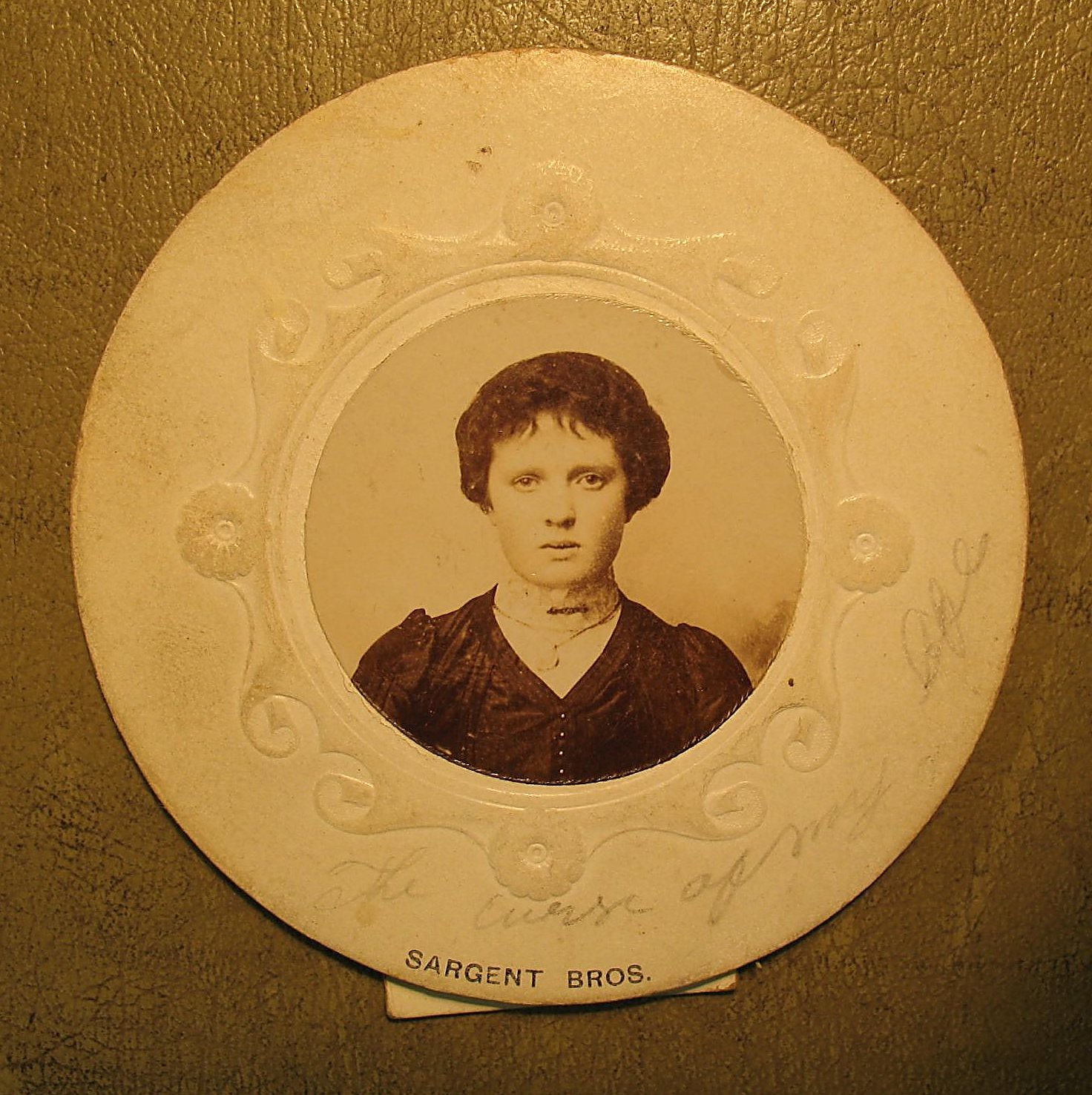
After his arrest they found a photograph of Hetty in his pocket. He had written across the bottom ‘the curse of my life.’
The Ship Inn, Westcott Place published courtesy of Local Studies, Swindon Central Library
The facts …
Esther, also known as Hester or Hetty, was born in Fairford, Gloustershire in 1883, the daughter of farm labourer Edwin Swinford and his wife Alice. By 1901 she had moved to Swindon where she worked as a barmaid at the Ship Inn for Mrs Isabella Groves. The following year the widowed Mrs Groves married Walter Ernest Matthews and together they continued to run the large establishment in Westcott Place.
It was Mr Matthews who paid for the funeral expenses while local people donated towards a memorial. A large cross stands on Hetty’s grave. The inscription reads:
In Memory of Esther Swinford who was the victim of the shooting tragedy in Swindon on Sep 18th 1903. Aged 19 years
“In the midst of life we are in death.”
Cut into the stone is a cascade of passion flowers. Is this how Hetty’s death should be remembered, as a crime of passion, like something out of a romantic novel?
Hetty’s funeral took place on September 22. She was buried in plot A760 which she shares with one other who died in 1889; a railwayman by the name of George Frederick Palmer, could this just be a macabre coincidence?
Edward Richard Palmer hanged for the crime on November 17, 1903 in Devizes gaol.
The memorial was repaired and restored in 2009 by Highworth Memorials after a project by James Turner.
The story of Sarah Cox was revealed for all to read in the local press; to question her morality; to gossip and pass on the details of her crime. Yet who knew the facts; who knew what had happened to her? Her employer W.H. Stanier, Chief Clerk to William Dean, Chief Locomotive Engineer at Swindon Works, described her as ‘a God-fearing, steady girl.’ To his knowledge she never went out but once a week, besides going to a place of worship.
She kept the secret of her pregnancy and the identity of the child’s father, but in the end she confessed to her crime.
The inquest on Sarah’s baby was reported at great length. Then, perhaps surprisingly, the charge was commuted from ‘wilful murder’ to the lesser, second indictment of ‘concealing the birth of her child’.
But what happened to Sarah …
Rolleston Street pictured in 1957 shortly before demolition. Published courtesy of Local Studies, Swindon Central Library.
Inquest on an Infant at Swindon
Verdict of Wilful Murder
On Saturday Mr. Coroner Browne held an enquiry at the Clifton Hotel, New Swindon, into the circumstances attending the death of an infant which was found buried in a garden at the rear of No. 28, Rolleston Street, New Swindon. The case has excited considerable gossip in the town. It appears that a young girl named Sarah Cox, in service at Mr. W.H. Stanier’s, the Sands, Old Swindon, was confined on Wednesday night, April 24th, unknowing to any of the family, and that she took the child away in her box, and afterwards buried it in her brother’s garden in Rolleston-street. Mr George Wiltshire was chosen foreman of the jury, and the following evidence was taken:-
Richard Cox, brother of Sarah Cox, stated that he lived at 28 Rolleston-street. His sister came to his house on Thursday morning. He saw her at nine o’clock in the evening, after he came home from work. He went to bed that night about 11 o’clock, leaving her on the couch in the front room. She would not go to bed that night. She brought her box with her when she came to his house in the morning. He went to his work as usual the next day, and at twelve o’clock he was sent for by his wife, who told him of what had taken place, and that the body was in the back garden. He at once went into the garden, and saw where the earth had been removed, and then gave information to the relieving officer and Inspector Cruse. He saw Sarah Cox, his sister, about eight days previously, and noticed she was stouter than usual, but she had never made a decided statement that she was enceinte. His sister had been away from his house since October last, except coming occasionally since Christmas, on account of ill-health. His sister had had a child before, but it only lived a short time – some three months.
Mary Ann Heath, a laundress, living in the Quarries, Swindon, said she knew Sarah Cox as a servant at Mr. Stanier’s. She saw her there at a quarter to eight on Thursday morning. Witness had not then any suspicion as to the girl’s condition. She looked very ill; her face was as white as paper, and her lips were black. The girl never said anything as to her state of health. She left at half-past nine o’clock on Thursday morning in a cab, which Mr. Stanier had ordered;- By the Coroner; All the time witness was attending at Mr Stanier’s she never saw anything wrong with the girl, nor misjudged her in any way. The girl had told Mrs Stanier that she met with an accident a month ago. Mrs Stanier asked witness if she had any suspicion about the girl, and she replied, “Not in the least.” No complaint was made to her by the girl. Witness noticed a large bloodstain on the bed when she made it.
Inspector Cruse said that just before one o’clock on Friday morning he had his attention called to this matter by Richard Cox, and in consequence went to 28, Rolleston-street. He saw that the earth in the back garden had been disturbed. He removed it, and found about three inches below the ground the body of a newly-born male child wrapped in two newspapers, and with a piece of tape tied tightly round its neck. He saw Ellen Cox, the previous witness, who told him all that she had stated in her evidence. He had the body removed to the mortuary, and communicated with a doctor.
Mr E.C. Arnold, FRCS, MB, said he was called soon after one o’clock on Friday to the house, 28, Rolleston St. He went and saw Mr and Mrs Cox there. He went upstairs, and there saw Sarah Cox. He found she had every symptom of having been recently confined. She informed him that she had been delivered of a child on Wednesday night. He examined her in the presence of a witness. He saw the body of a child with a piece of tape tied round its neck. He afterwards made a post-mortem examination of the body and found that it had breathed. The girl said she had no recollection of anything except that she was confined on Wednesday night, and the next morning she found the child dead on the floor with the tape tied round its neck. He called in Dr. Streeten to assist him in the post-mortem examination, and they concurred in the opinion that it was fully developed, and perfectly healthy in every organ. There was a deep groove round the neck, and the signs were those of asphyxia. With the exception of the mark made by the tape, there were no signs of violence. The tape was tied with sufficient tightness to cause death. There was no proof, however, that the child had had a separate existence from its mother. The cord was divided near the placenta end, and had the appearance of having been cut, and not torn. The girl could have cut it herself.
Mr W.H. Stanier was the last witness called. He said that Sarah Cox had been servant at his house for the past six months. Within the last two months she had complained of stiffness in her hips. About four months ago she went to her brother’s in consequence of illness. During the past month she had frequently complained of her hip, and ascribed it to rheumatism. On several occasions she had gone to the GWR Surgery for advice and medicine.
On the night of Thursday, April 11, on her return from the surgery, she said that Dr. Bromley had advised her to take rest for a few weeks. Mrs Stanier asked her if she wished to go at once, or if she could remain until another servant was obtained. She replied that there was no difficulty in her staying a week or two longer.
The girl had a bedroom to herself all the time she was with the family. Mrs. Heath, the laundress, who had given evidence, had been in the habit of coming to assist in the house once or twice a week, and she would be the only woman likely to go into the girl’s room. On Thursday morning she got up and set the breakfast. Mrs. Stanier came to him shortly after eight o’clock, and remarked that the servant seemed very ill. The result of their conversation was that he ordered a cab to take her to her brothers. Mrs Stanier sent Mrs Heath to her bedroom, and she afterwards said there appeared to be nothing inconsistent with the girls’ statement.
Witness had previously consulted Dr. Bromley, and he said he did not notice that the girl was in the family way. Witness said he would like to add that he had always held the highest opinion of the girl’s character. He believed her to be a God-fearing, steady girl. To his knowledge she never went out but once a week, besides going to a place of worship. The excellent character she bore (disarmed) all suspicion.
This was the whole of the evidence and after some deliberation the jury returned a verdict of “Wilful Murder” against the mother, Sarah Cox.
The jury gave their fees to the Victoria Hospital.
Extracts from The Swindon Advertiser, Saturday, May 4, 1889.
The Alleged Wilful Murder
In the case of Sarah Cox, 27, servant, indicted for the wilful murder of her child at Swindon, the Grand Jury thew out the bill for wilful murder, returning a true bill on the second indictment of concealing the birth of her child at Lyneham. Prisoner pleaded guilt to the lesser count, and she was let out on her own recognisances and those of her brother to come up for judgment when called upon.
The Salisbury Times and South Wilts Gazette Saturday, July 6th, 1889.
The details of the baby are recorded in the Radnor Street Cemetery burial registers as – Cox 1 day old 28 Rolleston Street buried on April 29, 1889 in plot B1178, an unmarked, public grave.
William John Josiah Fellowes Thomas. What a long name for such a small person. It was a name to grow into. Sadly, he never had that opportunity.
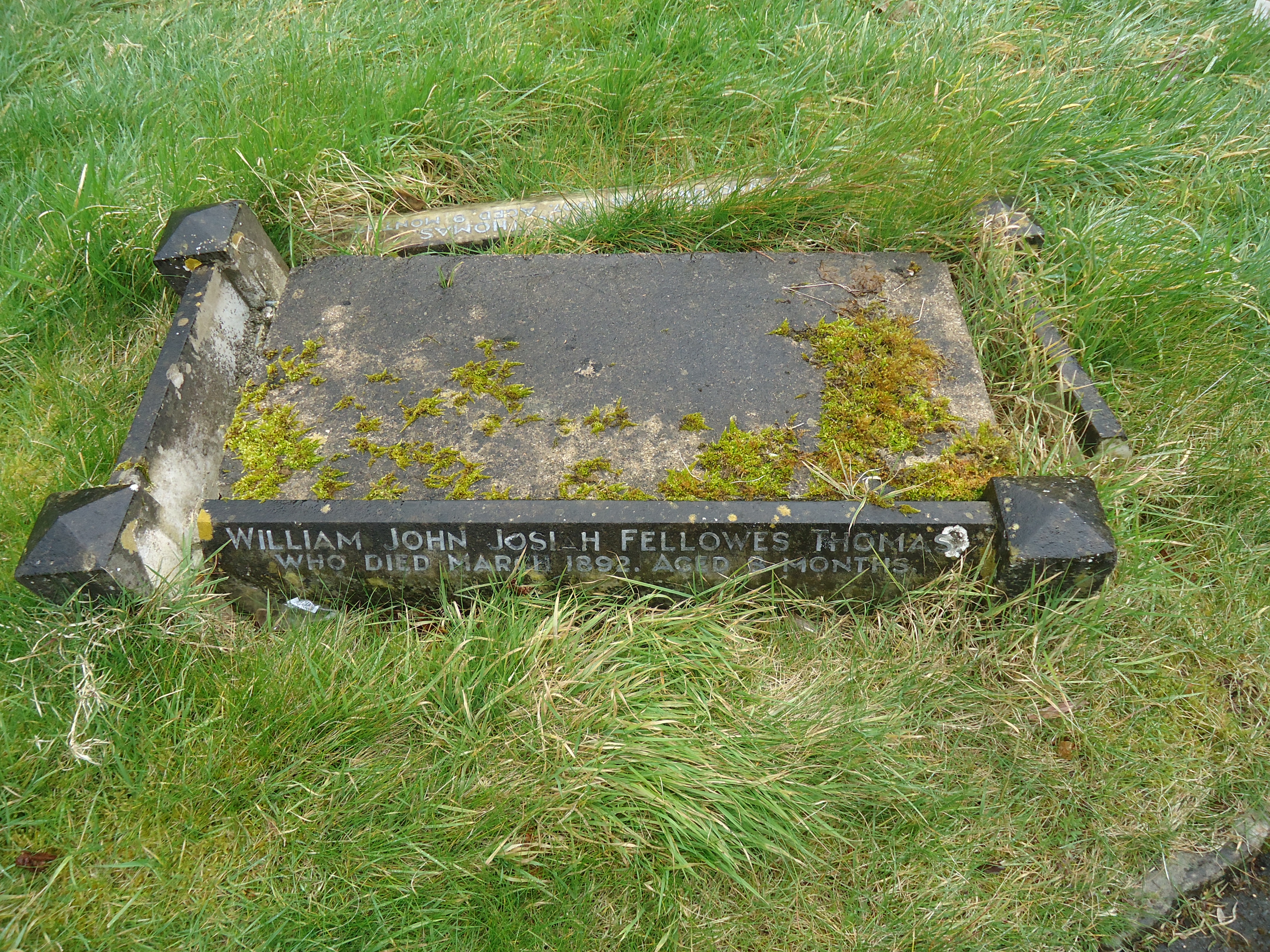
The inscription stretched the length of the small kerbstone memorial. ‘William John Josiah Fellowes Thomas who died March 1892 Aged 8 months.’ They had lived at No 4 Albion Street then, their first home together. Such a happy time, waiting for the birth of their first child.
She had prayed she would never have to bury another child in the cold earth and for several years it seemed as if God had heard her; spared her. Two daughters survived and thrived and then another son; a small, sickly baby.
‘Also of Cyril Thomas who died Feb 1907 aged 9 months.’
Why had they named him Cyril; she couldn’t remember now. Why hadn’t they given him a more impressive name. Cyril; not much of a name. She didn’t even care for it now. Cyril.
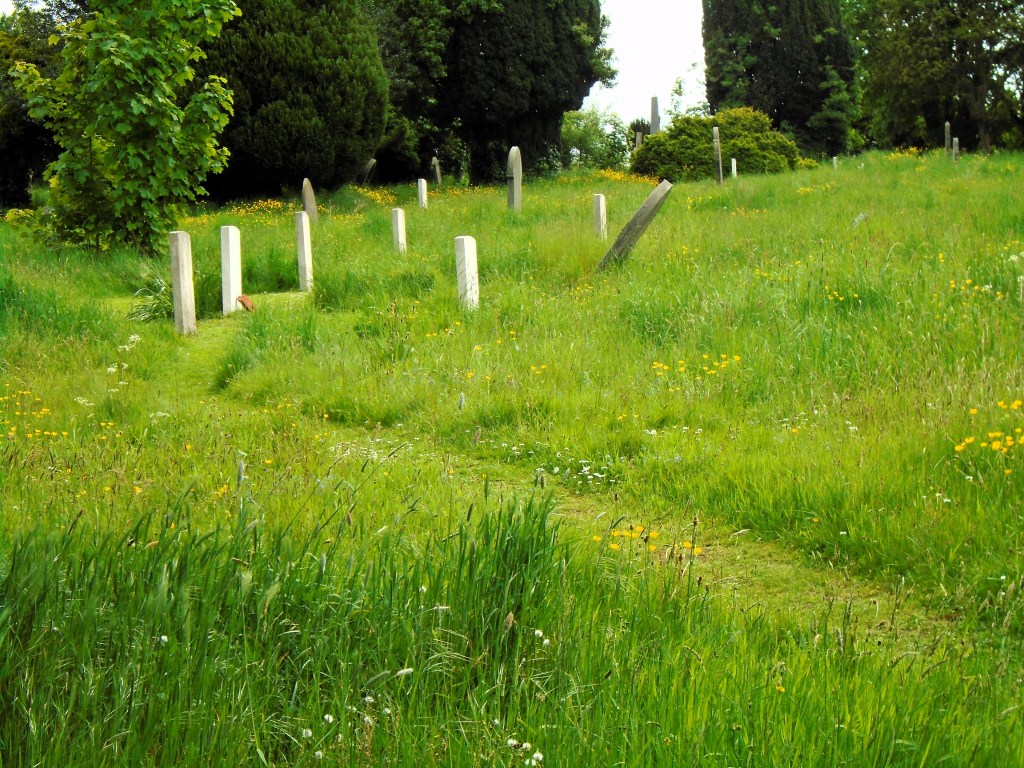
The little grave was the size of a cot. She wished John hadn’t chosen this plot in the lower half of the cemetery. She wished they had buried the babies up on the higher ground, near the other family graves, where the early morning sun peeped through the trees. The boys always woke early. She remembered that, watching the sunrise at the bedroom window, rocking them, trying to soothe them.
She looked across the cemetery. Some of the mourners were still standing at the graveside. This was where she would be laid to rest when the time came, buried with John, next to her parents, close to her brothers. She wished she could have her sons with her.
She left a spray of flowers on the small grave. Two daughters survived and thrived, two sons died.
The facts …
During the 1870s William Fellowes, an iron moulder, brought his family down to Swindon from Wolverhampton. By the time of the 1881 census William and his wife were living at 22 Albion Street. His sons William and Josiah had followed their father into the railway works while their sister Adelaide is working as a dressmaker.
On July 9, 1890 Adelaide married John Thomas, a widower with two young daughters. Her first child, a son named William John Josiah Fellowes Thomas, named after her father and three brothers, was born in 1891 and baptised on November 3. A daughter named Adelaide Fellowes Thomas was born in 1896; Gwendoline was born in 1900 a second son Cyril in 1906.
By the end of the 19th century William and Sarah were running a grocer’s shop at 35 Commercial Road, a property that would remain in the Fellowes/Thomas family for more than forty years.
William died at his home in Commercial Road in May 1905 and was buried in plot E7812. The burial registers include the following information – ‘Exhumed 14th March 1906 Re-interred in 7741E.’ His wife Sarah died nine years later and was buried in the same plot on October 22, 1914.
Adelaide and John were buried next to William and Sarah in plot E7740 and brother William and his wife Mary were buried in plot E7742.
Josiah died in 1902 aged just 37. He is buried in plot E7955 with his brother John who died in 1910 aged 50. Their grave is just two plots away from their sister Adelaide.
The Fellowes family remained close in life and death, except for the two little babies buried together on the other side of the cemetery.
The Matthews family is another story I keep returning to although a recent attempt to track them all down has proved frustrating.
Maria Smith and Jesse Matthews married in 1867 and during 38 years of marriage produced 16 children, 13 of whom survived to adulthood.
Unfortunately, there is no key to this magnificent family portrait taken in around 1893, but it has been possible to identify some of the siblings by later photographs.
Ada Maria Matthews
Ethel Sarah Matthews
George Stephens Matthews
Walter W.J. Matthews
Edward Thomas Matthews
Emmeline Dorcas Matthews
Mary Catherine Bramble Matthews
Gertrude Amelia Matthews
Frances Josephine Matthews
Winifred Dorothy Matthews
All of the 10 sisters were apprenticed to trades and at least two became teachers. Eldest daughters Ada and Ethel both emigrated to Canada with possibly a third, Emmeline, joining them.
In 1901 daughter Jessie Ellen Matthews (born in 1876) worked alongside her brother Walter in a Stationer’s shop they ran together at 14 Victoria Street. In 1905, the year her father died in tragic circumstances, Jessie married Stephen William Filtness at the Wesley Chapel, Faringdon Road where the family worshipped. Sadly, Jessie was admitted to the Wiltshire County Lunatic Asylum in Devizes on June 10, 1911 where she died on August 9. She is buried in grave plot E7455 where she was later joined by her mother-in-law Mary Elizabeth Filtness who died in 1912; her husband Stephen William who died in 1931 and his sister Mary Sophia Boxall who died in 1932.
Jesse Matthews died in 1905 and Maria in 1940. They are buried in grave plot E7389 with their baby granddaughter Rosemary Gay who died aged 4 days old in 1929.
My research into the Matthews family continues. Many thanks go to Shelley Hughes who has provided so much information and so many photographs and to Prof John Gregory for his gift of Memories of Another Age – Frances Josephine Gay 1886-1974. Frances was a writer, teacher and founder member of the Richard Jefferies Society. Copies of this book are available in Local Studies, Swindon Central Library. Frances was Jesse and Maria’s second youngest daughter.
Jane Helena Tuckey photograph courtesy of Peter Guggenheim
The re-imagined story …
Mother went to Mrs Dicks funeral. It was a very quiet affair, she said. Not many at the church and even fewer at the graveside.
“I don’t know why she wasn’t buried at St Mary’s, along with all her family,” said mother. “There’s a long avenue of Tuckey graves in the churchyard there. Great big gravestones enclosed by iron railings. Of course, there was money in the family then.”
A familiar guilty twinge stabbed me.
I used to visit Mrs Dicks most weeks. Mother would send me round with a meat pie or a suet pudding.
“She doesn’t eat very well.”
Mrs Dicks lived opposite us in Hawkins Street. Her husband had died several years before.
“He was a fitter in the Works. Nice man, people said, although a bit of a come down for her. Her first husband had been a wealthy farmer from Chippenham.”
Mrs Dicks’ terrace house was crammed full of great big pieces of dark furniture.
“No doubt from her father’s house in Shaw.”
Sometimes she would open the drawer in the big, old dresser and hand me a tortoiseshell casket and together we would look at her ‘treasures’ as she called them.
Then one day Nellie Fitch came with me.
I usually went to Mrs Dicks on my own but this day Nellie was sitting on our front wall.
“She can smell the pie.”
Nellie Fitch wore shoes with holes in them and her winter coat was too small for her. Nothing unusual about that. During the war most of the kids in Rodbourne wore hand me downs. But then she told me she often didn’t eat.
We didn’t have much, but I always knew I would have a cooked dinner. Nothing fancy mind, but mother was a good, plain cook and she knew how to make a little go a long way.
Nellie’s dad was away fighting the Hun, she told me.
“Nellie’s father disappeared years ago,” said mother. “And so has the layabout she thinks is her father.”
Mrs Dicks opened her front door to a small hallway, just like the one in our house and all the other houses in Hawkins Street.
She was pleased to see me, but less so to see Nellie. I don’t think it was her dirty clothes and shabby shoes that bothered Mrs Dicks. I imagine it was more the fact that now Nellie would know she accepted food from neighbours. Mrs Dicks tried to keep up appearances. She had come down in the world and keenly felt her loss of status. But to me she was just another little old lady who wore old fashioned dresses and spoke in a posh voice.
“Good morning girls. How lovely Violet. Please thank your mother,” she said as she took the warm basin into the kitchen. “Tell her I will settle up with her at the end of the week.”
She always said the same thing. No money ever changed hands, my mother wouldn’t have expected any and Mrs Dicks had none to give.
“Come into the kitchen girls. I was just making a cup of tea.”
If Nellie was hoping for a piece of cake or a biscuit she would be out of luck.
Nellie probably wondered why I spent time with the posh old lady in her dark and dreary house where there was nothing nice to eat.
Mrs Dicks would tell me about the house in Shaw where she had grown up with her eight sisters and her brother. How they played in the orchard at the back of the house and on Sundays they would walk all the way to the church in Lydiard Millicent. She would bring out her photograph album and tell me about the people; bewhiskered old men and wasp waisted ladies.
And sometimes she would bring out the tortoiseshell box and show me the beaded bag she took to dances when she was a young woman, and the diamond tiara that became a pair of dangly earrings at the click of a pin at the back. There was an amethyst ring that had belonged to her grandmother and brooches and pins.
Please don’t bring out the tortoiseshell box today, I silently pleaded. But the atmosphere was awkward with Nellie there. We were probably the only two quiet children in Rodbourne that morning.
I watched Nellie’s eyes grow as wide as saucers as she peeped inside Mrs Dicks’ tortoiseshell box, and she looked at me and smiled. Not a big, open smile, but something sly.
I never wanted to visit Mrs Dicks after that.
“I don’t have time to go calling in on Mrs Dicks,” my mother complained when she had to deliver the meat pie.
Nellie got a new winter coat that year, and a new step father.
“They’re not married,” said my mother. “She’s never marries any of them.” And then they moved away from Rodbourne.
The facts …
Jane Helena Tuckey was born on March 15th 1848 at Langley Burrell, the fourth daughter of Robert and Ann Tuckey.
The 1841 census returns for Yatesbury record wealthy bachelor farmer Robert Tuckey living with Ann Trotman, an unmarried servant and her four year old daughter.
Perhaps Tuckey family opposition to this mismatched alliance delayed a wedding. By the time the couple did get around to walking up the aisle at St. Saviours in Bath they had two daughters and Ann was pregnant again.
But by 1851 Robert had come into his inheritance and the growing family moved into Shaw House along what is now called Old Shaw Lane in West Swindon.
In 1872, shortly after the death of her father, Jane married farmer John Clarke, thirty years her senior, and moved to nearby Kington St. Michael where John farmed 381 acres. With 20 farm and house servants on the payroll, this was a big establishment.
Then in 1882 John Clarke was found dead in one of his fields having suffered a fatal heart attack and Jane’s life was to change dramatically.
In 1884 Jane married Francis Dicks. Her second husband, seven years her junior, was a fitter employed in the GWR works. The couple with Jane’s girls moved into 37 Hawkins Street, Rodbourne where a further two children were born.
In the small terraced house Jane’s lifestyle was far removed from the comfortable childhood she had enjoyed, playing in the orchard at Shaw House.
Widowed for the second time in 1903 she survived on an income derived from taking in a lodger.
Mrs Dicks died on November 26, 1918. She was buried in plot B1494, a pauper’s grave in Radnor Street Cemetery.


















 Radnor Street Cemetery