Thanks to readers of the Radnor Street Cemetery blog it seems that not only have we filled in the missing details of Olive Henry’s life, but the volunteers have revealed I was looking in the wrong place for her grave.
The portable (and therein lies the problem) grave marker had been rested against the wrong grave. When further investigations were made Olive’s grave was discovered to be completely hidden and further back from the path. Here she is buried with her baby son with the details of her husband’s burial in Lisbon, Portugal also recorded.
So, at last we have the complete story and the correct grave recorded.
Death of Mrs. Olive Henry
Swindon Conservative Party’s Loss
Funeral Tributes
The funeral of Mrs Olive Henry of 7, College-street, Swindon, who died on 20 May, took place on Saturday. The interment was at Radnor Street Cemetery, following a service at the Sanford Street Congregational Church, Swindon. The Rev. A.R. Smart officiated.
Mrs Henry, who was 69 years of age, was born in Swindon, but had spent most of her life abroad. When she was 12, her brother took her to Portugal, where she lived until the death of her husband, only a year after her marriage. She then returned to Swindon, and left again after the death of her infant son, to qualify as a nurse at the Brighton and Sussex Hospital. She was then appointed Matron to the Eastern Telegraph Co., at Durban, South Africa, retiring 14 years ago and returning to live with her sister, Mrs. Gabb, in College Street Swindon.
Sincer her retirement she had taken a keen interest in the affairs of the Conservative Association, being at one time secretary and later president of the Women’s Section, King’s Ward “A.”
Extract
Many thanks to Ken Gamston who sent me this newspaper obituary this morning.
I read a lot of newspaper reports as part of my cemetery research and I’ve noticed that both the style of writing and the content has changed considerably over the years.
Back in the 19th century local newspapers published at great length meetings of governing bodies in the town – the Local Board Meetings (precursor of Swindon Borough Council) for both Old and New Swindon, the Swindon School Board and the Mechanics’ Institute Council to mention just three. Columns and columns of tightly packed print recording who said what to and about whom! The Great Western Railway featured prominently as might be expected with reports of social events, the retirement of old railwaymen, accidents and inquests where all the gory details were reported.
And then there are the odd gossipy bits that creep in. In Arthur Jefferies Lewis White’s obituary there is a reference to his widow with the comment –
Mr White’s widow is a Swindon lady, formerly a Miss Sendell. She will be the fourth widow in the family of the Sendells – three other sisters having lost their husbands.
So, of course, that set me off on the search of these sisters.
The first of the three sisters to marry was the eldest Ellen who married Herbert Henry Llewellyn a railway clerk. The couple lived at 23 Dixon Street where Herbert died in 1898 aged just 27. Ellen returned to the family home where she can be found on the 1911 census. She died at St. Margaret’s Hospital on May 23, 1943 and was buried with her husband.
The next sister to marry was Kate and her story requires more research. Kate married George Astill a draper in 1904 at St. Saviour’s Church, Brixton Hill, South London. Their son Reginald was born in Otago, New Zealand but baptised in the UK in June of that year before George and Kate returned to New Zealand. On April 6, 1912 Kate and her 3 year old son arrived in London without her husband George. Was this just a holiday; a family visit? Did she plan to return? George died the following year in New Zealand. Kate’s last home was 344 Western Avenue, Acton. She died in the Central Middlesex Hospital in 1956.
Youngest daughter Margaret married Charles Robert Tippetts in the Wesley Chapel, Faringdon Street on April 19, 1915. He died in 1928 and Margaret died two years later. They are buried together in grave plot E8204, next to Margaret’s parents.
Emily Sendell was born in 1876, the third of four surviving daughters. Her parents Henry and Lucy married in Chipping Norton in 1870. They can be found living in Bristol at the time of the 1881 census with 5 of their 8 children. By 1891 they had moved to 15 Theobald Street where the family would remain for more than 55 years until Lucy’s death in 1933. Emily was the last sister to marry. She was 42 years old when she married Arthur Jefferies Lewis White in 1917 at Christ Church. Arthur died in 1919. Emily outlived him by some 40 years. She died in the Cheriton Nursing Home in 1968 aged 92 years. She was buried in plot E8134A next to Arthur.
Perhaps it’s a shame that journalism has changed so much over the years! I might never have discovered these family stories without the gossipy bit in the newspaper.
This is the grave of Lucy and Henry Sendell who died in 1933 and 1935 respectively. Their daughter Margaret Tippetts and her husband are buried in the neighbouring grave.
The grave of Herbert Henry Llewellyn and Nellie (Ellen nee Sendell).
Mam would take flowers up to the cemetery every week. People did in those days, but what I thought was odd was that Mrs Adlam always went with her.
Mam would knock on her door at number 18 and they would walk together up Cambria Bridge Road to the cemetery in Radnor Street.
Mam looked after a few graves in the cemetery, alternating the flowers each week. She’d tidy up Pop and Nanny Williams grave, then she would move on to Gramps and Grandma Griffiths and then Auntie Hilda and Uncle Len. Dad grew the flowers in his greenhouse otherwise it would have cost her a small fortune, he used to say.
But quite why Mrs Adlam joined her, I could never understand. Well, not then I couldn’t.
Mrs Adlam was from Somerset originally and had spent the first years of her married life living in Frome. The Adlam’s were a big family, more than ten children she had. Two of the sons went to America but most of the others lived around and about in Swindon.
She lost two babies when they lived away, Mam told me, and another child buried in the churchyard at Rodbourne Cheney. One little boy was only 12 days old. That wasn’t unusual either in those days. All those dreadful diseases that swept through families. Our mam was one of the fortunate ones. Tidy little family we were, just the four of us, all grown up with families of our own.
Two babies left behind, buried in Frome. I wonder if anyone looked after their little graves. Now I understood why Mrs Adlam visited the cemetery in Radnor Street with our mam. It was her way of being close to her babies.
Of course she is long dead herself now and buried with her husband. But recently another burial was made in the family plot. A little baby just three weeks old, Mrs Adlam’s great-grandson. At last she has a baby she can watch over.
The facts …
Sarah Elizabeth Smith was baptised on May 4, 1856 at the parish church in Marston Bigott, Somerset, the illegitimate daughter of Mercy Smith.
She married Thomas Adlam at the same church on April 19, 1877. Thomas states his occupation as a Rivetter and that he was the son of Thomas Adlam, a gardener. Sarah Elizabeth was of full age and written across the space where father’s name and occupation is required is written ‘illegitimate.’
At the time of the 1881 census Thomas and Elizabeth were living at 2 Cottages, Nunnery Lane, Frome. They already had three children, William Henry aged 3, Eleanor Sarah 2 and Ernest Thomas five months old. Eleanor died later that year and was buried at Holy Trinity church, Frome on July 6. Oswell Joseph Adlam was buried in the same churchyard on October 16, 1888. He was just 12 days old.
By the 1890s the family had moved to Swindon where Thomas had a job in the Works. On February 2, 1893 Mercy Alice was baptised at St Augustine’s and on July 29 1896 their youngest daughter and last child, Dora May was baptised at St Barnabas Church when they lived at 51 Ferndale Road.
By 1911 Thomas and Sarah had moved to 18 Cambria Place where they lived with their three youngest children. Alice Mercy 20 who worked as a shop assistant in a drapers, Reginald Frank 18, an apprentice brass finisher in the works (and part time student) and fourteen year old Dora. Sarah declares that she and Thomas have been married 34 years and that they had 11 children, seven of whom are living and four who have died by 1911. The fourth child could be son Gilbert who left for the USA and about whose date of death there seems to be some confusion.
Sarah died on March 7, 1920 and was buried in plot E8190. Her son Ernest Thomas died in Southmead Hospital Bristol and was buried with her on May 29, 1936. Husband Thomas spent his last years living with his married daughter Dora M. Baker at 38 Osborne Street. He died in May 1946 aged 93 years old and was buried in the same plot on May 20. The last burial in the grave was that of Peter William Graville the three week old son of Marie Helena, Thomas and Sarah’s granddaughter.
Percy Adlam was born in Frome in 1883 and died in 1890 aged 6 and a half years old. He was buried on January 7, 1890 at Rodbourne Cheney.
Adlam, Sarah Elizabeth of 18 Cambria Place Swindon Wiltshire died 7 March 1920 Administration Salisbury 26 April to Thomas Adlam boilersmith Effects £382 0s 10d.
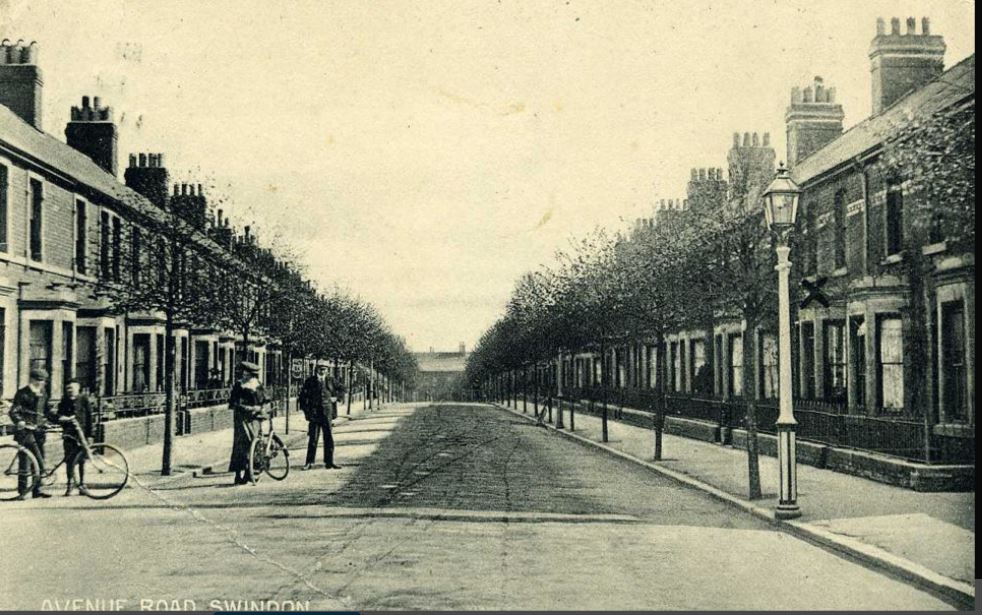
Every cemetery story is a recognition, a celebration of a life, but sometimes that story is one so sad it is difficult to write and to read. Such is the story of Minnie Louisa Roach whose future looked promising when she was born in 1874. Her father John Roach was an erector employed in the Works, her mother was Louisa Roach and she had a brother William born in 1873. By the turn of the new century the family were living in Avenue Road.
Minnie married Frederick William Gilchrist, a railway clerk, at the Wesleyan Chapel Bath Road on March 23, 1901. He was 38 years old and she was 26. They began married life at 39 Dean Street, but sadly less than 3 years later Frederick died.
A Well Known Volunteer
For 7 Years Bugle-Major
The death took place on Thursday, Dec. 31st at his residence, 4 Lethbridge-road, Swindon, of Mr F.W. Gilchrist, a well-known Swindonian, who has been a great sufferer for the past two years or more, his illness being induced by the after effects of influenza. He has been taken in the prime of life – he was only 40 years of age, – and leaves a sorrowing widow, but no children. Deceased, who was the son of Capt. G. Gilchrist, of the Royal Artillery, was for many years employed in the Drawing Office, GWR Works, Swindon. But he was best known to the public as a prominent member of the Wilts Rifle Volunteers. He was a man of fine physique and good soldierly bearing. He was a member of the F and G Companies for 27 years, during 7 of which he held the position of bugle-major.
Extracts from The Swindon Advertiser, Friday, January 8, 1904.
Minnie moved back into 45 Avenue Road where she lived with her widowed mother. In 1913 she married again. Her second husband was Frederick Charles James Perry Day, the illegitimate son of Kate Day. Frederick was a coach body maker in the GWR Works and had spent most of his life living with Charles and Elizabeth Davies, presumably relatives, at 101 Stafford Street. At the time of her second marriage Minnie was 39 and Frederick 34. They should have been looking forward to a long and financially secure marriage, but of course a war was just around the corner and Frederick enlisted.
Perhaps the fear and anxiety proved too much for Minnie. She died in 1917, a patient in the Devizes Asylum.
A Soldier’s Wife’s Death – The death took place on Tuesday, at the age of 42 years, of Minnie Louisa Day, wife of Corporal Day, RFA now on active service at Salonika.
Deceased was the only daughter of the late Mr John Roach, of 45, Avenue Road, Swindon, and leaves her husband, an only brother, and a widowed mother to mourn a heavy loss.
The funeral took place on Saturday at Swindon Cemetery amid many tokens of respect on the part of friends and neighbours.
Amongst the beautiful wreaths was the following – “With deep sympathy and in grateful remembrance of much kindness shown in 1907 – from Mrs L.A. Baugh – ‘Thy will be done.’”
The relatives of deceased desire to return sincere thanks for the many kind expressions of sympathy received in their sad bereavement.
North Wilts Herald, Friday, May 25, 1917.
Stafford Street
Minnie was buried in grave plot E7888 on May 19, 1917. The burial registers record her address as 101 Stafford Street, the home where Frederick grew up. She was buried with Charles Henry Davies who had died in 1904 and was later joined in 1919 by Elizabeth, his wife, the couple who had raised Frederick.
When I begin my research I never know how much I can actually find out about any given person. This time I found an obituary, a career profile and several family photographs, although unfortunately none of Sarah Annie Witcomb.
Sarah Annie Witcomb was born in Trevethin, Monmouthshire in about 1863. She was the second of Alfred and Sarah Witcomb’s seven children. By 1864 the family had moved to Swindon and in 1871 they were living at 3 Brunel Street where Alfred worked as a Forgeman in the Works. By 1881 they had moved to 31 Carfax Street where they would remain for more than 35 years until Alfred’s death in 1916.
As you can read in the obituary, Sarah became a teacher and eventually moved away from Swindon. She was one of four siblings who all entered the teaching profession.
The Late Miss Witcomb – The remains of Miss Sarah A. Witcomb, eldest daughter of the late Mr Alfred Witcomb, were laid to rest in Swindon Cemetery on Wednesday. Miss Witcomb’s end came with unexpected suddenness. She felt very deeply the recent death of her father, and an attack of influenza, resulting in heart failure, caused her death. As a young teacher in Swindon, there are many who will remember her, from when a pupil teacher she worked under Mrs Watson at College Street School. After leaving Southlands Training College she worked for a few years at Peckham, leaving there to take up a headship at Barking, Essex. Here the last 26 years of her active life have been spent as head mistress of a girls’ school of over 500 scholars.
The first portion of the burial service was held in the Wesleyan Chapel, Faringdon Street of which in her early days the deceased had been a member. The Rev. John Hall and Mr Godber were the officiating ministers. As the mourners entered the building the hymn, “Now the labourer’s task is o’er,” was sung. The hymn during the service was “Rock of Ages,” and as the procession left the chapel “O Rest in the Lord” was played by the Organist (Mr. H.C. Reynolds). The committal at the graveside was impressively performed by the Rev. John Hall.
Amongst those who attended to pay a last tribute to Miss Witcomb were Mr. G. Jackson (Essex County Council), representing the Barking Education Committee, and Mr W. Weston, an old and esteemed associate in former Sunday School work in Swindon.
Extract from the North Wilts Herald, Friday, October 13, 1916.
Family historians on Ancestry have shared photographs of Alfred, Sarah and another daughter Mary Jane.
Alfred Witcomb
Sarah Witcomb
Mary Jane (teacher)
Alfred died in July 1916 aged 75 years and was buried in grave plot E8161. Sarah Anne died just three months later, aged 53 and was buried with her father. Alfred’s wife Sarah died in April 1918 aged 77 years and was buried with her husband and daughter.
Easter Gadd is an obvious character to research this Easter weekend.
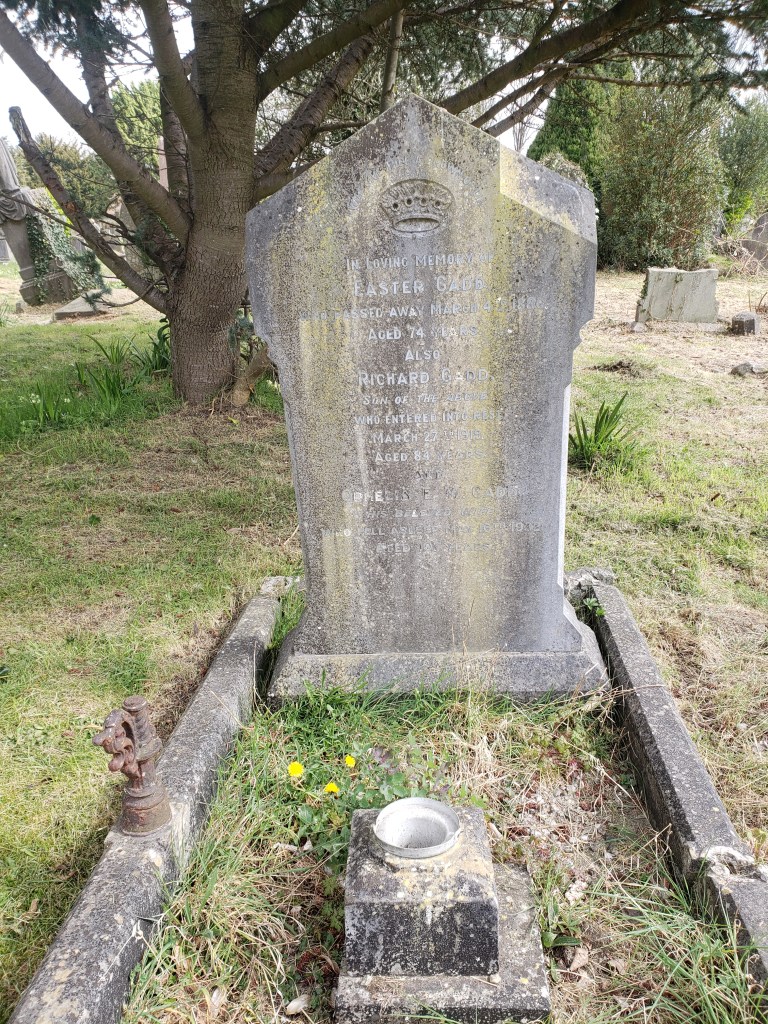
I’ve often paused at this headstone and wondered what the upstanding Mr Gadd might have looked like and what his profession might have been. Something in the legal profession I imagined, or possibly a vicar with such an appropriate name, a character stepped straight out of a Dickens novel.
But Easter Gadd was not a man but a woman.
Easter was born on August 27, 1811, the daughter of Henry and Mary Pascall and baptised at George Street Independent Church, Croydon, Surrey in October.
She married Richard Gadd at St John’s Church, Croydon by licence on April 5, 1833 (which just so happened to be Good Friday that year) and most clearly signed her name as Easter. I mention this as there appears to be a certain amount of confusion as to the spelling of her name on official documents, especially census returns, when she is frequently recorded as Easther or Esther.
But when she was baptised, married and died her name was most definitely recorded as Easter.
Richard and Ophelia Gadd and their five children
When Easter died in 1886, she was living with her son Richard and his family. Richard, it can be assumed, arranged for his mother’s headstone to be erected and had overseen the spelling of her name. Now I have the utmost faith in the accuracy of the spelling on the gravestone and I’ll tell you why – Richard’s immaculate attention to detail.
Richard Gadd was born in Croydon on July 1, 1834. His father died on May 17, 1835 and at the time of the 1841 census Easter was living with her brother-in-law Charles Gadd and his family in Lambeth, South London.
By 1851 she had moved to Hulme, Manchester and was living with her widowed brother William Pascall and his daughter where she is described as ‘housekeeper.’ The enumerator records her name as Esther (because he obviously knew better!)
Easter remains living with William for more than ten years and after that with various nephews and nieces until the census of 1881 when she is living at Lima Terrace, Ashton upon Mersey (today a part of Greater Manchester) with Henry Pascall who is confusingly described as her son (like we need any more confusion in this story). By the way, the census enumerator spells her name as Esther. I’m beginning to wonder if Easter was a bit of a chatterbox and confused these men as they recorded her details.
Sometime after this date Easter moved to Swindon to live with her son Richard and his family. Richard had settled in Swindon in 1853 when he started work as a clerk in the GWR Works.
Richard left the employ of the GWR sometime in the 1860s when he is recorded in Harrod’s Directory as an architectural & mechanical draughtsman living in Prospect Place. However, by 1891 he was back at the Works working as an accountant where he remained until he retired in 1899.
At the time of the 1881 census Richard lived at 35 Prospect with his wife Ophelia, their son William, who was a railway draughtsman, and their two daughters Annie Ophelia and Edna Mary.
Easter died shortly after moving to Swindon. Her funeral took place on March 10, 1886 when she was buried in plot E8427 where she was later joined by Richard and Ophelia.
Now why am I so certain Richard has spelled his mother’s name correctly? Well, it is because of the 1911 census returns. On this document the head of the household completed the form themselves unlike in previous censuses when an enumerator did it for them.
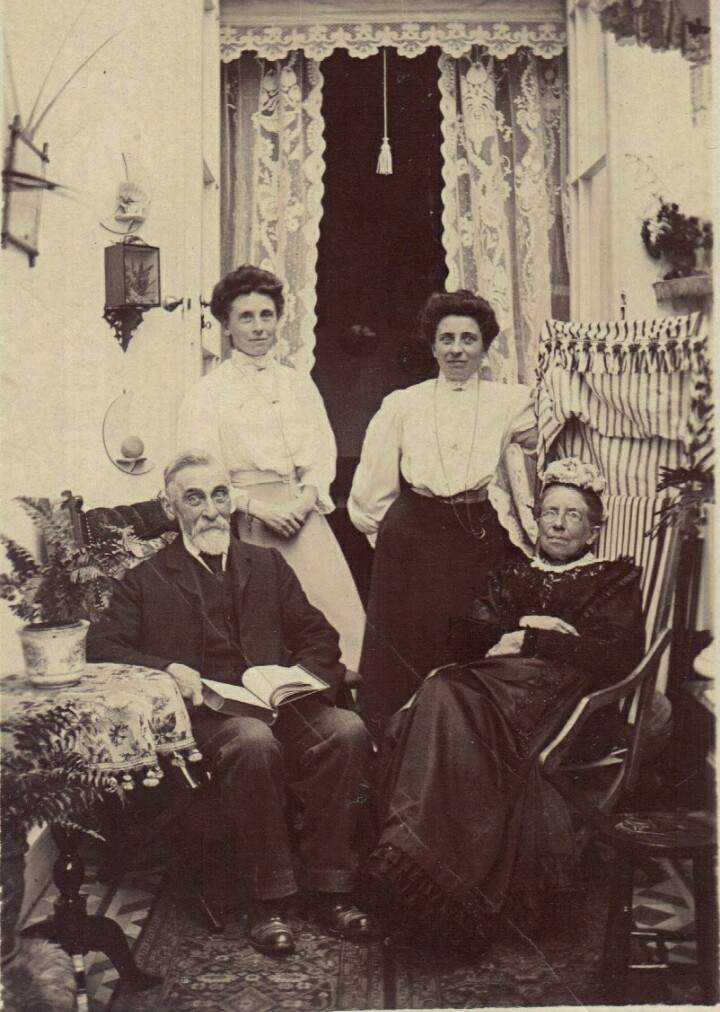
Richard and Ophelia Gadd in old age with their two daughters
As you would hopefully expect of an accountant, Richard completes the form with meticulous accuracy. He states that his age is 76 9/12 (that is 76 years and 9 months). Ophelia was 80 8/12 and their daughter Edna Mary 47 4/12. (The young domestic servant Mary Coxhead is recorded as 15 years old. Perhaps he didn’t know her date of birth or maybe he didn’t ask!) He declared that he and Ophelia have had 5 children, all of whom are living, and that they have been married 56 3/12 years.
Now a man like that will definitely get the spelling of his mother’s name correct on her gravestone.
Three of Richard and Ophelia’s children are buried in the neighbouring grave plot E8428. William who died in 1944 aged 85; Annie Ophelia who died in 1955 aged 86 and Edna Mary who died in 1958 aged 94.
Images of Richard and Ophelia Gadd and their family are published courtesy of an Ancestry public family tree.
During some 20 years of research at Radnor Street cemetery I have discovered some fascinating family stories. Among my favourites is that of the Alley family who I’ve featured at various times on cemetery walks.
George Richman Alley and his brother Frederick were both born in Trowbridge and eventually made their way to Swindon and jobs in the Works.
This is the story of George (pictured below) with his wife Emma on the occasion of their youngest daughter’s wedding at the Baptist Tabernacle in 1911.
The family moved to Swindon in the 1870s when they lived first at 3 Carfax Street and then at 8 Merton Street. The couple had a son George who pursued a career in the navy and 8 daughters (Annie died just after her 1st birthday).
The bride in the photograph, Eva Ross Alley, married George Babington on March 1, 1911 at the Baptist Tabernacle. The couple managed a draper’s shop at 92 Victoria (next to her sisters’ millinery business). Eva died in 1978 aged 92.
Ethel Gertrude Alley worked as a milliner with her sister Amelia. Another active member of the Baptist church, Ethel married Wilfred Hewer, a tailor. They later ran the Oddfellows’ Arms in Cricklade Street. Ethel died in 1958 aged 74.
Flora Elizabeth Alley was a teacher until she married William Harold Hall. The couple had two children and lived in Country Road. Flora died in 1974 aged 93.
Amelia Annie Alley was the only sister not to marry. She worked as a milliner at 90 Victoria Road and was also a member of the Baptist Church. She died in 1973 aged 94.
Mabel Alley married Thomas Charles Harding. In 1960 she was awarded the British Empire Medal for Meritorious Service as sub postmistress at Westcott Place Sub Post Office for 50 years. She died in Cheriton Nursing Home in 1965 aged 88. Her daughter Vera is the little bridesmaid in the photo.
Maud Richman Alley was a dressmaker. She married Henry J. Lewis in her 40s and lived in Chippenham. She died in 1963 aged 93.
My interest in the Alley family began when I discovered the story of eldest daughter Emma Louisa who trained as a tailor, married Walter Lloyd Hull and moved to Bournemouth. Emma (known within the family as Lousia) took an active role in the Votes for Women campaign in the early 20th century. She joined the Women’s Freedom League formed in 1907 by Teresa Billington-Greig and Charlotte Despard in a break away organisation from the Pankhurst led Women’s Social and Political Union.
Emma was arrested several times, once with several other women who all gave their name as Smith or Smythe. On another occasion she was among a group of women who cheered the magistrate from the dock in appreciation of the way he had dealt with their case.
She returned to Swindon after the death of her husband in 1947 and gave talks to local women’s groups about her involvement with the suffrage campaign. She wore a badge carrying an engraving of Holloway prison. Other suffragette souvenirs she had included a Votes for Women banner and a cocoa mug and a salt pot smuggled out of Holloway gaol!
Emma eventually returned to Bournemouth where she continued to tell her story. She died on July 24, 1967 aged 100 years old.
Who’s Who in the wedding photographas provided by a family member
George Richman Alley died aged 84 at his home 8 Merton Street and was buried in grave plot D31A on December 1, 1925. His wife Emma died aged 87 at 12 Park Lane and was buried with him on October 24, 1932.
Two interesting properties, long since demolished, and the story of one woman who lived in both of them – Adelaide Carlton.
Messrs. Bishop and Pritchett are favoured with instructions from Mr C. H. Barker to sell by auction, at their Sale Room, Regent Circus, Swindon, on Monday, September 28th, 1903, at Seven o’clock in the evening …
Lot 2 – The substantial stone-built residence, of roomy accommodation, known as “Elm Villa,” Wellington Street, Swindon, with flower garden and lawn, a useful shed with paved floor, off which are harness room and well-fitted stabling, having a loose box and three stalls with loft over, a large coach house with loose box, and a yard with good entrance from Merton Street.
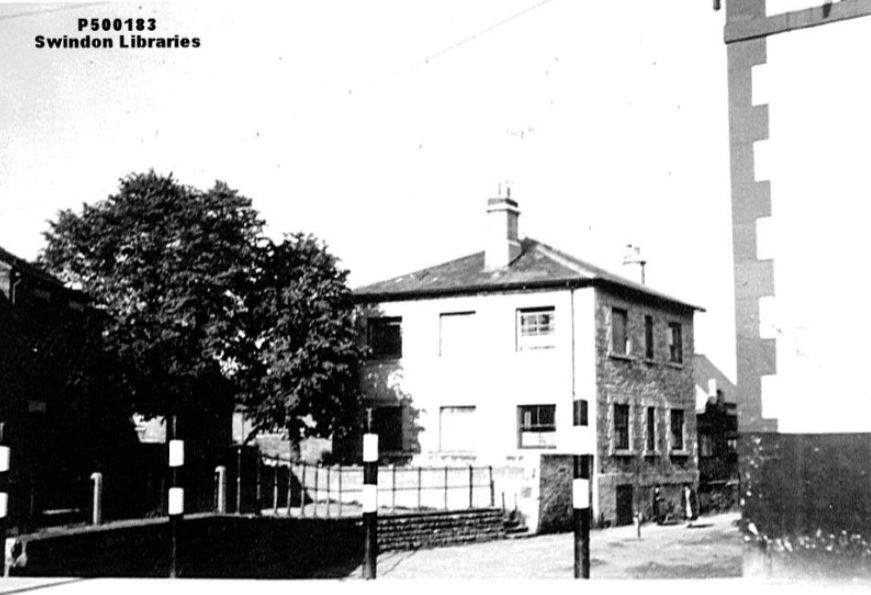
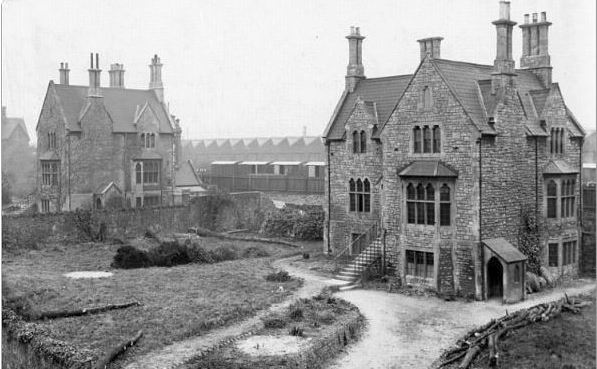
These managers residences or villas (Marlow House is on the left) were built to the north of Swindon Station. Similar houses had once stood adjacent to the Railway Village but were demolished in the 1870s.
It is probably fair to say that Edmund and Elizabeth Bramwell were an aspirational couple. Edmund was a fitter and turner in the Great Western Railway Works, a skilled occupation in which he had served a lengthy apprenticeship. Elizabeth had worked as a school mistress, a career she could no longer pursue after her marriage, a situation that didn’t alter within the teaching profession until 1944.
Edmund Bramwell and Elizabeth Burroughs married at Christ Church, Swindon on December 23, 1854. They both came from a railway family. Edmund’s father Joseph was a mechanic as was Elizabeth’s father Richard.
The couple made their home in Reading Street where their four daughters were born; Frances in 1856, Mary in 1859, Clara in 1866 and Maud in 1870.
Frances and Mary trained as draper’s assistants. By 1881 Mary had left Swindon and in subsequent years worked in large stores in Bath and Birmingham. Clara and Maud became teachers. Clara began her teaching career working as a 14 year old pupil teacher. By 1891 she was headmistress at one of Swindon’s local board schools. Her sister Maud also worked as an Assistant School Mistress.
Swindon Suffragette Edith New was some ten years younger than the two teaching Bramwell sisters. In 1891 she was also beginning her teaching career as a 14 year old pupil teacher in Swindon. By 1908 she had left Swindon and teaching and had joined the women’s suffrage movement as a paid organiser for the Women’s Social and Political Union. Edith fought in the Votes for Women campaign, serving several terms of imprisonment and going on hunger strike. She eventually returned to teaching and devoted her life to fighting for women’s rights within that profession.
Edith New
Perhaps the sisters followed the news of Edith’s involvement in the suffrage campaign, which featured in the Swindon Advertiser on several occasion. Perhaps they had known her when they were all setting out on their teaching careers.
Draper’s Assistant Frances married in 1885, ending any career progression she might have had. She briefly moved away to Portsmouth where her husband was a fitter in the dockyard and where her son Edmund was born, before returning to Swindon by 1890.
Maud married in 1896 and Clara married in 1901 and in so doing sacrificed their teaching careers. Clara’s status as Headmistress was not even mentioned on her marriage certificate.
Elizabeth Bramwell died in 1907 and was buried in grave plot D87 with her brother Samuel Burroughs, a boilermaker, who had died five years previously. Her husband Edmund died in 1910 and was buried with her. Mary, the daughter who spent a lifetime working in the drapery business, eventually returned to Swindon. She was buried in the family grave on January 18, 1911.
Frances died in 1915 and is buried with her husband in grave plot B3327.
Clara died in 1909 and is buried alone in grave plot E8626B
Maud died in Swansea in 1957.
After a life time teaching in London, Edith New retired to Polperro in Cornwall where she died in 1951.
In a blogpost last year I mentioned that there were very few old photographs of the cemetery. There were only three pre-dating the 1920s and two of these were taken by William Hooper. And then when I looked more closely into the work of this prolific Swindon photographer I found another taken at the funeral of his mother-in-law Eleanor Stroud.
Eleanor (sometimes known as Ellen) was born in Aldbourne in 1834, the daughter of agricultural labourer Thomas Brind and his wife Mary. She married James Stroud, also from Aldbourne, a railway guard, in 1864.
In 1871 Eleanor and James lived in Leominster with their two little daughters, Mary Jane 3 and Alice Kate 1. By 1881 the family had moved to 22 Merton Street, Swindon. On census night James and his daughters were at home. Eleanor, meanwhile, was employed as a monthly nurse at number 10 Merton Street where Annie Hacker had given birth three days previously.
In 1891 Mary Jane married William Hooper, a stationery engine driver with a passion for photography.
Two years later James Stroud was involved in a fatal shunting accident at Tetbury Road station when he was crushed between a waggon and the goods shed. He was brought to the GWR Medical Fund Hospital in Swindon but sadly died as a result of his injuries the following day on January 14, 1893.
After the death of her husband Eleanor lived with her elder daughter Mary Jane and her husband William Hooper. By 1911 William was working full time as a Portrait and Landscape Photographer. Eleanor is pictured here with William and Mary in their roof garden at Cromwell Street.
Eleanor Stroud died at her daughter’s home 6 Cromwell Street. She was buried on April 29, 1915 in grave plot A823 alongside her husband. William took this photograph at her funeral.










 Radnor Street Cemetery