Another day, another churchyard – Christ Church

I am intrigued by the two spinster sisters with names that could come straight out of a Thomas Hardy novel, Tryphena and Hephzibah Evenden. 

Family historians researching the Evenden family have little information about these two unmarried sisters who left no descendants and apparently no photographs either. 

As is so often the case these women lived within a close knit family but when they died their life’s work disappeared into the ether. No doubt there were nephews and nieces who retained fond memories of their two aunts, but more than a hundred years later nothing is left of these women except a handsome headstone in Christ Church graveyard.

The two sisters were born in Wrotham, Kent the daughters of John Evenden and his first wife Naomi Frances. Hephzibah was christened on March 26, 1820 and Tryphena on July 16, 1826 in St George’s Church, Wrotham.

They first appear in Swindon on the 1881 census returns living at Ightham Villa, (a property named after their childhood home) Bath Road, but how did they end up here?

You would think that with such distinctive names it would be easy to track them through the census returns. In 1841 Hephzibah is living with her sister Ruth and brother John in Wrotham where he works as a grocer. In 1851 she is visiting the Leney family in Bow Road, Wateringbury while Tryphena is at home in Greenhithe, Swanscombe with her father, his second wife Sophia Sarah, her grandmother Elizabeth Evenden and three servants. 

I can’t discover what the women’s father did for a living as he describes himself variously as a ‘fund holder’ and a ‘gentleman’.

So, in 1881 the sisters are living in Bath Road where Tryphena died on August 1, 1889 and Hephzibah on July 21, 1905. Tryphena leaves effects valued at £5,398 2s 11d and Hephzibah £9,894 3s 1d. Both women leave their estates to the administration of Swindon bank manager William Wearing,

Tryphena is a Greek name meaning ‘delicate’.

Hephzibah is from the Hebrew ‘my delight is in her’

Beautiful names due for a revival.
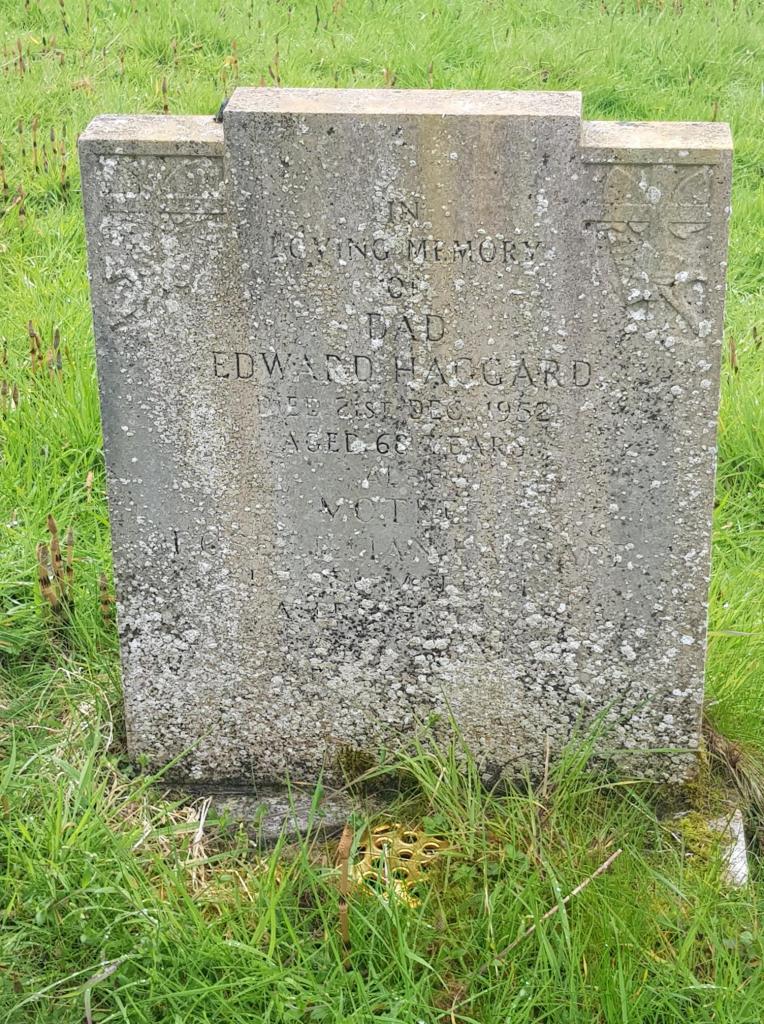
The Haggard family

The first time I heard the story of Charles Edgar Haggard was more than 20 years ago on a cemetery walk with Mark Sutton. He told how Charles, a regular soldier at the outbreak of war in 1914, was captured in 1915 and spent the rest of the war in a German prisoner of war camp.

Mark told the story with such pathos that it has always remained in my memory and I too have written and spoken about Charles Haggard on many occasions since.

This is the story of his brother Edward and his three sons, Gordon, Eddie and Cyril.

In the middle of Section C there is a cluster of Haggard family graves, the family of Charles’s brother Edward.

Edward was younger than Charles by two years. Like Charles he was born in Minety while his father was landlord at the Old Red Lion Inn. By 1891 the family were living at 60 Stafford Street, Swindon where on his 15th birthday in 1899 Edward began a 6½ year Tender & Fitting apprenticeship in the Works. He married Rose Lillie Edwards in 1913 and the couple had three sons.

Edward died in 1952 and Rose in 1969 and they are buried in grave plot C180.

They are surrounded by the graves of their three sons. Gordon died in 1933 aged just 10 years old. He is buried in grave plot C155 with his brother Eddie who died in 1992 aged 78.

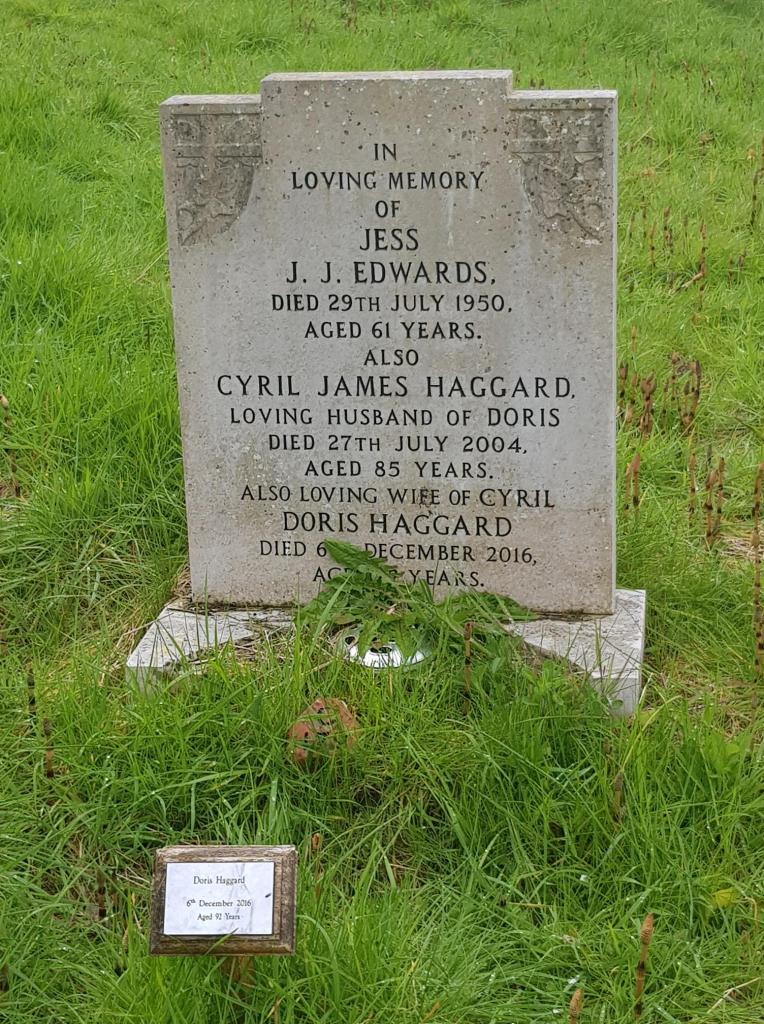
Close by in grave plot C179 is family member Jess J. Edwards who died in 1950, and is buried with the youngest Haggard son, Cyril, who died in 2004 aged 85. The last burial in this family plot was that of Cyril’s wife Doris who died in 2016 aged 92.

Walter Perkins – one of the ordinary people of Swindon

The purpose of this blog is to record the lives of the ordinary people of Swindon, and that is exactly what Walter was.

Born in 1884 Walter makes an appearance on the 1891 census when he lived at 20 Vilett Street. His father Joseph, born in Banbury, was an Iron Moulder in the Works. His mother Elizabeth, born in Stratton, was busy having babies – five by 1891. She had 9 in total with 7 surviving childhood.

By 1901 the family were living at 21 Farnsby Street. Walter 17, and his younger brother Hubert 14, had already begun their Fitting apprenticeships in the Works.

In 1911 Walter was one of 6 children still living at home with Joseph and Elizabeth at 63 Curtis Street. He was the eldest at 27, William John Perkins, his youngest brother, was 9.

Walter married Florence M. Farr in the June quarter of 1919. He died on May 18, 1933 aged just 49 years. He was buried in grave plot C88 where he was later joined by his sister-in-law Frances Annie Hardiman who died in 1959.

There are so many facts about Walter’s life that remain unknown. Did he serve in WWI? Did he and Florence have any children?

Walter Perkins, one of the ordinary people of Swindon.

In Cherished Memory of

My dear Husband

Walter Perkins

Who passed within the veil

May 18th 1933

Resting where no shadows fall

Peacefully sleeping he waits us all

The Clifton Hotel

Any old building worth its bricks and mortar should have a spectral presence and The Clifton has long boasted one of its own. Supernatural sightings have included those of a hooded figure, possibly a nun, in keeping with the tradition that the pub was built on the site of an ancient priory. However, evidence to support this legend is lacking.

The surrounding area once comprised part of the former Kingshill Estate owned by John Harding Sheppard where around 300 houses were built along Clifton, Albion, William, Redcross (renamed Radnor) and Exmouth Streets between 1877 and 1880. The Clifton Hotel, complete with a tiled mural of Brunel’s Clifton Suspension Bridge, was built around 1878.

As with so many Swindon Streets, Clifton Street grew piecemeal across a number of years. Among the 19th century builders was Job Day who constructed an unspecified number of cottages in 1882 and Edwin Harvey who built eleven houses in the same year with further properties in 1883. W.H. Read designed Clifton Street Schools in 1884-6 and the Primitive Methodist Chapel, built in 1900, was designed by R.J. Beswick.

To date no documentary evidence of a priory has made an appearance, and neither has the nun. Apparently religious ghosts have slipped out of fashion in recent years.

Ghostly goings on at The Clifton hit local news headlines during one busy Christmas Day celebrations when a poltergeist joined Christmas revellers.

Manager’s wife Mrs Blanche Chirgwin reported sherry glasses jumping from shelves behind the bar while her husband recalled an eerie presence in the beer cellar. Then there was the story of a previous landlord’s dog that went mad and a jammed attic window found open only to jam again.

One long serving landlord at The Clifton was Cardiff born Henry Jefferies and his wife Frances. Local trade directories place them at the pub in the mid 1880s and Frances was still there at the end of the 19th century.

During their occupancy of the pub, two of the couple’s sons died, Edwin in 1887 and Frank ten years later. Henry died in 1896 and was buried with his son Edwin Bernard Jefferies in Radnor Street Cemetery, grave plot A778. Frank died in 1897 and is buried in neighbouring plot A779. Frances returned to Cardiff where she married Isaac Edmunds in 1902. She died in 1920 and was buried back in Swindon with her son in plot A779.

The Paranormal Site Investigators (PSI) conducted an overnight investigation at the pub in March 2005. Despite a few bumps in the night the team failed to detect any ghostly activities. And still no sign of the nun.

Views of The Clifton Hotel in the 1950s and 60s published courtesy of Arkells and Local Studies, Swindon Central Library.

William Henry and Sarah Daniels

Most of us would extend a helping hand to a family member on hard times. Make sure they had food in the cupboard, perhaps lend them some money, maybe even put them up for awhile until they get back on their feet, but Sarah Daniels went way beyond this.

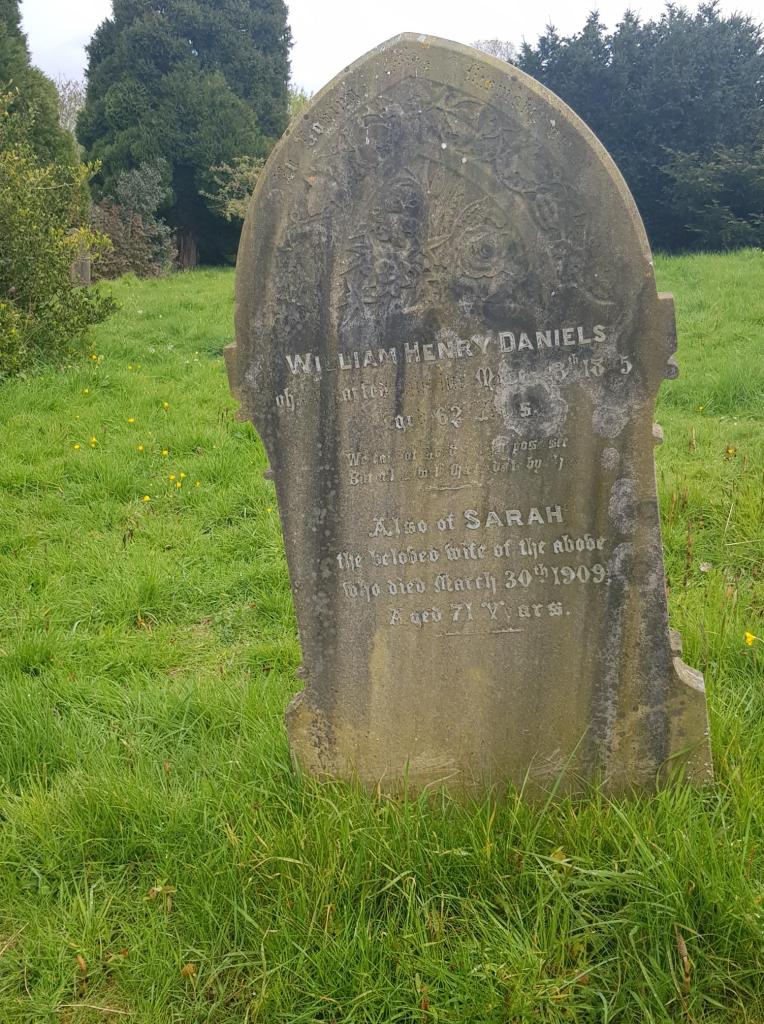
Sarah Bull married William Henry Daniels in 1855. By the time of the 1861 census they were living at 42 Westcott Place. William worked as an Engine Driver. They had a 4 year old daughter Dianah and living with them were Sarah’s elderly mother and William’s brother Samuel, an Iron Factory Labourer.

Ten years later Sarah and William had 3 children. Sarah’s mother died in 1867 but Samuel Daniels, now an Engine Driver, continued to live with them. Perhaps Samuel wasn’t down on his luck, perhaps he just liked living with his brother and enjoyed the home comforts.

In 1881 William and Sarah were living in Merton Street with their daughter Diana, now 24 years old and sons Mathew 19 and Frederick 16, both employed in the Carriage Works. Oh yes, and Samuel as well.

In 1891 the family were living just round the corner from the cemetery at 5 Clifton Street – they even employed a young servant girl to help Sarah with the housework. Only younger son Frederick continued to live with William and Sarah – and Samuel of course.

William Henry Daniels, Engine Driver, died aged 62 years old at 55 Farnsby Street in March 1895. In 1901 Sarah is living with Samuel at 22 Reading Street, where he is recorded as head of the household.

Sarah died in 1909 at Boxbush House, Brinkworth. She was buried on April 3 in grave plot B2414 with her husband William – but without Samuel!

Frederick Leonard Hayes – the reveal

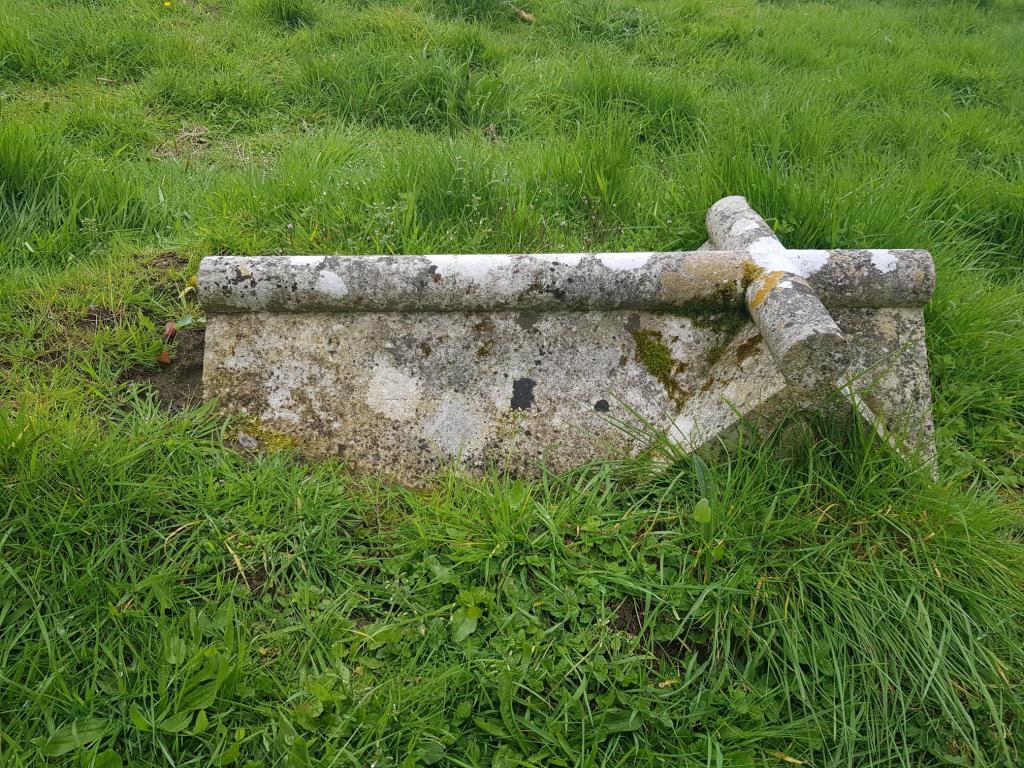
I’ve often stopped at this beautiful little memorial discovered by Bex last November.

On our recent seed scattering exercise, Bex and I paused here and wondered if there might be an inscription we were both missing. Using a cloth she carefully rubbed a handful of loose earth across the stone and as if by magic an inscription began to appear. We could soon see the name of Frederick Leonard Hayes who died in 1890 aged 15 months, eldest son of Joseph and Teresa – enough information for me to begin researching when I got home.

In 1891, the year after Frederick’s death, I found his parents living at 63 Prospect where Joseph worked as a Master Stone Mason. Joseph and Teresa left Swindon soon after this and ten years later, at the time of the 1901 census they were living in Shrewsbury with their younger son Bernard, where they remained for the rest of their lives.

But there is something special about little Frederick’s memorial. The grave is a public one that Frederick shares with two other children; four year old Maud Mary Young who died around the same time as Frederick in 1890 and Dorothy Ann Cowley, a 5 month old baby girl who died in 1905 – 15 years after Frederick.

It is most unusual to discover a memorial on a public grave. I wonder when Frederick’s family were given permission to install it and whether Joseph, the master stone mason, made it himself.

Wild flowers

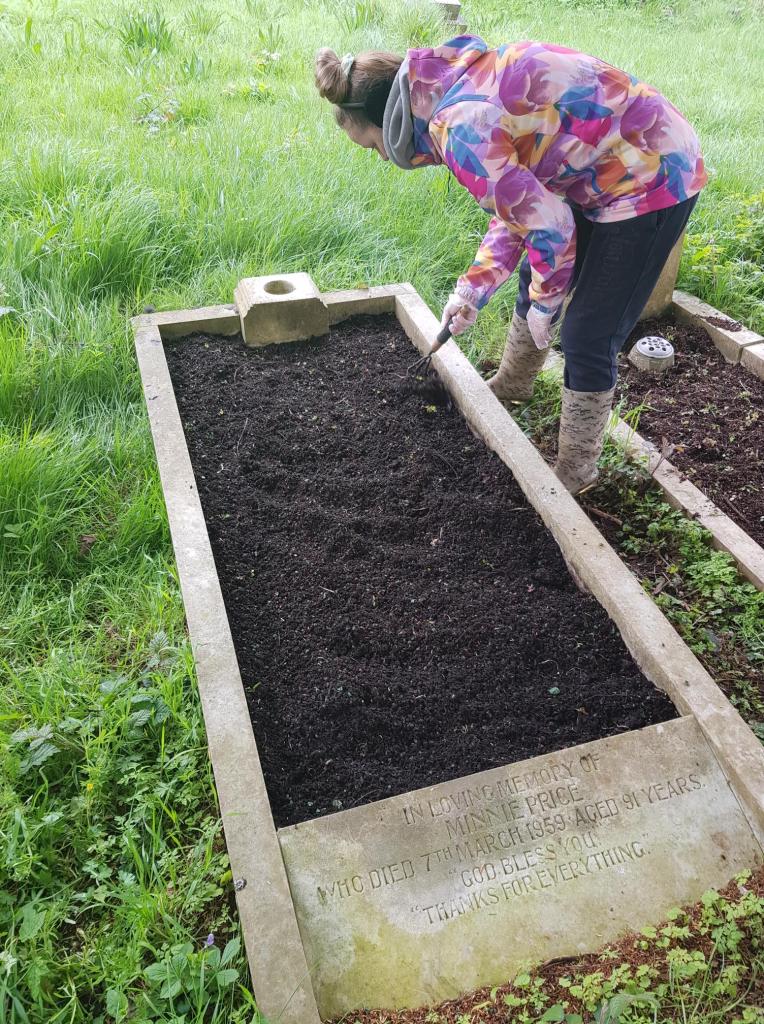
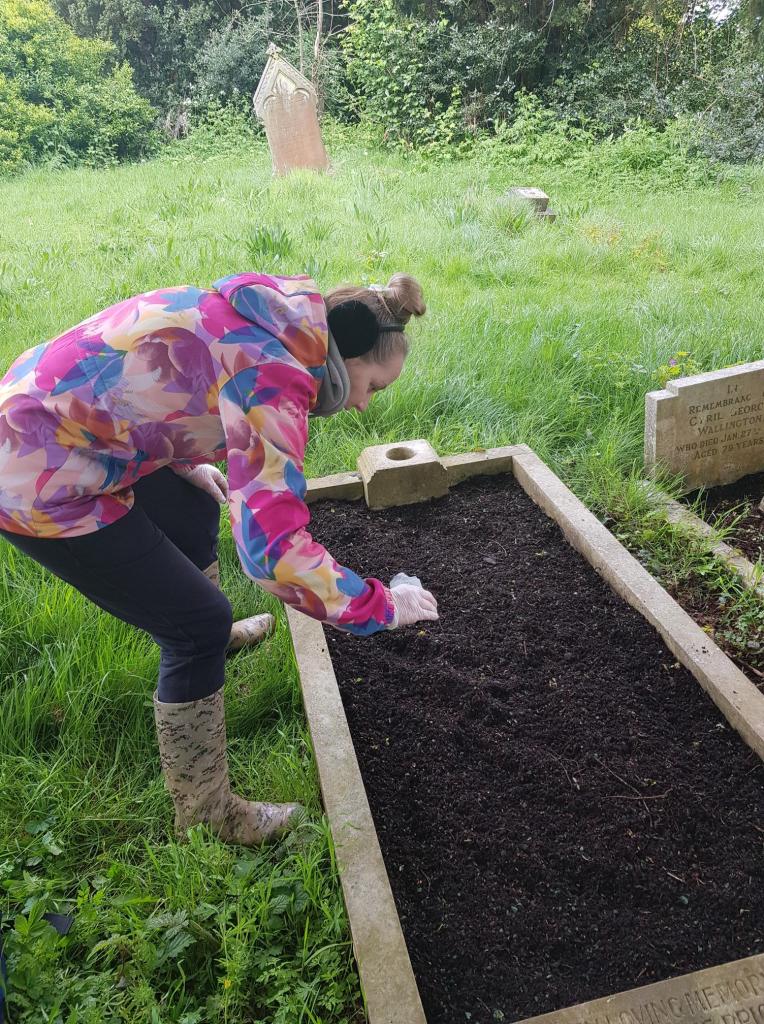
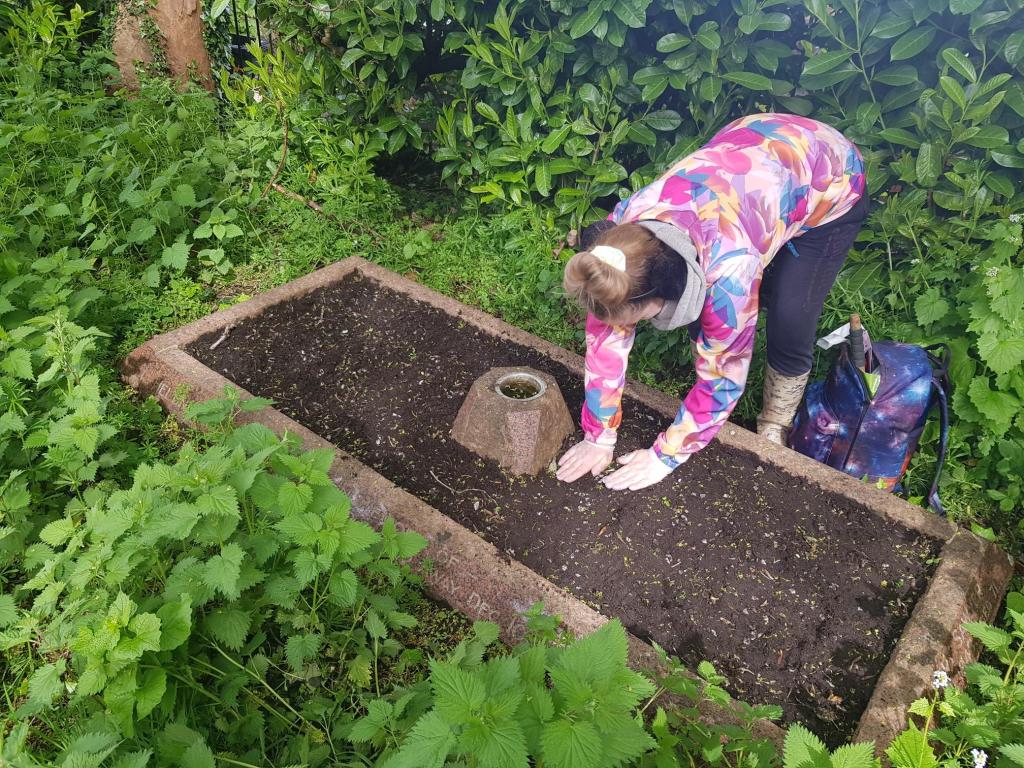
At the end of our cemetery walk yesterday one of our regular followers donated an envelope of wild flower seeds. She explained she had no garden of her own and that she would like them used in the cemetery, so today I accompanied cemetery volunteer Bex to scatter the seeds. We had decided on dividing the small envelope between two of our favourite ladies – Minnie Price and Helene Celine Sawyer – two graves that Bex regularly attends to.

We’ll keep you updated!

Guided Cemetery Walk April 28.

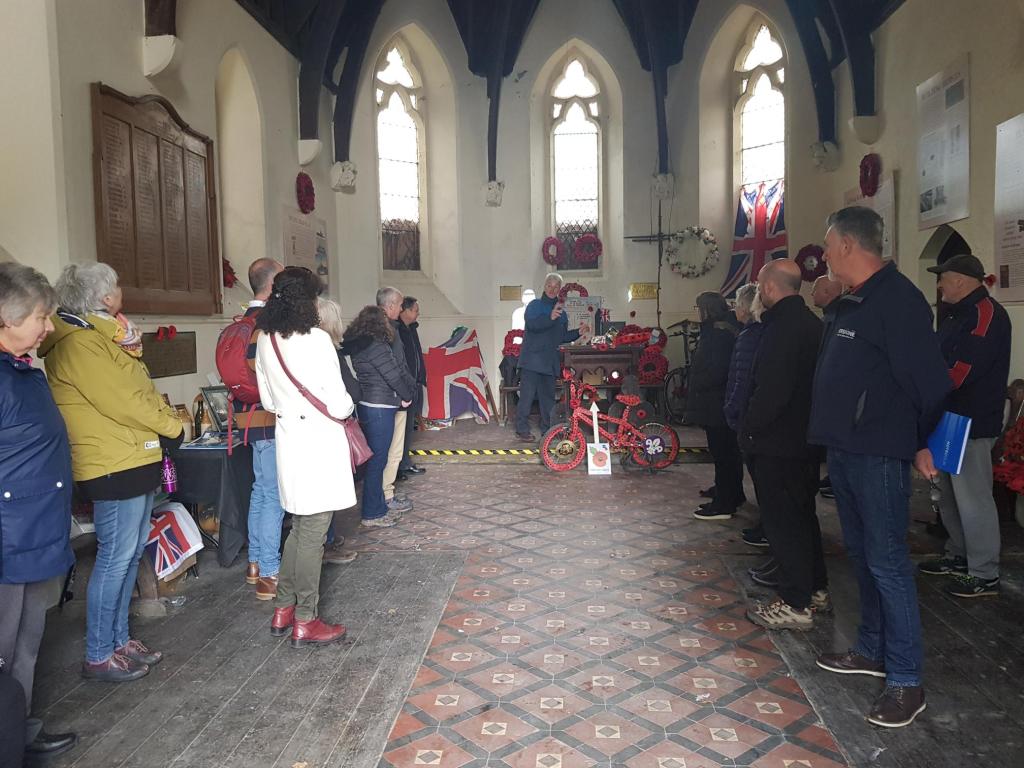
Thank you to everyone who joined us on Sunday for a guided cemetery walk. We are always so fortunate with the weather and following a morning of rain we enjoyed a dry and pleasant afternoon.

This week Andy, Kevin and I told the stories of Trooper Cecil Howard Goodman and Scout leader William Rowland Bird among others and I will (eventually) sort out the story of Olive Henry, which has left me in confusion over recent weeks.

Here are a few cemetery photographs. Our next walk is on Sunday May 26.

Job Richardson – House and Estate Agent

Image of Rodbourne Road published courtesy of Local Studies, Swindon Central Library.

It’s not very often I get the opportunity to visit a house owned by the same family for 100 years (unless they are an aristocratic family) but recently I did. One hundred years of children running up and down the narrow stairs, one hundred years of washing on the line. There was even a saucepan dating back to those days – how many meals had been dished out from that pan and eaten at the kitchen table where I looked at family photographs and letters?

At the end of the 1860s Even Swindon was still mostly farmland but with the Great Western Railway Works on the doorstep it was growing fast. Development began in the 1870s with the sale of Northaines Farm, Edwards Farm and part of Even Swindon Farm and an early speculator was Job Richardson.

Job Richardson was born in 1842 in Somerset, the son of coal miner Elijah Richardson and his wife Eleanor. By 1861 19-year-old Job was also working in the Somerset coal mines.

In 1866 Job married Henrietta Milsom in Radstock.  Sadly, Henrietta died the following year, during or soon after the birth of her daughter Henrietta Milsom Richardson. She is buried in the churchyard at Radstock, most probably with the baby who died. By 1871 Job had moved to Bath, lodging in St James Parade, where he worked as a mason.

In 1872 Job married Sarah Rebecca Tanner at the parish of Widcombe, Somerset and by 1877 they had arrived in Swindon where Job bought land in Even Swindon. In 1881 Job was living at 33 Henry Street (quickly renamed Hawkins Street to avoid confusion with a street in the town centre) and working as a House & Estate Agent.

1884 notice published courtesy of Rodbourne Community History Group.

Job and Rebecca later moved to 133 Clifton Street but continued to rent out their properties in Rodbourne. Job died in 1903 and is buried in grave plot D163 with his father-in-law Henry Tanner who died earlier that same year. Rebecca sold her stake in the Rodbourne properties in 1924 and was buried with her husband and her father on January 4, 1928.

John Seward – retired butcher

Butcher John Seward was born in Dunsford, Devon in 1835. In 1861 he was living in London when he married Mary Jane Connett at St Dunstan’s Church in the West, Fleet Street.

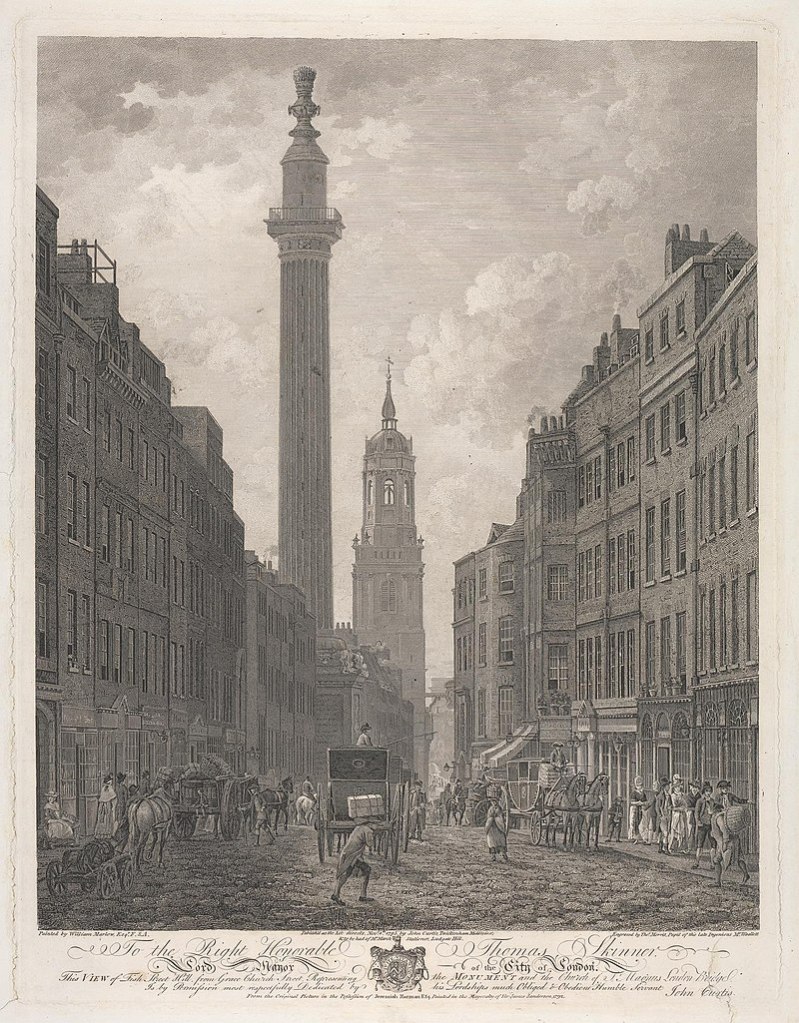
The newly weds set up home in a fishy part of London with butcher John Connett, no doubt a relative of Mary Jane. They all lived in Fish Street Hill in the parish of St Margaret New Fish Street, which runs at the back of the Monument to the Great Fire of London.

In subsequent years they lived in Haggerston Road, Hackney and Paignton Road, Tottenham. Then, after more than 30 years living and working in London, John and Mary retired to Swindon and a property in Ashford Road that they named Devonshire House.

John died in 1903 and was buried on July 25 in grave plot E8606. He was later joined by his son-in-law John P. Jackson who died in 1905 and his wife Mary Jane Seward who died in 1906.