A piece of Paradise

If you are looking for an escape this beautiful April Sunday you will find a piece of paradise in the churchyard at St. James’s, Avebury.

As you might expect the parish church of St James’s, Avebury is an ancient one. A place of worship has existed on this site for more than a thousand years and evidence of those Anglo Saxon builders remain in the church today, including masonry, window apertures and the tub font.

The present church includes a magnificent 15th century rood loft saved by the parishioners a century later when such features were banned. Concealed behind a lathe and plaster construction on the east wall of the nave it was rediscovered during restoration work in the early 19th century. Outside in the churchyard the headstones are arranged in neat rows, although unfortunately few survive from the early history of the church.

Lying in their own piece of paradise is the fittingly named Paradise family. James Paradise was born in Avebury, the son of Francis and Hester Paradise, and was baptised in St James’s on March 29, 1763. On December 11, 1794 he married Susanna Townsend at Winterbourne Monkton. The parish register for that church reveals that James made a firm signature while Susanna made just her mark.

Susanna returned to James’s home in Avebury where she raised a large family of 13 children, all of whom were baptised at St. James’s church. Her first child, a daughter named Hester after the child’s paternal grandmother, was baptised on November 1, 1795 and her last, another daughter, Jane on December 6, 1821.

James appears to have spent his working life as a labourer, although when he made his Will in 1834 he describes himself as a Yeoman. James died in March 1837. His detailed Will runs to four pages, but Susanna’s, written in 1838, is much more straightforward.

This is the last Will and Testament of me Susanna Paradice of the parish of Avebury in the County of Wilts Widow I give and bequeath all my monies and securities for money wearing apparel Personal Estate and Effects whatsoever and wheresoever unto & equally between all my daughters who shall be living at the time of my decease and I hereby appoint Hester Underwood wife of George Underwood sole Executrix of this my Will hereby revoking all former Wills by me at any time heretofore made and declaring this only to be my Will In witness whereof I have to this my last Will and Testament set my hand and affixed my seal this fifteenth day of August one thousand eight hundred and thirty eight Susanna Paradice – Signed by the Testatrix Susanna Paradise in the presence of us present all the same time who have hereunto subscribed our names as witnesses this fifteen day of August one thousand eight hundred and thirty eight John Whittington Solcr Bristol Robert Coles his Clerk.

Susanna died in January 1841 aged 66 years and was buried on January 8 with her husband James. Susanna’s five daughters were all still living at the time of her death.

Eldest daughter Hester, whom Susanna made her executrix, married George Underwood, a sawyer, in 1821. She had just one surviving daughter, Ann. Hester died in 1845.

Second daughter Sarah married agricultural labourer George Coleman in 1831. When she made her Will (valued at a Personal Estate of £22) she appointed Thomas Kemm, gentleman farmer at Avebury Manor, as her Executor. Sarah died on April 11, 1884 aged 84.

Third daughter Ann married James Dew, a master Carpenter on July 4, 1839. She died in 1865 aged 55.

Fourth daughter, Eliza married William Maton, a joiner, on February 12, 1835. Eliza had two sons, John and James. On April 9 1849 they set sail on the Tory for a new life in New South Wales.

Youngest daughter Jane Paradise married Thomas Blake, a saddler, on October 20, 1842. Jane had at least seven children and died in 1908 at the age of 86.

While James and Susanna’s daughters lived long and eventful lives their sons were not so fortunate, four of them dying at a tragically young age.

The burial registers record that Richard Paradise died aged 9 was buried on January 7, 1815. His death had occurred ‘by an accident from an Horse.’

Next to be buried in the churchyard at Avebury was James and Susanna’s eldest son George. Born in 1797 George died in 1817 aged 19 years.

On February 4, 1830 William Paradise was buried next to his brothers George and Richard. He died aged 23 years and according to the burial registers he was ‘accidently killed.’ Aaron Paradise died in 1832 aged 20 years old and joins the sad row of brothers reunited in death.

Today the churchyard at St. James is a tranquil place, despite the many visitors who visit historic Avebury, a tourist attraction since time immemorial.

The Church of St. James’s, Avebury

Paradise family graves

The four widowed Sendell sisters

I read a lot of newspaper reports as part of my cemetery research and I’ve noticed that both the style of writing and the content has changed considerably over the years.

Back in the 19th century local newspapers published at great length meetings of governing bodies in the town – the Local Board Meetings (precursor of Swindon Borough Council) for both Old and New Swindon, the Swindon School Board and the Mechanics’ Institute Council to mention just three. Columns and columns of tightly packed print recording who said what to and about whom! The Great Western Railway featured prominently as might be expected with reports of social events, the retirement of old railwaymen, accidents and inquests where all the gory details were reported.

And then there are the odd gossipy bits that creep in. In Arthur Jefferies Lewis White’s obituary there is a reference to his widow with the comment –

Mr White’s widow is a Swindon lady, formerly a Miss Sendell. She will be the fourth widow in the family of the Sendells – three other sisters having lost their husbands.

So, of course, that set me off on the search of these sisters.

The first of the three sisters to marry was the eldest Ellen who married Herbert Henry Llewellyn a railway clerk. The couple lived at 23 Dixon Street where Herbert died in 1898 aged just 27. Ellen returned to the family home where she can be found on the 1911 census. She died at St. Margaret’s Hospital on May 23, 1943 and was buried with her husband.

The next sister to marry was Kate and her story requires more research. Kate married George Astill a draper in 1904 at St. Saviour’s Church, Brixton Hill, South London. Their son Reginald was born in Otago, New Zealand but baptised in the UK in June of that year before George and Kate returned to New Zealand. On April 6, 1912 Kate and her 3 year old son arrived in London without her husband George. Was this just a holiday; a family visit? Did she plan to return? George died the following year in New Zealand. Kate’s last home was 344 Western Avenue, Acton. She died in the Central Middlesex Hospital in 1956.

Youngest daughter Margaret married Charles Robert Tippetts in the Wesley Chapel, Faringdon Street on April 19, 1915. He died in 1928 and Margaret died two years later. They are buried together in grave plot E8204, next to Margaret’s parents.

Emily Sendell was born in 1876, the third of four surviving daughters. Her parents Henry and Lucy married in Chipping Norton in 1870. They can be found living in Bristol at the time of the 1881 census with 5 of their 8 children. By 1891 they had moved to 15 Theobald Street where the family would remain for more than 55 years until Lucy’s death in 1933. Emily was the last sister to marry. She was 42 years old when she married Arthur Jefferies Lewis White in 1917 at Christ Church. Arthur died in 1919. Emily outlived him by some 40 years. She died in the Cheriton Nursing Home in 1968 aged 92 years. She was buried in plot E8134A next to Arthur.

Perhaps it’s a shame that journalism has changed so much over the years! I might never have discovered these family stories without the gossipy bit in the newspaper.

This is the grave of Lucy and Henry Sendell who died in 1933 and 1935 respectively. Their daughter Margaret Tippetts and her husband are buried in the neighbouring grave.

The grave of Herbert Henry Llewellyn and Nellie (Ellen nee Sendell).

Remembering Henry John Hatter

What impression can a 20 year old make on history? Unmarried and without children, once his parents and his sister died, who would remember Henry John Hatter. He didn’t die on a battlefield as so many young men would during two World Wars. Unless we order his death certificate we will not know what killed him.

More than 100 years after his death, we can remember him.

Henry John Hatter was born on June 4, 1884 in Swindon. His father Henry was a Sawyer and Machine Man in the Works. His mother Selina was a housewife. The following year a daughter was born. The family was complete.

Henry John began work as an office boy in the GWR Works on July 18, 1897 aged 14. Just after his birthday in June 1904 he transferred to the General Manager’s Office at Paddington. He proved to be a popular member of staff.

By special request we give a portrait of Mr. H.J. Hatter, who death occurred at the end of February. Mr Hatter, who was only 20 years of age, was a member of the staff of the General Manager’s office, having come to London from the Locomotive Engineer’s office, Swindon, as recently as July last. In this short time he had established himself a favourite with his office colleagues and with the Athletic Association, of which he was regarded as a promising member. His early death caused much sympathy and regret both at Paddington and Swindon.

Great Western Railway Magazine 1905

Henry John Hatter of 31 Granville Street died aged 20. He was buried on March 3, 1905 in grave plot E8612.

Selina Hatter died in 1915 at her home in Granville Street. Henry died a year later. They are buried with their son. Mabel Louise became a teacher. She never married. She died on March 26, 1948. Who would remember Henry John now, or her come to that. We can.

A baby to watch over

The re-imagined story

Mam would take flowers up to the cemetery every week. People did in those days, but what I thought was odd was that Mrs Adlam always went with her.

Mam would knock on her door at number 18 and they would walk together up Cambria Bridge Road to the cemetery in Radnor Street.

Mam looked after a few graves in the cemetery, alternating the flowers each week. She’d tidy up Pop and Nanny Williams grave, then she would move on to Gramps and Grandma Griffiths and then Auntie Hilda and Uncle Len. Dad grew the flowers in his greenhouse otherwise it would have cost her a small fortune, he used to say.

But quite why Mrs Adlam joined her, I could never understand. Well, not then I couldn’t.

Mrs Adlam was from Somerset originally and had spent the first years of her married life living in Frome. The Adlam’s were a big family, more than ten children she had. Two of the sons went to America but most of the others lived around and about in Swindon.

She lost two babies when they lived away, Mam told me, and another child buried in the churchyard at Rodbourne Cheney. One little boy was only 12 days old. That wasn’t unusual either in those days. All those dreadful diseases that swept through families. Our mam was one of the fortunate ones. Tidy little family we were, just the four of us, all grown up with families of our own.

Two babies left behind, buried in Frome. I wonder if anyone looked after their little graves. Now I understood why Mrs Adlam visited the cemetery in Radnor Street with our mam. It was her way of being close to her babies.

Of course she is long dead herself now and buried with her husband. But recently another burial was made in the family plot. A little baby just three weeks old, Mrs Adlam’s great-grandson. At last she has a baby she can watch over.

The facts …

Sarah Elizabeth Smith was baptised on May 4, 1856 at the parish church in Marston Bigott, Somerset, the illegitimate daughter of Mercy Smith.

She married Thomas Adlam at the same church on April 19, 1877. Thomas states his occupation as a Rivetter and that he was the son of Thomas Adlam, a gardener. Sarah Elizabeth was of full age and written across the space where father’s name and occupation is required is written ‘illegitimate.’

At the time of the 1881 census Thomas and Elizabeth were living at 2 Cottages, Nunnery Lane, Frome. They already had three children, William Henry aged 3, Eleanor Sarah 2 and Ernest Thomas five months old. Eleanor died later that year and was buried at Holy Trinity church, Frome on July 6. Oswell Joseph Adlam was buried in the same churchyard on October 16, 1888. He was just 12 days old.

By the 1890s the family had moved to Swindon where Thomas had a job in the Works. On February 2, 1893 Mercy Alice was baptised at St Augustine’s and on July 29 1896 their youngest daughter and last child, Dora May was baptised at St Barnabas Church when they lived at 51 Ferndale Road.

By 1911 Thomas and Sarah had moved to 18 Cambria Place where they lived with their three youngest children. Alice Mercy 20 who worked as a shop assistant in a drapers, Reginald Frank 18, an apprentice brass finisher in the works (and part time student) and fourteen year old Dora. Sarah declares that she and Thomas have been married 34 years and that they had 11 children, seven of whom are living and four who have died by 1911. The fourth child could be son Gilbert who left for the USA and about whose date of death there seems to be some confusion.

Sarah died on March 7, 1920 and was buried in plot E8190. Her son Ernest Thomas died in Southmead Hospital Bristol and was buried with her on May 29, 1936. Husband Thomas spent his last years living with his married daughter Dora M. Baker at 38 Osborne Street. He died in May 1946 aged 93 years old and was buried in the same plot on May 20. The last burial in the grave was that of Peter William Graville the three week old son of Marie Helena, Thomas and Sarah’s granddaughter.

Percy Adlam was born in Frome in 1883 and died in 1890 aged 6 and a half years old. He was buried on January 7, 1890 at Rodbourne Cheney.  

Adlam, Sarah Elizabeth of 18 Cambria Place Swindon Wiltshire died 7 March 1920 Administration Salisbury 26 April to Thomas Adlam boilersmith Effects £382 0s 10d.

Minnie Louisa Day – a soldier’s wife

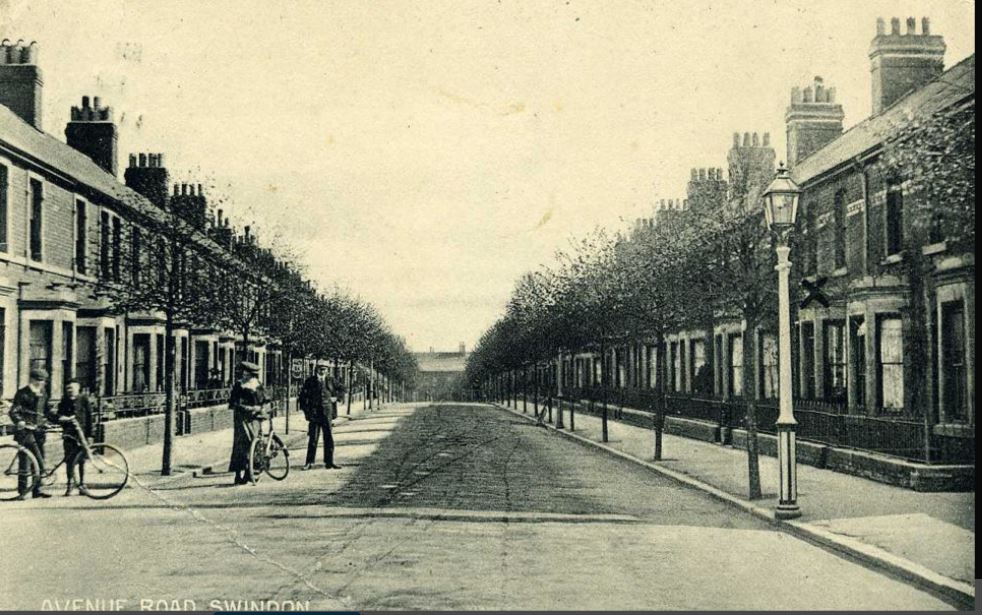
Every cemetery story is a recognition, a celebration of a life, but sometimes that story is one so sad it is difficult to write and to read. Such is the story of Minnie Louisa Roach whose future looked promising when she was born in 1874. Her father John Roach was an erector employed in the Works, her mother was Louisa Roach and she had a brother William born in 1873. By the turn of the new century the family were living in Avenue Road.

Image published courtesy of Swindon Museum and Art Gallery

Minnie married Frederick William Gilchrist, a railway clerk, at the Wesleyan Chapel Bath Road on March 23, 1901. He was 38 years old and she was 26. They began married life at 39 Dean Street, but sadly less than 3 years later Frederick died.

A Well Known Volunteer

For 7 Years Bugle-Major

The death took place on Thursday, Dec. 31st at his residence, 4 Lethbridge-road, Swindon, of Mr F.W. Gilchrist, a well-known Swindonian, who has been a great sufferer for the past two years or more, his illness being induced by the after effects of influenza. He has been taken in
the prime of life – he was only 40 years of age, – and leaves a sorrowing widow, but no children. Deceased, who was the son of Capt. G. Gilchrist, of the Royal Artillery, was for many years employed in the Drawing Office, GWR Works, Swindon. But he was best known to the public as a prominent member of the Wilts Rifle Volunteers. He was a man of fine physique and good soldierly bearing. He was a member of the F and G Companies for 27 years, during 7 of which he held the position of bugle-major.

Extracts from The Swindon Advertiser, Friday, January 8, 1904.

Minnie moved back into 45 Avenue Road where she lived with her widowed mother. In 1913 she married again. Her second husband was Frederick Charles James Perry Day, the illegitimate son of Kate Day. Frederick was a coach body maker in the GWR Works and had spent most of his life living with Charles and Elizabeth Davies, presumably relatives, at 101 Stafford Street. At the time of her second marriage Minnie was 39 and Frederick 34. They should have been looking forward to a long and financially secure marriage, but of course a war was just around the corner and Frederick enlisted.

Perhaps the fear and anxiety proved too much for Minnie. She died in 1917, a patient in the Devizes Asylum.

A Soldier’s Wife’s Death – The death took place on Tuesday, at the age of 42 years, of Minnie Louisa Day, wife of Corporal Day, RFA now on active service at Salonika.

Deceased was the only daughter of the late Mr John Roach, of 45, Avenue Road, Swindon, and leaves her husband, an only brother, and a widowed mother to mourn a heavy loss.

The funeral took place on Saturday at Swindon Cemetery amid many tokens of respect on the part of friends and neighbours.

Amongst the beautiful wreaths was the following – “With deep sympathy and in grateful remembrance of much kindness shown in 1907 – from Mrs L.A. Baugh – ‘Thy will be done.’”

The relatives of deceased desire to return sincere thanks for the many kind expressions of sympathy received in their sad bereavement.

North Wilts Herald, Friday, May 25, 1917.

Stafford Street

Minnie was buried in grave plot E7888 on May 19, 1917. The burial registers record her address as 101 Stafford Street, the home where Frederick grew up. She was buried with Charles Henry Davies who had died in 1904 and was later joined in 1919 by Elizabeth, his wife, the couple who had raised Frederick.

The continuing story of James Henderson

When I began researching the Henderson family grave I suspected this might be a story that would run and run.

First there was the account of how James Henderson averted a train collision with Royalty on board the “Lord of the Isles” loco. Next came Noel’s story about the Musical Stones of Skiddaw. Today we have an account of James Henderson’s career upon his retirement complete with a photograph of the man himself!

Swindon. – On November 7 Mr James Henderson, who for the last twenty years has been an inspector attached to the Locomotive Running Department, retired from the service, and was made the recipient of a handsome testimonial, subscribed to by the officers and staff, and a large number of enginemen and firemen, throughout the system. Mr. Henderson joined the GW Railway as a fireman at Paddington in 1865, and acted in that capacity on the engine “Lord of the Isles,” which frequently worked royal trains between Windsor and Paddington. He quickly reached the position of driver, and from 1874 until his removal to Swindon as inspector was a familiar figure on express broad-gauge engines. Mr W.H. Waister, in making the presentation, which consisted of a solid silver cigar case and a purse of gold, stated that during the time Mr. Henderson had been inspector he had won the respect and esteem of all the staff. It is interesting to note that during the Olympic Regatta at Henley in August last Mr. Henderson was presented with a silver cup and an illuminated address by the Traffic Department staff in appreciation of his work there, he having taken charge of the locomotive arrangements during the Henley Regatta for a number of years.

Great Western Railway Magazine

You may like to read:-

Sarah A. Witcomb – Head Mistress

When I begin my research I never know how much I can actually find out about any given person. This time I found an obituary, a career profile and several family photographs, although unfortunately none of Sarah Annie Witcomb.

Sarah Annie Witcomb was born in Trevethin, Monmouthshire in about 1863. She was the second of Alfred and Sarah Witcomb’s seven children. By 1864 the family had moved to Swindon and in 1871 they were living at 3 Brunel Street where Alfred worked as a Forgeman in the Works. By 1881 they had moved to 31 Carfax Street where they would remain for more than 35 years until Alfred’s death in 1916.

As you can read in the obituary, Sarah became a teacher and eventually moved away from Swindon. She was one of four siblings who all entered the teaching profession.

The Late Miss Witcomb – The remains of Miss Sarah A. Witcomb, eldest daughter of the late Mr Alfred Witcomb, were laid to rest in Swindon Cemetery on Wednesday. Miss Witcomb’s end came with unexpected suddenness. She felt very deeply the recent death of her father, and an attack of influenza, resulting in heart failure, caused her death. As a young teacher in Swindon, there are many who will remember her, from when a pupil teacher she worked under Mrs Watson at College Street School. After leaving Southlands Training College she worked for a few years at Peckham, leaving there to take up a headship at Barking, Essex. Here the last 26 years of her active life have been spent as head mistress of a girls’ school of over 500 scholars.

The first portion of the burial service was held in the Wesleyan Chapel, Faringdon Street of which in her early days the deceased had been a member. The Rev. John Hall and Mr Godber were the officiating ministers. As the mourners entered the building the hymn, “Now the labourer’s task is o’er,” was sung. The hymn during the service was “Rock of Ages,” and as the procession left the chapel “O Rest in the Lord” was played by the Organist (Mr. H.C. Reynolds). The committal at the graveside was impressively performed by the Rev. John Hall.

Amongst those who attended to pay a last tribute to Miss Witcomb were Mr. G. Jackson (Essex County Council), representing the Barking Education Committee, and Mr W. Weston, an old and esteemed associate in former Sunday School work in Swindon.

Extract from the North Wilts Herald, Friday, October 13, 1916.

Family historians on Ancestry have shared photographs of Alfred, Sarah and another daughter Mary Jane.

Alfred Witcomb

Sarah Witcomb

Mary Jane (teacher)

Alfred died in July 1916 aged 75 years and was buried in grave plot E8161. Sarah Anne died just three months later, aged 53 and was buried with her father. Alfred’s wife Sarah died in April 1918 aged 77 years and was buried with her husband and daughter.

St Mark’s – ‘all spikes and prickles outside’

A large number of people attended our last Radnor Street Cemetery walk as you can see from the photograph below. However, perhaps surprisingly, far fewer attended the walks we organised at St Marks several years ago.

Among those buried in the churchyard by the railway track are Engineer William Frederick Gooch the younger brother of Sir Daniel Gooch, employed as Manager at the Swindon GWR Works at the time of the 1861 census.

A hugely influential man in the early history of the Works and the Railway Village was Works Manager Minard C. Rea. who died in 1857. His memorial is published below.

And, probably most famously, is the memorial to Joseph Armstrong, Locomotive, Carriage and Wagon Superintendent at the Great Western Railway 1864-1877.


The churchyard was closed to new burials in 1881 – after a mere 36 years it was already full. The new Swindon Cemetery on Kingshill, better known today as Radnor Street Cemetery, opened on August 6 that same year.


Poet Laureate John Betjeman was a big fan of St. Mark’s.


‘The parishioners of St Philip and St Jacob in Bristol entreated the Great Western to build a church for their workers; directors stumped up money, subscriptions were raised, land was presented and by 1845, St Mark’s church was built.


There it stands today close beside the line on the Bristol side of the station. A stone building, all spikes and prickles outside, designed by Gilbert Scott who was then a young man and who lived to build hundreds of rather dull copy-book churches all over Britain, and to build St Pancras Hotel, the Foreign Office in London and to restore many cathedrals.


One cannot call it a convenient site. Whistles and passing trains disturb the services, engine smoke blackens the leaves and tombstones, and eats into the carved stonework of the steeple. But it is a strong church and though it is not much to look at, it is for me the most loved church in England. For not carved stones nor screen and beautiful altars, nor lofty arcades nor gilded canopies, but the priests who minister and the people who worship make a church strong. If ever I feel England is Pagan, and that the poor old Church of England is tottering to its grave, I revisit St Mark’s, Swindon. That corrects the impression at once. A simple and definite faith is taught; St Mark’s and its daughter churches are crowded. Swindon, so ugly to look at to the eyes of the architectural student, glows golden as the New Jerusalem to eyes that look beyond the brick and stone…

Extracts published from First and Last Loves a collection of essays on architecture published in 1952.

With so many interesting stories to tell we were a little surprised that these walks did not prove more popular. Perhaps it is because Radnor Street Cemetery has an extra special place in the hearts and memories of 21st century Swindonians.

Photograph from our most recent guided cemetery walk at Radnor Street Cemetery

A profusion of primroses

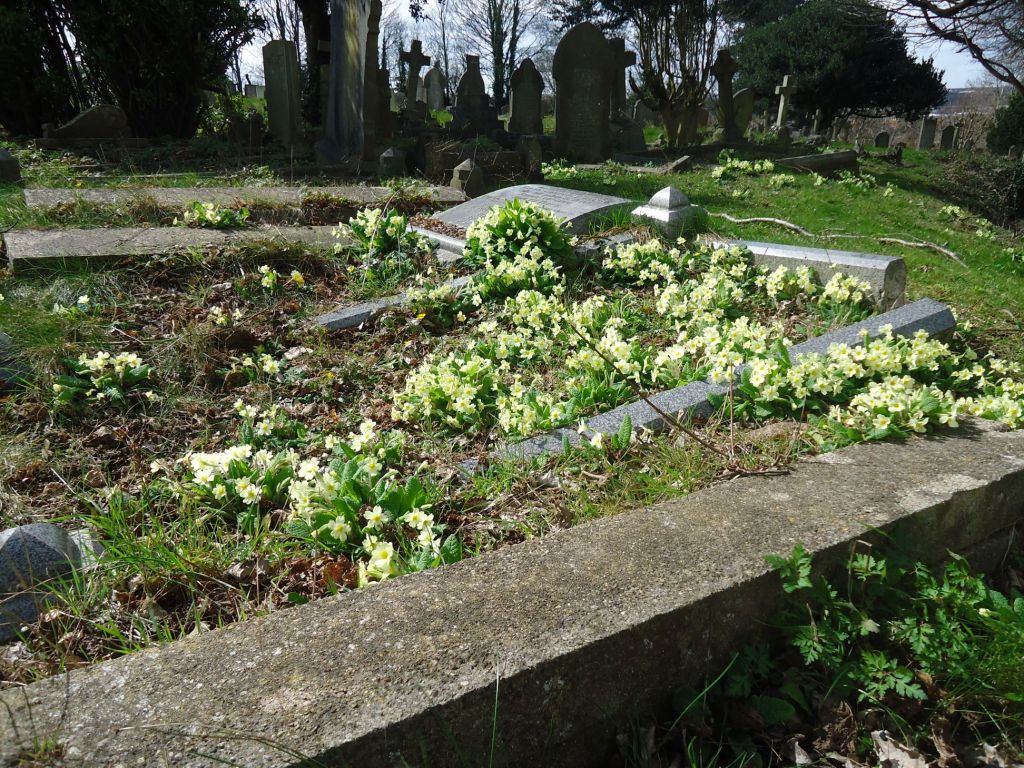
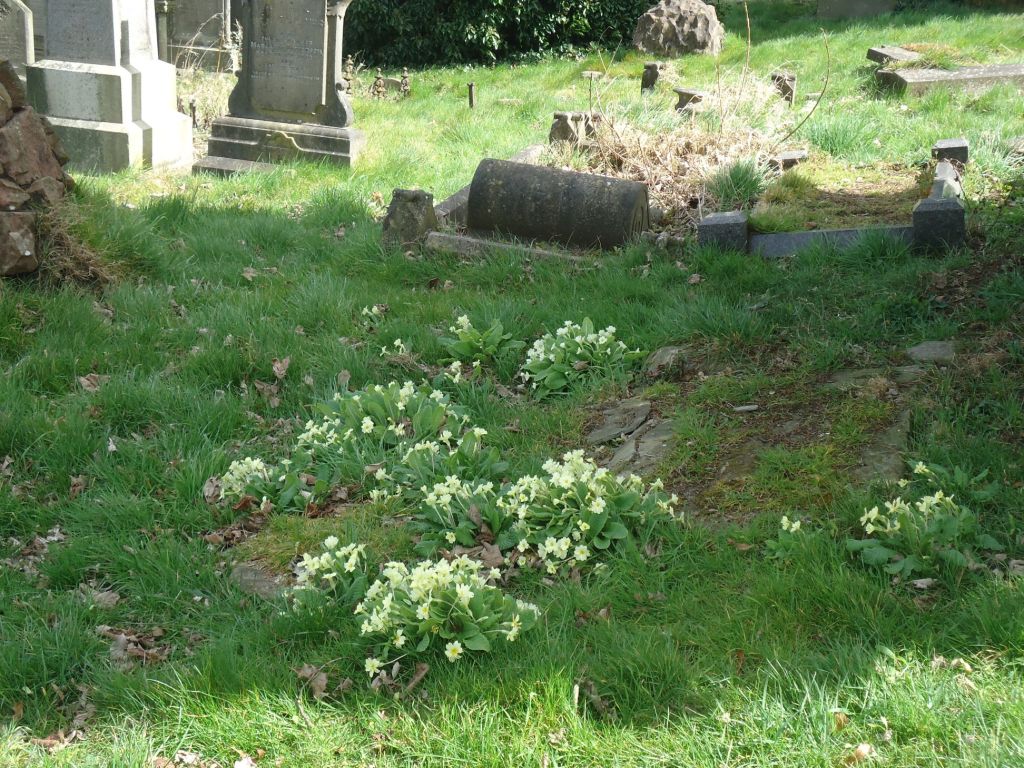
Despite the persistent rain of recent weeks the cemetery is boasting a profusion of primroses. You may like to read again the story of James Shopland whose grave is wreathed in the cheery little spring flower, whatever the weather.

James Shopland, a civil engineer, was born in Purton in 1873, the son of James Rew Shopland, also an engineer.

By 1900 James had moved to the Southampton area and on July 6, 1900 he was at the Southampton Sewage Works, although it was pointed out at the inquest that he had nothing to do with the works, but was assisting in the rescue.

Three labourers working in the press house at the Sewage Works had attempted to free a blockage in a lime vat, firstly by ramming a rod down from the top, which was the usual way of clearing it. However, when this didn’t work, one of them went down into the ejector chamber and tried to free the pipe by undoing it. They tried to remove the cap but this wouldn’t move either, so they proceeded to remove a flange from the bottom and then the upright pipe. This immediately set off a fast flow of sludge and released a smell that rendered the men semi-conscious.

Passing workmen attempted to rescue the three men who were all lying unconscious in the sludge. As a call went out for volunteers, James Shopland arrived on the scene. A witness at the inquest described how as Mr Shopland descended the ladder he saw him put his hand to his head.

At one point someone tried to stop any more men going into the chamber, declaring that at this rate there would soon be fifty dead at the bottom.

James was brought to the surface where artificial respiration was attempted, but he was already dead. At the subsequent post mortem the cause of death was found to be due to congestion of the lungs brought about by carbolic acid gas poising.

The jury at the inquest recorded a verdict of accidental death and commended the noble endeavour made by James Shopland and four others who had attempted to rescue the men.

James was 26 years old and had been married for just a year. He is buried in plot D100 with his wife Helena (Nellie) Elizabeth Shopland. Helena moved to Bournemouth where she lived with her widowed mother-in-law, but she eventually came back to Swindon. At the time of the 1911 census she was living at 159 Goddard Avenue with her sister Violet Blanche Brown. She died just a few weeks later, on June 16, 1911. Her funeral took place on June 20 and she is buried with her husband.

Richard James and Eliza Chirgwin

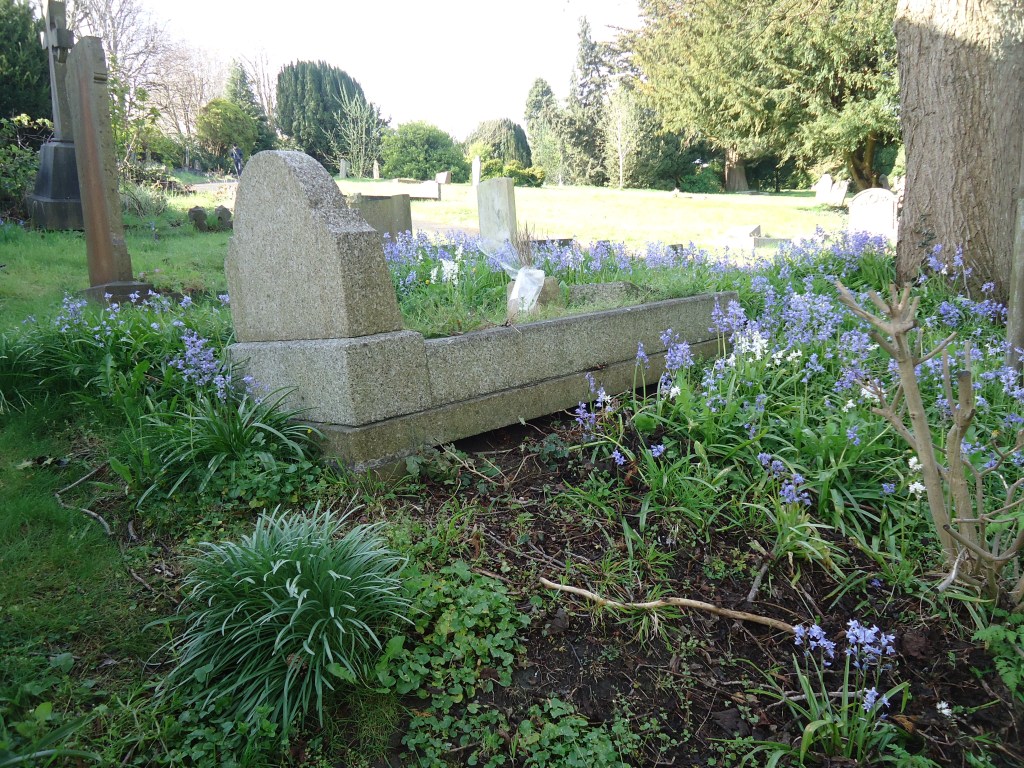
This grave always looks particularly beautiful at this time of year, although sadly my photographs don’t do it justice. This is the grave of Eliza Chirgwin and her husband Richard James Chirgwin, just by the Dixon Street cemetery gate, close to their former home at No. 27. I have long meant to research this couple and every year when the bluebells bloom I resolve yet again to see what I can find out about them, and there is a surprisingly extensive amount.

Richard James Chirgwin was born on September 20, 1850 at Phillack, Cornwall, the youngest child of George, an engineer, and his wife Honor. He married Eliza Callaway in 1873 and by the time of the 1881 census the couple were living at 19 Read Street where Richard James worked as an Engine Fitter in the GWR Works.

You can read more about Eliza and Richard in the obituaries published in the North Wilts Herald (see below) and if you should pass through the Dixon Street gate while the bluebells are in bloom you might like to pause awhile, as I usually do.

Death of Mrs R.J. Chirgwin – Mr Richard J. Chirgwin, J.P., of 27 Dixon Street, has suffered a great loss by the sudden death of his wife. The deceased lady was 77 years of age. She was about the house as usual on Wednesday, although her health had not been good of late. Early in the evening she went upstairs, intending to take a short rest, but she had a seizure, and before her husband, who was downstairs at the time, could reach her she had passed away. Dr. Lavery was fetched, but he could only pronounce life extinct. Both Mr and Mrs Chirgwin have been well known residents in Swindon for the past half a century, and they celebrated their golden wedding on December 23rd last. They are both natives of Cornwall, and came to Swindon 50 years ago. Mr. Chirgwin was for many years employed in the GWR Works but has been living in retirement for a number of years. There are two daughters. One is the wife of Mr Joseph Williams, who holds an appointment on the United Havana Railway in Cuba. The other daughter is Mrs. Anderson, wife of Mr Walter Anderson, Headmaster of Lethbridge Road Schools. The funeral will take place tomorrow.

North Wilts Herald, Friday, November 28, 1924.

A Swindon Social Worker

Death & Funeral of Mr R.J. Chirgwin, J.P.

Public Tributes

While on a visit to Exmouth, Mr Richard James Chirgwin of 2[7], Dixon Street, Swindon, passed away in his sleep, and the town has thus lost a devoted worker in social and religious causes. He had been in indifferent health for some time, and on medical advice had recently given up a number of his activities.

Mr Chirgwin was a native of Cornwall, but early went to live in South Wales, and after staying there six years came to Swindon in 1873, as an employee in the GWR Works. He gradually worked his way up, and at the time of his retirement four years ago was a leading foreman.

He was a very active Liberal, and had taken a prominent part in the work of the Party in Swindon and district for many years. He was a borough magistrate for a number of years, and was a very regular attendant at sittings of the Bench. Mr Chirgwin was well known in educational circles, and at one time was a tutor at the science classes before the Technical School was built. He was keenly interested in the work of the Workers’ Educational Association, and attended the meetings of the local branch until quite recently. He was also very fond of their summer rambles, and was a lover of long walks.

The deceased had occupied every position open to a layman in the Wesleyan Methodist Church. He had been a local preacher for 55 years, and last year, in company with Messrs. T.B. Jefferies, W. Chilton, E. Ransome, J. Clark, J.P., and T. Hiscocks, he received a special certificate from the Connexional Local Preachers’ Association. He began preaching in Cornwall in 1871, and frequently occupied the pulpit while in Wales. In Swindon he did service as a fully-qualified local preacher until 1924, when, on medical advice, he had to give up some of his preaching work. He was local secretary for the Aged Local Preachers’ Fund for 30 years, and also held the office of President of the Free Church Council for a time.

Mrs Chirgwin pre-deceased her husband three years ago, just after they had celebrated their golden wedding.

At Swindon Borough Police Court on Monday the Chairman (Mr. W.E. Morse) said he had to record the passing away of a member of their bench, Mr R.J. Chirgwin, who, as long as he (Mr Morse) could remember, had been a well-known citizen of Swindon. Five-and-a-half years ago he was appointed a magistrate, and he was always very regular in his attendance and diligent in the duties he was called upon to perform. He (Mr Morse) thought it would be the desire of the justices and the Court that a letter of condolence be sent to the members of the family of deceased.

This was carried in silence, all in Court standing.

The Funeral

The funeral took place on Wednesday in the presence of a large company at the Faringdon Street Wesleyan Church by the Rev. H.B. Turner (Bath Road).

The Rev W. Kelson (Superintendent Minister of the Swindon Wesleyan Circuit) conducted the service, being assisted by the Rev. W.B. Turner (Bath road), the Rev Montague Ashdown and Pastor Stocking.

The Hymns sung were “O God, the Rock of Ages,” and “Who fathoms the Eternal Thought.”

Voluntaries on the organ were played by Mr. Cassell.

Mr Kelson said when he first came to Swindon he and Mr Chirgwin were comparative strangers, but he had been able to enter into Mr Chirgwin’s life from the very first. Mr. Chirgwin had attained the most worthy objects in life. He was a man – a man after the type of the Supreme Man whom he came to know in his early years.

His religion was not merely an emotional one. It occupied all his heart, and also his mind. One could not wish to come into contact with a better character. His heart was warmed with the love of Christ, and his intellect had passed into his religion as well as his soul. He was not afraid to die.

His was a life of social and religious activity. There were a great many in Swindon who could speak of him with the highest appreciation of his services and all had a great esteem for him. His religion was comprehensive, a life embracing thing. They did not mourn for the life which had just been taken from them. Mr Chirgwin was a man who passed worthily through life: his end was peaceful, and his latter days were serene, which was fitting for one who took such an interest in life until the last.

Mr. Kelson referred to Mr Chirgwin’s debating powers, and added that although he regarded life seriously, he had learnt to smile at life’s troubles.

Not only the church with which he was so closely associated but also the town of Swindon would be greatly the poorer by his death.

The interment took place at the Swindon cemetery, the chief mourners being: Mr and Mrs Joseph Williams (son-in-law and daughter), Mr and Mrs Walter Anderson (son-in-law and daughter), Mr Kenneth Anderson, Miss D. Gibbs, Mrs C. Clack (niece), Mr and Mrs Ronald Clack, and Miss L. Symons (niece).

Long list of mourners and floral tributes.

North Wilts Herald, Friday, February 11, 1927.