When James John was born in Bristol in 1857 he shared the family surname Green. His parents, James Henry Green and Sarah Kettle Cummings, had married at St. James, Bristol on December 25, 1856. In 1861 they were still living in Bristol, still under the name of Green but sometime after this they adopted the name Brown and so far I haven’t been able to discover why.
Their eldest son James John Green/Brown led an equally colourful life. He had three wives (not all at the same time) and 9 children.
In 1879 he married Annie Russell the first of his three wives and by 1881 they were living with the Brown family at 13 Holbrook Street, Swindon where James worked as a Hair Carder.
By 1891 he had set up in business as a Furniture Dealer at 8 Station Road where the couple were living with their five children Annie 9, Charles 8, Nellie 6, Mabel 4 and three year old Archibald. It is here that Annie sadly died in 1899 aged 37 years and the couple’s daughter Nellie in 1906 aged 21.
In 1900 James John married Emma Harrison who died in 1903. His third wife was Elizabeth Nutman whom he married in 1908. She died in 1920. Neither of these two wives appear to be buried in Radnor Street Cemetery.
In 1911 James John Brown was the licensed victualler at the Bell Hotel in Old Town. In 1915 he was a candidate in the local elections where he represented Queens Ward.
James John Brown died on November 27, 1921 at the Duchess of Sutherland Public House in Hornsey, London where his son was the landlord. His home address was given as The Burlington, 8 Buenos Ayres, Margate.
His body was returned to Swindon where he was buried Radnor Street Cemetery in grave plot D40. He is buried with his first wife Annie and their daughter Nellie. The grave is marked by an obelisk memorial. All things Egyptian were popular in the 19th century and remained so into the 20th. The Egyptian obelisk is a symbol of eternal life and resurrection and represents the sun god Ra. Perhaps James John Brown was hoping to have a go at continuing his colourful life!
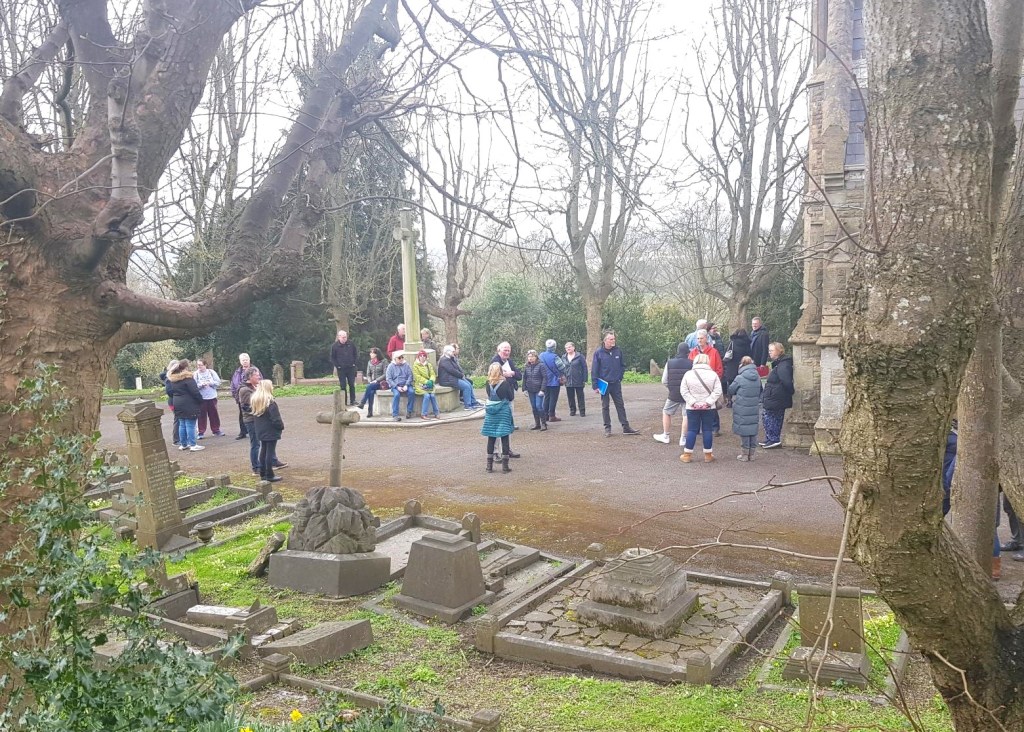
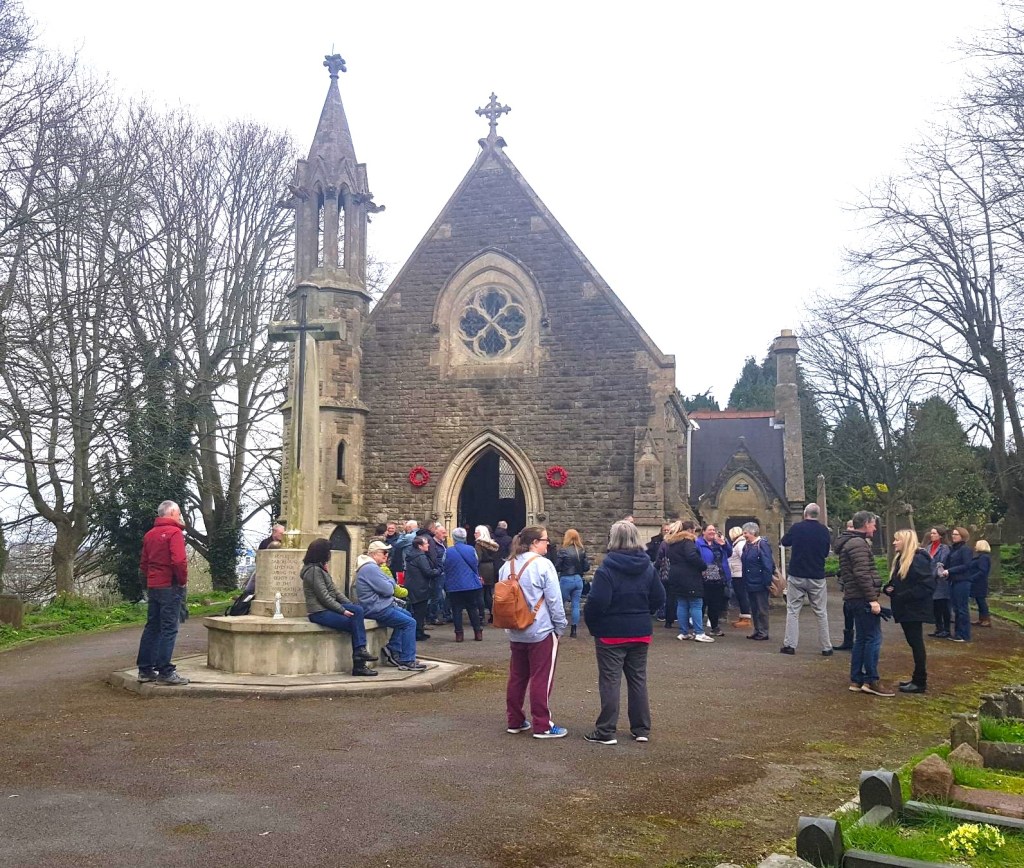
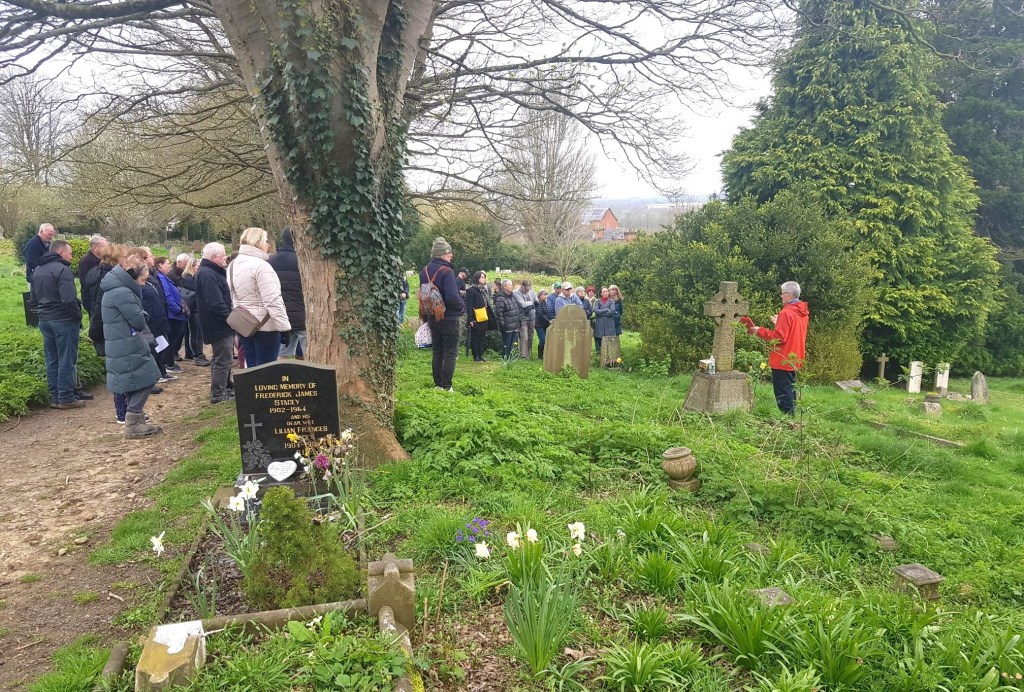
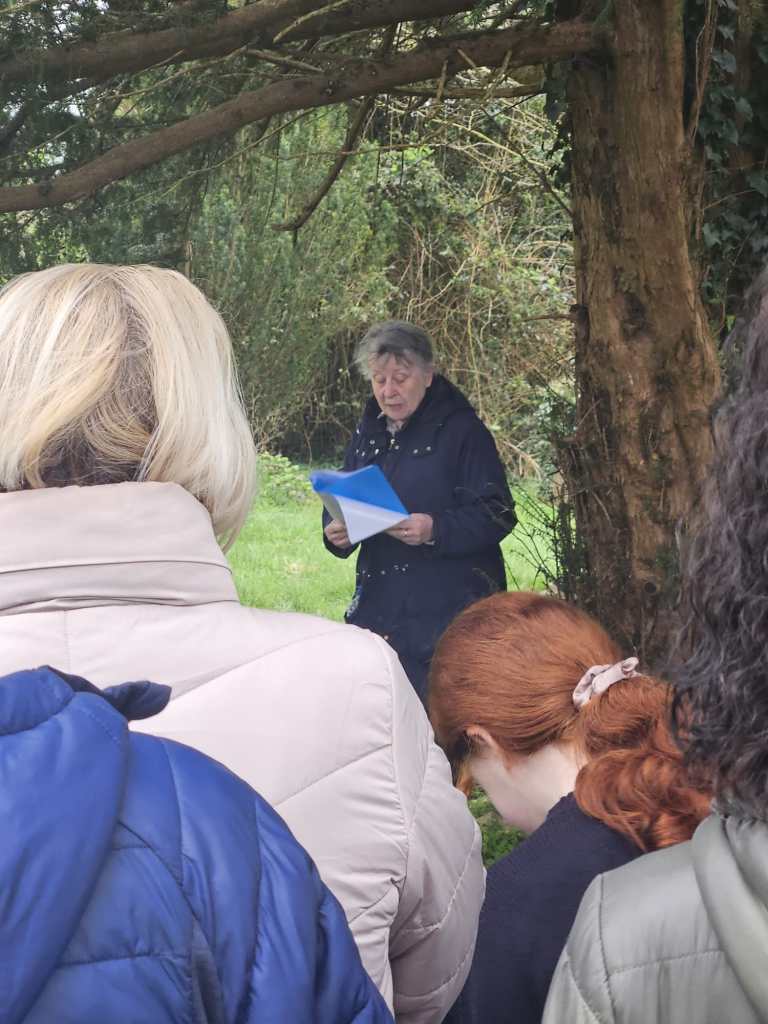
Many thanks to everyone who joined us for the first of this season’s walks. The weather was kind and the rain held off.
We were joined by members of the Menham family as Andy spoke about Swindon Town football legend Bob Menham. Kevin followed by telling us of the military career of his son Reginald Menham and reading a poignant letter taken from Mark Sutton‘s book Tell Them of Us.
There were lots of fascinating conversations as visitors shared their family history stories with us. It was lovely to meet Clare and I hope you found your family grave. I look forward to receiving your information and photographs to publish here.
Our next walk will take place on Sunday April 28. Meet at the chapel for 2 pm.
Today’s story is one for the railway enthusiasts among you and another example of the fascinating ordinary people who lie in Radnor Street Cemetery.
Swindon Inspector’s Reminiscences
How a Railway Disaster was Averted
An interesting incident has been recalled by the frontispiece in the Great Western Railway Magazine for April, showing the “Lord of the Isles,” bedecked to draw the royal train, conveying the Shah of Persia, on the occasion of his visit to England in 1873. The name of the fireman was given as Hetherington, but it transpires that Mr James Henderson (late inspector at Swindon), is the man referred to. An exciting occurrence attended the journey of the royal train, and is related in this month’s magazine by Mr. Henderson thus:-
“I have good reasons for remembering the day the photograph was taken – June 24th, 1873. We left Paddington with the Shah of Persia, the late King Edward with Queen Alexandra, and the late Czar of Russia and his Consort on the train, attended by many distinguished persons. In honour of the Shah’s visit, a great review was being held at Windsor, and many excursion trains were being run. All went well with the train until we were passing through Slough Station. At that time there was no “locking gear” there, and trains had to pass from the down main line and go through the down platform road to reach Windsor. At the western end of the platform there was a pair of points turned by hand, which led either to Windsor, or across the Windsor Branch to the main line. On passing through Slough Station I noticed that these points were wrong, being set for the main line instead of for Windsor. I shouted to my driver. “Whoa, mate, the points are wrong,” and we stopped the train just in time to avert a collision with an empty train coming from Windsor. We put the train back over the points, and I jumped down and turned the points myself, the man whose duty it was to attend to them being so overcome that he was unable to do any more work.
Mr Tyrrell (then Superintendent of the Line), was on the platform, and witnessed the whole affair. He got on to the engine and rode with us to Windsor. After we started from Slough he enquired from my driver who had first noticed that the points were wrongly set, and the engineman, who was Jos. Groves, replied, “My fireman, sir.” Mr Tyrrell turned to me and expressed his pleasure at my having observed the position of the points. Subsequently I was sent to Swindon to see Mr. Joseph Armstrong, (late Locomotive Superintendent), who promised that I should receive recognition for the occurrence. Shortly afterwards I was promoted to be a driver, and before long made a driver on the broad gauge expresses, being the youngest man ever promoted to that position. Many people wondered at the time at my early promotion, but it was the prevention of that collision that led to it. It may be imagined that the occasion on which the photograph was taken stands out as a red-letter day in my life.
“I may say that during my service with the Company I had the good fortune to be the means of preventing five other collisions with passenger trains.”
The Evening Swindon Advertiser, Saturday, June 1, 1912.
James Henderson died aged 89 years at his home, 51 Rolleston Street. He was buried on November 14, 1934 in grave plot A2526.
Easter Gadd is an obvious character to research this Easter weekend.
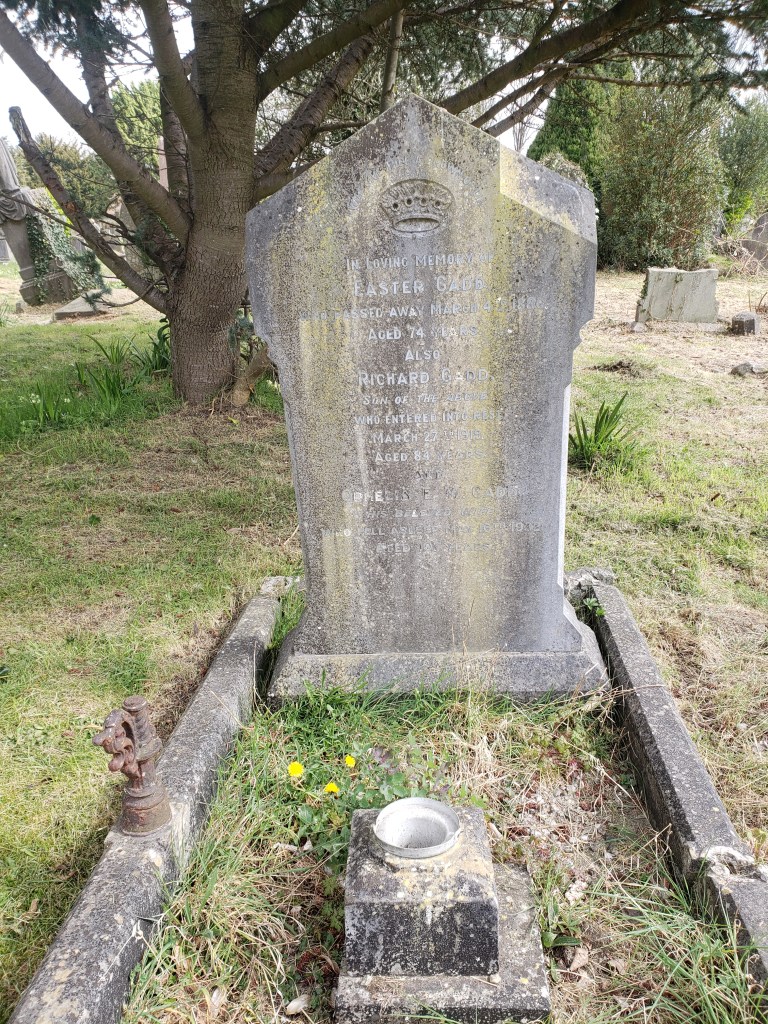
I’ve often paused at this headstone and wondered what the upstanding Mr Gadd might have looked like and what his profession might have been. Something in the legal profession I imagined, or possibly a vicar with such an appropriate name, a character stepped straight out of a Dickens novel.
But Easter Gadd was not a man but a woman.
Easter was born on August 27, 1811, the daughter of Henry and Mary Pascall and baptised at George Street Independent Church, Croydon, Surrey in October.
She married Richard Gadd at St John’s Church, Croydon by licence on April 5, 1833 (which just so happened to be Good Friday that year) and most clearly signed her name as Easter. I mention this as there appears to be a certain amount of confusion as to the spelling of her name on official documents, especially census returns, when she is frequently recorded as Easther or Esther.
But when she was baptised, married and died her name was most definitely recorded as Easter.
Richard and Ophelia Gadd and their five children
When Easter died in 1886, she was living with her son Richard and his family. Richard, it can be assumed, arranged for his mother’s headstone to be erected and had overseen the spelling of her name. Now I have the utmost faith in the accuracy of the spelling on the gravestone and I’ll tell you why – Richard’s immaculate attention to detail.
Richard Gadd was born in Croydon on July 1, 1834. His father died on May 17, 1835 and at the time of the 1841 census Easter was living with her brother-in-law Charles Gadd and his family in Lambeth, South London.
By 1851 she had moved to Hulme, Manchester and was living with her widowed brother William Pascall and his daughter where she is described as ‘housekeeper.’ The enumerator records her name as Esther (because he obviously knew better!)
Easter remains living with William for more than ten years and after that with various nephews and nieces until the census of 1881 when she is living at Lima Terrace, Ashton upon Mersey (today a part of Greater Manchester) with Henry Pascall who is confusingly described as her son (like we need any more confusion in this story). By the way, the census enumerator spells her name as Esther. I’m beginning to wonder if Easter was a bit of a chatterbox and confused these men as they recorded her details.
Sometime after this date Easter moved to Swindon to live with her son Richard and his family. Richard had settled in Swindon in 1853 when he started work as a clerk in the GWR Works.
Richard left the employ of the GWR sometime in the 1860s when he is recorded in Harrod’s Directory as an architectural & mechanical draughtsman living in Prospect Place. However, by 1891 he was back at the Works working as an accountant where he remained until he retired in 1899.
At the time of the 1881 census Richard lived at 35 Prospect with his wife Ophelia, their son William, who was a railway draughtsman, and their two daughters Annie Ophelia and Edna Mary.
Easter died shortly after moving to Swindon. Her funeral took place on March 10, 1886 when she was buried in plot E8427 where she was later joined by Richard and Ophelia.
Now why am I so certain Richard has spelled his mother’s name correctly? Well, it is because of the 1911 census returns. On this document the head of the household completed the form themselves unlike in previous censuses when an enumerator did it for them.
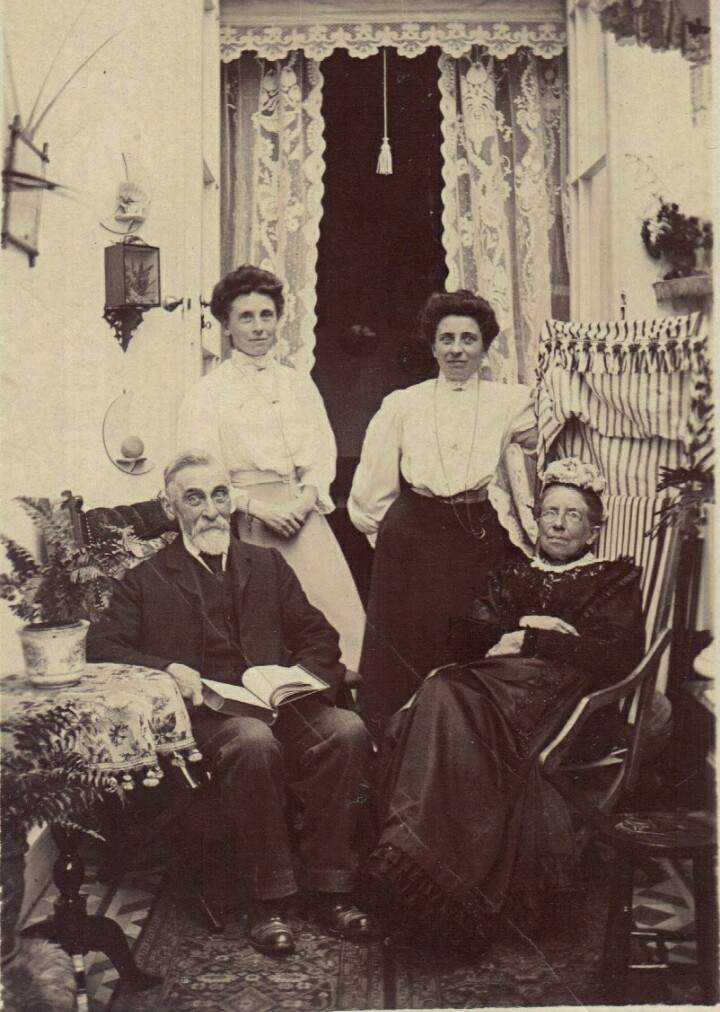
Richard and Ophelia Gadd in old age with their two daughters
As you would hopefully expect of an accountant, Richard completes the form with meticulous accuracy. He states that his age is 76 9/12 (that is 76 years and 9 months). Ophelia was 80 8/12 and their daughter Edna Mary 47 4/12. (The young domestic servant Mary Coxhead is recorded as 15 years old. Perhaps he didn’t know her date of birth or maybe he didn’t ask!) He declared that he and Ophelia have had 5 children, all of whom are living, and that they have been married 56 3/12 years.
Now a man like that will definitely get the spelling of his mother’s name correct on her gravestone.
Three of Richard and Ophelia’s children are buried in the neighbouring grave plot E8428. William who died in 1944 aged 85; Annie Ophelia who died in 1955 aged 86 and Edna Mary who died in 1958 aged 94.
Images of Richard and Ophelia Gadd and their family are published courtesy of an Ancestry public family tree.
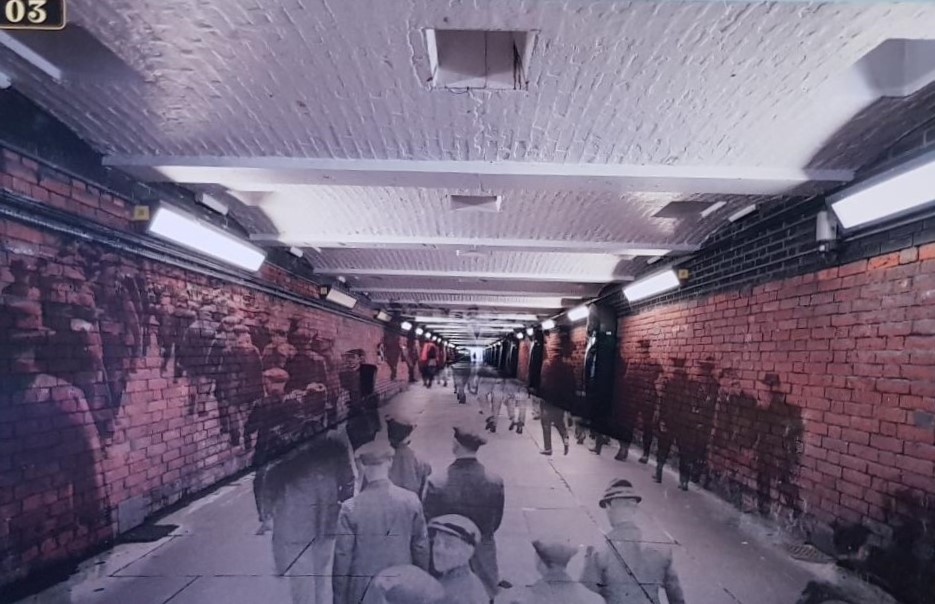
The GWR Works was a dangerous place in which to work and until the construction of the main entrance tunnel it was even a dangerous place to get inside.
The original Workmen’s East Gate Works entrance was a route that involved crossing the mainline track and was the scene of numerous fatal accidents. There were 3 deaths in a single month in 1869, the year before the tunnel opened.
Joseph Armstrong, the first Locomotive, Carriage and Wagon Superintendent ushered in a period of rapid expansion during the 1870s which included the construction of the Carriage Works and a new, safer route into the railway factory. The main entrance into the Works was built on Bristol Street, opposite the Mechanics’ Institution and consisted of a tunnel measuring approximately 100 yards [91.4m] that ran northwards beneath the mainline track.
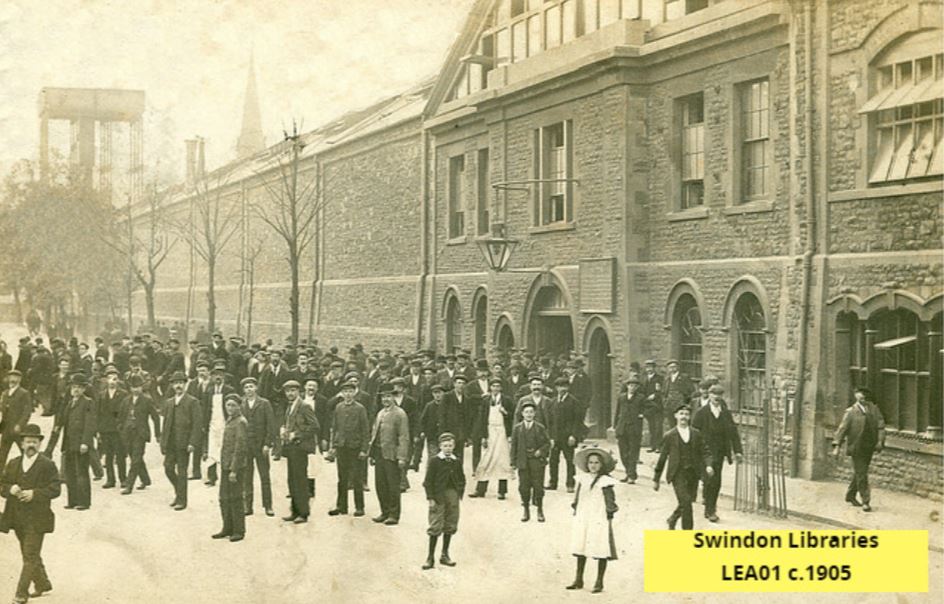
Contemporary photographs record the hundreds of men streaming out of the tunnel at the end of the working day, however, even after the tunnel opened on February 5, 1870 accidents continued to occur as men still cut across the railway line to work.
In 1905 William Dicks was struck down and killed going back to work on Saturday January 14. The report of the inquest published in the Wiltshire Times makes for gruesome reading.
Fatal Accident
Man Killed at the Works
A shocking fatality occurred on the Great Western Railway at Swindon on Saturday. William Dicks, an employe in the locomotive works had just returned from breakfast and crossed the rails in order to reach the check office. He failed to notice the approach of an engine which was out on its trial trip, and though his workmates tried to warn him of his danger, it was without avail, and he was knocked down by the locomotive and injured so terribly that he died on his removal to the hospital. Both his legs were severed, and his head was frightfully battered. Deceased, who was 52 years of age, was well known as a clarionist. [clarinetist].
At the inquest on Monday it was stated that deceased had no business to cross the line, a tunnel being provided for the men. – Dr Swinhoe said the man was practically cut in half.
The Coroner said he thought they could only return a verdict of “Accidental death” but they might add a rider to the effect that notice boards should be fixed in prominent places to warn the men not to cross the line. The Company certainly took every precaution in protecting employes, and the men should use the tunnels which had been provided for their express use.
The jury concurred, and returned a verdict accordingly.
The Wiltshire Times, Saturday January 21, 1905.
William Dicks was buried on January 18, 1905 in grave plot C1445, a public grave, which he shares with his wife Jane who died in 1909, and one other person
Today the Grade II listed former Carriage Works is the subject of a Heritage Action Zone project. Work has included improvements to the Sheppard Street underpass, London Street and the Bristol Street tunnel has also received a makeover. New interpretation boards at the entrance tell the story of the railway factory and the railway families who made New Swindon.
Image dated c1905 published courtesy of Kevin Leakey
Image dated c1950 published courtesy of Local Studies, Swindon Central Library.
Ghostly railway workers superimposed on a photo of the tunnel – see new interpretation boards at the tunnel entrance
Arthur Jefferies Lewis White was born on November 23, 1872, the son of Richard Lewis and Elizabeth Corbett White. He entered employment in the GWR on January 3, 1887, a month after his 15th birthday. A year later at a GWR Board Meeting to consider the promotion of the Lad Clerks Arthur was described as shorthand writer with previous office experience. He was already on a career path that would see him become Chief Clerk and Chief Accountant to Charles B. Collett, Chief Mechanical Engineer.
Arthur married Emily Sendell at Christ Church on October 2, 1917. He was 44 years old and she was 42.
A keen musician and mandolin player, Arthur White was chairman of the Great Western Railway Amateur Operatic and Dramatic Society and President of the Swindon Great Western Railway Social and Education Silver Band. He was a director of the New Swindon Permanent Building Society and a Freemason and member of the Sussex Lodge of Emulation, No. 355. He was also a writer and wrote several books about the Swindon Railway Works. But it is probably fair to say his greatest love (after his wife, of course) was football.
Arthur White was elected Chairman of the directors of Swindon Town Football Club in the 1910-11 season and served for nearly 20 years. The obituary published in the North Wilts Herald on Friday November 1, 1929 declared his pride of the club knew no bounds.
Swindon Town Football Club 1910-11 squad – the year in which Arthur J.L. White was elected Chairman
Arthur Jefferies Lewis White died at his home at 13 Okus road, Swindon after suffering a year of poor health.
The funeral service at St. Saviours Church was attended by a great many mourners and the North Wilts Herald reports that:
Practically every shop in the GWR Works was represented, and directors, players and officials of the Swindon Town Football Club also attended.
A guard of honour was formed by the local Freemasons, who led the procession and behind the coffin walked the family mourners, representatives of the Great Western Railway, the different societies with which Mr White was connected and the Town footballers.
Arthur Jefferies Lewis White was buried in grave plot E8134. His wife Emily survived him by nearly 40 years. She died aged 92 years of age at the Cheriton Nursing Home and was buried in the neighbouring plot E8134A.
During some 20 years of research at Radnor Street cemetery I have discovered some fascinating family stories. Among my favourites is that of the Alley family who I’ve featured at various times on cemetery walks.
George Richman Alley and his brother Frederick were both born in Trowbridge and eventually made their way to Swindon and jobs in the Works.
This is the story of George (pictured below) with his wife Emma on the occasion of their youngest daughter’s wedding at the Baptist Tabernacle in 1911.
The family moved to Swindon in the 1870s when they lived first at 3 Carfax Street and then at 8 Merton Street. The couple had a son George who pursued a career in the navy and 8 daughters (Annie died just after her 1st birthday).
The bride in the photograph, Eva Ross Alley, married George Babington on March 1, 1911 at the Baptist Tabernacle. The couple managed a draper’s shop at 92 Victoria (next to her sisters’ millinery business). Eva died in 1978 aged 92.
Ethel Gertrude Alley worked as a milliner with her sister Amelia. Another active member of the Baptist church, Ethel married Wilfred Hewer, a tailor. They later ran the Oddfellows’ Arms in Cricklade Street. Ethel died in 1958 aged 74.
Flora Elizabeth Alley was a teacher until she married William Harold Hall. The couple had two children and lived in Country Road. Flora died in 1974 aged 93.
Amelia Annie Alley was the only sister not to marry. She worked as a milliner at 90 Victoria Road and was also a member of the Baptist Church. She died in 1973 aged 94.
Mabel Alley married Thomas Charles Harding. In 1960 she was awarded the British Empire Medal for Meritorious Service as sub postmistress at Westcott Place Sub Post Office for 50 years. She died in Cheriton Nursing Home in 1965 aged 88. Her daughter Vera is the little bridesmaid in the photo.
Maud Richman Alley was a dressmaker. She married Henry J. Lewis in her 40s and lived in Chippenham. She died in 1963 aged 93.
My interest in the Alley family began when I discovered the story of eldest daughter Emma Louisa who trained as a tailor, married Walter Lloyd Hull and moved to Bournemouth. Emma (known within the family as Lousia) took an active role in the Votes for Women campaign in the early 20th century. She joined the Women’s Freedom League formed in 1907 by Teresa Billington-Greig and Charlotte Despard in a break away organisation from the Pankhurst led Women’s Social and Political Union.
Emma was arrested several times, once with several other women who all gave their name as Smith or Smythe. On another occasion she was among a group of women who cheered the magistrate from the dock in appreciation of the way he had dealt with their case.
She returned to Swindon after the death of her husband in 1947 and gave talks to local women’s groups about her involvement with the suffrage campaign. She wore a badge carrying an engraving of Holloway prison. Other suffragette souvenirs she had included a Votes for Women banner and a cocoa mug and a salt pot smuggled out of Holloway gaol!
Emma eventually returned to Bournemouth where she continued to tell her story. She died on July 24, 1967 aged 100 years old.
Who’s Who in the wedding photographas provided by a family member
George Richman Alley died aged 84 at his home 8 Merton Street and was buried in grave plot D31A on December 1, 1925. His wife Emma died aged 87 at 12 Park Lane and was buried with him on October 24, 1932.
A family of Belgian immigrants have left their name to a beauty spot in Rodbourne Cheney, possibly one of Swindon’s best kept secrets.
Plaum family history facts can be gleaned from notes on the 1911 census made by George Jacques Plaum. At that time he was newly married and living with his wife Catherine and his younger brother Robert Maximilian (who he describes as ‘feeble minded since birth’) at 489 Ferndale Road. He also adds that his father was German and his mother English and that the family had been resident in England since 1888.
Matthias and Clara Plaum had lived in Antwerp, Belgium from at least 1882 to 1887 during which time their children Georgius, Ernestus, Joannes, Robert and Frederick were all born. As George states in 1911, they have been living in England since 1888, so it should be possible to find them on the 1891 census.
On August 25, 1893 Matthias was admitted to the Wiltshire County Lunatic Asylum in Devizes where he sadly died on October 13. Now it was up to Clara to support three sons, one of whom could not work due to a disability. In 1901 she was living at 21 Vilett Street where she worked as a dressmaker. George 19 is employed in the GWR. Younger brother Frederick 13 claims he is a Railway Fitter and Wheel Turner. It is more likely he was an apprentice or perhaps a labourer. Robert is 15 years old. Life was obviously very difficult for them. The Radnor Street Cemetery registers state that Clara died in 1908 at 29 Villett Street aged 48 years. She was buried on December 10 in a public grave with two other unrelated persons.
But by dint of hard work and an entrepreneurial talent, George Plaum and his family prospered.
He purchased the Rodbourne Bathing and Boating Pool in the 1920s with financial help from a Bristol business man. The lake, like the one in Queens Park, began life as a clay pit feeding Victorian Swindon’s rapacious brick making industry. Quarrying came to an end when diggers hit underground springs and forced the closure of the clay pit.
By the 1920s the lake offered a number of leisure activities including swimming, boating and fishing. An additional income was derived from entrance and camping fees and refreshments. Grass, grazing and allotment fees brought in £5 7s 6d in 1925.
Today Plaum’s Pit is home to Plaum’s Pit Angling Club who can be contacted via their website.
This is the story of two boys born 20 years apart – William Batley Pitts, the natural son of Robert and Elizabeth Pitts, the other Archibald Kenneth Poulton, their adopted son.
Today railway safety is heavily promoted and Network Rail has a series of safety campaign videos on their website aimed at everyone from the very young to the distracted commuter.
You might expect railway safety to have been a priority in Swindon of all places, but perhaps it wasn’t so in 1893.
On September 1, 1893, a group of boys were playing on the level foot crossing close to the residence of William Dean, Chief Locomotive Superintendent at the GWR Works. The horrific accident was described in great detail during the inquest held at the Cricketer’s Arms the following day.
Shocking Accident on the GWR at New Swindon – On Friday evening, the 1st inst., about six o’clock, a shocking accident occurred on the GWR at the level foot crossing near the subway close to Major Dean’s house. The victim was a lad 12 years of age, name William Batley Pitts, son of Robert Pitts, of 19 Clifton Street, Swindon. It appears that the lad had been at play with others near the foot crossing close to the residence of Mr Dean, the chief locomotive superintendent. A goods train passed on the down line, and as soon as he thought the line was clear the boy attempted to run his hoop across the line when he was struck by the up Cornish express, of the approach of which he was not apparently aware. The poor lad was cut to pieces and the train carried his body 23 yards before throwing it off the line. When picked up the boy was terribly mutilated. A lad named Smith witnessed the sad occurrence, and rushed to Major Dean’s house, close by, for assistance. Dr. Pearman and PC Pinchen were soon on the spot, and had the scattered portions of the poor child’s body collected and conveyed to the GWR Medical Fund Hospital. The Coroner was communicated with, and the inquest was held this morning at the Cricketer’s Arms, a verdict of accidental death being returned by the jury.
Swindon Advertiser Saturday, September 2, 1893.
William was buried on September 5, 1893 in plot B2193, a privately purchased grave. Thirty years later he was joined by Archibald Kenneth Poulton, the boy his parents adopted long after William’s death.
At the beginning of the 20th century adoption was frequently an informal affair. Perhaps he was related in some way, a nephew, maybe a grandson. It is now not possible to trace how little Archibald ended up with the Pitts family. He died in 1924 and was buried with William in grave plot B2193 on April 22.
George Bellwood Palphramand retired in 1913 after 41 years in the service of the Great Western Railway.
George was born in Wolverton, Buckinghamshire on June 17, 1851, the son of George, an engine driver and his wife Isabella. Following the death of Isabella in 1861 the family moved to Rugby where George jnr served his apprenticeship with the London and North Western Railway. In 1872 he moved to Swindon where he married Mary Ellen Strong in 1876.
In 1884 George and Mary were hit by tragedy when their three year old son Ernest drowned in the canal near their home at 24 Read Street. In an age when child mortality was high they could not have expected to lose one of theirs in such traumatic circumstances. How do parents recover from such a loss? George had to go to work, Mary had to cook, clean and care for her surviving three children. In time they would have another son, Reginald born in 1887. Three siblings that had no memory of their little brother and one who never knew him.
In time Reginald followed his father into the railway works and having completed his fitting and turning apprenticeship moved to Coventry where he worked as a fitter in the aviation industry.
Following his retirement George and Mary moved to 69 Broadway, Earlsdon, Coventry. Mary died there in 1926. George died 11 years later on December 7, 1937.
Both Ellen and George were buried back in Swindon in Radnor Street Cemetery grave plot E8469 where they joined their little son who had died so many years before.
The site of the former Wilts & Berks Canal
Presentation to Mr. G. Palphramand – An interesting affair took place in the G Shop Office, Loco. Dept., GWR Works, Swindon, on Saturday morning last, the occasion being a presentation to the Foreman, Mr G. Palphramand, on his retirement from the Company’s service. The presentation took the form of a handsome silver-mounted ebony walking stick and a pipe, given by the assistants and Office Staff of the G. Shop. Mr A. Beer, in making the presentation, said he was expressing the sentiments of all those present in wishing Mr Palphramand the best of health to enable him to enjoy his retirement. He asked him to accept the gifts as a small token of respect and esteem of the members of his Staff. He would carry away with him the best wishes of all whom he had been associated with during his long service, and no doubt the walking stick and pipe would bring back pleasant recollections of bygone days.
Mr Palphramand thanked his colleagues for their kindness, and said he should appreciate the gifts very much indeed, as coming from his Staff, with whom he had always had harmonious dealings during the whole of his service as Foreman; and he thanked them all for the support they had at all times given him in carrying on the work of the Shop, at times under very trying circumstances. He felt very sorry to leave them all, and he had not thought of retiring quite so soon, but he found his health was not good enough now to enable him to carry on the work, and he thought it wise to give up in time.
Mr Palphramand served his apprenticeship with the L. and N.W. Railway at Rugby, and entered the service of the GWR in June 1872, thus completing 41 years with the Company. He was appointed Assistant Foreman in May, 1884, and took over the G (Millwrights) Shop as Foreman on Jan 1st, 1891. He has served under five different Managers, and was for many years Captain of the GWR Works Fire Brigade. He was also for some years a member of the Council of the GWR Mechanics’ Institution, and also served in the old Volunteer Force in connection with the Wilts Regiment.

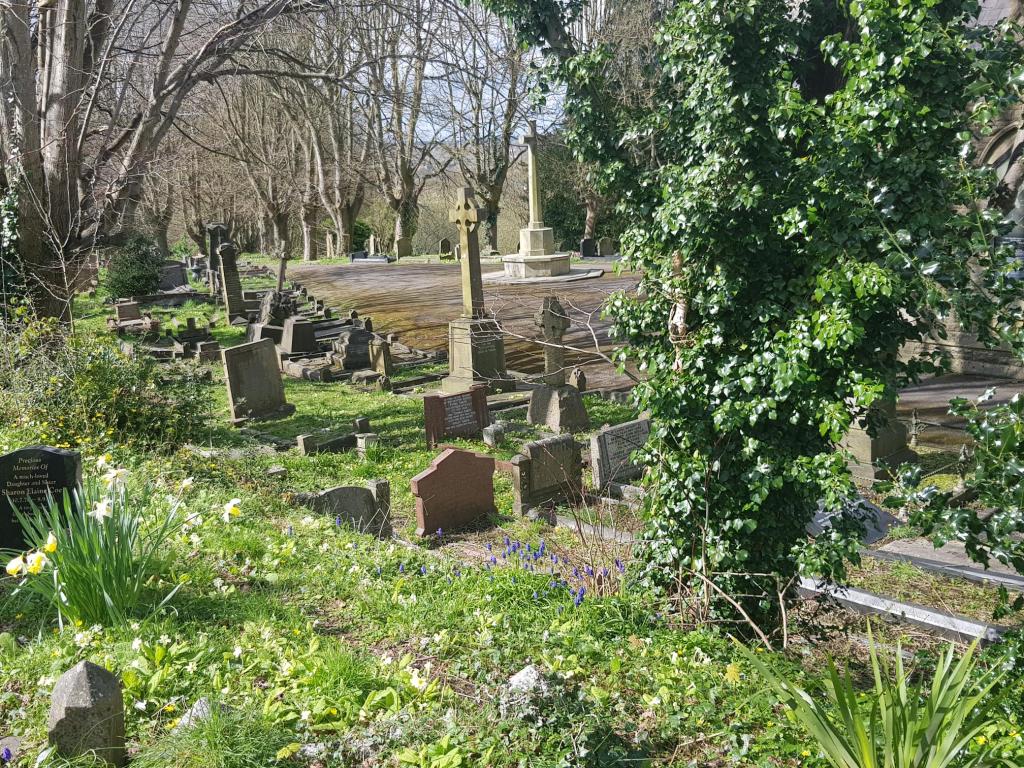








 Radnor Street Cemetery