Martha Ann Croom – farmer at Lower Walcot

Among the fitters and turners, the boilermakers and the carriage makers buried in Radnor Street Cemetery lie the farmers. Richard Strange, tenant at Mannington Farm, is buried with members of his family in a triple grave plot numbered E8463/4/5 and Martha Hale from Creeches Farm in Hook, Lydiard Tregoze is in grave plot E7999 and most recently I have discovered the Croom family, originally from Somerset, who farmed at Walcot Farm.

The 1891 census records three properties in the Walcot Tything. Henry Thorne and his family occupied the ‘farmhouse’; Ernest E. Cox was at Walcot Farm (3) and Robert Croom at Walcot Farm (2). Lower Walcot Farmhouse remains to this day, renamed Bailey’s farm after its long association with the family of butchers who signed a lease with Fitzroy Pleydell Goddard in 1916. It seems likely that this was where Robert Croom and his family lived in the 1890s.

Robert Croom and his wife Martha Ann nee Crees shared ancestral links to Witham Friary near Frome, Somerset. Both came from large, farming families. Robert was the son of James Croom and Elizabeth Ann nee Crees and grew up at Quarry Hill Farm in Witham Friary while Martha Ann Crees was the daughter of Benjamin Crees and Charlotte nee White and grew up at Brook House Farm, Westbury, Wilts. As you can see the Crees and Croom families intermarried.

Robert and Martha Ann married in 1866 and in 1871 were living at Grange Farm, West Lydford in Somerset where they farmed 200 acres and employed 9 men and 3 boys. Within a couple of years they had moved to Draycot Foliat, Wiltshire and by 1891 they were at Walcot Farm, most probably Lower Walcot. Following Robert’s death on October 14, 1892 Martha carried on in business with the support of sons James, Edward, Henry and youngest son Archibald Ernest Crees Croom.
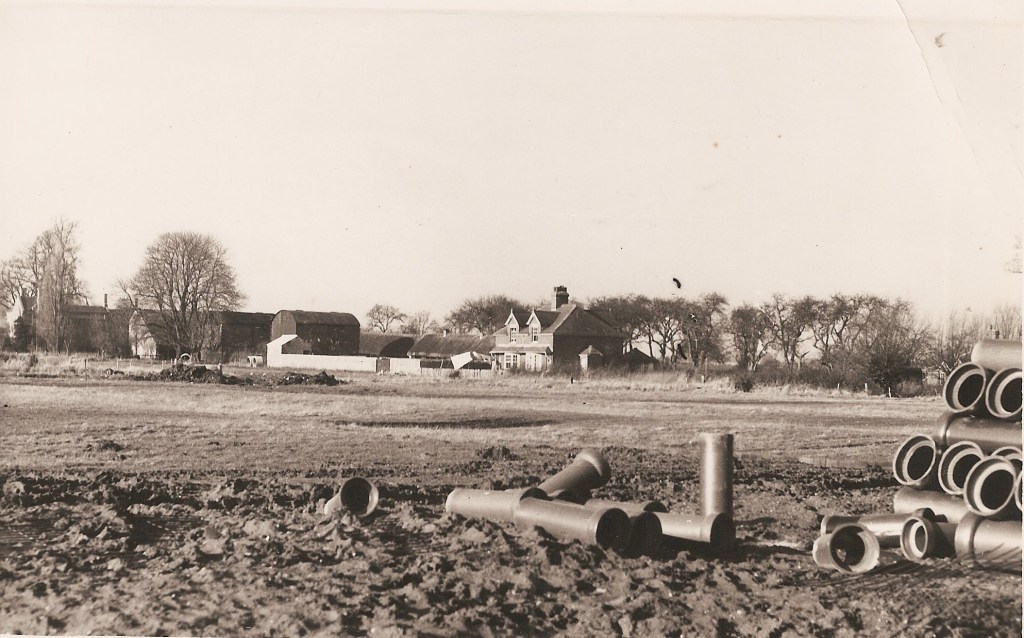
Walcot under construction, but which of the farms is pictured in the distance?

It is difficult today to picture the numerous farms that comprised our town but several were still in existence until the 1952 Town Development Act was adopted. Swindon Corporation acquired 1,000 acres of land for building to the east of the town, swallowing up long held Goddard family property, including Lower and Upper Walcot Farms. The housing estates at Walcot cover former farmland that included ancient fields once named Glazemore Ground and Chantery Green.

Martha Ann Croom died in 1899 at Walcot Farm and was buried in grave plot D43 where she was later joined by her 5 year old granddaughter Ethel Lilian Croom who died in 1911. Lilian Croom, Martha Ann’s daughter-in-law, died in 1927 and was also buried in D43. Then in 1949 Martha Ann’s youngest son Archibald Ernest Crees Croom (husband of Lilian and father of Ethel) died at Liddington Wick Farm, Coate and he too was buried in plot D43.
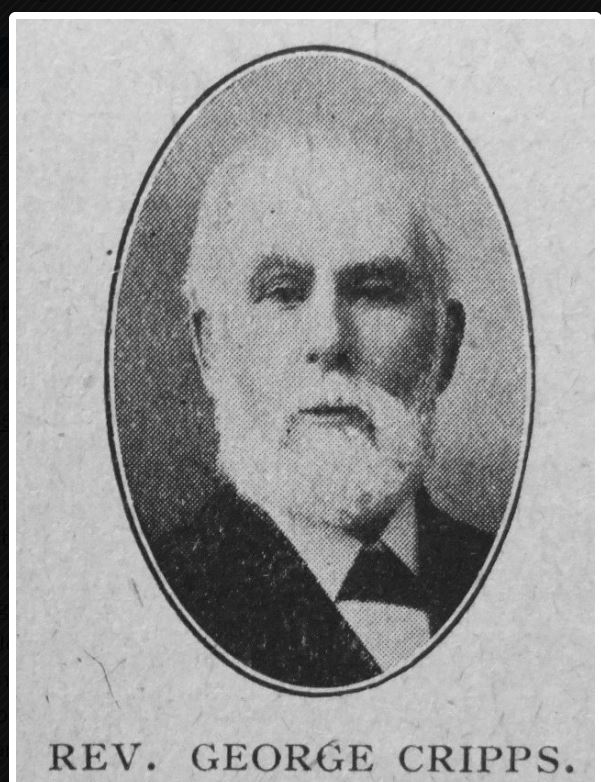
George Cripps – Primitive Methodist Minister

George Cripps was born on May 2, 1839 in Badbury and baptised on May 26 at Chiseldon Parish church.  He was the son of James and Sarah Cripps and when aged just 15 he dedicated himself to a life of Christian service. Within months of his conversion he was preaching on the local circuit and embarked upon a long career as a travelling preacher. He began his ministry in Witney in 1861 travelling the country and serving in various circuits including those at Andover, Thetford and Ipswich before returning to Swindon in 1897.

In 1866 he married Ursula Ellen Bayman and the couple had six children, two of whom had sadly died before 1911. Their son Raymond George Cripps married Beatrice Maud Raggett, a member of another prominent local Primitive Methodist family, and went on to become Mayor of Swindon in 1938-39.

George retired to Swindon where he worshipped at the Prospect Place Primitive Methodist Chapel. In 1901 he and Ursula were living at 134 Goddard Avenue. George died at his home on August 25, 1920 and was buried in grave plot D300 which he shares with Ursula who died in 1918.

A lengthy obituary written by Joseph Burton was published in the Primitive Methodist Magazine in 1920 – extracts can be read below:

After a period of further preparation, involving much thought and prayer, he commenced his life’s work as a minister of the glorious gospel of our Lord and Saviour Jesus Christ in 1861. The Witney Circuit pledged him, and he laboured with considerable success and acceptance on the Sturminster Newton, Faringdon, Andover, Newbury, Basingstoke, Thetford, King’s Lynn, Wangford, Ipswich, Tunbridge Wells and Guildford Circuits.

There were many preaching places on most of these circuits, covering a wide area, and sometimes necessitating a walk of fifteen or sixteen miles each way. Besides the ordinary week-night work, our brother frequently preached three and four times on the Sabbath. He built five chapels and reduced debts on others. It seemed to be his lot to have to grapple with such cases, but with indomitable perseverance and tact, he generally succeeded. At Ipswich, where I first formed his acquaintance, he waited upon a gentleman with the intention of getting financial help, but was unable to see him. He called again—twenty times—before he was granted an interview. The gentleman said: ‘‘I believe you have been before.” Our brother replied that he had called twenty times, and should call again unless he got what he desired. The gentleman bade him sit down, and retired to another room. Presently he brought a cheque for £20—a pound per visit—as a reward for his pertinacity, and, told him whenever he needed help, he could call again. 

The same zeal was in evidence for winning souls. Well do I remember as a probationer, the Saturday evening open-air services, with sometimes opposition, sometimes police interference; but if we were moved from one place it was to begin again elsewhere: the singing and exhortations went on, and, we had reason to believe, were made a blessing to souls.

He got the Free Church ministers to join him in a mission in connection with our Rope Walk Church, and as they proceeded down the Rope Walk, headed by a brass band, it was the signal for a tremendous opposition that required the whole of the town’s police, except two, to quell. But not before much damage was done. They smashed the windows of the chapel, brick-ends falling on to the platform, and those who had ventured inside the chapel had to be got out by the back door and through the caretaker’s house. Happily no one was seriously hurt. The windows were boarded up, and the mission proceeded for some weeks, leading ministers and friends of other Churches taking part. The riot was due to a misapprehension that the Salvation Army were beginning their mission in the town, but it turned out for great good, many souls professing conversion.

It was while on the Tunbridge Wells Circuit, under the strain of heavy chapel liabilities, and special services—including mid-day services to men during their dinner hour—that his health broke down. His condition was so serious that his medical adviser ordered a sea voyage to New Zealand on a sailing vessel. In a crisis of this kind, one sometimes discovers that: some of God’s servants have been watching the struggle. It was so in his case. One friend secured his passage, others sent useful presents for his comfort on his voyage, and almost weekly, during an absence of eleven months, never failed to minister to his wife and family. On his return it was found there was very little improvement in his health. The Conference of 1887 stationed him at Guildford, from whence he superannuated in 1892, having travelled thirty-one years. He settled down in Swindon. Though broken in health and a great sufferer, he served nine years on the Swindon Board of Guardians, and preached in nearly all the, Free Churches in the town. His wife, never strong in health, but a great helpmate on his circuits, ideal in the home, hospitable and very kind, predeceased him in 1918. Most of the time after her death he was obliged to remain indoors, and latterly was confined to his room suffering from a complication of diseases—uncomplaining, bright, cheerful and hopeful in spirit, and heartily responsive to prayer and spiritual conversation. 

Image published courtesy of My Primitive Methodists

You might also like to read:

Raymond George Cripps – first Mayor to be invested in new Civic Offices

Archdeacon Samuel Christelow – missionary

Samuel James Christelow was born in 1883 the son of John Christelow,-  a boilermaker, and his wife Priscilla. He was baptised at St Mark’s Church on November 30, 1879 and grew up at 42 Wellington Street, a property that remained the family home for more than 70 years. After several years working in the railway factory, Samuel Christelow travelled to Zimbabwe where he was ordained. In 1938 the Rev Christelow returned to Swindon for an extended holiday with his family.  A reporter from the North Wilts Herald interviewed Rev Christelow at the home of his sister and brother in law in Goddard Avenue.

Home From South Africa.

Archdeacon’s Five Months’ Leave

Native of Swindon

After a trip from South Africa aboard the Llanstephan Castle, the liner in which a mystery illness caused four deaths on the way, Archdeacon Samuel Christelow, of Southern Rhodesia, has arrived in Swindon on five months’ leave. image Swindon born and bred – he is an old Sanford-street scholar – Archdeacon Christelow has been working in the mission field in South Africa for 30 years, that time being spent in periods of five years in the Dark Continent broken up by spells on leave.

Plenty of Travel.

The diocese of Southern Rhodesia includes part of Bechuanaland, Mashonaland and Matabeleland, and the Archdeacon is also Director of Missions for the whole diocese. This mission work affords him plenty of travel – chiefly by car – throughout the whole territory in which are one and a half million natives and 65,000 whites. The whites are chiefly concentrated in Salisbury and Bulawayo. A good deal of translation work occupies Archdeacon Christelow’s attention, for he has an excellent knowledge of the languages of the country. He speaks Chishona, the language of Mashonaland, Zulu in Matabeleland, and Sechuana, which is spoken in Bechuanaland. “I learned the languages fairly quickly,” he told me. “I used to have to go off on trips lasting several weeks with natives who could not speak a word of English, so of course I had to learn. Most of my journeys then were done on foot, although I sometimes had a horse, but these animals were inclined to get horse sickness. We had to take all food with us to last for journeys of several hundred miles, covering about 25 or 30 miles each day. Occasionally, of course, I was able to shoot some game.”

Native Problems

Of the changes which had taken place in his 30 years’ experience of the country, Archdeacon Christelow said: “The attitude of the Government towards mission work has changed. It is much more sympathetic and shows it in various ways; among them it has started a scheme for providing medical aids for there is very little medical work indeed, most of it having been done by the missionaries, who also had to fill the roles of dentists, builders and carpenters. “The Government has also begun a series of clinics. Extracts from the North Wilts Herald, Friday, 4 March, 1938. samuel-james-christelow Widowed and retired he returned to Swindon where he lived with his sister Rosa at 125 Goddard Avenue. He died in St Margaret’s Hospital in 1972 and is buried in plot D1587. You might also like to read: Up at the Castle  

The Summer Cemetery

Listening to Storm Jocelyn battering Britain, I’m looking forward to kinder, calmer climes. While the bluebells hunker down and the ox-eye daisies rest their roots, let’s revisit the summer cemetery.  With our guided walks paused during the winter months, we are compiling our 2024 calendar of events – dates to be announced soon.

Meanwhile, you might like to check out our video page where you can see Noel’s sunny reports from New Zealand.

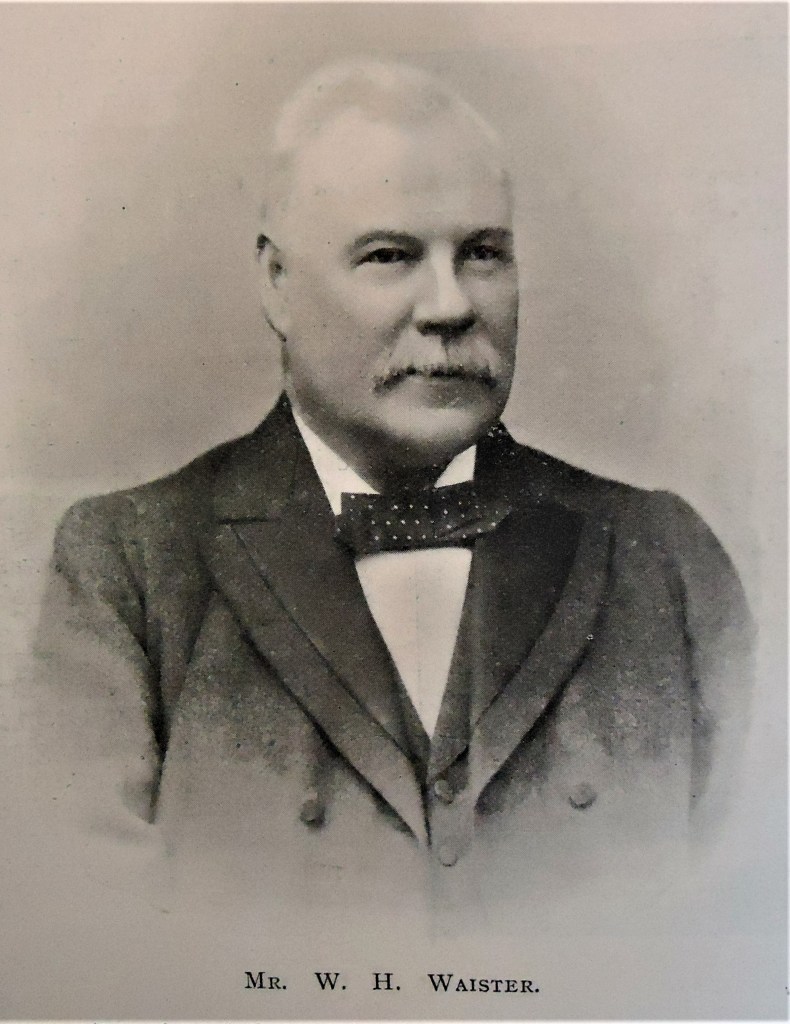
William Henry Waister – an interesting career recalled

Sometimes there is little I can add to the words written in an obituary. This is a lengthy report but well worth reading.

Death of Mr W.H. Waister

Interesting Career Recalled

Honoured by the German Emperor

Many Swindonians will hear with regret of the death of Mr William Henry Waister, of Clifton House, Swindon, which occurred on Saturday, after a long illness.

Mr Waister, who was 66, had been in failing health for the last five years, and during that time his sister-in-law, Mrs Clarke, had resided with him. Three weeks ago he went to Weston-Super-Mare, in the hope that the change would be beneficial, but when he returned home on Thursday his state of health was about the same, and he passed away as stated. Deceased leaves two sons and two daughters. The elder son is in the service of the GWR and occupies the position of Assistant Divisional Locomotive Superintendent at Newport, while the younger son is in Canada. Of the two daughters one is married and resides in London. Mr Waister’s wife, who was a daughter of Mr. William Elliott, of Wolverhampton, pre-deceased him 11 years ago.

Mr Waister’s association with the GWR was a long and honourable one, and was marked by the bestowal of many more honours than fall to the lot of the average railway official. Under the age limit he retired from the Company’s service at the end of 1912, and was succeeded by Mr W.H. Williams, who for some years had acted as his assistant. For 15 of the 48 years he was connected with the GWR he occupied the position of Chief Outdoor Assistant to the Locomotive, Carriage and Waggon Superintendent, and when he retired into private life he took with him several tokens of the high regard in which he was held, opportunity being taken of the occasion by the members of his own personal staff, over 60 in number, to present him with a handsome silver salver. The presentation was made, in felicitous terms, by Mr T. Piggott (chief clerk in Mr Waister’s department) and many tributes were then paid to Mr Waister’s services and high personal qualities.

Mr. Waister was a Tynesider, and, following some experience in the Marchioness of Londonderry’s workshops at Seaham Harbour, he was in 1865 apprenticed to the mechanical engineering in the GWR Works at Wolverhampton. As time went on he made satisfactory progress in his passage through the various departments, and after having acted as relieving foreman he eventually became Chief Draughtsman. In 1885 Mr Waister was transferred to Swindon to take charge of the Drawing Office, and a year later he became Locomotive Superintendent of the Swindon Division. In 1888 he returned to Wolverhampton in the capacity of assistant to Mr. George Armstrong (the Superintendent of the Northern Division) and as manager of the Stafford Road Works. His second stay at Wolverhampton extended over a period of nine years. In February, 1897, on the retirement of Mr. Armstrong, he became superintendent of the Northern Division, and the following October witnessed his return to Swindon as Chief Running Superintendent, under the late Mr. W. Dean, and from June, 1902, until the date of his retirement he was under the Chief Locomotive and Carriage Superintendent (Mr G.J. Churchward).

Mr Waister had a very interesting career. He served under no fewer than six General Managers, and it worthy of note that from 1886 onwards he accompanied practically every royal train running over the GWR system. He was with the train in which the German Emperor and Empress and their suite travelled over the line in 1907, and the Kaiser then conferred upon him the Order of the Red Eagle. He also accompanied the Czar and Czarina on their journey from Wolverhampton to Basingstoke in October, 1896. For the services he rendered in arranging accommodation for Royal personages he several times received the thanks of the General Manager and Chief Superintendent, and it is also interesting to note that he was one of the recipients of a medal from the Company commemorating the reign of the late Queen Victoria.

Mr Waister’s organising and administrative abilities were little short of remarkable, and for the services he rendered in connection with the removal of troops from one part of the system to another for the purposes of manoeuvres and mobilisation he received the thanks of the War Office on more than one occasion.

Funeral

The remains were laid to rest in Swindon Cemetery on Tuesday afternoon the funeral being attended by several of the deceased gentleman’s old colleagues and representatives of the Great Western Railway Company. The Vicar of Swindon (the Rev. C.A. Mayall) conducted the service in the Cemetery chapel and also performed the last rites at the graveside. The coffin, which was of polished elm with brass furnishings, was covered with beautiful wreaths, and the inscription on the breast plate was as follows:-

William Henry Waister

Died October 3, 1914.

Aged 66

Extracts from the North Wilts Herald, Friday, October 9, 1914.

William Henry Waister was buried on October 6, 1914 in grave plot E7949, a plot he shares with his wife Annie Maria who died in 1902. Their daughter, Lilian Waister, died in Newport in July 1950 and was buried with her parents here in Swindon.

This is all that remains of the Waister family memorial.

Clayton Joyce – bungalow builder

Clayton Walter Joyce was born in Moredon in 1863 the second son of Charles Joyce, a mason and builder, and his wife Pamela. Clayton started work in the GWR Works and when he married Emily Jones in 1888 he stated that his occupation was that of mechanic. But inevitably he went into the building trading, working as a bricklayer from at least 1891.

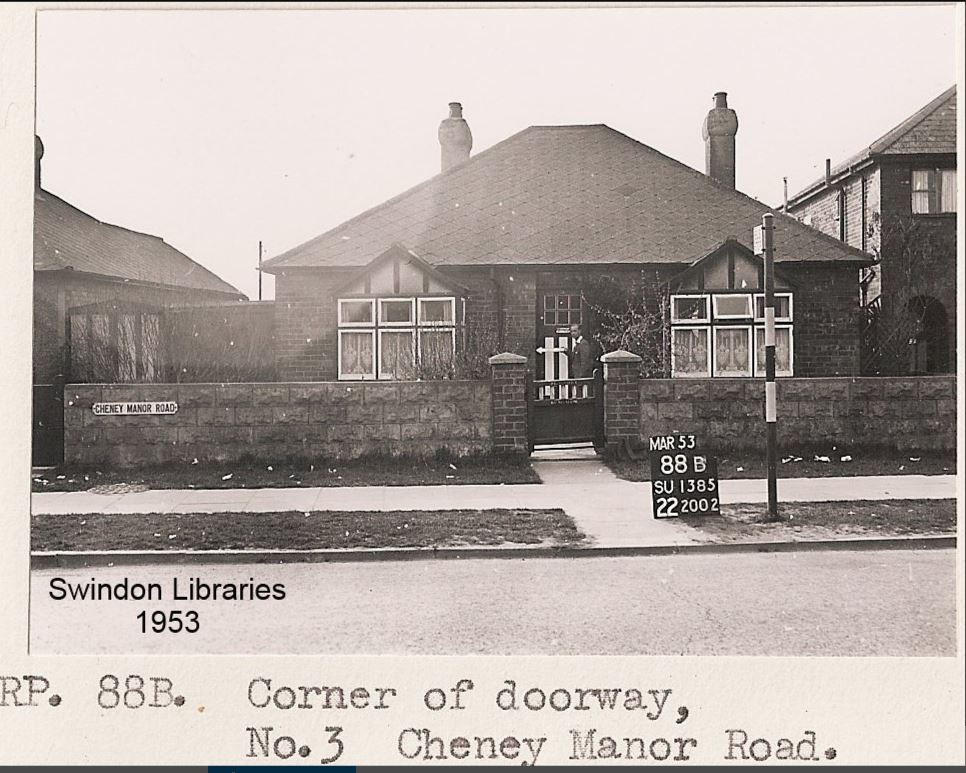
In 1925 Clayton began work on properties in Telford Road, Rodbourne Cheney. He built two bungalows both completed in 1926. That same year he built a bungalow for Mr Keene and began work on a house and shop completed in 1927. In 1927 he went on to build four bungalows, one for Miss Perry, one for Mr Walker and two for Mr G. Mabberley, the man who commissioned his first build in 1925. In 1928 he built a bungalow (nearest shop) and then in 1932 another bungalow in Telford Road for Mr A.J. Thorne in the recently renamed Cheney Manor Road.

This image is published courtesy of Local Studies, Swindon Central Library from the Ordnance Survey Revision Point series of photographs. Could this be one of Clayton Joyce’s bungalows?

By the 1920s Telford Road in Rodbourne Cheney had become a desirable residential area. Builders active in the area include Tydeman Bros who built a house for Mr Keefe in 1928. Our friend James Hinton (who owned the land on which the cemetery was laid out) was also busy in the area and had been for sometime, according to an entry in Architects and Building Craftsmen with Work in Wiltshire Pt 2., James Hinton – Swindon Telford Road, Harcourt Road, Cobden Road, Ferndale Road, new streets and back roads 1905.

Another view of Cheney Manor Road courtesy of Local Studies, Swindon Central Library. Could the bungalow on the right be a Clayton Joyce build?

In 1928 the Swindon Borough boundary was extended to incorporate Rodbourne Cheney and Telford Road was renamed Cheney Manor Road.

Clayton’s wife Emily died in 1925 and was buried on January 31 in grave plot D210. At the time of the 1939 census Clayton was living with his son and his family at 9 Suffolk Street. He died at Ogbourne Hospital in 1945 aged 82 and was buried with Emily on February 7.

Blanche Louisa Smith

In some respects the desires of the 19th century Swindon railway families were not so far removed from our own. People wanted a good standard of living, a regular income, food on the table and nice things in their home.

And when Blanche Louisa Smith married Thomas Edward Watkins she no doubt wanted the same.

The couple married in the June quarter of 1892 – not many weeks before their first child was born, again, not so very different from life today. At that time Thomas was working as an Engine Fitter in the railway works, a well paid job with good prospects.

Life had been a little different for Blanche. Her family had also been drawn to Swindon and the employment prospects here. On the 1861 census Blanche’s father was working as an ‘iron factory labourer’ (in the railway factory).

George died in 1879 aged just 41 years old. He was buried in the churchyard at St. Mark’s. By the time of the 1882 census his widow Ellen was living at 7 High Street (later renamed Emlyn Square) where she worked as a laundress. Living with her were three of her children, George 22 who worked as a boilermaker and Blanche 8 and John 5.

When Blanche and Thomas Watkins took their baby son to be baptised at the Primitive Methodist Church in Regent Street in 1892 they were living with Thomas’ parents in Eastcott Hill, but they would soon move away. In 1901 they were living at 17 Flathouse Road in the dockland area of Portsmouth, with their three young sons Thomas 8, George 6 and one year old Archibald.

When Blanche died in 1911 aged 38 years her address is recorded in the Radnor Street Cemetery burial registers as being 10 Oxford Street, Swindon. With no members of her Smith family buried in the cemetery Blanche was laid to rest with her father-in-law Charles Watkins who died in 1907.

Her two little daughters who died in infancy are buried in Portsmouth but remembered on the Watkins family grave in Swindon.

You may like to read more about the Watkins family here.

Granville Street and the Watkins family

The Griffin family – another Swindon story

The national news this weekend has been dominated by the announced closure of the Tata Steelworks in Port Talbot, South Wales with the loss of more than 4,000 jobs, half that number going within the next 18 months. Steel production in Port Talbot dates back more than a century with 20,000 employed there during the peak of production in the 1960s. The people of Port Talbot are fearful for the future of their town and the prospects for their young people.

Does all this sound rather familiar? Here in Swindon, where the railway factory closed in 1986, we now have a whole generation who never knew Swindon when it was a railway town.

For the children of Rodbourne who attend Even Swindon School the history of the railway works is kept alive, but is this the same for other schools in the town where local history has a low priority on the national curriculum.

Once upon a time (and yes, this is beginning to sound like a fairy tale) whole families were employed in the Works. Take the Griffin family for example.

Phillip James Griffin was employed as a clerk in the railway factory and all four of his sons followed him ‘inside.’ Eldest son Frank Aldworth Griffin entered service in the Works as a clerk, passing his probationary period satisfactorily along with the Paddington examination on May 17, 1898. He was followed by Phillip William Griffin who embarked upon a 7 year Fitting and Turning Apprenticeship on his 14th birthday in 1899.  Ralph Ernest Griffin was 15 years old when he began a Fitting and Turning Apprenticeship on April 16, 1903 and youngest brother Cyril Arthur started work on September 8, 1908 as an office boy aged 14.

The four brothers never married; Frank, Ralph and Cyril lived with their widowed mother Caroline in Clifton Street. Only Phillip William Griffin moved away, and when the time came he returned home to be buried with the family in Radnor Street Cemetery, the last resting place for so many of the railway men and their families.

Cyril died in 1934 and was buried with his parents in grave plot A742.

Frank, Ralph and Phillip Griffin are buried together in grave plot D440.

Emma Louisa Newberry

Image of Drove Road taken c1926 and published courtesy of Local Studies, Swindon Central Library.

Emma Louisa Newberry died in 1964 aged 96 years. Emma was born in Guernsey in 1867. She had lived through almost a century of enormous social change including two world wars, the second of which saw the German occupation of her former island home.

Unfortunately, I can find out very little about her family background, not even her maiden name, but I will continue to research.

By 1893 she had married Ernest Walter Newberry, a gas fitter, quite probably in Guernsey where he was also born and raised. Emma’s Swindon story begins in 1894 when her daughter Gertrude May was baptised at St. Mark’s Church on May 27. Emma and Ernest, who was employed in the GWR Works, then lived at 28 George Street. In 1901 they were living at 54 Dean Street where their second daughter Clarice Louise was born. In 1939 Ernest and Emma were living at 86 Drove Road, their last home together.

Emma outlived not only her husband Ernest but both her two daughters as well. She died in the Isolation Hospital, Swindon on May 17, 1964.

Emma was buried on May 22, 1964 in grave plot B2669 which she shares with her husband Ernest who died in 1940, her daughter Clarice Hallard who died in 1958 and her son-in-law Herbert Hallard who died in 1948.

Her elder daughter Gertrude May died in 1954 but she is not buried here in Radnor Street Cemetery.

A happy ending for one war torn family

On January 9, 1919 the SS Northumbria sank in the North Sea. Only two members of the crew survived; among those lost was Thomas Poole.

Thomas Poole was born in 1882, the son of William and Elizabeth Poole. He enlisted with the Royal Marine Light Infantry on April 9, 1901. In 1919 he had been drafted to the SS Northumbria, a Defensively Armed Merchant Ship carrying wheat from Baltimore to the UK, to man the ship’s gun. The ship sank off the coast of Coatham, County Durham, after striking two mines.

Thomas’s younger brother Henry John joined the Royal Navy in January 1907. He served on HMS Empress of India, Argyll and Leviathan before being transferred to the Royal Fleet Reserve in 1912. Able Seaman Henry Poole ended his naval career in 1921 on Vivid I, a shore based ship.

And along with a patriotic love of their country, the two brothers shared the love of a woman.

On February 16, 1916 Thomas Poole, a Royal Marine aged 34, married Beatrice Fanny Dixon aged 26 at Christ Church. The couple’s son Derrick Thomas Poole was born on October 20, 1918. Less than three months later Thomas was killed on the SS Northumbria.

Did he ever get to see his son? What was Beatrice to do now?

We can’t begin to imagine what life was like for those women in the immediate aftermath of the war. The 1921 census figures revealed that there were in excess of 1.7 million more females than males in the population – known collectively as the ‘Surplus Women.’ The prospect of marriage and a family unlikely for so many. But what about the women like Beatrice, widowed aged 30 and with a child to support. What kind of future could she expect?

In the December quarter of 1919 Beatrice married Henry John Poole, Thomas’s younger brother. They went on to have two children of their own – Gordon Henry John born in 1920 and Doreen Elsa born in 1930.

In 1939 the family lived at 138 Broad Street. Henry John Poole was working as a Rivetter’s Holder Up in the railway factory, Derrick was a Motor Mechanic and Gordon a Metal Machinist also in the railway works. Nine year old Doreen was still at school.

A happy ending for one war torn family.

Henry John Poole died in 1965 and Beatrice Fanny in 1977. Neither of them are buried in Radnor Street Cemetery.

Thomas Poole was buried on January 16, 1919 in grave plot D1023 where he lies alone. The CWGC Eyes On Hands On team of volunteers care for his grave.