Richard Bellwood Pattinson was born in Heighton in Durham on November 28, 1841 and moved to Swindon as a child. His father, Richard Renwick Pattison, was one of a large contingent of railway workers from the north east who moved down to Swindon in the early years.
In 1861 Richard married Alice Grandison, the daughter of another early incomer David Grandison, and the couple had three daughters.
Richard jnr followed his father into the Works, as most sons did. The UK Railway Employment Records provide a resume of the various roles he filled in his working career.
His service with the GWR began as an Office Boy in the Goods Department in April 1854 when he was 12 years old. He worked there until he was older enough to begin an apprenticeship. He then worked as a draughtsman, then a valve setter. He became an Assistant Foreman and then a Foreman. He resigned on June 2, 1897 aged 56 after approximately 43 years of service. Perhaps he was secure enough financially to retire early. Richard died on December 2, 1900, just three years after his retirement. His effects were valued at £10,884 11s 2d, a fortune in 1900.
Death of Mr R.B. Pattison – Mr Richard Bellwood Pattison, who for 23 years was foreman of the B1 and C sheds (erectors’) in the GWR Works at Swindon, died at his residence, No. 7 Sheppard street on Sunday, at the age of 59. The deceased gentleman succeeded his father as foreman in 1874, after a previous experience of 20 years in the workshops, and retired in 1897. He leaves a widow and two married daughters.
The Citizen, Tuesday, December 4, 1900
Richard Bellwood Pattison was buried on December 2, 1900 in grave plot E8497. He is buried with his daughter Sarah Bellwood Jones who died in 1926. His wife Alice and their two other daughters are buried in the neighbouring grave plot E8496
James Sweeper was born in Marlborough in about 1824 the son of William and Harriett Sweeper. On December 8, 1845 he married Jane Gilbert at the church of St. Peter, Marlborough.
By 1851 James and Jane with their two young children Eliza 2 and 2 months old George, lived above the stables at the Queens Hotel, Swindon. He was 28 years old and employed as a post boy – a job description open to interpretation. Sometimes described as a mail carrier, a post boy was also a person who rode one of the horses pulling a carriage. The two roles could be, and frequently were, combined.
In 1861 James and Jane and their 5 children lived at the Queens Hotel Tap, Railway Station, Swindon. In 1871 James, now widowed, lived at the Queens Hotel Stable with daughter Eliza and sons George, Henry and William. However, sorting out the various town centre Queens Hotels is confusing.
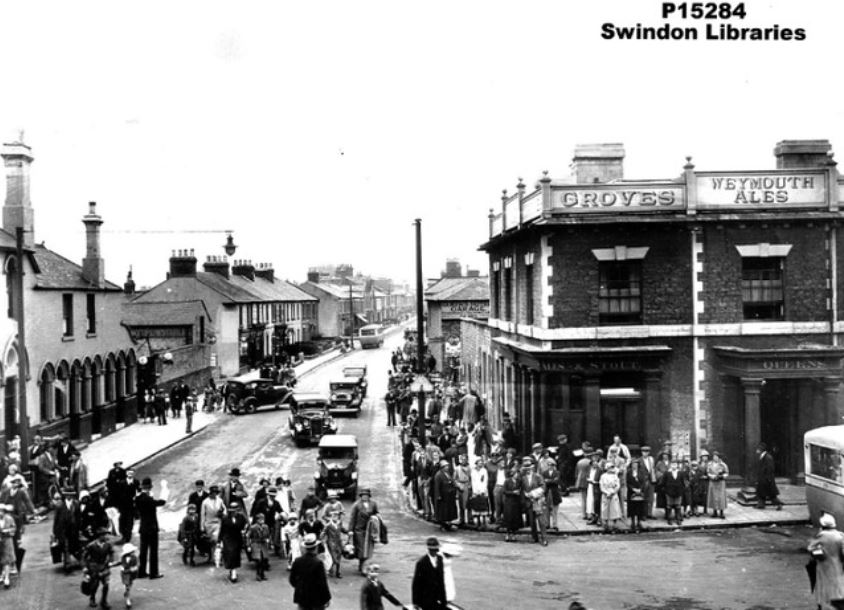
The Queen’s Tap pictured on Trip day 1934 published courtesy of Local Studies, Swindon Central Library.
Swindon Junction Station (now called Swindon Station) was built in 1841-42 by J.D. & C. Rigby. A far more impressive building in those days, it originally consisted of 2 separate 3 storey buildings straddling either side of the railway line and linked by a footbridge. These buildings contained the infamous refreshment rooms and the Queen’s Royal Hotel. Was this where James worked as a post boy and later an ostler (a man employed to look after the horses of people staying at an inn)?
The second candidate is an inn built in 1841 that once stood at the bottom of Corporation Street close to the Whitehouse Bridge. It later became known as The White House and was demolished in 2002, but in James’s day it was called the Queen’s Arms Hotel.
Finally, we have the only one left standing, the Queen’s Tap, opposite the station on the corner of Wellington Street and Station Road.
So where did James live and work between 1850-1870. My money is on the Queens Arms Hotel but then again perhaps he worked at all three hotels at various times.
Jane Sweeper died in April, 1868 aged 44 years and was buried in St. Mark’s churchyard. James married for a second time in 1875 when he was working as a horse dealer in East London. James married Lucy W. Hunt, a widow, at St Leonard’s Church, Bromley and by 1881 had returned to Swindon where they lived at 22 Holbrook Street with James’s son Harry.
It has been much easier to establish James’s last resting place here in Radnor Street Cemetery! He died in 1887 aged 65 and was buried on December 7, in grave plot E8582 with Lucy who had died earlier that same year.
In which our roving researcher Noel goes to great lengths to follow a Swindon story.
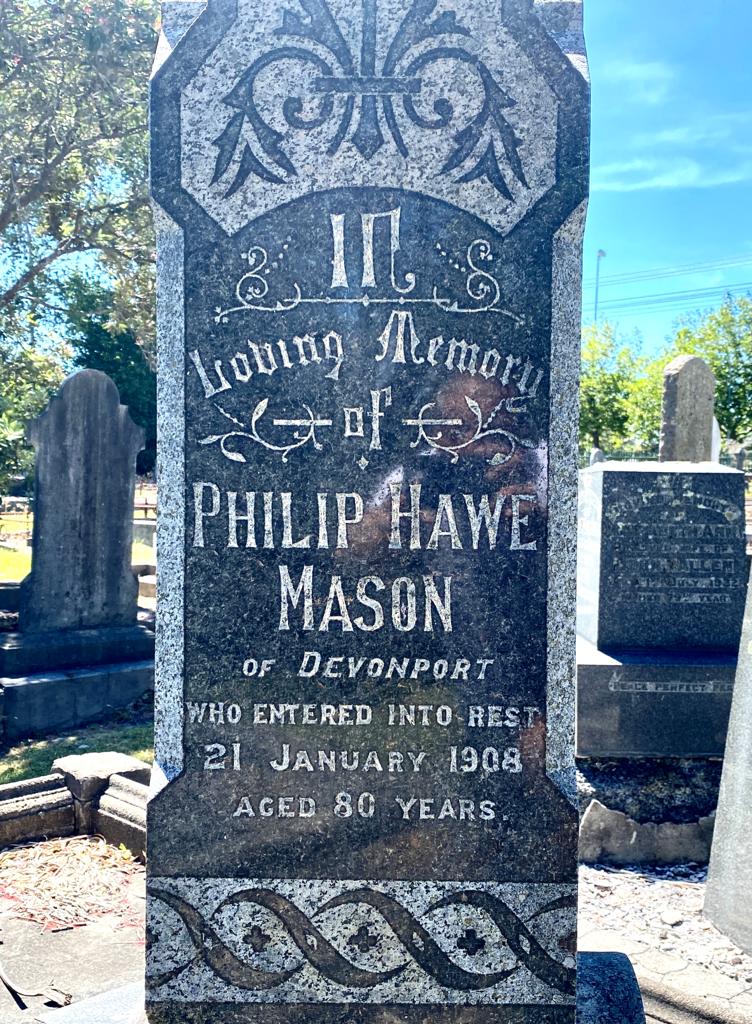
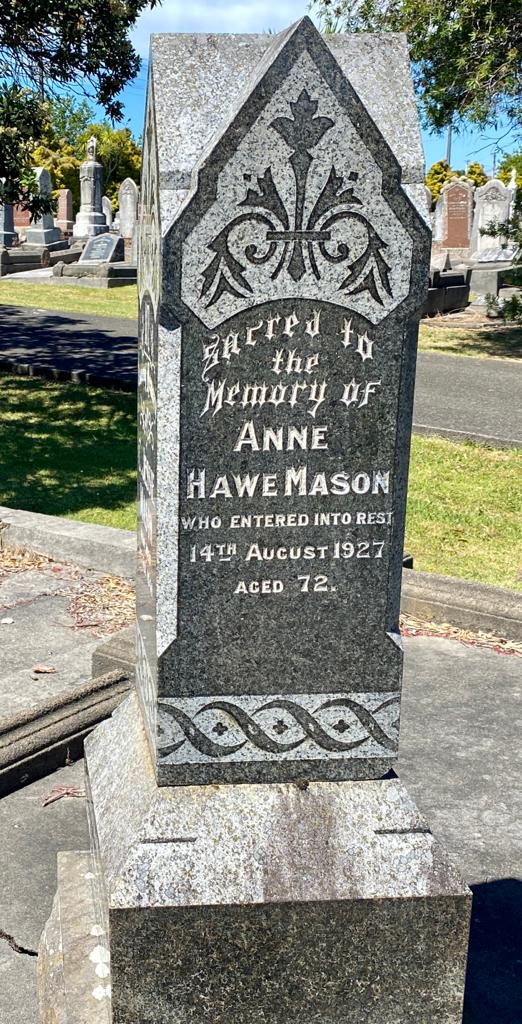
Philip Hawe Mason was born on December 5, 1827, the son of Wesleyan Minister John Mason and his wife Anne. His baptism appears in the Methodist Register of Births & Baptisms as having taken place on February 1, 1828 at his father’s house in Saint Luke’s Parish, London, performed by John Stephens.
An enterprising young man, Philip had arrived in Swindon by 1851 when he has his own grocer’s shop in the High Street. He later opened a second shop in Regent Street and by 1871 he is no longer living over his business premise but at Sanford House, a sizeable property on the corner of what is now Springfield Road and Croft Road. In 1871 he describes himself as a Grocer and Provision Merchant employing 15 men and 5 boys. Philip was an active member of Swindon’s society serving as Chairman of the Swindon School Board and heavily involved with the Wesleyan Church in Swindon, when tragedy struck.
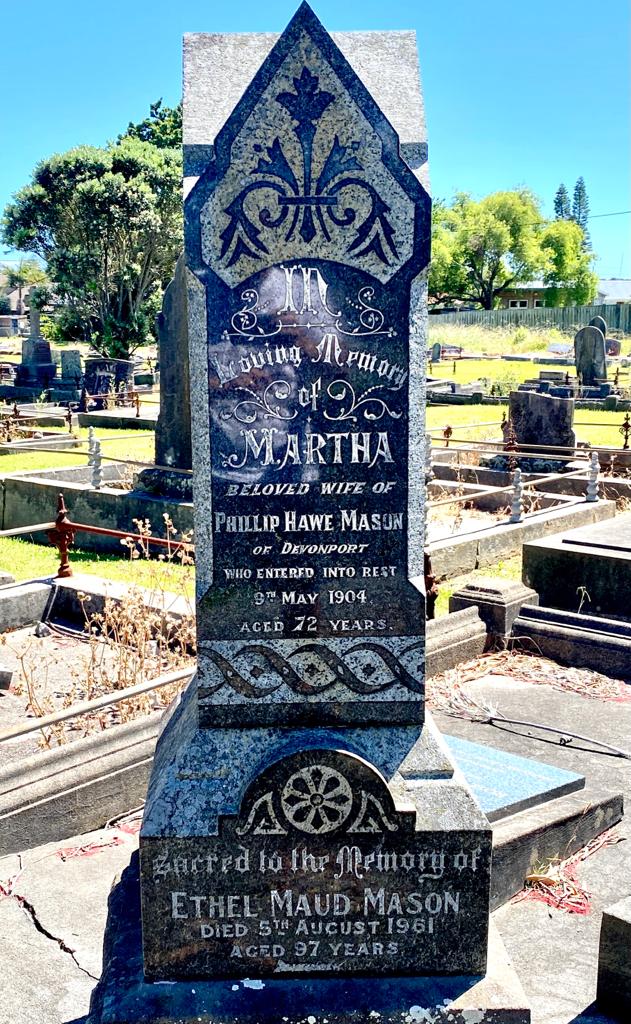
His wife Martha, whom he had married in 1853, took ill (possibly worn down by 10 pregnancies). Medical advice was to move to a warmer climate so in the 1880s Philip, Martha and several of their children, moved to Devonport, Auckland, New Zealand.
Here too Philip took an active part in the local community, serving as an elected Councillor of the Borough of Devonport.
Martha died in 1904 aged 72 and Philip in 1908 aged 80.
Death of Mrs P.H. Mason
The news of the death of Mrs P.H. Mason, at Devonport, Auckland, New Zealand, will be received with undisguised feelings of regret in Swindon by those who were acquainted with that lady and her family during their residence in the old town.
According to a cablegram received by the deceased lady’s daughter, who resides at Bristol, Mrs Mason’s demise took place last Monday, May 9th. The first intimation of the sad event was conveyed to Swindon in a letter addressed to the Mayor (Ald. James Hinton), by Miss Mason. The letter supplies a pathetic fact as to the suddenness of the news, for Miss Mason states that a letter intimating that Mrs Mason was quite well arrived simultaneously with the cablegram announcing her death.
Some little time must necessarily elapse before a further letter explaining the cause of Mrs Mason’s sudden demise can be expected.
The deceased lady, who was 72 years of age, was highly esteemed during her residence in Swindon. She was a prominent Wesleyan, and took an active interest in the welfare of that body. Mr Philip Hawe Mason was also held in high esteem. He held the position of Chairman of the School Board, and was Circuit Steward in connection with the Wesleyan body for many years.
Mr and Mrs Mason left Swindon in 1881 and such was Mrs Mason’s state of health that she had to be carried on to the boat.
During the time she was abroad, Mrs Mason enjoyed excellent health. It is only recently that Mr and Mrs Mason celebrated their golden wedding.
The Swindon Advertiser, Friday, May 20, 1904.
Their daughters Anne Hawe Mason died in 1927, Catherine Jessie Mason in 1940 and Agnes Martha Mason in 1944.
In the cemetery we have a problem with grass and it would appear that it was ever thus …
There was quite a commotion at the monthly meeting of the New Swindon Local Board held in the summer of 1882.
Mr Dawson asked the Chairman if he would be in order in referring to the late sale of grass at the Cemetery? –
Mr Dawson then said there were three tenders received for the grass, one from Mr Wiltshire of £5, Mr Barker £5 and Mr Morris, junr., or one of the young Morris’s, of £4 5s. The committee appointed to sell the grass, Messrs W. Wearing and W. Morris, after opening the tenders, went and looked at the grass, and then Mr Morris said he would give £5 5s for the same for his son, and this was agreed to between the two. He (Mr Dawson) looked upon this as a very unfair and discreditable transaction on the part of Mr Morris, and having said this much left the matter in the hands of the Board.
The Chairman said there certainly appeared to have been some irregularity, but after what had taken place he did not think such a thing was likely to occur again.
Mr W.E. Morris said he had heard a good deal about the said “tenders,” were they in writing or by word of mouth?
The committee had no idea that there was £5 worth of grass at the place, and simply gave instructions that any one wishing to purchase could leave word with the caretaker at the lodge. The grass, however, appeared to have grown very rapidly and hence the competition for it.
The Chairman repeated that much irregularity appeared to have taken place, but the fault rested as much with the whole committee as with any individual member. The sum in question appeared to be so small that no one for a moment would believe that a gentleman in Mr Morris’ position would knowingly sacrifice his honour over it.
After further remarks the subject dropped, and the meeting broke up at an early hours.
Extracts from the Swindon Advertiser, Saturday, August 5, 1882.
By the spring of the following year the situation would appear to have been resolved and the sale of grass was advertised in the Swindon Advertiser.
Swindon Cemetery
The Swindon Burial Board are desirous of selling the GRASS growing in the Cemetery, for cropping or feeding purposes, to the 31st October next.
Particulars may be obtained of the Caretaker at the Cemetery.
Sealed tenders to be sent to the undersigned, on or before the 16th April latest.
J.C. Townsend, Clerk.
42 Cricklade-street, Swindon, 6th April, 1883.
The Swindon Advertiser, Saturday, April 7, 1883
Now I wonder if anyone would be prepared to come and cut the cemetery grass for a fiver today!
One of the first guided cemetery walks I went on was at Arnos Vale in Bristol where the guide introduced us to a ‘husband sandwich’; a man buried with his two wives. As an inexperienced ‘apprentice’ I was slightly shocked (especially by the term), but since then I have come across numerous ‘sandwiches.’ People are ever pragmatic and burials were expensive, making for some unlikely grave companions. Death is a great conciliator.
Emily was born in 1869 in the parish of Lydiard Tregoze, the daughter of George and Martha Lovelock. George was an agricultural labourer and the family lived at Flaxlands Cottages. George most probably worked at Flaxlands Farm, then owned by Viscount Bolingbroke of Lydiard House.
Emily’s childhood was a rural one; Lydiard Tregoze was then out in the sticks, four miles from the industrial town centre of New Swindon. She married Albert James Fry on June 8, 1889 at the ancient parish church of St. Mary’s situated in the parkland next to Lydiard House.
But by 1891 Emily was living in busy Swindon at 22 Carfax Street with her husband James and baby daughter Florence. In 1901 James and Emily were living at 25 Turner Street. James worked as a rivetter in the GWR Works and the couple had five children ranging in age between 9 months and 11 years.
In 1911 the family were still at 25 Turner Street. On the 1911 census returns women were required to include details of their marriage and we can see that James and Emily had been married for 21 years and they had 7 children of whom two had sadly died. We also know more about the accommodation in which they lived – 5 rooms, not counting the scullery, landing, lobby, closet or bathroom.
As we can see from this headstone, Albert James Fry died in 1915, by which time the couple had been married 26 years.
Two years later Emily married her recently widowed near neighbour James William Covey and moved down the road to live with him at number 21 Turner Street. Emily had a long second marriage as well. When James Covey died in 1942 they had been married for 25 years.
Emily’s two husbands were buried together and when she died in 1951 aged 81 years she joined them in grave plot B3321, to spend eternity together, amicably.
This is the last resting place of Charles Henry Wiltshire, one of 104 war graves here in Radnor Street Cemetery.
Charles was born in 1897, the youngest of ten children. His father William was an engine driver and in 1901 the family lived at 32 Regent Circus. In 1911 the family were living at 57 Eastcott Hill. On the census of that year Mary Ann declared that the couple had been married 32 years and 2 of their 10 children had previously died. She could hardly have anticipated the war that was to follow and the loss of yet another child.
Charles’s service records date from May 1, 1916 when he enlisted as an 18 year old. At the time of his death he was an Air Mechanic First Class in the Royal Naval Air Service.
Charles was invalided out of the Royal Naval Air Service on September 1, 1917. His service records state that he was suffering from tuberculosis caused by his military service. He died on October 16, 1918 at the family home, 39 Commercial Road. He was buried on October 22 in grave plot A2459 and later awarded an official Commonwealth War Graves headstone. He is buried with his father William who had died in 1913 and escaped the fear of seeing his young son in service during war time.
Charles’s mother, Mary Ann, was buried with her husband and son following her death in 1927. The last person to be buried in this grave was Winifred Jessie Wiltshire, William and Mary Ann’s daughter, who died in 1948 following yet another world war.
The story of Charles Wiltshire was remembered at our recent special event at the cemetery.
When the end came it was peaceful. Thomas got up early with the intention of sitting with his wife who was ill. He was found dead in his usual chair at 8.30 a.m.
Aldbourne by Kate Tryon published courtesy of Swindon Museum and Art Gallery
Thomas was born in Aldbourne in about 1834, although finding him there has proved difficult. At the age of 17 he apparently upped and left Aldbourne for London, some adventure for a young Dabchick. Did he go alone or was there a flock of them?
It was here he met Ann Hill and on October 16, 1858 they married at Trinity Church, Paddington. In 1861 they were living at 52 Alfred Road, a multi occupancy property in Paddington, where Thomas worked as a porter.
By 1871 the family were living at Wootton Ville, Gloucester. Thomas was working as a railway guard. He had a large family to support – six children aged 10 and under. Another son was born before they left Gloucester. By 1881 they were in Swindon living at 27 Princes Street, 4 more children and their family was complete. Where did they all sleep – those houses weren’t very big.
Thomas & Ann raised 10 of their 11 children – set them up in good jobs, their youngest became a school teacher. Not bad for a Dabchick, Thomas would no doubt reflect.
And at the end there was sadness, but isn’t there always? At his funeral the hymn “Now the labourer’s task is o’er” was sung.
Died in his Chair
Swindon Railway Veteran Passes Away
The remains of the late Mr Thomas Sawyer, who was one of the oldest inhabitants of Swindon and a railway veteran, were laid to rest in the Cemetery on Monday afternoon. The funeral was largely attended by railwaymen, amongst whom were many “old hands” and intimate friends of the deceased. From the residence, 48, Princes Street, the cortege proceeded to the Sanford Street Congregational Chapel, where a service was conducted by the Rev. J.H. Gavin, who also officiated at the graveside. At the chapel service the well known hymn, “Now the labourer’s task is o’er” was feelingly sung, and the organist subsequently played the Dead March in “Saul.” Six railway employes, in uniform, acted as pall-bearers.
Mrs Sawyer and family wish to thank all kind friends for their kindness and sympathy in their sad bereavement.
The deceased, who was in his 79th year, was a native of Aldbourne. He entered the service of the GWR Company at the age of 17 years, when he joined the Goods Shed staff at Paddington. After serving there for some time he was transferred to Gloucester, and later to Swindon, where he worked himself up to the position of Chief Goods Inspector. He retired from the Company’s service 13 years ago. While at Paddington he was married, and his golden wedding was celebrated three years ago. There were several children of the marriage. Mr. Sawyer never had a serious illness, but the illness of his wife and the death of one of his daughters, which took place in October last, affected his health. He got up as usual at an early hour on Friday, when he expressed his intention of going to sit with his wife, who was dangerously ill. This he did, but at 8.30 a.m. he was found dead in his chair. Deep sympathy is felt for the family in their bereavement.
The funeral arrangements were carried out by Messrs. Smith & Son, of Gordon Road.
Extracts from the North Wilts Herald, Friday, June 6, 1913.
Princes Street changed little between 1913 and 1965. Image published courtesy of Local Studies, Swindon Central Library.
Thomas Sawyer died aged 79 years at his home, 48 Princes Street. He was buried on June 2, 1913 in grave plot E7309. Ann died a month later. She was buried with her husband on July 12, 1913.
This photograph was published in Swindon in Old Photographs collected by The Swindon Society in 1988. The pet tombstones were discovered in the grounds of the Goddard family home The Lawn, but it is unlikely they will be there now.
Jessie Henrietta Goddard was born in 1850 at the London home of Ambrose Lethbridge Goddard and his wife Charlotte. She was baptised in Swindon on June 7, 1850 in the old parish church of Holy Rood during a service to bless the building of the new one, Christ Church.
Charlotte Goddard died in 1904 and following a lifetime devoted to her mother, Jessie moved into Tollington House, Faringdon where she would spend her last years surrounded by her pets.
But, the instructions in her will may seem at odds with her reputation as an animal lover.
‘My dogs Jill and Gem, to be put to sleep when I die, and buried with me if possible.’ She added:- ‘I should like Mr Crundell to come and put to sleep my pony Kitty, and my dogs Jill and Gem and Jasper, if he is still here.’
Perhaps Jessie feared for the future of her much loved pets after her death. Who would take care of them? Would they pine for their mistress – perhaps they too were elderly.
Jessie was buried on September 23, 1920. Whether her beloved dogs were buried with her is not known.
Jessie is pictured here with her parents and her four brothers published courtesy of Local Studies, Swindon Central Library.
Sudden Death of Miss Goddard
We deeply regret to announce the death of Miss Jessie Henrietta Goddard, which took place with most painful suddenness at her residence, Tollington House, Faringdon, early on Sunday morning. It was the custom of Miss Goddard, who was a great lover of animals, to rise early in the morning and tend to the needs of her pets, often before the rest of the household was astir. On Sunday morning it was noticed that she had not performed her customary duties and about 8 o’clock, the maids having heard no movement upstairs, entered her room and were horrified to find their mistress lying dead on the floor in front of the bedroom window, which she had evidently been in the act of opening when seized with heart failure, which must have proved instantly fatal. Medical aid was sent for but Dr. Dornford, who was quickly in attendance, pronounced life to have been extinct for about two hours.
Miss Goddard, who was the daughter of Mr Ambrose Lethbridge Goddard, J.P., of “The Lawn,” Swindon, had resided at Tollington House for the past fifteen years and was held in high esteem by a large circle of friends. She was a great lover of nature and besides her animal pets, took a keen and personal interest in her garden, where it gave her much pleasure to welcome her friends and neighbours. A few years ago she took an active and practical interest in the advancement of the effort to encourage home industries, a movement, which it is to be feared, has not materialised, as she, for one would have wished.
The funeral took place at Swindon on Thursday afternoon, when the remains were laid to rest in the family vault in the Old Churchyard, which immediately adjoins the family residence, in the company of numerous relatives and friends.
Extracts from The Faringdon Advertiser, Saturday, September 25, 1920.
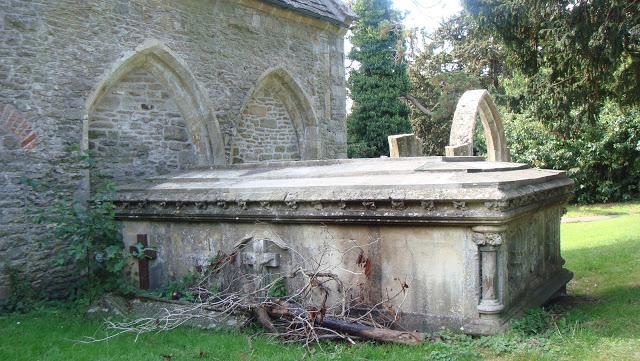
There are no members of this branch of the Goddard family buried in Radnor Street Cemetery. They have their own mausoleum at the ancient Holy Rood Church.
August 1882 and the new cemetery on Kingshill had been open a year. There were 14 burials during the month of August 1882, numbered 221 to 235 in the burial registers. In those early years most of the burials took place in Section A.
The oldest person buried in August 1882 was Richard Cowley aged 91. Richard Cowley was baptised on December 12, 1790 at St. Mary’s Church, Lydiard Tregoze, the son of John and Sarah. In 1810 he married Susannah Smith at the church where he had been baptised and they had five children (possibly more) Maria, Joseph, William, Sarah and John. In 1841 they were living in the Lodge Gate, Spittleborough Farm, Lydiard Tregoze, close to present day Junction 16 on the M4. They were living alone, both in their 50s, the children had all left home. In 1851 the couple were living near Marsh Farm, Lydiard Tregoze. No chance of retirement for Richard who still worked as an agricultural labourer. Susannah died in 1858.
The following year Richard married Elizabeth Green at All Saint’s Church, Lydiard Millicent. He was 68, she was twenty years younger. In 1861 Richard and Elizabeth lived at The Green, Lydiard Millicent. Richard, aged 70, was still working as an agricultural labourer, possibly for Anthony Kibblewhite at neighbouring Godwin Farm. By 1871 Richard was widowed for the second time; still living in Lydiard Millicent, still working.
Richard died in August 1882, aged 91. His last home was 63 Westcott Place where he lived with his youngest son John and daughter-in-law Caroline. He was buried on August 19, 1882 in grave plot A551, a public grave.
The youngest person to be buried in August 1882 was 2 month old Arthur William Thomas. He was baptised William Arthur Thomas at St. Mark’s Church on August 13. He was buried 15 days later in a babies grave plot A285 when he was recorded as Arthur William Thomas. Were his parents too distraught to notice his name was incorrectly recorded?
If William Arthur Thomas had lived as many years as Richard Cowley he would have seen man land on the moon!
In August 1882 Radnor Street Cemetery had been open a year; 14 burials took place that month, the oldest person was Richard Cowley, the youngest was William Arthur Thomas.
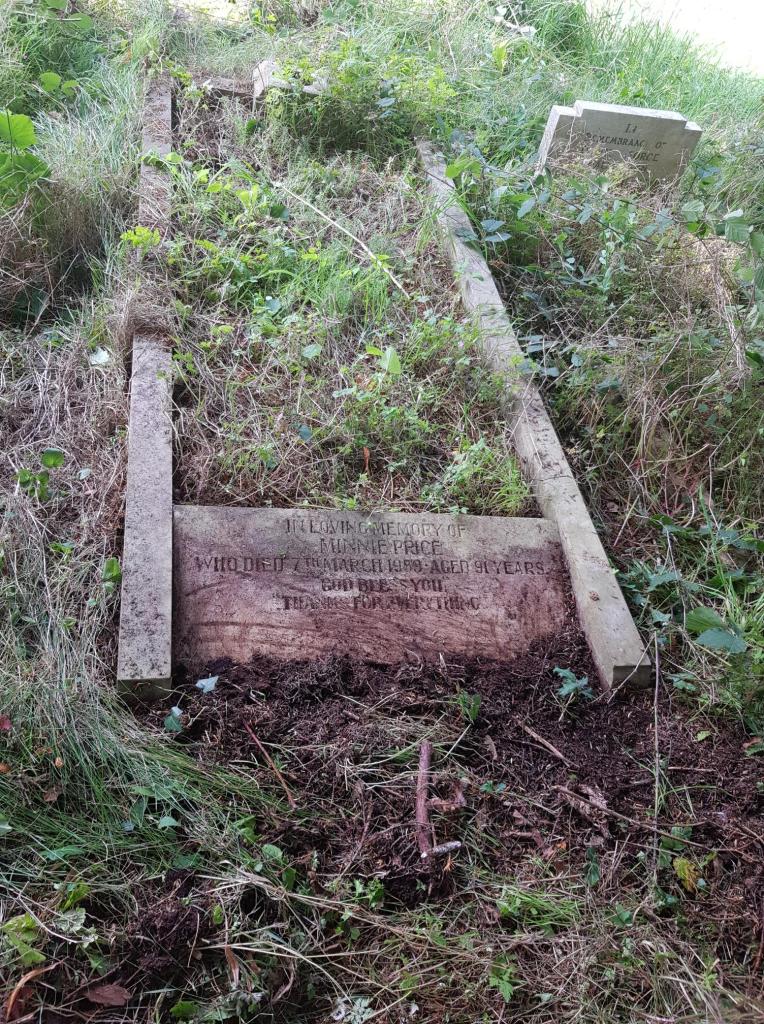
Minnie Price could so easily have slipped out of the pages of history. As a single woman she left no children to tell her story, but she did leave someone who remembered her with affection and made sure the world knew of their gratitude.
In loving memory of
Minnie Price
who died 7th March 1959 aged 91
God Bless You
Thanks for everything
Minnie was born on July 19, 1867 the daughter of John Price, a pudler in the GWR Rail Mills, and his wife Mary. By 1881 13 year old Minnie was out at work, employed by James Chisholm Wilson, a grocer with premises at 72 Regent Street. James’s wife Jane had recently given birth and young Minnie was employed as a nurse to care for both mother and child.
Minnie continued to live a life in service and in 1911 she was working as a housekeeper and recorded as a visitor at Richard Smith’s home in Didcot. Visiting with her was 10 year old Clifford Eugene Price. Clifford was born on November 19, 1900. He can be found on the 1901 census living in Barry – the 5 month old son of Arthur Price and his wife Jane. Arthur Price was Minnie’s elder brother.
The 1911 census finds Arthur back in Swindon and living with his father at 68 Curtis Street. Widower John Price is 82 years of age, a retired labourer who has several boarders living with him. Arthur is 49 years of age, also a widower and in 1911 has no job. He died in 1926 but cannot be found in the Radnor Street Cemetery burial registers.
In 1915 Clifford Eugene Price is also living in Swindon when he began work as a Machine Boy in the GWR Works Loco factory. By 1917 he was working as an engine cleaner and in 1918 he was a fireman, well on his way to becoming a loco driver. From July to September 1938 he was employed as ‘acting driver.’ At the time of the 1939 census he was living at 68 Curtis Street with Minnie and he states that he was working as a Loco Engine Driver. But by 1946 his mental health had taken a downward turn. His employment records reveal that at his regular annual medical examinations he suffered from ‘neurosis’, ‘nervousness’ and ‘nervous exhaustion’.
Clifford lived with Minnie for most of his life and I feel sure that he was the person who chose those words on her gravestone.
God Bless You
Thanks for everything
Minnie died at her home 48 Euclid Street and was buried in Radnor Street Cemetery on March 11, 1959. She shares this plot with her mother Mary, who died in 1900 and her father John, who died in 1920.
Clifford died at 48 Euclid Street on July 21, 1972. He is not buried in Radnor Street Cemetery.
This gravestone, recently cleared by one of our cemetery volunteers, has saved the story of both Minnie Price and her nephew Clifford.
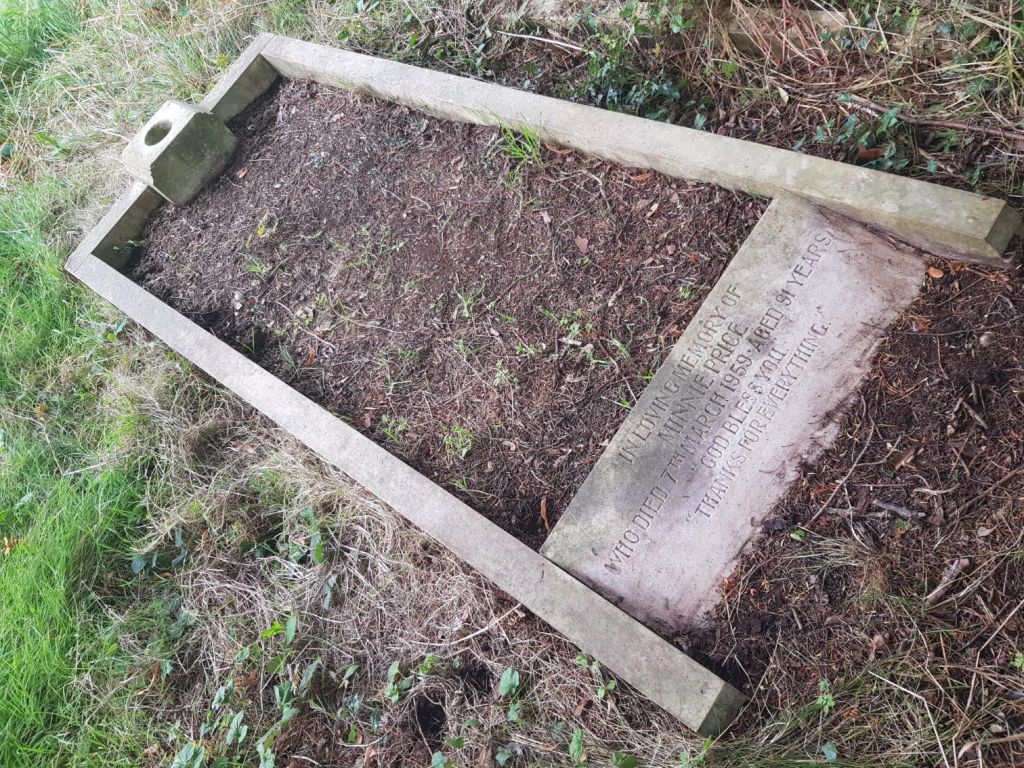
Our cemetery volunteer has returned and completed the clear up of Minnie Price’s grave.







 Radnor Street Cemetery