Stephen and Augusta Nicholas

Sometimes I find articles in the local newspaper which provide so much information that there is really no need to do any further research.

The North Wilts Herald published the story of their life together when Stephen and Augusta Nicholas celebrated their Diamond Wedding Anniversary in 1931. Just four months later they published an account of Stephen’s funeral.
Married 60 years

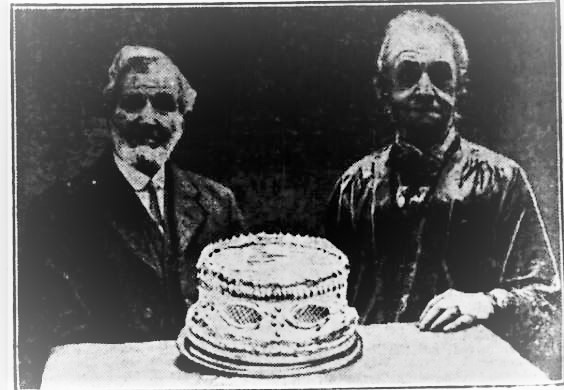
Diamond Wedding of Mr and Mrs S. Nicholas, of Swindon

Mr and Mrs Stephen Nicholas of 106 Princes street, Swindon, celebrated their diamond wedding on Saturday. Mr Nicholas is 83 years of age and his wife 79.

Both are in fairly good health, and they enjoyed a little party of relatives who came to wish them good luck. Mr Nicholas was particularly pleased with a wedding cake which his children had made for him.

Both Mr and Mrs Nicholas were born at Nunnery, near Frome, in Somerset, and they were married at the Parish Church on 10 October, 1871. Mrs Nicholas was formerly Miss Augusta Hillier.

In those days her husband worked in the flour mills, and at the time of his marriage his wages were only 12s a week. A little more than two years after the wedding they moved to Wales, where Mr Nicholas worked for the Gloucester Wagon Repairing Company. The next move was to Bristol, and in August, 1876, he and his wife came to Swindon, where he entered the GWR Works. Here he remained for 43 years, retiring in 1919 at the age of 71 years.

Mr and Mrs Nicholas had six children, all of them born in Swindon, but only three are now alive. These are Miss Nicholas, who lives with her father and mother, Mrs J. Ruddle and Mr Bertie Charles Nicholas, who worked in the GWR factory. There are five grand-children – the children of Mrs Ruddle.

Mr Nicholas was a wood wagon builder by trade, and for 30 years he was a chargeman in the 21 Wagon Shop. His foreman was Mr Joseph Wilkinson, and his under foreman, Mr John Money, is now 86 years of age and lives close to him in Gordon Road.

Ever since they came to Swindon Mr and Mrs Nicholas have been members of the Regent street Primitive Church, which they joined when the Rev. Thomas Pinnock was the minister. Mr Nicholas is still a trustee of the church, and both he and his wife have been Sunday School teachers.

Mr and Mrs Nicholas have been the recipients of numerous presents from members of the Regent Street Primitive Methodist Church.

North Wilts Herald, Friday, October 16, 1931.

Mr S. Nicholas

Fine Tributes to a Swindon Methodist

The funeral of Mr Stephen Nicholas, of 106, Princes street, Swindon, took place on Wednesday afternoon, and was largely attended by relatives and friends and representatives of religious and other bodies with which he was associated.

Mr Nicholas, who had reached the age of 84, recently celebrated his golden [diamond] wedding. His wife has been ill for some time. They were both natives of Nunney, near Frome, Somerset. They came to Swindon in 1876, and Mr Nicholas was employed in the GWR Works for 43 years, retiring in 1919. He was a chargeman in the Wagon Shop for 30 years.

Ever since they came to Swindon, Mr and Mrs Nicholas have been members of the Regent Street Primitive Methodist Church and both were Sunday School teachers.

The first portion of the burial service was conducted at the Regent Street Church, the officiating ministers being the Revs. J. Lindsay, T. Sutcliffe and E.P. Sellars.

The interment took place in the Radnor street cemetery. The family mourners were Mr and Mrs B. Nicholas ( son and daughter in law), Mrs J. Ruddle (daughter), and Mr Ruddle, Mr L. Ruddle (grandson), Miss G. Ruddle (grand daughter), Mr J. Nicholas (brother) and Mrs Cooper.

Representatives were present from the GWR Works, from the Primitive Methodist Church, the sons of Temperance Friendly Society, and other bodies with which Mr Nicholas was associated. Amongst these were Messrs. T. Greenwood, S. Stone, A. Painter, Llewellyn, Wheeler, S. Hanks, G. Harvey, H.J. Franklin, F. Smith, F. Hoare, S. Hardy, Beasant, F. W. Vincent, W.T. Harding, G. Shell, W. King and F.W. Ludlow.

The funeral arrangements were carried out by Mr A.E. Smith, of Gordon Road.

North Wilts Herald, Friday, February 5, 1932.
James Haydon and his son Lancelot

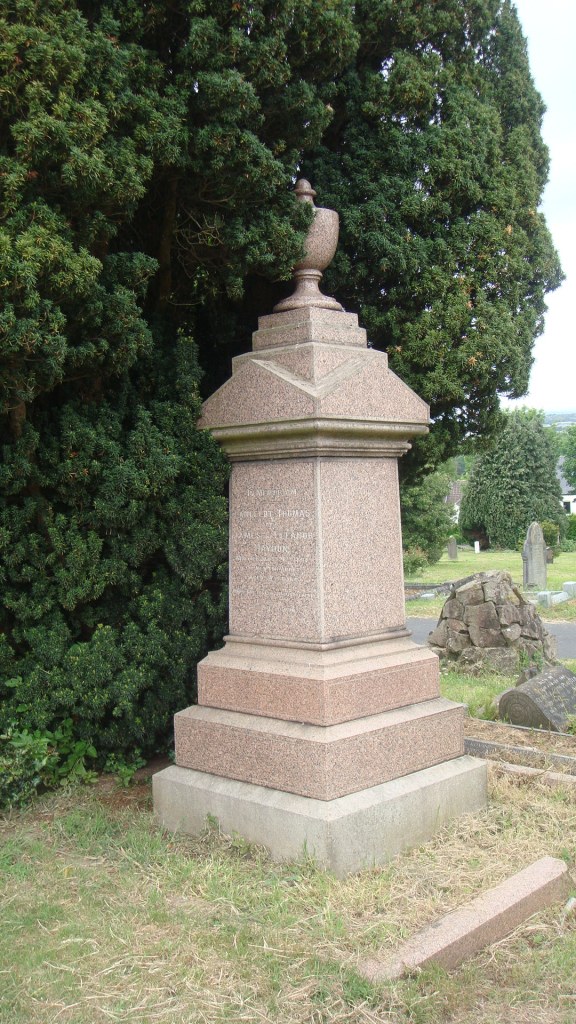
It’s easy to almost miss this magnificent monument (pink granite again) and another railway family. 

Like the Carlton monument opposite, this memorial was also subscribed to by employees at the GWR Works.

James Haydon was born in Bristol in 1826.  The UK Railway Employment Records on the Ancestry website, indicate that James entered the railway employment in March 1851 aged about 25 years old.

By 1861 he was working as an engine fitter in the Swindon Works.  He lived with his wife Ellen, their young son Lancelot and his wife’s nephew Henry Wardle at 9 London Road. There were an awful lot of people living in this house in 1861 – three inter-related households comprising James and Ellen; Lancelot and Eleanor Young with two young grandsons and Thomas and Ann Watson with their niece.

By 1871 James was Deputy Manager at the Works and living in a property in what was then still known as Sheppard Fields. This later became Sheppard Street, named after the former owner of this area, John Harding Sheppard.

James died on July 5, 1888.  He had been Assistant Manager in the Loco Works for 22 years. 

Also remembered on this memorial is James’ son, Lancelot who died in 1894 aged just 37.

Lancelot followed his father into the Works and his career can be charted through the same railway records.

He began work as a pattern maker in 1871 when he was 14.  In 1877, presumably after he had finished his apprenticeship, he transferred to the Drawing Office.

In 1881, by then a mechanical draughtsman, Lancelot left the GWR for an appointment on the Swindon, Marlborough and Andover Railway, but by 1888 he was back at the GWR firstly as Assistant Draughtsman and later as Chief Draughtsman.

At the time of the 1891 census he was living at his old family home, 21 Sheppard Street, with his wife Isabella and their young daughter.

The following year Lancelot was on the move again, this time to Newton Abbott as Assistant District Superintendent Loco Carriage Dept.  He died less than two years later.

Buried in this double plot are James and Eleanor Haydon. Eleanor died first in 1888 aged 52 years. Her funeral took place on April 11. James died just three months later and was buried with her on July 9. He was 61 years old. Their son Lancelot Thomas Haydon died aged 37 years in 1894 and was buried with them.

Thank you to local historian Kevin Leakey who provided this extra information.

James Haydon was one of the original Directors of the Swindon Permanent Benefit Building & Investment Society (Swindon Permanent Building Society).

Haydon Street was named after him, as well as the nearby Carlton Street – after fellow director Samuel Carlton. Both streets were built on land originally purchased by the Building Society from the GWR. It would become the Queenstown area.

Astley Cooper Swinhoe – a career full of promise

Astley Cooper Swinhoe was born on August 30, 1871 the 8th of George Money and Diana Swinhoe’s 12 children who survived to adulthood. He was baptised on November 17, 1871 by his grandfather, Rev Thomas William Wrench, Rector at St Michael’s, Cornhill in the City of London.

By 1901 Astley was working alongside his father and brother as a medical practitioner at Park House where he died on March 18, 1905.

Dr Astley Cooper Swinhoe

Death of Mr Astley Cooper Swinhoe

The Funeral

An Impressive Service

We deeply regret to announce the death of Mr. Astley Cooper Swinhoe, who passed away at Park House, Swindon, Saturday. The deceased gentleman, who was the third son of Dr. G.M. Swinhoe, contracted pneumonia, and this hastened his death in a painfully sudden manner.

He was well-known and highly esteemed by all classes in Swindon and the loss will be keenly felt. Deceased, who was only 33 years of age, was educated at Marlborough College, and had his medical training in London, where he was for some time in St Thomas’s Hospital. His career was full of promise.

Amid signs of mourning on every hand, the mortal remains of the late Dr Astley Cooper Swinhoe, who died last Saturday, after a short illness, at the early age of 33 years, were laid to rest in Swindon Cemetery on Wednesday morning.

It was a beautiful spring morning, and there was an immense concourse of persons assembled in the Cemetery, where the cortege arrived at a quarter past ten. The mourners left Park House at half-past nine, and proceeded to St Mark’s Church, where a large congregation had gathered. The service was simple and impressive, and was conducted by the Vicar, the Rev. A.G. Gordon Ross, and the Rector of Inkpen, the Rev. H. D. Butler, a former curate at St Mark’s, who also officiated at the graveside.

The body was enclosed in an elm shell, with unpolished oak coffin, with massive brass furniture. On the lid of the coffin was a large brass cross, at the foot of which was the following inscription:- “Astley Cooper Swinhoe, died March 18th, 1905, aged 33 years.”

The coffin was made by Mr Joseph Williams, and the funeral arrangements carried out by Messrs Chandler Bros., Swindon.

Extracts from The Swindon Advertiser, Friday, March 24, 1905.

Swinhoe Astley Cooper of Park-house New Swindon Wiltshire died 18 March 1905 Administration London 15 April to George Money Swinhoe surgeon Effects £1533 2s 2d

This image has an empty alt attribute; its file name is swinhoe-family-3.webp

Dr Astley Cooper Swinhoe was buried in grave plot E8228/29/30 which he shares with his parents and three brothers.

You may also like to read:

The Death of Mrs Swinhoe

George Money Swinhoe – Swindon doctor

Maurice Carew Swinhoe – banana planter and exporter

Dr George Rodway Swinhoe – GWR Company doctor


Samuel Carlton – held in esteem

The GWR provided for their workers from the ‘cradle to the grave’ or so the history books would have you believe.

The Mechanics’ Institution out of which came so many fine things – a library for the use of the working man, opportunities for further education and so many other initiatives to improve the lot of the working class – well that was down to the men employed in the Works.

The men were also quick to acknowledge those they respected, contributing from their hard earned wages towards a memorial. A walk around the cemetery will quickly reveal an inscription to that effect on numerous headstones.

Close to the chapel is a magnificent pink granite obelisk above the grave of Samuel Carlton with the inscription  – ‘This Memorial was erected by Officials and Workmen of the Great Western Railway and other Friends, To mark the esteem in which he was held during the 32 years he was Manager of the Locomotive Works at Swindon.’

20230526_132229

Death of Mr S Carlton

Swindon has lot another well-known inhabitant in the person of Mr Samuel Carlton who died on Tuesday night, after but a brief illness, the result of a chill.

As the manager of so large an affair as the locomotive department of the GWR Works at Swindon for over 40 years, Mr Carlton was necessarily brought into contact with many thousand of workmen, and these are scattered all over the world, and will learn with regret of the death of their old chief, who died in harness so shortly before his intended retirement on a pension from the company he has served so long and well.

The deceased gentleman had a blunt style with him, that stood no humbug, but those who knew him knew that a kind heart was within. The greatest evidence that can be afforded of his proper treatment of those under him is the fact that during the long number of years he has had control of a large body of skilled workmen such a thing as a strike or dispute as to wage has never occurred.

Every object for the social well-being of the men met with ready support from him, as musicians and others will be most ready to acknowledge. In fact, Mr Carton had the making or unmaking of many an institution that perhaps will not realise this properly until some other chief, without the knowledge of humanity possessed by Mr Carlton may shew it them. But we hope this will not be the case.

A life-long worker, for he is said to have started work at eleven years of age, the deceased was able to appreciate the difficulties of a workman’s life and to thoroughly understand his requirements. He, like his old chief, Mr Joseph Armstrong, rose with the GWR Company. He served his apprenticeship in the engineering departments of the L. and NWR Works at Edge Hill (Liverpool) and Crewe, and, having subsequently spent 10 years in the same service, left it for an appointment under Messrs Pearson and Co., marine engineers, of Liverpool. On resigning his position he was engaged by the Vulcan Foundry Co., at Warrington, and at length, in 1855, accepted a position under the company of which he has been the trusted chief and adviser for over 40 years.

Mr Carlton was first engaged by the GWR Company for their works at Stafford Road, Wolverhampton, under the direction of Mr Joseph Armstrong. A short time after his employment there he was selected as foreman of the fitting, erecting, and machine shop; and in 1864, Mr Carlton followed Mr Armstrong, who had removed there, receiving the appointment of manager of the Locomotive Department, which he filled up to his death.

Since his appointment to the charge of the department, the number of employees had doubled. Besides being one of the oldest of the company’s officials, he was one of the ablest and most practical, and he had much to do with the extensions and developments of the company’s system during late years.

His original genius was shown in his authorship of several railway patents, including fastening for securing engine, carriage and wagon tyres to the wheels – a system now largely used both at home and in the colonies.

When it is remembered the great extension the GWR Co. has made of its mileage by amalgamation and otherwise during the period of Mr Carlton’s service, it will be readily understood how much the company has had to rely on such officers as he. In local affairs of a public character, Mr Carlton had no particular ambition, although at one time he was a member of the New Swindon Local Board. His aim had more in concerns more directly associated with the workmen, such as the Swindon Building Society, the Mechanic’s Institute, the Park, etc.

In 1891 he was the recipient of a beautiful framed address from the foremen of the department under his control congratulating him his restoration to health, and hoping that he would be spared for many years to come. He leaves a widow and seven children to mourn their loss, and we are sure the thousands of workmen who have worked under him, and the inhabitants of the town generally, will join in sympathy with their great trouble.

The funeral will take place today (Saturday), at the Cemetery, the procession leaving the deceased’s residence at noon, for St Mark’s Church. It is expected a vast concourse will attend at the cemetery which will be reached at one o’clock.

The Swindon Advertiser, Saturday, March 28, 1896.

Funeral of the late Mr. Samuel Carlton – The remains of the late Mr Samuel Carlton, whose demise was recorded in our last issue, were conveyed to their last resting place in Swindon Cemetery on Saturday last, in the presence of an immense concourse of people.

The funeral cortege left deceased’s late residence, Marlow House, at noon, and proceeded to St Mark’s church, where the first portion of the service was conducted by the vicar, the Hon. Canon Ponsonby, assisted by the Rev. A.G. Ross (curate).

The coffin was borne on a shillibeer, eight foremen from the GWR Works acting as bearers. Following the coffin were 13 mourning coaches, in which were the chief mourners including deceased’s widow and sons and daughters. About 500 mourners followed on foot, there being present representatives from all the shops in the Works. At the cemetery there was a vast concourse of people to witness the concluding portion of the service, which was conducted during a blinding hailstorm which proved most discomforting to the mourners. The grave was literally covered with beautiful wreaths and crosses.

Wilts and Gloucestershire Standard, Saturday, April 4, 1896.

Samuel Carlton was born in Manchester on December 15, 1829.  He trained as an engineer and in the 1861 census he was living in Wolverhampton.  He had moved around the large railway centres during his early career as can be seen from the birthplaces of his children in 1861.  The eldest was born in Crewe, the next in Liverpool and the two younger ones in Wolverhampton.

Samuel Carlton joined the GWR and worked under Joseph Armstrong at Wolverhampton.  He came down to Swindon with Armstrong soon after the 1861 census.  At the time of the following census ten years later Samuel was living at a house called Elm Villa, a former inn, on Wellington Street.  He describes himself as a Civil Engineer and Manager of the Railway Works.

Samuel retired in 1895 and died the following year after what appears to be a very short illness.  

Samuel Carlton is buried here with his wife Adelaide and his daughter Alma. There is also a dedication to his son Thomas William Carlton, Captain of the Honourable Artillery Company who died on a voyage to South Africa and was buried at sea.

You may also like to read:

Adelaide Carlton – on the move

Thomas and Beatrice Rose

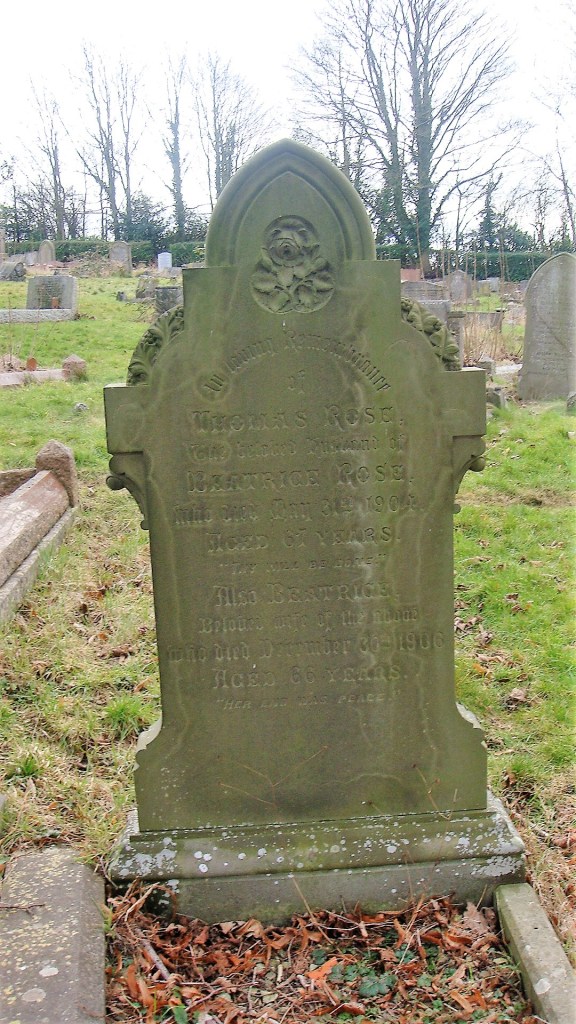
What drew my attention to this headstone was the couples’ surname, Rose, and the rose motif on the top.

Thomas Rose was born in 1836 in Leamington Spa, the son of a cabinet maker.  By 1869 he was living here in Swindon and the UK Railway records show he entered the GWR Service as a Railway Carriage Maker that year.

At the time of the 1881 census Thomas and Beatrice were living at 11 Faringdon Street. By this time Thomas was a Foreman Finisher earning £2 18s a week – enough to support his six children with a few pennies to spare to employ a young servant girl, 13 year old Emily Drew. It’s always tricky comparing historic wages with money value today, but a wage of £2 18s in 1881 would have the purchasing power of about £1,200 a week today.

Thomas’ sons all followed him into the Works. Eldest son Thomas became a fitter as did George; William became a carriage trimmer and Frank completed a seven year apprenticeship to become a pattern maker. Frank began his apprenticeship in 1869 aged 14 on a daily rate of 10d which increased to three shillings a day in year seven.

Thomas died in 1904 aged 67 and Beatrice two years later aged 66. Both of them left a will. Thomas left effects to the value of £200 to his wife. When Beatrice died she left £150 1s 5d.

Thomas’ funeral took place on June 4, 1904 when he was buried in grave plot D1568. Beatrice was buried with him on January 5, 1907.

Silas Fry – Primitive Methodist

Silas Fry and his wife Lydia were a pretty dynamic couple. When Silas died in 1925 the North Wilts Herald published a lengthy obituary detailing his many accomplishments, which included his work as a member of Swindon Town Council, his membership of the old Gorse Hill Cricket Club and his lifelong membership of the Primitive Methodist Church.

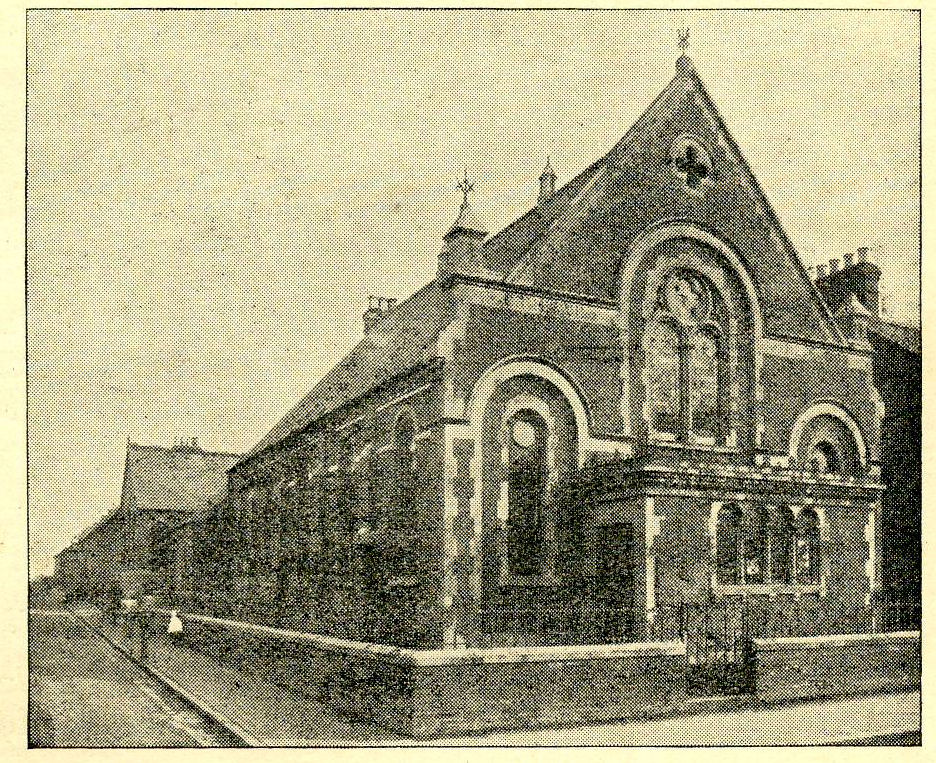
Primitive Methodist Chapel, Cricklade Road, Gorse Hill

Silas was born in 1874, the son of Oliver Fry, newsagent/grocer and Primitive Methodist preacher, and his first wife Esther Ayliffe. He grew up in Gorse Hill and never moved away, living with his wife Lydia at first 110 Chapel Street and then 71 Cricklade Road where he died on June 14, 1925.

Death of a Swindon Councillor

Mr Silas Fry’s Many Activities

The Funeral

The death occurred on Sunday of Mr Silas Fry, a member of the Swindon Town Council and a well known figure in many departments of public life in the town.

A few months ago Mr Fry, who was 51 years of age, underwent a serious operation at a Swindon nursing home, and he made such good progress afterwards that strong hopes were entertained that he would make a complete recovery, but he suffered a relapse.

A son of Mr Oliver Fry, who was prominently identified with local government affairs, deceased was at one time a member of the Swindon and Highworth Board of Guardians, and on his retirement from that body he was succeeded by his wife, who is still an active and useful member. In November 1922, Mr Fry was elected to the Town Council as one of the representatives of North Ward, and in that capacity he rendered much useful public service. He served on the Watch and Pleasure Grounds Committee, being this year’s vice chairman, and other committees of which he was a member were the Sewage and Allotments, Works and Streets, General Purposes and Emergency, and the Swindon and District Hospital Board.

Deceased had been organist at the Gorse Hill Primitive Methodist Church since he was nine years of age, and when the services were conducted in the old chapel, now used as the Salvation Army Barracks. He was also Superintendent of the Sunday School, and president of the local Christian Endeavour. For 20 years Mr Fry was choirmaster, succeeding the late Mr J.J. Henly. He was also one of the pioneers of the old Gorse Hill Perseverance Cricket Club, which afterwards became the Gorse Hill Primitive Methodist. He was a keen cricketer, and played until four years ago.

Extracts from the North Wilts Herald, Friday, June 19, 1925.

You may also like to read:

Lydia Fry – For Services Rendered

William Miles – chemist

This is the last resting place of the Miles family.

William Miles was born at 30 Reading Street in 1851, the son of William Miles, a modeler and pattern maker from Tredegar in Monmouthshire and his wife Mary.

By the mid 1870s William had left Swindon for Yorkshire where he worked as a chemist’s assistant in Scarborough and married Harriet Matilda Thompson.

William didn’t return to Swindon until the end of the 1890s when he opened a Chemist and Drug Store in Fleet Street.

William died in 1912. Harriet outlived her husband by nearly twenty years. She died in 1931 and is buried here with him. The couple’s only son, William Edward Vivian Miles and his wife May Till Miles are also buried here with their two young sons, William and John.

This magnificent monument is loaded with funereal iconography. With her outspread wings she represents a guardian angel, the five-pointed star behind her is symbolic of divine guidance and protection and the garland she carries is emblematic of victory in death. And in the world of 1980s New Wave pop music she is quite famous. She appeared in a pop video made by Swindon band XTC. The film accompanied their song In Loving Memory of a Name – a song about a soldier laid to rest in the churchyard he knew in childhood.

You might also like to read:

In Loving Memory of a Name

Richard James Leighfield – Master Builder

This is another magnificent pink granite memorial full of funerary iconography.  The fluted pillars or columns at the top symbolise the door to heaven and the passageway to eternity.  The letter L is displayed prominently passing through this entrance. The thorny acanthus leaves symbolise the prickly path of earthly life to death and eventual eternal life.

This is the last resting place of the Leighfield family. Firstly, of Elizabeth, ‘the devoted wife of Richard James Leighfield of Witney Street, Swindon who died after a long and painful illness after which she sweetly fell asleep in Jesus on February 2, 1910 aged 49 years.’ Elizabeth was buried with the couple’s second son David who had died aged just 3 weeks old in 1892.

The inscription on this memorial is the first verse of a hymn called The Christian’s Good Night – lyrics by Sarah Doudney and music by Ira D. Sankey.

Sleep on beloved sleep and take thy rest,

Lay down thy head upon thy Saviour’s breast.

We love thee well but Jesus loves thee best.

Good night, good night, good night.

Richard was born in Wootton Bassett in 1859 the son of postman James Leighfield and his wife Ann. At the age of 12 Richard was already working as a mason’s labourer, later becoming a bricklayer and by 1891 he was a Master Builder.

In 1887 he married Elizabeth Hunt and at the time of the 1891 census they were living at 83 Clifton Street with their two year old son James. 

Richard built houses on Clifton Street, Whitney Street* and Ponting Street. At the turn of the century, encouraged by the growth of New Swindon, he purchased a parcel of land on the east side of Whitney Street on which he built a house known as 1 Whitney Street. Behind the house he developed office accommodation, yard, stables and a workshop from which he conducted his business. On the rest of the land he built 6 cottages which he let, principally to members of his staff. Between 1901-1916 the family firm built 39 houses at St Mary’s Grove.

Following Elizabeth’s death, Richard married Clara Williams in 1913. The couple married at the Primitive Methodist Chapel in Regent Street where they were both members. Clara was a descendant of John and Mary Pike who opened their home on Eastcott Hill for meetings during the early days of Primitive Methodism in Swindon.

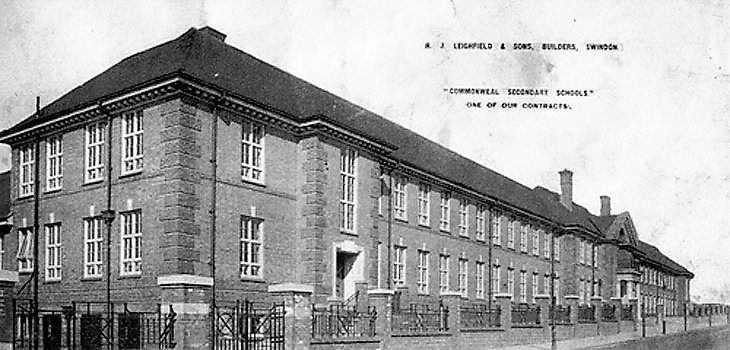
The Leighfield family firm continued to be busy during the 1920s and 30s when among their projects they built the Primitive Methodist Church at The Circle, Pinehurst; Commonweal School, The Mall, Old Town; the Co-op on Groundwell Road and the Swindon Corporation Electricity Dept showrooms at Regent Circus.

Richard died at his home 109 Bath Road in 1948 aged 89. His funeral took place on April 22 when he was buried in grave plot E8440 with his first wife and son. His second wife Clara died in 1964 and was buried in the family plot.

The Leighfield business continues today at the Coped Hall Business Park in Royal Wootton Bassett.

*The spelling of Whitney/Witney Street varies.

Ignatius Michael Howell

It was the name of the occupant that drew my attention to this grave.

Ignatius Michael Howell. He had a brother, Aloysius. Pretty distinctive names in Stratton St Margaret, I would imagine.

St Ignatius was an early Christian writer. He was one of the five Apostolic Fathers and the third Bishop of Antioch. He died c108 in the Roman arena. St Aloysius was a 16th century Jesuit who died during an epidemic in 1591. It’s probably fair to say that William and Esther Howell were a devout couple.

William worked as a Railway Clerk and in 1884 when he was 16 years old, Ignatius followed his father into the Works in the Clerks & Draughtsman Department. By 1893 he was earning £80 a year, rising to £110 by 1899.

Ignatius married Kate Celestine Knight on November 25, 1889 and the couple had eight children – seven daughters and one son, Mary, Agnes, Kathleen, Gertrude, Margaret, Monica, Winifred and William.

Ignatius died at his home at 154 Croft Road on April 19, 1951. He was buried in grave plot C3437 with his daughter Agnes who died in 1916 and his wife Kate Celestine who died in 1928.

Arthur William Burson J.P. – Prominent Baptist

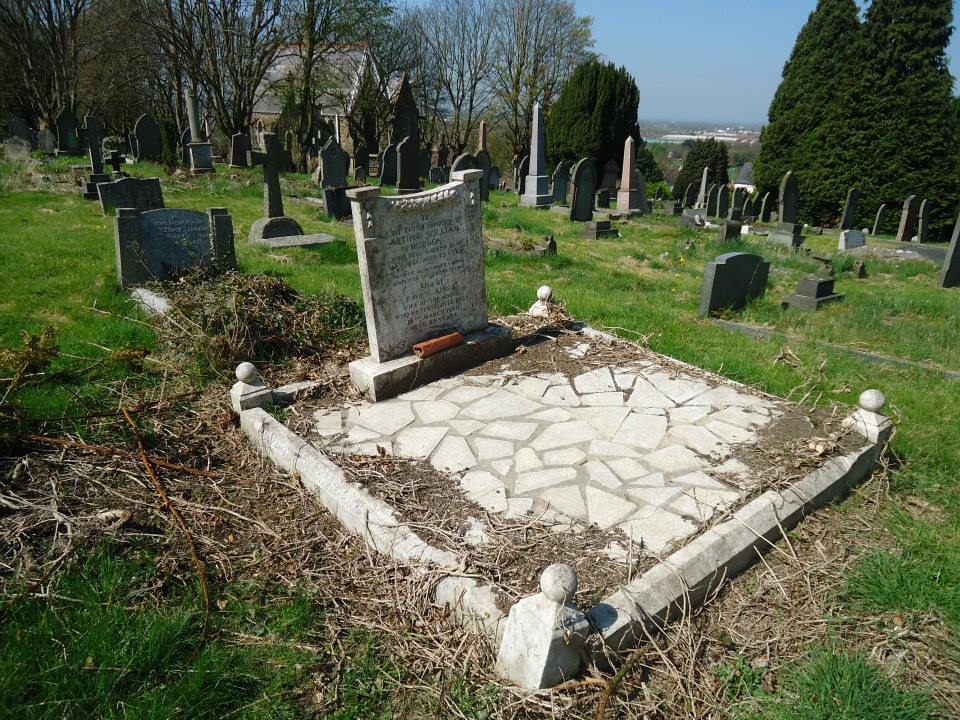
The photograph of the Burson family grave (see below) was taken several years ago. I now realise someone must have cleared and cleaned it around that time. When I tried to find it recently, thinking it would be an easy task, I was surprised to discover the memorial dulled and dirty. Is it the pollution in our air, less obvious than the smoke of factory chimneys and coal fires of the past, that causes such discolouration?

This is the story of Arthur William Burson who was born in Steventon, Berks, the son of farmer Richard Burson and his wife Louisa. In 1871 Richard was farming 140 acres and employing six labourers and two boys at Sutton Courtney, but Arthur appears to have been unwilling to follow in his father’s agricultural footsteps.

By 1881 Arthur had moved to Swindon and was working as a grocer’s assistant, living above the shop at 57 Bridge Street. In 1888 he married Emily Anna Solway and at the time of the 1891 census the couple were living at 52 Fleet Street where Arthur appears to have his own business.

Ten years later and the family business was at 94 Commercial Road. By now the couple have three daughters, Edith, Elsie and Hilda, fourth daughter Grace was born in 1903. The family later lived at 69, Bath Road.

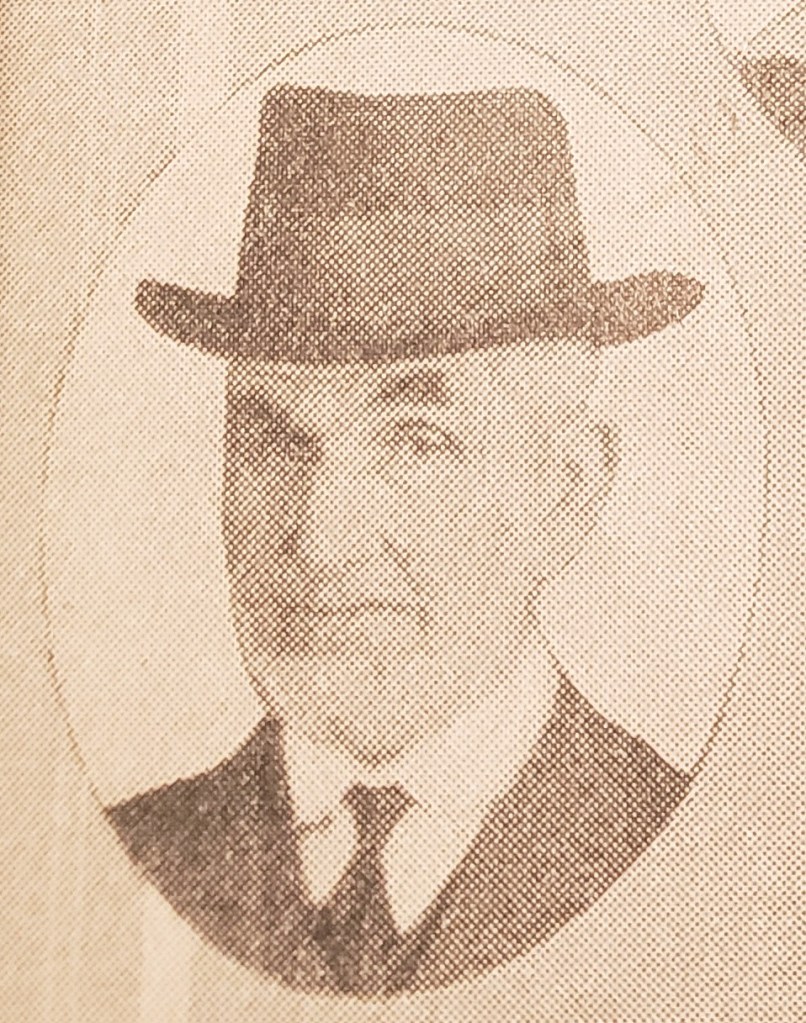
When he died in 1934 a lengthy obituary published in the North Wilts Herald described him as ‘A.W. Burson J.P. – Swindon Business Man Who Once Owned Seven Shops.’

Death of A.W. Burson J.P.

Swindon Business Man Who Once Owned Seven Shops

A Swindon man who rose from a lowly position behind a grocer’s counter to become the owner of seven prosperous shops in Swindon, in one of which he had served as an assistant, is the history of Mr Arthur William Burson, of 69 Bath road, Swindon, whose death occurred last Friday.

There is however a poignant side to his death in that it has robbed him of the opportunity of seeing the completion of the Stratton Green Baptist Chapel, towards the building of which he had given £1,000 as a memorial to two of his children.

Mr Burson, who was well known as a prominent Baptist, died after an illness which had lasted more than three months. He was suffering from bronchial trouble, when heart trouble supervened.

Born at Steventon.

In 1861, Mr Burson was born at Steventon, Berks, and at an early age was apprenticed to the grocery trade at Reading. His connection with Swindon started in 1880 when he was engaged as an assistant in the grocery busines of H. Freeth and Son. For five years he remained in this position, and then made his first venture into business ownership. In partnership with the late Mr Thomas Harry, of Swindon, he opened a shop in Abergwynid, near Maesteg, South Wales, and this business was carried on by the two for five years.

Then, however, he returned to Swindon. With Mr Harry, he became joint proprietor of the business in which he had served as assistant – H. Freeth and Son, and conducted no fewer than seven shops in the town.

The business continued in their joint ownership for two years until the death of Mr. Harry, when Mr Burson assumed sole control. As proprietor of the firm of H. Freeth and Son he continued to take an active part in the conduct of the business until 1926 when he retired.

Gift to Town Gardens

In the year of his retirement, and more or less as a token of gratitude for the prosperity which he had achieved in Swindon, Mr Burson presented to the town the clock over the bandstand in the Town Gardens.

Though he was one of the oldest members of the Swindon Bench of Magistrates, having been a member since the Bench was first appointed in 1907, it was by reason of his religious activities that Mr Burson was better known. He was baptised in 1880 at the Baptist church which stood in Fleet street, and which is now demolished.

On returning to Swindon he continued his association with the Baptist faith in the town, and became connected with the Baptist Tabernacle, which had replaced the former church in Fleet Street.

For many years he was also superintendent of the Gorse Hill Baptist Sunday School, and was also treasurer, and teacher in Baptist Sunday Schools in Swindon for over 50 years.

Former Town Councillor.

At the time of his death he was one of the elders of the Baptist Tabernacle, treasurer of the Tabernacle Sunday School and held a similar post in connection with the Swindon Colportage Association. A prominent teetotaller since the age of 18, he was one of the oldest members of the Tabernacle Temperance Society.

He held a seat on the Town Council from 1900 to 1909, and again from 1911 to 1921 continuous.

While in Wales Mr Burson married a Miss Salway, who was a native of Somerset. Mrs Burson survives him. They celebrated the 46th anniversary of their wedding last Easter. There were four children, all daughters, of whom two are dead. One died in 1913, and the other two years ago. The two surviving daughters are Mrs Dadds, [Dadge] of Bath road, and Mrs Higgins, of Broome Manor lane.

Early this year Mr Burson came forward with an offer of £1,000 towards the cost of the new church at Stratton Green as a memorial to his invalid daughter, on whom the money had been settled as a future provision for her. Announcing his gift, Mr Burson said, “She had been taken and I should like her memory to be enshrined in the new building.”

The cheque for £1,000 was signed by Mr Burson and handed over to the Stratton Baptist officials about six weeks ago, during Mr Burson’s final illness. The Swindon Advertiser is informed, therefore, that the gift will not be affected in any way by the death of the donor.

It has now been suggested by those connected with the Stratton Church that, as a gesture of gratitude to Mr Burson for his gift, the new church shall contain a memorial window to the two daughters of Mr Burson who had pre-deceased him.

The Funeral

In the presence of a large congregation of mourners, the funeral took place on Wednesday afternoon.

The first portion of the service was conducted at the Baptist Tabernacle and the interment took place in the Radnor Street Cemetery.

Extracts from the North Wilts Herald, Friday May 25, 1934.

Arthur William Burson, 73 years, of 69 Bath Road was buried on May 23, 1934 in grave plot E7588. His wife Emily Anna died in March 1950 and was buried with him his this impressive grave plot.