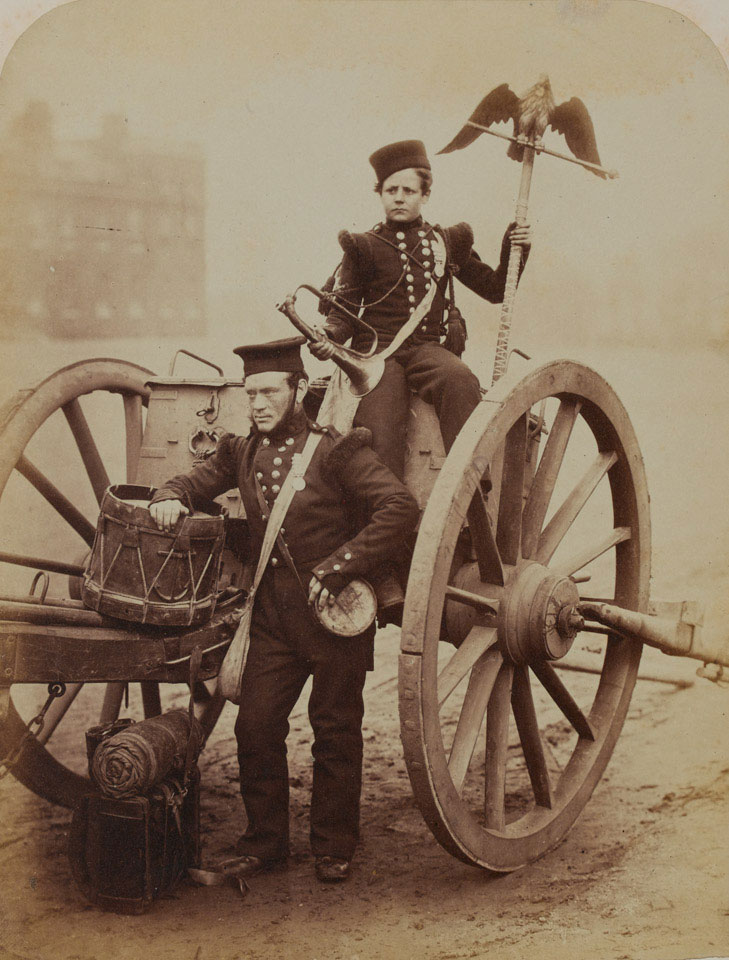
Read the first installment of the Crimean War Diary written by John Harris and published in the Swindon Advertiser following his death in 1902.
Veterans of the Royal Artillery
The Crimean War Day by Day
(Special to the “Swindon Advertiser.”)
The death took place last week, as we have already announced, of a Crimean Veteran, in the person of Mr John Harris, of Sanford Street, Swindon, who passed away on Tuesday, July 29, at the age of 74 years.
As we announced the other day, we have, through the kindness of the deceased Mr Harris’ son, been granted a perusal of a diary kept by the veteran during the Crimean war, and from the diary we take the following, feeling confident that this unique history of that arduous campaign will contain records abounding with interest to the majority of our readers.
The writer opens his account with some very sentimental passages provoked by the scenes of farewell he witnessed when, as a sergeant in the K Battery of the Royal Artillery, he took leave of England for the seat of war. He opens as follows:-
Sailed 26th. – It was on one of those beautiful summer mornings very often seen on our shores in the latter end of July, 1855, at about 4 o’clock a.m., that her Majesty’s steamship, “the Atlanta,” weighed anchor, and steamed out of the harbour of Sheerness, with about 800 of the Royal Artillery, 185 horses, 60 officers and a crew of 150 men, bound for the Crimea. And there was many a sad and heavy heart partook of the hard and scanty meal of a breakfast, whilst others of a more noble mind were singing and whistling away as the vessel parted the foaming sea from her stately bows. I was on deck with several others pacing to and fro, smoking my pipe, whilst others were lounging and talking in various parts of the ships. Several of them were talking of home, and wondering whether they would ever behold their dear native place again. How many of those brave men left those shores on that bright sunny morning never to behold them again, and now rest on those ironbound and snowy hills of the Crimean shore, where there is no mark of respect to denote to the passer by or the stranger that beneath lie sons of England waiting to receive their Heavenly reward; those who went forth in the hour of need to share in the toils and hardships of a campaign, leaving those who were dear to them at home.
This week I am dedicating seven daily posts to one of Swindon’s extraordinary, ordinary people.
John Harris was born in 1828 and baptised at St Mary the Virgin, Bathwick on November 9. He was the son of John, a Flour Factor and Coal Merchant, and his wife Ann, and grew up in the Sydney Wharf area of Bathwick.
He appears at Sydney Wharf on the 1841 census, aged 12, the eldest of four brothers. By the time of the 1851 census he is serving in the ‘Royal Regm Artillery.’ On census night he is at home in Sydney Wharf, Bathwick with his widowed mother, his uncle Robert Roe and his two younger brothers Edward and Frederick.
Five years later he would serve in the Crimean War. He recorded the events of that time and on his death in 1902 this diary still survived. As the obituary published in the Swindon Advertiser records, the newspaper was given access to the diary and published extracts.
Read first about the life and times of John Harris.
Death of a Crimean Veteran
Mr J. Harris, of Sanford Street, Swindon
Some Remarkable Coincidences
There has just passed away, at the residence of his son, 24, Sanford Street, Swindon, an old soldier who could lay claim to the honour of being a Crimean Veteran, and one whose life was full of interesting incidents to the younger generation whose knowledge of the Crimea is gained from the classroom. We refer to Mr John Harris, who died last (Tuesday) evening after only a week or so of illness, at the age of 74 years.
It was in the year 1855 that the deceased sailed for the Crimea with the K Battery of the Royal Horse Artillery, a Regiment in which he held the rank of Sergeant, and which Regiment, by the way, was subsequently merged into the 3rd Battalion of the Royal Artillery, garrison duty out there being the principal work.
The deceased was a very observant man, and, moreover, of methodical nature, for, through the kindness of deceased’s son, we have in our possession a complete diary kept by the old soldier, containing entries referring to the passage out, the campaign, and the passage home. We hope to publish many extracts from this interesting compilation in our weekly issue on Friday next.
The deceased was wounded during the campaign, and here is a remarkable coincidence. The Brigade Surgeon was no other than Dr. G.M. Swinhoe, of Swindon, and one can well imagine the surprise of both when they met face to face in Swindon years after the Crimean war.
Strange to relate, the Chaplain attached to the same brigade was the deceased was the late Rev. Campbell, whose place in Swindon, was taken by Canon the Hon. M. Ponsonby, at St. Mark’s Church, Swindon. Dr. Swinhoe, we may add, attended the old soldier up to the time of his death.
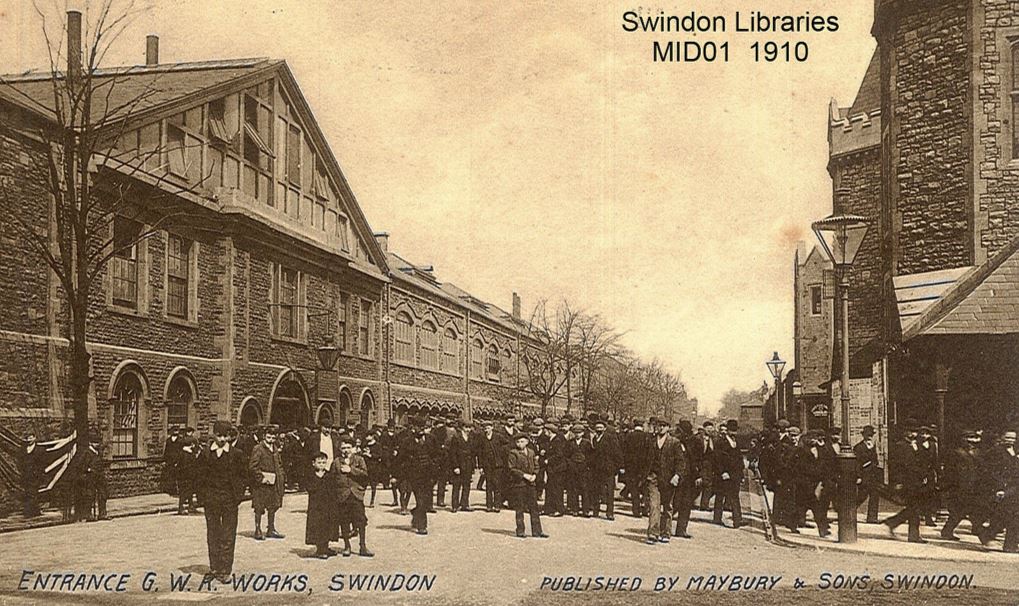
The deceased, who was a native of Bath, obtained a berth in the GWR Works, at Swindon, which he held for many years. Locally his scholastic ability was taken advantage of by the Ancient Order of Shepherds, he holding the position of Secretary and Master for many years. When he relinquished the post in 1882 he was made the recipient of a handsome illuminated address.
Mr Harris was a God-fearing man, a fact evidenced if only by reference to the diary already referred to, the scriptural quotations, particularly after the recording of some calamity, being very apt.
Deceased was a churchwarden at St. Paul’s, Swindon for some time.
He leaves a widow, and one son and a daughter to mourn the loss of a loving husband and a devoted father.
Image published courtesy of Local Studies, Swindon Central Library
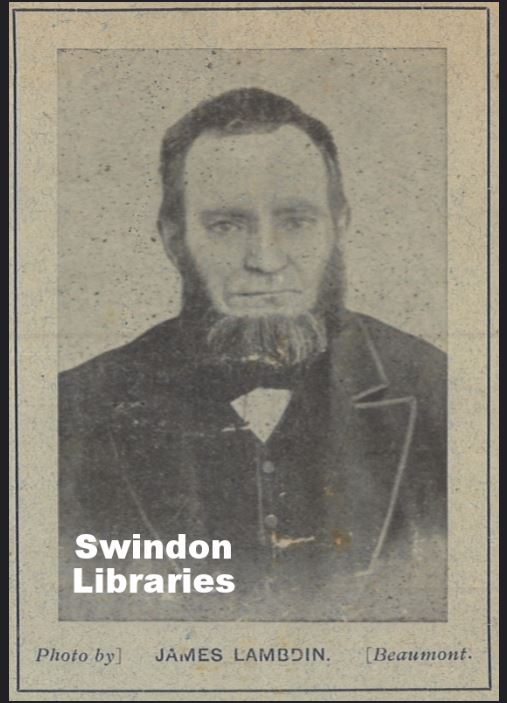
James Lambdin died suddenly and, it would appear, without making a will. Perhaps he had no worldly goods to leave. His life had been spent spreading the word of God.
James was born in Aldbourne in 1850, the son of Joseph and Sarah Lambdin. By the age of 10 years old he was working as an agricultural labourer. He later moved to Swindon and a job in the railway works, but it is his service in the Wesleyan Methodist Church that he is remembered for.
James married twice. His first wife, Faithfull Maria Dew, whom he married in 1874, died two years later aged just 22 years old. She was buried in the churchyard at St. Mark’s.
In 1878 he married Eliza Burt. The couple made their home first in Stratton St. Margaret (1881) and then in Gorse Hill living at 24 Hinton Street (1891) and 21 Avening Street (1901). They had one child, a daughter Beatrice, born in 1886.
A pamphlet produced after his death was entitled – Memoirs of James Lambdin – The Singing Ploughboy who became a Great Preacher and 30 years a Class Leader at Gorse Hill, Swindon.
The Angel Reaper has passed over the Bath Road Wesleyan Circuit, and taken away one of the staunchest adherents, Mr James Lambdin, of Gorse Hill. Mr Lambdin was a highly respected member of the Wesleyan body and looked up to throughout the whole circuit and was widely known for his wise exposition of the Scriptures.
He was a native of Aldbourne, and only the Sunday previous to his lamented death, he went to his birthplace to fulfil a preaching engagement. The day before that he had called upon one of his class members who was almost at the point of death, and the following day week, he himself had taken that journey from whence no traveller returns.
His illness was very short but painful, and his last words were a benediction for his fellow class members and workers. The loss is being felt very keenly throughout the circuit. Last Sunday morning, the preacher at Cricklade Road, a very old and devoted layman, was completely overcome with grief, and the evening congregation were greatly impressed by an impromptu memorial service.
I hear a whisper that a short memoir with a photograph will be prepared shortly.
The Swindon Advertiser, Friday, February 28, 1908.
James Lambdin was buried in Radnor Street Cemetery on February 27, 1908 in grave plot B2912. His wife Eliza survived him by more 19 years and was buried with him on February 3, 1927. The inscription on the modest headstone reads ‘To the revered memory of James Lambdin – Promoted Feb 23, 1908’
This is the final resting place of John Davison Robson, an engineer whose last home was at 24 Read Street. John was another person who had moved around the country. We tend to think of this as a modern trend, but people have always moved to go where the work is and 19th century Swindon had plenty of that to offer.
John was born in Wellington, County Durham in 1839. By 1858 he was living in Bristol where he married Alice Storey that year.
Each set of census returns reveal John and Alice living at a different address, with their children born in Bristol, Frome and Trowbridge.
This memorial is full of symbolism. The inscription is on a scroll, a symbol of life and time. Both ends rolled up indicate a life that is unfolding like a scroll of uncertain length with the past and future hidden.
The acanthus leaf has several meanings in funeral iconography. One of the oldest and most common motifs to appear on headstones, it is associated with the rocky ground where most ancient Greek cemeteries were located. Its thorny leaves also represent life’s prickly and difficult path.
Passion flowers represent Christ’s passion during Easter week. Across the cemetery there is a memorial to Esther Swinford, who was murdered by her former fiancé. Her headstone has a spray of passion flowers tumbling across it, possibly a misplaced reference to her murder as a crime of passion.
John died on December 4, 1904 and his wife Alice died just eight days later on December 12.
They are buried with their daughter Margaret who died in 1902. Another daughter Alice Cooper is remembered on this memorial. She died in 1893 and is interred in Cardiff cemetery.
“Put your feet up Gramps,” we used to tell my grandfather. Always dashing about he was, as if a ten hour shift in the Rolling Mills wasn’t enough to tire him.
Then, of course there was the Chapel. What little spare time he had was spent in the Baptist Chapel just behind the house where he and Nan lived. He might as well have lived there, I used to think. Wonder he hadn’t worn a path from the garden gate to the Chapel door.
One of the founding deacons he was, along with a Sunday School teacher and a dozen other duties he performed.
When he retired they presented him with an armchair.
“There we are Gramps, now you can put your feet up proper.”
He never did, mind.
The facts …
Ebenezer Evans was one of the foundation deacons of the Cambria Baptist Chapel
A Teacher’s Retirement – On Sunday afternoon an interesting ceremony took place at the Cambria Baptist Chapel, New Swindon, in the presentation to Mr Ebenezer Evans of an easy chair as a slight token of the esteem of his fellow teachers on his retiring from the school through advancing years and consequent declining health. Mr Evans has been a teacher in the Sunday School for 20 years, and had spent a similar time in Sunday School work in South Wales before coming to Swindon. The presentation was made by Mr J. Green, superintendent, on behalf of the teachers and scholars, who willingly subscribed towards the gift. Mr Evans, evidently much surprised, thanked the subscribers for their kindness, adding some good advice to those present who were beginning life.
The Faringdon Advertiser, Saturday, August 13, 1898.
Ebenezer Evans moved to Swindon following the opening of the Rolling Mills. By 1868 he was living at 38 Cambria Place and the 1871 census describes him as a 40 year old Rail Straightener born in Beaufort, Brecon. Living with him were his wife Jane and children John L. 14, Elizabeth 12 both born in Ebbw Vale, Monmouthshire and David 8, William 5, Sarah 3 and 1 year old Edith all born in Swindon. Also living with them in the small cottage were two lodgers. The couple would go on to have another two children, Mary Ann and George.
Jane, wife of Ebenezer Evans, died in November 1900 aged 65 and was buried on November 8 in grave plot C1167. Ebenezer died in 1903 aged 72 and was buried with his wife on February 19, 1903.
In 1900 the two towns of New and Old Swindon were incorporated to form a
single municipal borough. It was a sensible idea promoted by many for some
years. Today Old Swindon is still referred to as Old Town but the moniker New
Swindon has pretty much slipped out of usage.
The first Mayor of Swindon was George Jackson Churchward, Chief Mechanical
Engineer of the Great Western Railway but did you know a Provisional Mayor was
appointed in 1899? No, neither did I?
It was thanks to @jratcliffephoto who posted on twitter on
March 8, 2023 This month in Swindon history – 1899 – A draft Charter of
Incorporation is produced, making provisional appointments of Mayor (J.
Longland, Chairman of the Old Swindon Council), Deputy Mayor and Town Clerk.
Well, this led me on the trail of Swindon’s first and possibly only,
Provisional Mayor and whether he might be buried in Radnor Street Cemetery.
Image published courtesy of Local Studies, Swindon Central Library
Late Mr. J. Longland
Sudden Death of Swindon Resident,
His Public Work
The death took place on Friday at his residence, 6 Volta Road,
Swindon, of Mr James Longland, J.P. The deceased, who was 79 years of age, had
been in failing health for some months, but he was attending to business as
recently as the previous day.Mr Longland came to Swindon about 45 years ago, and started in
business as a grocer at premises at the corner of Bristol Street. Later he
removed to larger premises at the corner of Deacon Street and Commercial Road.
He retired, however, and in more recent years he had been engaged as clerk to
Messrs. Protheroe and Moon, income tax collectors.Deceased was a member of the old Urban District Council for New
Swindon, and once held the position of chairman of the Finance Committee. He
was the last chairman of the Council when the town was incorporated in 1901.
When, by a commission dated November 23rd, 1906, the borough of
Swindon was granted a magistracy of its own, Mr Longland was one of the first
of the appointed magistrates. He had not sat on the Bench in recent years, but
he was a regular attendant at the annual Licensing Sessions in February of each
year. He was a regular worshipper at the Baptist Tabernacle, and had filled
many offices, including those of treasurer and deacon.Mr Longland leaves two sons – one in business in London, and the
other in South Africa – and a daughter, who resided at home with her father.
Another daughter died a few years ago. Mr. Longland lost his wife two or three
years since, and had never fully recovered from the shock.
Funeral
The funeral on Tuesday was attended by a representative company. By
the request of the family the obsequies were of a semi-private character, and
the desire was expressed that no flowers should be sent. A short service was
conducted at the residence by the Rev. E.W. Probert (pastor of the Baptist
Tabernacle), and the internment took place in the Cemetery, Mr Probert again
officiating.
Mourners including members of the Baptist
Church.
In the course of a brief address at the graveside, the Rev. E.W.
Probert said they were assembled, as representatives of the Baptist Church and
of the civic life of Swindon, to pay their last tribute of respect to one whose
long life must assuredly be of a sweet memory to all. Mr. Longland was not only
a devoted member of the Baptist Tabernacle, but he was also an honoured
representative of the civic life of Swindon, pure in character, and filled with
honour and integrity. That was the type of men we required to-day in public life,
men who would carry the Spirit of Christ into the civic life. They were
grateful for his noble life, and he hoped that young people would arise and
fill the gaps made by the departure of such men as the late Mr. Longland.
The Mayor’s Tribute
At the meeting of the Town Council on Tuesday evening, the Mayor
(Ald. R. Evans) said he wished to refer to the passing of a gentleman who in
days gone by took an active interest in local government.Mr J. Longland was elected a member of the New Swindon Local Board in
April, 1893, and a member of the New Swindon Urban District Council in April,
1897. He took an active interest in the negotiations and the detail work for
bringing about the Incorporation of the borough, and might be termed the
“Charter Mayor,” as he was the gentleman named in the Charter as the person to
act as Mayor for conducting the election of the first Council and to preside at
the first meeting of the Council held on November 9th, 1900. At that
meeting he was also elected an alderman of the borough and served the full term
of six years, retiring in November, 1906. He was also one of the first
magistrates appointed on the grant of a separate Commission of the Peace for
the borough. All who knew Mr Longland knew him to be a man of upright character
and sterling integrity and a man who placed his best at the service of the town
in those days.
The Council passed a resolution tendering sincere sympathy and
condolence to the family.Extracts from North Wilts Herald, Friday, September 11, 1925
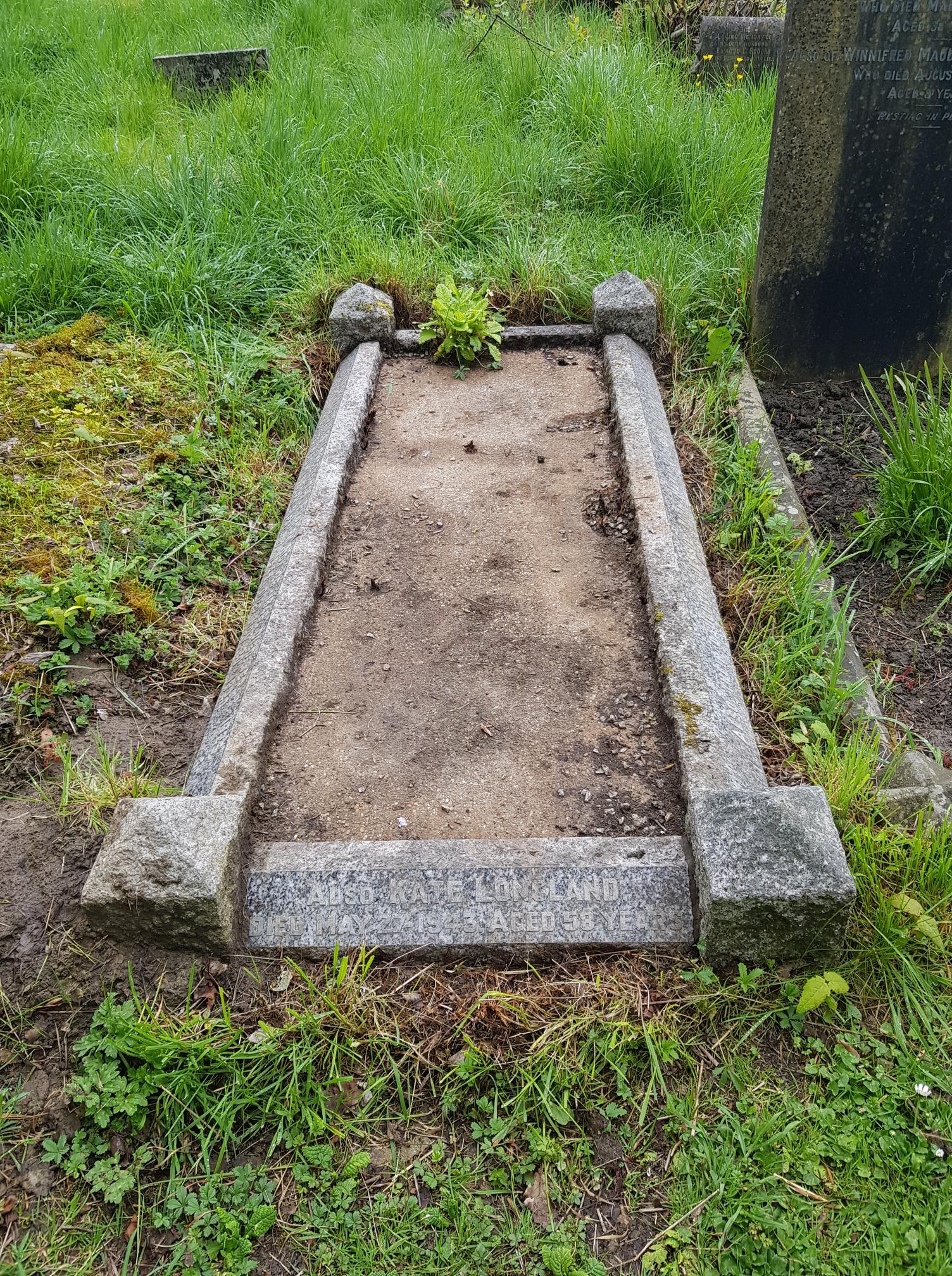
James Longland, aged 79 years of 6 Volta Road, was buried on September 8,
1925 in plot E7369, a grave he shares with his wife Naomi and two daughters,
Jessie who died in 1916 and Kate who died in 1942.
This kerbstone memorial was pretty much hidden, covered in grass and weeds, when I visited the cemetery last week. Radnor Street cemetery volunteer Rebecca has made a fantastic job of clearing and tidying it up.
You saw it happen so often in those days, a mother or father would die suddenly, but to lose both parents within a matter of three years was heart-breaking for those poor children. Little Arthur was just four years old when his mother died and only seven when he lost his father.
I would have happily taken that little boy into our home. It would have been what his mother would have wanted. We were close, the two of us. But his father had obviously made provision for his family.
It would have been hard on those children had their father not been a Freemason. The girls received a good education and Walter, the brother just a couple of years older than Arthur, went into the railway factory before moving to Wolverhampton and a job as a fitter in the GWR Stafford Road works. But I never knew what had happened to that little boy.
I often thought about young Arthur then one day there was a knock on my door and who do you think was standing there but him. My, he had grown into a handsome young man – I could see something of his mother in him. He came in for a cup of tea and a piece of my sponge cake and he told me he was about to start work as a clerk in the Works, following in his father’s footsteps.
He had been to the burial ground at St. Mark’s to visit his parents’ grave, but things looked very different to how he remembered them and he came away without paying his respects. Perhaps someone could help him find the grave? He’s been gone a long time.
The facts …
When Arthur White’s father Richard Lewis White died in 1879 it seems likely it was members of Swindon’s Freemasonry who provided for the young boy and his family of siblings.
Richard Lewis White, secretary and chief accountant for the GWR locomotive and carriage department, was a member of The Gooch Lodge when he died in 1879, leaving behind six orphaned children from his first marriage.
The first clue to what happened to the children comes in a newspaper article published in the Western Daily Press, Bristol on Wednesday, September 17, 1879:-
Somerset and Wilts Freemasonry – The balloting papers for the election of daughters of Freemasons to the Royal Masonic Institution for Girls have just been issued. The election will take place at the Freemasons’ Tavern, London, on Saturday October 11th. There are 48 candidates on the list, and 18 vacancies in the school. Among the candidates are one from Somerset and one from Wilts. The Somerset candidate is Mabel Jane Sampson, whose father, Thos. Sampson, nurseryman and farmer, was initiated, in the Lodge of Brotherly Love, No. 329, Yeovil, on the 16th March, 1859. The Wiltshire candidate is Adelaide Louisa White, ten years of age, whose father, Richard Lewis White, a clerk on the Great Western Railway, died on the 6th of February last. He was initiated in the Gooch Lodge, No. 1,395, New Swindon, on the 4th of April, 1870, of which he became Worshipful Master. He was also Past Provincial Grand Sword Bearer of Wilts.’
Adelaide was one of the successful candidates, polling 1,118 votes and at the time of the 1881 census she is recorded as a pupil at the Royal Masonic Institution for Girls, Battersea. In the same census Eleanor, aged 17, is recorded as a pupil at Queen’s College, a private school in Islington and 12-year-old Walter is a pupil at The College, Beach Road, Weston Super Mare.
Arthur’s eldest brother Richard Corbett White died in 1877 aged 15 while his sister Frances worked first as a domestic servant and then a dressmaker at the time of her marriage in 1893.
And what of little Arthur who was just four when his mother died and seven when his father died.
The first definite sighting of Arthur is on January 4, 1887 when he enters the GWR employment as a Lad Clerk and it is possible to track his employment record in the Swindon Works. By 1902 he is Assistant Chief Clerk and in 1918 he is promoted to Chief Clerk. His annual salary rose from £45 in 1889 to £1,000 in 1924, so the boy orphaned as a seven-year-old did well. And like his father he also became a Freemason, joining the Royal Sussex Lodge of Emulation in 1919.
Arthur married Emily Sendell in October 1917. He was 45 and she was 41. They did not have any children.
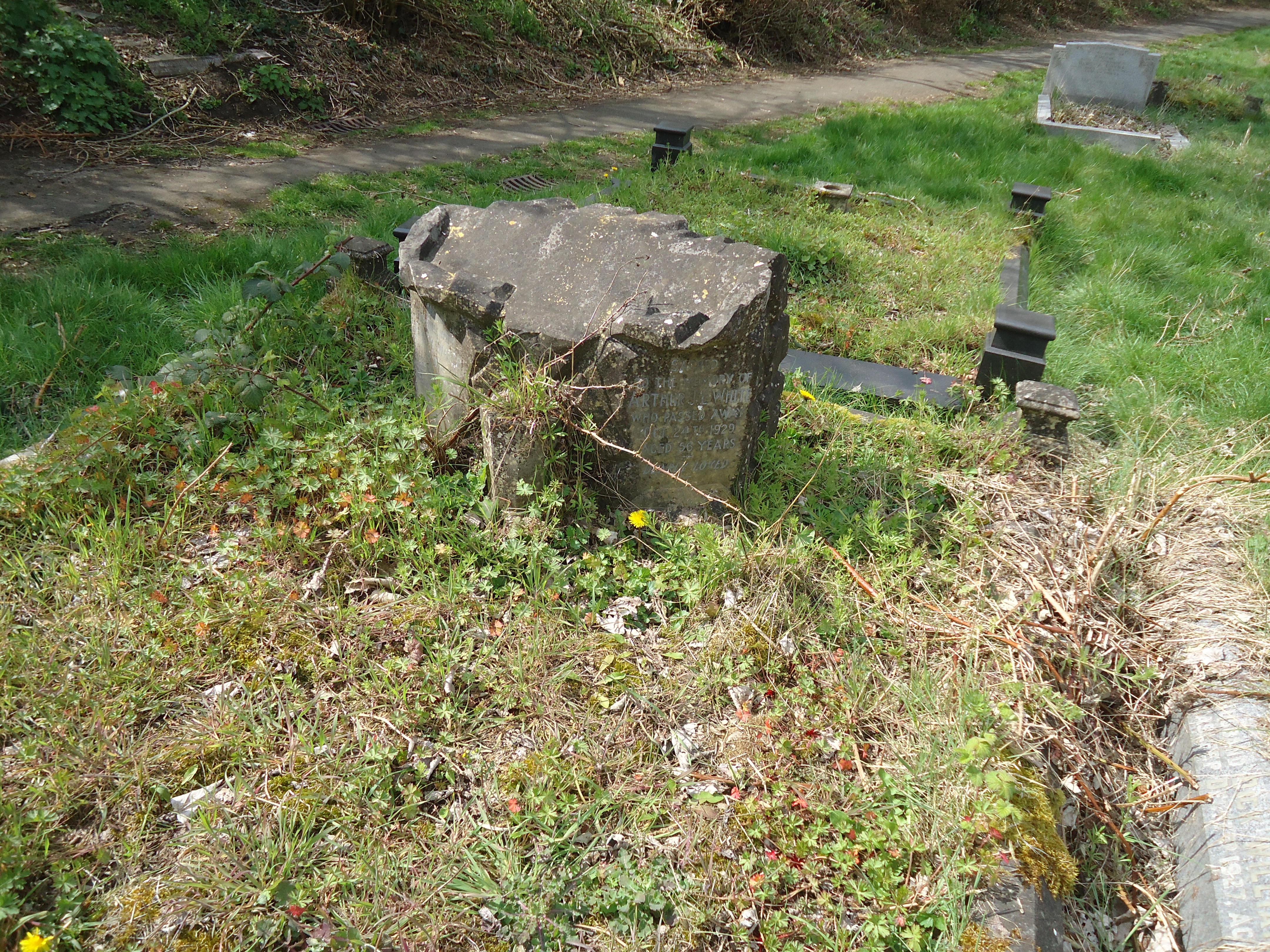
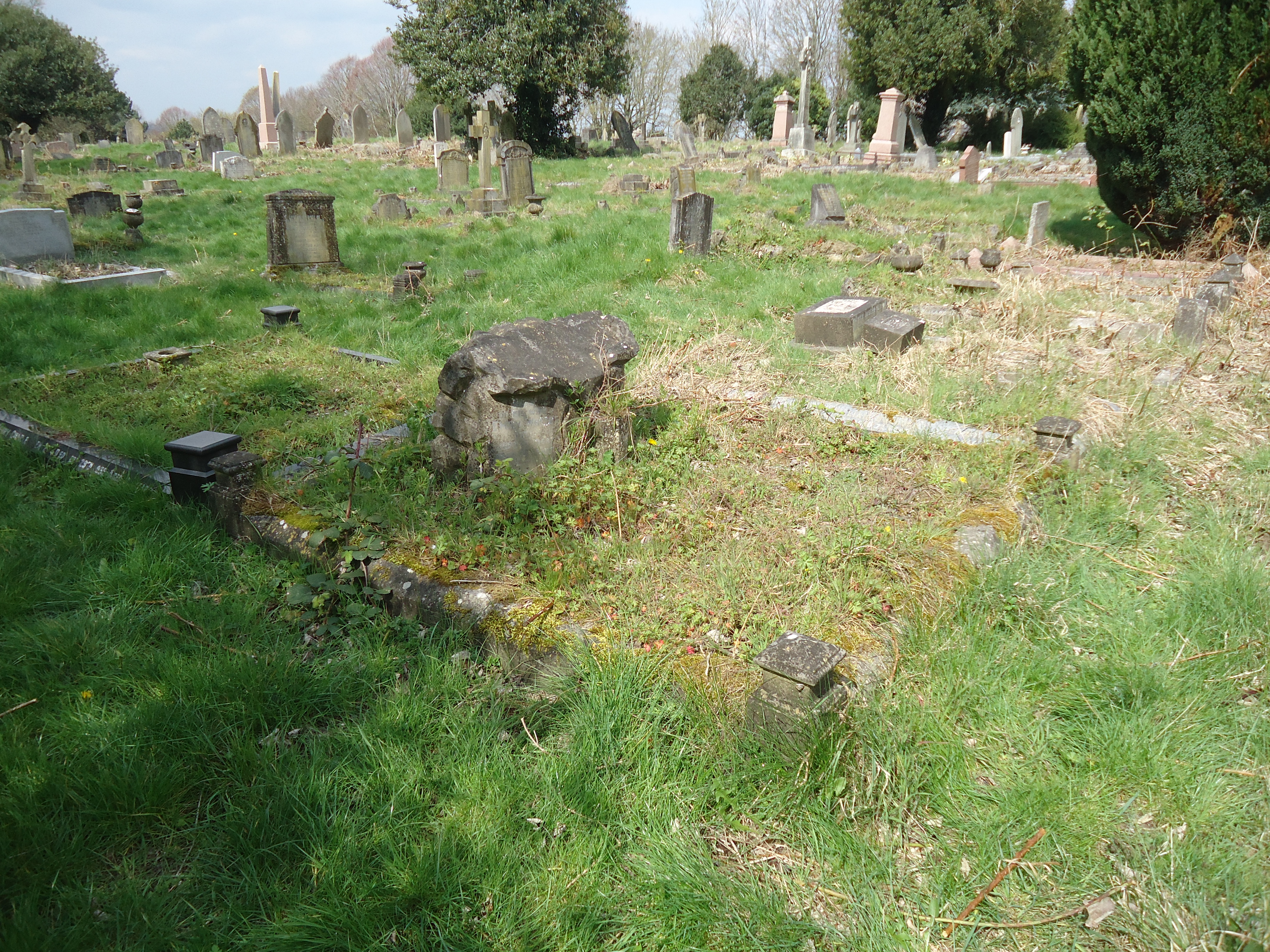
Arthur died on October 24, 1929 at his home in Okus Road. He left effects valued at more than £4,000 to his widow Emily. He was buried in plot E8134 in Radnor Street Cemetery on October 29, 1929, where Emily joined him when she died in 1968 aged 92.
Images of London Street published courtesy of Local Studies, Swindon Central Library.
The GWR Company doctors came and left, but the Swinhoe family of physicians were a constant presence from 1859 until 1918.
George Rodway Swinhoe was born on December 15, 1867 at 4/5 London Street, a property in the railway village which served as both accommodation for the GWR company doctor and as a surgery. George was the sixth child and first son of George Money Swinhoe and his wife Diana.
A member of the Royal College of Surgeons (England) and a Licentiate of the Royal College of Physicians (London) Dr George Rodway Swinhoe was appointed to the medical staff at the GWR in 1893. His name appears in the Register of Staff alongside such railway luminaries as Charles Benjamin Collett, Chief Mechanical Engineer; Wm Arthur Stanier, Principal Assistant to the Chief Mechanical Engineer and Frederick George Wright, Chief Assistant Locomotive and Carriage Superintendent.
In 1894 he married Mary Canning Gertrude Glass and the couple had two daughters.
Dr Swinhoe died at him home on November 10, 1929. The following obituary was published in the North Wilts Herald.
Death of Dr. G. Rodway Swinhoe
Popular Swindon Medical Man
Useful Career
Dr George Rodway Swinhoe, of The Close, Church Place, Swindon, passed peacefully away at his residence at 6.40 on Sunday evening.
He had been in ill health for some time, but was only taken seriously ill a week ago. On the previous Monday he was engaged in his professional duties as consulting surgeon and examiner to the GWR Company at Swindon.
Dr Swinhoe was 61 years of age and had lived in Swindon practically all his life. “Roddy” Swinhoe, as he was popularly known to a host of friends, was a son of the late George Money Swinhoe, who came of a very old Northumbrian family.
Dr. G.M. Swinhoe was born in Calcutta, and he went through the Crimean War, but came out of the ordeal unscathed. He came to Swindon as chief medical superintendent on the GWR Medical Fund staff, on the special recommendation of the late Sir Daniel Gooch.
Appointed to the Staff.
At a later period the medical staff comprised Drs. Swinhoe, Howse and Bromley. The last named died in 1894, and Dr. G. Rodway Swinhoe was then appointed to the staff. Dr. Howse retired in 1899, and Dr Rodway Swinhoe became chief assistant to his father, whilst his brother, the late Dr. Astley Swinhoe, became third assistant.
The father and two sons carried on the three chief positions on the GWR Medical Fund staff til 1905, when Dr. Astley Swinhoe died.
In 1908 Dr George Money Swinhoe died, and Dr. G. Rodway Swinhoe was appointed to the office of Chief Medical Officer, a position which he held till the year 1917.
Dr “Roddy” Swinhoe, who was the eldest of a large family*, was a zealous and most able physician and surgeon. He was a member of the Royal College of Surgeons (England) and a Licentiate of the Royal College of Physicians (London). His post on the GWR Medical Fund staff and with the GWR was an onerous and responsible one.
Services During the War
During the war Dr “Roddy” rendered valuable medical services. He was previously in the old Swindon Volunteer Corps, afterwards taken over by the Wilts Territorials. Then he was promoted to the rank of Major in the RMTC.
In Charge of Labour Battalion
For a period of the war Dr. Swinhoe was in charge of a Labour Battalion in the Park and Drill Hall. Later he was in charge of a private military hospital at Bowood, Calne, which was placed at the disposal of the authorities by the late Lord Lansdowne.
Dr Rodway Swinhoe was also a keen worker in connection with the GWR St. John Ambulance Association, and was the experienced lecturer to the classes for a number of years. For his services he was, on his retirement, made an Honorary Associate of the Grand Priory of the Order of St John of Jerusalem.
Interest in Sport
Always a lover of clean, good sport, Dr. Roddy was closely identified with the Swindon Amateur Swimming Club, the Swindon Amateur Athletic Association, the Gymnastic Societies, and many other sports associations. In his younger days fishing and shooting were his hobbies, and he used often to tell some good stories at dinners of various societies to which he was always invited.
The Funeral
The funeral took place on Wednesday.
The first portion of the service was conducted in St. Mark’s Church by Canon A.G. Gordon Ross (vicar). Canon Ross also read the committal sentences at the graveside in Radnor street cemetery.
A long list of mourners included family members, and representatives from the GWR Company and the Medical Fund Society.
Many beautiful floral tributes were placed on the grave.
The funeral arrangements were carried out by Mr A.E. Smith, of Gordon Road.
North Wilts Herald Friday, November 15, 1929
*He was the 6th child but the eldest son
Dr George Rodway Swinhoe was buried in a large grave plot numbered E8228/29/30 which he shares with his parents and three brothers.
Following the horrors of the First World War an increasing number of women began to take their place on the political stage at both national and local level.
Lydia Fry was already serving as a member of the Swindon and Highworth Poor Law Board of Guardians, before standing at the Town Council elections in December 1919.
Lydia was born in 1871, the fourth child and only daughter of agricultural labourer Richard Wilson and his wife Fanny.
She spent her childhood at Buscot, Berkshire but by 1891 Richard, Fanny and Lydia were living at 35 Bright Street in Gorse Hill. Richard worked as a platelayer labourer on the railway and Lydia was a shirt seamstress.
In 1892 Lydia married Silas Fry. Their first daughter Esther was born in December of that year. A second daughter Miriam was born in 1893. In 1901 the family lived at 110 Chapel Street and from around 1911 until the death of Silas in 1925 at 71 Cricklade Road.
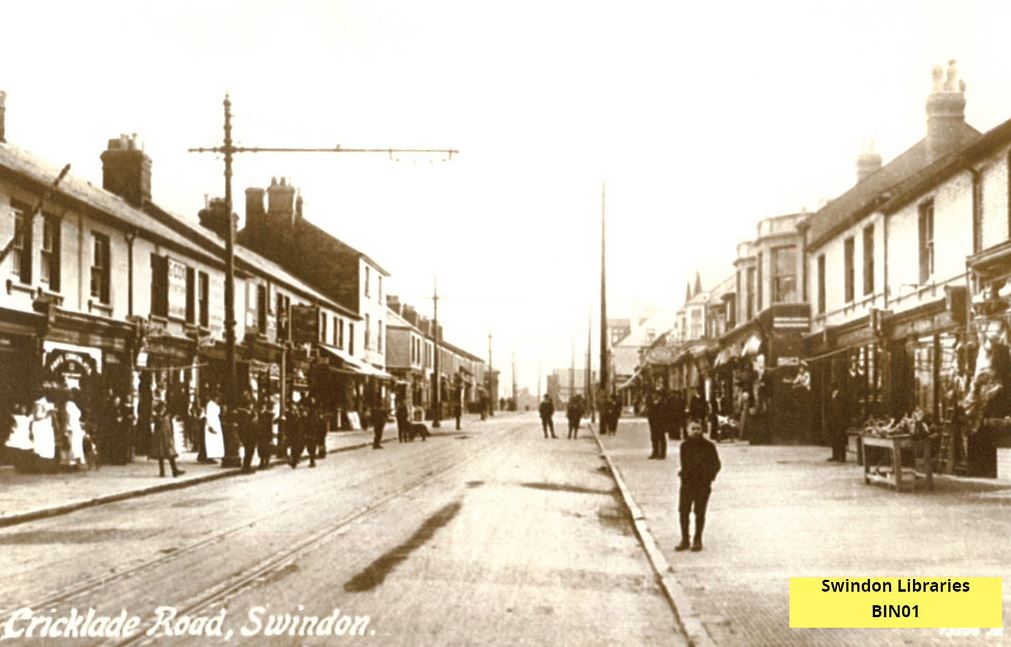
Image of Cricklade Road, Gorse Hill published courtesy of Andy Binks, Local Studies, Swindon Central Library.
When Silas died in 1925 the North Wilts Herald published a fulsome obituary detailing his many accomplishments. However, when Lydia died on April 24, 1941 only a brief account of her funeral was published in the same newspaper. There was no mention of her political career or her public service. Fortunately, in 1924 the North Wilts Herald published this account of Lydia’s life and work, written by W. Bramwell Hill.
For Services Rendered
Mrs Silas Fry’s Good Record
By W Bramwell Hill
Public service of all kinds has its times of difficulty, and, frequently, of irritation. You are not your own. You are bought with the price of the lurid light of criticism, half truth, misunderstanding, and misrepresentation. Happily that is not the only state. Such work does on occasion know a transition into the realm of tangible reward, even though the true reward is in the race well run, and the game well played, with patience and imperturbability of fine motive as the fairy hand-maidens of high endeavour. For what they receive in the unalloyed joy of doing a great work, whatever the sphere, multitudes toil on and in their toil rejoice.
To such a band the subject of our brief sketch this week belongs.
Mrs Silas Fry, of Cricklade Road, Gorse Hill, wife of Councillor S. Fry, is a lady well known for a splendid record of faithful work in her own area. Her chief activities have been in connection with the Swindon and Highworth Board of Guardians (of which she has been a member for some 17 years, I believe) and the Cricklade Road Primitive Methodist Sunday School. It is quite possible – yea, it is more than probable – that the energy for the one task has been found in the service of the other. In the realm of the Sunday School she has put in no fewer than 26 years of successive service, and during the recent Sunday School rally held amid the sylvan setting of Bassett Down House (by kind permission of Mrs Arnold Forster) Mrs. Fry was presented with a diploma of honour, the gift of the Connexional Sunday School Union.
Mrs Fry’s record, by the way, is largely confined to one school – Cricklade Road. In young people’s work, in the choir, the Christian Endeavour movement, as a representative to the Quarterly Board, as well as being a most effective speaker, she is well known. In these times of women’s recognition a certain appropriateness is found in the projection of the good record of Mrs Fry, who, in co-operation with her husband, has put in a vast amount of unostentatious service for the public weal.
North Wilts Herald, Friday, June 6, 1924.
Lydia Elizabeth Fry died aged 69 years at 24 Dudmore Road. She was buried on April 27, 1940 in grave plot D808 she shares with her husband Silas.
The report of the death of Albert William Hall published in the North Wilts Herald in 1920 is, in my opinion, a carefully worded account of an interview with his grieving family. Only they could have known the awful development of his ill health, the repeated operations, his re-admission to hospital again and again and the agonies of his final days.
Swindon Family’s Bereavement
The Late Mr A.W. Hall
The death occurred on July 13th, at 86 Ponting Street, Swindon, of Albert William Hall, the only son of Mr. and Mrs W.J. Hall, from disease contracted on active service.
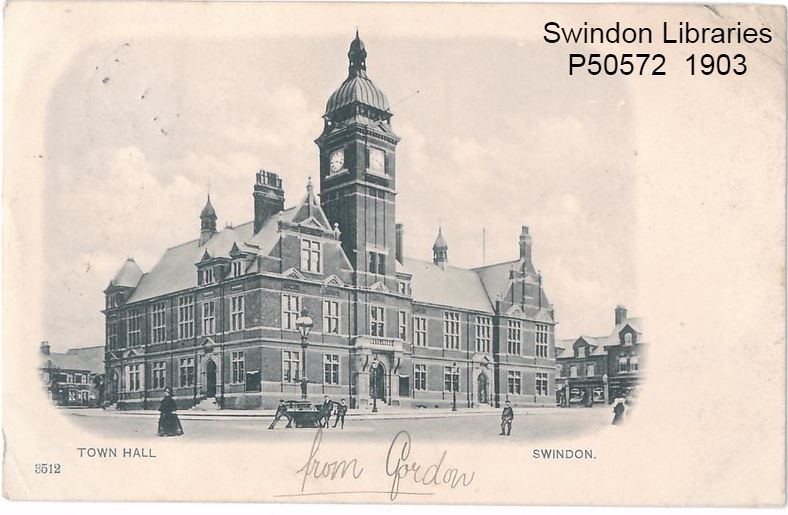
Prior to the war deceased was employed at the Town Hall, under Mr. H.J. Hamp (the borough surveyor). Enlisting in the local Territorials in January, 1914, he was in training at the outbreak of war and was mobilised for service with the Wilts RAMC (T). Through a minor defect he was marked for home service, and subsequently transferred to the 2/1st Wilts RAMC (T) on the formation of that Unit.
As soon as possible he underwent an operation, thus fitting him for foreign service, and, joining the staff of the “Aquitania” in December, 1916, he proceeded abroad, and was attached to the Mediterranean Expeditionary Force. On the outward journey he contracted pneumonia, and on the ship’s return he was admitted to Netley Hospital, on December, 1916.
Following a successful operation in that hospital, he was in May transferred to the War Hospital at Bath. After a further five months in Hospital he was taken to Winsley Sanatorium for treatment lasting over four months. He arrived home in January, 1918, but progress was unsatisfactory, and two months later he was admitted to University College Hospital, London, where another operation was performed. In September he was transferred to a convalescent hospital at Cobham, Surrey, and remained there until January, 1919. He then returned home, but two months later was re-admitted to the University College Hospital, to undergo yet another operation.
After four months in this hospital he was, at his own wish, brought to the GWR Hospital, Swindon, where he remained an in-patient for three months. From October, 1919, until a few days before his death he attended the hospital daily for surgical treatment. Altogether his illness extended over 3½ years, during which time he was constantly brave and cheery, thus commanding the respect and admiration of doctors and nurses, and, indeed, of all with whom he came in contact. What he really suffered can never be known, because he always hated to complain, and it was only latterly when he began to experience great difficulty with his breathing, that he showed any signs of weakening under the strain. He was confined to his bed for a day or two only before his rather sudden death, and though suffering great pain during that time he retained consciousness to the last, and passed away very peacefully.
The greatest sympathy is felt by all for his parents and fiancée, who in the midst of their great sorrow can yet feel justly proud of a life which, though taken so early, has been one of such splendid example.
The funeral took place on Saturday, and the presence of so many old friends from church, school, office, etc., spoke eloquently of the sympathy manifested by all who knew him. Leaving his home in Ponting Street, the cortege proceeded to the Railway Mission, where the first part of the burial service was conducted by Mr. Ernest M. Lewis (former Sunday School teacher), the bearers being old Sunday School friends. During the service special tribute was made to the brave and patient manner in which deceased bore his long illness, and the hymn, “Loved with an everlasting love,” was sung. The interment was in the Radnor Street Cemetery, and at the graveside Mr. Lewis again officiated, a prayer being offered by Mr. Ludlow (Supt. Of the Railway Mission Sunday School). The coffin was of polished elm with brass fittings, and bore the following inscription:-
Albert William Hall,
Died
July 13th, 1920.
Aged 23 years.
Mr and Mrs W.J. Hall and family desire to tender their heart-felt thanks for the many beautiful tokens and the sympathy shown to them in their sad bereavement, also for the many kind enquiries made during their son’s long illness.
Extracts North Wilts Herald, July 23 1920
Albert William 23 years of 86 Ponting Street was buried on July 17, 1920 in grave plot D1088. He shares the plot with his father and mother – William John Hall who died in 1946 and Esther Tucker Hall who died in 1958.
This photograph was taken several years ago before the Radnor Street Cemetery volunteers began caring for the war graves. Today you will find access across the cemetery to the headstones via a mown path. The area around each headstone is kept clear and maintained by the Eyes On, Hands On team of volunteers working under the supervision of the Commonwealth War Graves Commission.



 James Longland, aged 79 years of 6 Volta Road, was buried on September 8,
1925 in plot E7369, a grave he shares with his wife Naomi and two daughters,
Jessie who died in 1916 and Kate who died in 1942.
This kerbstone memorial was pretty much hidden, covered in grass and weeds, when I visited the cemetery last week. Radnor Street cemetery volunteer Rebecca has made a fantastic job of clearing and tidying it up.
James Longland, aged 79 years of 6 Volta Road, was buried on September 8,
1925 in plot E7369, a grave he shares with his wife Naomi and two daughters,
Jessie who died in 1916 and Kate who died in 1942.
This kerbstone memorial was pretty much hidden, covered in grass and weeds, when I visited the cemetery last week. Radnor Street cemetery volunteer Rebecca has made a fantastic job of clearing and tidying it up.





 Radnor Street Cemetery