So, where did responsibility lie for the death of Herbert Hole? Described as ‘a fully qualified man and a good man’ it seems unlikely it was due to his incompetence. Investigations later that day revealed a previously unseen flaw in the hydraulic press, which had been working constantly for 19½ years. Today we bemoan the curse of ‘health and safety regulations.’ I dare say Mrs Hole and her family would tell us how fortunate we are to have such laws in place.
Fatality in the GWR Works
The circumstances attending the sad death of Herbert Henry Hole, aged 53 years, of 20, Curtis Street, Swindon, a fitter in the GWR Works, who was killed by an accident, were inquired into before M A.L. Forrester, Coroner for North Wilts, on Friday afternoon in last week at the Mechanics Institution, Swindon.
Mr O.A. Shinner, H.M. Inspector of Factories, of Bristol, was in attendance.
Arthur Herbert Hole, a fitter, who said he left home only two days ago and went to Grimsby to work, identified deceased as his father, 53 years of age, who had been in the employ of the GWR Co. a number of years, and was engaged in the stamping shop.
Dr W. Boxer Mayne said he was called to the Hospital about 4.30 p.m. on Wednesday. He found deceased suffering from a deep and extensive wound in the neighbourhood of the rectum. There was also the evidence of the fracture of the pelvis. He died in a few minutes from shock following the injuries.
Alfred Edward Mayor, of 28, Oriel Street, Swindon, hydraulic forgeman in the factory, said he and deceased were working on two hydraulic presses in the Stamping Shop. On Wednesday afternoon one of the presses was out of work, and deceased came there to put a guage on the dies of the press which was out of work. Whilst he was doing this witness was working the other press. About 3.50 p.m. witness heard a banging noise, and on looking round he saw deceased lying on the floor. Witness went to pick deceased up, but found his left foot was pinned down by a piece of iron (the crosshead of the machine). With assistance, witness raised the iron, and got deceased up and found he was seriously injured. Witness had left the machine ready for Hole to do the work. He was down on the block, and witness told him it was all right. He told deceased not to touch the lever, or the press would go up. Deceased could work the guage without touching the lever.
By Mr Skinner: The machine was not doing any work at the time of the accident. Deceased was doing some work to the guage.
Thomas Axford, of 161, Victoria Road, Swindon, GWR foreman, said he was in charge of the shop where deceased was working. Witness was 15 yards away from the scene of the accident at the time, and heard the noise. On turning round he saw deceased on the ground. Witness fetched an ambulance and also telephoned for a doctor, who quickly arrived. The same day, about 6 p.m. witness examined the machine and found an unseen flaw in the tie-rod coupling the top piston of the cylinder to the bottom one. The effect or result of the accident was that the tie-rod broke. Deceased was evidently knocked down. Someone must have touched the lever for the tie-rod to break. Deceased was standing near the lever, and in witness’s opinion the lever must have been touched or the tie-rod would not have broken. After the accident the lever showed that the machine was on the down stroke ready to press. This showed that the machine had moved on the up-stroke about an inch and then come down. The water was not shut off on the main during meal hours or for repairs. Every machine had a separate valve. Deceased was a fully qualified man and a good man.
By Mr Shinner: There was no particular pressure put on to cause the accident. There must have been pressure, and an improper pressure put on accidentally. The machine had been working constantly for 19½ years.
The jury, of whom Mr Waldon was foreman returned a verdict of “Accidental death,” and passed a vote of condolence with the widow and family of deceased in their great bereavement.
The Faringdon Advertiser, Saturday July 14, 1917.

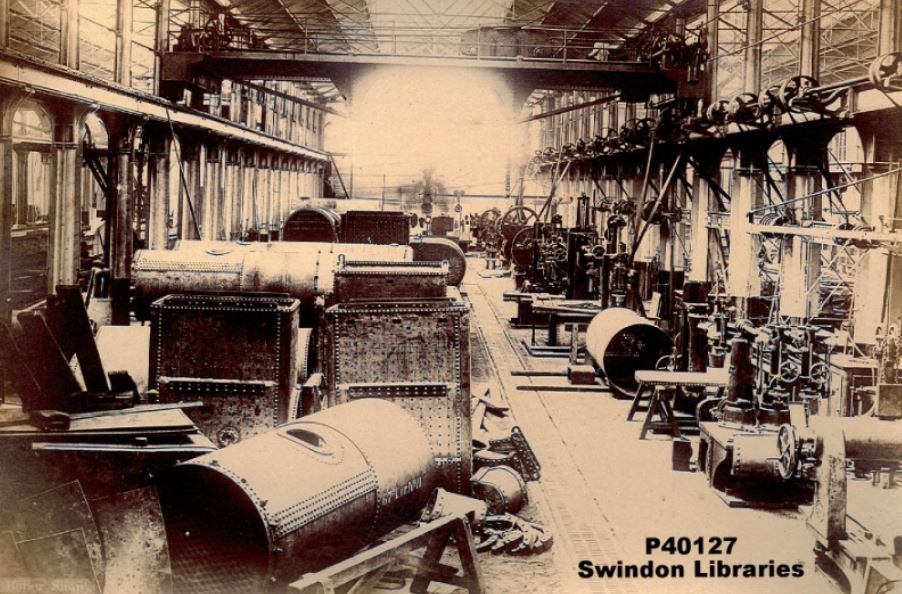
Photograph published courtesy of Local Studies, Swindon Central Library.
Was this the type of machine at which Herbert Hole was fatally injured?
Herbert’s funeral took place on July 9, 1917. He is buried in Radnor Street Cemetery in plot D1624 with his wife Priscilla and son A.P. Hole.

 Radnor Street Cemetery