Tell Them of Us – Jesse Bray

Military and local historian Mark Sutton spent a lifetime dedicated to the research of the Swindon men who served in the First World War. In 2006 he published Tell Them of Us – Remembering Swindon’s Sons of the Great War 1914-1918 – a go-to book for anyone researching their Swindon ancestors who served.

Among the many stories Mark tells in his book is that of Jesse Bray.
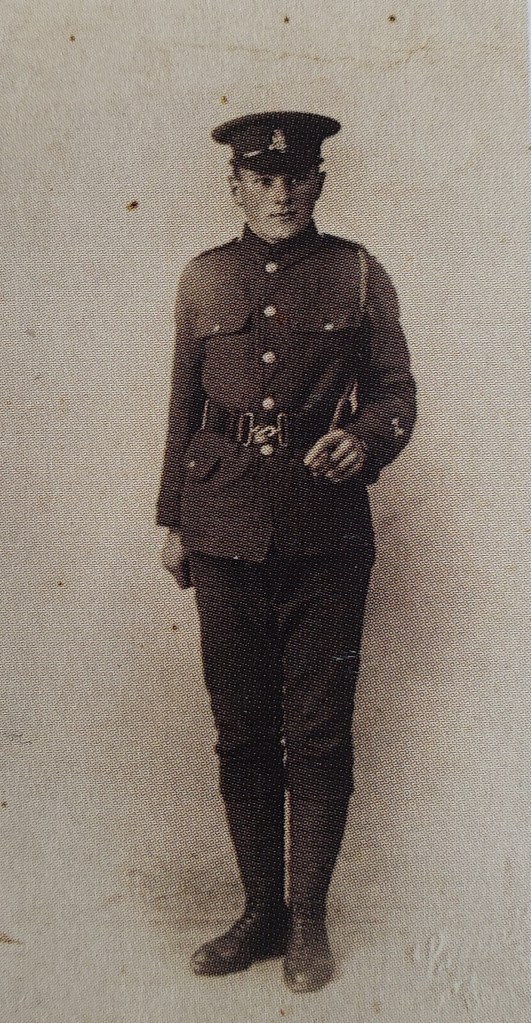
Born on November 13, 1897 in Aldbourne, Jesse was the son of Albert, a Windsor chair maker, and his wife Honor Bray. He was baptised on January 30, 1898 at the parish church of St. Michael’s and grew up in Castle Street and South Street, Aldbourne.

Taking up the story in Tell Them of Us, Mark writes how Jesse Bray enlisted at the age of just 17 and served with the 4th Battalion Wiltshire Regiment, attached to the Signal Service Royal Engineers. Jesse kept a diary recording his movements during the war, which Mark was allowed access to and which he reproduced in his book.

Jesse enlisted with the 4th Wilts on April 24, 1915. He returned to Aldbourne for a brief holiday before being sworn in at Princes Street, Swindon. On September 3 he joined the Signal Service and was moved to Winton, Bournemouth where he was billeted with “Mrs Best 33 Somerly.”

On March 14, 1916 Jesse embarked on HMS Saturnia at Devonport. “Set sail at noon. Destination unknown.” On April 3 he arrived at Alexandra Docks, Bombay. From 13-17 April he marched more than 60 miles from Jelicote to Chanbattia. On July 7 he visited Ranikhet, the Indian hill station, which made such an impression on another Wiltshire man, the Hammerman poet Alfred Williams.

Jesse spent 3 years serving in India recording his movements and memorable incidents in his diary. He recorded the marches, the outbreaks of fever and a minor wound. And then on November 11, 1918 Jesse Bray, signaller for 37th Brigade HQ, took the historic telegram that announced the armistice and an end to hostilities.

On August 29, 1919 Jess writes: “Transferred to departure camp.” On September 22 he enters “Warned for England.” The following day he left Deolali to begin his journey home. October 14 and he writes “Arrived Plymouth and entrained for Fovant.” Oct 16 – “Handed in rifle and left for Swindon.” On April 1, 1920 he is able to write “Final Discharge.”

Jesse returned to Swindon where he married Teodolinda Stefani in 1922. Despite the dangers and deprivations of his military service, Jesse lived to the grand age of 95. He died on March 24, 1992 at 26 Tiverton Road, Swindon and lies buried in St. Michael’s churchyard, Aldbourne.

Perhaps without Mark’s dedicated research we would never have known about Jesse Bray’s Great War Service.

Tell Them of Us – Remembering Swindon’s Sons of the Great War 1914-1918 by Mark Sutton.

Snap village and the Bates family

The re-imagined story …

My mother wasn’t an emotional type of woman, but when John and Hannah Bates moved away she was inconsolable. I don’t think I’d ever seen her cry before, so it came as quite a shock.

The Bates boys Bill and Tom had already gone and with the selfishness of youth all I could think was how lucky they were to escape. There was nothing in Snap anymore, but to be honest the village probably never had a thriving social life; not like Swindon where there were theatres and clubs and pubs.

But what there had been in Snap was a sense of community, and now even that had gone. I think that’s probably what upset mother as much as the departure of John and Hannah Bates. The families she had lived alongside had all left – the babies born at the same time she had hers, the children raised, the hardships shared, the good times celebrated, all in the past.

I hoped we might follow the Bates family but my parents were loathe to leave. We stuck it out a while longer, but things were never going to improve. There would be no new jobs, no one moving into the empty cottages; no one even came back to visit those of us still here.

I never made it to the bright lights of Swindon. My parents moved up the road to Aldbourne, and now I find, like mother, I don’t like change much either.

The facts …

The first recorded mention of Snap, or Snape as it was sometimes called, is in a medieval document dated 1268. In the 14th century Snap was the smallest settlement in the parish of Aldbourne and one of the poorest in Wiltshire.

During the last decades of the 18th century the village consisted of five cottages built on the southern side of the valley and by 1851 there were just 41 inhabitants. For more than one hundred years Snap village was the home of the Bates family.

Three generations of the Bates family made their home in Snap. They worshipped at the Wesleyan Methodist Chapel at Woodsend where John Bates was a trustee, and worked as agricultural labourers on the two farms that supported the village.

In 1861 John Waldron owned Snap Farm where he employed 8 men, 7 boys and a groom on his 411 acre holding. Thomas Bates was employed as a carter, living in one of the larger properties in the village which had an extension to accommodate the cart and stable the horses.  His son Joseph boarded at Snap Farm where he worked as under carter. Thomas’ father Joseph lived in the village and at the age of 76 he was still working as an agricultural labourer.

The difficult years 1871-1880 saw the onset of an agricultural depression. A series of cold, wet summers resulted in a succession of poor harvests and the residents of Snap began to move away.

At the time of the 1881 census there were just seven occupied cottages and a property described as a hut where the young shepherd William Marten lived.

John Bates lived at Snap Cottage with his wife Hannah and their three youngest children, William 14, Emily 10 and Thomas 7. For William, already working as an agricultural labourer, and his younger brother Thomas, there was no future for them in Snap.

William moved to Swindon where there were jobs aplenty in the railway factory. He married Ada Florence Gerrard at St Mark’s Church on September 30, 1893 and at the time of the 1901 census the couple and their three young children Dorothy 6; Hubert 4 and 8 month old Frances, were living at 13 Curtis Street. William’s brother Thomas was boarding with them and the brothers both worked as Machinemen in the GWR Works.

Back home in Snap a series of events would sound the death knell for the village. William’s parents had already left the cottage that had been their home for more than thirty years and moved to East Garston near Lambourn. Then in 1905 Henry Wilson, a butcher and sheep dealer from Ramsbury, bought both Snap and Leigh Farms. He quickly turned the land to grass and shipped in a more profitable crop – sheep.

Snap was all but deserted with just two remaining residents, James and Rachel Fisher. Following the death of her husband, Rachel was persuaded to move into Aldbourne, which she found too quiet, missing the birdsong and the barking of foxes in her cottage garden at Snap.

Following the outbreak of war in 1914 the village was used by the War Office for military training. The cottages fell into ruin, the stones robbed for new building in neighbouring Woodsend during the 1940s.

William Bates died on September 26, 1925 at his home in Curtis Street. His funeral at Radnor Street Cemetery took place on September 30th when he was buried in plot D907 where he was later joined by his son Hubert who died in 1932 and [Ada] Florence, his wife, who died in 1943.

William and Hubert and Florence Bates

Snap 3

Snap 2

Above photograph pictures the ruins of Snap farmhouse in the 1930s.

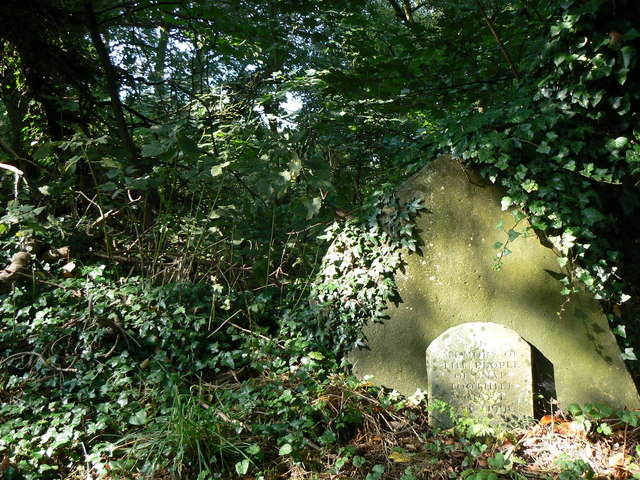
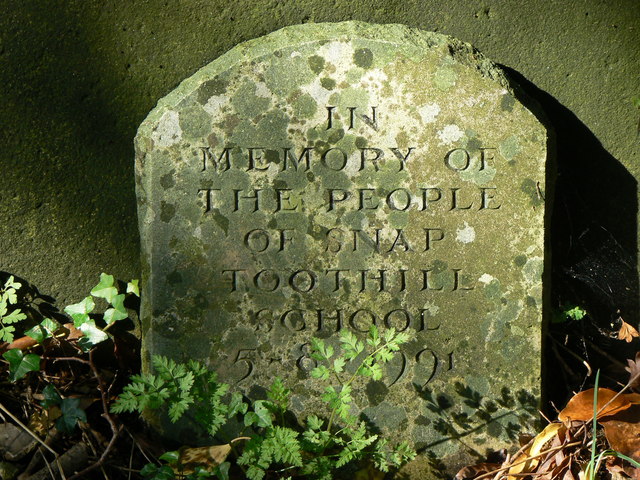
In 1991 the pupils of Toothill School, Swindon placed a stone in memory of the people of Snap. Photograph is published courtesy of Brian Robert Marshall.

Eleanor Stroud

In a blogpost last year I mentioned that there were very few old photographs of the cemetery. There were only three pre-dating the 1920s and two of these were taken by William Hooper.  And then when I looked more closely into the work of this prolific Swindon photographer I found another taken at the funeral of his mother-in-law Eleanor Stroud.

Eleanor (sometimes known as Ellen) was born in Aldbourne in 1834, the daughter of agricultural labourer Thomas Brind and his wife Mary. She married James Stroud, also from Aldbourne, a railway guard, in 1864.

In 1871 Eleanor and James lived in Leominster with their two little daughters, Mary Jane 3 and Alice Kate 1. By 1881 the family had moved to 22 Merton Street, Swindon. On census night James and his daughters were at home. Eleanor, meanwhile, was employed as a monthly nurse at number 10 Merton Street where Annie Hacker had given birth three days previously.

In 1891 Mary Jane married William Hooper, a stationery engine driver with a passion for photography.

Two years later James Stroud was involved in a fatal shunting accident at Tetbury Road station when he was crushed between a waggon and the goods shed. He was brought to the GWR Medical Fund Hospital in Swindon but sadly died as a result of his injuries the following day on January 14, 1893.

After the death of her husband Eleanor lived with her elder daughter Mary Jane and her husband William Hooper. By 1911 William was working full time as a Portrait and Landscape Photographer. Eleanor is pictured here with William and Mary in their roof garden at Cromwell Street.

Eleanor Stroud died at her daughter’s home 6 Cromwell Street. She was buried on April 29, 1915 in grave plot A823 alongside her husband. William took this photograph at her funeral.

You may also like to read

William and Mary Hooper rock up at Stonehenge

Alice Kate Richards – smile please!

Dabchick Thomas Sawyer

When the end came it was peaceful. Thomas got up early with the intention of sitting with his wife who was ill. He was found dead in his usual chair at 8.30 a.m.

Aldbourne by Kate Tryon published courtesy of Swindon Museum and Art Gallery

Thomas was born in Aldbourne in about 1834, although finding him there has proved difficult. At the age of 17 he apparently upped and left Aldbourne for London, some adventure for a young Dabchick. Did he go alone or was there a flock of them?

It was here he met Ann Hill and on October 16, 1858 they married at Trinity Church, Paddington. In 1861 they were living at 52 Alfred Road, a multi occupancy property in Paddington, where Thomas worked as a porter.

By 1871 the family were living at Wootton Ville, Gloucester. Thomas was working as a railway guard. He had a large family to support – six children aged 10 and under.  Another son was born before they left Gloucester. By 1881 they were in Swindon living at 27 Princes Street, 4 more children and their family was complete. Where did they all sleep – those houses weren’t very big.

Thomas & Ann raised 10 of their 11 children – set them up in good jobs, their youngest became a school teacher. Not bad for a Dabchick, Thomas would no doubt reflect.

And at the end there was sadness, but isn’t there always? At his funeral the hymn “Now the labourer’s task is o’er” was sung.

Died in his Chair

Swindon Railway Veteran Passes Away

The remains of the late Mr Thomas Sawyer, who was one of the oldest inhabitants of Swindon and a railway veteran, were laid to rest in the Cemetery on Monday afternoon. The funeral was largely attended by railwaymen, amongst whom were many “old hands” and intimate friends of the deceased. From the residence, 48, Princes Street, the cortege proceeded to the Sanford Street Congregational Chapel, where a service was conducted by the Rev. J.H. Gavin, who also officiated at the graveside. At the chapel service the well known hymn, “Now the labourer’s task is o’er” was feelingly sung, and the organist subsequently played the Dead March in “Saul.” Six railway employes, in uniform, acted as pall-bearers.

Mrs Sawyer and family wish to thank all kind friends for their kindness and sympathy in their sad bereavement.

The deceased, who was in his 79th year, was a native of Aldbourne. He entered the service of the GWR Company at the age of 17 years, when he joined the Goods Shed staff at Paddington. After serving there for some time he was transferred to Gloucester, and later to Swindon, where he worked himself up to the position of Chief Goods Inspector. He retired from the Company’s service 13 years ago. While at Paddington he was married, and his golden wedding was celebrated three years ago. There were several children of the marriage. Mr. Sawyer never had a serious illness, but the illness of his wife and the death of one of his daughters, which took place in October last, affected his health. He got up as usual at an early hour on Friday, when he expressed his intention of going to sit with his wife, who was dangerously ill. This he did, but at 8.30 a.m. he was found dead in his chair. Deep sympathy is felt for the family in their bereavement.

The funeral arrangements were carried out by Messrs. Smith & Son, of Gordon Road.

Extracts from the North Wilts Herald, Friday, June 6, 1913.

Princes Street changed little between 1913 and 1965. Image published courtesy of Local Studies, Swindon Central Library.

Thomas Sawyer died aged 79 years at his home, 48 Princes Street. He was buried on June 2, 1913 in grave plot E7309. Ann died a month later. She was buried with her husband on July 12, 1913.