The re-imagined story …
It was a bitterly cold morning but we were the best dressed passengers on the platform at Swindon Junction that Boxing Day in 1906.
Uncle Alfred had polished his top hat to a shine and Bill looked prosperous, if a bit portly, with his fob watch chain stretched across his ample stomach.
I wasn’t sure how we would keep the children neat and tidy for the duration of the journey, but so far, they have been very well behaved.
We managed to find seats all together in one carriage, although it was a bit of a squeeze and Fred almost sat on Annie’s hat.
Aunt Charlotte would have loved all this.
My mother came prepared with a picnic hamper and enough food to sustain us on an expedition across the dark continent, never mind a trip to Cardiff.
No sooner had we passed through the station at Wootton Bassett Junction than my mother was handing round the scotch eggs.
We were met at Cardiff station by Florence’s uncle who took us to the church at Canton where the wedding ceremony took place and then it was back to the Davies’s home in Conbridge Road for the wedding breakfast.
The other day I was looking through some of my old bits and pieces with Maisie, my granddaughter. I’m moving in with her and her husband, I just can’t manage living alone anymore. I have to get rid of so much. It’s difficult.
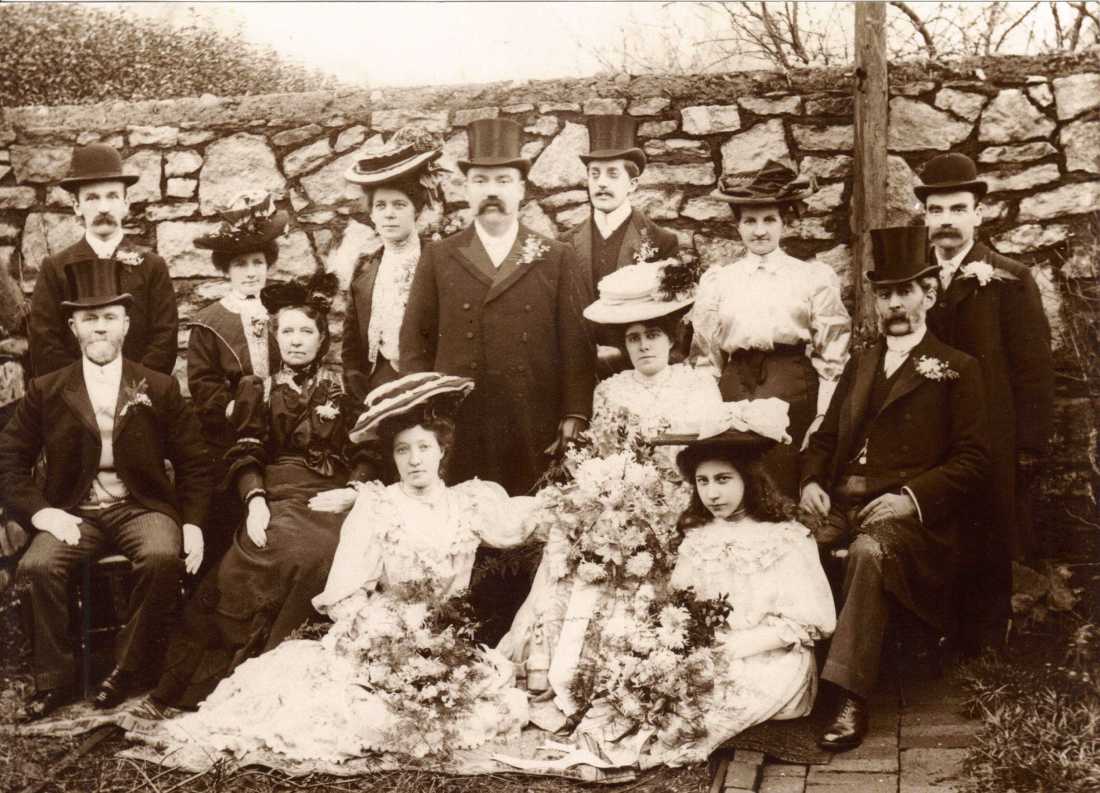
Maisie found Florence and Bill’s wedding photograph taken in the back garden in Canton on Boxing Day 1906.
“I love the ladies dresses,” said Maisie as she studied the sepia image. “Who are they all?”
I pointed out Uncle Alfred and Bill and Florence.
“I can’t remember who the others are, they are all members of the bride’s family.”
“They look a serious bunch,” she pulled a straight face. “Where are the Drinkwaters?”
“We were laughing and talking behind the photographer. I remember he asked us to be quiet as we were too much of a distraction.”
Aunt Charlotte would have loved that.

The facts …
Alfred Drinkwater was born in Barton St Michael, Gloucestershire in 1848. He married Charlotte Dent at St Mark’s Church, Gloucester on April 12, 1869. The couple had a large family of eight sons and four daughters.
Alfred worked as an engine cleaner, a fireman and a 1st Class Engineman (Engine Driver) The family moved from Gloucester to Reading, eventually arriving in Swindon in the mid-1890s. There is a family story that he once drove Queen Victoria’s train.
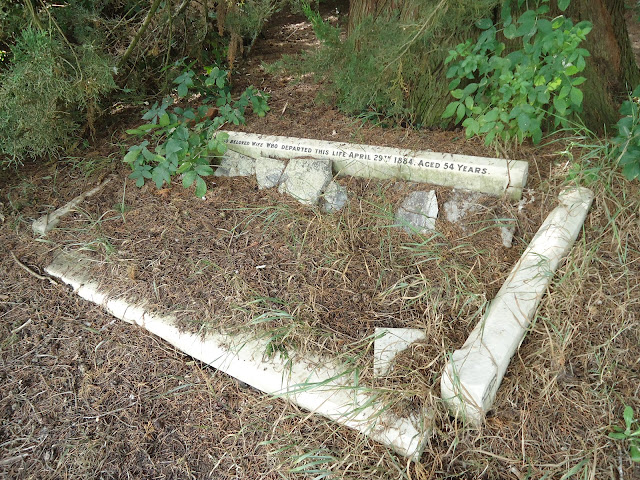
Charlotte died at the family home in Theobald Street and was buried in Radnor Street Cemetery in plot D1453 on June 29, 1904.
Alfred outlived her by almost 30 years. He died at 112, Millbrook Street, Gloucester on July 26, 1932, his body returned to Swindon and the plot he shares with his wife.
Alfred and Charlotte’s nine-year-old daughter Nellie died in 1895. She is buried in Radnor Street Cemetery in plot B2398.
The couple’s eldest son Alfred James Henry served a six-year apprenticeship in the railway factory where he worked as a fitter. He married Annie Cummins in 1892 at St Mark’s, Swindon. The couple never left Swindon and their last family home together was at 27 Whitehead Street. Alfred James Henry died in 1949 and his wife Annie died the following year, 1950. They are buried together with Alfred’s parents. The cremated remains of L.C. Drinkwater, probably Alfred and Annie’s daughter Lilian Charlotte, were interred in the family plot in 1989.
William Charles John Drinkwater and his wife Florence, the couple who married in Cardiff on Boxing Day 1906, were living at 40 Montagu Street, Rodbourne at the time of the 1911 census. They later moved to Wales. William died in the Pontypool and District Hospital on July 9, 1942 and Florence died at her home, 21 Saint Matthews Road, Pontypool on June 5, 1958.
Additional family history information obtained from Public Member’s Trees on http://www.ancestry.co.uk.
 Radnor Street Cemetery