Season of mists – last day

Sadly, we have arrived at the last day of our virtual walk through Radnor Street Cemetery – it’s been fun, hasn’t it and the weather wasn’t too bad? It could have been worse. We conclude by stopping off at the grave of William Chambers.

Despite a shortage of readily available building land and a depression in the railway industry during the 1870s, Swindon enjoyed a building boom throughout much of the late Victorian period.  Many of our street names bear testimony to a number of local builders, George Street, Crombey Street, Colbourne Street, Ponting Street, Turner Street.

William Chambers lived and worked as builder and funeral director in the end house in Ashford Road, the one with the Calvary cross in the brickwork.  The silhouette of the shop sign can still be seen.  As we have already discovered William Chambers was building on the Kingshill estate in the 1890s.

William was born in Stroud in 1839 the son of Samuel, a handloom weaver, and his wife Maria.  In 1859 he married Sarah Tyler and the couple raised their family of eight children in nearby Bisley where William then worked as an agricultural labourer.

In 1871 he was working as a bricklayer and by 1884 the family had moved to Swindon where William established himself as a builder and contractor.  His four sons would eventually join him in the business, William and Alfred both bricklayers and Robert and Samuel who were joiners.
From 1884-1897 William was engaged in building projects in Stafford Street and Hythe, Kent and Maidstone Roads.  In the last decade of the nineteenth century William was also busy building in Ashford Road.

At the time of the 1891 census eldest married sons Alfred and William both had homes in Stafford Street.  Family folklore tells how so many relatives once lived in Stafford Street that it was known locally as Chambers Street.

William’s son Samuel took over the family business after his father’s death.  A 1906 trade directory entry describes the business at 1 Ashford Road as under new management – S. Chambers (late W. Chambers) builder & contractor, dealer in all kinds of building material, funerals completely furnished, repairs promptly attended to at moderate charges.

William died in 1901 and Sarah in 1926.  I think this stylish headstone befits a couple who spent their lives in the funeral business.

I’ve very much enjoyed your company this week. You may like to join us for ‘an in person’ cemetery walk this Sunday September 29. Meet at the chapel 1.45 pm for a 2 pm start.

Extracts taken from To Autumn by John Keats

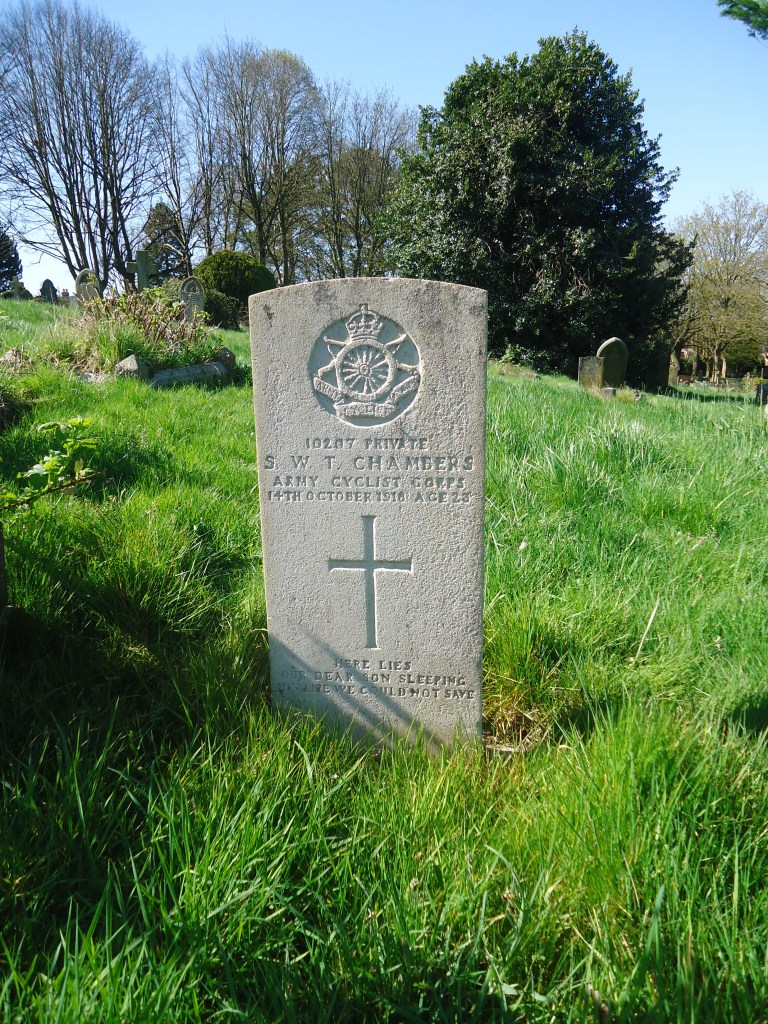
Sidney William T. Chambers – Army Cycle Corps

The re-imagined story …

In 1911 three of the Chambers uncles lived in Stafford Street; people used to jokingly call it Chambers Street. Actually, there is no Chambers Street in Swindon. Funny that really when you think how many other builders had streets named after them.

William Chambers lived and worked as builder and funeral director in the end house in Ashford Road, the one with the Calvary cross in the brickwork. You can still see it now, and the silhouette of the shop sign.

Sam, William’s youngest son took over the business when his father died. I suppose that’s pretty unusual when you think about it. You’d expect the eldest son to take over usually. After the war there were few elder sons left to carry on the family businesses.

Sidney was working in the business as a 15-year-old polisher. We all ended up working for one of the uncles. As kids there were always errands to run, materials to move, digging, sweeping. Uncle Sam could always find you a job to do although none of us liked helping in the funeral parlour.

My dad talked a lot about Sidney. They had grown up together, worked together, served together. They both came home. Dad unscathed, that is if you didn’t count the nightmares and the terrifying rages that so frightened us kids. Sidney only got as far as Devonport Hospital where he died on October 14, 1918.

Uncle Robert and Aunt Kate never got over his death. Some parents blamed the Hun, some blamed the government. Others blamed themselves.

It’s barely ten years since the war ended and sometimes it seems like yesterday. Some scars never heal. But those who died will always be remembered, well by my generation at least they will. It remains to be seen if those that follow will. Will anyone remember Sidney a hundred years from now?

The facts …

Sidney William T. Chambers was born in Swindon in 1895, the eldest of Robert and Kate Chambers’ four children.

He served first in the Cyclist Corps, later transferring to the Labour Corps. His military records do not survive.

Sidney died at Devonport Hospital on October 14, 1918. He was 23 years old. His funeral took place at Radnor Street Cemetery on October 19 and he is buried with his father and three other family members in plot C1052.

The inscription on the Commonwealth War Graves headstone reads:

Here lies our dear son sleeping

His life we could not save

First published January 15, 2022.

The aspirational Percival Seymour Scott

The re-imagined story …

When I was growing up in Swindon there was a ‘can do’ atmosphere in the town. If you wanted to make something of your life you could, yes even those from disadvantaged families.

From the very early days Swindon was an ambitious town with a self belief that permeated all aspects of life. It was taught in the schools and colleges; preached in the churches and chapels and honed and forged in the Works.

It was said an apprenticeship in the Works was the hallmark of excellence and recognised across the world.

Take George and Eliza Scott’s boy. He grew up in Ashford Road, one of the many roads of ubiquitous red brick terrace houses that crept up Kingshill, but what an exciting life he led. They must have been so proud of him. I’m sure they would say it was worth all the sacrifices they made.

The facts …

George Albert Scott and Eliza Seymour were married in the Providence Baptist Chapel on July 9, 1892. George was 26 and worked as an Engine Fitter and Turner in the GWR Works. He was born in Bristol in 1866 and first appears in Swindon on the 1881 census living with his mother Caroline and stepfather Charles Jefferies at 10 Queen Street. Aged 15 years old, George had already begun an apprenticeship as an engine fitter.

Eliza was born in Lechlade in 1871. In 1891, the year before her marriage, Eliza was living with her parents at 124 Stafford Street. Her father John was a grocer and Eliza worked as a dressmaker.

The newlyweds set up home in Ashford Road where the family would live for more than 70 years. They had three children, Percival born in 1896, Ivy in 1898 and Gwendoline in 1906. The 1911 census records the couple’s only son Percival 15, was a part time student whilst working as an Office Boy in the Works.

In 1915 Percival joined the Royal Navy for the duration of hostilities (the First World War). His naval records describe him as 6ft ½ ins tall with black hair, brown eyes and a dark complexion. At the beginning of 1918 he transferred to the newly created RAF. 

In 1920 Percival married Elsie Holbrow, the daughter of another railwayman Samuel Holbrow and his wife Minnie. The following year Percival’s name appears on the Ship’s Register of the SS Highland Glen bound for South America where Elsie would join him at their home in Buenos Aires, Argentina.

The couple apparently made return visits to Swindon and are recorded as passengers on the Asturias in 1926, their destination 47 Deacon Street (the home of Elsie’s parents), their permanent residence Argentina. They were too late to see Percival’s mother Eliza who died in 1922.

Elsie died in Buenos Aires just three years later on January 29, 1929 aged 32. Her details are recorded on her parents’ headstone.

George Scott married for a second time in 1924. He died in 1928 aged 62 years and was buried with his first wife Eliza in Radnor Street Cemetery plot E7492. His second wife Margaret died in 1973 and was buried in the same grave.

Percival remained in South America until at least the 1960s when he is recorded as living in Peru but he died closer to Swindon at his home The Hermitage, Combeland Road in Minehead on November 5, 1979.