The continuing story of James George Merricks

Sometimes I get lucky. No, honestly, I get really lucky.

Last year I came across some details concerning James George Merricks while researching the Astill family. Catch up here with the information I discovered then about James https://radnorstreetcemetery.blog/2024/06/04/james-george-merricks/

James spent some 15 years in South Africa but why had he left England and why did he eventually come back. And even more intriguing, what was the story behind his romance with Alice Healey, born in Bath in 1861, whom he married in South Africa in 1891.

I put out a general enquiry on this blog, hardly thinking anyone would reply but this week James’s great-grandson David got in touch and filled in all the blanks.

David forwarded me several family photographs including a most beautiful one of Alice Sarah Merricks nee Healey born in 1861 the daughter of Edward Healey, a wire worker, and his wife Frances who grew up at 7 Southcot Place, Bath.

David was also kind enough to send me a typed transcript of James George Merricks’ diary 1876-1896.

James Merricks was born February 24, 1860 in Chichester, Sussex. He left school in 1876 and began work as first an auctioneers clerk then later becoming apprenticed to draper Alfred Dunn of West Street, Chichester.

His apprenticeship completed in 1880 James began working for Stokes and Sons of Cheap Street, Bath which he describes as a “high class drapers etc easy berth, think I shall get on allright.”

The first mention of Alice comes in a diary entry dated June 4, 1880.

Have been impressed considerably by a young lady I met at Mr. Philpot’s and find her to be the daughter of Mr Healey, Stall Street, shall look forward to a closer acquaintance if possible.

By July 1 James writes.

Have managed to meet Miss H. several times and like her even better than I expected, suppose in my position tis foolish to look so far forward but should feel upset I am sure if I saw anyone else with her.

And after attending Mr Philpot’s New Year’s Eve party James writes: Believe Miss H. has some liking for me and I am quite sure I never knew anyone I liked as well.

However, the course of true love never did run smooth.

March 1881 and James had become disenchanted with his job in Bath. A chance meeting with Mr Burnet-Stoakes from South Africa convinced him his future lie there where he could easily earn £120 a year, a vast improvement on the £30 he was earning in Bath.

A mere three days later, his berth to Hong Kong booked, James wrote to his parents and Alice.

By this time Alice was employed as a governess working for Walter G. Cloke at Wiltshire Farm in Wokingham, Surrey where she had responsibility for his 5 school age children (and most probably the two babies in the nursery as well).

At home in Chichester for 10 days prior to his departure, James cycled across country to visit Alice before he left England.

May 9 – Slept or rather passed the night at “The Bush” and met Alice soon after sunrise for another hours talk, she was most kind and promised if I could make her a home in S. Africa she would be mine.

On May 19, 1881 James embarked for South Africa at Southampton, arriving in Cape Town on June 9.

After two low paid, short term jobs James began work for T. Copelands at £11 per month. He writes home to his parents and Alice, but she fails to reply.

James leads a busy life with work, church and an active social round. He joins the Baptist choir, the Choral Society and assists the Desalins Sisters Opera Company.

Eventually he writes on January 1, 1882 …also generally have enjoyed this Christmas and New Year day exceedingly, but although accompanied by some of the jolliest and prettiest girls have not lost my heart to any of them, cannot understand the underlying motive (if any) which prompted Alice’s letter received Oct 11th last finally deciding that she could never leave England for me – well perhaps I may go home someday and then – but its no good guessing the future.

More than 18 months passes and James writes … as I have not heard directly from Alice since October 11th 1882 can now decide that I must think no more of the matter.

Although, of course, we know differently!

During the intervening years James set up his own store in the area that was soon to become Johannesburg. This was probably precipitated by the opportunities presented by the Witwatersrand Gold Rush, which really got under way with the 1886 discovery of gold at Langlaagte, where it is believed the stores were situated.

After six long years the mystery is solved… my Alice was true to me after all and that her long silence was only the result of her having misunderstood my careless conduct with regard to another in her absence for my heart was not in least affected by Miss M.P. though she (the latter) might have imagined she had fascinated me, but I always took her for an accomplished flirt, however “Alls well that ends well”…

Alice arrived in South Africa on October 15, 1890. The couple signed an ante nuptial contract the following day and were married on October 17 by Landrost Von Blommestein at his house Doornfontein with a religious service at Mrs. Jones by Rev. Ecclestone. Their first son, Eric George was born on August 9, 1891, their second Edward Alfred on November 30, 1893 and a third Lionel Marten on January 7, 1896.

In 1896 the volatile political situation, the threat of war and the Jameson Raid with the subsequent commotion probably caused James to reassess the family’s situation.

Alice and their three young boys accompanied by James’s brother Alfred sailed for England on April 24. By the end of 1896 James had joined them. There were no further entries in the diary.

By the time of the 1901 census James and Alice were living at 42 St. Margarets Road, Swindon where a fourth son, John Gordon was born on June 14, 1900.

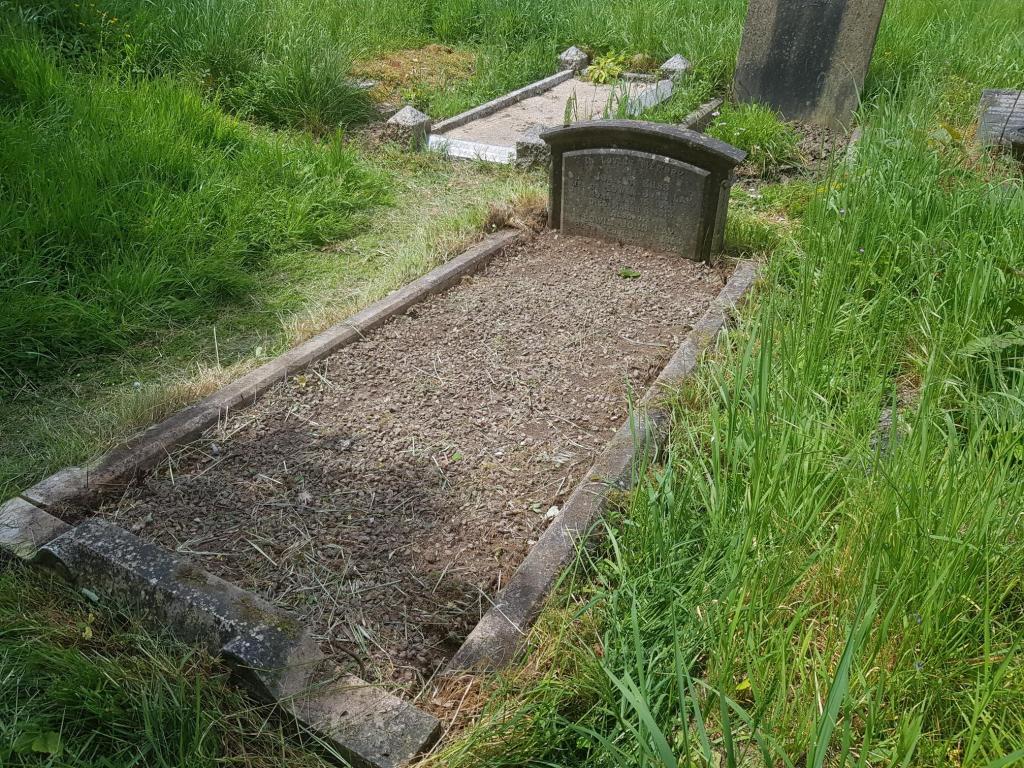
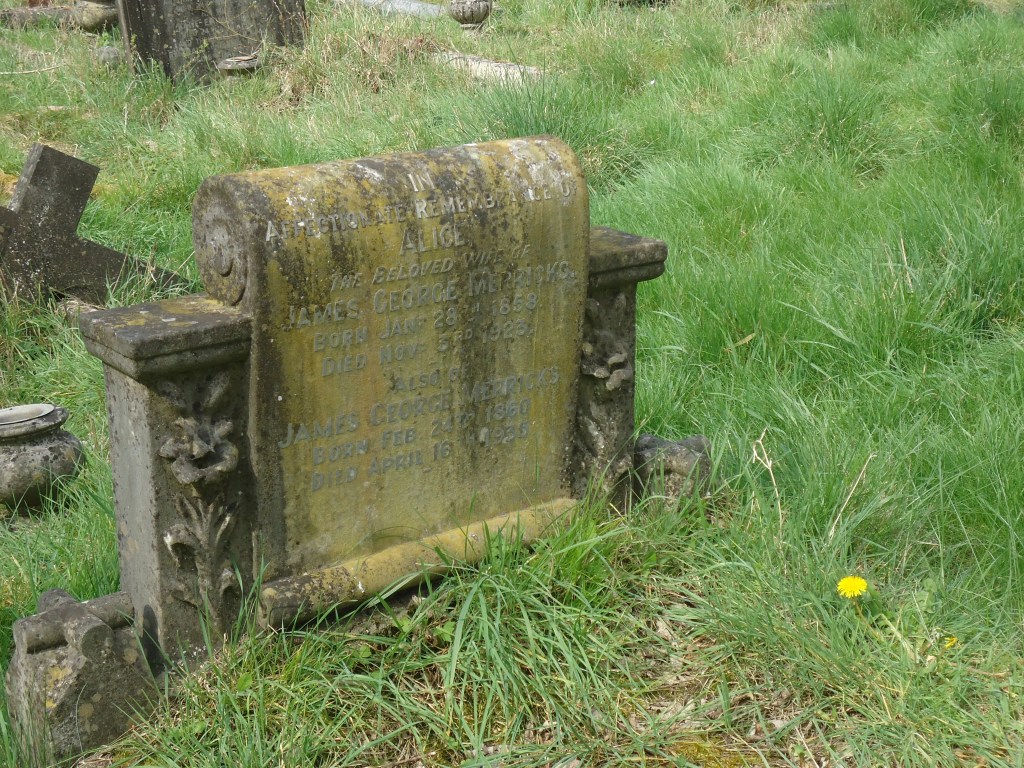
James George Merricks died aged 75 years at his home 38 Devizes Road. He was buried on April 20, 1935 in Radnor Street Cemetery in grave plot E7574, joining his beloved wife Alice who died in November 1923.

published with thanks to David Merricks

Alice Sarah Merricks nee Healey

James Merricks’ store

Alice and James with one of their grandchildren
W.H. Read – local architect

The re-imagined story …

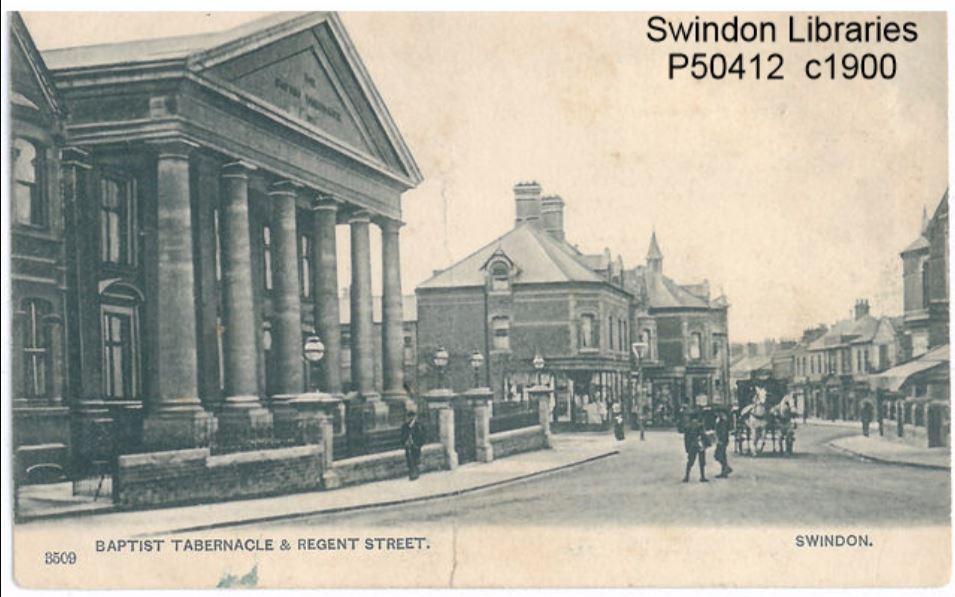
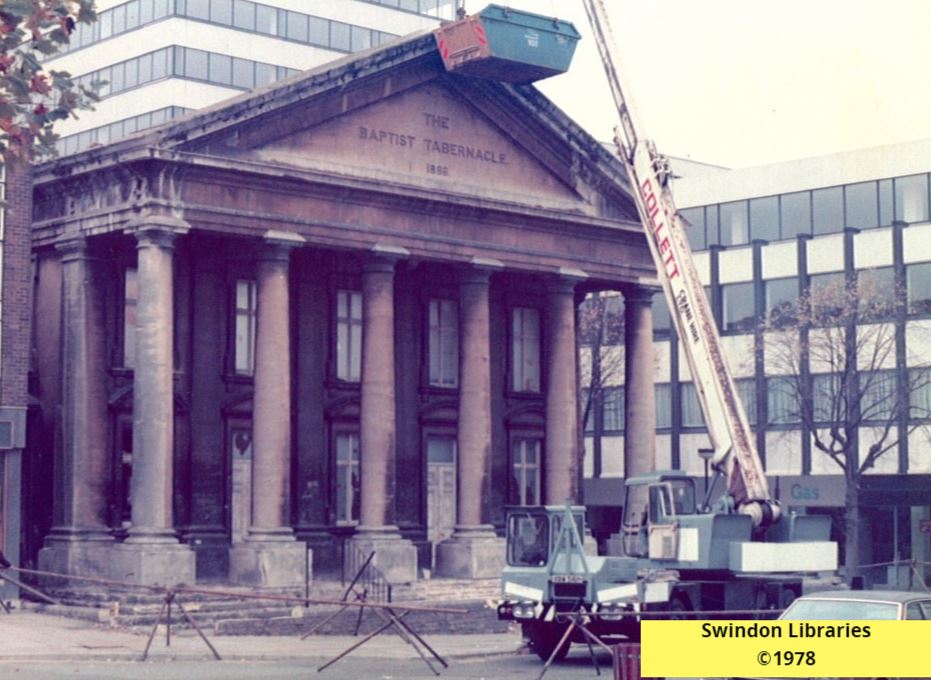
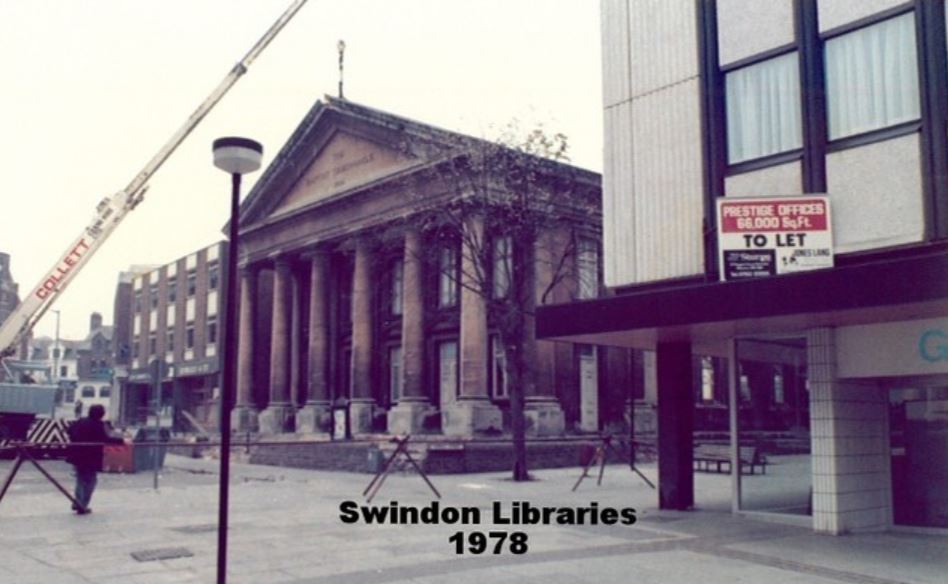
They began dismantling the Baptist Tabernacle as if it were a child’s construction kit. The classically designed building dominated the top end of town but not everyone was a big fan. Some said it was too posh for Swindon and that it didn’t sit well among the other red brick buildings in the town centre.

Gran was a Sunday School teacher at the Tabernacle and insisted we grandchildren attend. My sister and I were reluctant bible students. I’d have rather been up the Rec playing football with my mates and my sister was terrified the building would fall down about our ears. Any number of pictures and paintings would fail to cheer up that dank schoolroom and my sister was forever watching out for falling lumps of masonry.

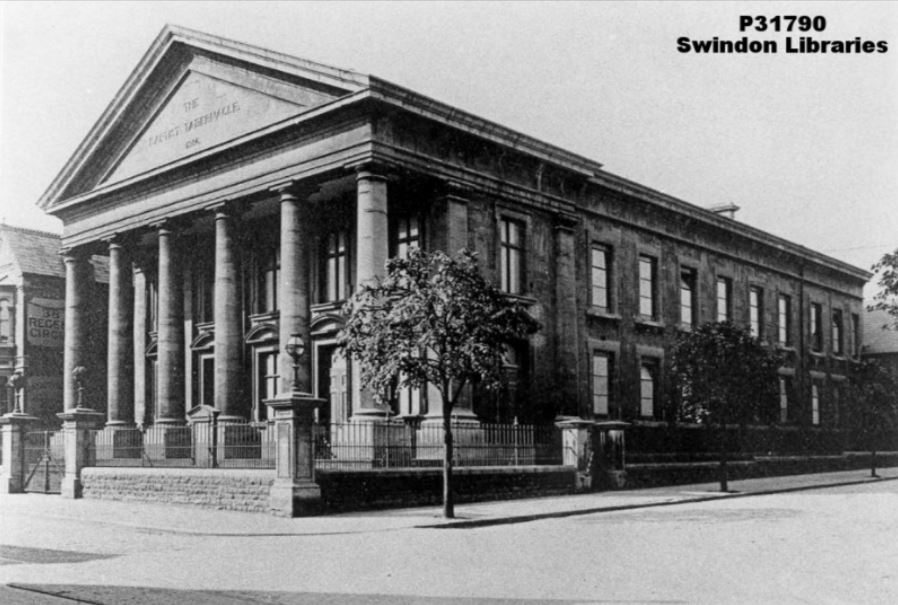
Baptist Tabernacle

Demolition of the Baptist Tabernacle published courtesy of Local Studies, Swindon Central Library.

And that’s what sounded the final death knell for the building. It wasn’t demolished by the Council as everyone has repeated for the last forty or more years, but by the Baptist church itself. The congregation was too small and the reduced income not enough to pay for the vast amount of repair work necessary.

Today it is difficult to imagine a magnificent, classically designed building with a colonnade of six Tuscan columns and a flight of stone steps the width of the building lording it over the shops in Regent Street.

I would have liked to have one last look around inside, for old times’ sake. I’d have liked to have stood in the pulpit, forbidden to us as children. Neither were we allowed to hang over the gallery to see who sat below us, we soon felt the warmth of Gran’s hand if we stood up in our seat.

Funnily enough my sister wouldn’t have stepped inside that building again if you paid her.

Baptist Tabernacle 2

The Baptist Tabernacle in its heyday – published courtesy of Local Studies, Swindon Central Library.

The facts …

William Henry Read was a popular and prolific local architect whose commissions included the Victoria Hospital, the Anderson’s Almshouses in Cricklade Street and the Baptist Tabernacle.

He was born at Croft House, Swindon in 1850 the son of surveyor William Read and his wife Louisa and educated at Henry C. Lavander’s Grammar School in New Park Street, Devizes. The family later moved to 31 Wood Street and William Henry married Susannah Elizabeth Chandler, the girl who lived next door, in 1876.

The couple lived at Moravia, 10 Bath Road where they raised their family of four sons, William, Kenneth and Norman, and a daughter Grace.

William died at his Bath Road home on Sunday November 3, 1901. The announcement in the local press noted that ‘although a prominent townsman [he] took small part in local government.’

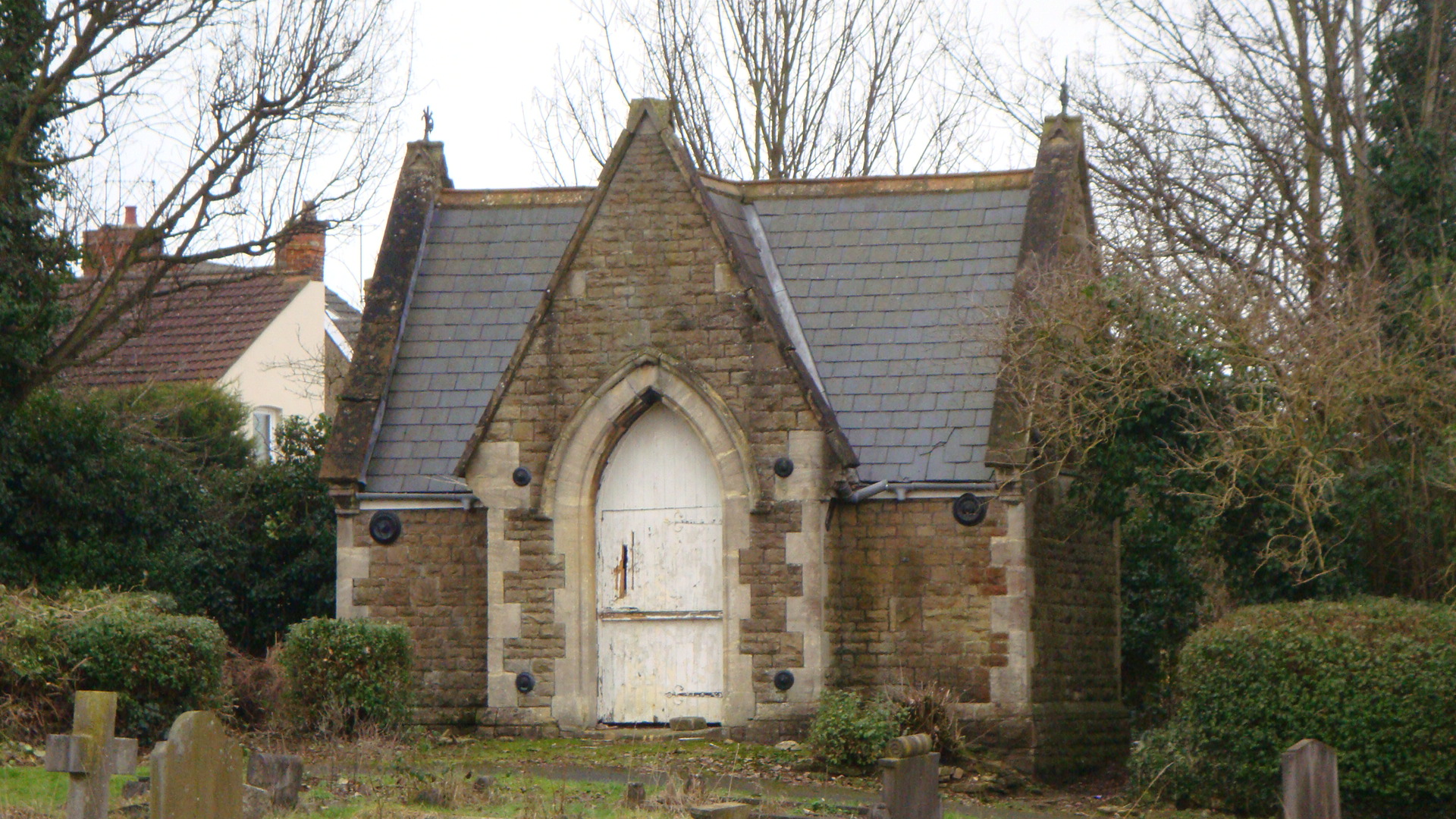
mortuary

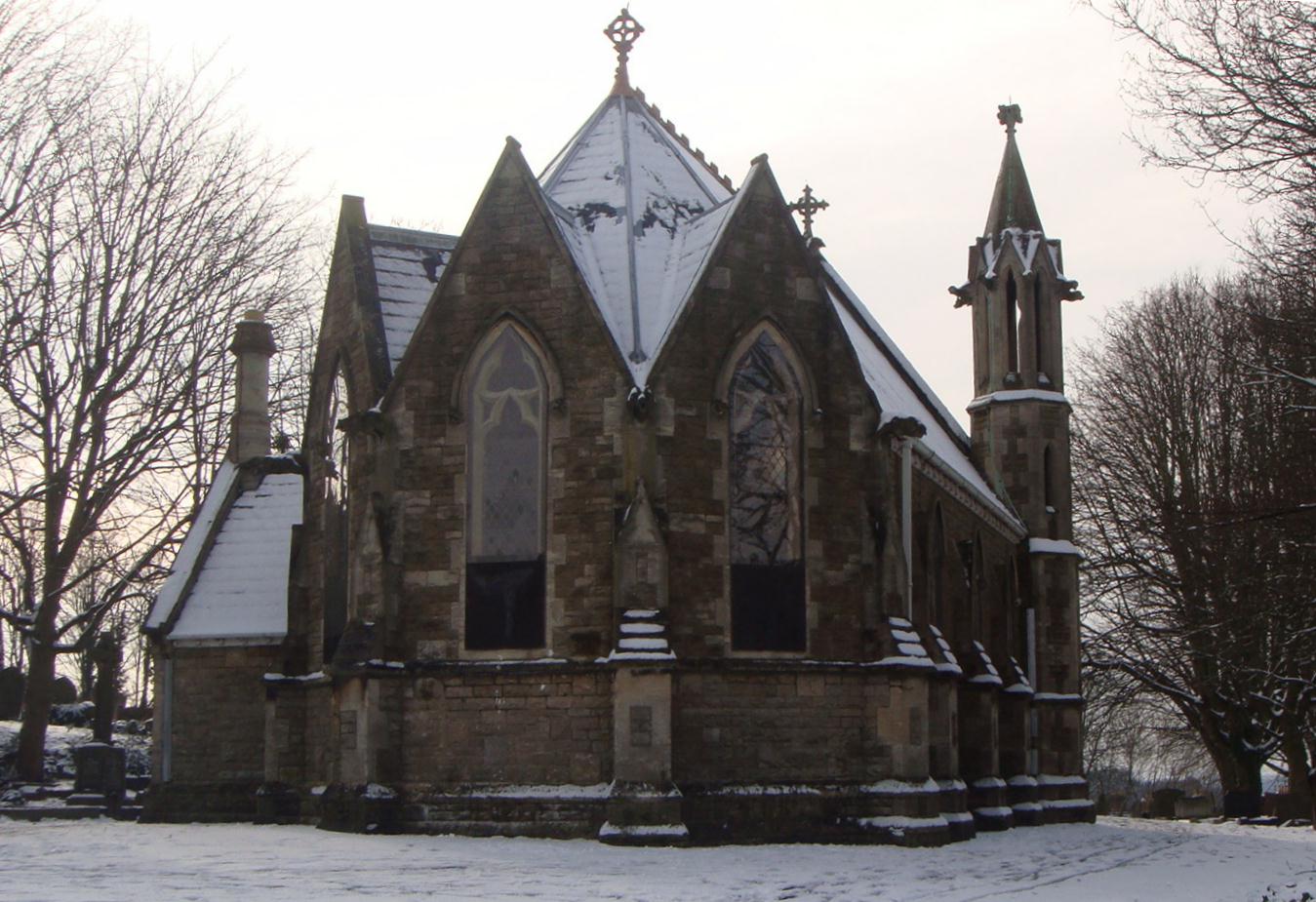
William designed the chapel, mortuary building and caretakers lodge at Radnor Street Cemetery in 1881 where he was buried twenty years later. He must have liked how it all turned out! Susannah died on March 21, 1903 and is buried with her husband.

chapel in the snow

The best bits of the Baptist Tabernacle building materials were sold off. The portico was bought by artist Stanley Frost, the columns, bases and façade wall went elsewhere. People had big plans, which sadly never came to fruition. Then in 2006 Swindon Borough Council bought back the remains at a cost of £360,000 but so far their plans to incorporate them into a town centre regeneration project have failed to materialise and these remain in storage.

William Henry and Susannah Read


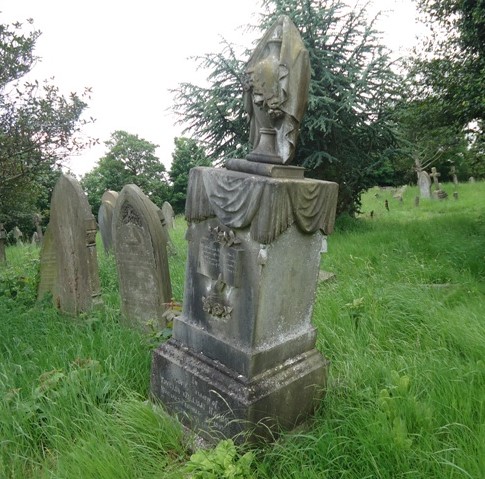
James George Merricks

James George Merricks has already appeared on our radar, thanks to Rhonda and her Astill family history research.

She tells us that Amy Maud Astill’s husband Arthur Mills was assistant to Mr Merricks of Gilbert’s Furniture shop in Newport Street, Swindon in 1900, becoming a partner in the business in 1923 and moved the shop to Bridge Street, Swindon and renamed it Mills and Merricks – of course Gilberts is still trading in Newport Street to this day, perhaps Arthur and James became partners in an independent venture.

Now I need someone to fill in a few more gaps, such as how did James end up in South Africa in 1891 and what was Alice doing there?

In 1881 Alice was working as a governess for farmer Walter G. Cloke at Wiltshire Farm in Wokingham. Meanwhile James was working as a draper’s assistant in Bath. But by 1891 they were getting married in South Africa where three of their four sons were born, Eric George in 1892, Edward Alfred in 1893 and Lionel Marten in 1896. A fourth son, John Gordon was born in Swindon on June 14, 1900.

James George Merricks

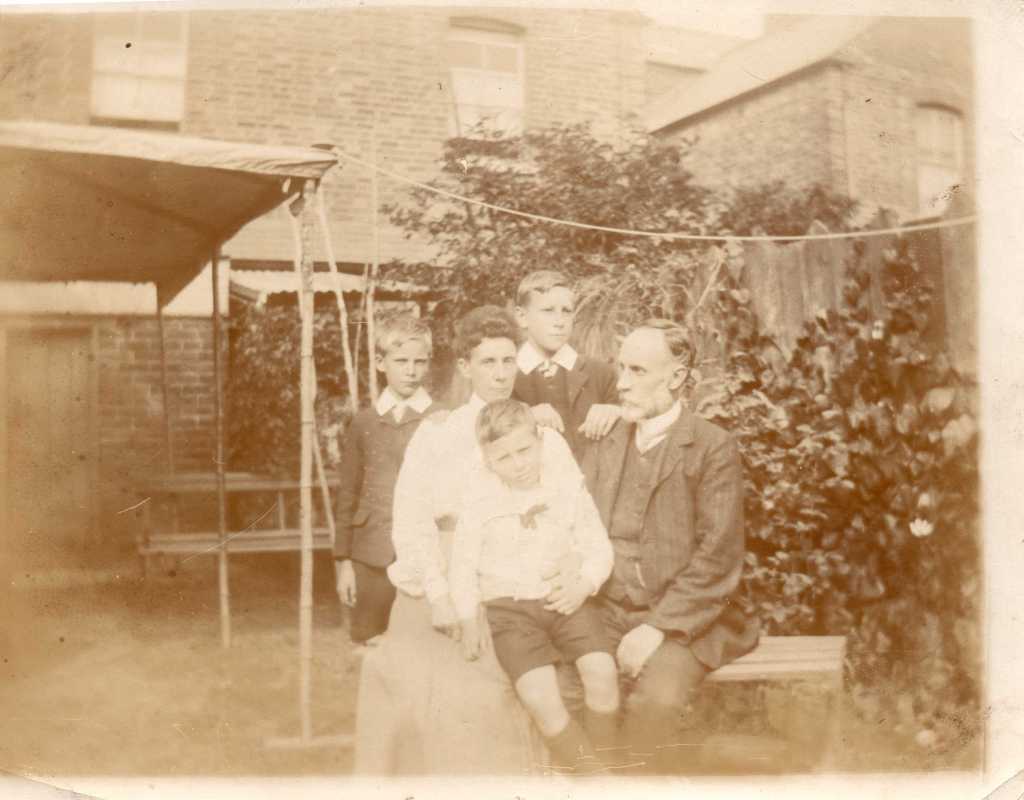
By the time of the 1901 census James and Alice were living at 42 St. Margarets Road, possibly where this photograph was taken in the back garden.

James George Merricks was a member of the Baptist Tabernacle, acting as Treasurer for 21 years. In 1934 shortly before his death, Mr J.G. Merricks presented a complete set of individual Communion bread plates to fit the cups previously given by his great friend and associate Mr. E.J. Lay. The two men are pictured together here.

There is still more to be learnt about this man. Especially how he came to spend such a lengthy spell in South Africa. Could this have been to do with the Baptist Tabernacle, I wonder?

James George Merricks died aged 75 years at his home 38 Devizes Road. He was buried on April 20, 1935 in grave plot E7574, joining his wife Alice who died in November 1923.

Hubert John Deacon – jeweller and watchmaker

Image of Hubert John Deacon published courtesy of Deacons website

I’m sure the name Deacon will be familiar to many, but did you know Hubert John Deacon was also a leading figure in the Baptist Church, Swindon.

The jewellers at 11-13 Wood Street was founded in 1848 by George Deacon who was later joined in business by his two nephews Hubert and Joshua.

Hubert John was born in Trowbridge in 1846 and joined the business in the late 1860s, during what was a period of considerable expansion for the family firm.

In the online company history Hubert is described as an entrepreneurial figure.  He was the first President of the Swindon Chamber of Commerce in 1893 and was responsible for supplying Swindon’s first public clock on the Town Hall.  He also brought the plot of land on which Deacon Street was built and named in his honour.

By 1881 he and his wife Susan had moved in over the Wood Street shop where they lived with their six children, cousin William Nash who was a watchmaker apprentice, Ann Shackleton, a jeweller’s shopwoman and two young servant girls. The Deacon children would eventually number ten.  The youngest, a daughter was named Dorothy Decima.

Hubert was succeeded in the business by his only surviving son George. Today the family firm is in the hands of Richard Deacon and his sister Sara, the 6th generation

Image of Deacons store published courtesy of Deacons website

Death of Mr H.J. Deacon

50 Years a Resident in Swindon

Public Activities

The death took place on Thursday at Margate of Mr Hubert John Deacon, who was associated with the public life of Swindon for over half a century. Mr Deacon, who was 81 years of age, had been in delicate health for some time, and succumbed to an attack of bronchitis.

For many years Mr. Deacon carried on business as a jeweller and watchmaker in Wood Street, a business that was established by his uncle, Mr George Deacon, nearly a century ago. On the death of his uncle, Mr. Deacon succeeded to the business. His son, the late Mr. George Deacon, entered the business, but died at a comparatively early age, and it is now carried on by the widow, Mrs Mildred Grace Deacon, under the style of Deacon & Son.

The late Mr. Deacon first married Miss Lay, of Harwell, Berks, who predeceased him soon after they celebrated their golden wedding when they resided at “Grovelands”, Springfield Road. They had a family of two sons and eight daughters, and two daughters survive. Deceased married again when he went to Margate to reside.

An ardent worker for many years in connection with the Baptist Church in Swindon, Mr Deacon was a member when the old church was in existence at the corner of Bridge Street and Fleet Street. He took a prominent part in the scheme for building the Tabernacle 40 years ago, and gave liberally to the church funds. On the retirement of the late Mr. W.B. Wearing as superintendent of the Sunday School, Mr Deacon succeeded to that post, which he filled with success for many years. He was also a member of the Baptist Union of Great Britain and Ireland.

Interest in Public Work

Mr Deacon was associated with many enterprises in the town, notably the Swindon Permanent Building Society, of which he became successively vice-chairman and chairman, and witnessed a wonderful advance in that society as the town grew.

The public work and interests of the town always commanded his attention, and his greatest interest. He was for a number of years a member of the Local Boards, and afterwards of the District Councils of Old and New Swindon, and was also one of the first members of the Corporation, when Mr. G.J. Churchward was Mayor. He also devoted some years to Poor Law work as a member of the Swindon and Highworth Board of Guardians.

Of the Swindon Horticultural Society he was a great supporter, and his lovely garden and grounds at “Grovelands,” which he frequently lent for social gatherings in connection with churches in the summer months, were evidence of his love for flowers.

Mr. Deacon also interested himself greatly in the Victoria Hospital, with the establishment of which he was associated, as well as with its opening in Queen Victoria’s Jubilee year. For some years he was vice-chairman of the committee of management. He was one of the founders of the Old Swindon Traders’ Society, which was the forerunner of the Swindon Chamber of Commerce. Of the latter body Mr. Deacon was the first President. He was also a former chairman of the Swindon Plate Glass Insurance Society and for some years chairman of the Southern Laundry Company.

Bowls was his only out-door sport, though he did not play that extensively. He was a member of the Westlecott Club, and was instrumental in its formation.

In various other spheres the deceased did good work in the town.

Extracts from the North Wilts Herald, Friday, January 28, 1927.

This is the last resting place of Hubert, his wife Susan, their daughters Honoria Edith and Winifred Elsie and their son also named Hubert John. Susan died in Swindon in 1920 aged 73.  Hubert died in 1927. 

Samuel Colborne and the Baptist Tabernacle

Baptist Tabernacle published courtesy of Local Studies, Swindon Central Library

The Baptist Tabernacle lives long in the collective memory of Swindon – even by those who can’t actually remember it!

The Baptist Tabernacle was built at the top of Regent Street in 1886 and designed in a classical style of architecture by popular local architect W.H. Read. The frontage consisted of a colonnade of six massive columns, supporting a pediment of the Tuscan order.  The contract for the work went to Swindon builder Mr Thomas Barrett for the sum of £5,798.

One of the four memorial foundation stones installed on November 4, 1885 was laid by Mr. Samuel Colborne. The silver trowel and wooden mallet he used were later presented to the Church. Under this stone was placed a bottle containing a copy of the Baptist Magazine and the Baptist Year Book.

During the 1930s the Baptist Tabernacle congregation mourned the loss of several of its founder members including that of Samuel Colborne.

The Baptist Tabernacle was demolished in 1978, the blame for which is always heaped upon the local authority but in this instance they were not guilty. The fabric of the building was in a perilous condition and the ever diminishing Baptist congregation were unable to maintain it.

Loss to Swindon

Death of Mr Samuel Colborne.

End of a Busy Life.

By the death of Mr Samuel Colborne, which took place at his residence, Barbary, Westlecott road, Swindon, on Saturday night, there has passed away a very old and highly esteemed resident of the town and neighbourhood.

Mr Colborne, who had reached the great age of 92 years, was ill only a short time, and passed peacefully away, the cause of death being senile decay. Mr. Colborne’s wife predeceased him 15 years ago, two years after the celebration of their golden wedding. There are no children, and no surviving relatives on Mr. Colborne’s side.

Mr Colborne entered into farming pursuits when a young man, and for many years had a large farm in the parish of Stratton St. Margaret. At one period he owned the land now known as the Hurst farm estate, which the Swindon Corporation have developed as a housing estate.

The Funeral

The funeral took place on Wednesday afternoon at Radnor Street Cemetery, where the service was conducted in the chapel by the Rev. E.W. Probert, Pastor of the Baptist Tabernacle, who also officiated at the graveside. Deceased was interred in the same grave as his wife, who died 15 years ago.

Mr Probert spoke of Mr Colborne’s long association with the Baptist Church and his devotedness to all good causes. He had lived a good life, and had now been called to a higher life. He was a good Christian and a good citizen.

In religious matter he was thoughtful, consistent, and helpful. In his generous support for his church he had been in his younger days accustomed to labour and spend his time for the enlightenment and food of others, and his memory will be ever fragrant in the neighbourhood of Stratton St. Margaret.

I shall not soon forget when he laid the foundation stone of a new Sunday School at Upper Stratton when in his 91st year. He spoke with the vigour of one in the fifties, and at the close of his address, many of the rank and file of adults crowded round to shake hands with him and remind him of his having ministered to them in the Sunday school in their earlier days.

Extracts from the North Wilts Herald, Friday, March 28, 1930.

Samuel Colbourne pictured top left

Images published courtesy of Local Studies, Swindon Central Library.

Arthur William Burson J.P. – Prominent Baptist

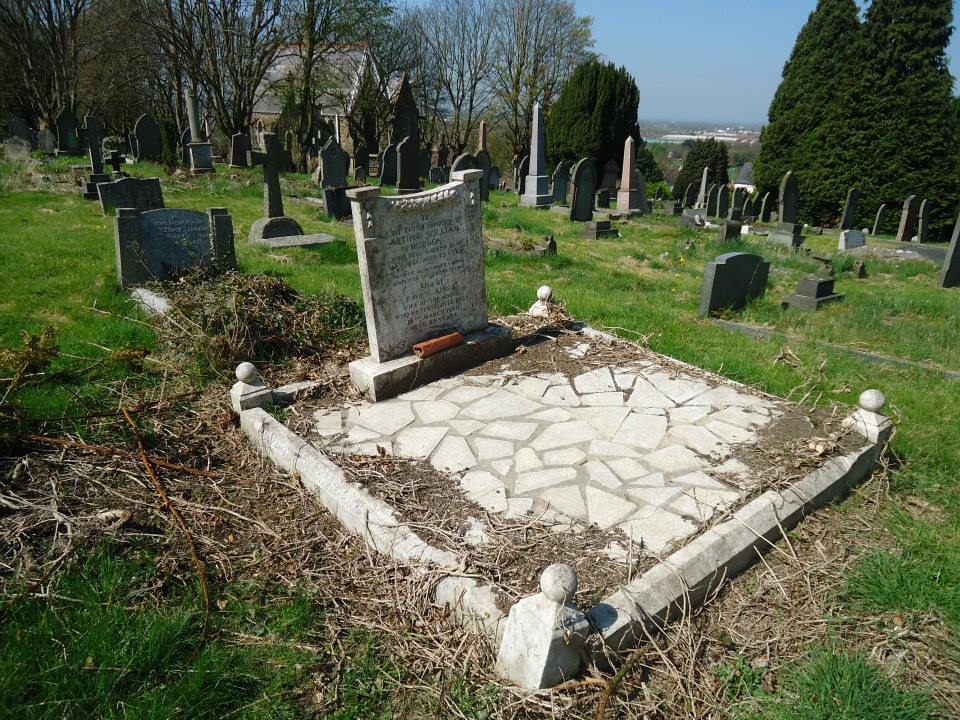
The photograph of the Burson family grave (see below) was taken several years ago. I now realise someone must have cleared and cleaned it around that time. When I tried to find it recently, thinking it would be an easy task, I was surprised to discover the memorial dulled and dirty. Is it the pollution in our air, less obvious than the smoke of factory chimneys and coal fires of the past, that causes such discolouration?

This is the story of Arthur William Burson who was born in Steventon, Berks, the son of farmer Richard Burson and his wife Louisa. In 1871 Richard was farming 140 acres and employing six labourers and two boys at Sutton Courtney, but Arthur appears to have been unwilling to follow in his father’s agricultural footsteps.

By 1881 Arthur had moved to Swindon and was working as a grocer’s assistant, living above the shop at 57 Bridge Street. In 1888 he married Emily Anna Solway and at the time of the 1891 census the couple were living at 52 Fleet Street where Arthur appears to have his own business.

Ten years later and the family business was at 94 Commercial Road. By now the couple have three daughters, Edith, Elsie and Hilda, fourth daughter Grace was born in 1903. The family later lived at 69, Bath Road.

When he died in 1934 a lengthy obituary published in the North Wilts Herald described him as ‘A.W. Burson J.P. – Swindon Business Man Who Once Owned Seven Shops.’

Death of A.W. Burson J.P.

Swindon Business Man Who Once Owned Seven Shops

A Swindon man who rose from a lowly position behind a grocer’s counter to become the owner of seven prosperous shops in Swindon, in one of which he had served as an assistant, is the history of Mr Arthur William Burson, of 69 Bath road, Swindon, whose death occurred last Friday.

There is however a poignant side to his death in that it has robbed him of the opportunity of seeing the completion of the Stratton Green Baptist Chapel, towards the building of which he had given £1,000 as a memorial to two of his children.

Mr Burson, who was well known as a prominent Baptist, died after an illness which had lasted more than three months. He was suffering from bronchial trouble, when heart trouble supervened.

Born at Steventon.

In 1861, Mr Burson was born at Steventon, Berks, and at an early age was apprenticed to the grocery trade at Reading. His connection with Swindon started in 1880 when he was engaged as an assistant in the grocery busines of H. Freeth and Son. For five years he remained in this position, and then made his first venture into business ownership. In partnership with the late Mr Thomas Harry, of Swindon, he opened a shop in Abergwynid, near Maesteg, South Wales, and this business was carried on by the two for five years.

Then, however, he returned to Swindon. With Mr Harry, he became joint proprietor of the business in which he had served as assistant – H. Freeth and Son, and conducted no fewer than seven shops in the town.

The business continued in their joint ownership for two years until the death of Mr. Harry, when Mr Burson assumed sole control. As proprietor of the firm of H. Freeth and Son he continued to take an active part in the conduct of the business until 1926 when he retired.

Gift to Town Gardens

In the year of his retirement, and more or less as a token of gratitude for the prosperity which he had achieved in Swindon, Mr Burson presented to the town the clock over the bandstand in the Town Gardens.

Though he was one of the oldest members of the Swindon Bench of Magistrates, having been a member since the Bench was first appointed in 1907, it was by reason of his religious activities that Mr Burson was better known. He was baptised in 1880 at the Baptist church which stood in Fleet street, and which is now demolished.

On returning to Swindon he continued his association with the Baptist faith in the town, and became connected with the Baptist Tabernacle, which had replaced the former church in Fleet Street.

For many years he was also superintendent of the Gorse Hill Baptist Sunday School, and was also treasurer, and teacher in Baptist Sunday Schools in Swindon for over 50 years.

Former Town Councillor.

At the time of his death he was one of the elders of the Baptist Tabernacle, treasurer of the Tabernacle Sunday School and held a similar post in connection with the Swindon Colportage Association. A prominent teetotaller since the age of 18, he was one of the oldest members of the Tabernacle Temperance Society.

He held a seat on the Town Council from 1900 to 1909, and again from 1911 to 1921 continuous.

While in Wales Mr Burson married a Miss Salway, who was a native of Somerset. Mrs Burson survives him. They celebrated the 46th anniversary of their wedding last Easter. There were four children, all daughters, of whom two are dead. One died in 1913, and the other two years ago. The two surviving daughters are Mrs Dadds, [Dadge] of Bath road, and Mrs Higgins, of Broome Manor lane.

Early this year Mr Burson came forward with an offer of £1,000 towards the cost of the new church at Stratton Green as a memorial to his invalid daughter, on whom the money had been settled as a future provision for her. Announcing his gift, Mr Burson said, “She had been taken and I should like her memory to be enshrined in the new building.”

The cheque for £1,000 was signed by Mr Burson and handed over to the Stratton Baptist officials about six weeks ago, during Mr Burson’s final illness. The Swindon Advertiser is informed, therefore, that the gift will not be affected in any way by the death of the donor.

It has now been suggested by those connected with the Stratton Church that, as a gesture of gratitude to Mr Burson for his gift, the new church shall contain a memorial window to the two daughters of Mr Burson who had pre-deceased him.

The Funeral

In the presence of a large congregation of mourners, the funeral took place on Wednesday afternoon.

The first portion of the service was conducted at the Baptist Tabernacle and the interment took place in the Radnor Street Cemetery.

Extracts from the North Wilts Herald, Friday May 25, 1934.

Arthur William Burson, 73 years, of 69 Bath Road was buried on May 23, 1934 in grave plot E7588. His wife Emily Anna died in March 1950 and was buried with him his this impressive grave plot.

Thomas William Harry – member of the Baptist Tabernacle

This impressive monument suggests to me it was originally meant to mark the final resting place of an entire family, but there is only one person buried here, Thomas William Harry.

Among some fine examples of Victorian funeral iconography there is the urn symbolising immortality, heavily draped signifying mourning.  Books are a reference to scholarly habits and religious faith.  There is a book beneath the urn and one opened on the first verse of a hymn – Hiding in Thee.

It reads:

O safe to the Rock that is higher than I

My soul in its conflicts and sorrows would fly

So sinful, so weary, Thine, Thine would I be,

Thou blest Rock of Ages, I’m hiding in Thee.

Written by William Orcutt Cushing with music by Ira David Sankey.

This is the last resting place of Thomas William Harry, born in Swindon in 1863 the eldest child of William and Mary Harry.  This young couple were among the advance guard that moved from South Wales when the new Rolling Mill opened at the Works.

It is likely their first home was in the Barracks, the unpopular lodging house in the railway village that became a Wesley chapel, then the Railway Museum and then a youth project called The Platform.

By 1871 the Harry family were living at 7 Cambria Place, a two up two down terraced house in to which they managed to squeeze William, Mary and their five sons, Mary’s mother, two nephews (both employed at the Works) and two nieces.

William and Mary eventually returned to Wales to run a pub in Jenkins Town near Swansea.  They took their four younger children with them but the four elder boys stayed in Swindon and lived at 12 Clifton Street.  Head of the household was young Thomas, aged 18 and an apprentice fitter at the Works.

Thomas eventually left the works to set up in business as a grocer in a shop on Park Lane.  He married in 1890 and in 1895 his son Cyril Arthur was born.  Sadly, Thomas died before the little boy was two years old.

Thomas’ brother Henry known as Harry (making him Harry Harry) took over not only Thomas’s business interests but in 1909 married his widow as well. 

Funeral of Mr T.W. Harry. – The funeral of Mr T.W. Harry, whose death was recorded in our last weekly issue, took place on Saturday afternoon at the Swindon Cemetery. The mournful cortege left deceased’s late residence, Bath Road, Old Swindon, at 2.15, the mourners being Mr H. Harry, Mr W. Harry, Mr C. Harry, and Mr A. Harry (brothers), Mr D. Harry and Mr Evan Harry (uncles), Mr F. Williams, Mr J. Williams, and Capt J.G. Morris (brothers-in-law), Mr A.W. Burson (partner), Mr G. Howells, etc. Upwards of 60 members of the Swindon Trader’s Association were present, including the president (Mr W.G. Little) and the secretary (Mr J.S. Protheroe), and representatives also attended of the deacons, the Sunday School, and the Christian Endeavor Society in connection with the Baptist Tabernacle, where deceased was a prominent member.

The bearers and representatives of the firm (Messrs Freeth & Son) included Mr Frank Burson, Mr Woolfrey, Mr Sutton, Mr Banwell, Mr Carver, Mr Hancock, Mr Strong, Mr Galpin, and others. A short service was held at the Tabernacle previous to the internment, the Rev F. Pugh (pastor) officiating. In addressing the large congregation Mr Pugh referred to his having baptised deceased as a member of the Church, and touched upon Mr Harry’s earnest and self-sacrificing labors on behalf of movements associated with the Tabernacle. He also paid a feeling tribute to deceased’s personal character and worth. Mr. Pugh conducted the service at the grave-side, which was witnessed by a large number. The coffin was of polished and panelled Canadian elm, with plain brass furniture, the brass plate being inscribed: “Thomas William Harry, died Feb. 2. 1897, aged 34 years.” Numerous floral offerings were received …

The funeral arrangements were efficiently carried out by Mr A.J. Gilbert, of Swindon. At the morning service at the Tabernacle on Sunday the pastor preached an impressive sermon on “The Passing of Jordan” from Joshua iii, 17, and made special reference to the circumstances of Mr Harry’s life and death. During the service deceased’s favourite hymns, “Hiding in Thee,” and “He fell asleep” were sung.

Extracts from the North Wilts Herald, Friday, February 12, 1897.

Read more about the Harry family on the excellent http://www.swindonbottles.co.uk/harry.html

Joanna C. Lay – silent, quiet and faithful worker

Today we celebrate International Women’s Day with the story of Joanna C. Lay.

It’s difficult to imagine a farm located in what is now Corporation Street, Swindon but this is where Joanna Cuss Smith and her seven siblings grew up.

When Joanna was born in 1851 her father worked as a master butcher with a shop in Wood Street but by 1861 he also farmed 110 acres at Lower Eastcott Farm, employing three men and two boys.

Joanna married jeweller Edwin John Lay in the summer of 1884. The couple had three sons and lived at 17 Bath Road, an elegant establishment opposite Apsley House.

Sometimes there is not much I can add to a sympathetic obituary published in the local media – so let me hand you over to the Swindon Advertiser.

Death of Mrs E.J. Lay

Well Known Swindon Lady

We regret to have to announce the death of Mrs Joanna Lay, wife of Mr Edwin J. Lay, watchmaker and jeweller of 17, Bath Road, Swindon. The deceased lady was a member of a very old Swindon family, being the eldest daughter of the late Mr Edward Smith, butcher and farmer, who carried on business in the town for many years at High Street and Eastcott Farm.

Mrs Lay possessed a great personal charm, a kindly nature, and thoughtful disposition, which she had always exhibited from her girlhood upwards. She was 62 years of age, and had been ailing a few weeks, but not seriously ill. Then she had an attack of bronchitis.

On Friday her condition was better, but on Saturday she had a relapse, and passed peacefully away.

The deceased lady leaves a sorrowing husband and a family of three sons – two of whom are in South Africa – to mourn the loss of a loving and devoted wife and mother.

Funeral at Swindon

Attended by a large number of sympathising friends, the funeral of the late Mrs Edwin Lay, of Bath Road, took place at Swindon on Wednesday afternoon.

Enveloped in a profusion of beautiful floral tributes, the coffin was conveyed from the deceased’s residence to the Baptist Church on a hand-bier. The deceased lady was a prominent member of the Tabernacle, being for 27 years the Secretary of the Sewing Circle (with Mrs W. Clappen as President), and the respect and esteem in which she was held by the members of the congregation was strikingly testified to by the large number of people who attended the funeral service. Conducted by the Pastor (Rev. J. Ivor Cripps) and the Rev. F.C. Shellard, the service was of an impressive character. The hymns, “Come let us join our friends above,” and “Calm on the bosom of thy God,” were sung, and in the course of the service the Pastor paid a touching tribute to the memory of the deceased. They looked upon something that day, he said, as something incredible, something which they found difficult to believe was true, for less than a fortnight ago Mrs Lay gave, at the annual Church social, a report on behalf of the Sewing Circle, and only last Sunday week was present at the Sacrament. He left to others who knew her more intimately the honour of praising her, but he knew her enough to say that she was one of the silent, quiet and faithful workers on whom the substance of Church life relies and depends. What she did she did faithfully and well, and those who were acquainted with her work could say that hers was indeed a place of honour in the Church.

The interment subsequently took place at the Cemetery, where the last sacred rites were performed by the Rev. J. Ivor Cripps.

Extracts from the Swindon Advertiser, Friday, March 14, 1913.

Joanna Cuss Lay 62 years of 17 Bath Road buried 12 March 1913 in grave plot E7310. Joanna is buried with her husband E.J. Lay.

You might also like to read:

Elsie Wootten White – wartime volunteer

Harriett Annie Veness – political activist

Edith Whitworth – Mrs Great Heart

Celia Morkot – the first woman employed in the Works

Ada Ellen McHardy – always happy, always in a hurry.

A fatal road traffic accident and a mysterious ‘dark shadow’ on the road made front page news in the North Wilts Herald, Friday January 15, 1937.

Ada Ellen McHardy died of her injuries following the accident at the Bath Road and Goddard Avenue junction when she was struck by a car driven by Mr Edwin Bradley. Witnesses at the inquest referred to a ‘large black shadow’ seen on the road when wet, although it was not explained whether this shadow contributed to Mr Bradley’s driving or Mrs McHardy’s ability to safely navigate the road.

Ada Ellen Cave was born in Bath in 1860 the eldest of ten children. Her father Isaac W. Cave was an engine fitter and turner who moved to Swindon from Wolverton. In 1882 Ada married Robert S. McHardy, a clerk in the railway works. The couple and their two children lived at 24 Sheppard Street before moving to 53 Newhall Street, Ada’s home for many years.

Ada was a member of the Baptist Tabernacle and heavily involved with the work of the church (see newspaper report below). At her funeral the Rev. C.H. Cleal quoted – “As a writer in the Swindon Press rightly said of her. ‘She was always happy, always in a hurry, seemingly, to be about her Master’s business, possessing the helping hands of Martha, and the loving heart of Mary. She has left Swindon the poorer by her death.’”

Ada’s funeral took place on January 16, 1937. She is buried in grave plot D166 which she shares with her husband who died in 1902.

Swindon Resident Killed in Road Accident

Motor Car Driver Exonerated from Blame at the Inquest

Mrs Ada Ellen McHardy, president of the Swindon Women’s Free Church Council, was knocked down by a motor-car on Tuesday night and received injuries from which she died early on Wednesday.

The accident took place on Tuesday at about 7.45 at the junction of Bath-road and Goddard-avenue.

The car, which was driven by Mr Edwin Bradley, of 55, Okus-road, Swindon, was going along the Bath-road. Mrs McHardy was taken to the Victoria Hospital with head and leg injuries and died at 6.30 on Wednesday morning without regaining consciousness. She lived at 151 Goddard-avenue, and was 77 years of age.

For about 60 years Mrs McHardy had been a keen member and worker for the Baptist Church in Swindon, and it was only a month ago that she had a presentation made to her on her resignation of the post of secretary of the Baptist Women’s League of the church after 28 years’ service. In the year 1920 she was appointed a Deacon of the church, and for a few years occupied the office of Elder.

For 12 years she has represented the Church on the Wilts and East Somerset Association Executive Committee and was called to the presidency of the association for the year 1929. Always keenly interested in the young people, she was for many years a Sunday school teacher and was with her class last Sunday morning. She was a great help to the church in visiting the sick, while the Sewing Circle claimed her services since its formation nearly 50 years ago.

During Carnival week she was always a hard-working collector for the hospital, working for the council, and also at the stall run by the Free Church Council.

Loyal Worker

When Mrs J.F. Marquis, secretary of the Swindon Women’s Free Church Council, was informed by a “Swindon Advertiser” reporter of Mrs McHardy’s death, she expressed considerable concern. “I always found her a most conscientious and loyal worker,” said Mrs Marquis. “She was a woman of very high Christian character. She conducted our executive and general meetings most ably, and she will be greatly missed. I think I shall be expressing the general view of all the Free Church women of the town, especially those connected with the Baptist Church, when I say how sorry I am to hear the news.”

Mrs Marquis pointed out that this is the second loss that the Women’s Free Church Council has sustained during the past few months, Mrs Harrison, the vice-president, having died a short while ago. On Monday Mrs McHardy presided at a meeting of the council, when the question of filling the vacancy created by Mrs Harrison’s death was discussed.

The daughter of an engineer in the Great Western Railway Swindon Works, Mr Isaac William Cave, Mrs McHardy had lived in Swindon all her life. She was one of a family of ten, five girls and five boys, of whom two sisters and three brothers are living. She married Mr Robert Stewart McHardy, who was employed as a draughtsman in the Swindon Works of the railway and was a well-known figure in the town. Her husband died some years ago. For many years he was choirmaster at the Tabernacle. She had two children, a son and a daughter.

Before her marriage, Mrs McHardy was employed as a teacher at a College-street school. Her son is the Rev. Robert McHardy, B.Sc., of Chorley Wood, a Baptist minister, who received his education at Swindon College, and later at Aberystwyth University. Her daughter, Ethel, was also in the scholastic profession before her marriage to Mr Ernest Hughes, of Trowbridge. Her brother-in-law, Mr J. Ballinger, of 20, Goddard-avenue, is senior master at Even Swindon school.

The Inquest

A large black shadow which only appears on the road after rain, at the Bath-road and Goddard-avenue junction, in Swindon, was referred to by witnesses at the inquest at Old Town Police Station yesterday afternoon.

A verdict of “Accidental death” was returned, and the jury exonerated the driver of the car from blame.

Police Constable Worth, who was called to the scene of the accident, said he took up a position in Bath-road, over which a vehicle might normally be expected to travel. At the spot were three lights – a large green overhead lamp and two ordinary street lamps.

“Between two of the lights – the green one and a yellow,” he said, “was a large black shadow extending to Goddard-avenue in a triangular shape.

Witness went on to say that when he visited the scene on Wednesday night, the shadow was not there. Apparently it was only caused when the roads were wet.

In advising the jury, the Deputy-Coroner (Mr Harold Dale) said they should consider the question of a black patch which was caused by the green lights and the smaller ones.

Evidence of identification was given by Rev. R.S. McHardy, a son, who said his mother’s hearing was good but not perfect, while her eyesight was good.

Dr Christina Alexandra Gunn said Mrs McHardy was admitted to hospital about 8 o’clock. She was semi-conscious, and had a depressed fracture of the skull above the left eye and a fracture of the left leg. She died at 6.30 a.m. from hemorrhage of the brain as a result of the fracture of the skull.

Driver’s Story

The driver of the car. Edwin Bradley, 55 Okus-road, Swindon, said that on 12 January about 7.55 p.m. he was driving his car along Bath-road towards Okus-road.

“I passed Goddard-avenue,” witness went on “And the only person I saw was someone who stepped right in front of my car. There was no traffic about and I saw no other pedestrians.”

Answering the Deputy-Coroner, Mr Bradley said he did not see Mrs McHardy at all until she was directly in front of his car on the offside. She was then hardly more than a foot away from the front of the car.

“I pulled up as soon as I could – in the length of my car – and immediately jumped out.” The offside headlamp struck the woman and she was thrown forward.

It was a dark night and raining at the time. He had his side lights and a spot light on.

Asked by Mr Lemon if he had since visited the scene of the accident and noticed anything peculiar, witness said that in between the streets lamps was a black shadow, just where the accident happened. His speed was between 15 and 20 m.p.h.

“A Black Spot.”

Mr W.J. Colman, 77, Goddard-avenue, Swindon, said he was walking down the avenue towards Bath-road. “On reaching the junction I saw a car approaching from Bath-road. I stood on the zero (sic) to let it pass and it had gone 10 to 12 yards towards Okus-road when it pulled up with a sudden jerk.

“I walked along and found a woman on the ground lying about two feet directly in front of the car.”

Mr Colman said he noticed particularly a black spot in the road where the rays of overhead lights ended.

Mrs McHardy was lying seven or eight feet out from the kerb.

Mr Anthony Snow, foreman of the jury, expressed sympathy with the relatives, while similar sentiments were expressed by Mr H. Lemon, solicitor, Swindon, on behalf of Mr Bradley.

Mr D.C.A. Morrison, solicitor, Swindon, appeared on behalf of relatives of Mrs McHardy.

North Wilts Herald, Friday, 15 January, 1937.