Samuel Chappell – boot maker and Minister of the Gospel

The re-imagined story…

We always bought our shoes and boots from Mr Chappell’s shop in Bridge Street. I say ‘always’ as if it were a weekly event. Buying shoes and boots in our family was a big occasion and only done after much forethought and deliberation.

Father patched up our footwear until it was beyond repair and the new purchase was only embarked upon at the moment of absolute need, never on a whim or a fancy.

My sister always chose a dainty pair of shoes with buckles and bows. Of course these were never the ones she ended up with. I was just happy to have a pair of boots that kept my feet dry and didn’t scrunch up my toes.

My sister told me that Mr Chappell was born in America; New York, she said, but I knew that couldn’t be true. He didn’t look American and he certainly didn’t sound American. And why on earth would you leave New York and move to Swindon?

She also said he was a Minister of the Gospel and I didn’t believe that either. Why would he sell boots and shoes if he was a man of God?

Girls have some funny notions.

invoice from Chappell

The facts …

This is the final resting place of Samuel Chappell, master shoemaker, boot and leather seller and as inscribed on the headstone, 40 years a Minister of the Gospel.

Samuel was the eldest son of Eli and Ann Chappell.  His father was born in Castle Combe where he worked for many years as a tailor.

Samuel, however, was born in New York in 1847.  By the time of the 1851 census the Chappell family were back in Wiltshire and living in Hullavington where Eli was working as a Master Tailor.  Living with him were his wife Ann, 8 year old daughter Ann who was born in Castle Combe, obviously before the family’s big American adventure, and a baby son John, born in Hullavington on their return.

Samuel appears to have been raised in Castle Combe by his aunt and uncle, Susanna and William Chappell.  William was a master shoemaker and in 1861 Samuel was working as his apprentice.

The 1871 census has two entries for Samuel, one living in Stratton St Margaret with his parents and two brothers. The other entry shows him lodging with the Keylock family at 5 Albert Street in Old Swindon.

Samuel opened his own boot and leather shop at 26 Bridge Street in 1872. In 1874 he married Sarah Ann Sainsbury.  On the 1911 census Samuel and Sarah Ann are living at 68 Eastcott Hill and state that they had six children, four of whom were still living.

This photograph shows Samuel and his eldest son William outside the shop in the early 1900s.  According to a family member who kindly sent me this photograph, the shop remained open until the 1950s. 

Samuel Chappell

Samuel died at his home in Eastcott Hill and was buried in plot A2560 in Radnor Street Cemetery on January 19, 1926.  He shares the grave with his wife Sarah who died in 1916 and their youngest son Samuel, who died aged 24 in 1909 following a leg injury sustained whilst playing football. 

Ernest Henry Cousens – butcher

This stylish art deco headstone marks the grave of Ernest Henry Cousens. Ernest was born in Little Coxwell in 1885 the son of William Cousens, a carter, and his wife Annie. In 1891 they appear on the census living in the village of Lyford in Berkshire. Ernest has an 11 year old sister Edith Emma and a brother William aged 8.

In 1901 Ernest was lodging at 30 Hythe Road with Henry J. Keen, a butcher’s assistant. Sixteen year old Ernest was a butcher’s apprentice, so probably worked alongside Henry.

In 1908 he married Laura Young and the couple had four children; Irene born in 1912, Ernest born in 1916, Cecily 1918 and Eric 1922. At the time of the 1911 census he was living over his butchers shop at 15 Bridge Street with his wife Laura who is described as ‘assists in business’. The couple were aged 27 and 25 and had been married for three years. The first of their four children was born the following year. Living with them on census night was Ernest’s uncle James aged 59, a widower who worked as a general labourer.

Ernest Henry Cousens of 14 and 15 Bridge Street, Swindon died on March 28, 1939, aged 54. Probate was declared in London on June 15 and effects valued at £7,443 1s 8d were left to his widow Laura and his eldest son Ernest William Cousens, a chartered accountant. He is buried alone in grave plot C4708.

George Bishop – publican turned farmer

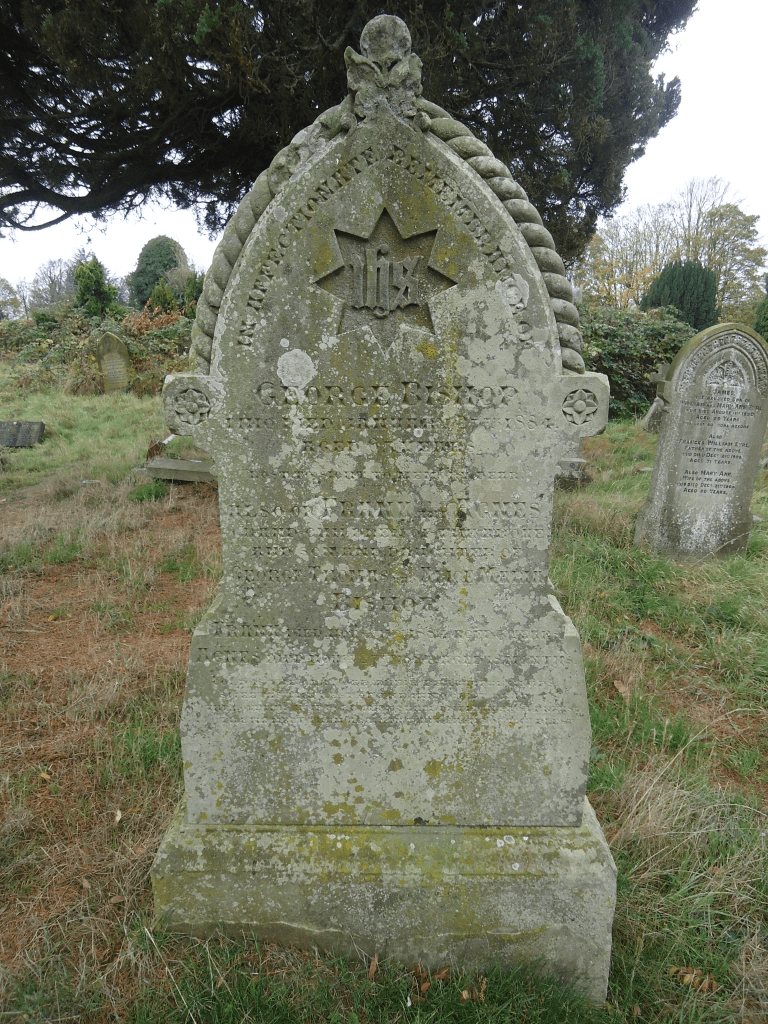
Sometimes a headstone can tell you a surprising amount of family history, although this one is becoming rather difficult to read.

Here is the story of a publican turned farmer and his two little grandchildren who were born and died during the 10 year gap between the 1881 and 1891 censuses.

George Bishop was baptised at the parish church in Wroughton on December 9, 1821, the son of Elizabeth Bishop, a servant, who did not provide a father’s name for the entry in the parish records. However, when George married Sarah Turner in 1846 he submitted his father’s details as George Gardener, a gardener.

Image of Bridge Street taken in c1925 published courtesy of Local Studies, Swindon Central Library.

At the time of the 1851 census George was recorded as a beerhouse keeper living on Eastcott Hill. A beerhouse was a premises licensed to sell only beer (no spirits). Beer could be brewed on the premises or purchased from a brewer. By 1861 George was landlord at a pub in Bridge Street, presently unidentified. (Could it have been the Sun Inn whose first recorded landlord was Robert Bishop – see Last Orders by John Stooke?) 

George and his family were still at No 55 Bridge Street in 1871. It must have been a large establishment as the census records for that year show the names of six boarders living there on census night.

George Bishop had been a publican for more than thirty years when at the end of the 1870s he gave it all up to become a farmer. At the time of the 1881 census George was farming 10 acres at Nore Marsh Farm in Wootton Bassett where he died on January 27, 1884. The cause of death was recorded as ‘syncope owing to diseased heart.’

His personal estate was valued at £126 14s 2d, administration of which was left to his only son George Thomas (his wife Sarah died in 1872 and is buried in St. Mark’s churchyard.)

Just months after George’s death the family were to gather again for the funerals of two little children. Three year old Frank Bishop was buried with his grandfather on November 21, 1884 and just eight days later one year old Agnes joined them. Frank and Agnes were the children of George Thomas Bishop and his wife Alice.

Almost 80 years after the sad events of 1884, a fourth and final burial took place in the Bishop family grave plot. On November 20, 1963 William Henry Bishop was buried alongside his grandfather and the remains of his little brother and sister, Frank and Agnes. He was 85 years old.