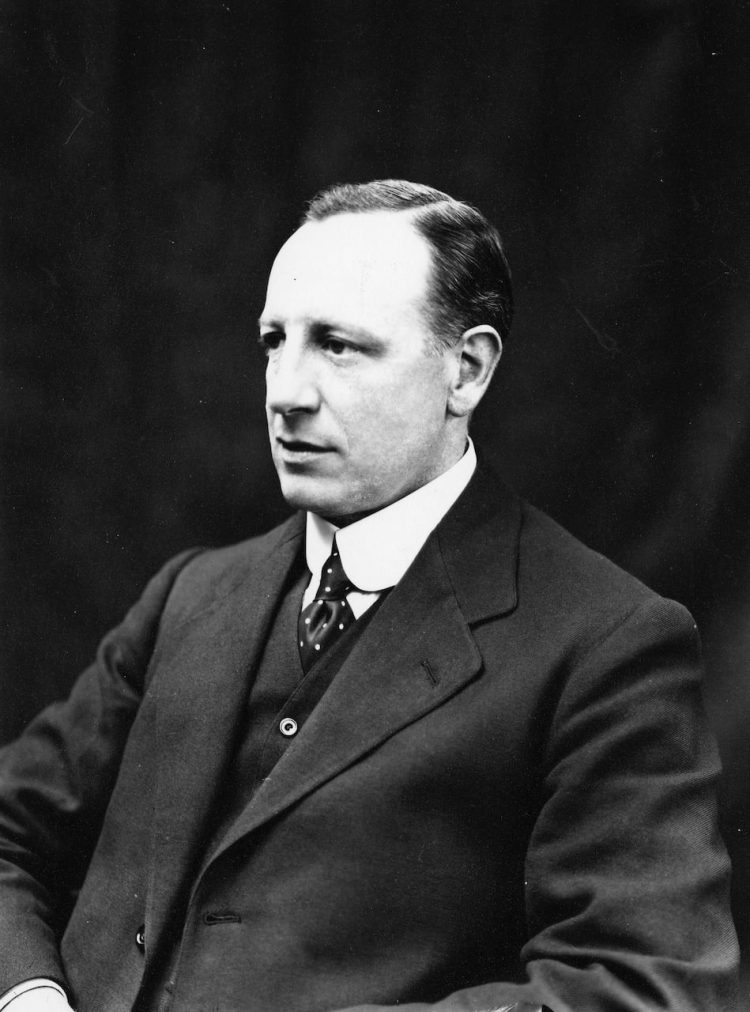
Charles Benjamin Collett – GWR Chief Mechanical Engineer 1922-1941
It is relatively easy to find out a great deal about Charles Benjamin Collett, OBE, Chief Mechanical Engineer at the Great Western Railway.
He has gone down in history as a well-respected, modest man who designed the iconic fleet of “Castle” and “King” Locomotives yet lived an unassuming lifestyle alongside the railwaymen and their families in the railway village.

Charles and Ethelwyn Collett’s home in the railway village
He was born on September 10, 1871 the son of journalist William Collett and his wife Mary. He was educated at the Merchant Taylors School Charterhouse Square and later studied at the City and Guilds College of London University. He was articled as a pupil to Mr Joshua Field, of Maudslay, Sons & Fields Ltd., London before joining the GWR in 1893 as a junior draughtsman. He then became assistant to the Chief Draughtsman and in 1900 Technical Inspector and later Assistant Manager. By 1919 he was Deputy Chief Mechanical Engineer before succeeding George J. Churchward as Chief Mechanical Engineer.
Rather less is known about his wife.
Ethelwyn May Simon was born in 1876 the daughter of Henry Simon, a Congregational Minister who served as Pastor at Westminster Chapel from 1876-87, and his wife Annie.
Charles and Ethelwyn married at St. George’s Church, Bloomsbury on November 4, 1896. It is said that the couple were very devoted and that Charles was greatly affected when Ethelwyn died in 1923, the year in which he launched the record breaking Caerphilly Castle Locomotive.
Ethelwyn was buried in Radnor Street Cemetery on March 23, 1923. Charles purchased two grave plots numbered Section A2517 and A2518. However, it seems unlikely that his intention was to be buried with his wife when the time came as a note in the burial registers reveal that Ethelwyn was buried in the centre of both graves.

Radnor Street Cemetery Jon stands at Ethelwyn’s unmarked grave
Ethelwyn lies in an unmarked grave, which is probably what Collett wanted. He lies in an unmarked grave in Gap Road Cemetery, Wimbledon, which he shares with two other unrelated persons. Apparently, he requested that his grave should also go unmarked.
 Radnor Street Cemetery