The re-imagined story …
I’ve been on some strange first dates in my time, but this one took the biscuit.
“It’s a lovely day. Let’s go for a walk round the cemetery,” she said, taking the initiative, as women so often do these days. When I was a youngster it was usual to ask a girl to go to the cinema on a first date, not to take a turn round a cemetery.
We paused at a crossroads where the meandering footpaths converged and she pointed out the grave of Trooper Cecil Howard Goodman. I was wearing the wrong glasses so she read the inscription to me.

“To the Memory of Trooper Cecil Howard Goodman 1st Co. Imperial Yeomanry who died November 11 1900 while fighting for his country in South Africa. Erected by his fellow clerks GWR Staff, Swindon, April 1901.”
I mentioned what an unusual headstone it was.
“He isn’t buried here of course, he’s in South Africa,” she said. “The headstone resembles the graves of the fallen soldiers buried in South Africa. There they heaped rocks on the grave to stop the wild animals digging up the bodies.”
How did she know such a bizarre fact?
The chapel was closed, but she could describe it perfectly.
“There used to be some lovely pews in there. Some said they were made in the Works. The council took them away a long time ago. Shame that.” We walked on.
“Poor Mr. Shopland – his was a tragic death,” she said pausing by a grave carpeted in primroses. I really hoped she wasn’t planning on going into detail.

At the end of the path, she stopped at a decorative headstone. Someone else she knew?
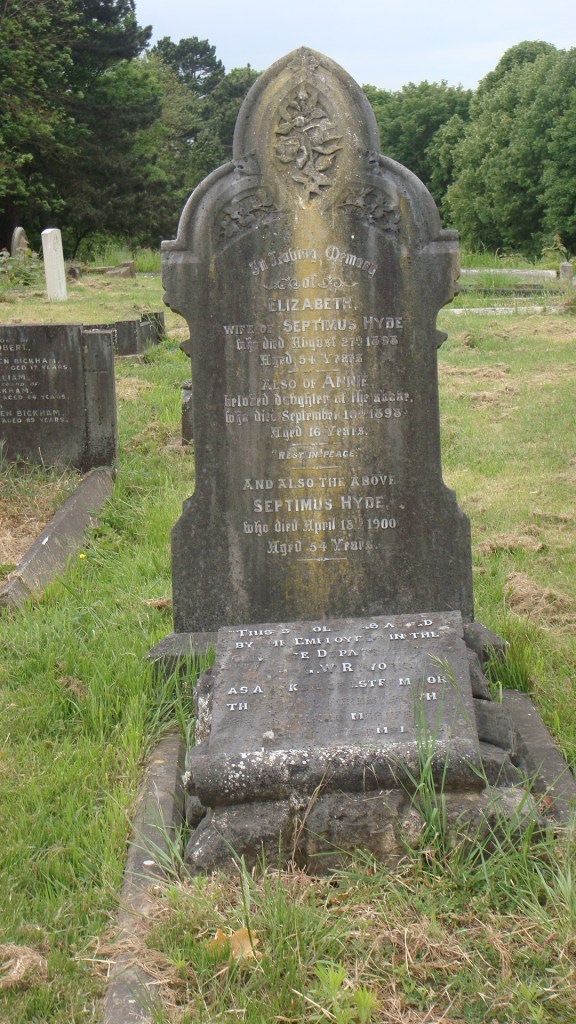
“Mr Septimus Hyde.” We paused while she read the inscription. “The story goes that he chose this plot because he could see his house from here.”
I looked around. The gardens on Clifton Street were clearly visible from this point, as the cemetery must be to those who lived in them. I assumed Mr Septimus Hyde must have lived there. I’m not sure how I’d feel about living alongside a cemetery.
“He must have had good eyesight,” she said, “he lived in Exmouth Street.” She looked at me with a twinkle in her eye. “Come on – I need a drink, and I don’t mean a cup of tea.”
This was the weirdest first date I had ever been on – but what can you expect when you’re pushing 80 – at least I’m not pushing up daisies.
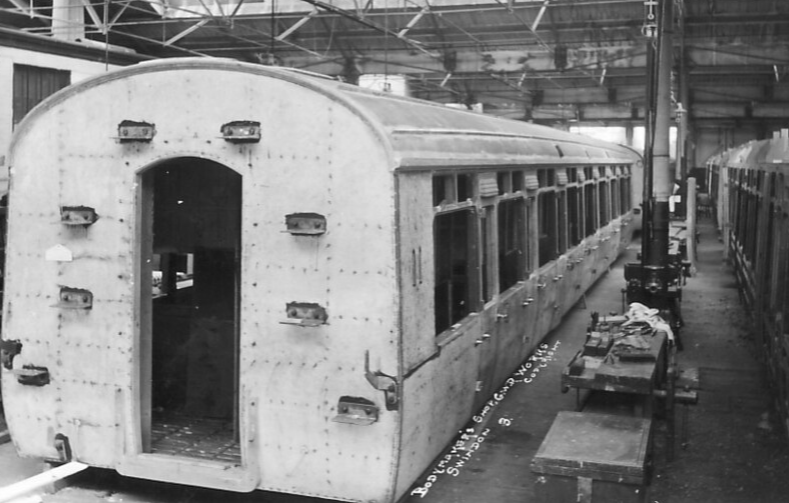
The eldest child of Henry Hyde, a tailor and his wife Elizabeth, Septimus was born in Worcester on May 26, 1846. He married Elizabeth Sturge at St. Peter’s, Worcester on August 2, 1868.
The UK, Railway Employment records, 1833-1956 state that Septimus Hyde re-entered the GWR as a Foreman in the Carriage Body Makers Shop on August 5, 1871. At the time of the 1881 census Septimus and Elizabeth were living at 5 East Street, New Swindon with their three children Frank E., Septimus G. and Robert.
Death of Mr. S. Hyde
A G.W.R. Foreman
Deep regret was expressed throughout the GWR Works, at Swindon, on Wednesday in last week, and especially in the Coach Body Making Department, when it was known that Mr. Septimus Hyde had passed away at his residence, No. 58, Exmouth Street. Deceased, who was born on May 26th, 1846, was during his long service as foreman of the coach body making shop, a very popular official. He was ever kind and thoughtful to his men, willing at all times to hear their troubles and to give them advice. As a foreman he will be greatly missed both by his employes and by the GWR Company, to whom he was ever a very faithful servant. Deceased had been unwell for some time past, suffering from paralysis of the brain, but in spite of his doctor’s orders to stay at home he would be at his post. So late as Saturday the 21st he was in the works attending to his duties. Later in the day he had a stroke from which he did not recover, and passed away at noon on Wednesday, deeply mourned by all who knew him.
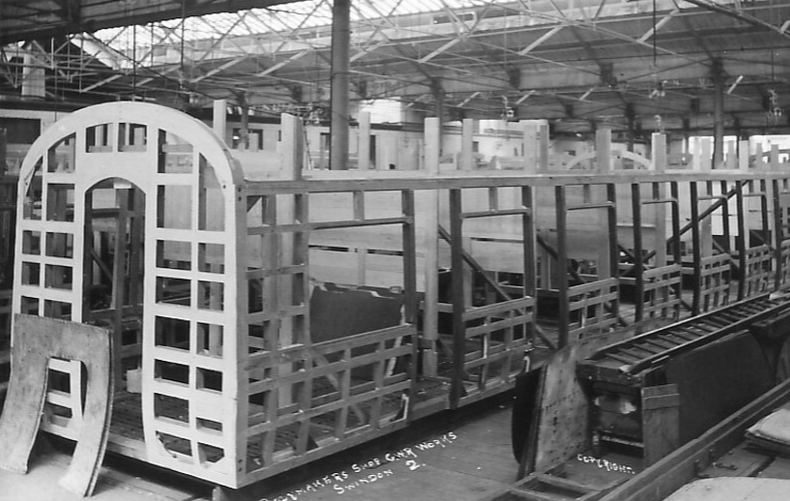
Deceased served his time with the Oxford, Worcester, and Wolverhampton Railway Company at Worcester, a line afterwards taken over by the GWR Company. When out of his time he worked at various places until August 5th, 1871, when he entered the service of the GWR at Swindon. Three years later, on August 8th, 1874, he was appointed foreman of his shop, which position he held till the time of his death. The Royal train used for the Diamond Jubilee and subsequent journeys was made under his supervision. He leaves a grown up family to mourn their loss, his wife having predeceased him.
The deep respect in which the late Mr. Hyde was held in Swindon generally, and in the GWR Works in particular, was evidenced by the large attendance at the cemetery on Saturday afternoon, when the remains were interred in the family grave, where some eighteen months ago the deceased’s wife and daughter were buried. Hundreds of the employes at the works took part in the funeral procession, and a large crowd awaited the arrival at the Cemetery. From the home the body was taken to St. Saviour’s Church, where a short service was conducted by Canon the Hon. M. Ponsonby, who also performed the last rites at the graveside….

The coffin which was of polished elm, bore the following inscription: “Septimus Hyde. Died April 18th, 1900: age 54 years.” A large number of wreaths and tokens of respect and sorrow were sent by his fellow employes and relatives.
All images of the Bodymakers Shop are published courtesy of P.A. Williams and Local Studies, Swindon Central Library
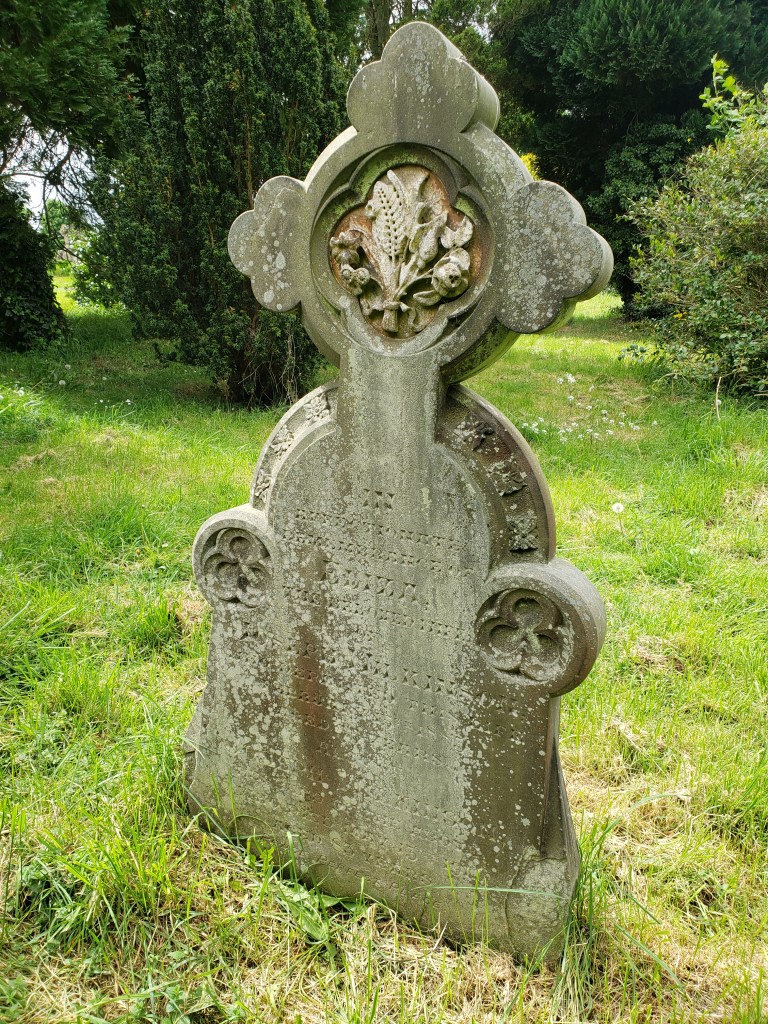
 Radnor Street Cemetery