A literary legacy and the Misses Baden

The re-imagined story …

Everyone with the name Jefferies wanted to tell us their memories of the man, even those who were unrelated and had never met him. The Swindon Advertiser had already published a fulsome obituary notice on the local writer Richard Jefferies but Mr Morris wanted me to come up with something more, something from a different perspective.

I did a bit of research and discovered that Mrs Jefferies sisters lived in town, so I made an appointment to visit them.

Mrs Jefferies came from a large farming family. Her father had married twice and produced some fourteen children. Mrs Jefferies was the eldest of the second family. The sisters who lived at 20 Sheppard Street hailed from the first family and were considerably older than the recently widowed Jessie Jefferies.

Jessie Jefferies nee Baden
Mrs Jefferies, the former Jessie Baden

I was greeted at the front door of the red brick villa by Miss Blanche Baden who introduced herself as niece and companion to the Misses Baden. The two sisters were waiting for me in the parlour.

The ladies were dressed in the old country fashion and were frail and elderly. Miss Mary, the younger of the two, spoke for her sister Miss Emma, explaining that she had been deaf and dumb since birth.

Looking out across the road to the looming railway factory, Miss Mary talked about a childhood spent at Day House Farm and their near neighbours, the Jefferies family who lived on the farm at Coate.

In pride of place on the bookcase was a set of Jefferies books. I was invited to select a volume, each one a first edition, inscribed by their famous brother-in-law.

I wrote what I thought was an interesting piece about the Misses Baden and their literary legacy, but Mr Morris didn’t like it. I had missed the point of the exercise, I was told. He’d wanted more insight into Jefferies ambition, the political motivation of the man and what had driven him, not a non-story about two old ladies who had done nothing of note.

It was then that I decided the Swindon Advertiser was not the vehicle for my work and that I would devote my life to writing about the lives of women who had supposedly ‘done little of note.’

Richard Jefferies
Richard Jefferies

The facts …

Death of a Distinguished Wiltshire Man

A large circle of readers will be sorry to hear that Mr Richard Jefferies died at Goring on Sunday morning. He will be known to all classes of readers as the author of a charming series of books and fugitive articles on rural life and kindred subjects, that were as interesting to dwellers in town as to those in the country. He united to a singularly close insight into the natural workings of animal and vegetable life a power of description almost unrivalled. His books and articles were redolent of the air of the country, and dealt with nature in so picturesque and graphic a style that the dweller in a city might almost fancy himself in the midst of the scenes described. These scenes were mostly taken from his native county of Wiltshire. The son of a farmer, he soon fell to writing on his favourite subjects in local journals. He soon, however, went to London, where he at once made himself a name as a writer of books and contributor of essays to magazines and periodical literature. Many will remember the delightful freshness of “The Gamekeeper at Home,” which introduced him to the London public about ten years ago. This was followed at short intervals by “Wild Life in a Southern County,” “Round about a Great Estate,” “Hodge and his Masters,” “Nature near London,” “The Life of the Fields,” “Red Deer,” and “The Open Air,” the last of which was published two years ago. Mr Jefferies also wrote a number of works of fiction, which are certainly not so well known – and perhaps deservedly so – as his pictures on country scenes. Thus between 1874 and the present year he published “The Scarlet Shawl,” “Restless Human Hearts,” “World’s End,” “Greene Fern Farm,” “Wood Magic,” “Bevis, the story of a Boy,” “The Dewy Morn,” “After London, or Wild England,” and “Amaryllis at the Fair,” the last in the present year. Also he wrote in 1883 a work of great interest entitled “The Story of my Heart, an Autobiography.”

Extract from The Swindon Advertiser, Saturday, August 20, 1887.

Emma Jane and Mary Hannah Baden

Emma Jane Baden aged 76 years of 20 Sheppard Street was buried on March 24, 1894 in grave plot E7206. Mary Hannah Baden aged 79 years of 15 Avenue Road was buried with her sister on November 27, 1907.

Death of Mrs R. Brunsden

By 1911 the population of Swindon was more than 50,000 with the Great Western Railway the largest employer by a country mile. You might think that the Radnor Street Cemetery residents would probably have a history of employment in the Works, and of course you would be correct. But just occasionally I discover a family with a history seeped in Swindon’s agricultural past.

Chiseldon Church by Kate Tryon

Rachel Hancock was baptised at the parish church Chiseldon on April 24, 1836, the daughter of William Hancock, an agricultural labourer, and his wife Mary.

By 1851 Rachel aged 15 was working as a house maid for Thomas Choules 60, a farmer at Badbury. Choules farmed 326 acres and employed 13 labourers. Living with him was his wife Mary 68 and his nephew Robert 24, a farm bailiff.

An entry in the Chiseldon parish registers record the baptism of Alfred Thomas the son of Rachel Hancock Single woman on April 25, 1851. (Could this be our Rachel?) At the time of the 1861 census Thomas is living with William and Mary Hancock in Badbury (Rachel’s parents). In the 1871 census I discovered Robert Choules living with his family in Swindon where he worked as a Railway Watchman. Boarding with him was Thomas Hancock 19, (is this our Alfred Thomas?)

Rachel married close neighbour Henry Brunsden on October 14, 1858. The couple married at St. James’s Church, Paddington, perhaps because they didn’t want a big, local wedding, perhaps because their first child (John) Henry Brunsden had been born the previous year.

I can’t discover the whereabouts of Rachel on the 1861 census (possibly a mis-transcription) but by 1871 the family are at Snodshill Farm where Henry employs 5 men and a boy, along with two live in servants – Mary Cox 17, a general domestic and Elizabeth Cook 15, a nursemaid. Henry and Rachel have seven children and Henry’s brother John also lives with them.

And Rachel’s life continues to be mis-recorded, right up to the very end.

Inquest at Coate

On Wednesday morning, with painful suddenness, the death occurred of Mrs Rachel Brunsden, widow of Mr Henry Brunsden* of Lane Farm Coate.

Deceased had not been ill for quite three years although she was 75 years of age, and therefore it was found necessary for an enquiry into the circumstances to be held.

Mr Brunsden and his wife have been well known and respected in the neighborhood for many years, and there are a number of grown up sons. Prior to their retirement for their active agricultural pursuits they tenanted the land adjoining the homestead in which they have resided for so many years.

An inquest was held the same evening by Mr A.L. Forrester at the farmhouse.

Ernest Brunsden (son) said his mother went to bed the previous night apparently in her usual health. She rose at 7 o’clock that morning and went downstairs, where she prepared breakfast.

She then took it upstairs on a tray for her husband, who was in bed. Afterwards, when she brought the tray down subsequent to partaking of her own breakfast, she complained of a pain round her heart, and almost immediately after fell down dead.

Dr Beatty said he was sent for, but could only pronounce life extinct. Death was due to heart failure.

A verdict was returned in accordance with the medical evidence.

North Wilts Herald April 12, 1912.

*Henry Brunsden was still alive at the time of Rachel’s death.

Lower Snodshill Farm where Rachel lived for most of her married life

Rachel was buried on April 13, 1912 (when the burial registers record her home address as Love’s Farm) in grave plot C1856. Henry died the following year, aged 88, and was buried with Rachel on October 25, 1913.

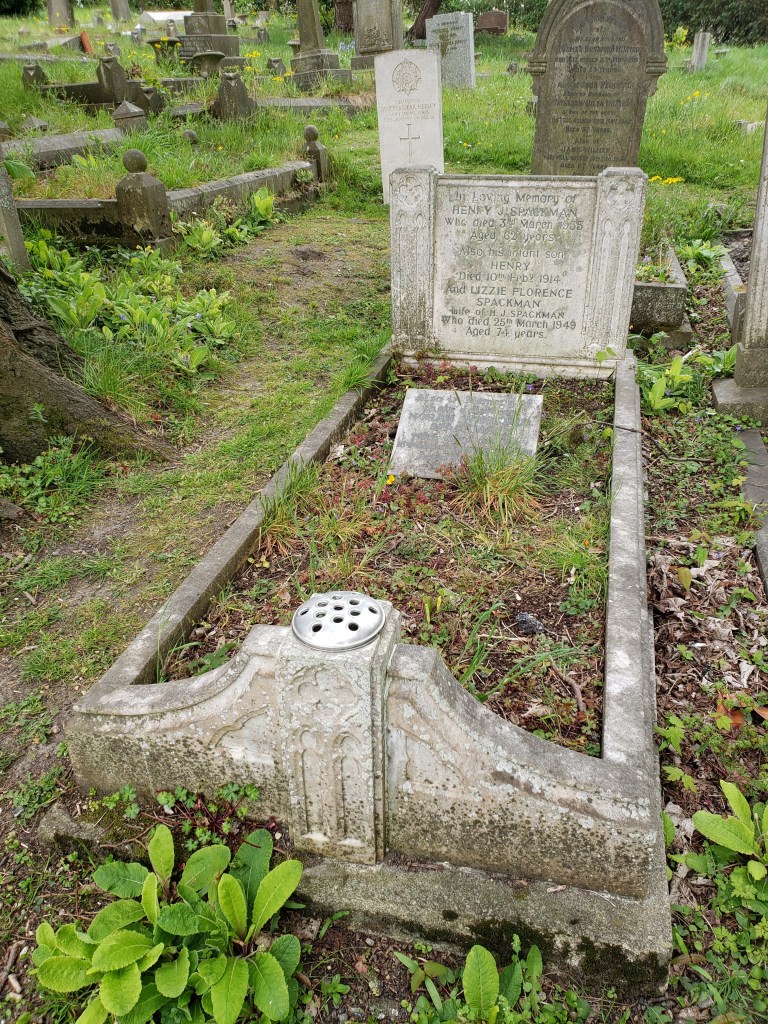
Henry John Spackman – boiler inspector

I can’t help wondering what kind of life Lizzie Florence Spackman had and whether she had much influence in the decisions made on her behalf. She grew up in a railway family and married a railway man, but could she have anticipated how her life would turn out.

Lizzie was born in 1874, the middle daughter of William and Elizabeth Richards’ three girls. By 1881 Lizzie’s mother had died and the three young sisters were living with their father and two elder half brothers in Carfax Street. In 1898 she married Henry John Spackman, a Boilersmith. He was 25 and she was 23.

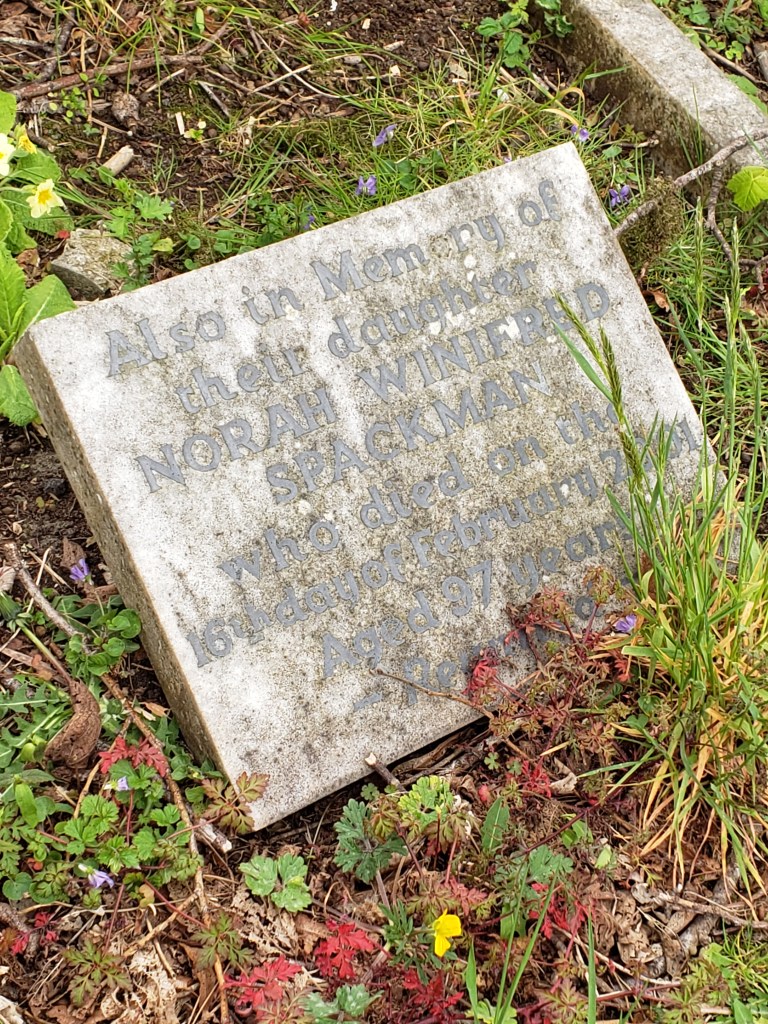
Henry and Lizzie lived at various addresses in Rodbourne and Westcott during the early years of their marriage. Their eldest daughter Dorothy was baptised at St. Marks’s Church on December 11, 1899 when the family lived at 22 Ford Street. Their second daughter, Norah Winifred, was baptised at St. Augustine’s on December 3, 1903 when they lived at 6 Bruce Street. Then at sometime around 1909 the family left for India where their third daughter, Marjorie Johanna was born in 1910 in Madras. Lizzie would live in India for the next 17 years until they returned to 13 Summer Street, Rodbourne in 1927.

What an adventure? Or was it a nightmare? Did Lizzie love India or was she homesick for Swindon? Once back in England the family settled down in Chiseldon, where Henry was obviously busy – but what about Lizzie? Did she enjoy her new life in the Wiltshire village or did it seem grey and lacklustre after the vibrancy of India? What was on the Spackman family menu – roast beef and Yorkshire pudding or curry?

There’s a lot about Henry in the following report, which is fair enough I suppose as it is his obituary. But I can’t help wondering what kind of life Lizzie had.

Photograph of the former railway works taken from the cemetery

A Broken Link,

Death at Chiseldon of Mr H.J. Spackman

The funeral of Mr Henry John Spackman, who died at The Gables, Hodson road, on Sunday, took place yesterday.

Mr Spackman, who was 62 years of age, was employed in the Great Western Railway Works, Swindon, as a young man. At the age of 25 he went to Madras as a boiler inspector and at a later date was appointed chief foreman. He remained in India until November, 1927, when he returned to England to go into retirement at Chiseldon.

Mr Spackman who had taken a great interest in the Chiseldon Hospital Carnival and in all forms of sport, played for Swindon Town on the Croft, and he was the possessor of a Wilts Cup medal. He gained this while playing for Trowbridge Town against Swindon. He leaves a widow and three daughters. Two of his daughters are married, they are Mrs C. Woods-Scawen, of Madras, and Mrs B. Lillie, of Shanghai. His other daughter, Miss Nora Spackman, resides with her mother at Chiseldon.

The funeral service at the Parish Church, Chiseldon, was conducted by the Vicar (the Rev. C. Foster Palmer) and the interment was in Radnor Street Cemetery, Swindon.

The family mourners were Mrs Spackman (widow), Miss N. Spackman (daughter), Mrs Webb (sister), Mr W. Spackman (brother), Mrs G. Tucker (niece), and Mrs A. Hunt (cousin).

Others present at the church were Mr. and Mrs H. Howell, Mr Hargreaves, Mr and Mrs H. Hewlett, Mr A. Hewlett, Mr J. Walters, Mr E. Walters, Mr H. Walters, Mr Phillips, Mr C. Frost, Sergt. A. Cook, Mr R. Culverwell, Mr R. Finn, Capt. Johnson, Mr H. Drewitt, sen., Mr H. Drewitt, Mr. C. Goldsmith (representing the 18 Overseas Club) Mr F. Blackford, Mr. Lucas, Mr H. Cavill, Mr F. Horsington, Mr A.A. Jarman, Mr and Mrs B. Davis, Mr C. Dommett, Mr D. Richards, Mr W. Long, Mr and Mrs W. Oakey, Mrs Beamish, Mr Gilbert Whiting, Mrs Dench, Mr Street and Mr A. Green.

The funeral arrangements were carried out by Mr John C. Liddiard, of New road, Chiseldon.

North Wilts Herald, Friday, 8 March, 1935.

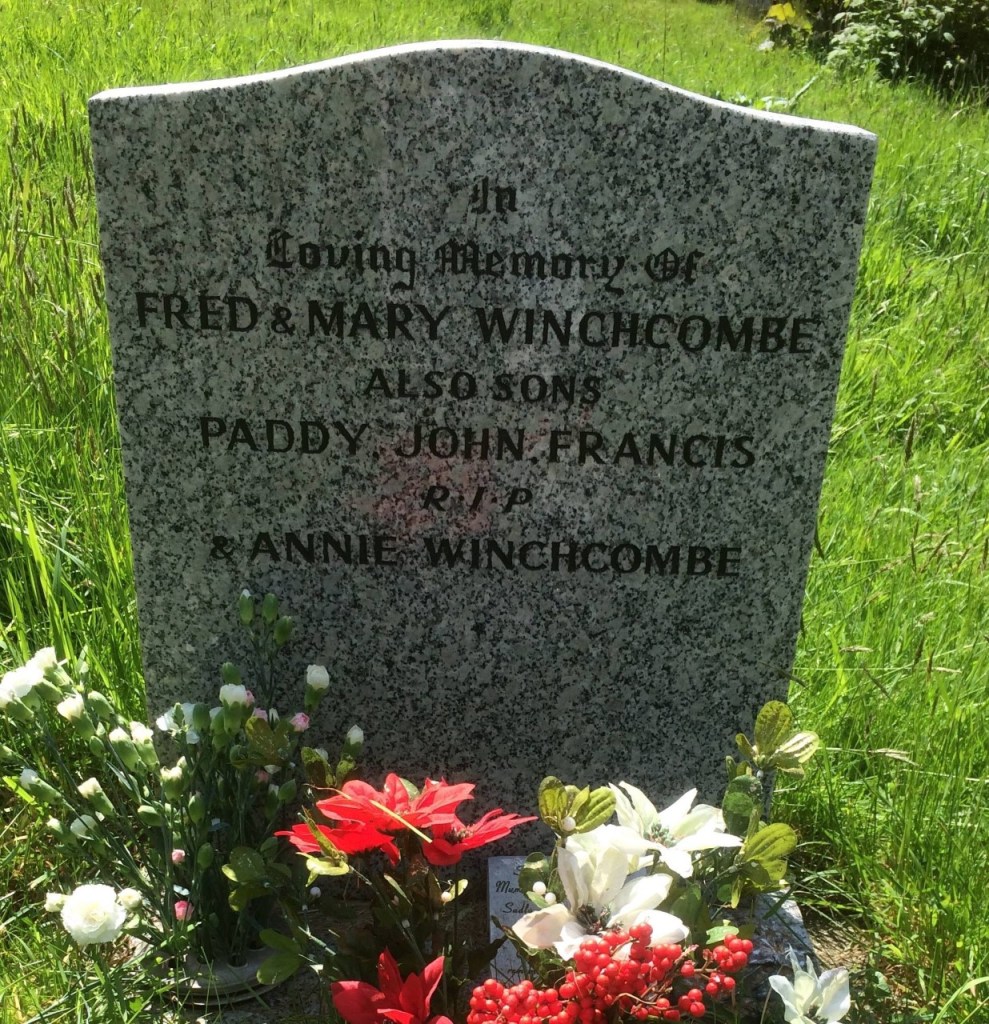
Fred and Mary Winchcombe

This is the last resting place of Fred and Mary Winchcombe who married in 1911 and had a family of six sons and two daughters. Mary died in 1951 and Fred in 1964.

Several years ago their granddaughter, Mary, joined us on one of our walks and kindly sent me the following information about her grandparents.

Fred Winchcombe worked in the GWR and walked in from Chiseldon each day. He and the men he walked in with had the habit of taking a quick pint in the Patriots Arms on the way in, and one day he met up with recruitment men from Kings Troop.

Grandad took the King’s Shilling and joined Kings Troop and was posted to Ireland. He was stationed just outside of Kilkenny and the only watering hole deemed safe for the troops to drink in (he was CofE) was Mastersons Hotel in Kilkenny High Street. This was owned by Mary Morrisey’s uncle, and she worked there. Mary was Roman Catholic.

They met, fell in love and Fred asked her to marry him. Her family were not opposed as long as Fred changed religion. He did, they were married in Holy Rood Church, Swindon.

They started married life in Chiseldon, but as Mary insisted on walking into Swindon every day for Mass, Fred moved them to 10 Union Street, Old Town where they raised their children in a two up two down terraced house with outside toilet and no bathroom.

Mary very much wanted to go back to Ireland to see her own parents and siblings, but both parents died before they ever managed to save enough money for her fare.